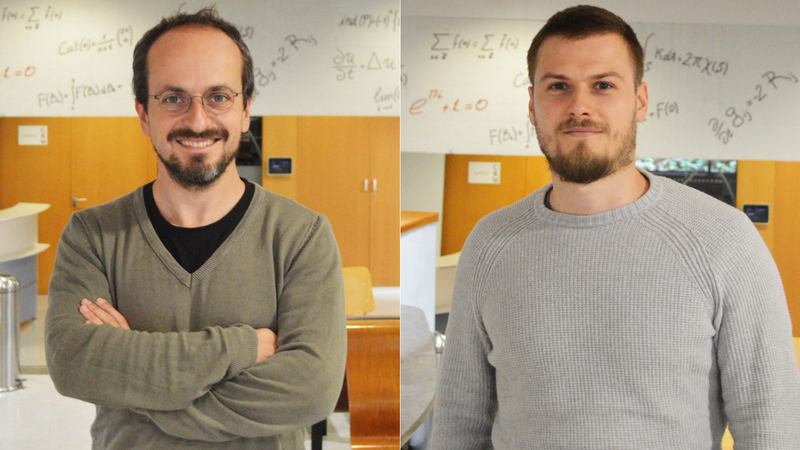
This November, Giovanni Dalmasso and Filip Ivancic have joined CRM research groups as postdoctoral researchers. They both join groups within the Mathematical Biology area.
Giovanni Dalmasso will work in the group of Tomás Alarcón as a Maria de Maeztu postdoctoral fellow. He will also collaborate with the group of James Sharpe at EMBL-Barcelona to combine mathematical modelling and biological experiments with the aim of understanding the phenomenon of vasculature regression during cartilage condensation (i.e. digit formation) in the growing limb.
Giovanni obtained his bachelor and master at the Polytechnic University of Turin, where he studied applied mathematics. To complete his master thesis, he moved to the ETH in Zürich (Switzerland). While at the ETH, he transitioned towards computational modelling and high-performance computing. He then moved to the Center of Environmental Research (UFZ) of Leipzig (Germany), where he strengthened his interest in biology and how to model biological processes. For his PhD, Giovanni relocated in Heidelberg at the German Cancer Research Center (DKFZ).
Before joining the CRM, he was a postdoctoral fellow with the Sharpe group in Barcelona at the Centre of Genomic Regulation (CRG), which then moved to EMBL-Barcelona.
Filip Ivancic has joined the Nonlinear Dynamics and Evolution Lab working on the MPA4SUSTAINABILITY project under the supervision of Josep Sardanyes, to assess the socioecological dimension in marine protected areas (MPAs) and biodiversity preservation, with case studies and math.
Filip obtained his bachelor’s and master’s degree in mathematics and applied mathematics at University of Zagreb, under the supervision of Boris Muha, and he conducted his PhD at the National Taiwan University under the supervision of Tony W.-H. Sheu and Maxim Solovchuk. Before joining the CRM, he was a postdoctoral fellow at the National Health Research Institutes in Taiwan under the supervision of M. Solovchuk.

CRM Comm Team
Anna Drou | Pau Varela
CRMComm@crm.cat
Subscribe for more CRM News
The CRM opens the academic year and unveils its Directors’ Gallery
A review of the year, the Communication Plan 2026–2030 and three research talks filled the morning of 19 October.The unveiling of the Directors’ Gallery.CRM CommPau VarelaCRMComm@crm.catGet the latest CRM news and activities in your inbox.Recent...
The CRM Mentoring Programme, as Told by One of Its Pairs
PhD student Joaquim Duran and mathematician Robert Cardona, one of the pairs in the CRM Mentoring ProgrammeJoaquim Duran (left) and Robert Cardona.CRM CommPau VarelaCRMComm@crm.catGet the latest CRM news and activities in your inbox.Recent...

When the reward comes within reach, the brain changes what it compares
As the tokens piled up, choices got faster and more accurate at the same time. The yardstick for judging each offer had moved.CRM CommPau VarelaCRMComm@crm.catGet the latest CRM news and activities in your inbox.Recent newsletters →Two subjects...

Almost every automaton can be reset with a short word
Guillaume Chapuy (Université Paris Cité, CNRS) and Guillem Perarnau (UPC, CRM) have shown that a random finite automaton with n states can, with high probability, be reset by a word of length of order √n log n. The result, published in ACM Transactions on Algorithms, pins the exponent at 1/2, the lower end of a decade of numerical estimates, and addresses the random version of the synchronization problem behind a conjecture Ján Černý posed in 1964 and which still remains open.
Exposició ‘Les matemàtiques de Gaudí’
CRM quod erat demonstrandum | 48

ADA: Decoding Brain Signals Misaligned in Time
The study addresses a key limitation of current brain decoding techniques: the difficulty of interpreting internal mental processes whose temporal dynamics vary from trial to trial.Decoding what is happening in a person’s mind from their brain activity is one of the...
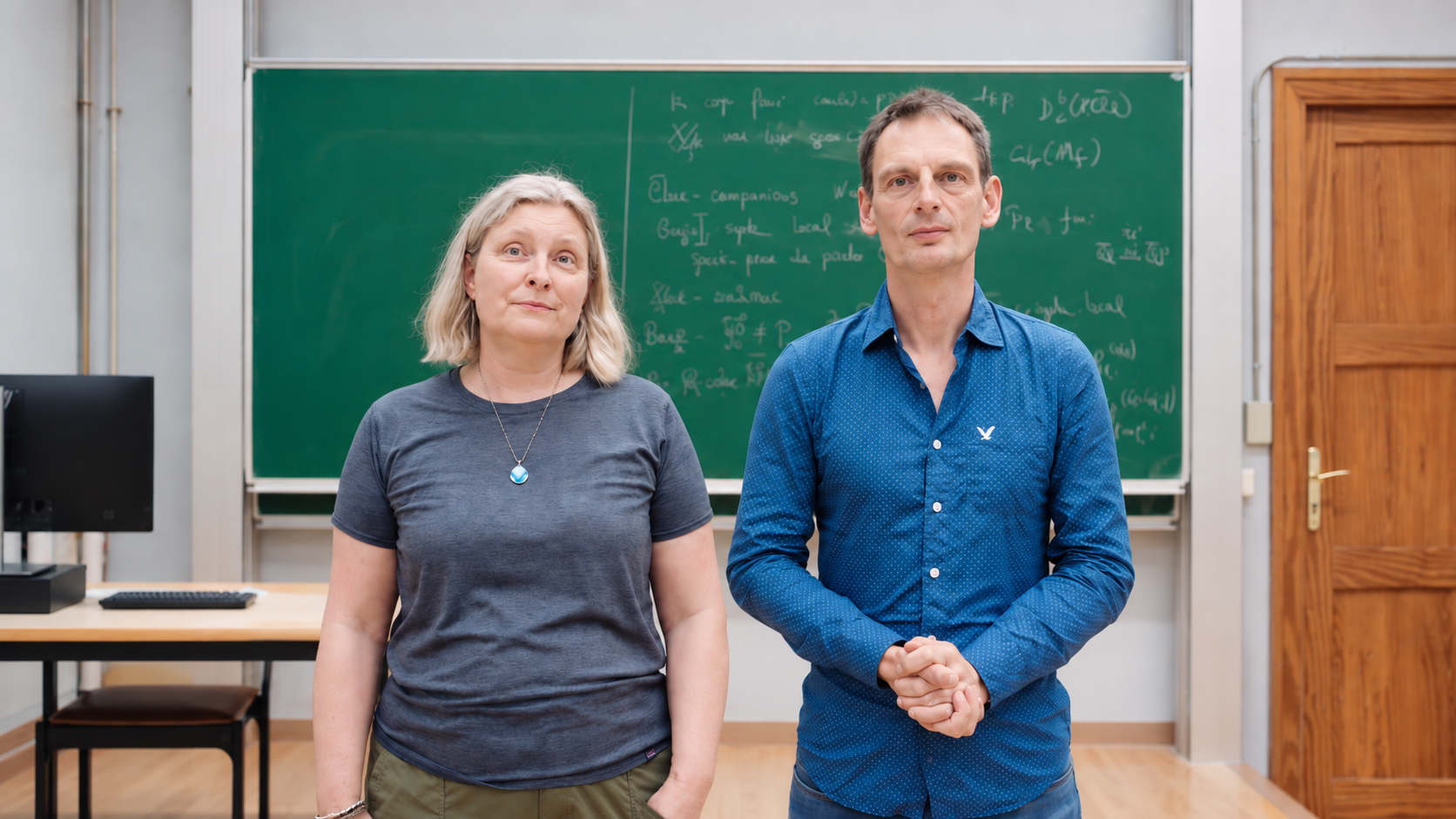
Rare curves, many points: Christophe Ritzenthaler and Rachel Pries on their research and the work around it
Christophe Ritzenthaler (Université de Rennes) and Rachel Pries (Colorado State University) both work on curves over finite fields: he hunts curves with as many points as possible, she hunts curves that almost never occur. In conversation with the CRM during their...

Call open for the 2027 Ferran Sunyer i Balaguer Prize
The Ferran Sunyer i Balaguer Foundation is accepting submissions for its 2027 prize, which awards 15,000 euros and publication in Birkhäuser's Progress in Mathematics series to an expository monograph on an active area of mathematical research. The deadline is 27...
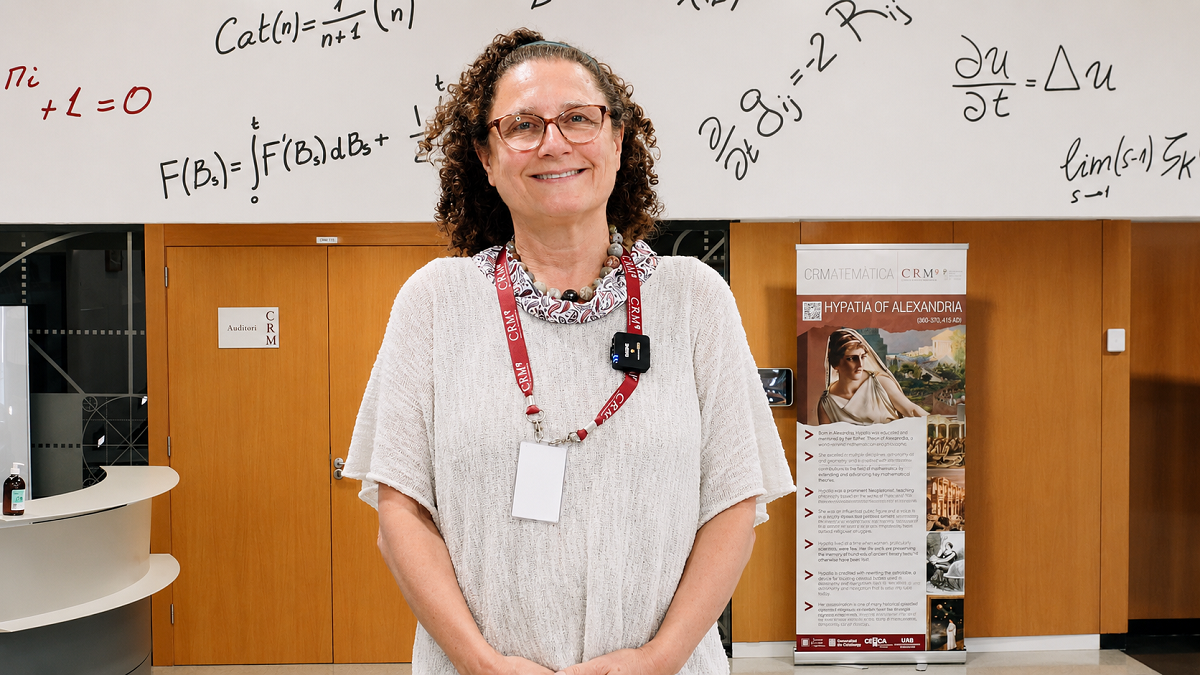
Susanna Terracini delivers the CRM Colloquium 2026
Susanna Terracini (Università di Torino) delivered the CRM Colloquium 2026 on 14 July, presenting a rigidity result for Kepler billiards obtained with Stefano Baranzini, Vivina Barutello and Irene De Blasi. She was at the centre as a member of the CRM Scientific...
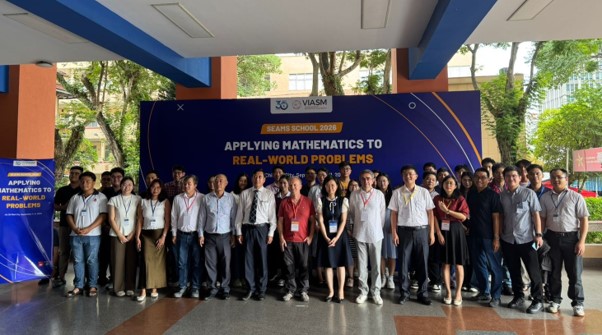
Ho Chi Minh City hosts the SEAMS School on applying mathematics to real-world problems
Students from across the region took courses and worked on group projects at a school co-organised by CRM researcher Tim Myers.CRM CommPau VarelaCRMComm@crm.catGet the latest CRM news and activities in your inbox.Recent newsletters →Between 4 and...

A single ball on a fixed table can compute: Eva Miranda and Isaac Ramos prove that two-dimensional billiards are Turing complete
Eva Miranda (UPC, CRM) and Isaac Ramos (ETH Zürich) show that a point particle bouncing inside a planar table with fixed walls can simulate a universal Turing machine, settling a question Cristopher Moore left open in 1990. The result grew out of a master’s project...