
The fourth edition of the Hypatia Graduate Summer School took place from 16 to 19 June 2025 in Barcelona. Addressed to PhD students, the school combined two advanced courses in number theory with a public colloquium, a film screening, and networking activities such as a research speed dating session.
From 16 to 19 June 2025, the CRM and the Institut d’Estudis Catalans hosted the fourth edition of the Hypatia Graduate Summer School, a training programme addressed to PhD students in mathematics. Organised by BGSMath, the graduate training unit of the Centre de Recerca Matemàtica, the school offers an intensive introduction to selected topics, combining formal lectures with opportunities for discussion and exchange.

This year’s edition featured two advanced courses. The first, led by Henri Darmon (McGill University) and Victor Rotger (UPC–CRM), focused on rational points on elliptic curves and deformations of modular forms. The sessions revisited the construction of algebraic points on elliptic curves from the perspective of the Birch and Swinnerton-Dyer conjecture and the Gross–Zagier formula, with particular emphasis on settings beyond complex multiplication. The course introduced participants to recent advances in p-adic methods and modular generating series that offer new strategies for identifying rational points in more general arithmetic contexts.
The second course, taught by Özlem Imamoğlu (ETH Zurich) and Paloma Bengoechea (UB–CRM), explored periods of modular functions over closed geodesics. Starting from the classical theory of complex multiplication and the algebraicity of singular moduli, the lectures extended the discussion to values of modular functions at real quadratic irrationals, defined via integrals over geodesics on the modular surface. The course combined proven results with current conjectures, opening a window onto an emerging area of research at the intersection of number theory and geometry.

One of the highlights of the programme was the Hypatia Colloquium, held at the IEC. In his talk “Modularity and other aspects of the Langlands program: walking in Wiles’ footsteps”, Luis Dieulefait (UB–CRM) presented a panoramic view of the development of modularity results over the past three decades, from Wiles’ proof of Fermat’s Last Theorem to recent generalisations of Serre’s conjecture and base change theorems. The colloquium also introduced the Rayuela conjecture, a proposal aimed at unifying several threads in the Langlands programme.
On its first afternoon, the school offered a screening of Le théorème de Marguerite (dir. Anna Novion, 2023), a French film portraying the personal and academic challenges of a young mathematician. The screening was followed by an informal group discussion.
Beyond its academic programme, the school provides a setting for community building among early-career researchers. On the third day, participants took part in a research speed dating session, in which participants rotated through short conversations in pairs. The goal of the activity was to encourage interaction across institutional and disciplinary boundaries, offering PhD students the chance to expand their professional network in an informal setting.
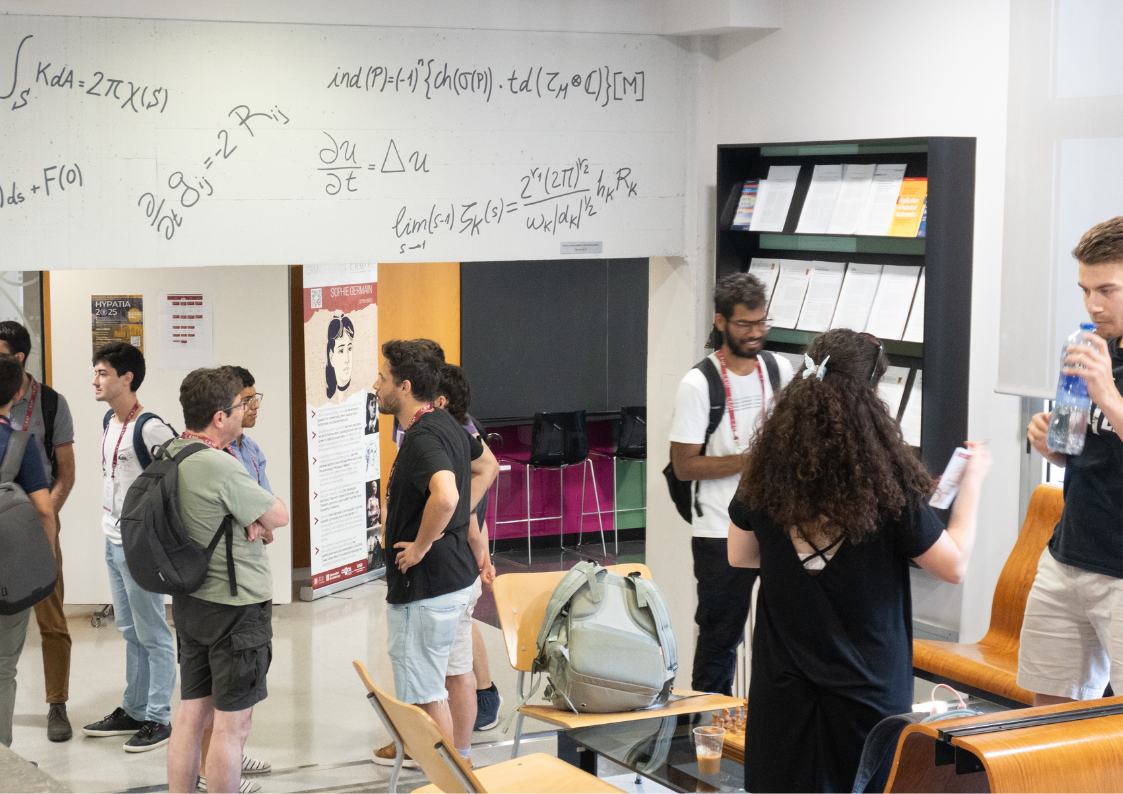
With more than 40 participants from institutions across Europe and North America, the Hypatia Graduate Summer School continues to serve as a platform for doctoral training, combining specialised content with opportunities for exchange and collaboration.
|
|
CRM CommPau Varela
|
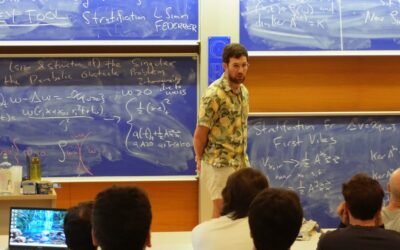
Advanced Course on Free Boundary Problems Opens the Intensive Weeks of the IRP
From 26 to 30 October, around forty researchers attended the Advanced Course on Free Boundary Problems at the CRM, three seven-hour mini-courses given by Bozhidar Velichkov (Università di Pisa), Max Engelstein (University of Minnesota) and Zihui Zhao (Johns Hopkins University). The course was the first of the two intensive weeks of the Intensive Research Programme on Analysis of Free Boundary Problems, which runs until 4 December.
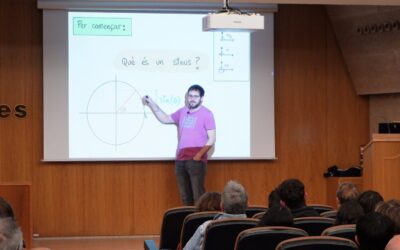
El CRM rep els estudiants de la prova de nivell de Bojos per les Matemàtiques 2027
Els aspirants a Bojos per les Matemàtiques 2027 van visitar el Centre de Recerca Matemàtica (CRM) dissabte 24 d’octubre, després de fer la prova de nivell a la Facultat de Ciències i Biociències de la UAB. En acabat, Tomás Sanz (UB-CRM) els va explicar què té a veure l’escalfament d’una barra de ferro amb els àudios de WhatsApp.
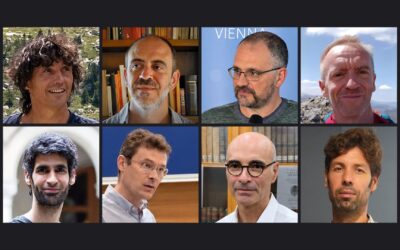
Eight CRM Researchers in the 2026 Stanford-Elsevier List of Highly Cited Scientists
The Centre de Recerca Matemàtica (CRM) has eight researchers in the 2026 update of the Stanford-Elsevier ranking of highly cited scientists, which John P. A. Ioannidis (Stanford University) and Jeroen Baas (Elsevier) compile from Scopus data. Xavier Cabré, Álvaro Corral, Tim Myers, Xavier Ros-Oton, Sergey Tikhonov and Xavier Tolsa appear both in the career-long ranking and in the one for 2025, and Diego Vidaurre and Simeon Ball in the 2025 ranking.
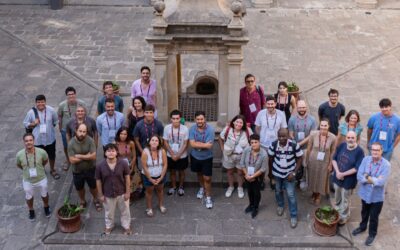
Fish schools and growing tissues: a workshop on how collective behaviour emerges
The Centre de Recerca Matemàtica (CRM) organised the Barcelona Workshop on Kinetic and Macroscopic Models in Biology with Friends II, held from 7 to 10 September at the Institut d’Estudis Catalans. More than thirty researchers discussed how order at the scale of tissues and animal groups arises from local interactions between individuals, in a programme that included talks by CRM researchers Daria Stepanova and Juan Arellano-Tintó. Two of the speakers, James Sharpe (EMBL Barcelona) and Chiara Villa (CNRS, Université Paris Cité), talked to the CRM about their research.
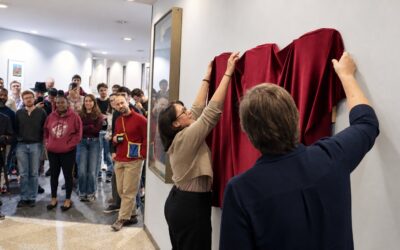
The CRM opens the academic year and unveils its Directors’ Gallery
A review of the year, the Communication Plan 2026–2030 and three research talks filled the morning of 19 October.The unveiling of the Directors’ Gallery.CRM CommPau VarelaCRMComm@crm.catGet the latest CRM news and activities in your inbox.Recent...
The CRM Mentoring Programme, as Told by One of Its Pairs
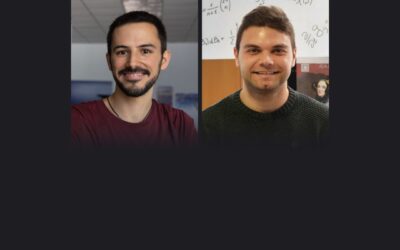
PhD student Joaquim Duran and mathematician Robert Cardona, one of the pairs in the CRM Mentoring ProgrammeJoaquim Duran (left) and Robert Cardona.CRM CommPau VarelaCRMComm@crm.catGet the latest CRM news and activities in your inbox.Recent...
When the reward comes within reach, the brain changes what it compares
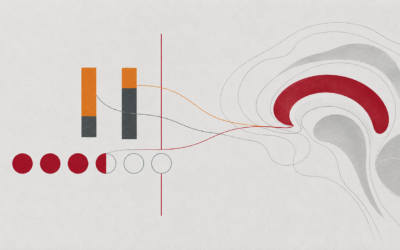
As the tokens piled up, choices got faster and more accurate at the same time. The yardstick for judging each offer had moved.CRM CommPau VarelaCRMComm@crm.catGet the latest CRM news and activities in your inbox.Recent newsletters →Two subjects...

Almost every automaton can be reset with a short word
Guillaume Chapuy (Université Paris Cité, CNRS) and Guillem Perarnau (UPC, CRM) have shown that a random finite automaton with n states can, with high probability, be reset by a word of length of order √n log n. The result, published in ACM Transactions on Algorithms, pins the exponent at 1/2, the lower end of a decade of numerical estimates, and addresses the random version of the synchronization problem behind a conjecture Ján Černý posed in 1964 and which still remains open.
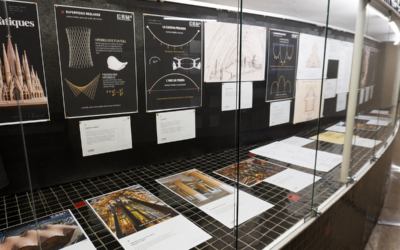
Exposició ‘Les matemàtiques de Gaudí’
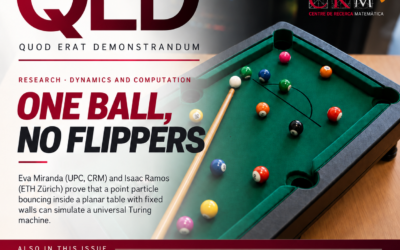
CRM quod erat demonstrandum | 48

ADA: Decoding Brain Signals Misaligned in Time
The study addresses a key limitation of current brain decoding techniques: the difficulty of interpreting internal mental processes whose temporal dynamics vary from trial to trial.Decoding what is happening in a person’s mind from their brain activity is one of the...
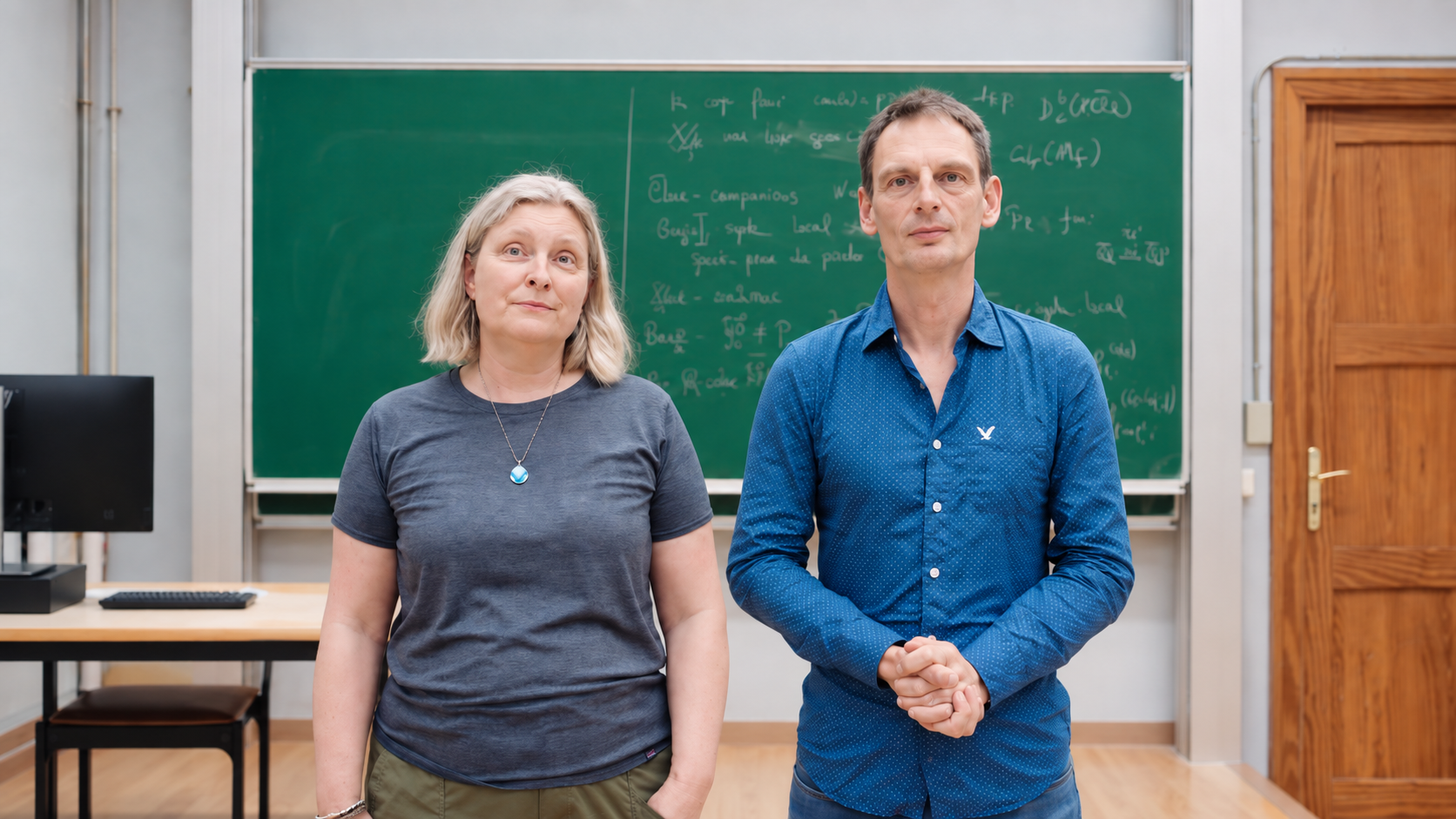
Rare curves, many points: Christophe Ritzenthaler and Rachel Pries on their research and the work around it
Christophe Ritzenthaler (Université de Rennes) and Rachel Pries (Colorado State University) both work on curves over finite fields: he hunts curves with as many points as possible, she hunts curves that almost never occur. In conversation with the CRM during their...