
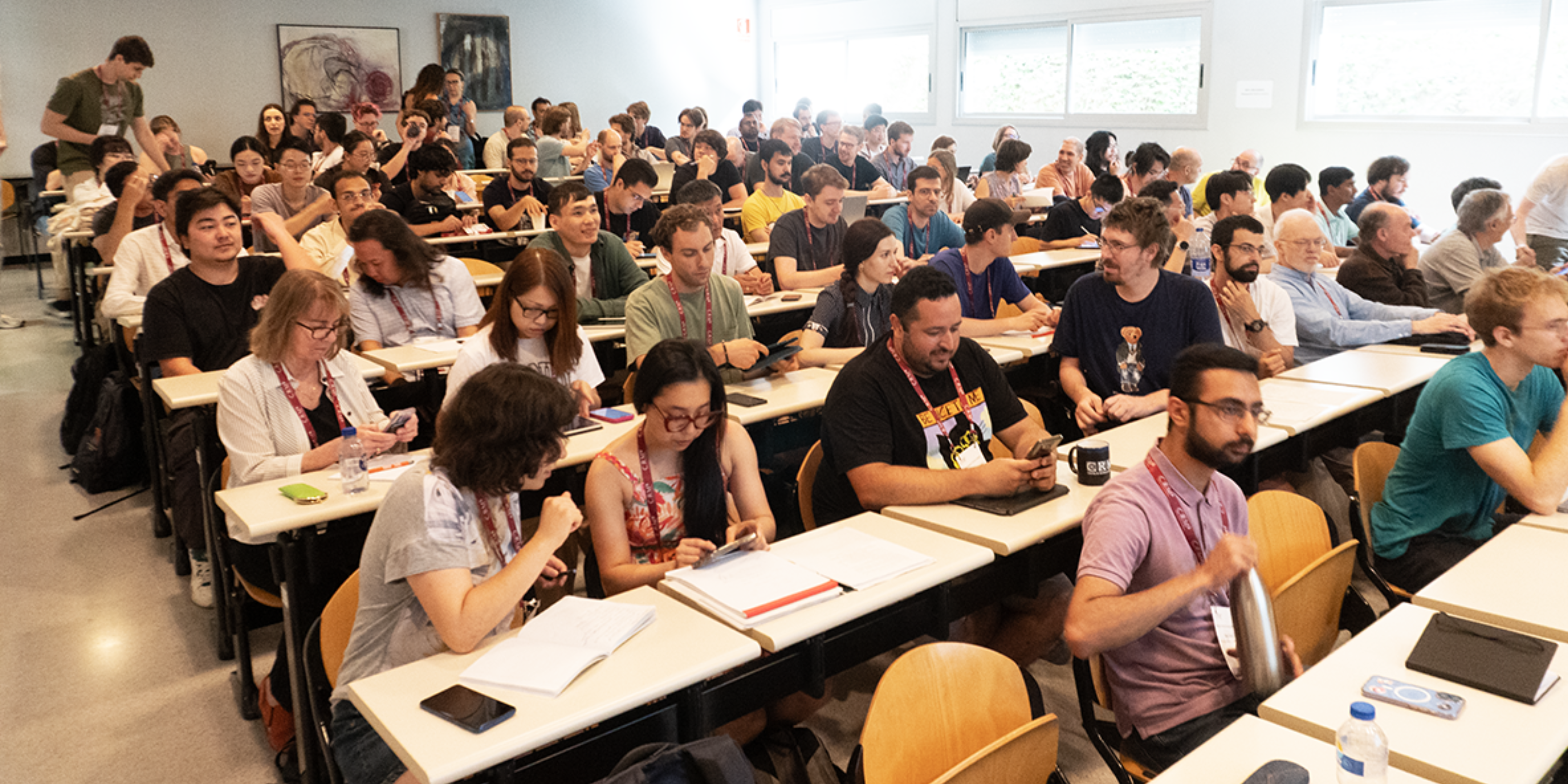
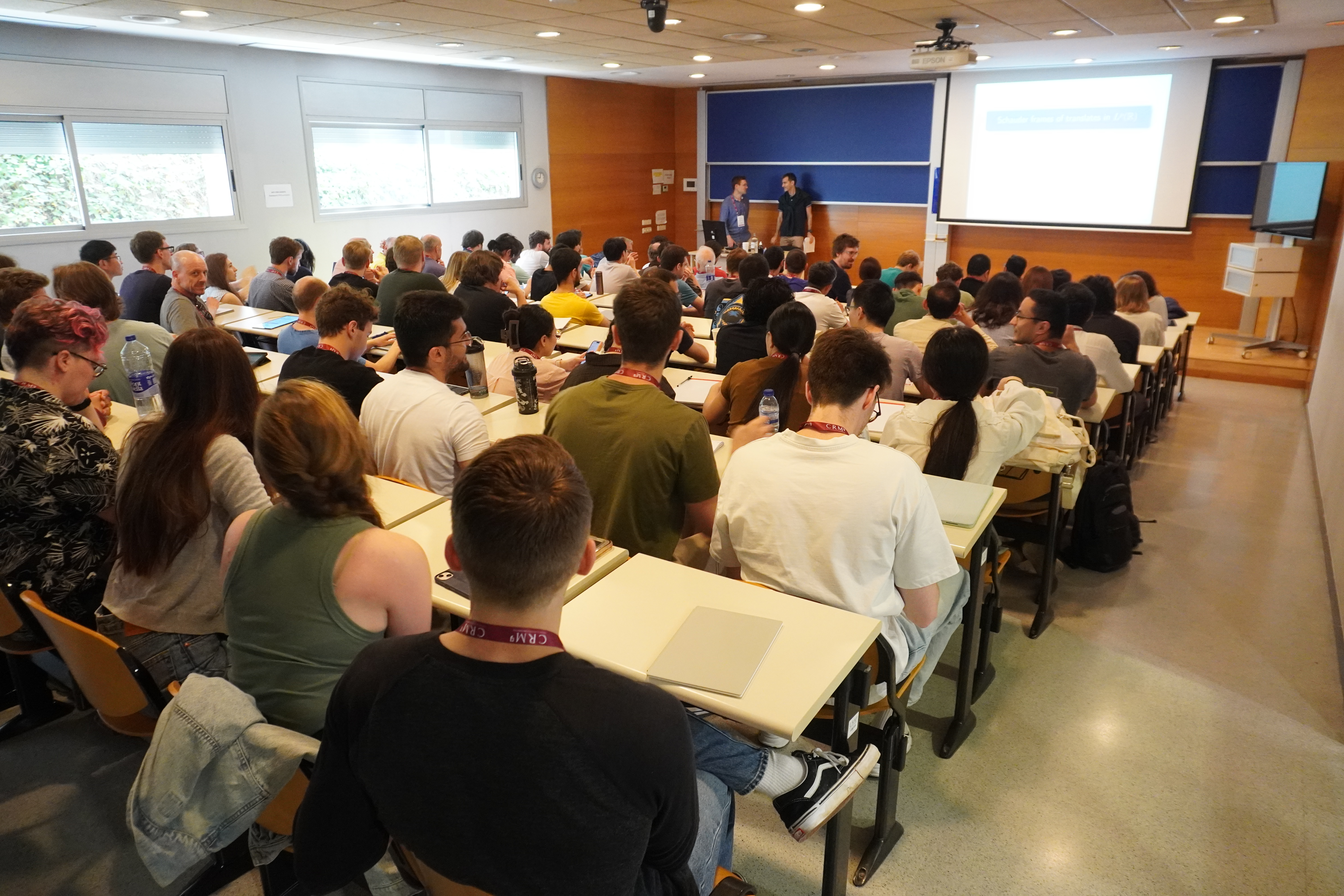
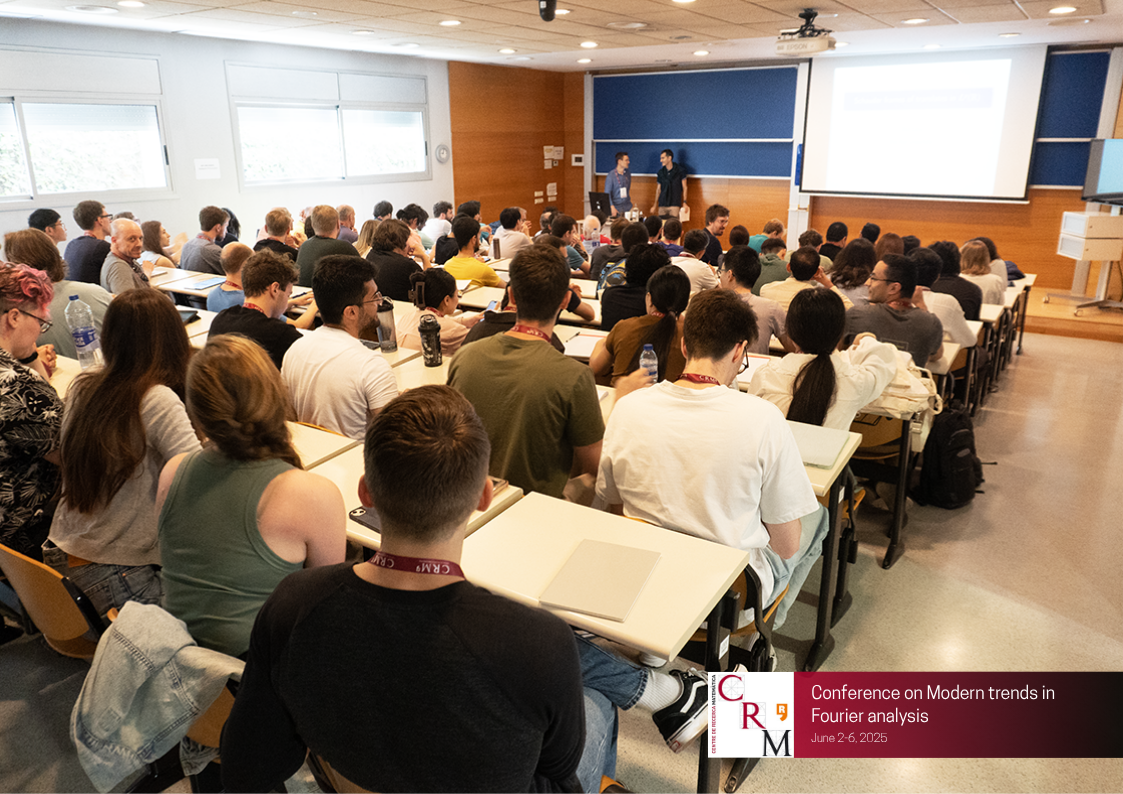
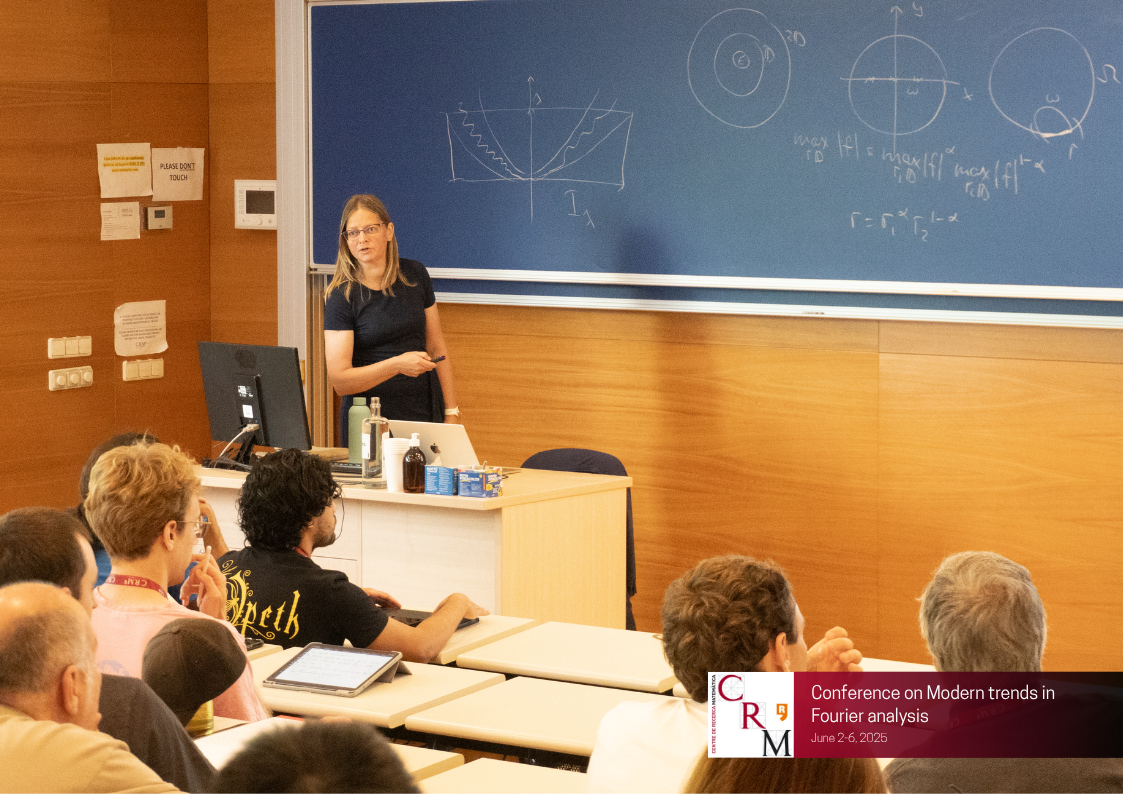
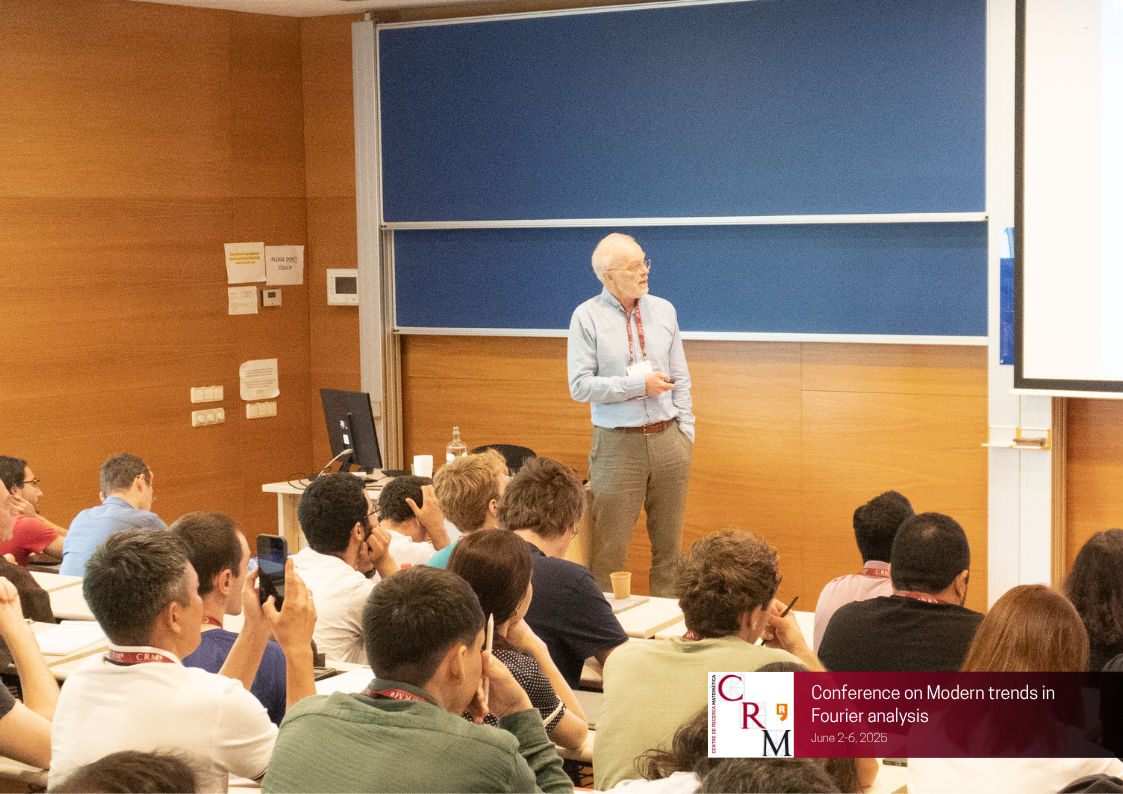
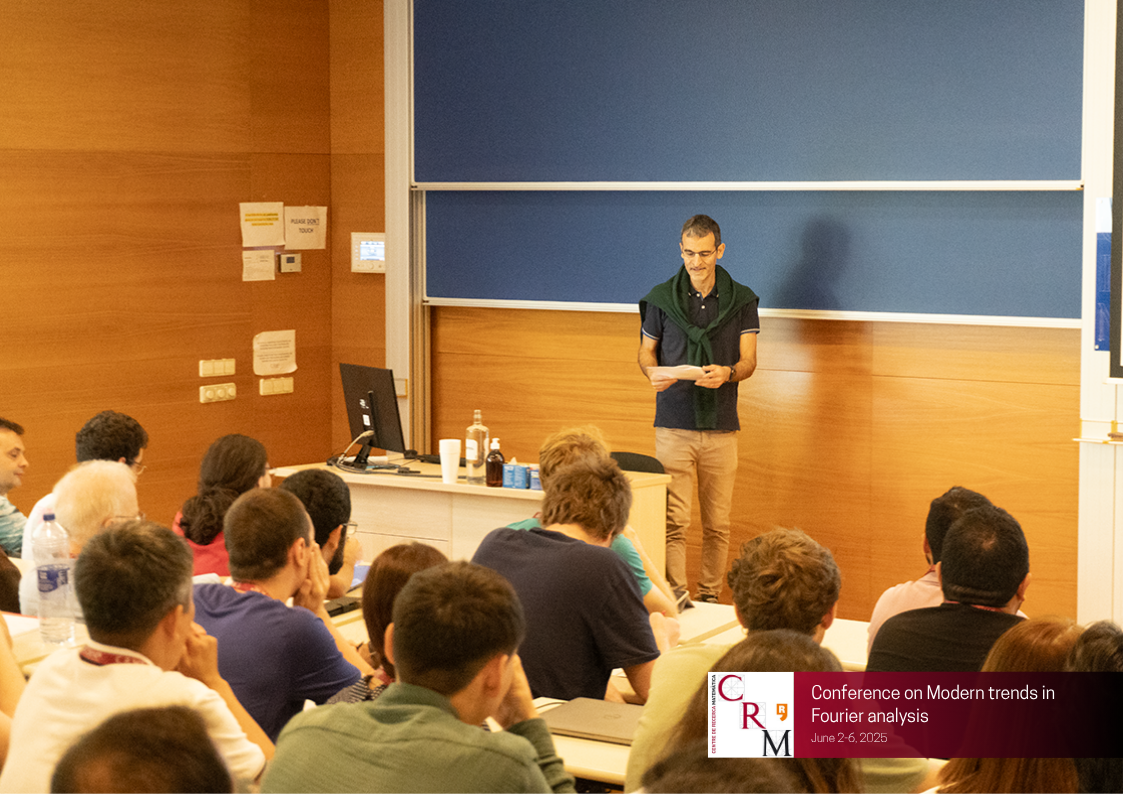
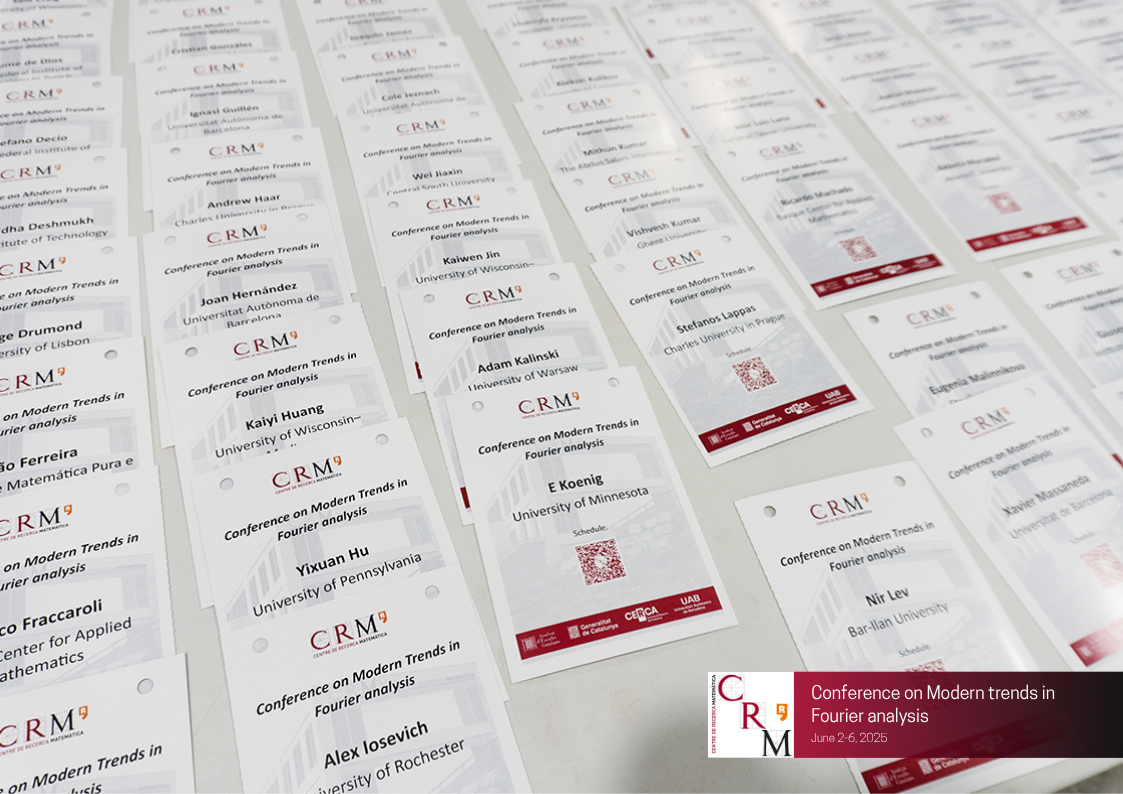
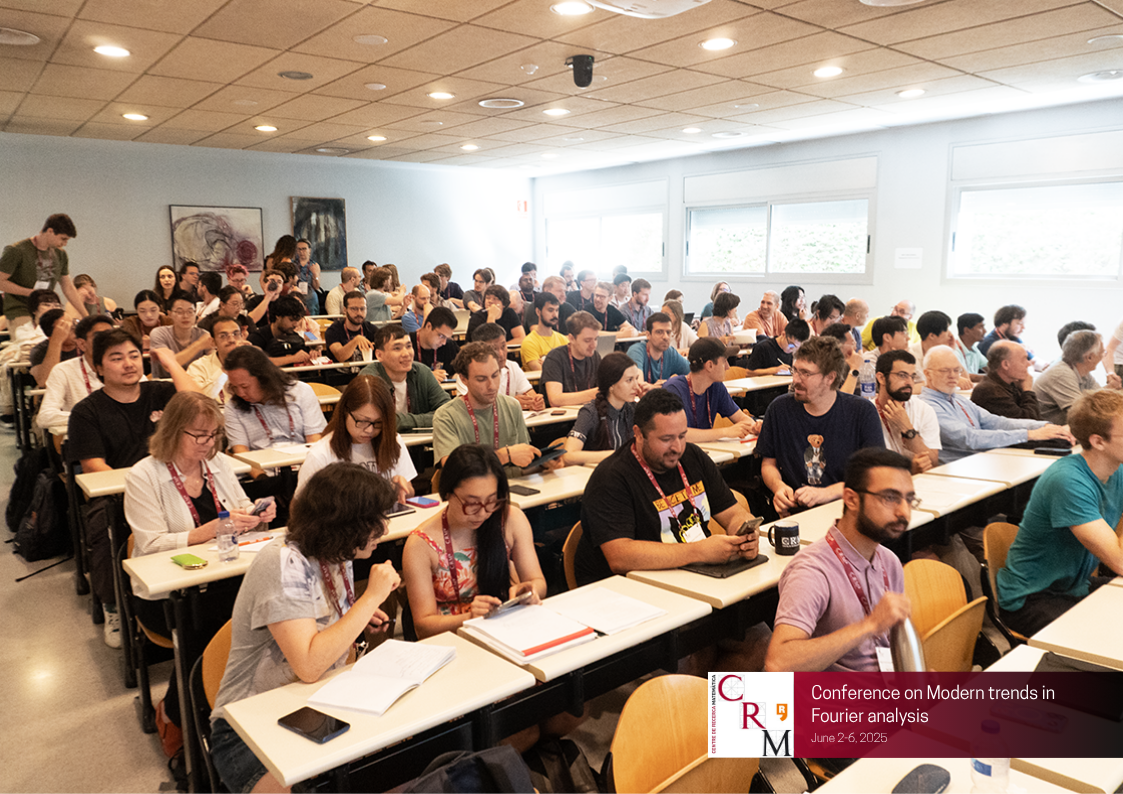
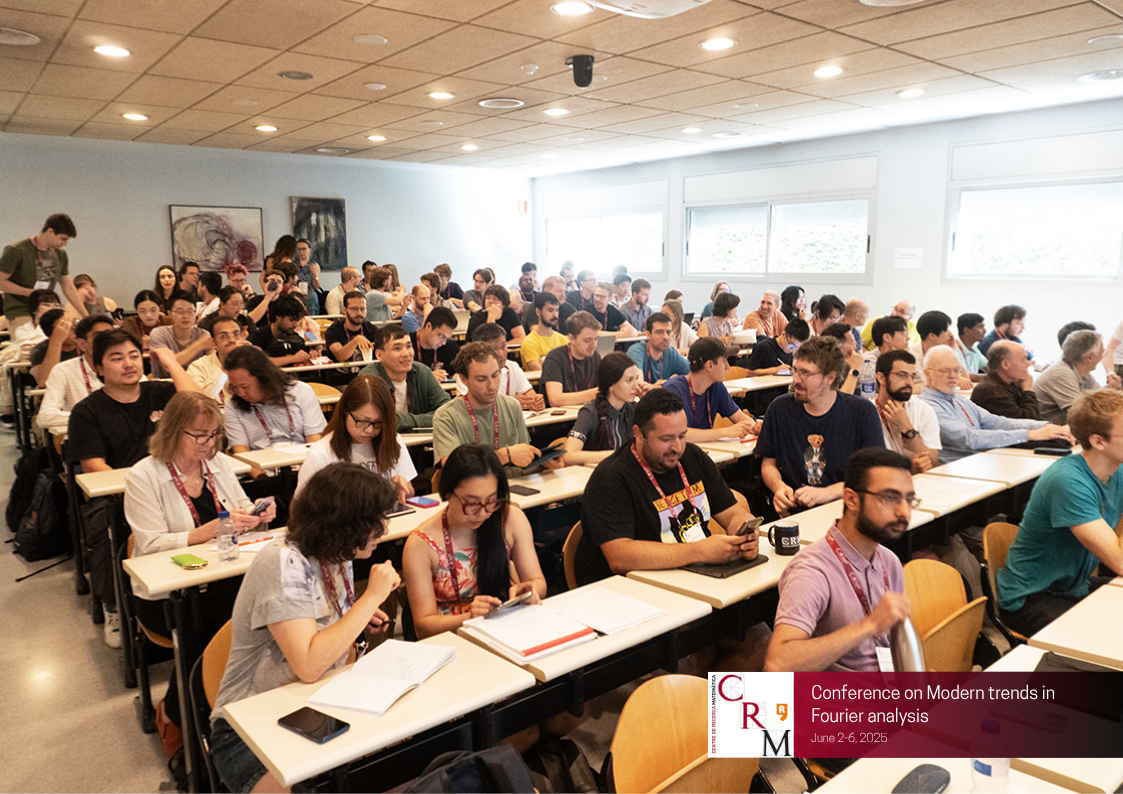
For one intense week, the CRM auditorium became a meeting point for some of the most active researchers in modern Fourier analysis. From June 2 to June 6, 2025, the Conference on Modern Trends in Fourier Analysis brought together senior experts, young mathematicians, and PhD students from across the globe to explore the latest developments in the field.
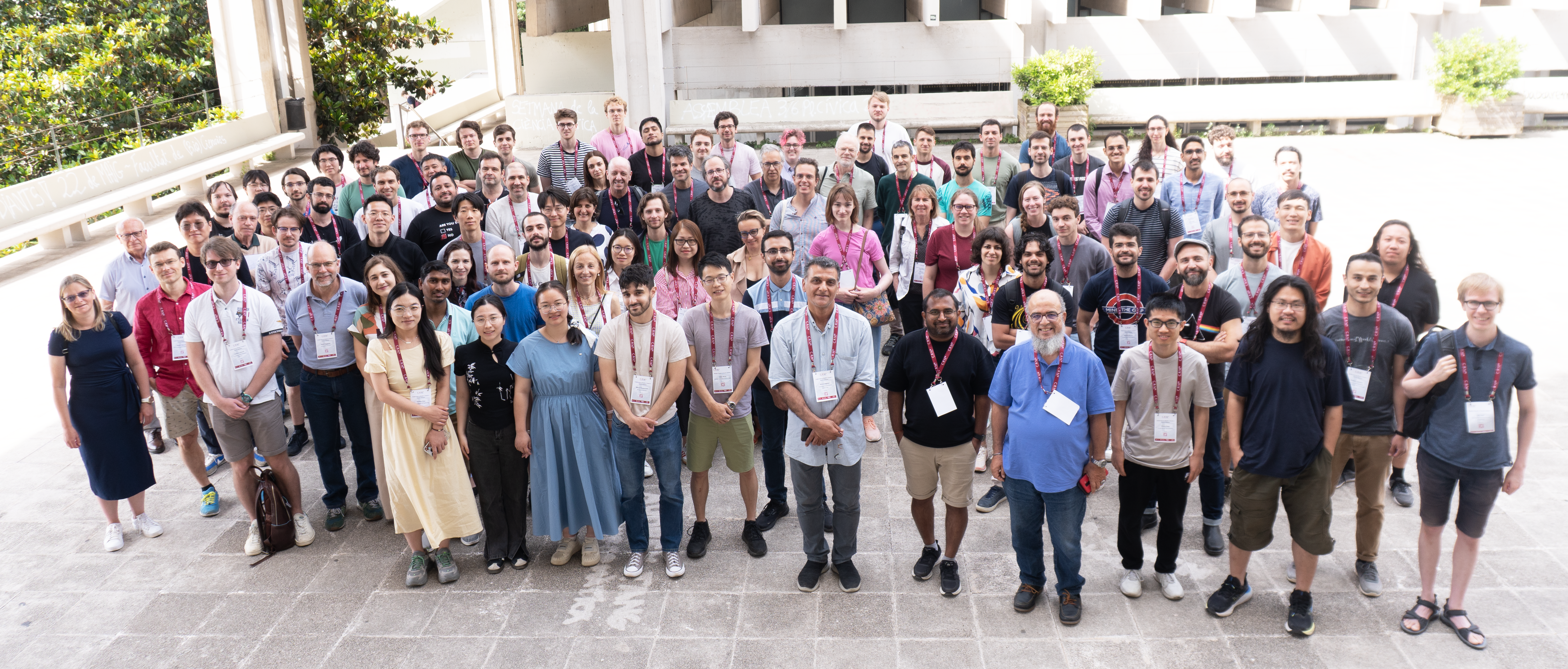
The conference, part of a two-month Intensive Research Programme, gathered more than 100 participants from Europe, North America, and Asia. The scientific and organising committee was led by Dmitriy Bilyk (University of Minnesota), Emanuel Carneiro (ICTP), Diogo Oliveira e Silva (Instituto Superior Técnico), Betsy Stovall (University of Wisconsin–Madison) and Sergey Tikhonov (ICREA, CRM).
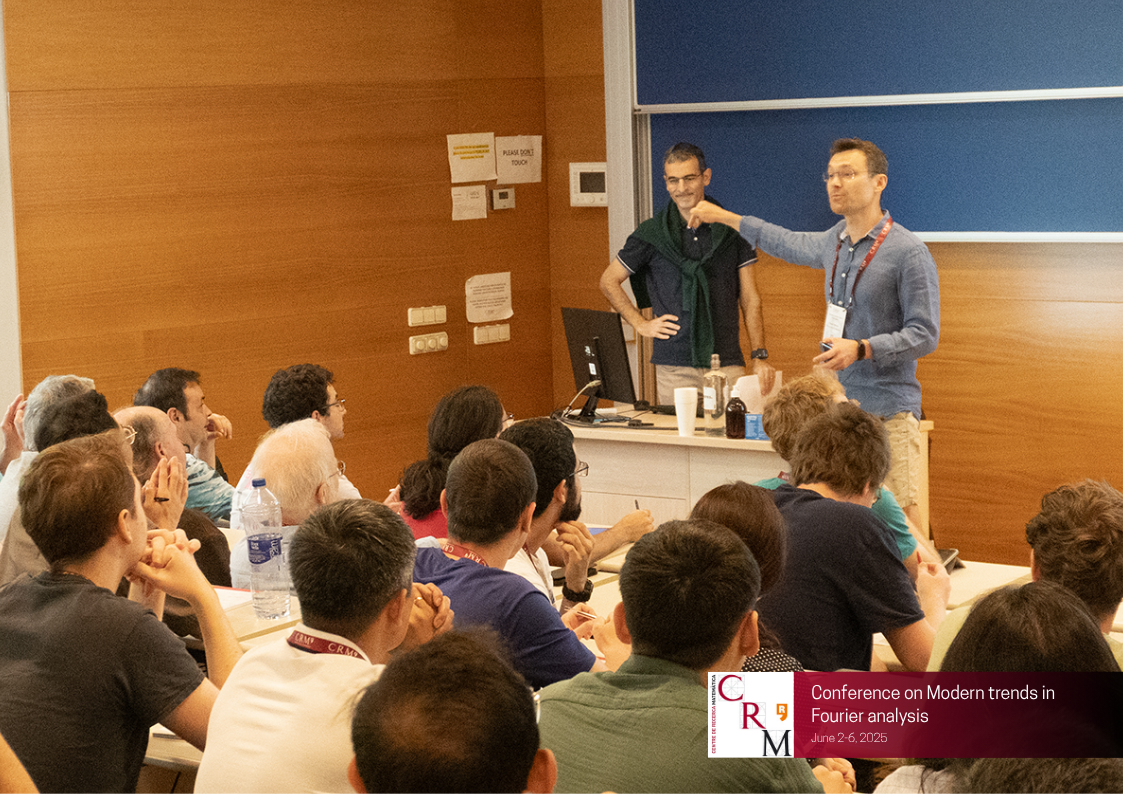
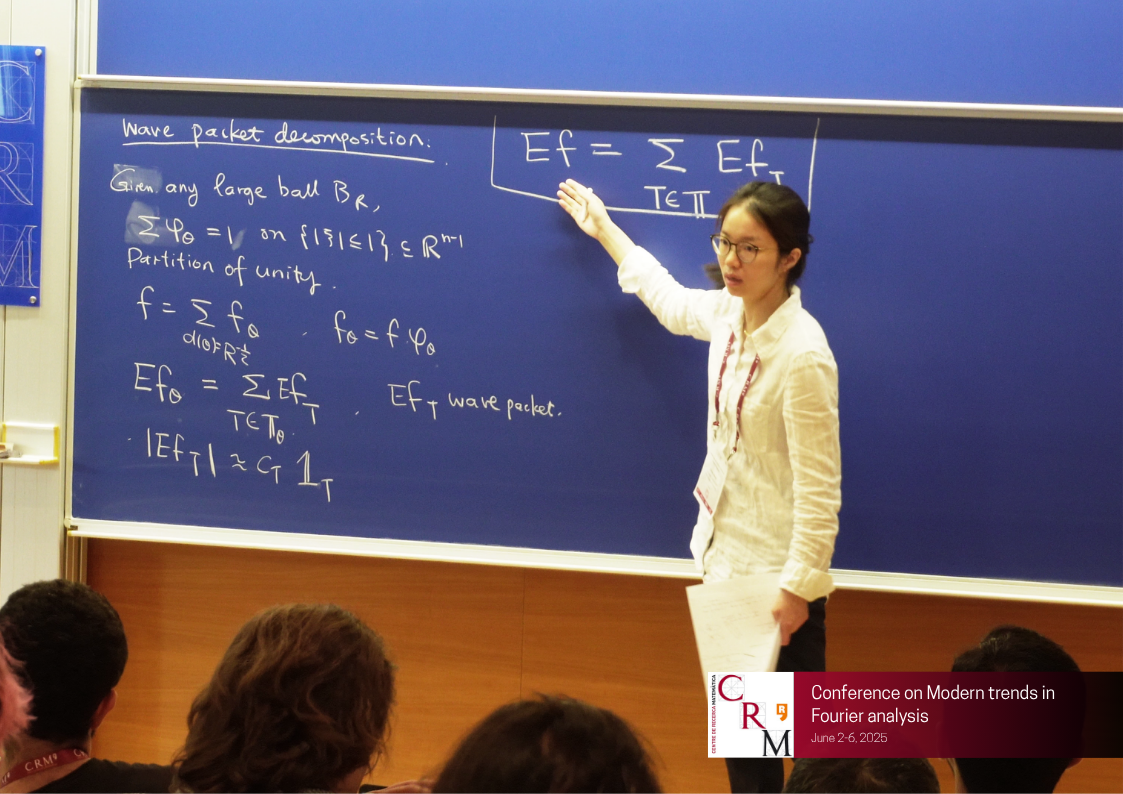
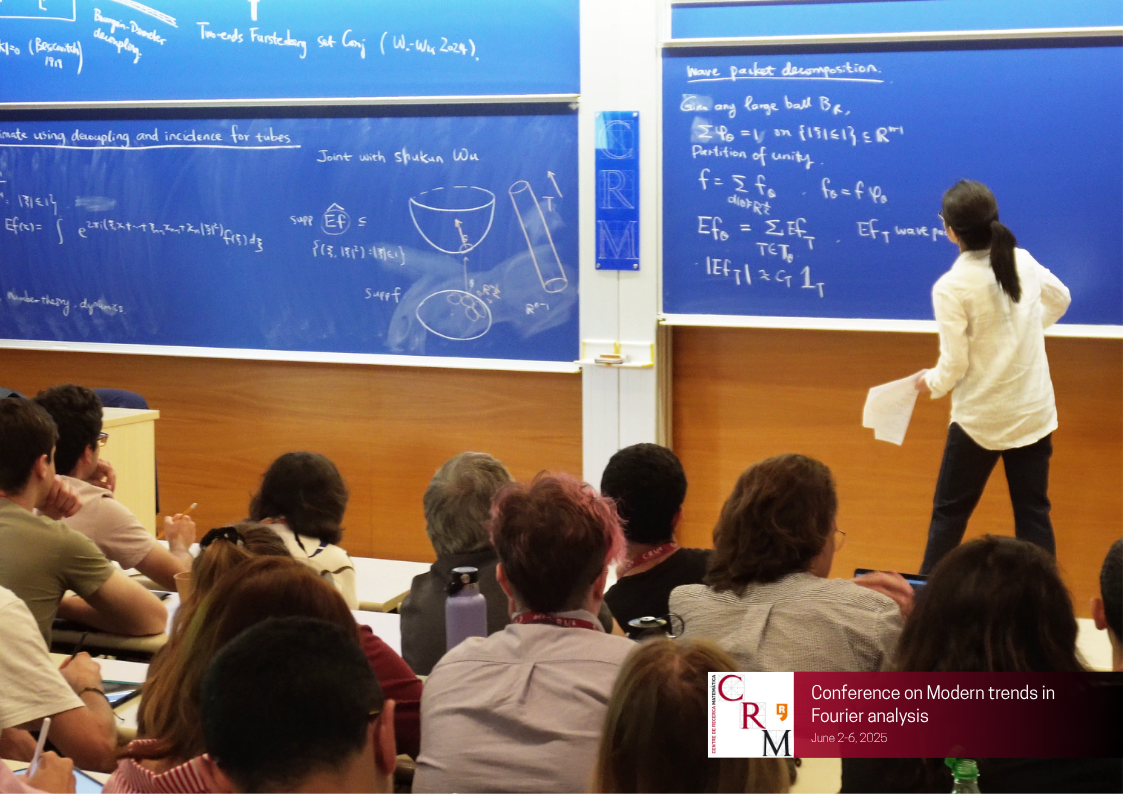
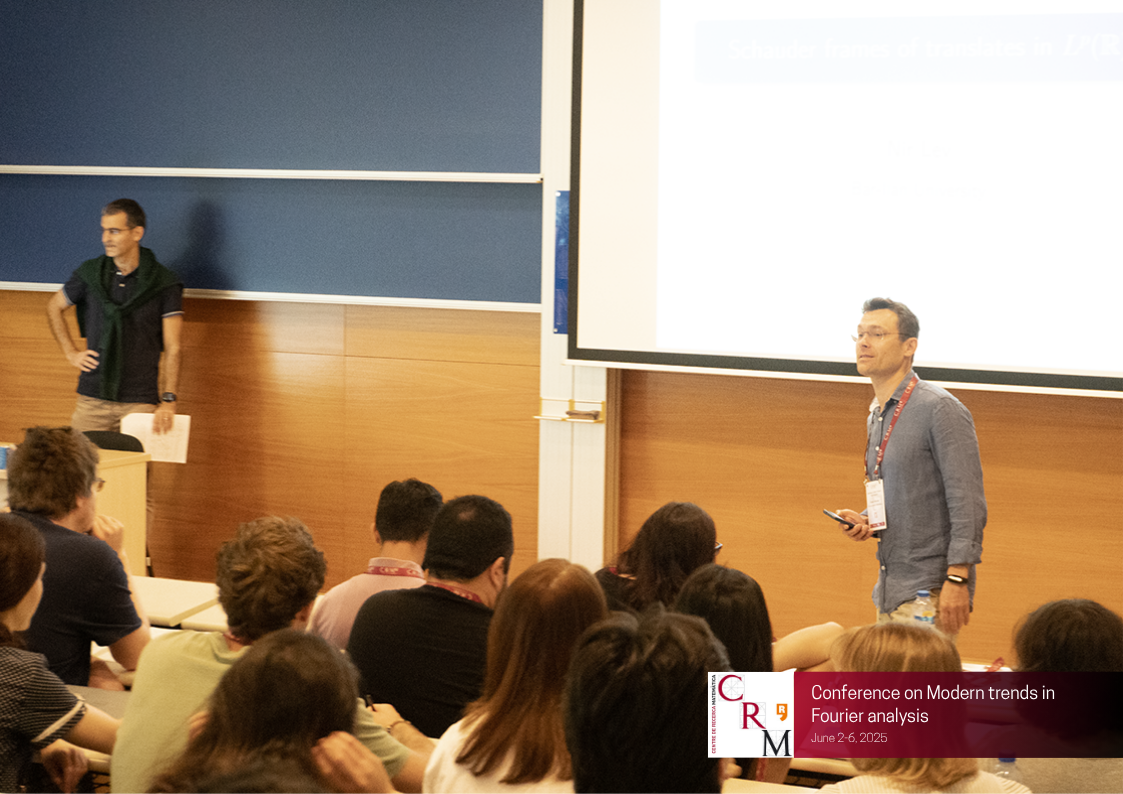
The invited talks spanned a wide spectrum of current directions. Hong Wang (Courant Institute) discussed restriction estimates using decoupling theorems and incidence geometry, offering new partial progress toward Stein’s conjecture via Kakeya-type estimates in dimension three. Nir Lev (Bar-Ilan University) explored Schauder frames of translates in  , revisiting fundamental questions about bases generated by translations of a single function.
Jill Pipher (Brown University) presented a joint work on regularity problems for time-varying parabolic equations, addressing boundary behaviour on Lipschitz domains using advanced tools such as Hardy spaces for parabolic operators. In a related vein, Eugenia Malinnikova (ETH Zürich) connected uncertainty principles with Schrödinger evolutions, including recent results on spectral inequalities and Logvinenko–Sereda-type theorems.
Several talks touched on fractal geometry and geometric measure theory. Krystal Taylor (Ohio State University) surveyed progress on the Buffon circle problem, investigating projections of fractal sets and open questions around Favard length decay. Yumeng Ou (University of Pennsylvania) addressed pinned distance and tree sets, proposing refined conditions related to Falconer-type conjectures. Svitlana Mayboroda (ETH Zürich) discussed free boundary problems for partially reflected Brownian motion, presenting results that challenge prior expectations on the dimension of Robin harmonic measures.
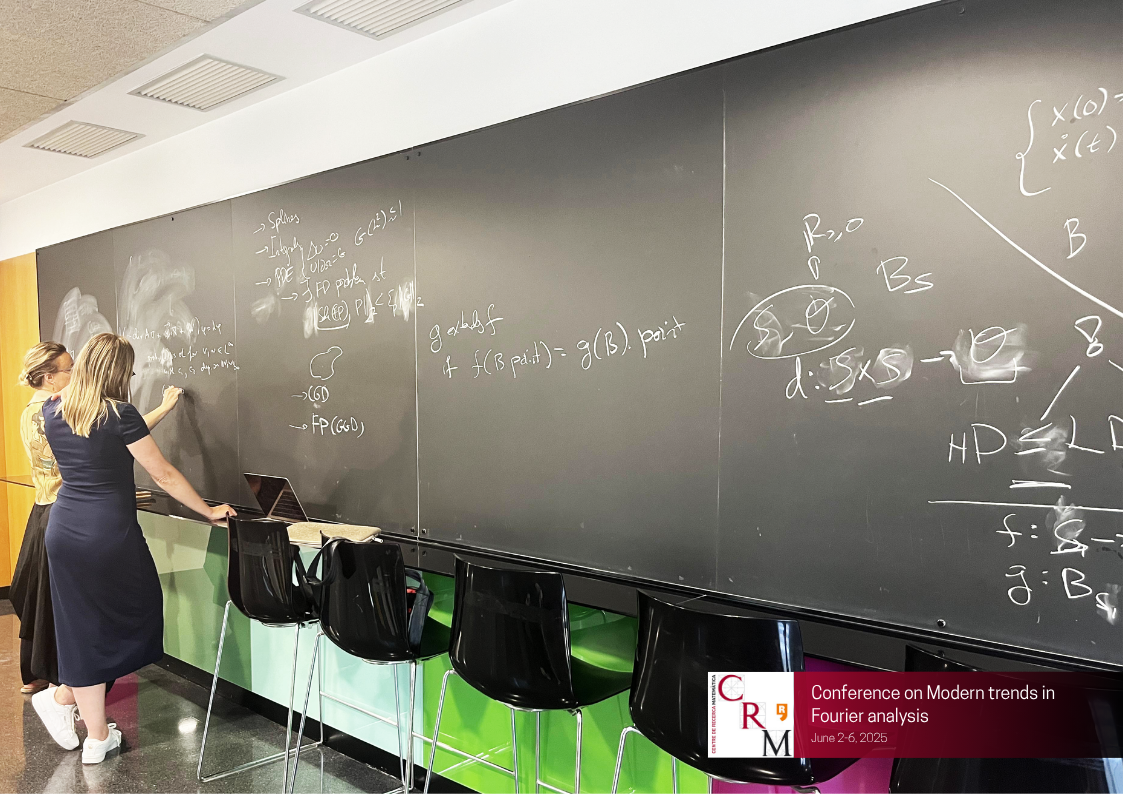
Other invited speakers contributed advances on classical harmonic analysis problems. Alex Iosevich (University of Rochester) linked restriction phenomena with signal recovery in finite settings through Bourgain and Talagrand-type estimates. Aleksei Kulikov (University of Copenhagen) described the spectral behaviour of one-dimensional time-frequency localisation operators, revealing sharp eigenvalue distributions with phase transitions.
Mateus Costa de Sousa (BCAM) surveyed recent progress in Fourier uniqueness theory and phase retrieval problems. Giuseppe Negro (IST Lisboa) introduced a new family of Fourier restriction inequalities where constant functions extremize the problem, strengthening long-standing conjectures about optimal constants. Kristian Seip (NTNU) characterised extremal functions of minimal  norm among exponential type functions. Shahaf Nitzan (Georgia Tech) revisited Riesz basis bounds for exponential systems, improving estimates in classical theorems of Avdonin and Levin. Finally, Jose Ramon Madrid Padilla (Virginia Tech) discussed isoperimetric inequalities on the hypercube, highlighting recent interactions between analysis, combinatorics, and geometry.
Beyond the invited lectures, the afternoon sessions featured an extensive program of contributed talks, with presentations by more than 40 early-career researchers. The multiple informal discussions allowed participants to exchange ideas and build new collaborations in a vibrant research atmosphere.
Many participants will continue their discussions next week at the complementary conference in El Escorial (Madrid), keeping alive the momentum generated during the CRM gathering. The Intensive Research Programme will continue throughout June, with ongoing seminars and several visiting researchers staying at CRM to deepen collaborations and advance their projects.

|
|
CRM CommPau Varela
|

When the reward comes within reach, the brain changes what it compares
As the tokens piled up, choices got faster and more accurate at the same time. The yardstick for judging each offer had moved.CRM CommPau VarelaCRMComm@crm.catGet the latest CRM news and activities in your inbox.Recent newsletters →Two subjects...

Almost every automaton can be reset with a short word
Guillaume Chapuy (Université Paris Cité, CNRS) and Guillem Perarnau (UPC, CRM) have shown that a random finite automaton with n states can, with high probability, be reset by a word of length of order √n log n. The result, published in ACM Transactions on Algorithms, pins the exponent at 1/2, the lower end of a decade of numerical estimates, and addresses the random version of the synchronization problem behind a conjecture Ján Černý posed in 1964 and which still remains open.
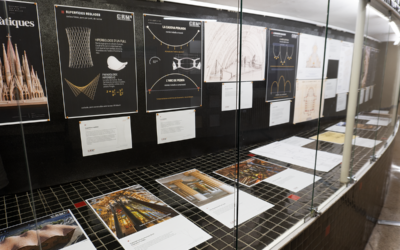
Exposició ‘Les matemàtiques de Gaudí’

CRM quod erat demonstrandum | 48

ADA: Decoding Brain Signals Misaligned in Time
The study addresses a key limitation of current brain decoding techniques: the difficulty of interpreting internal mental processes whose temporal dynamics vary from trial to trial.Decoding what is happening in a person’s mind from their brain activity is one of the...
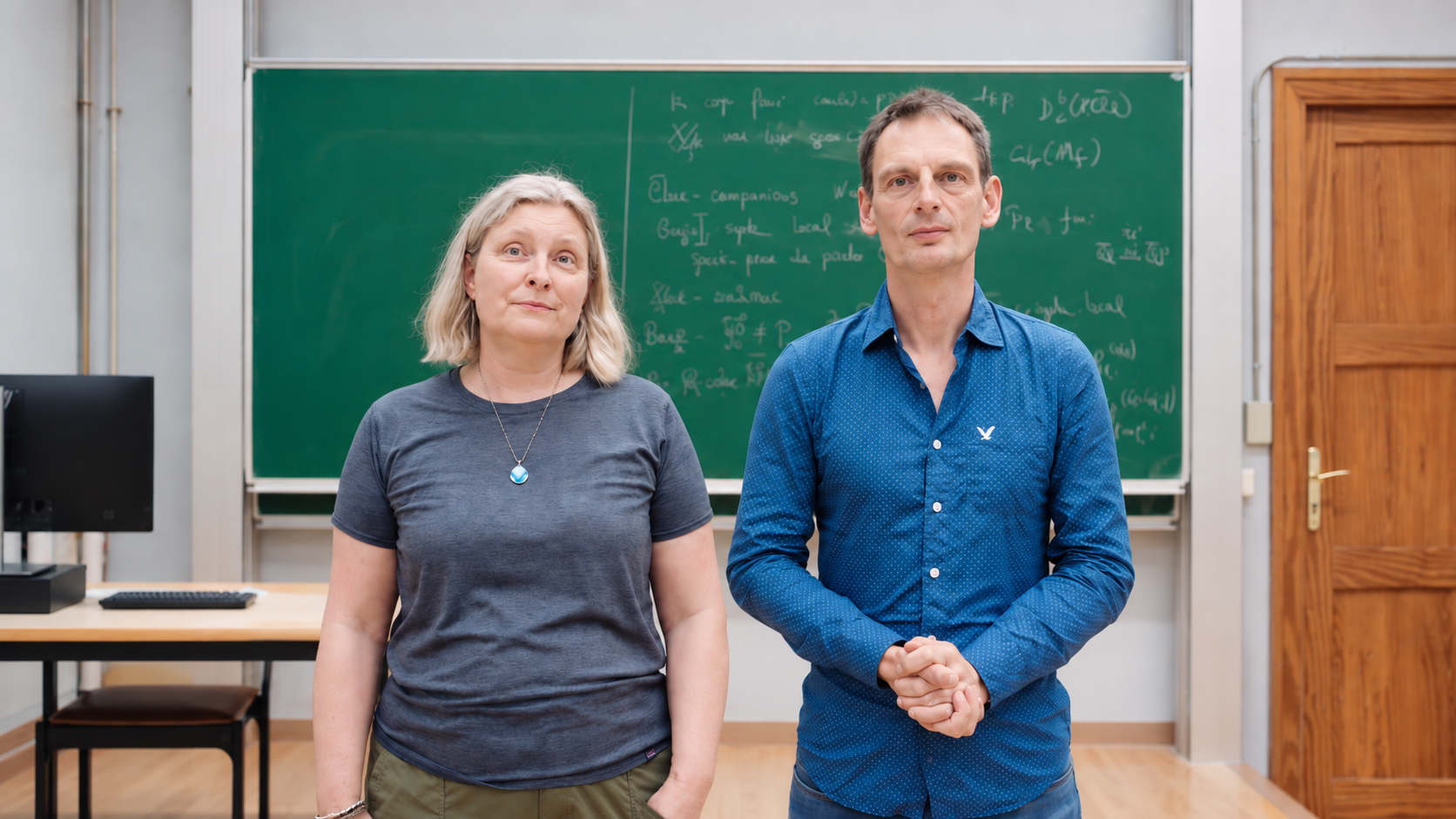
Rare curves, many points: Christophe Ritzenthaler and Rachel Pries on their research and the work around it
Christophe Ritzenthaler (Université de Rennes) and Rachel Pries (Colorado State University) both work on curves over finite fields: he hunts curves with as many points as possible, she hunts curves that almost never occur. In conversation with the CRM during their...

Call open for the 2027 Ferran Sunyer i Balaguer Prize
The Ferran Sunyer i Balaguer Foundation is accepting submissions for its 2027 prize, which awards 15,000 euros and publication in Birkhäuser's Progress in Mathematics series to an expository monograph on an active area of mathematical research. The deadline is 27...
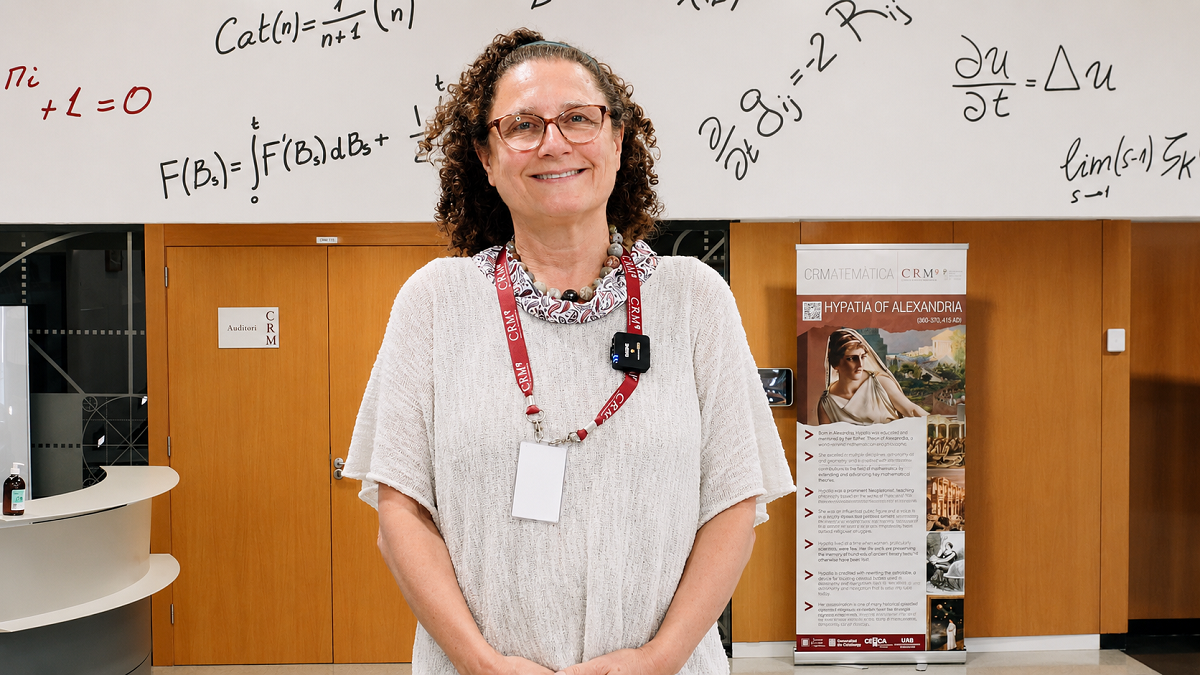
Susanna Terracini delivers the CRM Colloquium 2026
Susanna Terracini (Università di Torino) delivered the CRM Colloquium 2026 on 14 July, presenting a rigidity result for Kepler billiards obtained with Stefano Baranzini, Vivina Barutello and Irene De Blasi. She was at the centre as a member of the CRM Scientific...
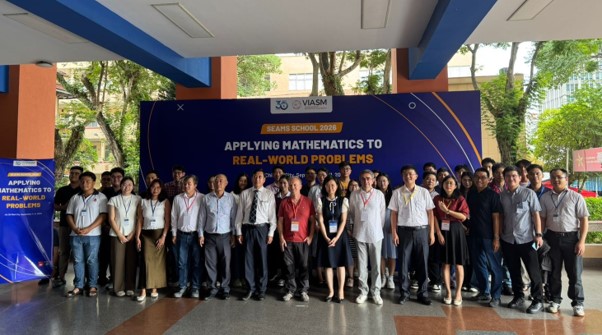
Ho Chi Minh City hosts the SEAMS School on applying mathematics to real-world problems
Students from across the region took courses and worked on group projects at a school co-organised by CRM researcher Tim Myers.CRM CommPau VarelaCRMComm@crm.catGet the latest CRM news and activities in your inbox.Recent newsletters →Between 4 and...

A single ball on a fixed table can compute: Eva Miranda and Isaac Ramos prove that two-dimensional billiards are Turing complete
Eva Miranda (UPC, CRM) and Isaac Ramos (ETH Zürich) show that a point particle bouncing inside a planar table with fixed walls can simulate a universal Turing machine, settling a question Cristopher Moore left open in 1990. The result grew out of a master’s project...
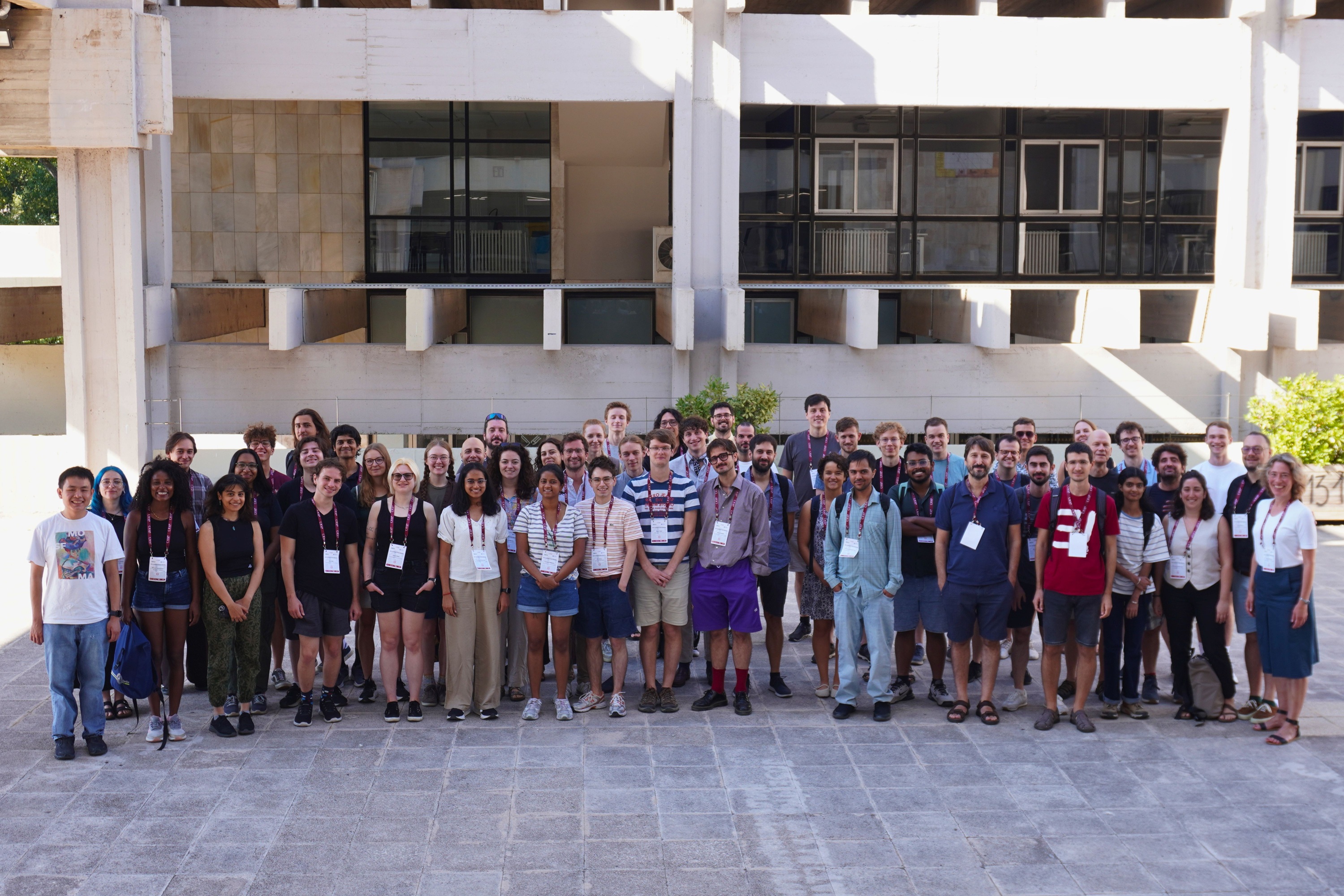
BMS-BGSMath Junior Meeting 2026: Barcelona and Berlin Strengthen Scientific Ties
From 2 to 4 September 2026, the Centre de Recerca Matemàtica (CRM) hosted the BMS-BGSMath Junior Meeting 2026, a three-day event jointly organised by the Berlin Mathematical School (BMS) and the Barcelona Graduate School of Mathematics (BGSMath), with the Centre de...
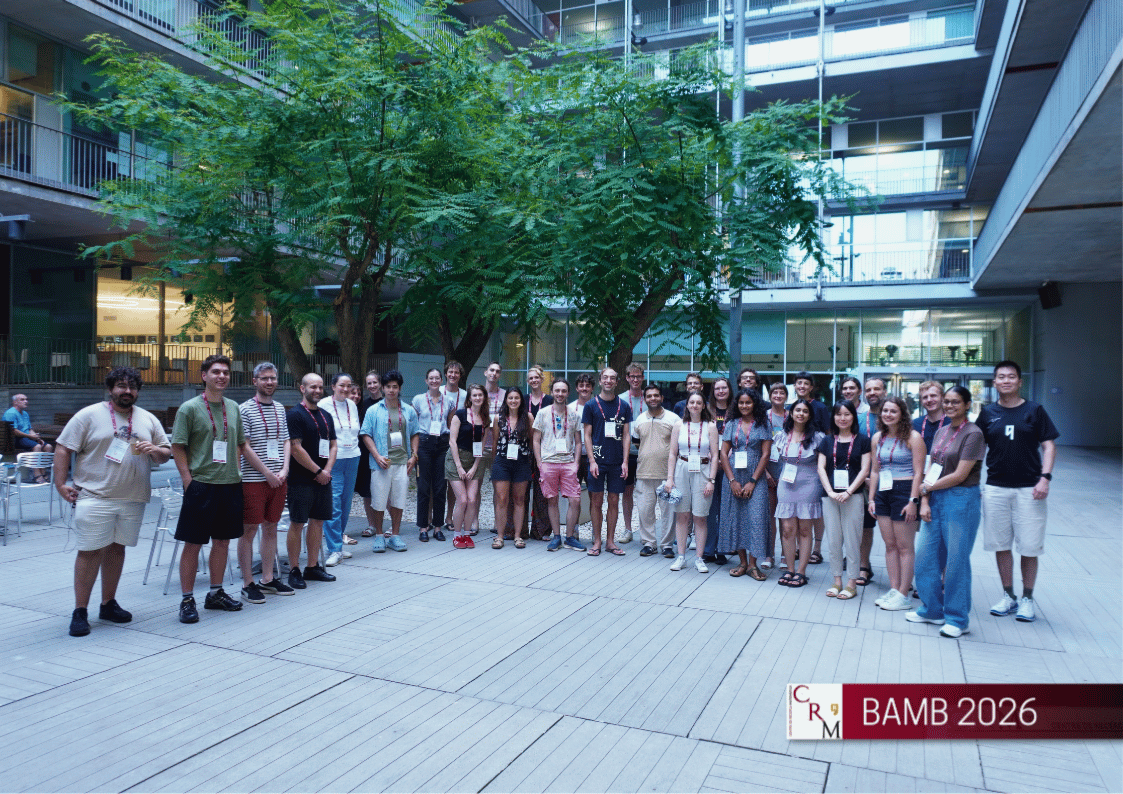
The CRM organises the 2026 Barcelona Summer School for Advanced Modeling of Behavior
The Centre de Recerca Matemàtica held the sixth edition of BAMB!, the Barcelona Summer School for Advanced Modeling of Behavior, from 12 to 23 July 2026 at the Parc de Recerca Biomèdica de Barcelona. Thirty early-career researchers from fourteen countries followed...