
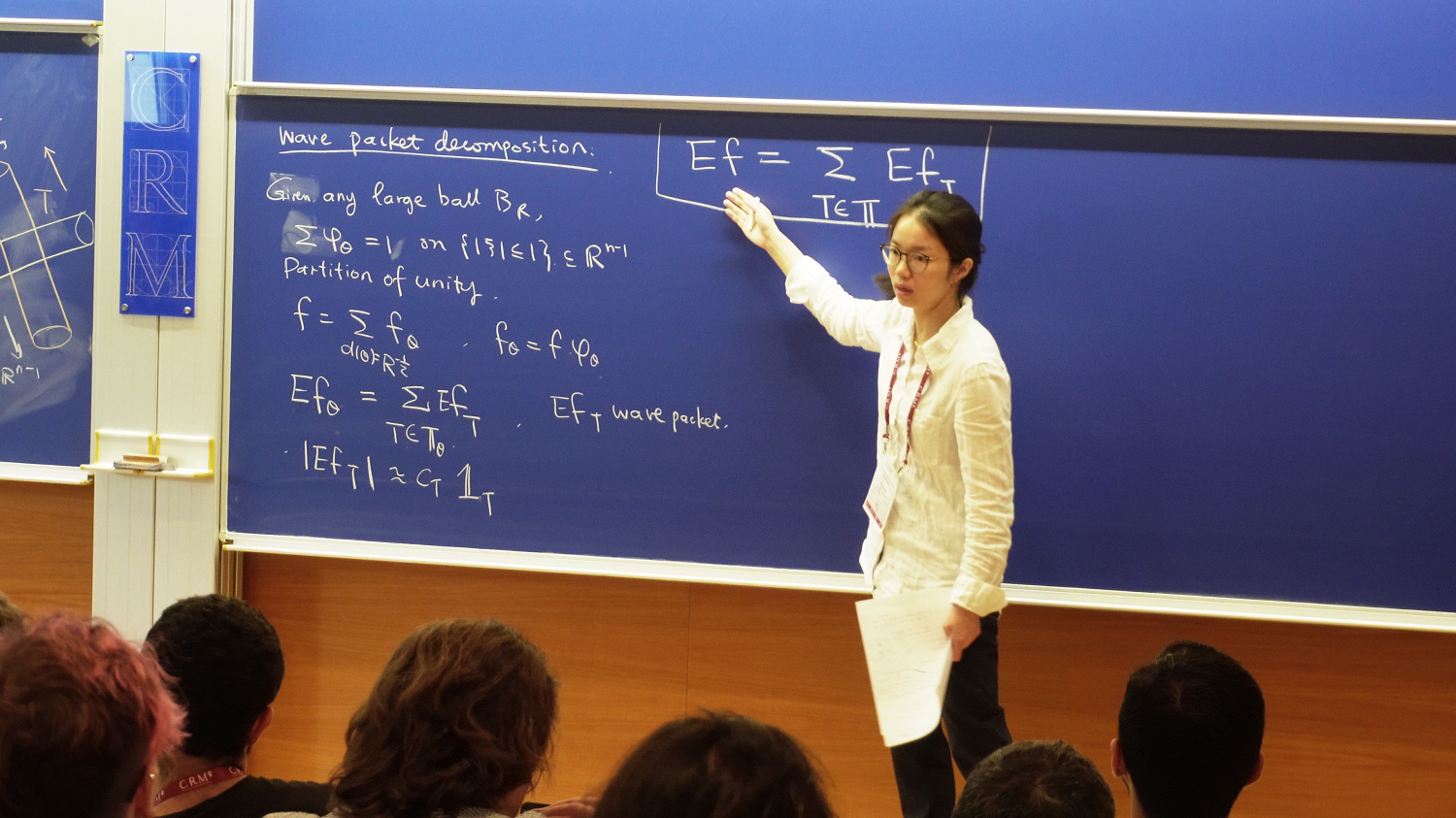
The Modern Trends in Fourier Analysis conference, held this June at the Centre de Recerca Matemàtica (CRM), gathered over a hundred researchers from around the world to explore advances in harmonic analysis. Among the invited speakers was Hong Wang, associate professor at NYU’s Courant Institute of Mathematical Sciences, who presented a lecture outlining a new geometric approach to the longstanding Stein restriction conjecture. Her talk followed closely on the heels of a landmark achievement: Wang’s recent resolution, with Joshua Zahl, of the celebrated three-dimensional Kakeya conjecture, one of the most challenging open problems in the field.
In her talk, Wang presented joint work with mathematician Shukun Wu, focused on a novel geometric method to approach the restriction problem. At its core is a deceptively simple conjecture: if a function has its Fourier transform supported on the unit sphere in  , then its
  -norm should be controlled by the -norm of its Fourier transform, for
  . This conjecture has guided decades of research in Fourier analysis.
Rather than attacking it directly, Wang and Wu propose to study it through a geometric lens: they formulate a conjecture about how many times thin tubes in space can intersect. “It’s a purely geometric question about incidences,” Wang explained. “And if the conjecture holds, it implies Stein’s.” They prove the two-dimensional case and obtain new restriction estimates in three dimensions for  , which in turn lead to a known bound in the Kakeya problem known as Wolff’s hairbrush estimate.
Solving Kakeya in 3D
This link between restriction and Kakeya is not incidental. Wang is one of the two authors, alongside Joshua Zahl (University of British Columbia), behind the 2025 proof of the three-dimensional Kakeya conjecture, a milestone that had eluded mathematicians for over fifty years.
The conjecture, inspired by a question posed by Japanese mathematician Sōichi Kakeya in 1917, asks whether a needle (or line segment) that turns in every direction can sweep out an arbitrarily small volume. Wang and Zahl proved that in three-dimensional space, any such Kakeya set must have Hausdorff and Minkowski dimension exactly 3. That is: it may be thin, but it cannot be small.
Their proof follows a layered strategy: first solving the problem for a specific class of objects called “sticky sets,” then extending the result to more general cases. A key insight came from a concept that transformed Wang’s approach: “You can find fractal structure in any set if you look at the right scales,” she explained. This idea, originally developed by Katz and Zahl, helped her rethink how to extract order from apparent geometric chaos.
More than just technique
Wang’s interest in the restriction problem began over a decade ago. “I got interested in Stein’s restriction conjecture when I read a paper by Luis Vega (BCAM), actually ,” she recalled. That early exposure laid the foundation for her current line of research, which combines deep harmonic analysis with geometric insight.
“It’s a long journey,” she said. “Sometimes you work for years and don’t solve the problem. But the tools, the intuition, what you build along the way, it all ends up useful.” She also spoke of the difficulty of knowing when to persevere or walk away: “You have to be honest with yourself. Not too optimistic, not too pessimistic. That process, I think, is very rewarding.”
Her work is deeply tied to real geometry, not just in theory but in essence: “If you move the problem to complex space, the statement becomes false. You need tools that really distinguish real from complex. Many standard techniques don’t.”
Conferences, community, and collaboration
Beyond the mathematics itself, Wang highlighted the value of gatherings like the CRM conference. “You get a sense of what’s happening in the field, have spontaneous conversations, meet potential collaborators; that’s a fundamental part of doing mathematics,” she said.
With her recent contributions, Wang has made a significant impact on harmonic analysis and geometric measure theory. Her work combines technical depth with a clear geometric intuition, offering new tools and perspectives for longstanding problems. As Nets Katz remarked, the solution to the Kakeya conjecture marks a once-in-a-century achievement, one in which Wang has played a central role.
You can watch the full interview on the CRM YouTube channel.
|
|
CRM CommPau Varela
|

When the reward comes within reach, the brain changes what it compares
As the tokens piled up, choices got faster and more accurate at the same time. The yardstick for judging each offer had moved.CRM CommPau VarelaCRMComm@crm.catGet the latest CRM news and activities in your inbox.Recent newsletters →Two subjects...

Almost every automaton can be reset with a short word
Guillaume Chapuy (Université Paris Cité, CNRS) and Guillem Perarnau (UPC, CRM) have shown that a random finite automaton with n states can, with high probability, be reset by a word of length of order √n log n. The result, published in ACM Transactions on Algorithms, pins the exponent at 1/2, the lower end of a decade of numerical estimates, and addresses the random version of the synchronization problem behind a conjecture Ján Černý posed in 1964 and which still remains open.
Exposició ‘Les matemàtiques de Gaudí’

CRM quod erat demonstrandum | 48

ADA: Decoding Brain Signals Misaligned in Time
The study addresses a key limitation of current brain decoding techniques: the difficulty of interpreting internal mental processes whose temporal dynamics vary from trial to trial.Decoding what is happening in a person’s mind from their brain activity is one of the...
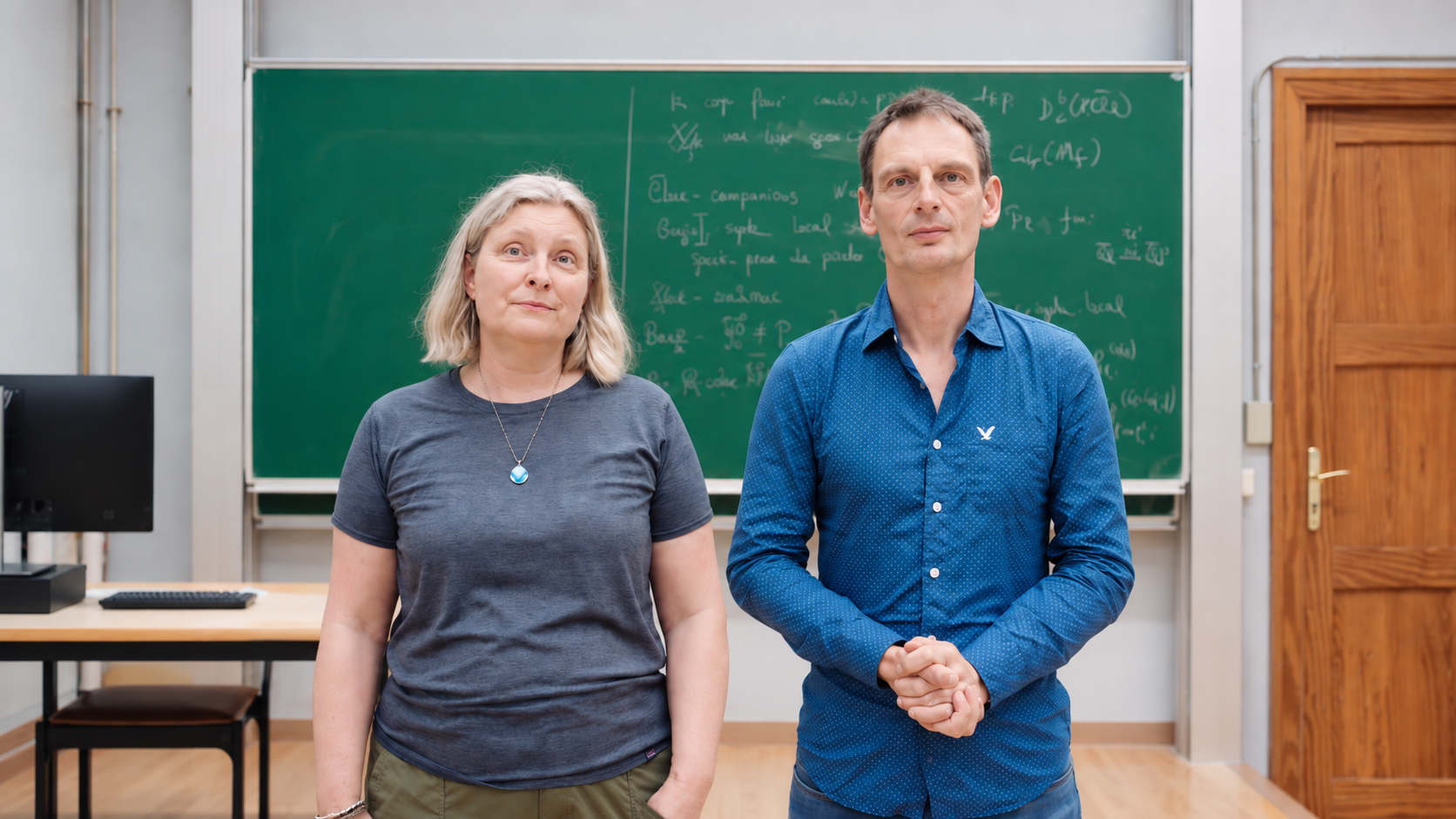
Rare curves, many points: Christophe Ritzenthaler and Rachel Pries on their research and the work around it
Christophe Ritzenthaler (Université de Rennes) and Rachel Pries (Colorado State University) both work on curves over finite fields: he hunts curves with as many points as possible, she hunts curves that almost never occur. In conversation with the CRM during their...

Call open for the 2027 Ferran Sunyer i Balaguer Prize
The Ferran Sunyer i Balaguer Foundation is accepting submissions for its 2027 prize, which awards 15,000 euros and publication in Birkhäuser's Progress in Mathematics series to an expository monograph on an active area of mathematical research. The deadline is 27...
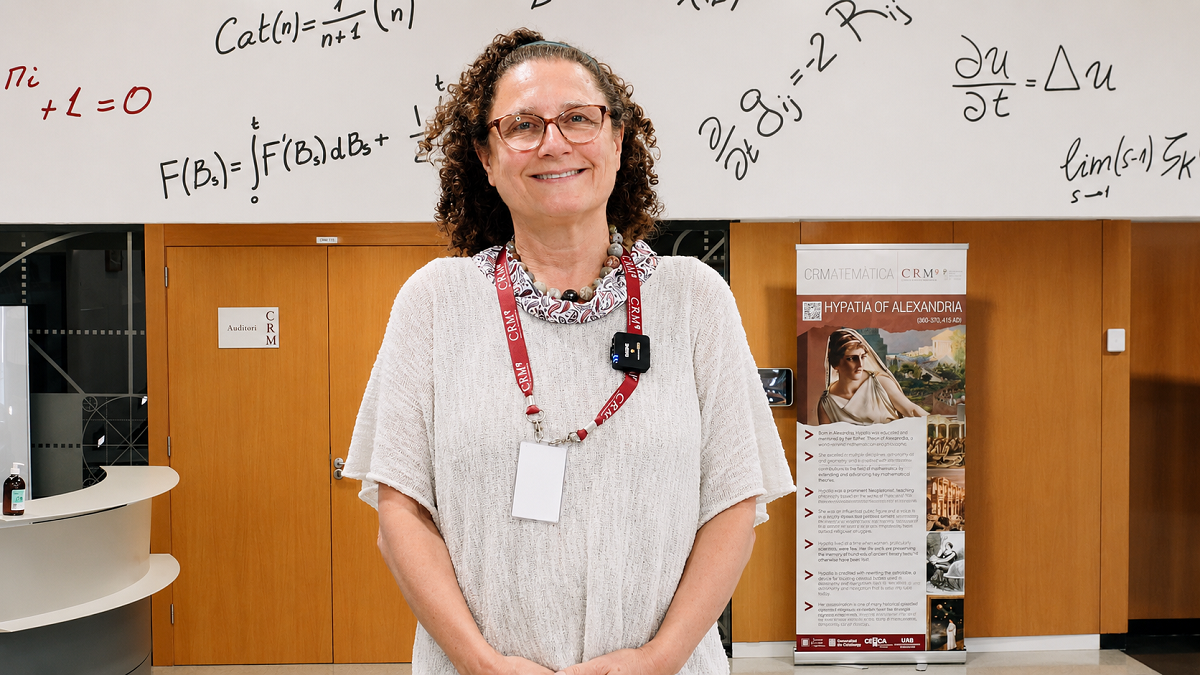
Susanna Terracini delivers the CRM Colloquium 2026
Susanna Terracini (Università di Torino) delivered the CRM Colloquium 2026 on 14 July, presenting a rigidity result for Kepler billiards obtained with Stefano Baranzini, Vivina Barutello and Irene De Blasi. She was at the centre as a member of the CRM Scientific...
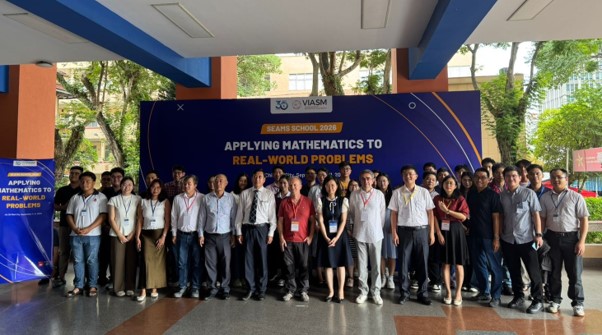
Ho Chi Minh City hosts the SEAMS School on applying mathematics to real-world problems
Students from across the region took courses and worked on group projects at a school co-organised by CRM researcher Tim Myers.CRM CommPau VarelaCRMComm@crm.catGet the latest CRM news and activities in your inbox.Recent newsletters →Between 4 and...

A single ball on a fixed table can compute: Eva Miranda and Isaac Ramos prove that two-dimensional billiards are Turing complete
Eva Miranda (UPC, CRM) and Isaac Ramos (ETH Zürich) show that a point particle bouncing inside a planar table with fixed walls can simulate a universal Turing machine, settling a question Cristopher Moore left open in 1990. The result grew out of a master’s project...
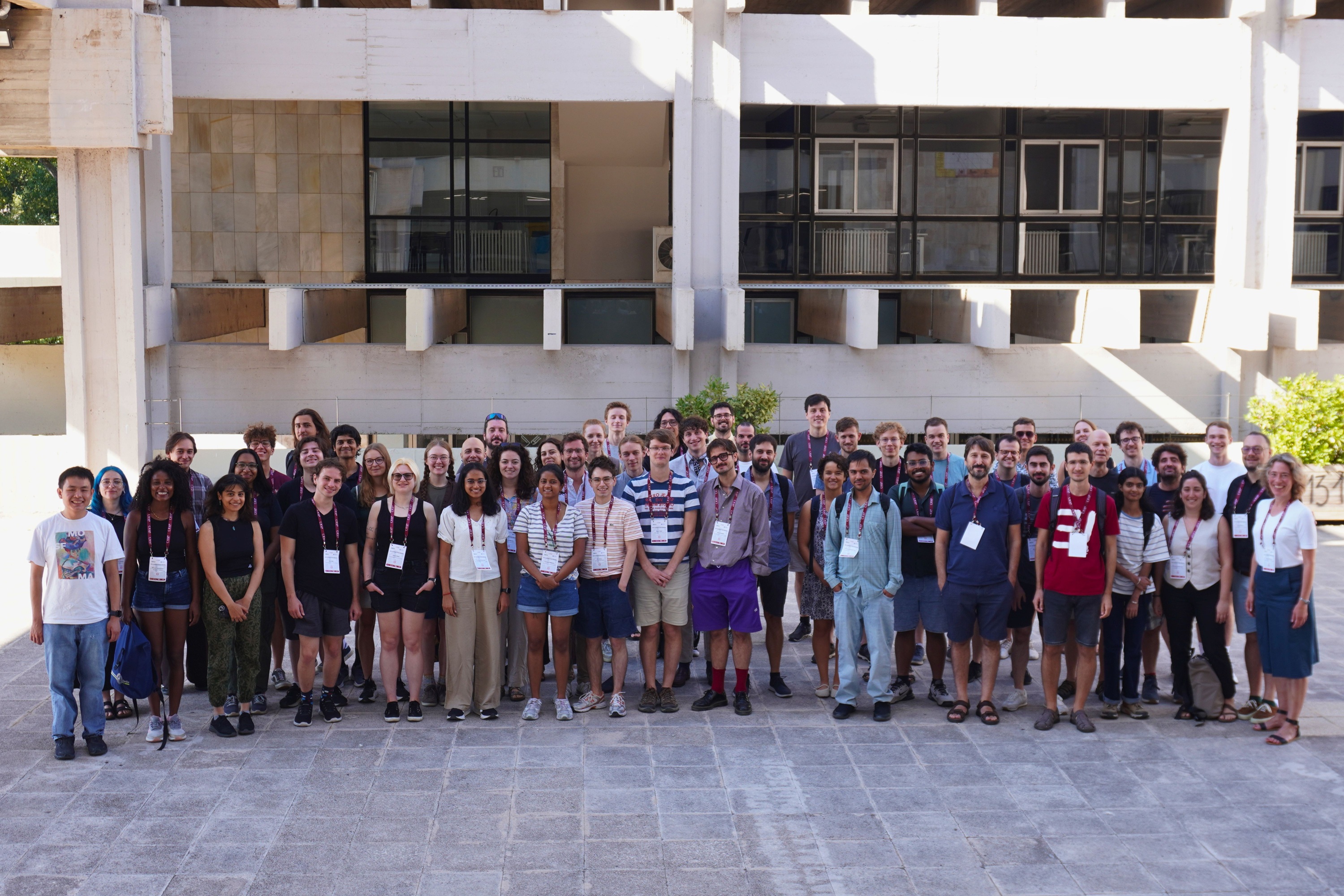
BMS-BGSMath Junior Meeting 2026: Barcelona and Berlin Strengthen Scientific Ties
From 2 to 4 September 2026, the Centre de Recerca Matemàtica (CRM) hosted the BMS-BGSMath Junior Meeting 2026, a three-day event jointly organised by the Berlin Mathematical School (BMS) and the Barcelona Graduate School of Mathematics (BGSMath), with the Centre de...
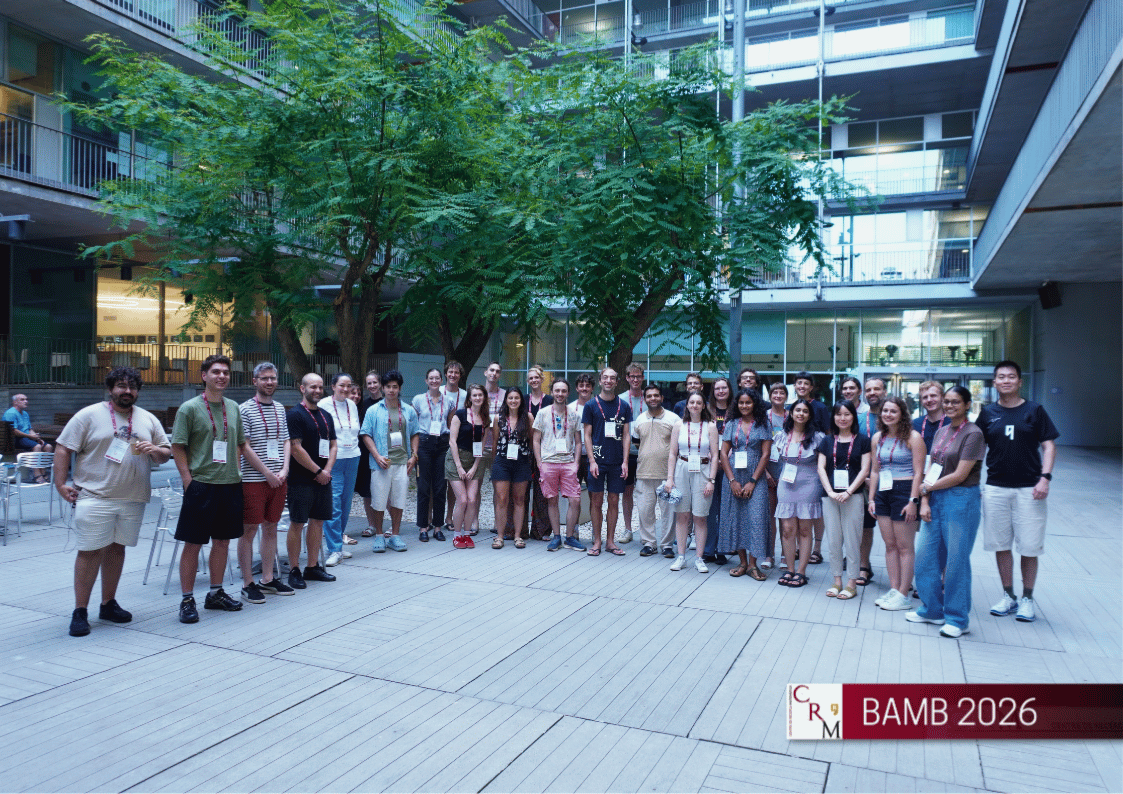
The CRM organises the 2026 Barcelona Summer School for Advanced Modeling of Behavior
The Centre de Recerca Matemàtica held the sixth edition of BAMB!, the Barcelona Summer School for Advanced Modeling of Behavior, from 12 to 23 July 2026 at the Parc de Recerca Biomèdica de Barcelona. Thirty early-career researchers from fourteen countries followed...