

Researcher Javier Gómez Serrano, a former member of the Centre de Recerca Matemàtica (CRM) from 2020 to 2022, and currently a professor at Brown University, is part of a new project at the intersection between mathematics and artificial intelligence. Together with mathematician Terence Tao, form the University of California, and a team at Google DeepMind, Gómez Serrano is helping to develop AlphaEvolve, a pioneering tool that explores a new way of doing mathematics. We had the opportunity to speak with him during the recent Conference on Modern Trends in Fourier Analysis at the CRM.
AlphaEvolve, publicly announced on May 14, 2025, is an evolutionary coding agent based on language models like Gemini. Its core idea is simple but powerful: generate multiple candidate solutions in code and evolve them iteratively through a process similar to natural selection. This method has already shown its potential by tackling major open problems, such as matrix multiplication or the kissing number problem in 11 dimensions. In this last case, AlphaEvolve discovered a configuration of 593 spheres tangent to a unit sphere, setting a new lower bound for this longstanding geometric challenge.
A new way to do mathematics?
Gómez Serrano first came into contact with DeepMind through a previous collaboration on the Navier–Stokes equations. “I had already been working with them on that topic, and at the end of January 2025 we started this new project,” he explains. For him, the emergence of tools like AlphaEvolve signals a turning point in mathematical research: “I believe the way we do mathematics is going to change, at least for part of the community. These kinds of models or assistants will become more widespread and will help us reach results that now take one or two years in just a few days.”
This acceleration also transforms the kind of questions mathematicians can ask: “We’ll be able to tackle harder problems, because we’ll have more powerful tools,” he says. But he also adds a note of caution: “We still don’t know the best way to interact with these models. The community is figuring out how to get the most insight with the least computational cost.”
Unlike systems like ChatGPT, AlphaEvolve does not operate through natural language. “We don’t talk to it with plain text,” Gómez Serrano explains. “We ask it to write code that tries to solve the problem, and that code then evolves and improves over time.”
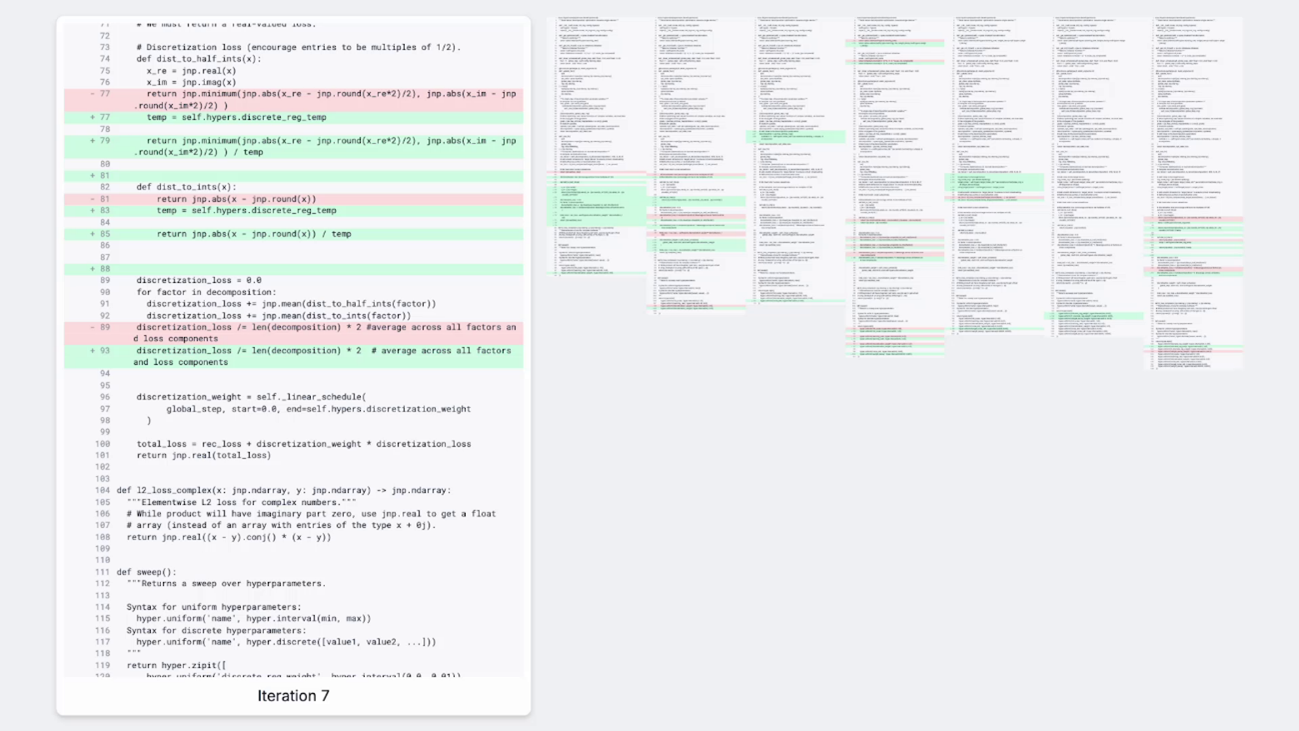
This raises new challenges, especially when it comes to extracting insight from the solutions. “When the model detects structure in a solution, how do we understand and translate that into mathematical intuition? That’s something we still don’t fully grasp.” As Terence Tao explained on Mastodon: “AlphaEvolve can attempt to extremize functions F(x) with x ranging over a high-dimensional parameter space, and can outperform traditional optimization algorithms when the function and space have non-obvious structure”.
When it comes to the role of AI in mathematics, Gómez Serrano is clear: it’s not a competition. “This isn’t about humans versus machines. The real value is in what humans and machines can do together. These tools allow us to go beyond our limits, not in competition, but in collaboration.”
As for the areas of mathematics most likely to be affected, he points to quantitative or concrete domains as natural early adopters. “It’s easier for a computer to handle numbers than to represent abstract concepts like groups. But with the speed these technologies are evolving, we don’t really know where the boundary will be.”
A message to young mathematicians
His advice to early-career mathematicians is simple: keep an open mind. “This landscape is evolving incredibly fast. The pace of results is no longer measured in years, but in months. Staying informed and open-minded is essential to understand how this new mathematical world will work.” He sees it not as a threat, but as an opportunity: “We’re starting from scratch in many ways. That gives us a chance to take the lead, not just in research, but in defining how mathematics is done in the future.”
New tools like AlphaEvolve are reshaping how we approach mathematical discovery. By combining human insight with AI-driven exploration, this project is opening new paths toward solving complex problems; faster, deeper, and with unexpected creativity.
The full interview with Javier is available on the CRM YouTube channel.
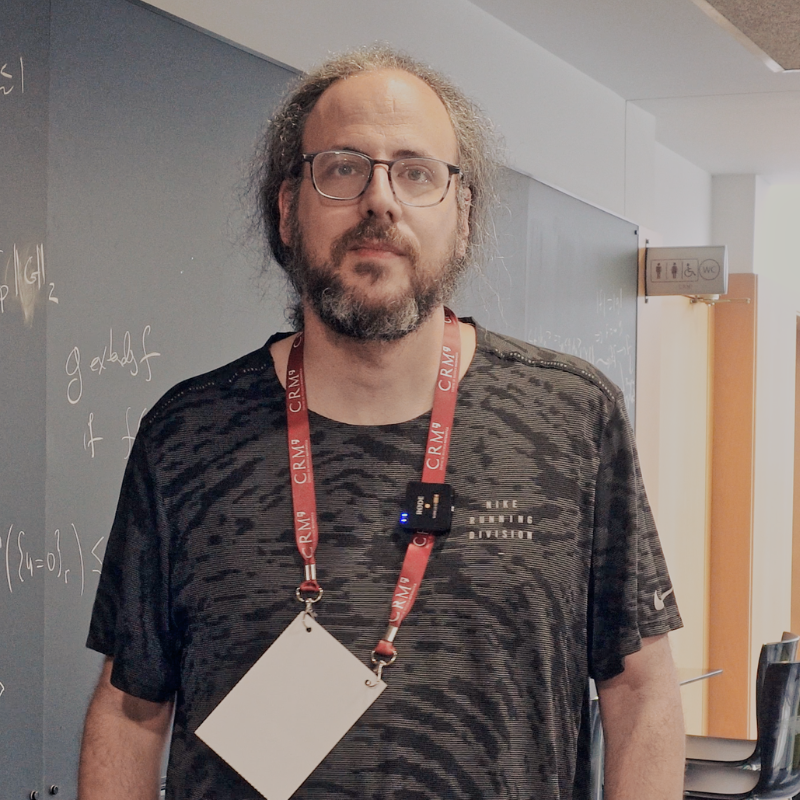
Javier Gómez Serrano is an Associate Professor at Brown University. He was previously a Distinguished Researcher at the University of Barcelona and held positions at Princeton University. From 2020 to 2022, he was an Affiliated Researcher at the Centre de Recerca Matemàtica (CRM).
His work sits at the crossroads of analysis, PDEs, fluid mechanics, spectral geometry, numerical computation, machine learning, and computer-assisted proofs.
Subscribe for more CRM News
|
|
CRM CommPau Varela
|

When the reward comes within reach, the brain changes what it compares
As the tokens piled up, choices got faster and more accurate at the same time. The yardstick for judging each offer had moved.CRM CommPau VarelaCRMComm@crm.catGet the latest CRM news and activities in your inbox.Recent newsletters →Two subjects...

Almost every automaton can be reset with a short word
Guillaume Chapuy (Université Paris Cité, CNRS) and Guillem Perarnau (UPC, CRM) have shown that a random finite automaton with n states can, with high probability, be reset by a word of length of order √n log n. The result, published in ACM Transactions on Algorithms, pins the exponent at 1/2, the lower end of a decade of numerical estimates, and addresses the random version of the synchronization problem behind a conjecture Ján Černý posed in 1964 and which still remains open.
Exposició ‘Les matemàtiques de Gaudí’

CRM quod erat demonstrandum | 48

ADA: Decoding Brain Signals Misaligned in Time
The study addresses a key limitation of current brain decoding techniques: the difficulty of interpreting internal mental processes whose temporal dynamics vary from trial to trial.Decoding what is happening in a person’s mind from their brain activity is one of the...
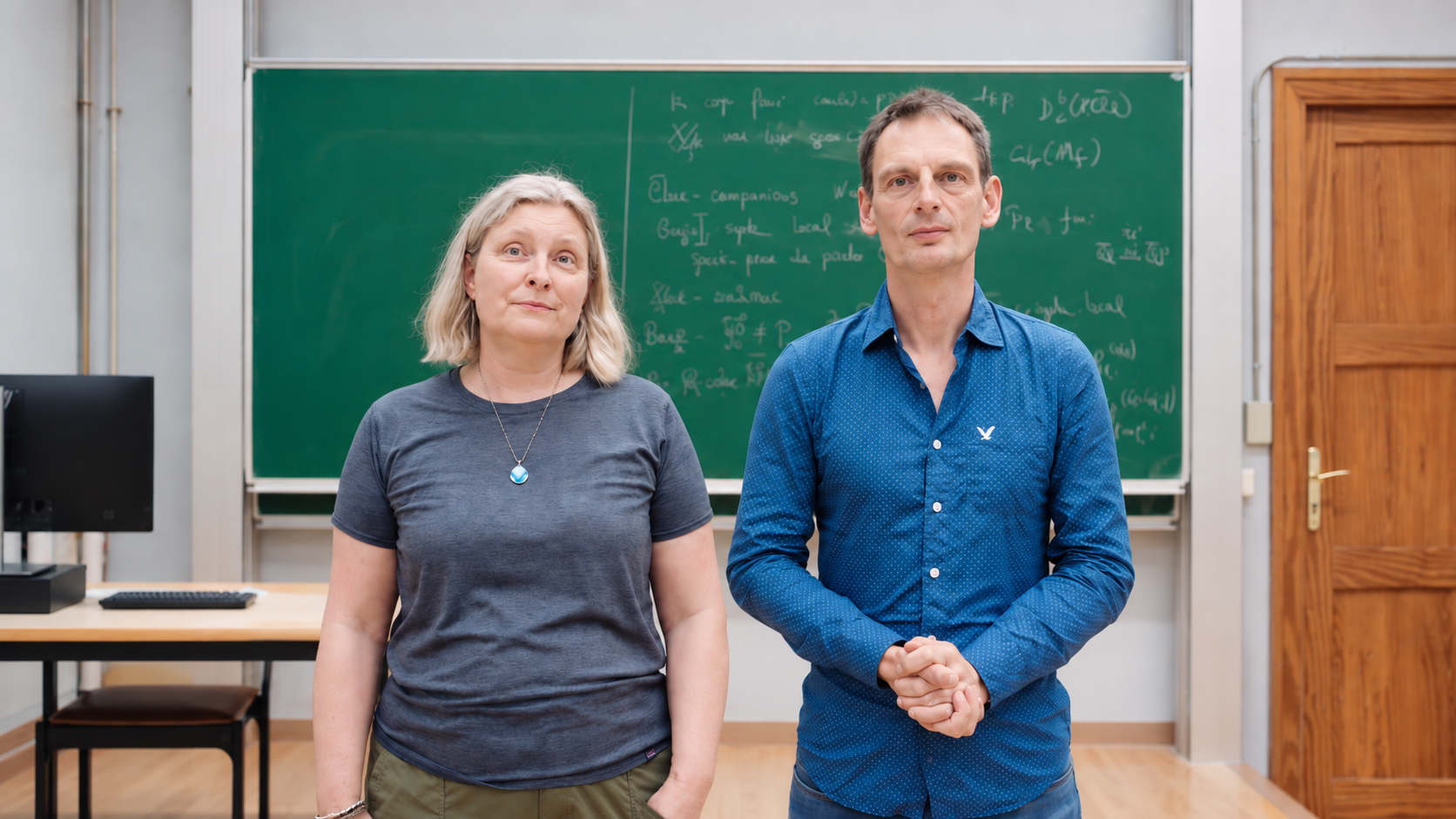
Rare curves, many points: Christophe Ritzenthaler and Rachel Pries on their research and the work around it
Christophe Ritzenthaler (Université de Rennes) and Rachel Pries (Colorado State University) both work on curves over finite fields: he hunts curves with as many points as possible, she hunts curves that almost never occur. In conversation with the CRM during their...

Call open for the 2027 Ferran Sunyer i Balaguer Prize
The Ferran Sunyer i Balaguer Foundation is accepting submissions for its 2027 prize, which awards 15,000 euros and publication in Birkhäuser's Progress in Mathematics series to an expository monograph on an active area of mathematical research. The deadline is 27...
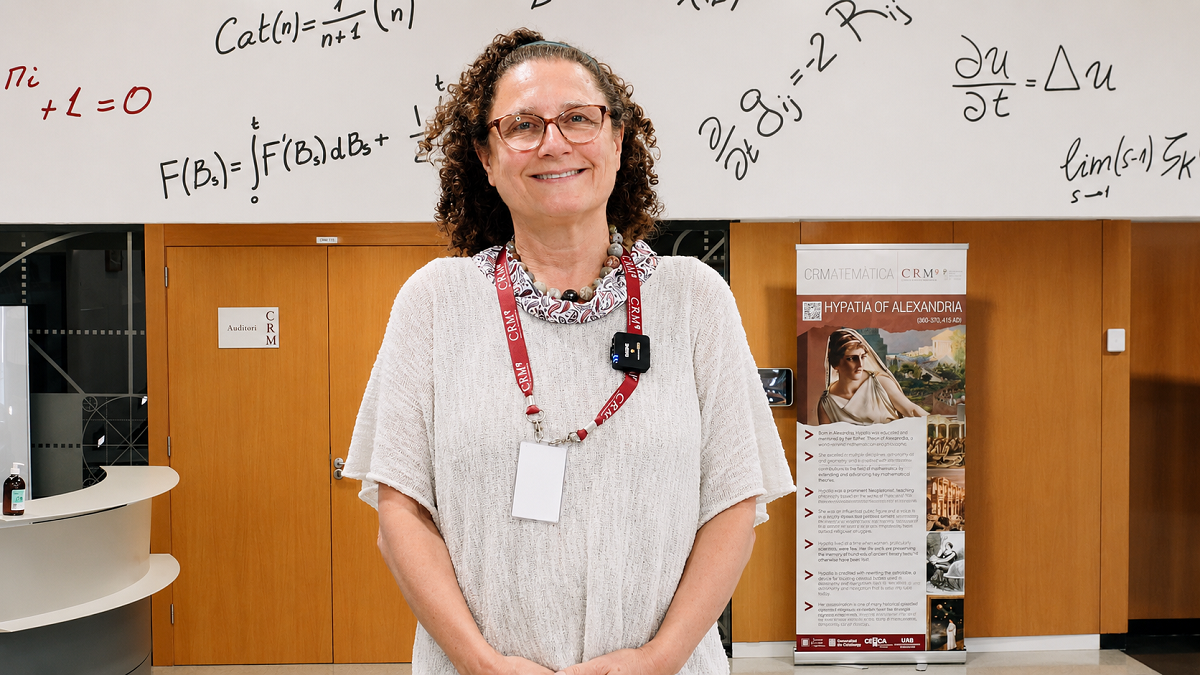
Susanna Terracini delivers the CRM Colloquium 2026
Susanna Terracini (Università di Torino) delivered the CRM Colloquium 2026 on 14 July, presenting a rigidity result for Kepler billiards obtained with Stefano Baranzini, Vivina Barutello and Irene De Blasi. She was at the centre as a member of the CRM Scientific...
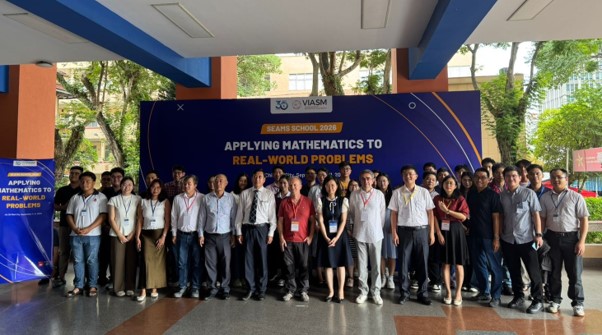
Ho Chi Minh City hosts the SEAMS School on applying mathematics to real-world problems
Students from across the region took courses and worked on group projects at a school co-organised by CRM researcher Tim Myers.CRM CommPau VarelaCRMComm@crm.catGet the latest CRM news and activities in your inbox.Recent newsletters →Between 4 and...

A single ball on a fixed table can compute: Eva Miranda and Isaac Ramos prove that two-dimensional billiards are Turing complete
Eva Miranda (UPC, CRM) and Isaac Ramos (ETH Zürich) show that a point particle bouncing inside a planar table with fixed walls can simulate a universal Turing machine, settling a question Cristopher Moore left open in 1990. The result grew out of a master’s project...
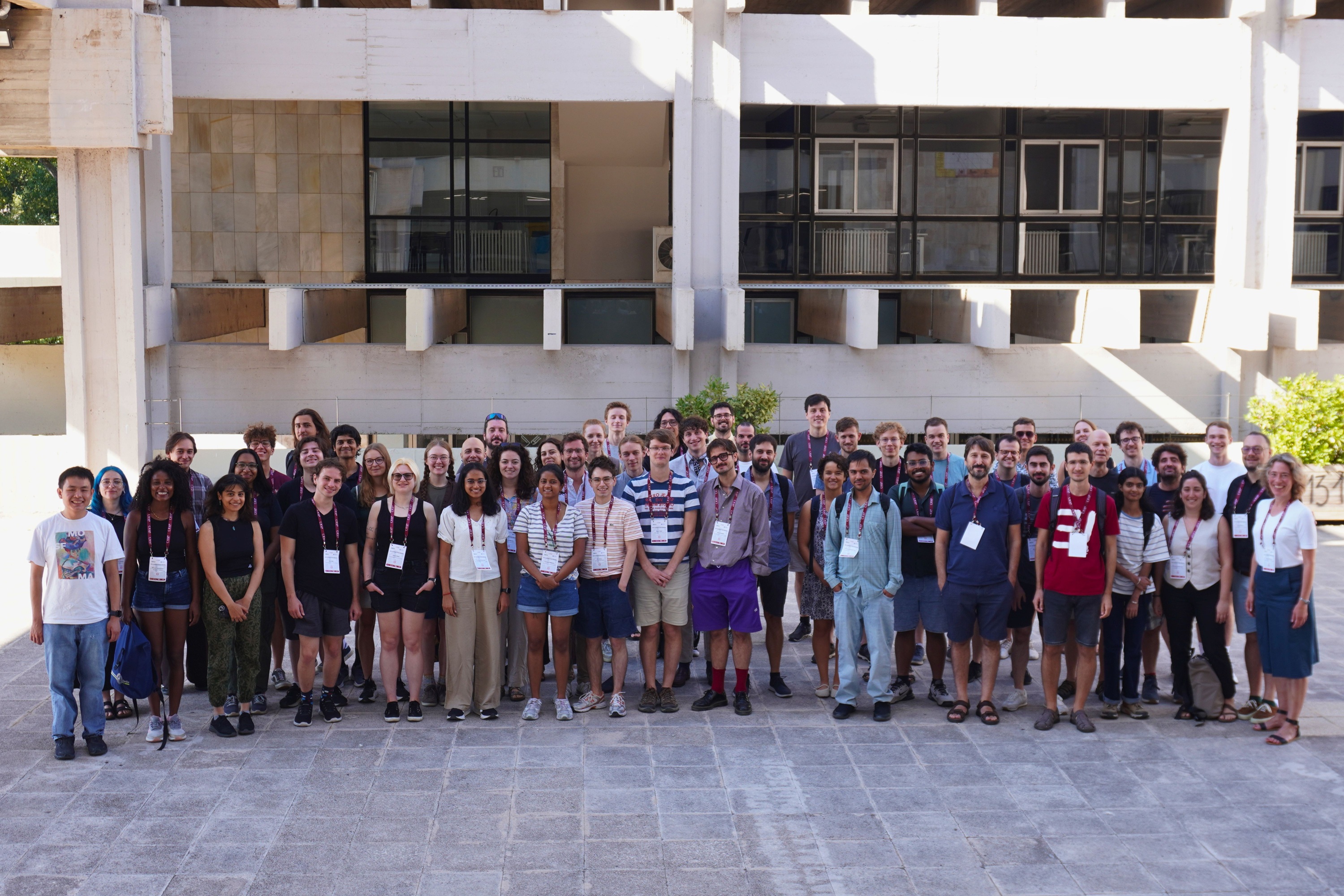
BMS-BGSMath Junior Meeting 2026: Barcelona and Berlin Strengthen Scientific Ties
From 2 to 4 September 2026, the Centre de Recerca Matemàtica (CRM) hosted the BMS-BGSMath Junior Meeting 2026, a three-day event jointly organised by the Berlin Mathematical School (BMS) and the Barcelona Graduate School of Mathematics (BGSMath), with the Centre de...
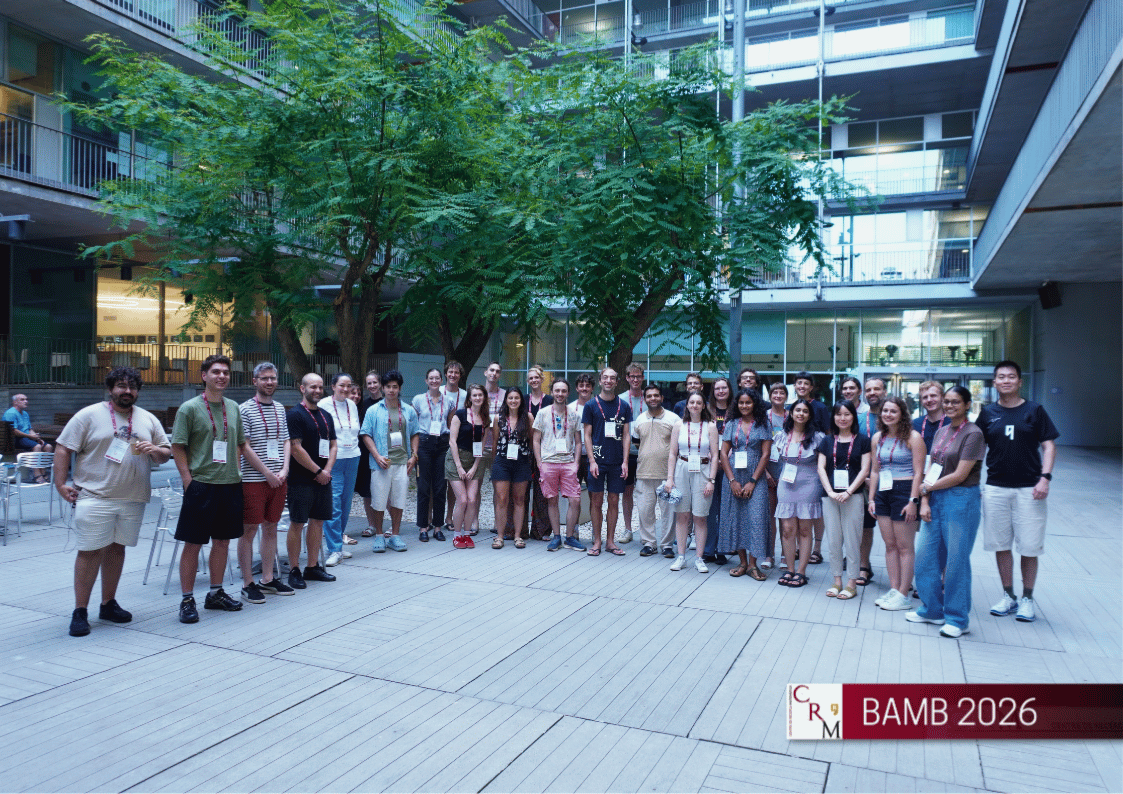
The CRM organises the 2026 Barcelona Summer School for Advanced Modeling of Behavior
The Centre de Recerca Matemàtica held the sixth edition of BAMB!, the Barcelona Summer School for Advanced Modeling of Behavior, from 12 to 23 July 2026 at the Parc de Recerca Biomèdica de Barcelona. Thirty early-career researchers from fourteen countries followed...