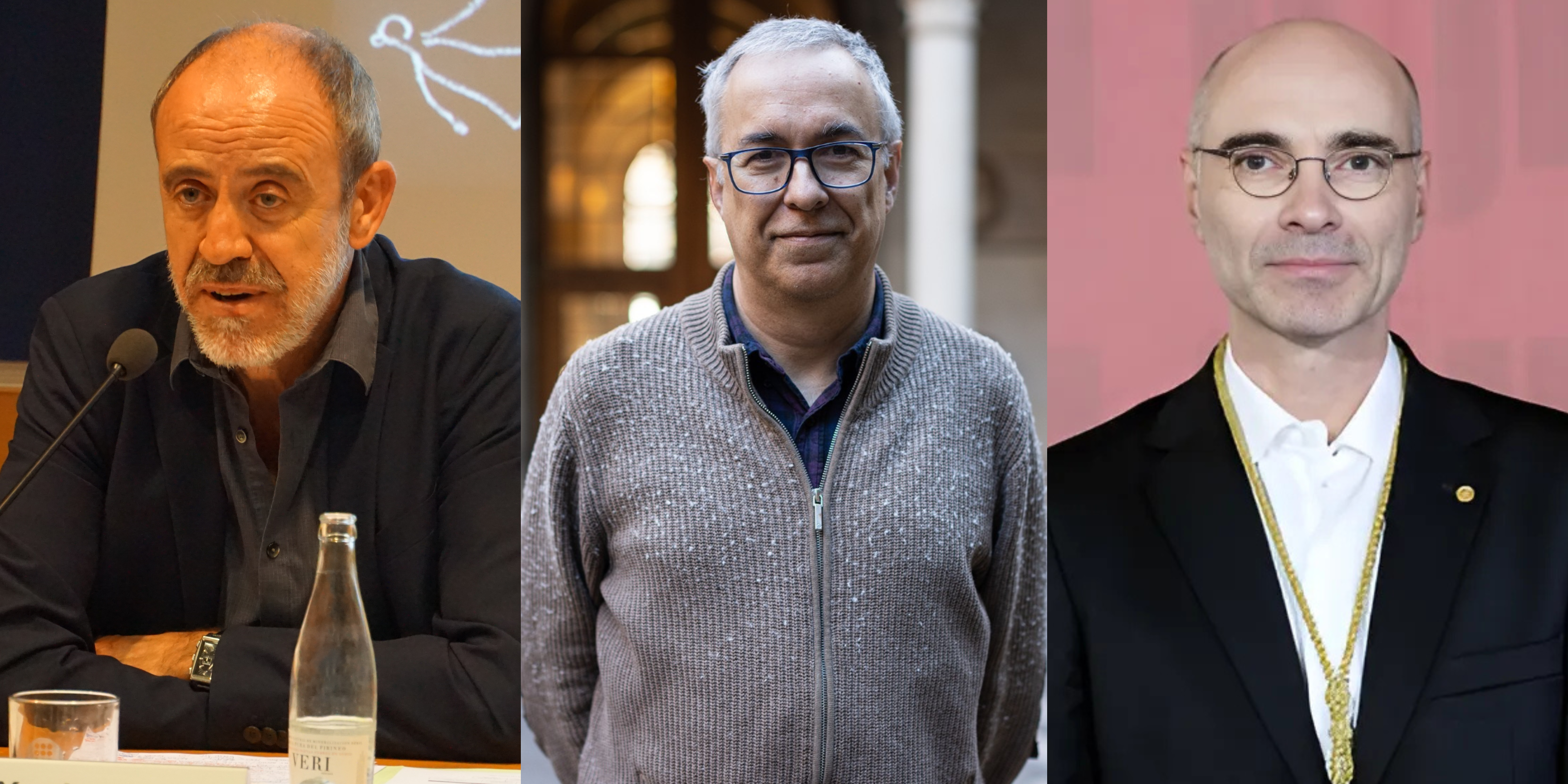
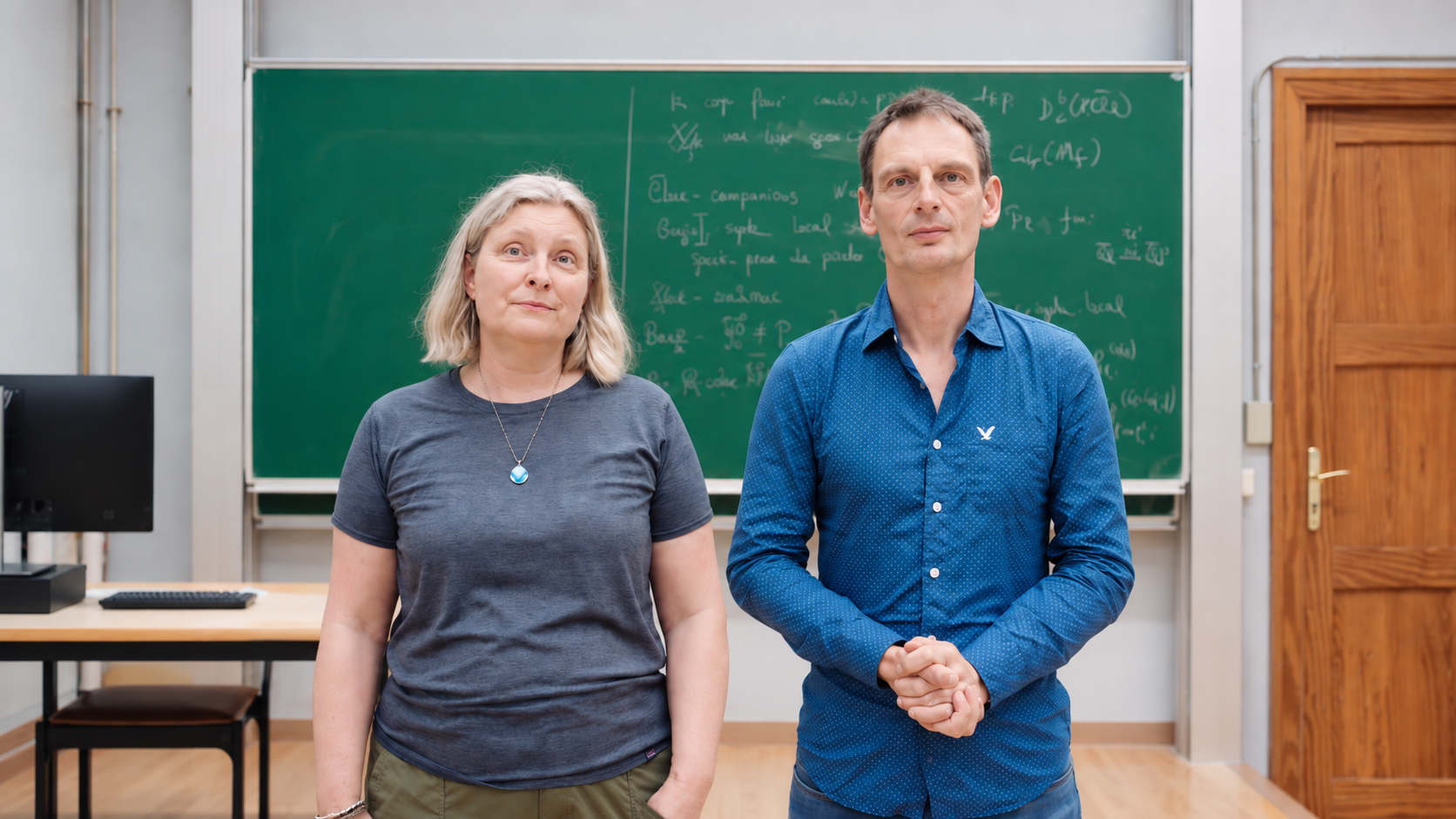
From left to right: Xavier Cabré, Joaquim Ortega (photo by Xènia Fuentes, UB), and Xavier Tolsa.
The International Congress of Mathematicians (ICM), to be held in Philadelphia in 2026, is the most prestigious event in the mathematical sciences. Being invited to speak at the ICM is one of the highest distinctions in the field. In this edition, three researchers affiliated with the Centre de Recerca Matemàtica (CRM) have been selected as invited speakers: Xavier Cabré, Joaquim Ortega-Cerdà, and Xavier Tolsa, who has been invited as a plenary speaker.
Xavier Cabré, Professor at the Universitat Politècnica de Catalunya and ICREA researcher affiliated with the CRM, will deliver a talk in the Partial Differential Equations section. His work in nonlinear PDEs has earned international recognition, particularly his contribution to solving a long-standing open problem posed by Haim Brezis.
“It’s an honour, of course,” Cabré explains. “Beyond my past contributions to PDEs, this invitation is especially meaningful to me, as I believe it’s connected to a paper I published in 2020 in Acta Mathematica, where I solved a problem posed by Haim Brezis that I had been working on since 1996, making progress through partial results until the final resolution in 2020.”
Reflecting on the broader impact, he adds: “This recognition highlights the progress made by the Catalan mathematical community in recent decades, especially since several Catalan researchers were invited to the ICM 2026. It also serves as motivation for young mathematicians here, who are already showing, as hoped and expected, a much higher level than my own generation.”
“This edition features more Catalan speakers than ever before. I believe it reflects the level of research we’ve reached as a community”
Joaquim Ortega-Cerdà, Professor at the University of Barcelona and member of the CRM, will speak in the Analysis section. His research in potential theory, function spaces, and interpolation problems has established deep connections between harmonic analysis, complex geometry, and spectral theory.
“It’s a great honour, and I feel truly flattered,” says Ortega. “I’ve never participated in an International Congress of Mathematicians, and I’m excited about this opportunity. Mathematics also has a strong social component; beyond the private joy of solving a problem, it’s always gratifying to receive recognition from your peers. I’m also looking forward to sharing some of the problems I’ve been working on recently and gaining a broad overview of the latest developments and trends in modern mathematics.”
On the presence of Catalan researchers at the event, he notes, “This edition features more Catalan speakers than ever before. I believe it reflects the level of research we’ve reached as a community and the international visibility that our predecessors worked so hard to build.”
Xavier Tolsa, ICREA Professor at the Universitat Autònoma de Barcelona and affiliated researcher at the CRM, has been selected as a plenary speaker, a recognition reserved for mathematicians whose work has had an extraordinary impact across the discipline. A recipient of the Rei Jaume I Prize and the Catalan National Research Award, Tolsa is widely recognised for his groundbreaking contributions to geometric measure theory and classical problems in analysis.
In addition, other mathematicians with ties to the Catalan community or the CRM will also be featured at the congress. David Asperó, a logician from Catalonia and professor at the University of East Anglia, has been invited to speak in the Logic and Foundations section. Afonso Bandeira, researcher at ETH Zurich and member of the CRM Scientific Advisory Board, will also give a talk in the Combinatorics and Optimization section.
The participation of these researchers highlights the strength and international standing of mathematical research carried out in Catalonia.
The full list of invited speakers is available at the following link: ICM 2026 Speakers.
Subscribe for more CRM News
|
|
CRM CommPau Varela
|
When the reward comes within reach, the brain changes what it compares
As the tokens piled up, choices got faster and more accurate at the same time. The yardstick for judging each offer had moved.CRM CommPau VarelaCRMComm@crm.catGet the latest CRM news and activities in your inbox.Recent newsletters →Two subjects...

Almost every automaton can be reset with a short word
Guillaume Chapuy (Université Paris Cité, CNRS) and Guillem Perarnau (UPC, CRM) have shown that a random finite automaton with n states can, with high probability, be reset by a word of length of order √n log n. The result, published in ACM Transactions on Algorithms, pins the exponent at 1/2, the lower end of a decade of numerical estimates, and addresses the random version of the synchronization problem behind a conjecture Ján Černý posed in 1964 and which still remains open.
Exposició ‘Les matemàtiques de Gaudí’
CRM quod erat demonstrandum | 48

ADA: Decoding Brain Signals Misaligned in Time
The study addresses a key limitation of current brain decoding techniques: the difficulty of interpreting internal mental processes whose temporal dynamics vary from trial to trial.Decoding what is happening in a person’s mind from their brain activity is one of the...
Rare curves, many points: Christophe Ritzenthaler and Rachel Pries on their research and the work around it
Christophe Ritzenthaler (Université de Rennes) and Rachel Pries (Colorado State University) both work on curves over finite fields: he hunts curves with as many points as possible, she hunts curves that almost never occur. In conversation with the CRM during their...

Call open for the 2027 Ferran Sunyer i Balaguer Prize
The Ferran Sunyer i Balaguer Foundation is accepting submissions for its 2027 prize, which awards 15,000 euros and publication in Birkhäuser's Progress in Mathematics series to an expository monograph on an active area of mathematical research. The deadline is 27...
Susanna Terracini delivers the CRM Colloquium 2026
Susanna Terracini (Università di Torino) delivered the CRM Colloquium 2026 on 14 July, presenting a rigidity result for Kepler billiards obtained with Stefano Baranzini, Vivina Barutello and Irene De Blasi. She was at the centre as a member of the CRM Scientific...
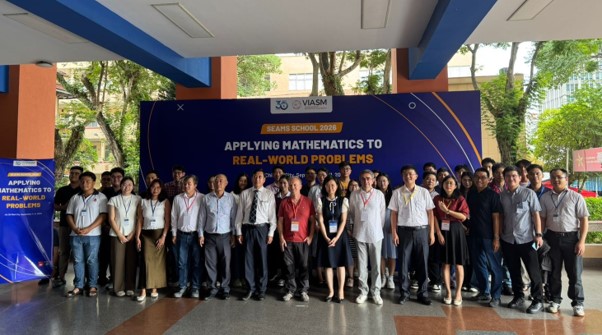
Ho Chi Minh City hosts the SEAMS School on applying mathematics to real-world problems
Students from across the region took courses and worked on group projects at a school co-organised by CRM researcher Tim Myers.CRM CommPau VarelaCRMComm@crm.catGet the latest CRM news and activities in your inbox.Recent newsletters →Between 4 and...

A single ball on a fixed table can compute: Eva Miranda and Isaac Ramos prove that two-dimensional billiards are Turing complete
Eva Miranda (UPC, CRM) and Isaac Ramos (ETH Zürich) show that a point particle bouncing inside a planar table with fixed walls can simulate a universal Turing machine, settling a question Cristopher Moore left open in 1990. The result grew out of a master’s project...
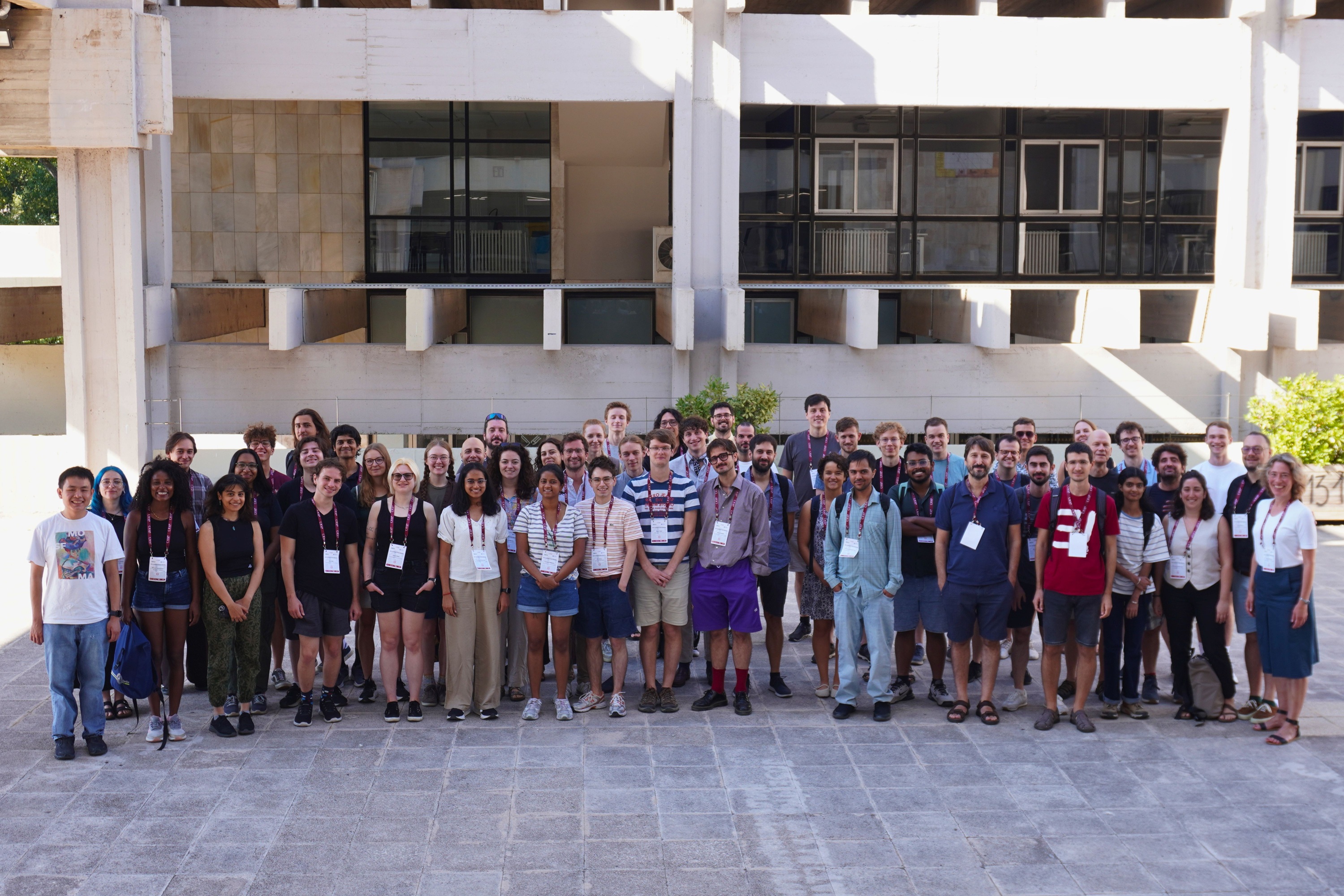
BMS-BGSMath Junior Meeting 2026: Barcelona and Berlin Strengthen Scientific Ties
From 2 to 4 September 2026, the Centre de Recerca Matemàtica (CRM) hosted the BMS-BGSMath Junior Meeting 2026, a three-day event jointly organised by the Berlin Mathematical School (BMS) and the Barcelona Graduate School of Mathematics (BGSMath), with the Centre de...
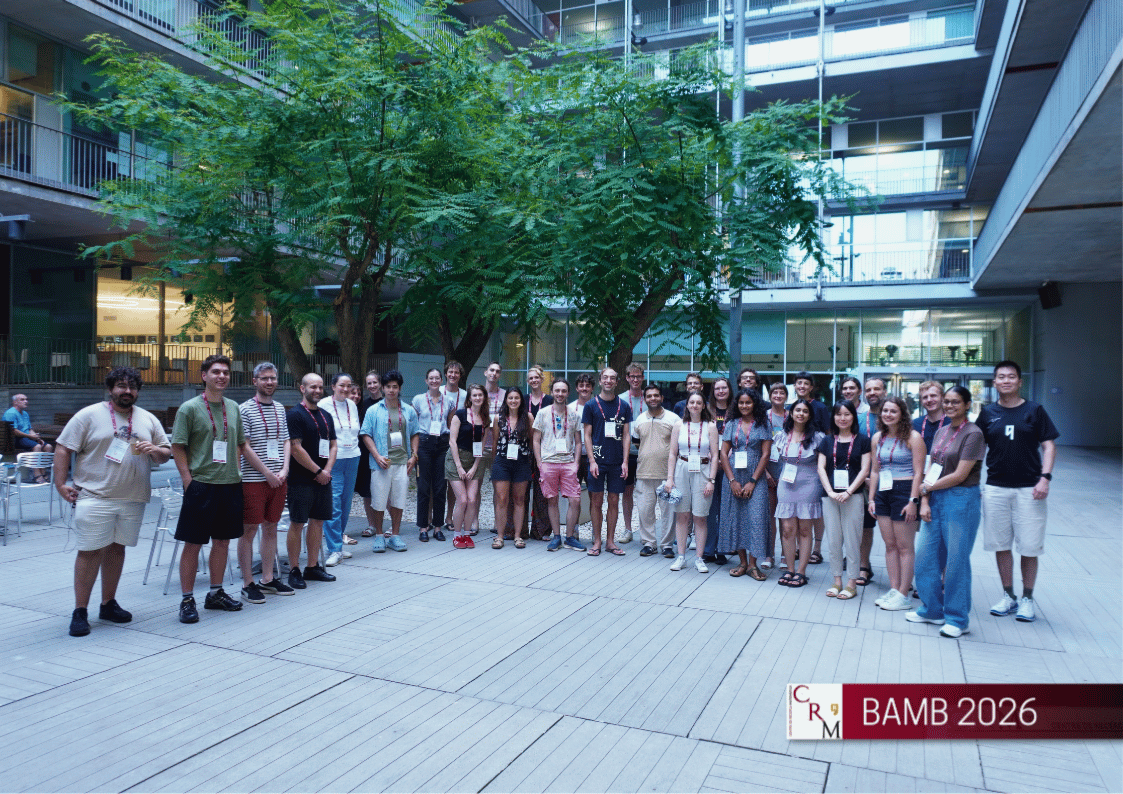
The CRM organises the 2026 Barcelona Summer School for Advanced Modeling of Behavior
The Centre de Recerca Matemàtica held the sixth edition of BAMB!, the Barcelona Summer School for Advanced Modeling of Behavior, from 12 to 23 July 2026 at the Parc de Recerca Biomèdica de Barcelona. Thirty early-career researchers from fourteen countries followed...