The CRM participates in the MSCA-COFUND TOUCH Project
- The MSCA-COFUND TOUCH project, spearheaded by the Universitat Autònoma de Barcelona (UAB), has been funded under the prestigious Marie Skłodowska-Curie Actions (MSCA) and the Horizon Europe program. The CRM will participate as an implementing partner.
- Among the PhDs projects being offered to potential students, three will be supervised or co-supervised by Klaus Wimmer and Alexandre Hyafil, principal investigators of the Neuroscience research group.
- The COFUND program stimulates regional, national, or international programs through co-financing mechanisms. It promotes the training, mobility, and career development of researchers.
The MSCA-COFUND TOUCH (Towards the next generation of excellent young doctoral researchers on mental health by developing an intersectoral & transdisciplinary approach) aims to advance mental health research by integrating various disciplines and sectors. The project’s primary goal is to recruit and train 24 doctoral candidates over three years. These candidates will explore the complexities of mental health and well-being through a rigorous and holistic training program that includes international collaborations and research stays at various partner institutions.
The project will investigate mental health across different life stages, examine a wide range of factors—including biological, psychological, and social determinants—develop and test new methods for assessing and addressing mental health issues, and explore the policies and frameworks governing mental health services and their implementation. In total, 7 implementing partners and 26 associated partners will collaborate under the coordination of UAB.
With a highly multidisciplinary and transversal vision, the TOUCH project includes participation from various affiliated institutions: Centre for Demographic Studies, Centre de Recerca Matemàtica, Computer Vision Center, Health and Ageing Foundation, Parc Taulí Research and Innovation Institute, Hospital de la Santa Creu i Sant Pau Research Institute, and Vall d’Hebron Research Institute. Additionally, the project is supported by the CORE network in mental health and other national and international institutions. Of the 24 predoctoral positions, 12 will be for UAB researchers, and 12 will be distributed among consortium institutions.
Contributors from the CRM Neuroscience Group
The Centre de Recerca Matemàtica (CRM) is an implementing partner in the TOUCH project. Of the PhD projects being offered to potential candidates, three will be supervised or co-supervised by Klaus Wimmer and Alexandre Hyafil, principal investigators of the Neuroscience research group.

The research project supervised by Klaus Wimmer will investigate how ageing affects brain networks related to working memory using computational modelling and experimental data analysis. Despite evidence showing cognitive decline with age, particularly in working memory, a cohesive theoretical framework explaining the interaction of age-related neuronal changes is lacking. The project aims to develop a neural network model to understand these changes, using data from 40 rhesus monkeys to explore how ageing impacts neuronal communication and working memory circuits.
Alexandre Hyafil is a co-supervisor in two projects offered to potential candidates. The first identifies computational markers for belief propagation in perception and their dysregulation in psychosis, using tasks and EEG/MEG data to model participant behaviour and correlate markers with psychosis traits. The second investigates the Sense of Agency (SoA) in psychosis, developing motor tasks and computational models, and using mobile-based studies to understand psychosis mechanisms and create new diagnostic tools. Both projects will be co-supervised with Neus Vidal, from the Department of Clinical and Health Psychology at UAB.
The MSCA-COFUND TOUCH project represents a substantial collaborative effort to make contributions to our understanding and treatment of mental health disorders, establishing a long-term partnership within the Research Network in Mental Health, part of the CORE (Communities Oriented to Strategic Challenges) initiative by the Universitat Autònoma de Barcelona. Through innovative research and comprehensive training of young researchers, TOUCH aims to pave the way for new diagnostic and therapeutic strategies, ultimately improving the lives of individuals affected by mental health issues.
The call for candidates to join the TOUCH project is currently open, applications will close on June 30th. For more information about the TOUCH project and its various components, you can visit the TOUCH project page.
Subscribe for more CRM News
|
|
CRM CommPau Varela & Mariona Fucho
|
Jagged walls and unknown edges: a workshop on free boundary problems
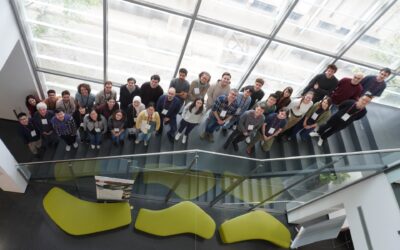
From 2 to 6 November, the Workshop on Free Boundary Problems brought together more than fifty registered participants from institutions in eleven countries at the CRM. Over five days they heard 21 talks on elliptic and parabolic free boundaries and on geometric measure theory and harmonic analysis in rough domains, with speakers including Guy David, Svitlana Mayboroda, Susanna Terracini and Robin Neumayer. The workshop was the second intensive week of the Intensive Research Programme on Analysis of Free Boundary Problems, which continues at the CRM until 4 December.
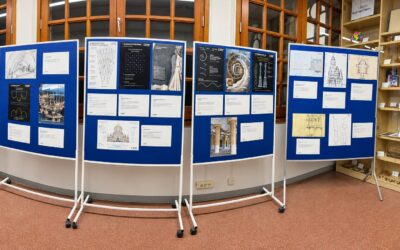
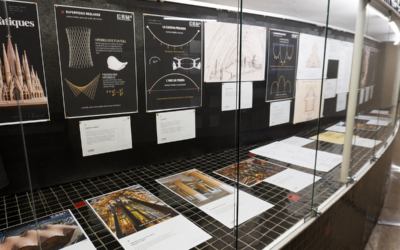
The CRM exhibition ‘Les matemàtiques de Gaudí’ moves to the University of Barcelona
After its October run at the UAB, the exhibition Les matemàtiques de Gaudí, produced by the CRM, can be seen at the University of Barcelona’s CRAI Biblioteca de Matemàtiques i Informàtica from 2 to 30 November 2026.
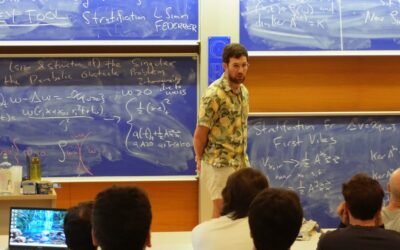
Advanced Course on Free Boundary Problems Opens the Intensive Weeks of the IRP
From 26 to 30 October, around forty researchers attended the Advanced Course on Free Boundary Problems at the CRM, three seven-hour mini-courses given by Bozhidar Velichkov (Università di Pisa), Max Engelstein (University of Minnesota) and Zihui Zhao (Johns Hopkins University). The course was the first of the two intensive weeks of the Intensive Research Programme on Analysis of Free Boundary Problems, which runs until 4 December.
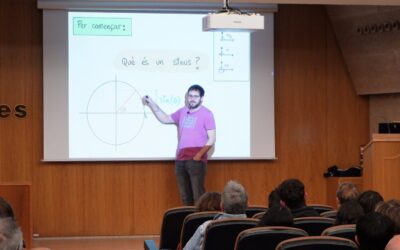
El CRM rep els estudiants de la prova de nivell de Bojos per les Matemàtiques 2027
Els aspirants a Bojos per les Matemàtiques 2027 van visitar el Centre de Recerca Matemàtica (CRM) dissabte 24 d’octubre, després de fer la prova de nivell a la Facultat de Ciències i Biociències de la UAB. En acabat, Tomás Sanz (UB-CRM) els va explicar què té a veure l’escalfament d’una barra de ferro amb els àudios de WhatsApp.
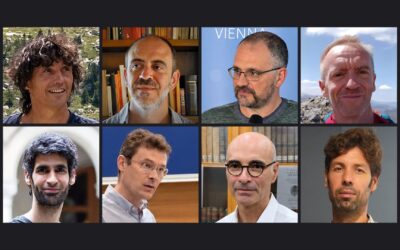
Eight CRM Researchers in the 2026 Stanford-Elsevier List of Highly Cited Scientists
The Centre de Recerca Matemàtica (CRM) has eight researchers in the 2026 update of the Stanford-Elsevier ranking of highly cited scientists, which John P. A. Ioannidis (Stanford University) and Jeroen Baas (Elsevier) compile from Scopus data. Xavier Cabré, Álvaro Corral, Tim Myers, Xavier Ros-Oton, Sergey Tikhonov and Xavier Tolsa appear both in the career-long ranking and in the one for 2025, and Diego Vidaurre and Simeon Ball in the 2025 ranking.
Fish schools and growing tissues: a workshop on how collective behaviour emerges
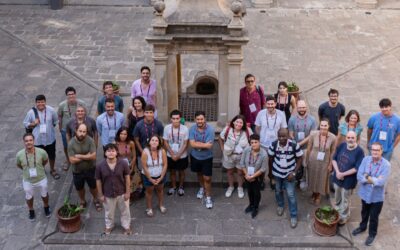
The Centre de Recerca Matemàtica (CRM) organised the Barcelona Workshop on Kinetic and Macroscopic Models in Biology with Friends II, held from 7 to 10 September at the Institut d’Estudis Catalans. More than thirty researchers discussed how order at the scale of tissues and animal groups arises from local interactions between individuals, in a programme that included talks by CRM researchers Daria Stepanova and Juan Arellano-Tintó. Two of the speakers, James Sharpe (EMBL Barcelona) and Chiara Villa (CNRS, Université Paris Cité), talked to the CRM about their research.
The CRM opens the academic year and unveils its Directors’ Gallery
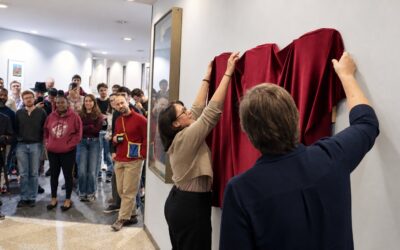
A review of the year, the Communication Plan 2026–2030 and three research talks filled the morning of 19 October.The unveiling of the Directors’ Gallery.CRM CommPau VarelaCRMComm@crm.catGet the latest CRM news and activities in your inbox.Recent...
The CRM Mentoring Programme, as Told by One of Its Pairs
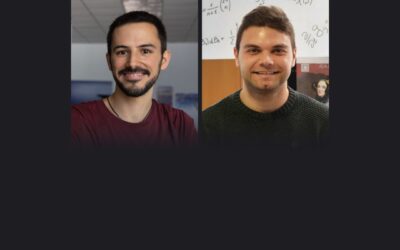
PhD student Joaquim Duran and mathematician Robert Cardona, one of the pairs in the CRM Mentoring ProgrammeJoaquim Duran (left) and Robert Cardona.CRM CommPau VarelaCRMComm@crm.catGet the latest CRM news and activities in your inbox.Recent...
When the reward comes within reach, the brain changes what it compares
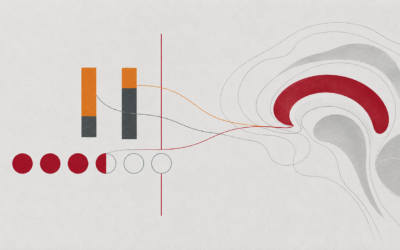
As the tokens piled up, choices got faster and more accurate at the same time. The yardstick for judging each offer had moved.CRM CommPau VarelaCRMComm@crm.catGet the latest CRM news and activities in your inbox.Recent newsletters →Two subjects...

Almost every automaton can be reset with a short word
Guillaume Chapuy (Université Paris Cité, CNRS) and Guillem Perarnau (UPC, CRM) have shown that a random finite automaton with n states can, with high probability, be reset by a word of length of order √n log n. The result, published in ACM Transactions on Algorithms, pins the exponent at 1/2, the lower end of a decade of numerical estimates, and addresses the random version of the synchronization problem behind a conjecture Ján Černý posed in 1964 and which still remains open.
Exposició ‘Les matemàtiques de Gaudí’