
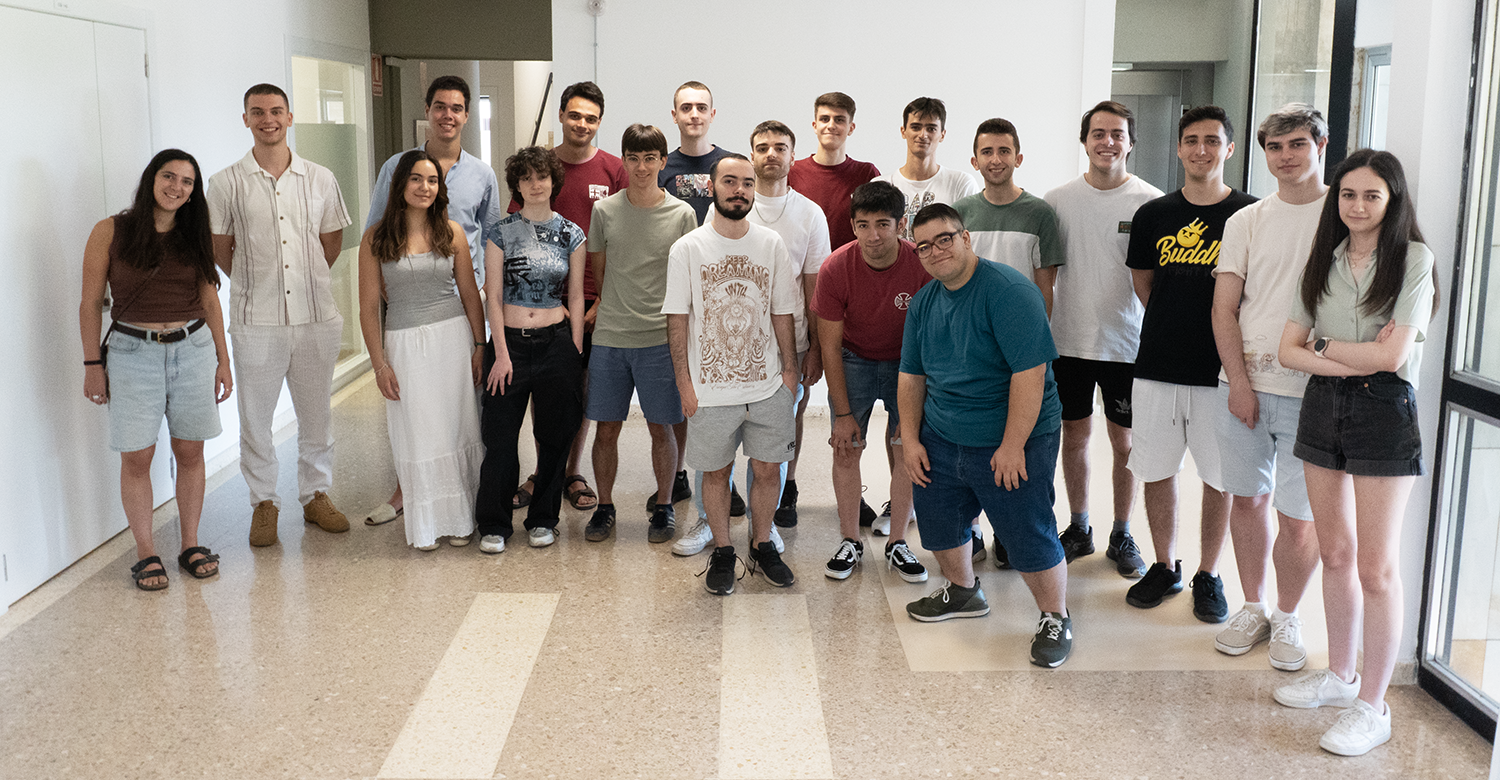
From June 30 to July 25, 2025, the CRM is organising a new edition of the Barcelona Introduction to Mathematical Research (BIMR), a summer school hosted at the Universitat Autònoma de Barcelona. The programme brings together 30 undergraduate mathematics students to explore research through hands-on projects, introductory minicourses, and mentoring activities. With over 20 research topics offered, ranging from analysis and dynamical systems to geometry, cryptography, and mathematical modelling, BIMR provides early exposure to the research environment in an engaging and collaborative setting.
From June 30 to July 25, the Universitat Autònoma de Barcelona is hosting a new edition of the BIMR 2025 – Barcelona Introduction to Mathematical Research summer school. This initiative is promoted by the BGSMath, the CRM’s training unit. The programme offers 30 undergraduate mathematics students the opportunity to engage with mathematical research for the first time, working side by side with active researchers.
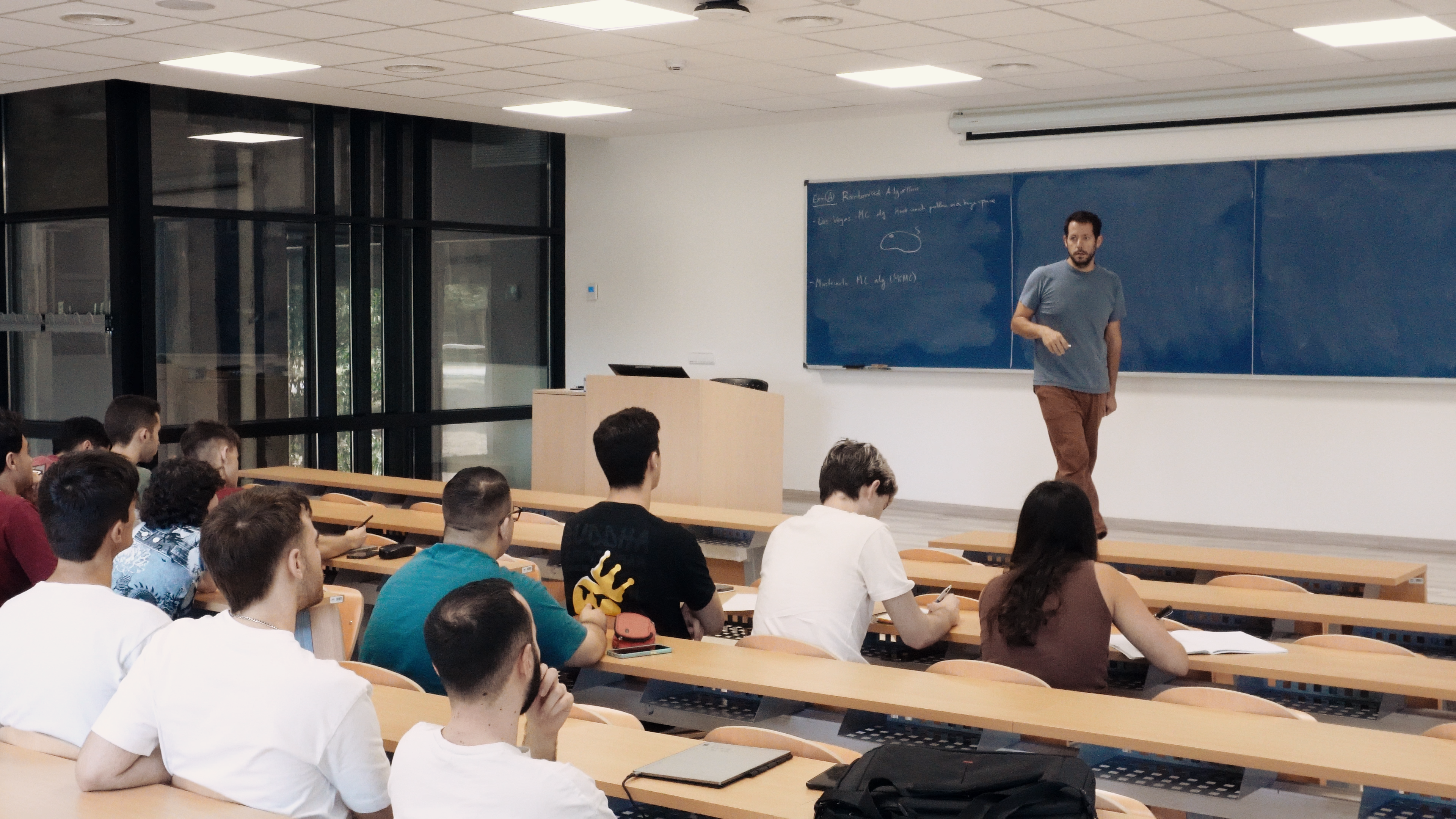
At the heart of BIMR are the research projects, assigned according to the preferences of both students and supervisors. This year’s edition features over 20 projects across a wide range of fields, including analysis, PDEs, dynamical systems, algebra, geometry, cryptography and mathematical modelling. Participants will work on topics such as Gamma-convergence, braid theory, Hausdorff measures, optimal control systems, Baker domains, and chaotic dynamical systems applied to cryptography.
Four minicourses to open the doors to research
During the first two weeks, students attend four introductory minicourses, designed to provide an accessible yet rigorous view of cutting-edge topics in mathematics:
Introduction to Stallings automata and the geometry of subgroups of free groups, taught by Enric Ventura and Jordi Delgado (UPC), explores a geometric and algorithmic approach to studying subgroups of free groups. Using intuitive graphical representations and avoiding overly formal language, the course covers key results such as the Nielsen–Schreier theorem, the Schreier index formula, and the Hanna–Neumann inequality.
Markov chains, mixing times and applications, with Guillem Perarnau (UPC – CRM), offers an introduction to discrete Markov chains with a special focus on the concept of mixing time. The course combines spectral theory with classical examples (such as random walks on graphs) and explores applications in statistical physics and theoretical computer science.
Singular integrals, Hausdorff measures and capacities, taught by Laura Prat (UAB), introduces fundamental tools in harmonic analysis and geometric measure theory. The course covers Calderón-Zygmund integrals, Hausdorff measures applied to fractal sets, and various notions of capacity with applications in the study of removable sets and partial differential equations.
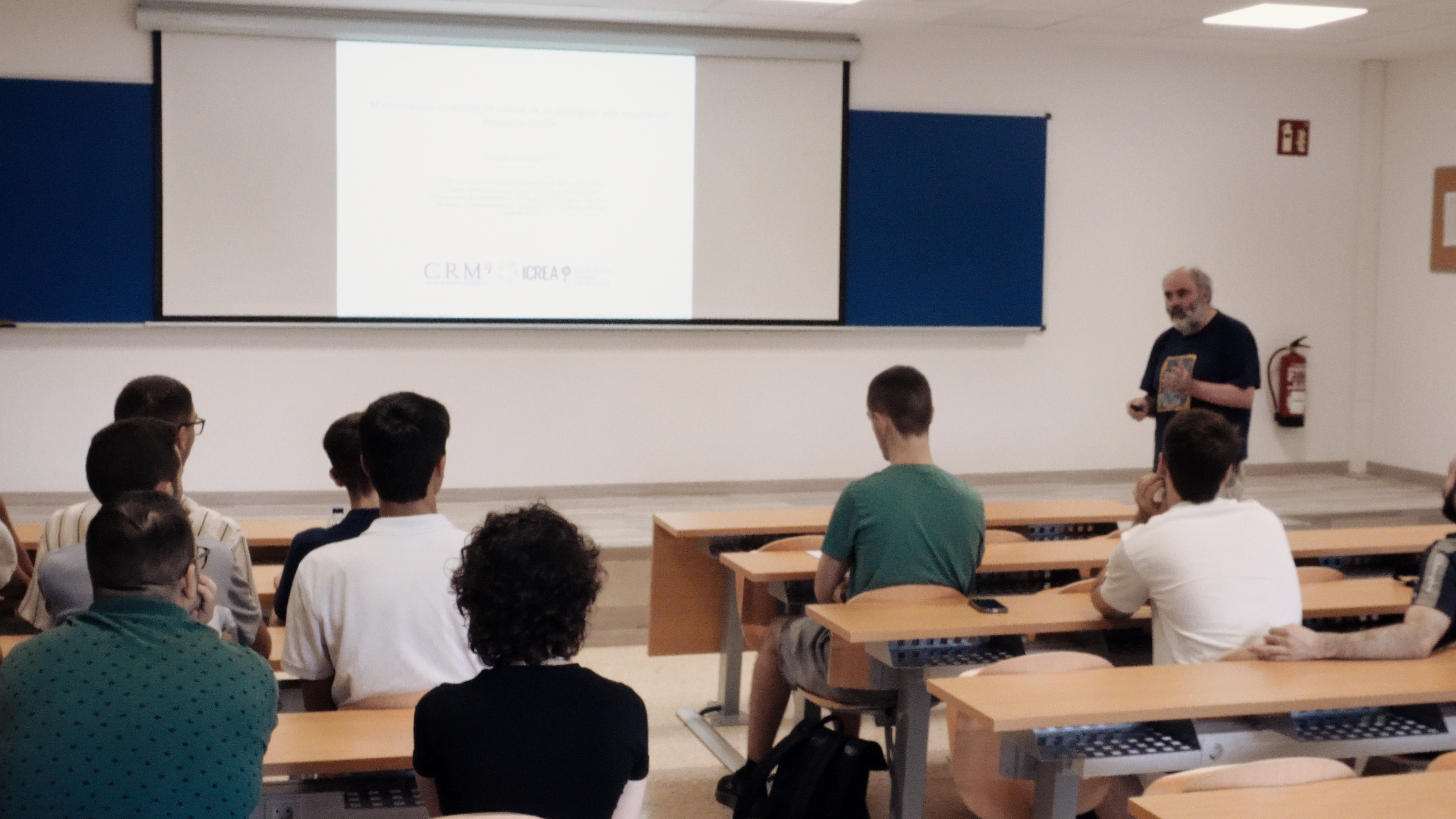
Mathematical modelling of cancer as an ecological and population dynamics system, with Tomás Alarcón (CRM), presents an innovative perspective on cancer biology through the lens of mathematics. The course shows how ecological tools and dynamical systems theory can help understand tumour behaviour as evolving ecosystems.
Beyond mathematics
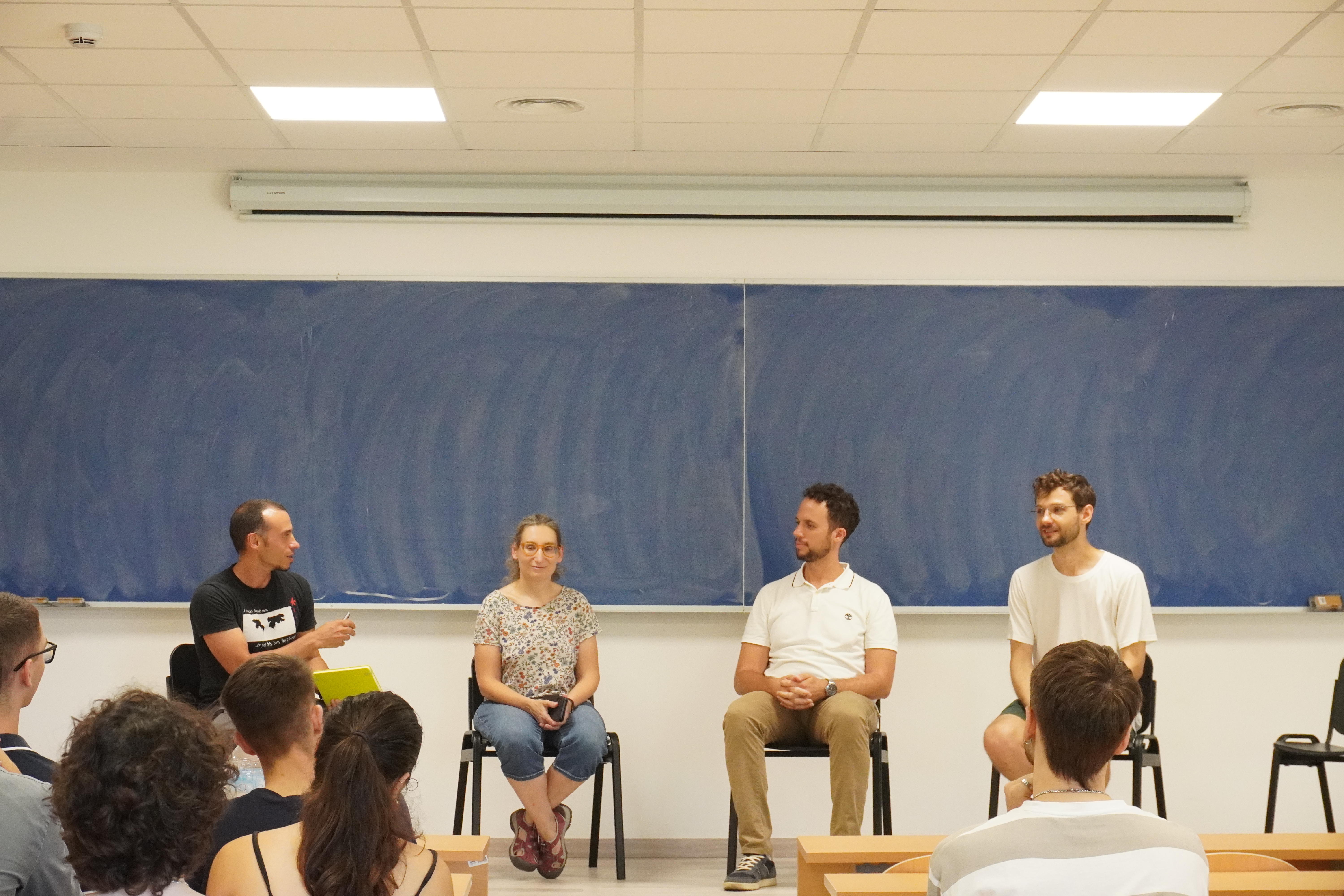
In addition to the academic programme, BIMR 2025 includes social and mentoring activities, such as a round table on academic careers, a public outreach talk, and weekly informal gatherings. For students living outside the metropolitan area of Barcelona, the CRM offers accommodation fellowships throughout July.
With this programme, BIMR aims to bring the research experience closer to a new generation of mathematicians and help spark scientific vocations early in their careers.
The programme is organised by Natàlia Castellana (Universitat Autònoma de Barcelona, CRM), Marc Masdéu (Universitat Autònoma de Barcelona, CRM), Xavier Ros-Oton (Universitat de Barcelona, ICREA, CRM) and Olli Saari (Universitat Politècnica de Catalunya, CRM), with the support of the BGSMath network.
Subscribe for more CRM News
|
|
CRM CommPau Varela
|

When the reward comes within reach, the brain changes what it compares
As the tokens piled up, choices got faster and more accurate at the same time. The yardstick for judging each offer had moved.CRM CommPau VarelaCRMComm@crm.catGet the latest CRM news and activities in your inbox.Recent newsletters →Two subjects...

Almost every automaton can be reset with a short word
Guillaume Chapuy (Université Paris Cité, CNRS) and Guillem Perarnau (UPC, CRM) have shown that a random finite automaton with n states can, with high probability, be reset by a word of length of order √n log n. The result, published in ACM Transactions on Algorithms, pins the exponent at 1/2, the lower end of a decade of numerical estimates, and addresses the random version of the synchronization problem behind a conjecture Ján Černý posed in 1964 and which still remains open.
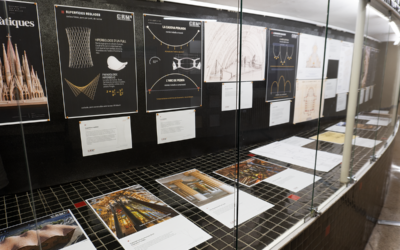
Exposició ‘Les matemàtiques de Gaudí’

CRM quod erat demonstrandum | 48

ADA: Decoding Brain Signals Misaligned in Time
The study addresses a key limitation of current brain decoding techniques: the difficulty of interpreting internal mental processes whose temporal dynamics vary from trial to trial.Decoding what is happening in a person’s mind from their brain activity is one of the...
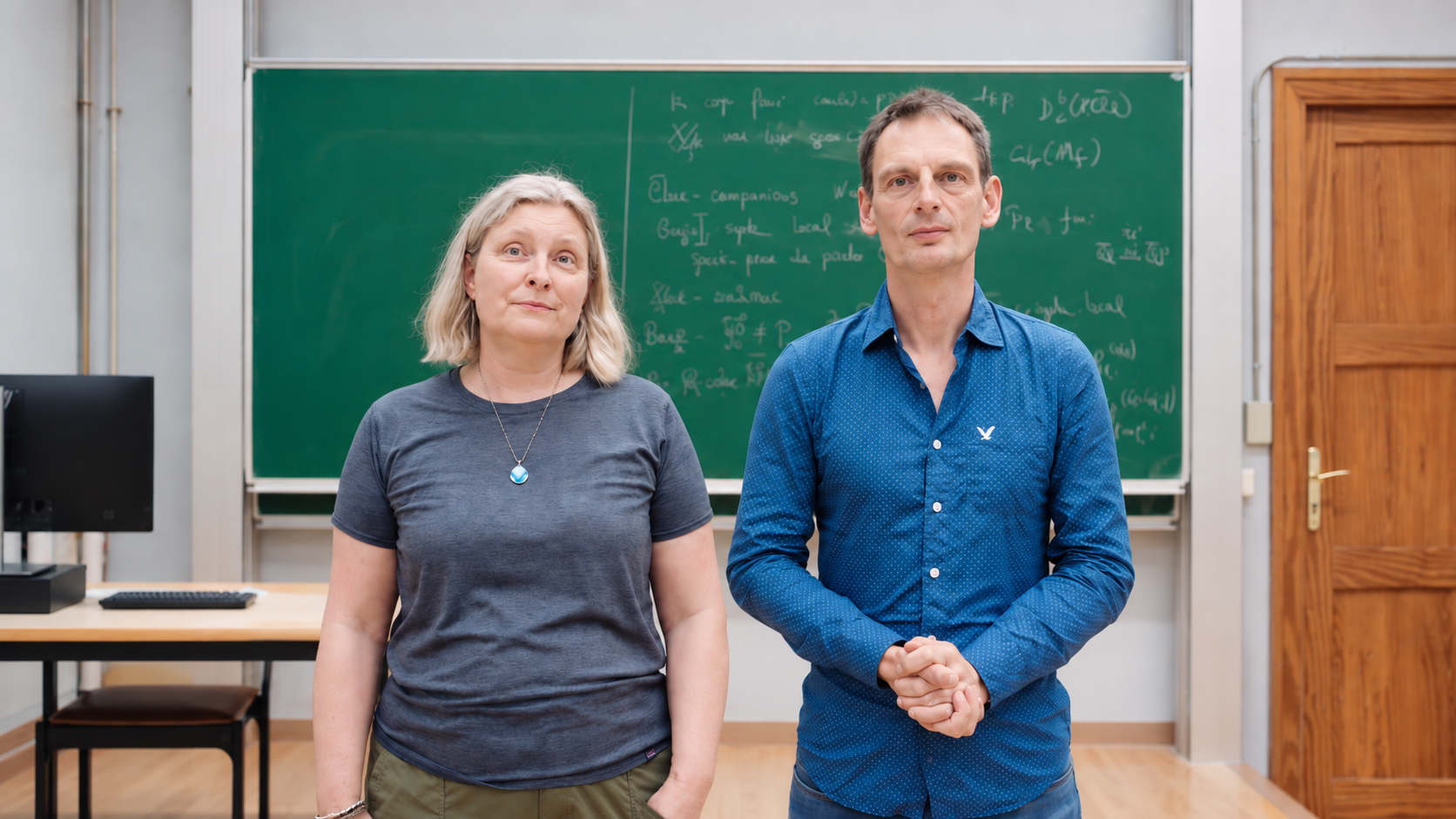
Rare curves, many points: Christophe Ritzenthaler and Rachel Pries on their research and the work around it
Christophe Ritzenthaler (Université de Rennes) and Rachel Pries (Colorado State University) both work on curves over finite fields: he hunts curves with as many points as possible, she hunts curves that almost never occur. In conversation with the CRM during their...

Call open for the 2027 Ferran Sunyer i Balaguer Prize
The Ferran Sunyer i Balaguer Foundation is accepting submissions for its 2027 prize, which awards 15,000 euros and publication in Birkhäuser's Progress in Mathematics series to an expository monograph on an active area of mathematical research. The deadline is 27...
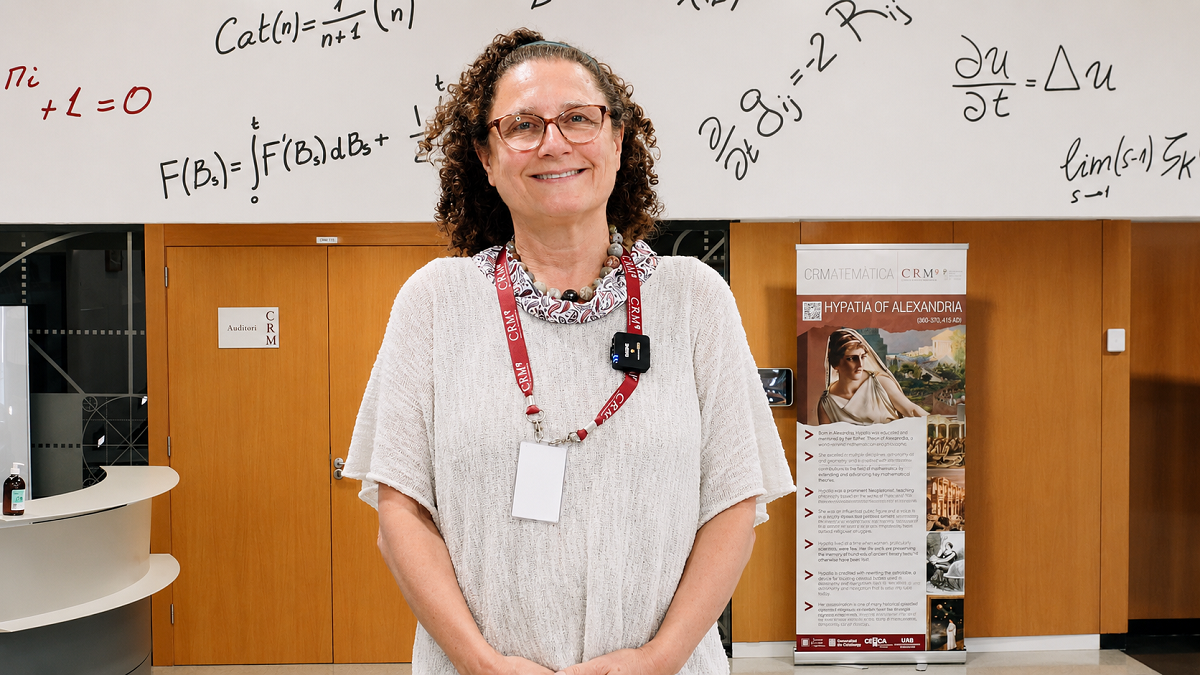
Susanna Terracini delivers the CRM Colloquium 2026
Susanna Terracini (Università di Torino) delivered the CRM Colloquium 2026 on 14 July, presenting a rigidity result for Kepler billiards obtained with Stefano Baranzini, Vivina Barutello and Irene De Blasi. She was at the centre as a member of the CRM Scientific...
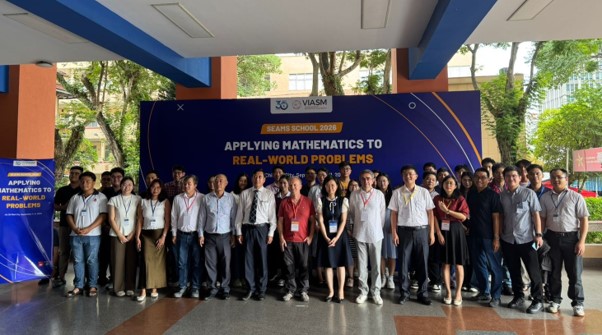
Ho Chi Minh City hosts the SEAMS School on applying mathematics to real-world problems
Students from across the region took courses and worked on group projects at a school co-organised by CRM researcher Tim Myers.CRM CommPau VarelaCRMComm@crm.catGet the latest CRM news and activities in your inbox.Recent newsletters →Between 4 and...

A single ball on a fixed table can compute: Eva Miranda and Isaac Ramos prove that two-dimensional billiards are Turing complete
Eva Miranda (UPC, CRM) and Isaac Ramos (ETH Zürich) show that a point particle bouncing inside a planar table with fixed walls can simulate a universal Turing machine, settling a question Cristopher Moore left open in 1990. The result grew out of a master’s project...
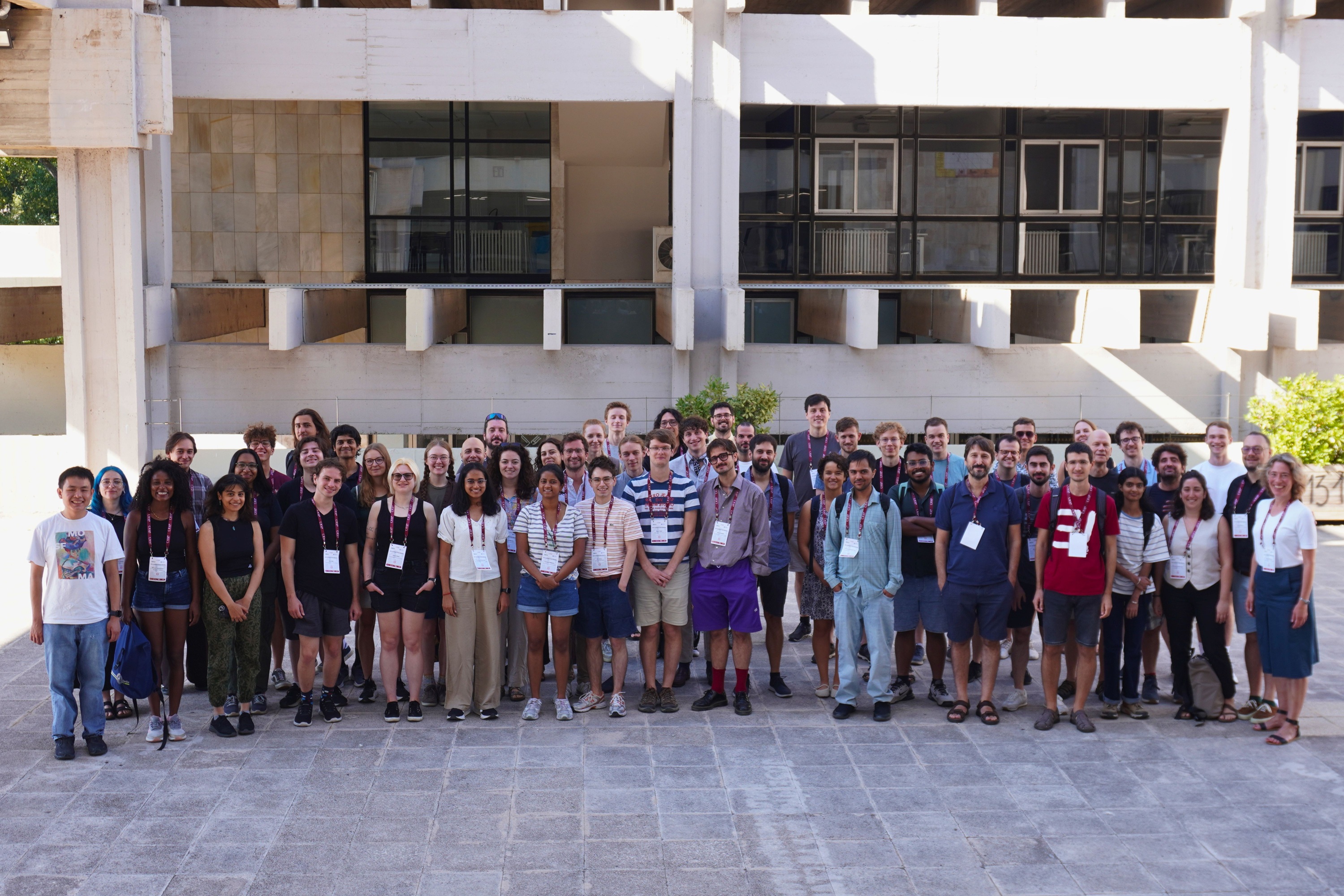
BMS-BGSMath Junior Meeting 2026: Barcelona and Berlin Strengthen Scientific Ties
From 2 to 4 September 2026, the Centre de Recerca Matemàtica (CRM) hosted the BMS-BGSMath Junior Meeting 2026, a three-day event jointly organised by the Berlin Mathematical School (BMS) and the Barcelona Graduate School of Mathematics (BGSMath), with the Centre de...
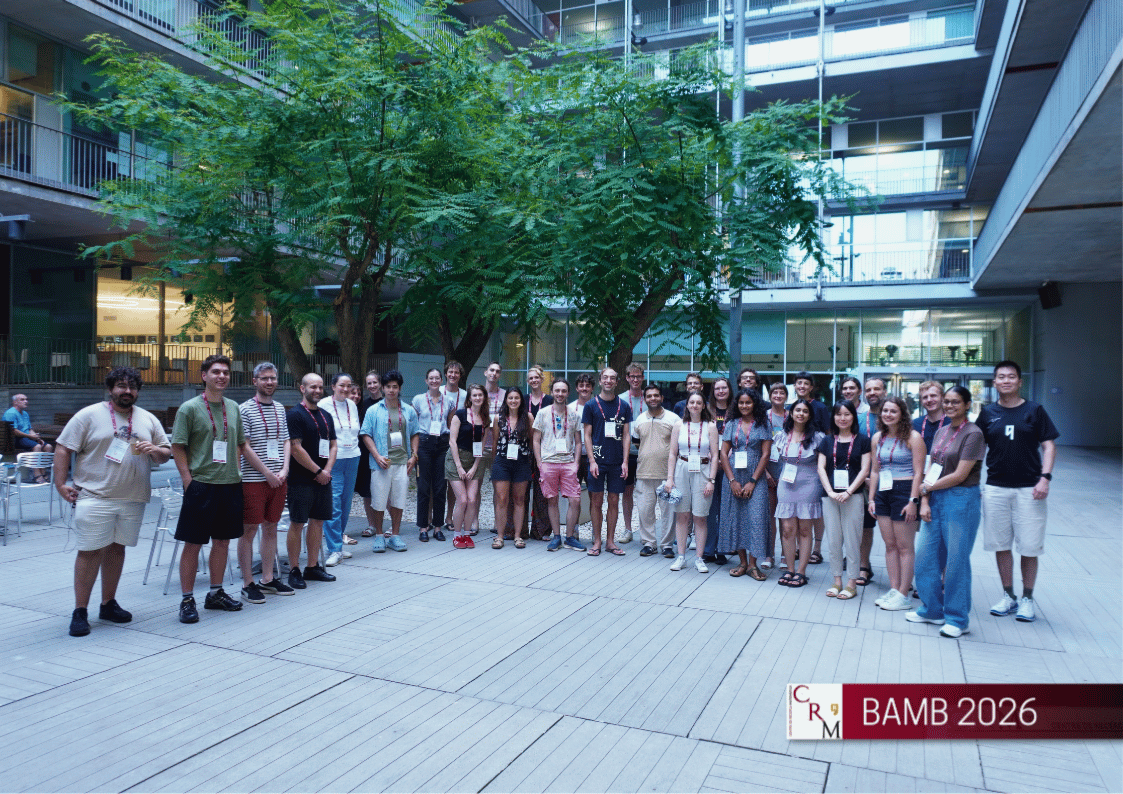
The CRM organises the 2026 Barcelona Summer School for Advanced Modeling of Behavior
The Centre de Recerca Matemàtica held the sixth edition of BAMB!, the Barcelona Summer School for Advanced Modeling of Behavior, from 12 to 23 July 2026 at the Parc de Recerca Biomèdica de Barcelona. Thirty early-career researchers from fourteen countries followed...