
The Spanish State Research Agency (AEI) has opened the call for PhD contracts to be performed at Maria de Maeztu Excellence Research Units. The period to apply is from January 12th, 2023 to January 26th, 2023 at 14:00h CET
The CRM is one of the six Maria de Maeztu Units of Excellence awarded by the Spanish State Research Agency (AEI) on the 2020 Call. The ‘Severo Ochoa’ and ‘Maria de Maeztu’ Excellence Centers and Units program aims to recognize public research organizations, in any scientific field, that stand out for the relevance and international impact of their research.
The award provides funding for the proposed strategic research plan, aimed at consolidating the centre’s scientific capabilities and enhancing its ability to attract talent over the next four years. It is obtained after a rigorous evaluation process carried out by an international committee consisting of top scientists, in accordance with the most demanding standards.
The CRM is offering FIVE fully-funded PhD positions to candidates who are interested to pursue their PhD Studies at the centre, in the following research areas:
| REFERENCE | Nº OF POSITIONS | DESCRIPTION |
| CEX2020-001084-M-20-1 | 1 | Analysis and PDE´s (Research groups/supervisors in this line) |
| CEX2020-001084-M-20-2 | 1 | Neuroscience (Research groups/supervisors in this line) |
| CEX2020-001084-M-20-3 | 1 | Combinatorics, logic and algorithmics (Research groups/supervisors in this line) |
| CEX2020-001084-M-20-4 | 1 | Climate change and Natural Hazards (Research groups/supervisors in this line) |
| CEX2020-001084-M-20-5 | 1 | Algebra, Geometry, Number Theory and Topology (Research groups/supervisors in this line) |
The positions are funded through the call “Ayudas para contratos predoctorales para la formación de doctores/as 2022”. Applications will be open from 12 to 26 January 2023 through the following link. The call is managed by the Spanish Agency for Research (AEI, acronym in Spanish).
For further scientific information, please contact with the corresponding supervisors. If you are interested in applying to this call or have any enquiries, please contact crmprojects@crm.cat with the subject “FPI-MDM-YourName”.
Eligibility Criteria
At the time of submission, candidates:
- Should have not received funding from the Spanish Programme for Research with the aim to pursue his/her PhD studies.
- Should hold a degree which would formally entitle him/her to join a doctoral programme for the academic course 2023-2024 or 2024-2025 (i.e should have finished an European Master Degree, be taking such degree or registering for it in 2023). The expected master could be in fundamental or applied mathematics, or other relevant topics, depending on the research line (engineering, computer science, etc). Should have not been granted any other PhD scholarship with a duration of 12 months or more, and she/he should not have a PhD degree.
- Should be in the position to be legally accepted in the PhD Programme of the UAB, UB or UPC .
- Advanced English speaking, willingness to learn Spanish if not a speaker yet.
Hiring Conditions
Hiring conditions are set by the Spanish Ministry, and they will be detailed in the Call for “Contratos predoctorales 2022”. Here are the main features for the previous call (note that quantities may slightly change):
- 4-year PhD fellowship with an annual evaluation. The gross salary will be approximately 16,640 euros gross for the first and second years, 17,830 for the third year, and 22,290 for the fourth. Gross means here that you would get about 85% of that in your bank account (i.e., 15% of income and social security taxes).
- The programme also includes a package of about 6,880 Euros to attend conferences, fieldwork and/or secondments during the duration of the fellowship.
Application Procedure
If you don’t have a MINECO account:
- Go to MINECO in “Registro Investigador” option. This first step consists in creating your personal account with your personal data at the MINECO website. This account will not be useful only for this call but for any MINECO funding call. In the RUS (“unified register for candidates”) form please make sure that the response to the question “¿Es también investigador?” (“are you also a researcher?”) is “Sí” (“yes”)
- Once you create your account you will receive an email for the account activation. You should press the link of that email so as to activate your account. From this moment on you will receive any communication from the MINECO in that email account. Please, do not change this contact information until the final resolution of the grant.
If you have a MINECO account:
- Login to the website https://aplicaciones.ciencia.gob.es/ayudaspredoctorales/ and click “Añadir”.
- Select by Reference Code (see above). Note that you can only apply for ONE Position.
- Click “Crear Solicitud” and then choose “Editar” option.
- Fill the 4 sections (“Personal data”, “Academic data”, “Requirement of the candidates” and add the corresponding documents: CV, academic record, etc.)
- Once the application is complete, click “Definitivo” to generate the application form and make sure that you send it by electronic signature (Spanish residents in Spain). Through the Spanish consulate if you are abroad (foreign researchers and Spanish citizens nor residents in Spain). The postal address is the following:Subdivisión de Planificación y Gestión Administrativa
División de Programación y Gestión Económica y Administrativa
Agencia Estatal de Investigación
Ministerio de Ciencia e Innovación
Calle Torrelaguna 58 bis, 28027 Madrid


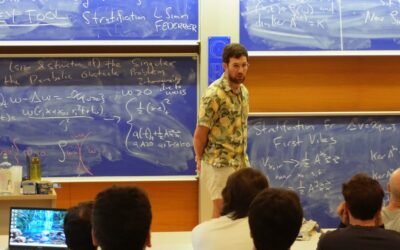
Advanced Course on Free Boundary Problems Opens the Intensive Weeks of the IRP
From 26 to 30 October, around forty researchers attended the Advanced Course on Free Boundary Problems at the CRM, three seven-hour mini-courses given by Bozhidar Velichkov (Università di Pisa), Max Engelstein (University of Minnesota) and Zihui Zhao (Johns Hopkins University). The course was the first of the two intensive weeks of the Intensive Research Programme on Analysis of Free Boundary Problems, which runs until 4 December.
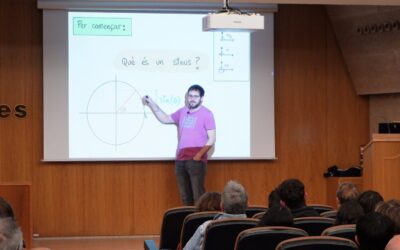
El CRM rep els estudiants de la prova de nivell de Bojos per les Matemàtiques 2027
Els aspirants a Bojos per les Matemàtiques 2027 van visitar el Centre de Recerca Matemàtica (CRM) dissabte 24 d’octubre, després de fer la prova de nivell a la Facultat de Ciències i Biociències de la UAB. En acabat, Tomás Sanz (UB-CRM) els va explicar què té a veure l’escalfament d’una barra de ferro amb els àudios de WhatsApp.
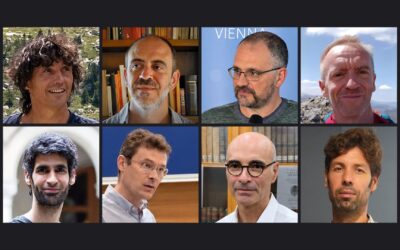
Eight CRM Researchers in the 2026 Stanford-Elsevier List of Highly Cited Scientists
The Centre de Recerca Matemàtica (CRM) has eight researchers in the 2026 update of the Stanford-Elsevier ranking of highly cited scientists, which John P. A. Ioannidis (Stanford University) and Jeroen Baas (Elsevier) compile from Scopus data. Xavier Cabré, Álvaro Corral, Tim Myers, Xavier Ros-Oton, Sergey Tikhonov and Xavier Tolsa appear both in the career-long ranking and in the one for 2025, and Diego Vidaurre and Simeon Ball in the 2025 ranking.
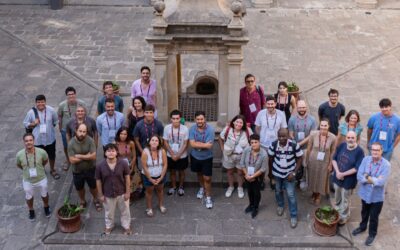
Fish schools and growing tissues: a workshop on how collective behaviour emerges
The Centre de Recerca Matemàtica (CRM) organised the Barcelona Workshop on Kinetic and Macroscopic Models in Biology with Friends II, held from 7 to 10 September at the Institut d’Estudis Catalans. More than thirty researchers discussed how order at the scale of tissues and animal groups arises from local interactions between individuals, in a programme that included talks by CRM researchers Daria Stepanova and Juan Arellano-Tintó. Two of the speakers, James Sharpe (EMBL Barcelona) and Chiara Villa (CNRS, Université Paris Cité), talked to the CRM about their research.
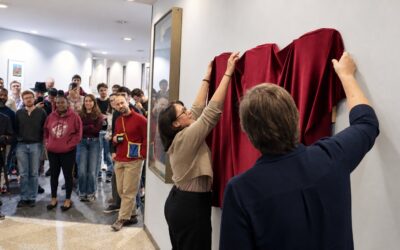
The CRM opens the academic year and unveils its Directors’ Gallery
A review of the year, the Communication Plan 2026–2030 and three research talks filled the morning of 19 October.The unveiling of the Directors’ Gallery.CRM CommPau VarelaCRMComm@crm.catGet the latest CRM news and activities in your inbox.Recent...
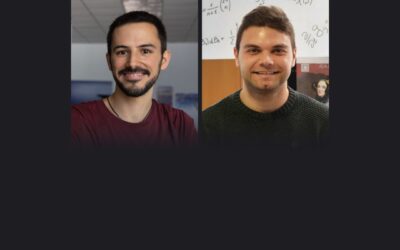
The CRM Mentoring Programme, as Told by One of Its Pairs
PhD student Joaquim Duran and mathematician Robert Cardona, one of the pairs in the CRM Mentoring ProgrammeJoaquim Duran (left) and Robert Cardona.CRM CommPau VarelaCRMComm@crm.catGet the latest CRM news and activities in your inbox.Recent...
When the reward comes within reach, the brain changes what it compares
As the tokens piled up, choices got faster and more accurate at the same time. The yardstick for judging each offer had moved.CRM CommPau VarelaCRMComm@crm.catGet the latest CRM news and activities in your inbox.Recent newsletters →Two subjects...

Almost every automaton can be reset with a short word
Guillaume Chapuy (Université Paris Cité, CNRS) and Guillem Perarnau (UPC, CRM) have shown that a random finite automaton with n states can, with high probability, be reset by a word of length of order √n log n. The result, published in ACM Transactions on Algorithms, pins the exponent at 1/2, the lower end of a decade of numerical estimates, and addresses the random version of the synchronization problem behind a conjecture Ján Černý posed in 1964 and which still remains open.
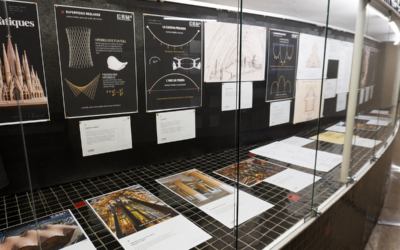
Exposició ‘Les matemàtiques de Gaudí’
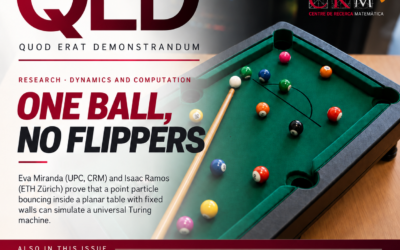
CRM quod erat demonstrandum | 48

ADA: Decoding Brain Signals Misaligned in Time
The study addresses a key limitation of current brain decoding techniques: the difficulty of interpreting internal mental processes whose temporal dynamics vary from trial to trial.Decoding what is happening in a person’s mind from their brain activity is one of the...
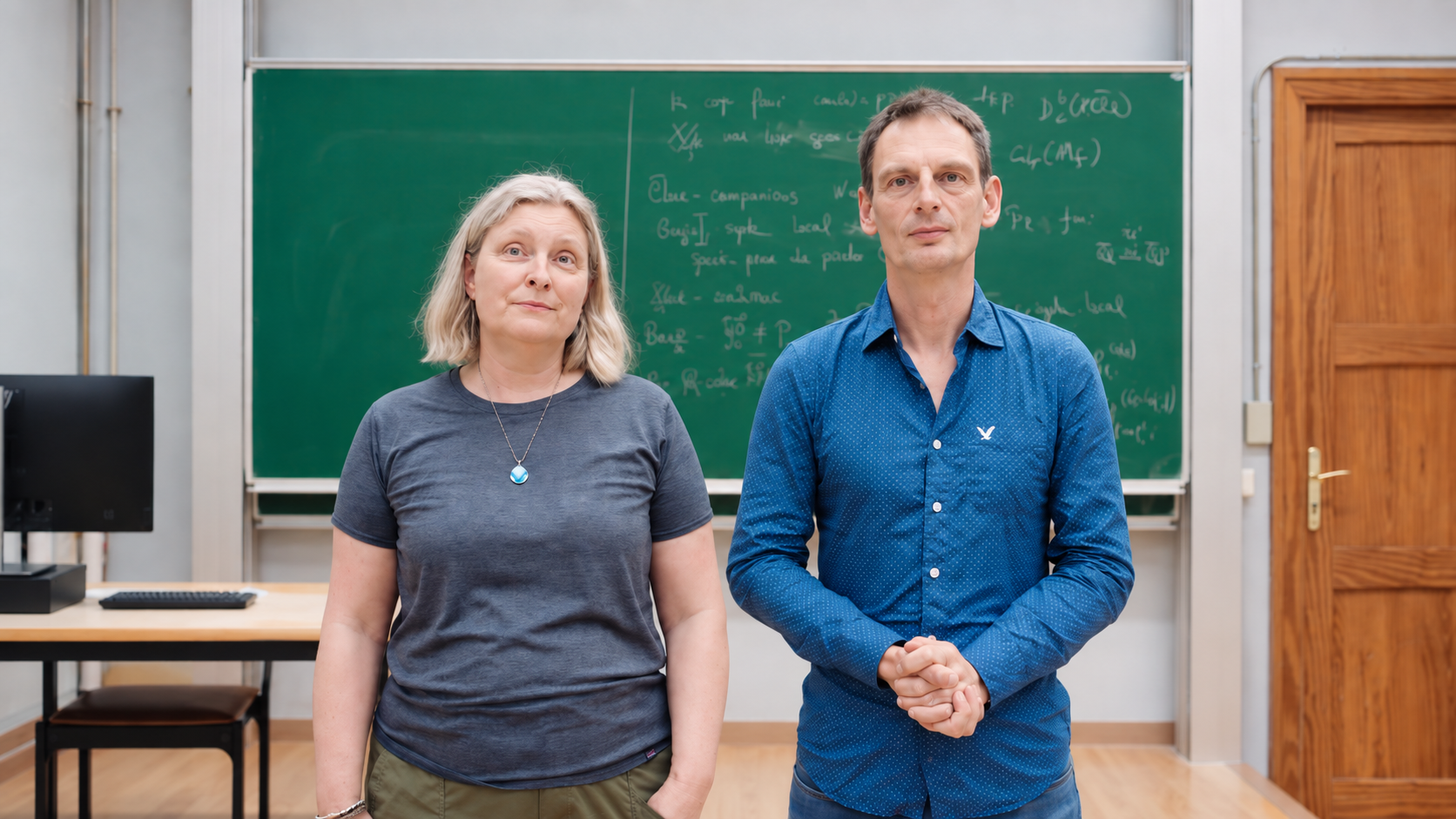
Rare curves, many points: Christophe Ritzenthaler and Rachel Pries on their research and the work around it
Christophe Ritzenthaler (Université de Rennes) and Rachel Pries (Colorado State University) both work on curves over finite fields: he hunts curves with as many points as possible, she hunts curves that almost never occur. In conversation with the CRM during their...