The CRM opens the academic year and unveils its Directors’ Gallery
A review of the year, the Communication Plan 2026–2030 and three research talks filled the morning of 19 October.
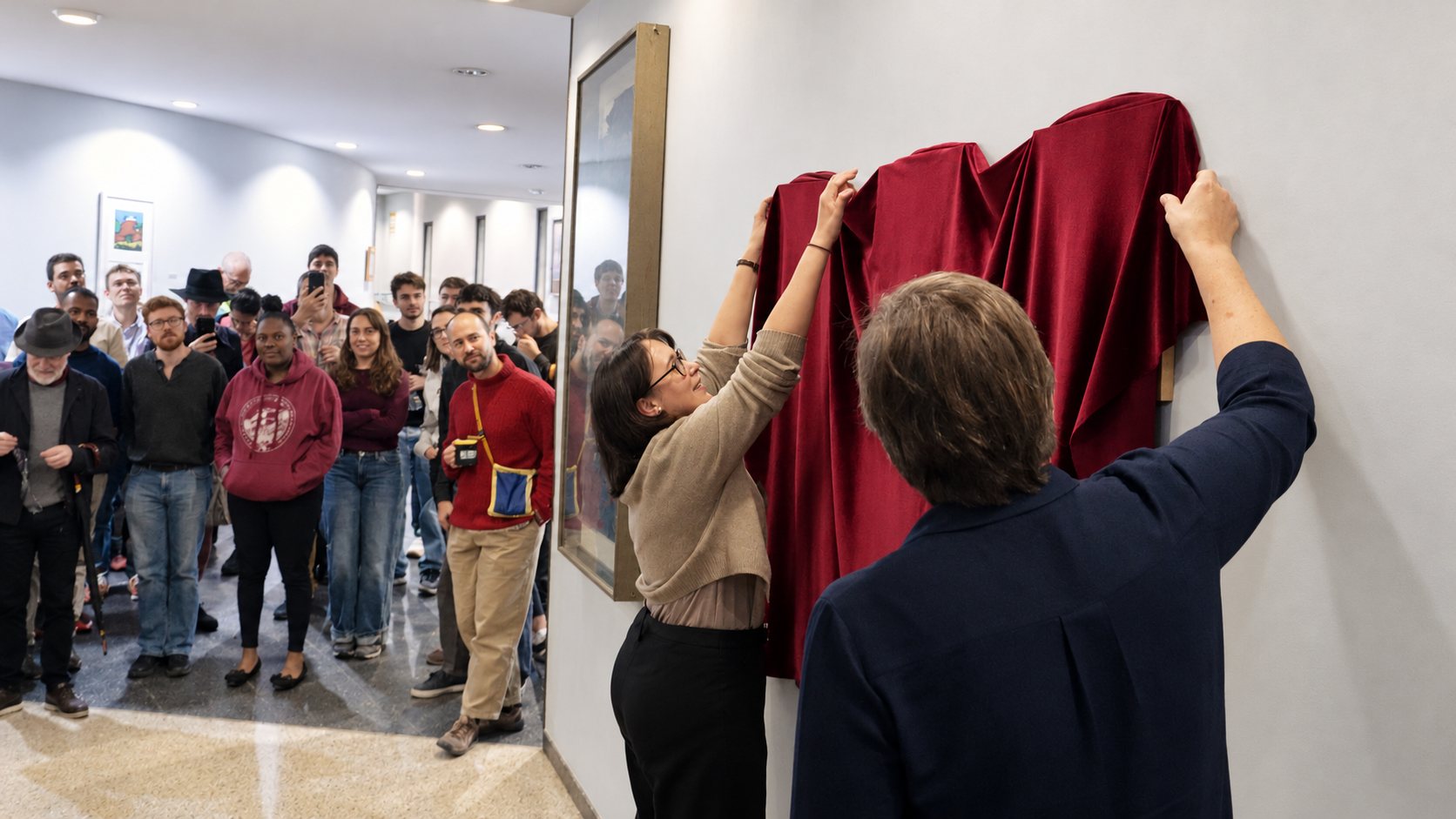
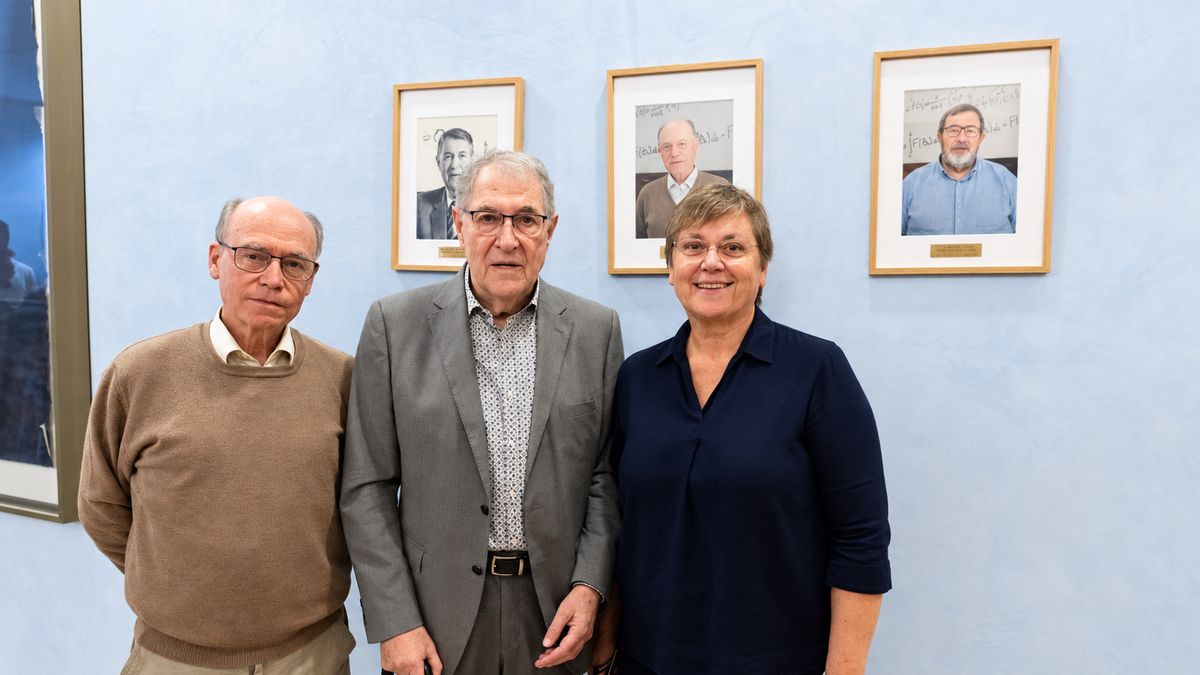
The unveiling of the Directors’ Gallery.
The CRM has had four directors in forty-two years. On Monday 19 October, the fourth, Carme Cascante, opened the 2026–2027 academic year before the centre’s community, and after the first research talk the portraits of the other three were unveiled in the new Directors’ Gallery.
Cascante’s welcome went over the centre’s figures for 2025. The CRM counted 171 members last year, and its output included 140 scientific papers and 24 doctoral theses. The centre organised 54 scientific activities, eight of them conferences and 15 advanced courses, with 1,397 participants from 66 countries. It also passed the CERCA evaluation of the 2021–2024 period successfully, and the external evaluators praised both its scientific results and its working environment.
Cascante also highlighted two activities for the forthcoming year. A lecture series on the mathematics of machine learning opens on 27 October at the Universitat de Barcelona, with Francis Bach (INRIA and École Normale Supérieure) as its first speaker. The other is a BGSMath course in November on formalising mathematics with the proof assistant Lean and AI tools, taught by Michail Karatarakis (Radboud University Nijmegen and Axiomatic AI). The CRM Faculty Colloquium, where researchers affiliated with the centre present their work to the whole mathematical community, started in February and has a 2027 session planned with Jezabel Curbelo, Joana Cirici and Eva Miranda. Maria Bruna, from the University of Oxford, visits the CRM this month through the María Wonenburger call, shared by five SOMMa centres.
The last part of her talk dealt with research integrity and the three texts that frame it at the centre. The European Code of Conduct for Research Integrity rests on reliability, honesty, respect and accountability, and names fabrication, falsification and plagiarism as misconduct. The CERCA Institute’s Code of Ethics and Conduct (in Catalan), from May 2025, applies to the staff of every CERCA centre and, besides research integrity, covers gender equity, linguistic rights, open science and the ethical use of artificial intelligence. Closer to home, the CRM’s rules on signatures and institutional affiliation set how researchers sign their papers and which funders every output must acknowledge.
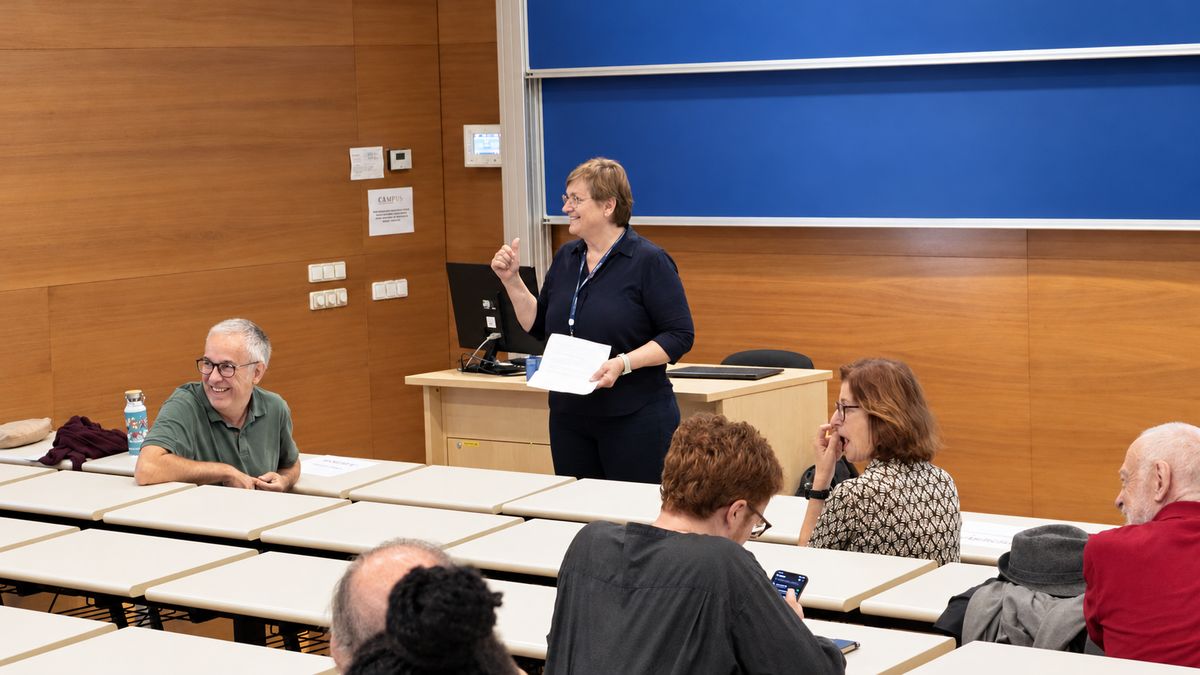
Pau Varela, the CRM’s Communication Coordinator, then presented the Communication Plan 2026–2030. Born from the CRM Strategic Plan 2026–2030, it gives the centre a defined communication strategy for the first time in more than forty years, with eight strategic objectives and 13 actions. Varela also reviewed what the Communication & Outreach Department has built since early 2022, when it became a stable unit with the start of the María de Maeztu programme. Its projects include the outreach blog El Gegant del π, the video interview series Mathematics in Conversation (43 people interviewed so far) and the podcast Ments Meravelloses, which passed 70,000 views in its first year on a YouTube channel that until 2023 was an archive of recorded talks. He closed with an invitation to take part.
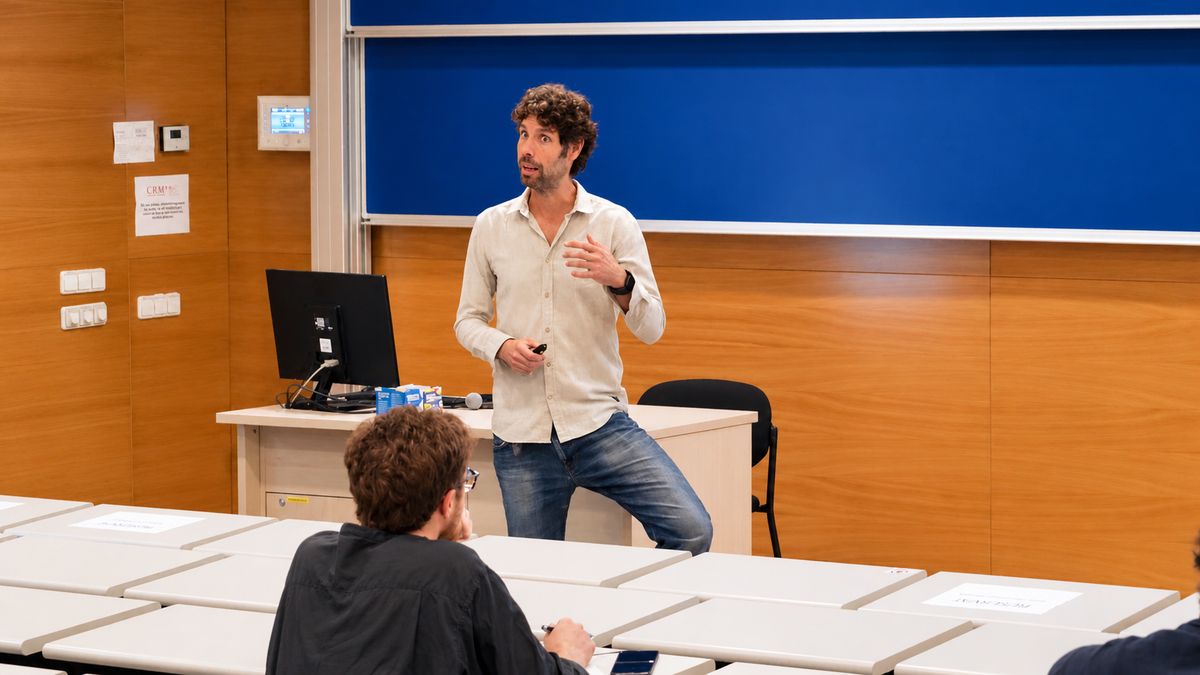
Diego Vidaurre, who joined the CRM’s Computational and Mathematical Neuroscience group through the ATRAE programme, gave the first research talk of the morning. Under the title “Machine learning and AI models for explaining perception”, he started from the difference between predicting and explaining. A falling barometer predicts a storm without causing it (both follow from the same drop in pressure), and a model trained on enough data can predict well on correlations alone. The field’s two standard tools (encoding models, which predict brain activity from a stimulus, and decoding models, which do the reverse) both have limits as explanations, and decoding results in particular have no mechanistic counterpart. Vidaurre’s answer is Genephys, published in eLife in 2024, a generative model of the brain’s electrophysiological signal that describes the mechanisms producing it. That brings the analysis closer to explanation as the philosopher James Woodward defined it, saying what would happen to an outcome if its causes were different. As one of his final slides acknowledged, it is still based on correlations, “but the gap is smaller”.
Between the first and second talks, the CRM inaugurated its Directors’ Gallery (Galeria de Direcció), conceived as a tribute to the centre’s history and leadership. It brings together the portraits of the three directors who preceded Cascante: Manuel Castellet, founder of the CRM and its director from 1984 to 2007; Joaquim Bruna, from 2007 to 2016; and Lluís Alsedà, from 2016 to 2024.
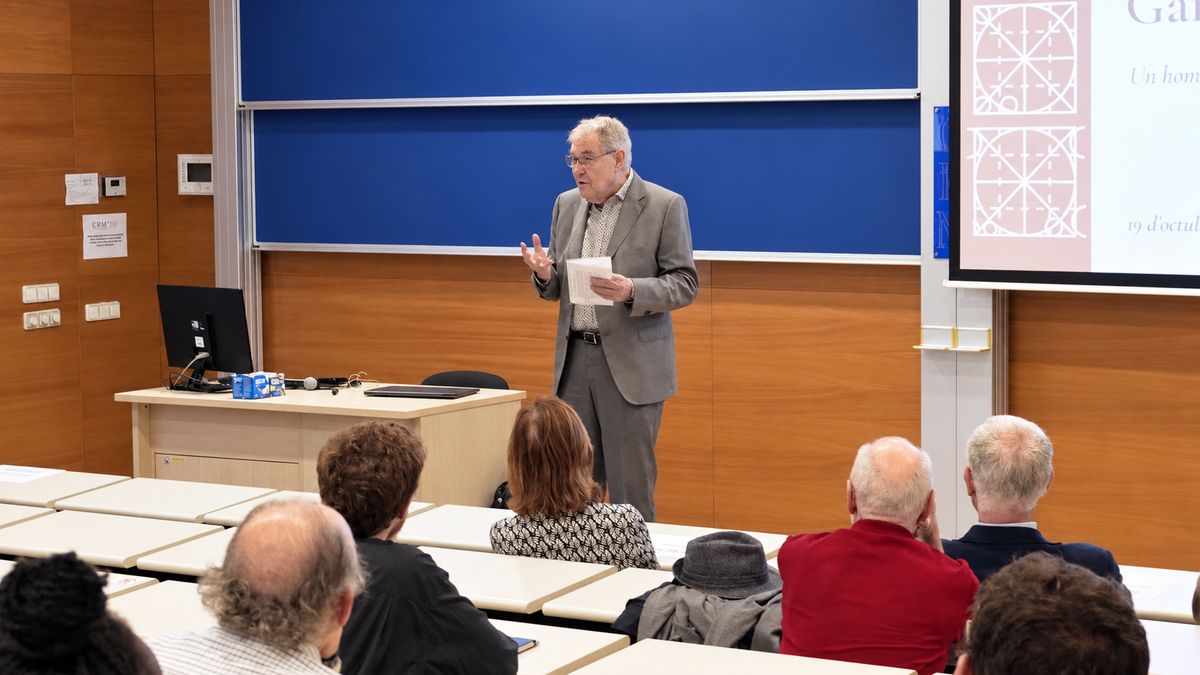
After the coffee break, Sergey Tikhonov, ICREA research professor at the CRM, spoke on “Uncertainty principles”. The best-known member of the family is Heisenberg’s, the position and momentum of a particle can’t both be known exactly. In Fourier analysis, a field that goes back to Joseph Fourier’s Théorie analytique de la chaleur (1822), the principle takes a precise form, a function and its Fourier transform cannot both be sharply concentrated. A police radar gun and a speeding ticket also made an appearance, under the question of whether the principle really works.
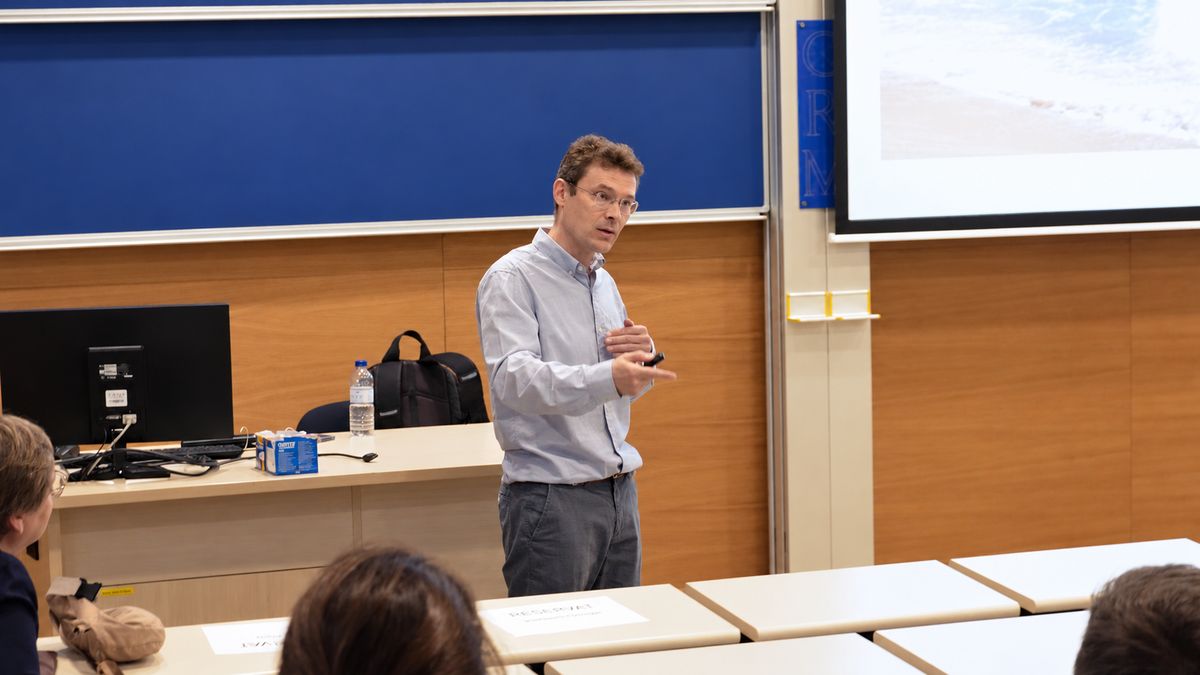
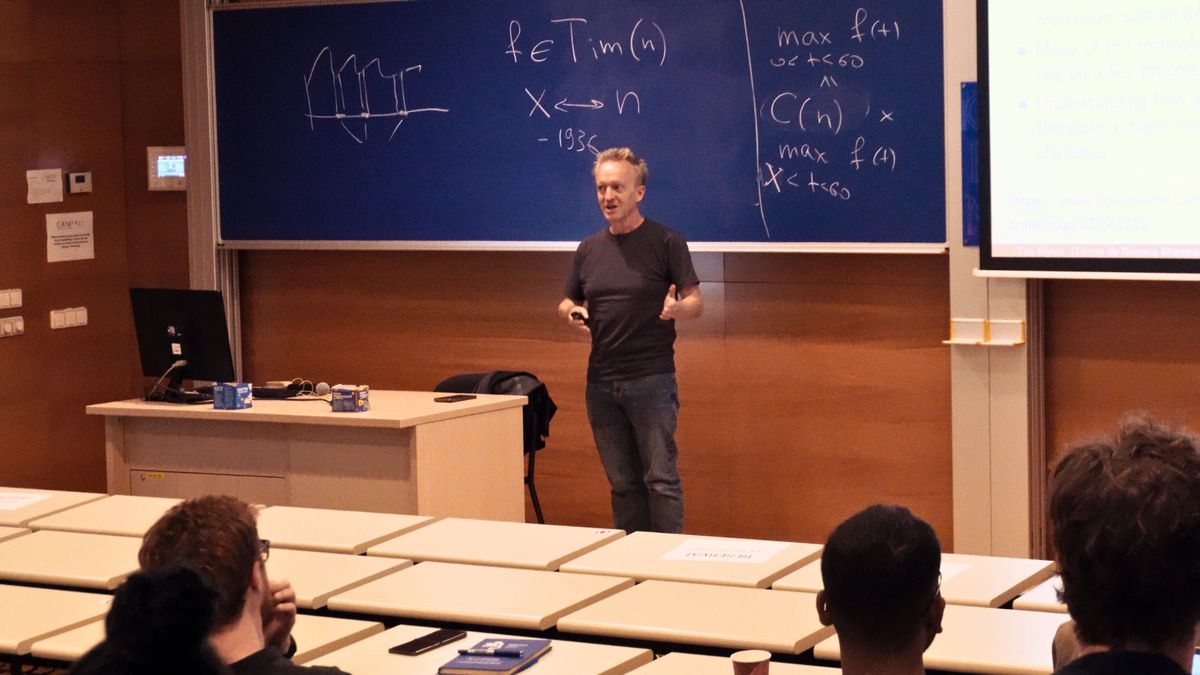
Tim Myers (CRM) gave the last talk, “Mathematical modelling of adsorption: From clean air to corrosion protection”. Adsorption, the process by which molecules stick to the surface of a solid, is used in water purification and carbon capture. Myers showed how a careful reduction of the equations for an adsorption column yields a simple formula, with a single fitted parameter, that predicts when the pollutant will emerge at the outlet. The standard Bohart–Adams model, from 1920, only fits the data by treating known quantities as free parameters. In steel pipelines the adsorbed molecules are, for once, wanted, corrosion inhibitors form a protective film on the metal, and a multilayer model explains why it keeps working for a while after dosing stops.
The event closed with a dinar de germanor, a standing lunch for the whole community.
More from the CRM
La guerra de les granotes i els ratolins
The CRM exhibition ‘Les matemàtiques de Gaudí’ moves to the University of Barcelona
L'exposició del CRM «Les matemàtiques de Gaudí» es trasllada a la Universitat de BarcelonaEight posters on the mathematics behind Gaudí's architecture, on display at the UB until 30 NovemberVuit pòsters sobre les matemàtiques que hi ha darrere l'arquitectura de Gaudí,...
Advanced Course on Free Boundary Problems Opens the Intensive Weeks of the IRP
Three mini-courses by Bozhidar Velichkov, Max Engelstein and Zihui Zhao, from 26 to 30 October at the CRMParticipants in the Advanced Course on Free Boundary Problems.CRM CommPau VarelaCRMComm@crm.catGet the latest CRM news and activities in your...
El CRM rep els estudiants de la prova de nivell de Bojos per les Matemàtiques 2027
The CRM welcomes students from the Bojos per les Matemàtiques 2027 entrance testVisita guiada al centre i xerrada de Tomás Sanz (UB-CRM) sobre les matemàtiques del soA guided tour of the centre and a talk by Tomás Sanz (UB-CRM) on the mathematics of soundTomás Sanz...
Eight CRM Researchers in the 2026 Stanford-Elsevier List of Highly Cited Scientists
The database ranks scientists by citation impact, over their whole careers and in 2025 aloneCRM CommPau VarelaCRMComm@crm.catGet the latest CRM news and activities in your inbox.Recent newsletters →The 2026 edition of the Stanford-Elsevier database...
Fish schools and growing tissues: a workshop on how collective behaviour emerges
Mathematicians and biologists met at the Institut d’Estudis Catalans to discuss how local interactions shape tissues and animal groups.A talk in the Pere i Joan Coromines room of the Institut d’Estudis Catalans. Image: CRMCRM CommPau...
The CRM Mentoring Programme, as Told by One of Its Pairs
PhD student Joaquim Duran and mathematician Robert Cardona, one of the pairs in the CRM Mentoring ProgrammeJoaquim Duran (left) and Robert Cardona.CRM CommPau VarelaCRMComm@crm.catGet the latest CRM news and activities in your inbox.Recent...
When the reward comes within reach, the brain changes what it compares
As the tokens piled up, choices got faster and more accurate at the same time. The yardstick for judging each offer had moved.CRM CommPau VarelaCRMComm@crm.catGet the latest CRM news and activities in your inbox.Recent newsletters →Two subjects...
Almost every automaton can be reset with a short word
For a random automaton with n states, a word of about √n log n letters is almost always enough to reset it.CRM CommPau VarelaCRMComm@crm.catGet the latest CRM news and activities in your inbox.Recent newsletters →Picture a conveyor belt carrying...