ExposicióExhibition
Les matemàtiques
de GaudíThe mathematics
of Gaudí
Vuit idees matemàtiques per llegir l’obra de Gaudí, i una d’elles ni tan sols és seva. Les figures d’aquesta pàgina es mouen, i gairebé totes es deixen tocar.
Eight mathematical ideas for reading Gaudí’s buildings, and one of them isn’t even his. The figures on this page move, and most of them don’t mind being handled.
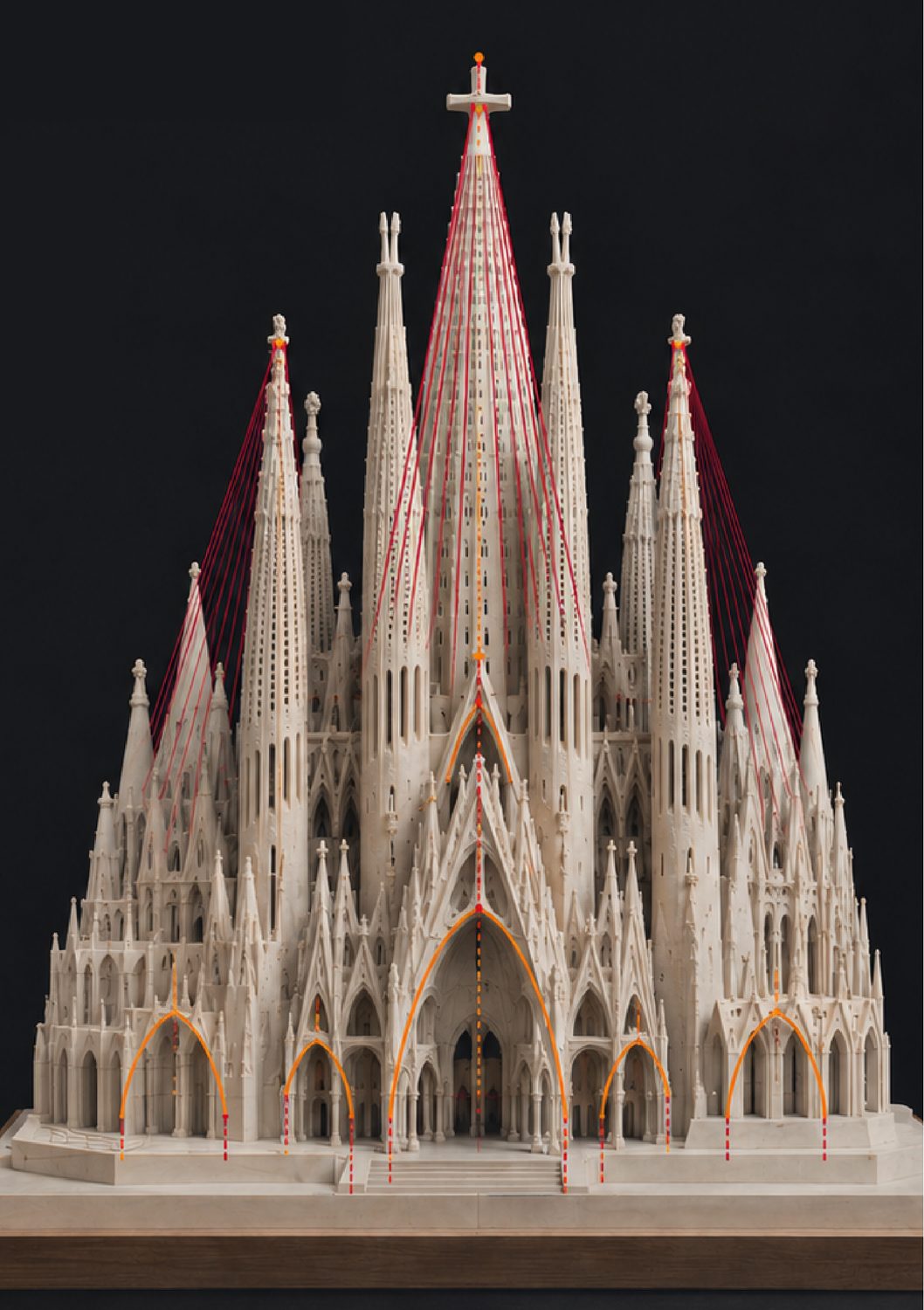
A Santa Coloma de Cervelló, en un taller de la Colònia Güell, hi va haver durant anys una església penjada del sostre. Era feta de cordes. D’un tauler amb la planta dibuixada en baixaven fils, i dels fils penjaven saquets de perdigons, lligats allà on l’edifici hauria d’aguantar pes. Entre tots dibuixaven, de cap per avall, les columnes i les voltes d’un temple que encara no existia.
In a workshop at the Colònia Güell, in Santa Coloma de Cervelló, a church hung from the ceiling for years. It was made of string. Threads dropped from a board with the floor plan drawn on it, and from the threads hung little sacks of lead shot, tied wherever the building would have to carry weight. Together they drew, upside down, the columns and vaults of a church that didn’t exist yet.
Gaudí fotografiava la maqueta i girava la foto. Del revés, aquell embolic de fils tibants es convertia en una església dreta, i ell hi dibuixava a sobre.
Gaudí photographed it and turned the photo over. Flipped, that tangle of taut threads became a church standing upright, and he drew on top of it.
El càlcul el feia la gravetat.
Gravity did the maths.
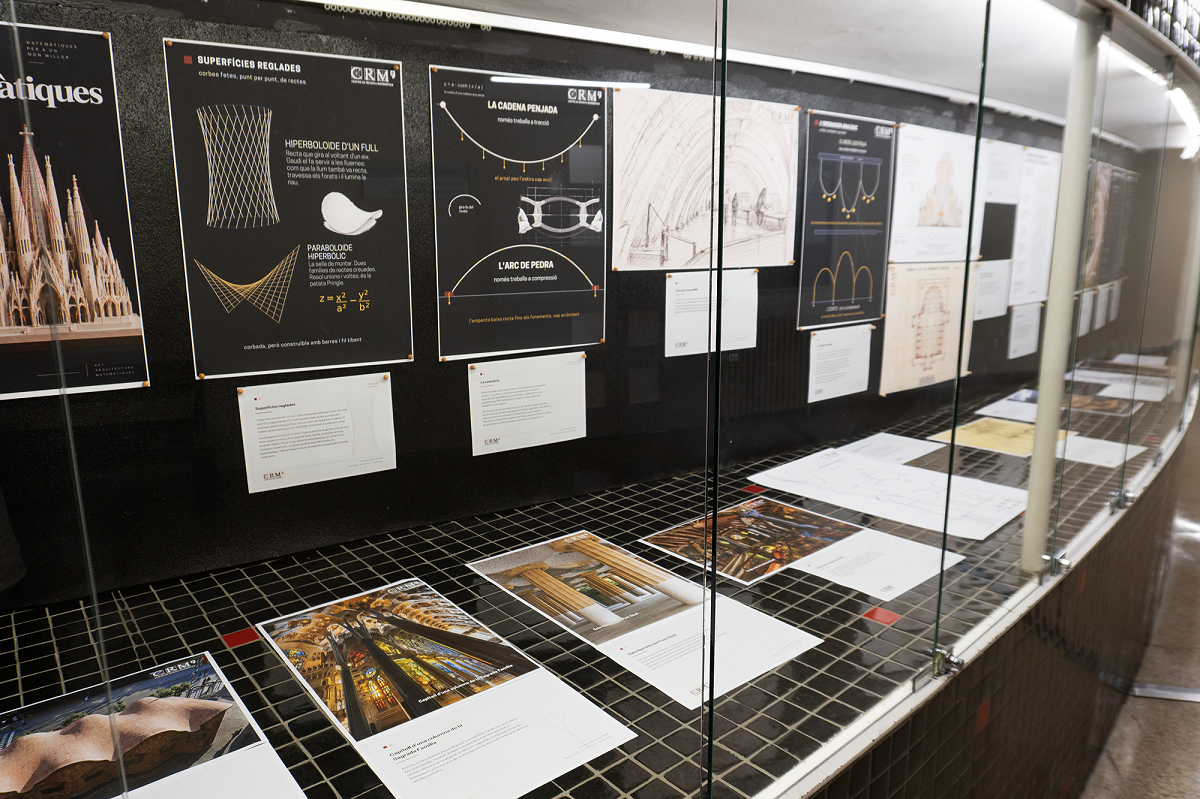
Aquesta pàgina neix de l’exposició Les matemàtiques de Gaudí, que es pot veure a la Biblioteca de Ciència i Tecnologia de la UAB de l’1 al 30 d’octubre de 2026 i, del 2 al 30 de novembre, al CRAI Biblioteca de Matemàtiques i Informàtica de la Universitat de Barcelona. Té vuit capítols, un per a cada pòster. Comença amb una cadena que penja i acaba davant d’una façana amb setze números. Les figures es deixen estirar i carregar de pes, que és més o menys el que feia ell, amb fil i perdigons.
This page grew out of Les matemàtiques de Gaudí, an exhibition at the UAB’s Biblioteca de Ciència i Tecnologia from 1 to 30 October 2026 and at the Universitat de Barcelona’s CRAI Biblioteca de Matemàtiques i Informàtica from 2 to 30 November. It has eight chapters, one per poster. It starts with a hanging chain and ends in front of a façade with sixteen numbers on it. The figures can be stretched and loaded with weight, which is more or less what he did, with string and lead shot.
01
La catenàriaThe catenary
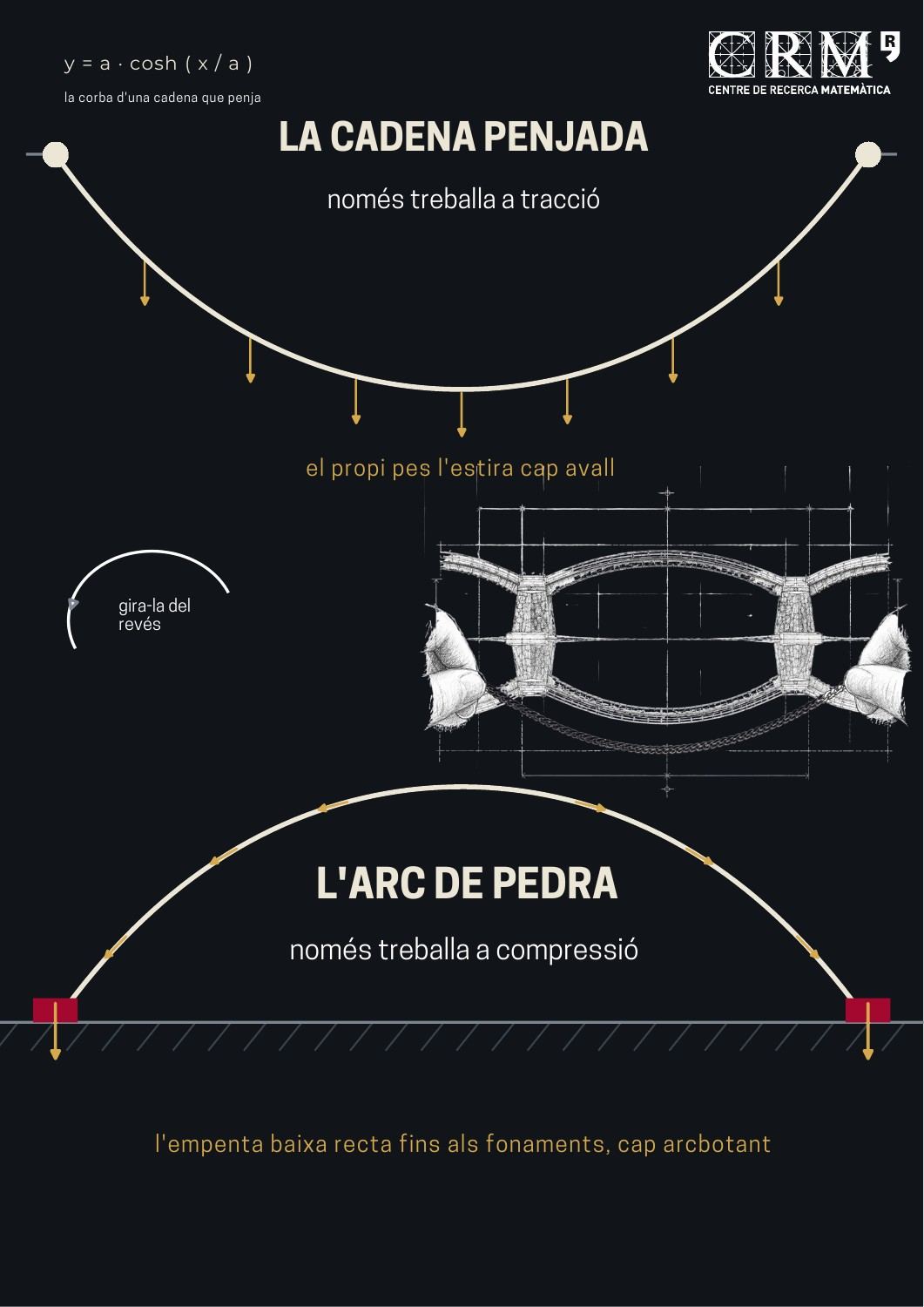
Penja una cadena, gira-la, i tens un arc que s’aguanta sol.
Hang a chain, turn it over, and you have an arch that holds itself up.
Penja una cadena pels dos extrems i espera que s’aturi. La corba que dibuixa té nom, catenària (de catena, cadena en llatí), i té equació: y = a · cosh(x / a).
Hang a chain by its two ends and wait for it to settle. The curve it draws has a name, the catenary (from catena, Latin for chain), and an equation: y = a · cosh(x / a).
S’assembla molt a una paràbola. Galileu ja ho va veure el 1638, i també va veure que només era una aproximació, bona quan la cadena penja poc. La solució exacta va arribar el 1691, quan Leibniz, Huygens i Johann Bernoulli van respondre, cadascú pel seu compte, un repte que havia llançat Jakob Bernoulli, el germà gran de Johann.
It looks a lot like a parabola. Galileo saw that in 1638, and he also saw that the likeness was only approximate, good when the chain hangs shallow. The exact solution arrived in 1691, when Leibniz, Huygens and Johann Bernoulli each answered, separately, a challenge set by Jakob Bernoulli, Johann’s older brother.
Gira la corba de cap per avall i passa una cosa curiosa. El que penjant només treballava a tracció, dret només treballa a compressió: l’arc aguanta el seu propi pes i l’empenta baixa resseguint la corba fins a terra. Robert Hooke ho va publicar el 1676, xifrat en un anagrama llatí, que era la manera de l’època de reclamar una idea sense ensenyar-la. La clau no va sortir fins al 1705, quan ell ja era mort: ut pendet continuum flexile, sic stabit contiguum rigidum inversum. Com penja el fil flexible, així, del revés, s’aguantarà dret l’arc rígid.
Turn the curve upside down and something odd happens. What worked purely in tension while it hung now works purely in compression: the arch carries its own weight, and the thrust runs down along the curve into the ground. Robert Hooke published this in 1676, in code, as a Latin anagram, which was how you claimed an idea in those days without giving it away. The key only came out in 1705, after his death: ut pendet continuum flexile, sic stabit contiguum rigidum inversum. As hangs the flexible line, so, inverted, will stand the rigid arch.
Les voltes gòtiques empenyen cap enfora des de dalt dels murs, i aquella empenta s’havia de portar a terra amb contraforts i arcbotants tot al voltant de l’edifici. Gaudí en deia crosses, ajudes que delaten un edifici que no s’aguanta sol. Els seus arcs no en fan servir.
Gothic vaults push outwards from the tops of the walls, and that push had to be carried down to the ground with buttresses and flying buttresses all around the building. Gaudí called them crutches, props that give away a building that can’t stand on its own. His arches don’t use any.
Què vol dir la aWhat the a means
A y = a · cosh(x / a), el paràmetre a és la tensió horitzontal de la cadena dividida pel seu pes per unitat de longitud. Com més tibant, més gran és a i més plana queda la corba. El cosinus hiperbòlic, cosh x = (ex + e−x) / 2, és la mitjana de dues exponencials, una que creix i una que decreix.
In y = a · cosh(x / a), a is the chain’s horizontal tension divided by its weight per unit length. The tighter the chain, the bigger a and the flatter the curve. The hyperbolic cosine, cosh x = (ex + e−x) / 2, is the average of two exponentials, one growing and one shrinking.
Quan la cadena penja poc, cosh x ≈ 1 + x2/2, que és una paràbola. Per això l’aproximació de Galileu funcionava, i per això la diferència només es veu quan la corba s’enfonsa.
When the chain hangs shallow, cosh x ≈ 1 + x2/2, which is a parabola. That’s why Galileo’s approximation worked, and why the difference only shows when the curve drops deep.
 El pòster de l’exposicióThe exhibition poster
 Des de propUp close
02
L’ordinador analògicThe analogue computer
Cordes, saquets de perdigons i la gravetat fent els comptes.
String, sacks of lead shot, and gravity doing the sums.
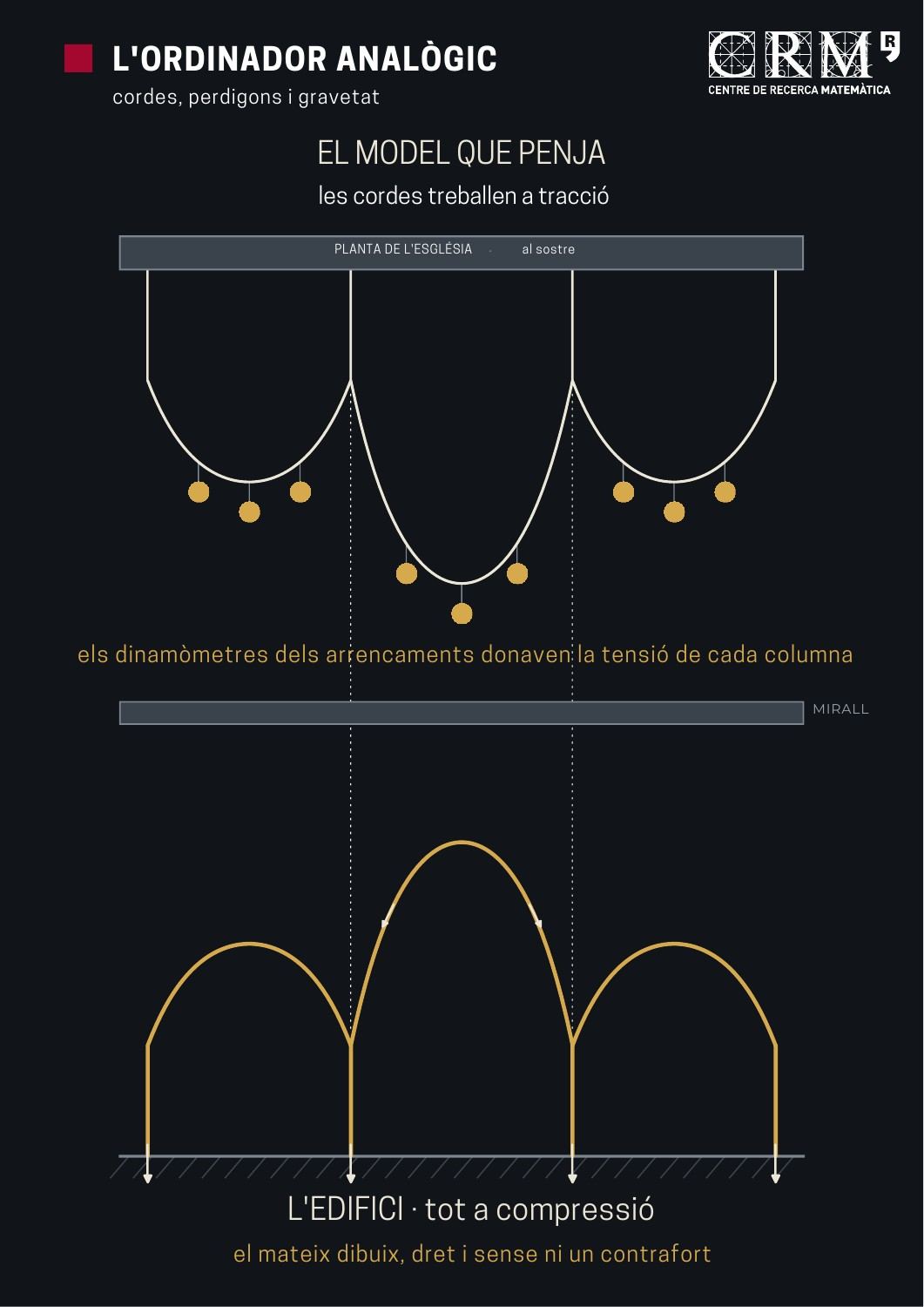
Per projectar l’església de la Colònia Güell, Gaudí va dibuixar la planta en un tauler, el va penjar del sostre i en va fer baixar cordes des dels punts on anirien les columnes. A les cordes hi va lligar saquets de perdigons, cadascun amb un pes proporcional a la càrrega que havia de suportar aquell punt.
To design the church at the Colònia Güell, Gaudí drew the floor plan on a board, hung the board from the ceiling and dropped strings from the points where the columns would go. On the strings he tied little sacks of lead shot, each weighing in proportion to the load that point would have to carry.
Cada corda troba tota sola la seva posició d’equilibri, i si es canvia un pes o es mou un ancoratge, tota l’estructura es reajusta en segons. Entre pes i pes la corda va recta, i a cada saquet es trenca en angle. Els enginyers en diuen polígon funicular.
Each string finds its own position of balance, and if you change a weight or move an anchor, the whole structure readjusts in seconds. Between one weight and the next the string runs straight, and at each sack it bends at an angle. Engineers call the result a funicular polygon.
Segons el catàleg de l’exposició Gaudí. La recerca de la forma (2002), el model, a més, mesurava: als arrencaments dels fils hi havia dinamòmetres, i llegint-los Gaudí sabia quina càrrega arribaria a la base de cada columna.
According to the catalogue of the 2002 exhibition Gaudí. Exploring Form, the model also took measurements: there were spring balances where the strings were anchored, and by reading them Gaudí knew what load would reach the foot of each column.
En un primer assaig, més petit, sembla que en va tenir prou amb mitja maqueta: un cable vertical tensat marcava l’eix de les cúpules centrals, i com que l’església és simètrica, resoldre’n la meitat ja ho resolia tot. La maqueta definitiva, en canvi, era sencera.
For a first, smaller trial he seems to have got by with half a model: a taut vertical cable marked the axis of the central domes, and since the church is symmetrical, solving half of it solved the lot. The final model, though, was complete.
Per què surt un polígonWhy a polygon
Cap saquet no estira de costat, de manera que la component horitzontal de la tensió és la mateixa a tot el fil. La vertical, en canvi, canvia de cop a cada saquet, exactament en el seu pes. D’aquí surten els trams rectes i els angles.
No sack pulls sideways, so the horizontal part of the tension is the same all along the string. The vertical part jumps at every sack, by exactly that sack’s weight. Hence the straight stretches and the kinks.
Si en lloc de saquets el pes estigués repartit per igual al llarg del fil, els angles es fondrien en una corba: la catenària del capítol anterior.
Spread the weight evenly along the string instead of hanging sacks, and the kinks melt into a curve: the catenary from the previous chapter.
 El pòster de l’exposicióThe exhibition poster
 Des de propUp close
03
La maqueta polifunicularThe polyfunicular model
Moltes corbes funiculars treballant alhora.
Many funicular curves working at once.
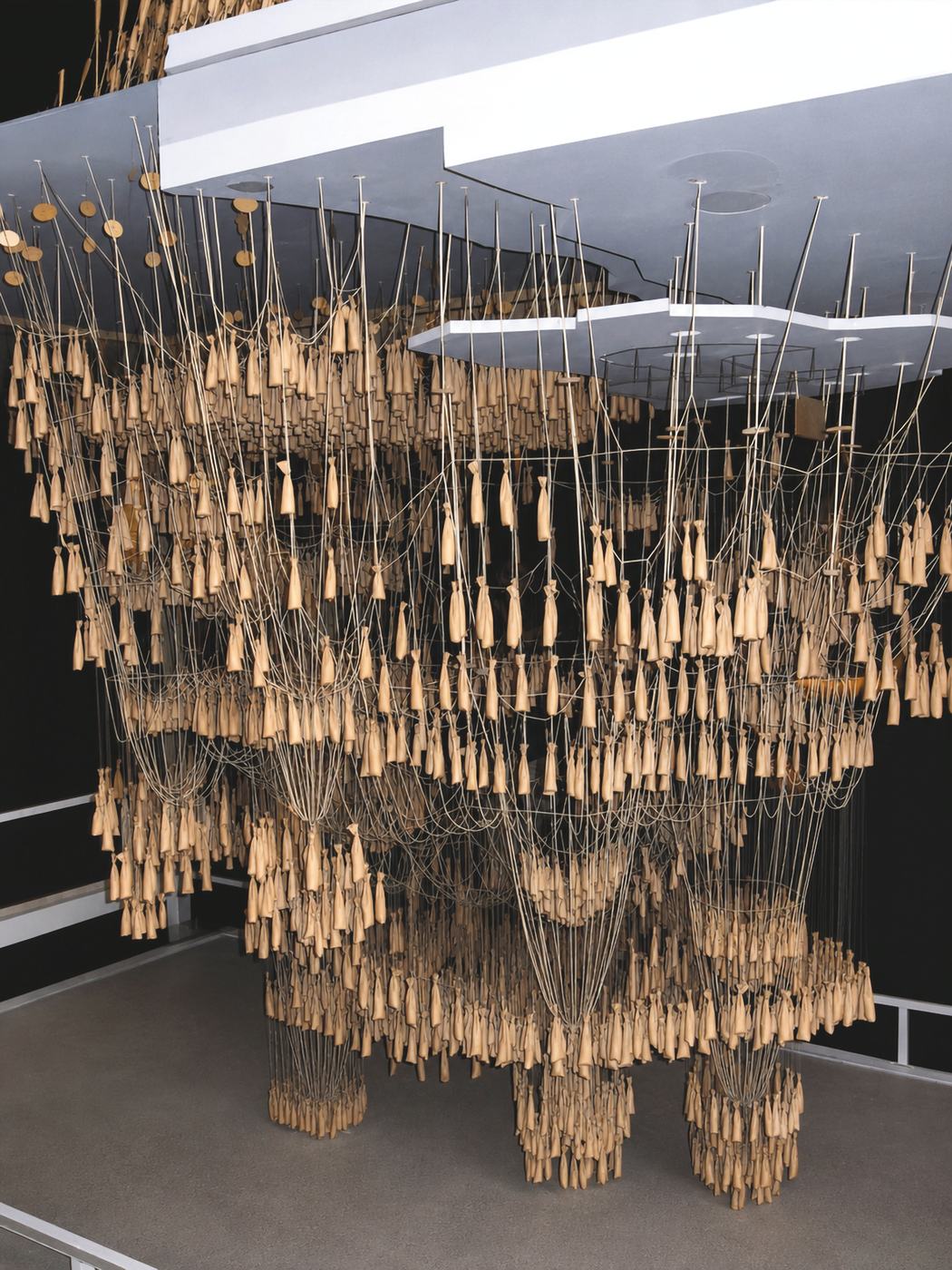
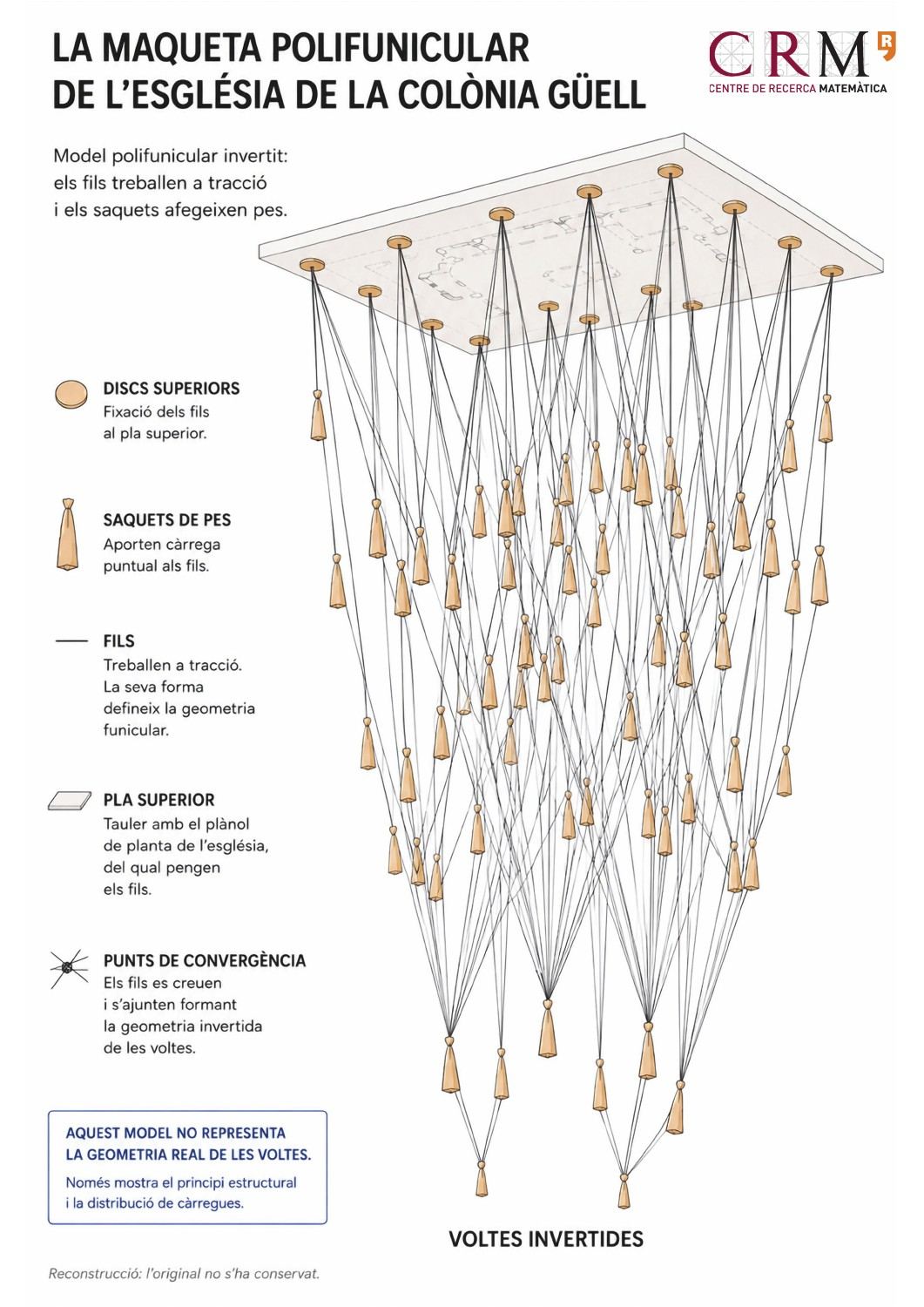
Una corda amb saquets resol un arc. Per resoldre una església sencera en calen centenars, encreuades, i que totes trobin l’equilibri a la vegada. D’aquí ve el nom del model: polifunicular, moltes corbes funiculars treballant alhora.
One string with sacks solves an arch. To solve a whole church you need hundreds of them, crossing one another, all finding their balance at the same time. Hence the model’s name: polyfunicular, many funicular curves at work together.
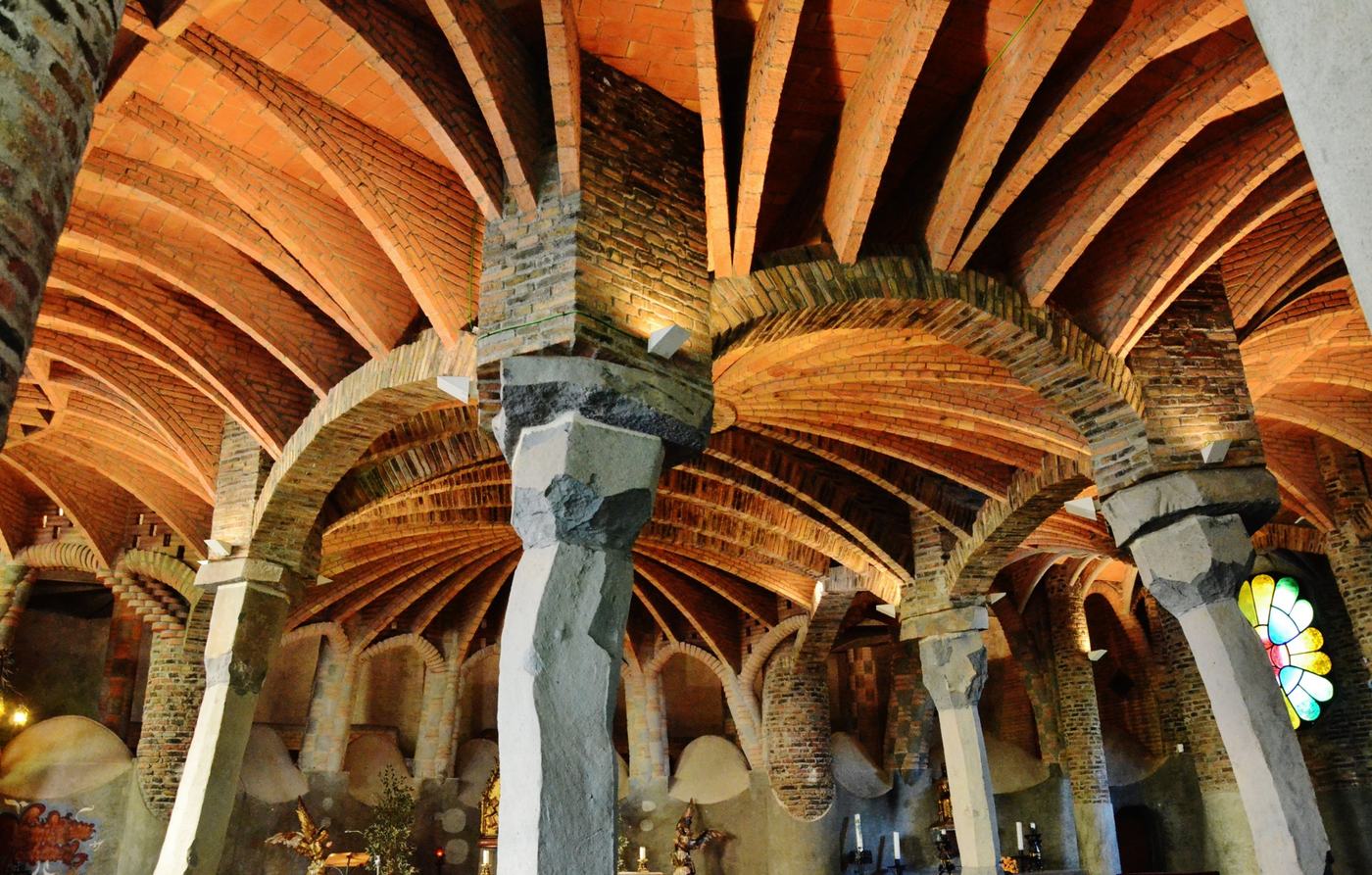
Tot plegat té una conseqüència que costa de veure en un plànol. Quan una corda n’estira una altra, la desvia, i les columnes que en surten ja no baixen verticals. A la cripta de la Colònia Güell, l’única part de l’església que es va arribar a construir, els pilars s’inclinen perquè segueixen la línia de forces que va sortir del model penjat. Cadascun s’inclina cap on li havia d’arribar la càrrega de l’església de dalt, que no es va arribar a fer.
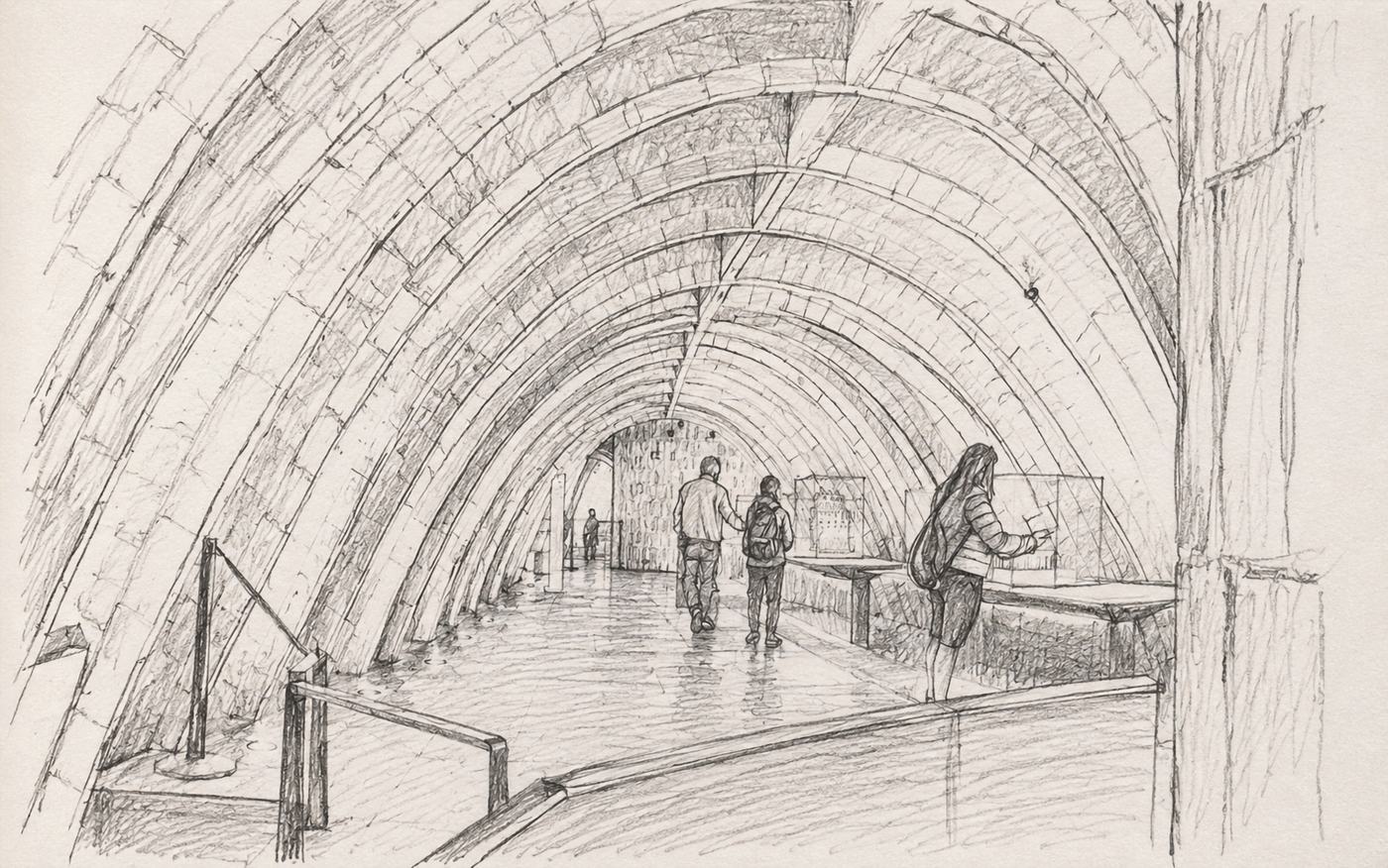
This has a consequence that’s hard to see on a plan. When one string pulls on another it deflects it, and the columns that come out of the model no longer drop straight. In the crypt of the Colònia Güell, the only part of the church that was ever built, the pillars lean because they follow the lines of force that came out of the hanging model. Each one leans the way the load of the church above was meant to reach it, though that church was never built.
El model no dibuixa la geometria definitiva de les voltes. Mostra com es reparteixen les forces, que és el problema difícil.
The model doesn’t give the final geometry of the vaults. It shows how the forces are shared out, which is the hard problem.
Dècades després, l’arquitecte alemany Frei Otto també penjava xarxes i cadenes per trobar la forma de les seves cobertes, i un equip del seu institut, a Stuttgart, va reconstruir la maqueta de Gaudí, la que avui es pot veure al museu de la Sagrada Família.
Decades later the German architect Frei Otto was also hanging nets and chains to find the shapes of his roofs, and a team from his institute in Stuttgart rebuilt Gaudí’s model, the one on show today in the Sagrada Família museum.
Com es fa avuiHow it’s done today
Qui busca formes així avui ja no penja perdigons: fa servir programes que simulen el mateix equilibri. Un dels mètodes més usats, el de les densitats de força, el van presentar Klaus Linkwitz i Hans-Jörg Schek a començament dels anys setanta, i va néixer per calcular les cobertes de cables del Parc Olímpic de Munic, on també hi havia la mà de Frei Otto.
Nobody hangs lead shot to find shapes like these any more: there’s software that simulates the same balance. One of the most common methods, force density, was introduced by Klaus Linkwitz and Hans-Jörg Schek in the early 1970s, and it was born to calculate the cable-net roofs of Munich’s Olympic Park, where Frei Otto also had a hand.
La figura d’aquesta pàgina fa servir un truc més humil: fils molt rígids que es van relaxant fins que la xarxa s’atura.
The figure on this page uses a humbler trick: very stiff threads that relax until the net stops moving.
 El pòster de l’exposicióThe exhibition poster
 Des de propUp close
04
Superfícies regladesRuled surfaces
Corbes fetes, punt per punt, de rectes.
Curves made, point by point, of straight lines.
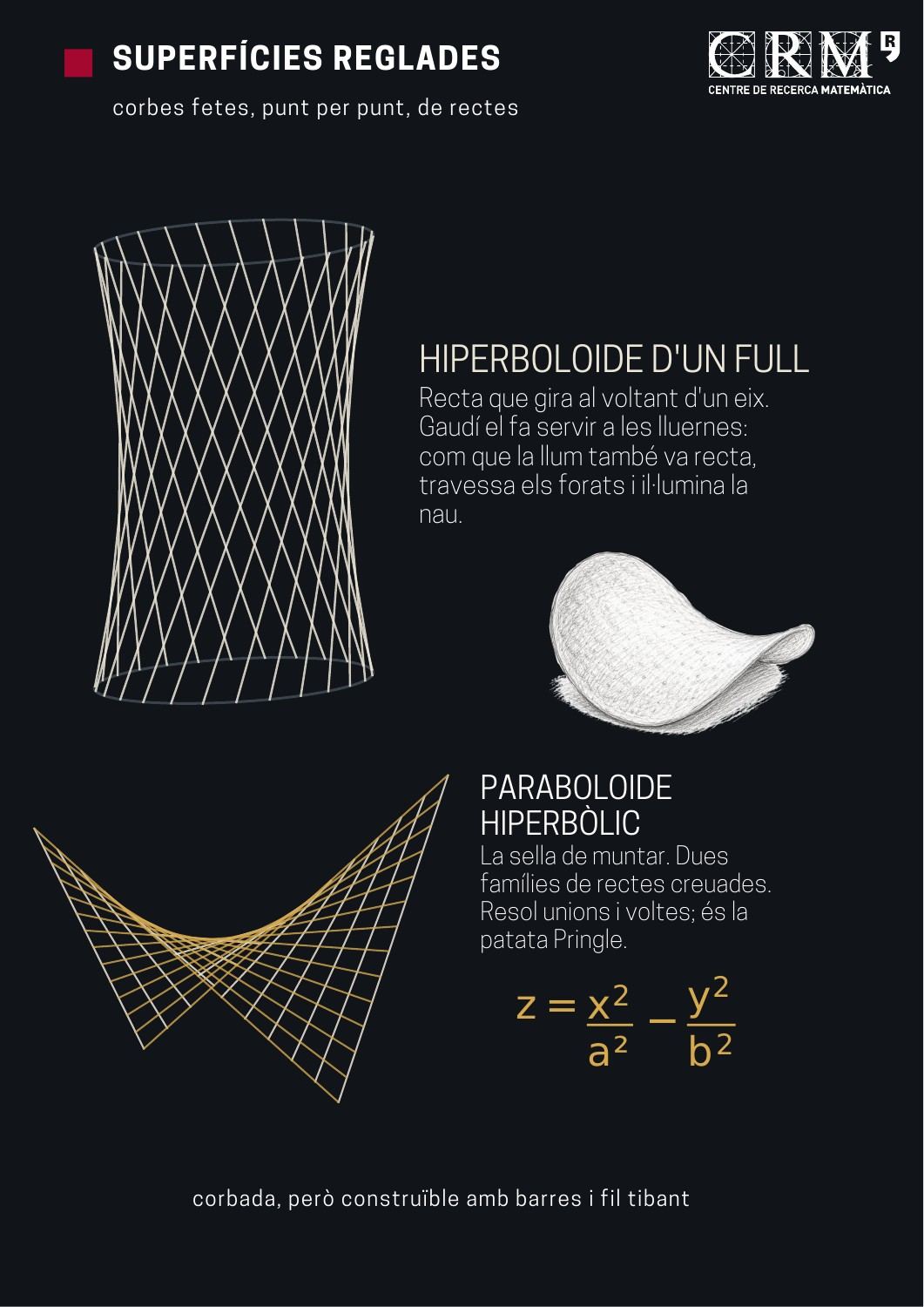
Agafa dos cercles, un sobre l’altre, i lliga’ls amb fils rectes. Tens un cilindre. Ara gira el cercle de dalt. Els fils continuen rectes, però el conjunt s’estreny per la cintura i es converteix en un hiperboloide d’un full.
Take two circles, one above the other, and join them with straight threads. You’ve got a cylinder. Now turn the top circle. The threads stay straight, but the whole thing pinches in at the waist and becomes a hyperboloid of one sheet.
Per cada punt d’aquesta superfície hi passen dues rectes que hi reposen senceres, una de cada família, i per això se’n diu doblement reglada. El mateix passa amb el paraboloide hiperbòlic, la forma d’una sella de muntar (o d’una patata Pringles, ja que hi som).
Through every point of this surface run two straight lines that lie on it completely, one from each family, which is why it’s called doubly ruled. The same goes for the hyperbolic paraboloid, the shape of a riding saddle (or of a Pringle, while we’re at it).
L’avantatge és immediat a l’obra. Si una superfície es genera movent una recta, es pot construir amb material recte: barres, taulons d’encofrat, un fil ben tibant. Gaudí va ser dels primers arquitectes que en van fer un ús conscient i sistemàtic. Les lluernes de la Sagrada Família, per exemple, són hiperboloides.
On a building site the advantage is immediate. If a surface is generated by moving a straight line, you can build it out of straight material: bars, formwork planks, a tightly stretched thread. Gaudí was one of the first architects to use these surfaces deliberately and systematically. The skylights of the Sagrada Família, for one, are hyperboloids.
Les equacionsThe equations
L’hiperboloide d’un full: x2/a2 + y2/a2 − z2/c2 = 1. Si els dos cercles tenen radi R i el de dalt gira un angle φ, la cintura queda amb radi a = R · cos(φ/2). A 180° tots els fils es creuarien a l’eix i l’hiperboloide es col·lapsaria en dos cons.
Hyperboloid of one sheet: x2/a2 + y2/a2 − z2/c2 = 1. If both circles have radius R and the top one turns through an angle φ, the waist ends up with radius a = R · cos(φ/2). At 180° every thread would cross the axis and the hyperboloid would collapse into two cones.
El paraboloide hiperbòlic: z = x2/a2 − y2/b2. Si a = b, girant els eixos 45° s’escriu z = k · x · y, i així es veu de seguida que és reglat: si fixes x, la z depèn de la y en línia recta.
Hyperbolic paraboloid: z = x2/a2 − y2/b2. If a = b, turning the axes 45° gives z = k · x · y, where the ruling is plain to see: fix x, and z depends on y along a straight line.
 El pòster de l’exposicióThe exhibition poster
 Des de propUp close
05
Corbes vivesLiving curves
Espiral, hèlix i sinusoide, més emparentades del que sembla.
Spiral, helix and sine wave, more closely related than they look.
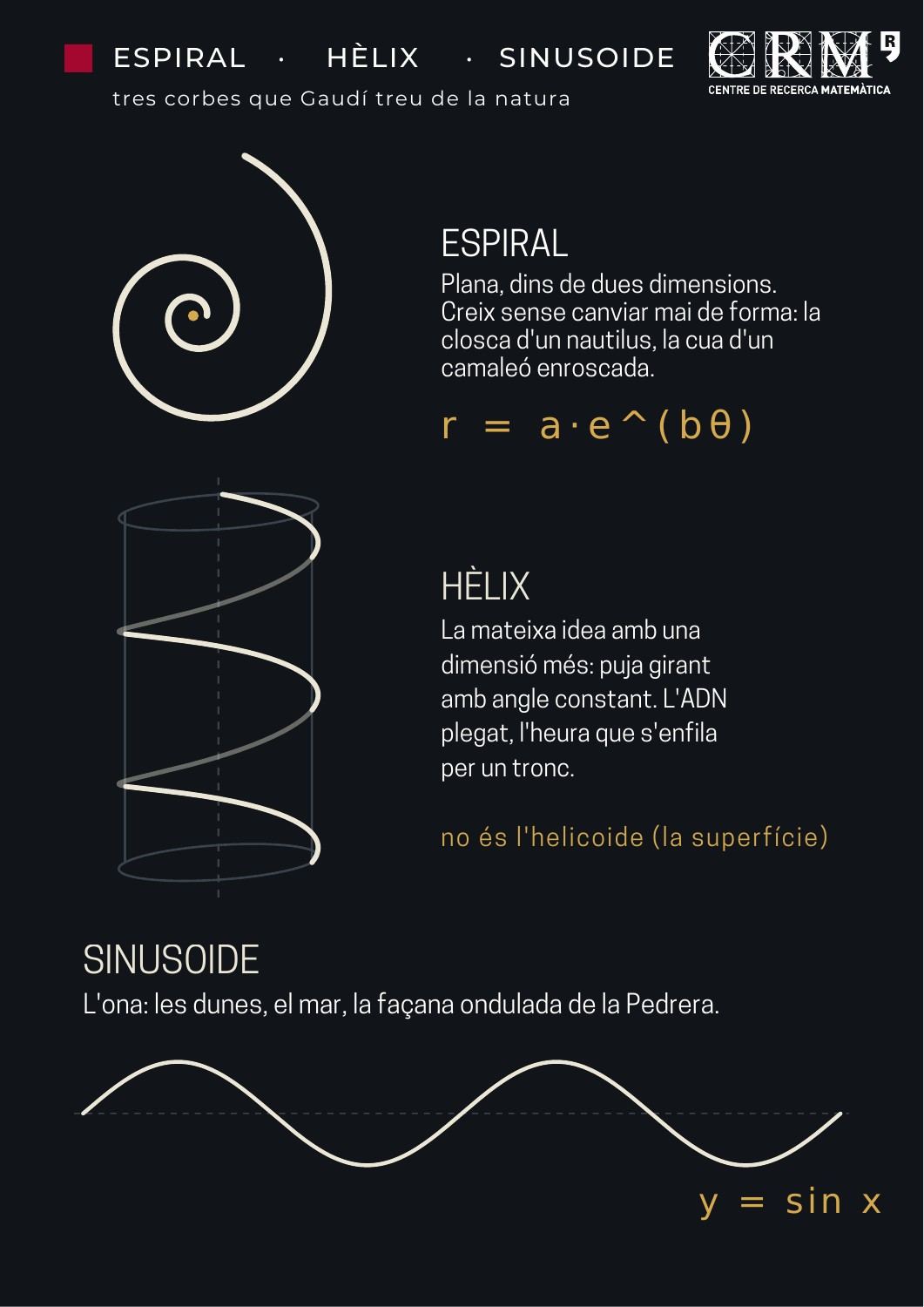
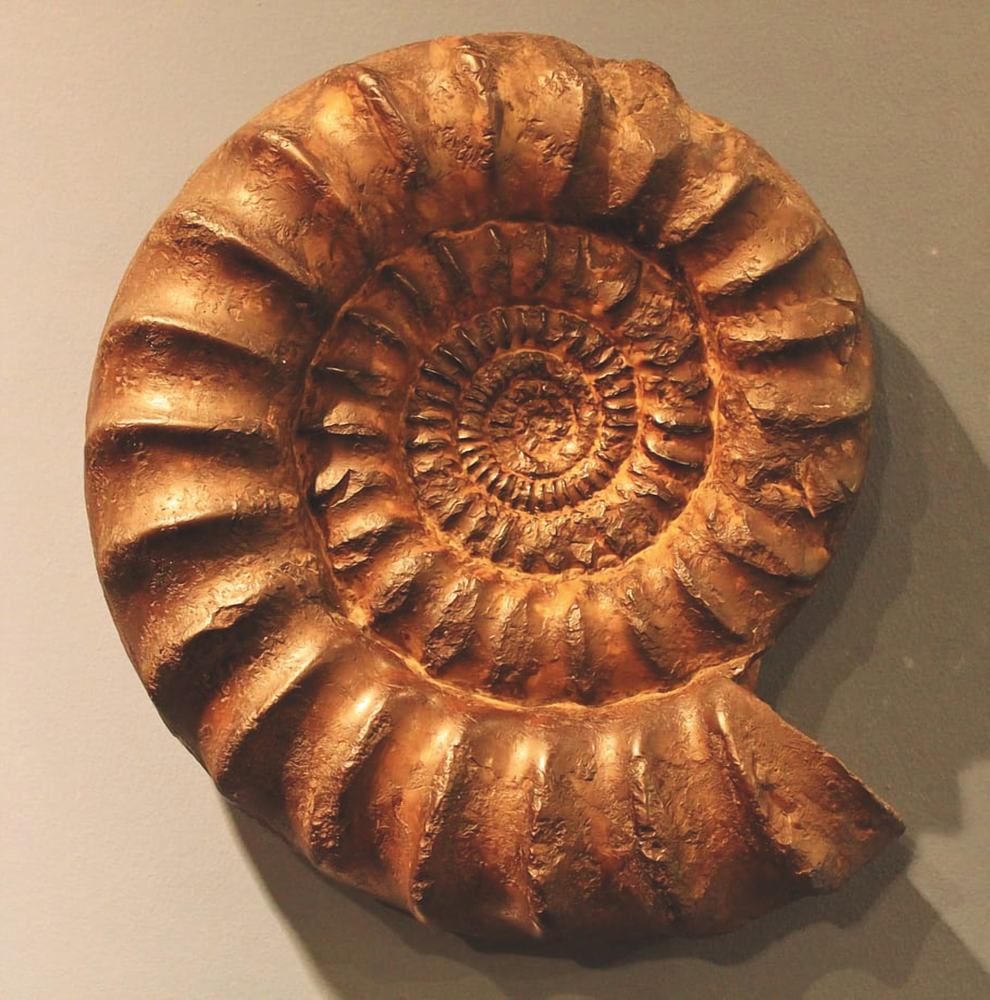
Tres corbes que es confonen sovint. L’espiral és plana: s’allunya del centre mentre hi gira al voltant, i en la versió logarítmica creix sense canviar mai de forma (r = a · ebθ). L’hèlix és la mateixa idea amb una dimensió més, una corba que puja girant amb angle constant. La sinusoide és l’ona, y = sin x.
Three curves that often get mixed up. The spiral is flat: it moves away from the centre as it turns around it, and in its logarithmic version it grows without ever changing shape (r = a · ebθ). The helix is the same idea with one more dimension, a curve that climbs as it turns, at a constant angle. The sine wave is the wave, y = sin x.
Val la pena no barrejar hèlix i helicoide. La primera és una corba; el segon és la superfície que escombra una recta quan gira i puja alhora, com la rampa d’una escala de cargol.
Helix and helicoid are worth keeping apart. The first is a curve; the second is the surface swept by a straight line that turns and climbs at the same time, like the ramp of a spiral staircase.
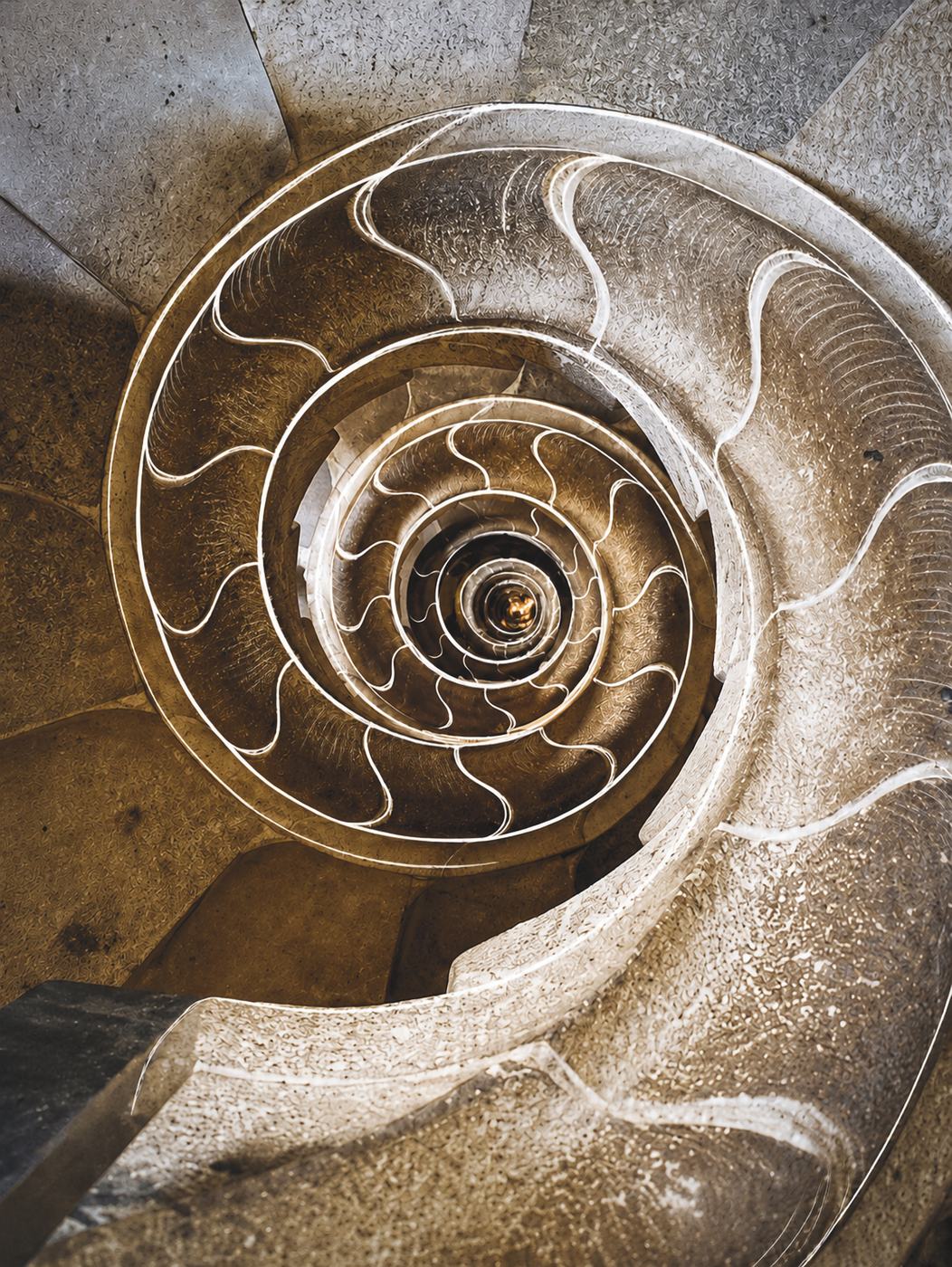
La figura amaga un parentiu. Mira l’hèlix de costat i veuràs una sinusoide. Mira-la des de dalt, amb perspectiva, i les voltes més llunyanes s’encongeixen fins a dibuixar una espiral. No és la logarítmica, però és el mateix efecte que fa que una escala de cargol, fotografiada des del replà, sembli una closca.
The figure hides a family resemblance. Look at the helix from the side and you’ll see a sine wave. Look at it from above, in perspective, and the far turns shrink until they draw a spiral. Not the logarithmic one, but it’s the same effect that makes a spiral staircase, photographed from the top landing, look like a shell.
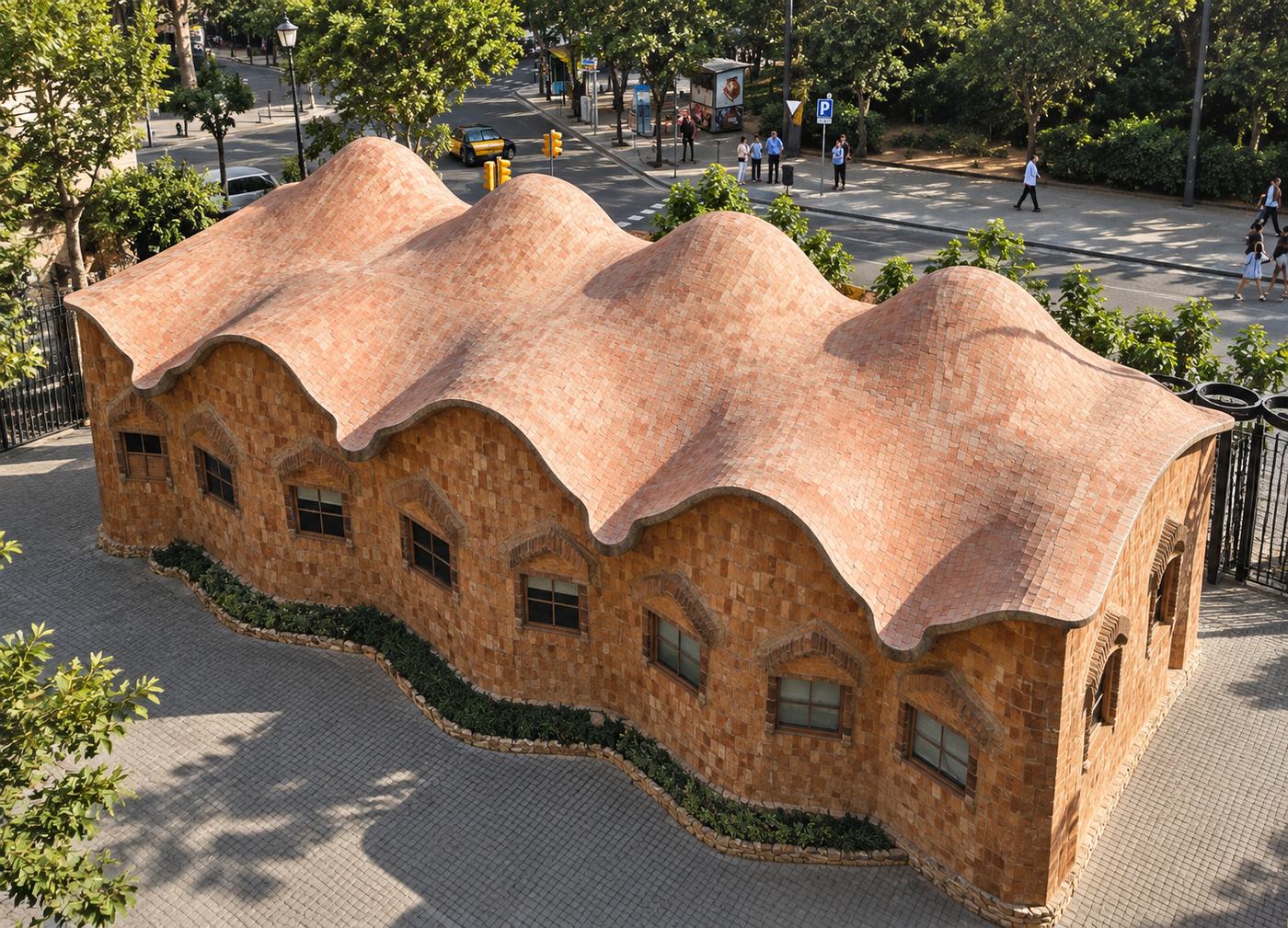
Gaudí les fa servir totes tres. Hèlixs a les escales de cargol, a les columnes i a les xemeneies; ones a la façana de la Pedrera i a la teulada de les Escoles. L’espiral apareix quan mires aquelles escales des de dalt.
Gaudí uses all three. Helices in the spiral staircases, the columns and the chimneys; waves on the façade of La Pedrera and on the roof of the schools. The spiral appears when you look down those staircases from above.
Girar i ampliar, la mateixa cosaTurning and zooming, the same thing
A r = a · ebθ, girar la corba un angle equival a ampliar-la o reduir-la per un factor constant. Per això, quan la figura gira, sembla que ens hi acostem sense fi, i per això talla tots els radis amb el mateix angle.
In r = a · ebθ, turning the curve through an angle is the same as scaling it by a constant factor. That’s why the spinning figure seems to draw you in forever, and why it cuts every radius at the same angle.
Una hèlix de radi R es pot escriure x = R cos t, y = R sin t, z = c t. Vista de costat, x contra z, és exactament una sinusoide.
A helix of radius R can be written x = R cos t, y = R sin t, z = c t. Seen from the side, x against z, it is exactly a sine wave.
 El pòster de l’exposicióThe exhibition poster
 Des de propUp close
06
La columna de doble girThe double-twist column
Una estrella que puja fins a fer-se gairebé cercle.
A star that climbs until it’s almost a circle.
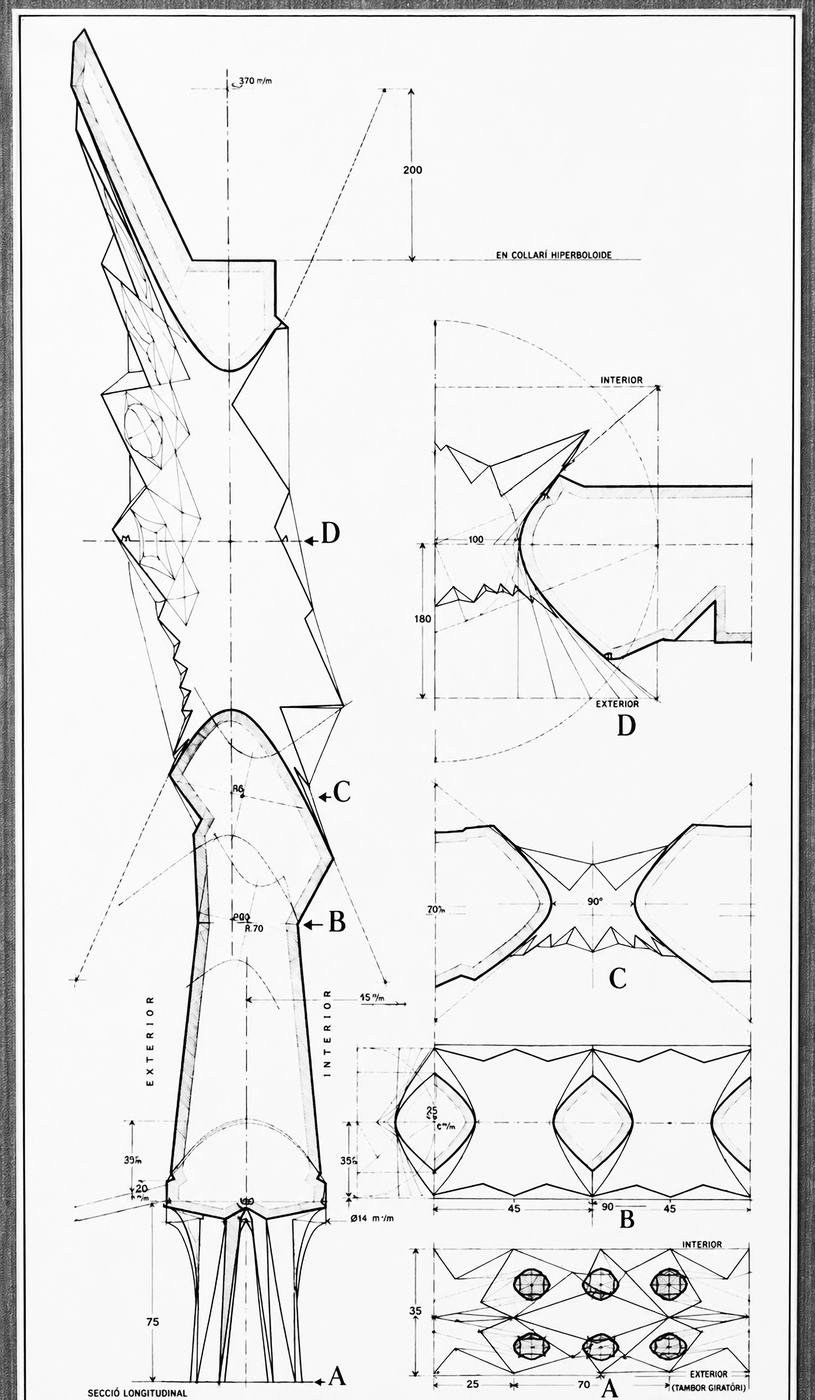
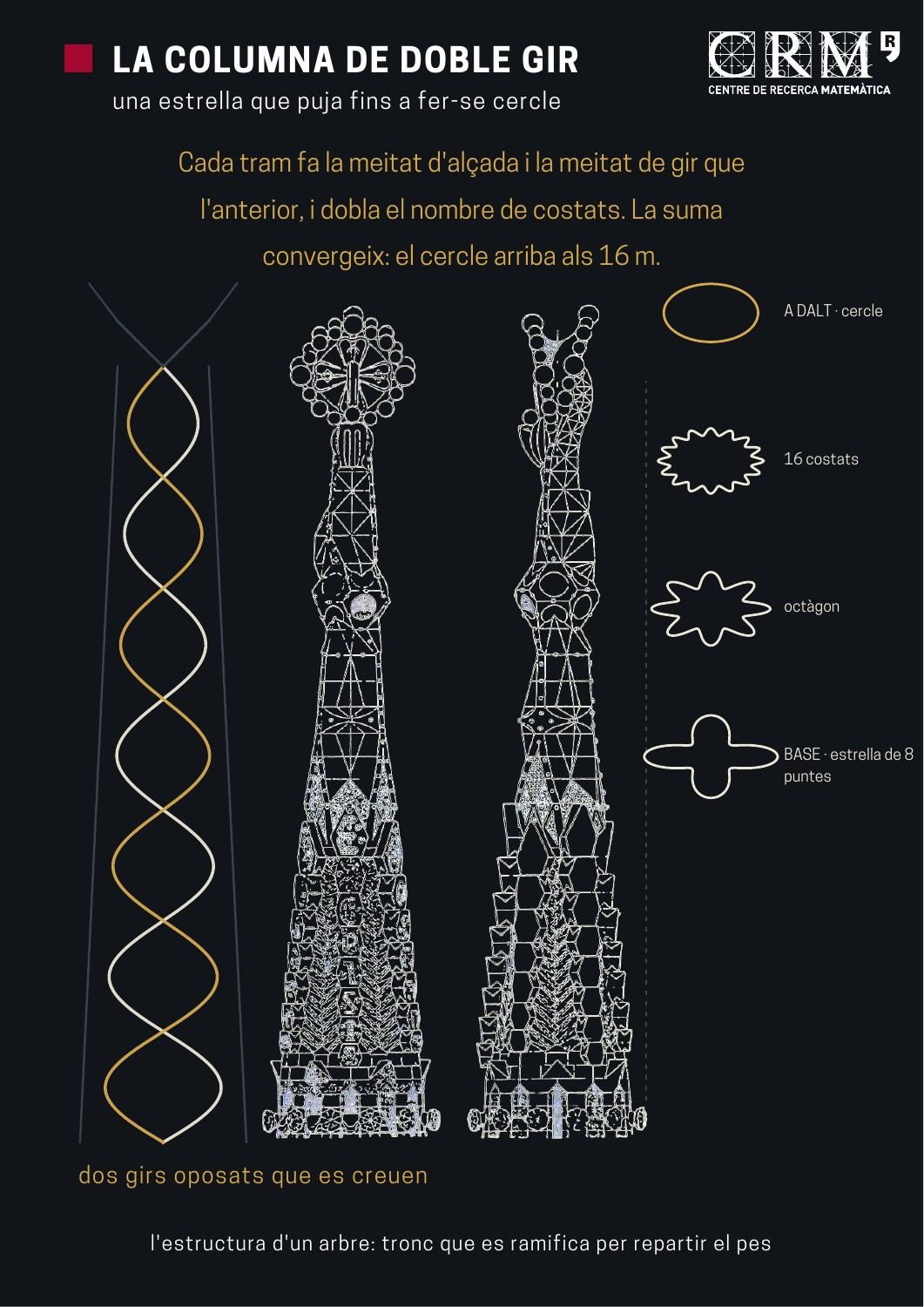
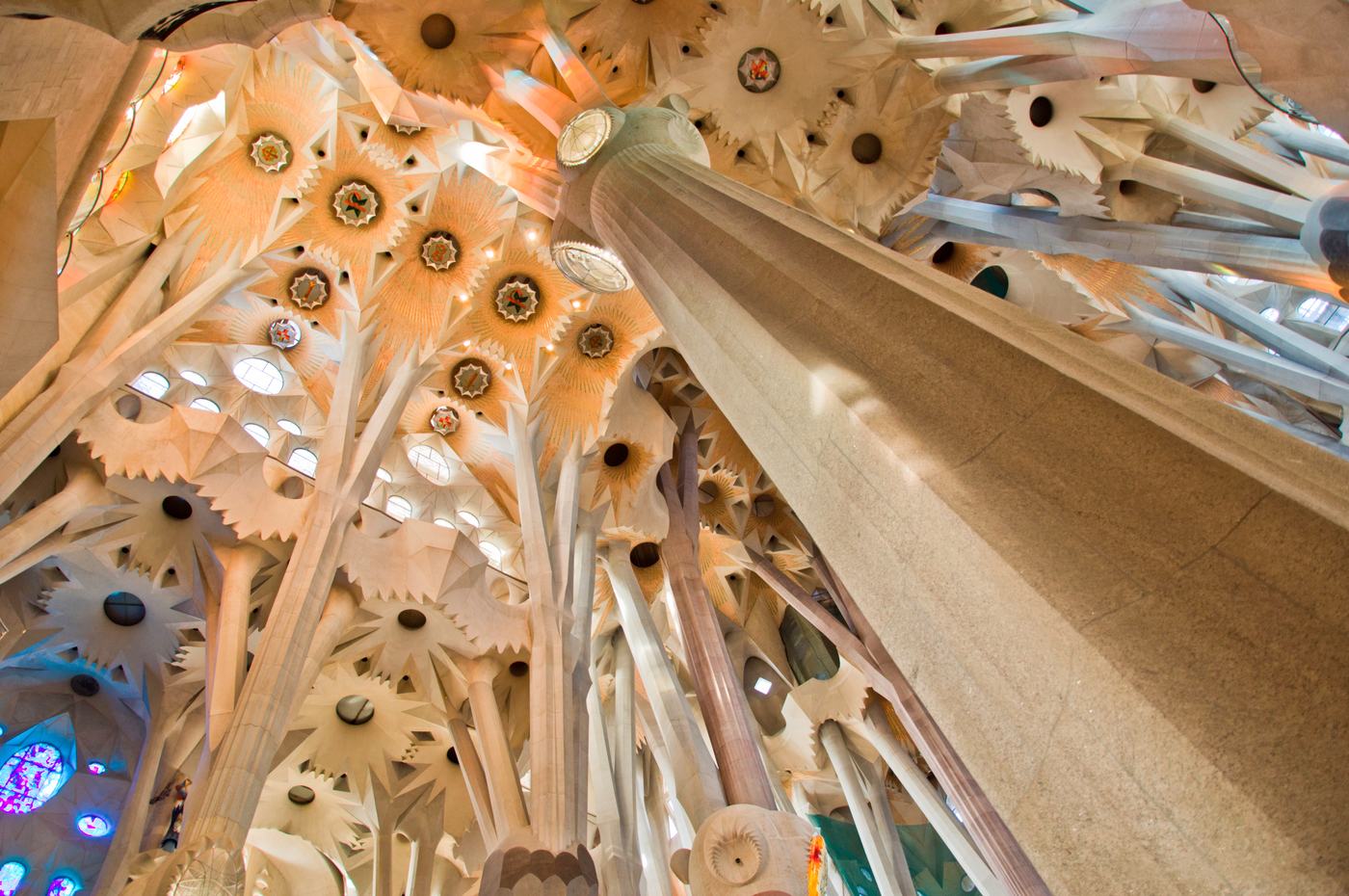
Les columnes de la nau central de la Sagrada Família no són cilindres. La secció de la base és una estrella de vuit puntes, formada per dos quadrats girats 45°, i el contorn són vuit paràboles convexes i vuit de còncaves. A partir d’aquí la columna puja torçant-se alhora en els dos sentits: dos helicoides de gir invers que neixen de la mateixa base. La columna és el tros que tenen en comú.
The columns of the Sagrada Família’s central nave aren’t cylinders. The cross-section at the base is an eight-pointed star made from two squares turned 45°, and its outline is eight convex parabolas and eight concave ones. From there the column rises twisting both ways at once: two helicoids turning in opposite directions from the same base. The column is the part they have in common.
Als vuit primers metres la plantilla gira en tots dos sentits i les paràboles còncaves passen de vuit a setze. Perquè les setze puntes surtin iguals, cada gir ha de ser d’11,25°: les dues estrelles queden desfasades 22,5°, la meitat de l’angle entre dues puntes. Cada tram següent fa la meitat d’alçada i la meitat de gir que l’anterior, i torna a doblar el nombre de paràboles còncaves: trenta-dues als dotze metres, seixanta-quatre als catorze.
Over the first eight metres the template turns both ways and the concave parabolas go from eight to sixteen. For the sixteen points to come out equal, each turn has to be 11.25°, leaving the two stars 22.5° apart, half the angle between two points. Each following stretch is half as tall and turns half as much as the one before, and doubles the number of concave parabolas again: thirty-two at twelve metres, sixty-four at fourteen.
Aquí hi ha la sorpresa. Sumant infinits trams que es redueixen a la meitat, el total no passa mai d’un límit: h + h/2 + h/4 + … = 2h. Amb un primer tram de vuit metres, el cercle arribaria exactament als setze. Gaudí no l’ensenya. El fust s’acaba als catorze metres, i a sobre hi ha el capitell, un nus en forma d’el·lipsoide que amaga la resta de trams. El cercle queda a dins, on no es veu.
Here’s the surprise. Add up infinitely many stretches, each half the last, and the total never passes a limit: h + h/2 + h/4 + … = 2h. With a first stretch of eight metres, the circle would arrive at exactly sixteen. Gaudí doesn’t show it. The shaft ends at fourteen metres, and on top sits the capital, an ellipsoid knot that hides the remaining stretches. The circle is inside it, out of sight.
La sèrie de ZenóZeno’s series
Zenó d’Elea feia servir aquesta mateixa divisió en meitats per argumentar que ningú no arriba mai enlloc: abans de fer tot el camí n’has de fer la meitat, i abans la meitat de la meitat, i així sense fi. La sèrie 1/2 + 1/4 + 1/8 + … té infinits termes i, tot i així, suma exactament 1.
Zeno of Elea used this same halving to argue that nobody ever gets anywhere: before covering the whole distance you must cover half of it, and before that half of the half, and so on forever. The series 1/2 + 1/4 + 1/8 + … has infinitely many terms and still adds up to exactly 1.
Els trams de la columna són 8 + 4 + 2 + 1 + … metres. Cada tram cobreix la meitat del que falta, i el total no passa mai de 16.
The column’s stretches are 8 + 4 + 2 + 1 + … metres. Each stretch covers half of what’s left, and the total never passes 16.
 El pòster de l’exposicióThe exhibition poster
 Des de propUp close
07
El mòdul de 7,5 metresThe 7.5-metre module
Un temple que es pot comptar.
A church you can count.
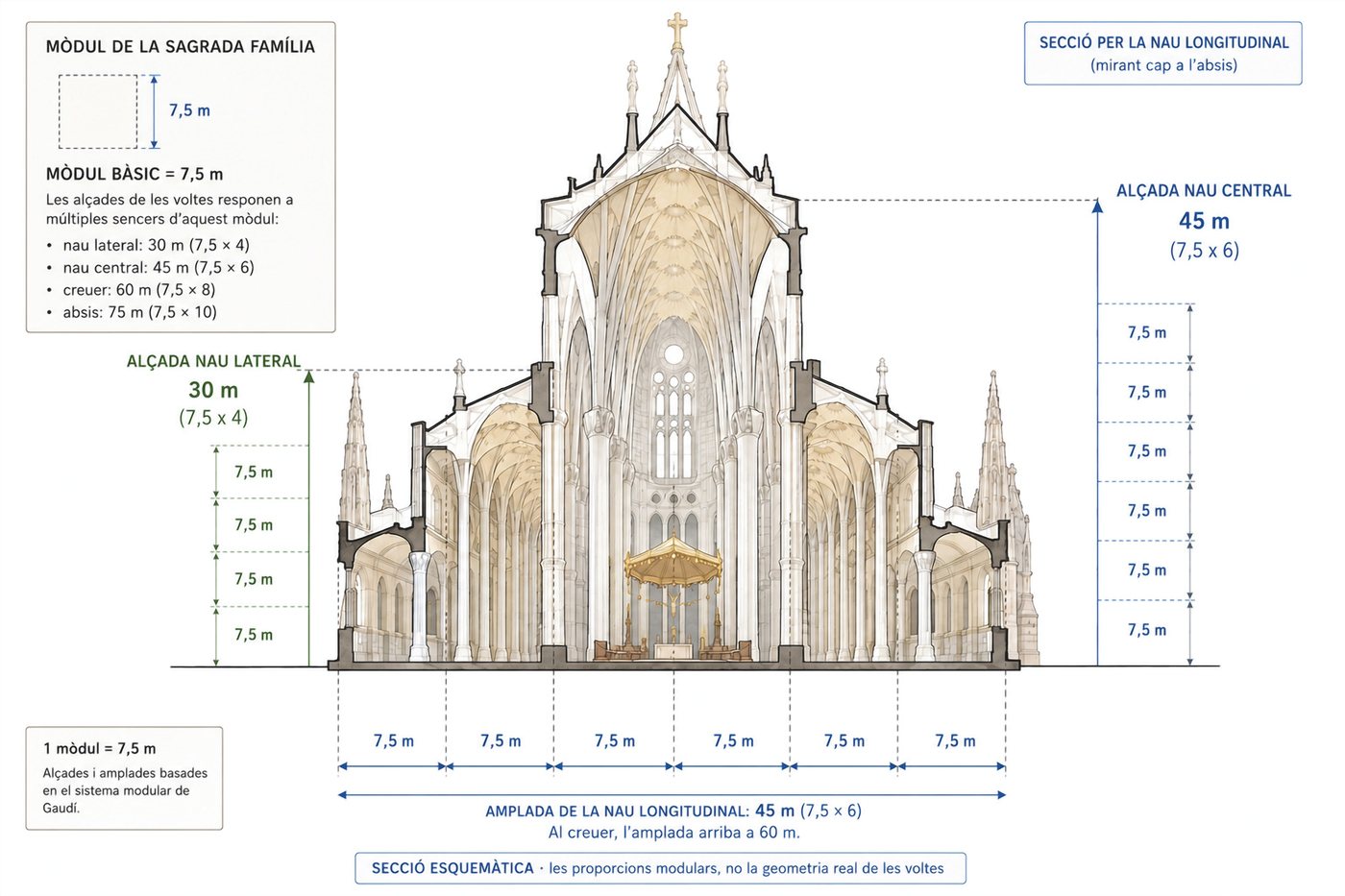
La secció de la Sagrada Família ensenya que el temple creix per múltiples d’una mateixa unitat, 7,5 metres. Les naus laterals arriben a 30 metres (7,5 × 4), la central a 45 (7,5 × 6), el creuer a 60 i l’absis a 75. L’amplada fa el mateix: sis mòduls, 45 metres, per a les cinc naus del cos principal.
The cross-section of the Sagrada Família shows that the building grows in multiples of a single unit, 7.5 metres. The side aisles reach 30 metres (7.5 × 4), the central nave 45 (7.5 × 6), the crossing 60 and the apse 75. The width follows suit: six modules, 45 metres, for the nave and its four aisles.
El que compta aquí és el sistema, més que les xifres. Fixar un mòdul vol dir que totes les mides principals s’expressen amb un nombre enter de mòduls, i això simplifica el traçat, permet construir per parts i deixa treballar generacions d’arquitectes que no van coincidir mai a l’obra.
What counts here is the system more than the figures. Fixing a module means every main dimension is a whole number of units, and that simplifies the setting-out, lets the building go up in parts, and allows generations of architects who never met on site to keep working on it.
El sistema arriba fins a les columnes. Tots els diàmetres són dotzenes parts dels 210 centímetres de les quatre columnes centrals del creuer. La de baix de la nau central en fa 140, vuit dotzenes, i té una estrella de vuit puntes que puja 8 + 4 + 2 metres. Les del creuer, dotze dotzenes, tenen dotze puntes i pugen 12 + 6 + 3. En totes dues, el mateix nombre fixa el gruix, les puntes i els metres.
The system reaches down to the columns. Every diameter is a number of twelfths of the 210 centimetres of the four central columns of the crossing. The lower column of the central nave is 140 cm across, eight twelfths, and has an eight-pointed star that climbs 8 + 4 + 2 metres. The crossing columns, twelve twelfths, have twelve points and climb 12 + 6 + 3. In both, the same number sets the thickness, the points and the metres.
Des de propUp close
08
El quadrat (gairebé) màgicThe (almost) magic square
Setze números a la façana de la Passió. No són de Gaudí.
Sixteen numbers on the Passion façade. They aren’t Gaudí’s.
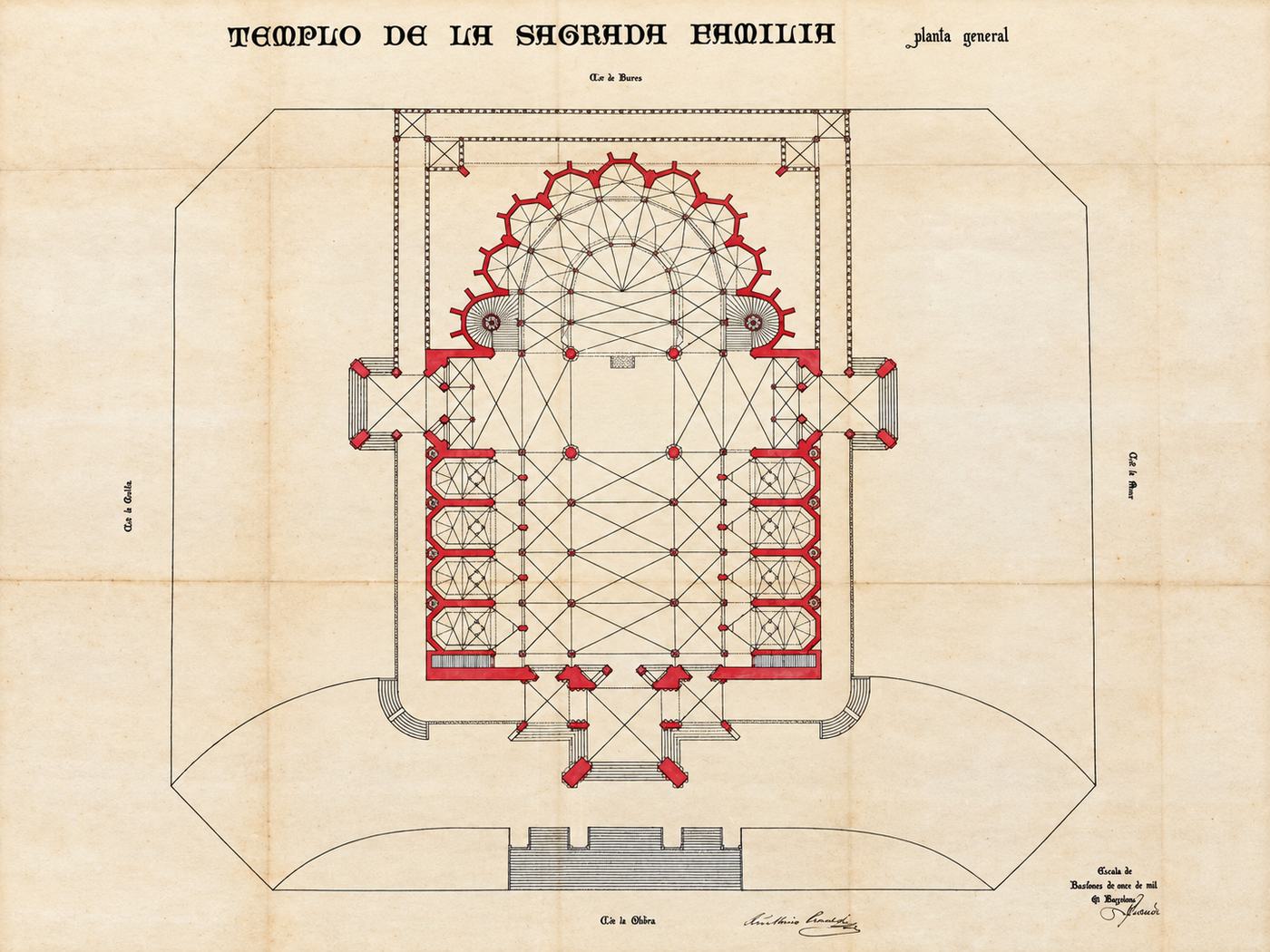
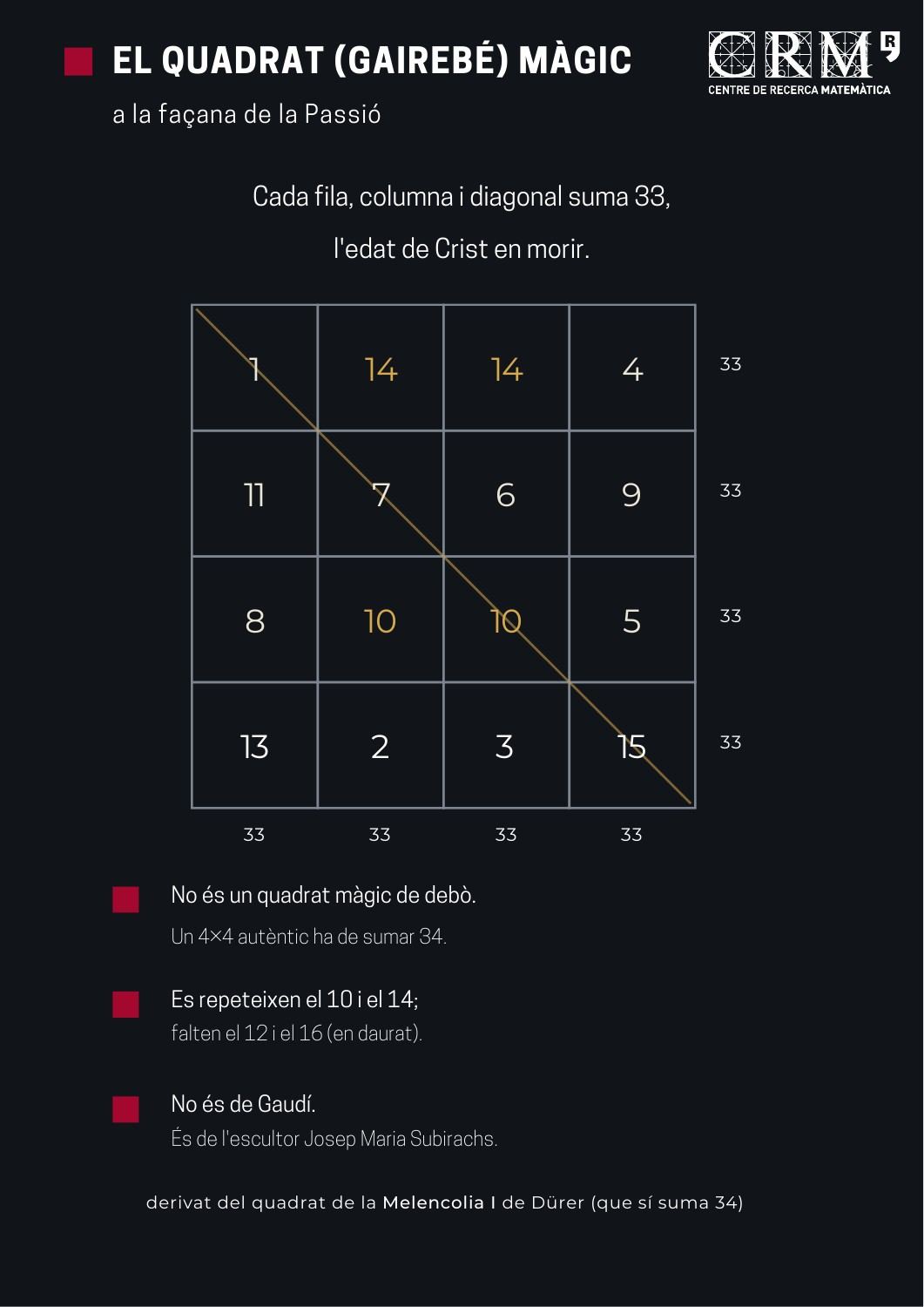
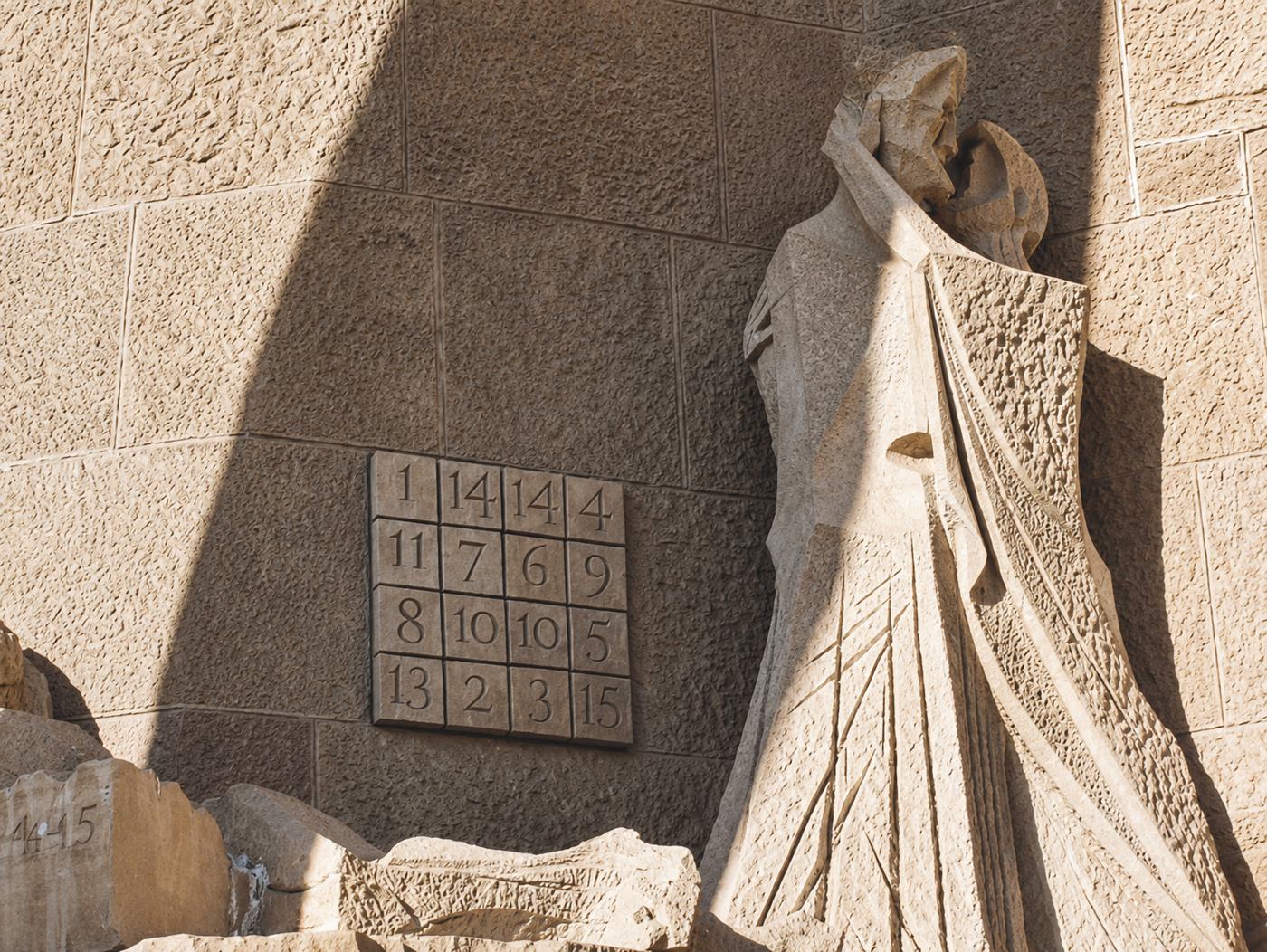
A la façana de la Passió hi ha setze números que sumen 33 en files, columnes i diagonals: l’edat de Crist en morir. El quadrat no és de Gaudí. El va posar l’escultor Josep Maria Subirachs, dècades després de la mort de l’arquitecte.
On the Passion façade there are sixteen numbers that add up to 33 along the rows, the columns and the diagonals: Christ’s age when he died. The square isn’t Gaudí’s. The sculptor Josep Maria Subirachs put it there decades after the architect’s death.
Un quadrat màgic de 4 × 4 autèntic conté els nombres de l’1 al 16 una sola vegada, i llavors la suma només pot ser 34. La demostració ocupa dues línies: tots els nombres sumen 136, i repartits en quatre files donen 34 per fila. Per abaixar la suma a 33, Subirachs va repetir el 10 i el 14 i va treure el 12 i el 16.
A genuine 4 × 4 magic square holds the numbers 1 to 16 once each, and then the sum can only be 34. The proof takes two lines: all the numbers add up to 136, and shared among four rows that’s 34 each. To bring it down to 33, Subirachs repeated 10 and 14 and dropped 12 and 16.
El punt de partida és el quadrat que Albrecht Dürer va gravar a la Melencolia I el 1514, que sí suma 34 i que duu la data amagada a la fila de baix. Gira’l mig tomb, resta 1 a quatre caselles ben triades, i tens el de Subirachs. Hi havia moltes maneres d’arribar a 33; aquesta deixa repetits el 10 i el 14, que sumen 48 si es compten les dues vegades, i 48 és la suma de les posicions de les lletres I, N, R, I a l’alfabet llatí clàssic, que no té J.
The starting point is the square Albrecht Dürer engraved in Melencolia I in 1514, which does add up to 34 and hides the date in its bottom row. Turn it half a turn, take 1 off four well-chosen cells, and you have Subirachs’s. There were many ways to reach 33; this one leaves 10 and 14 repeated, which make 48 if you count both appearances, and 48 is the sum of the positions of the letters I, N, R, I in the classical Latin alphabet, which has no J.
 El pòster de l’exposicióThe exhibition poster
 33
Des de propUp close
Al margeIn the margins
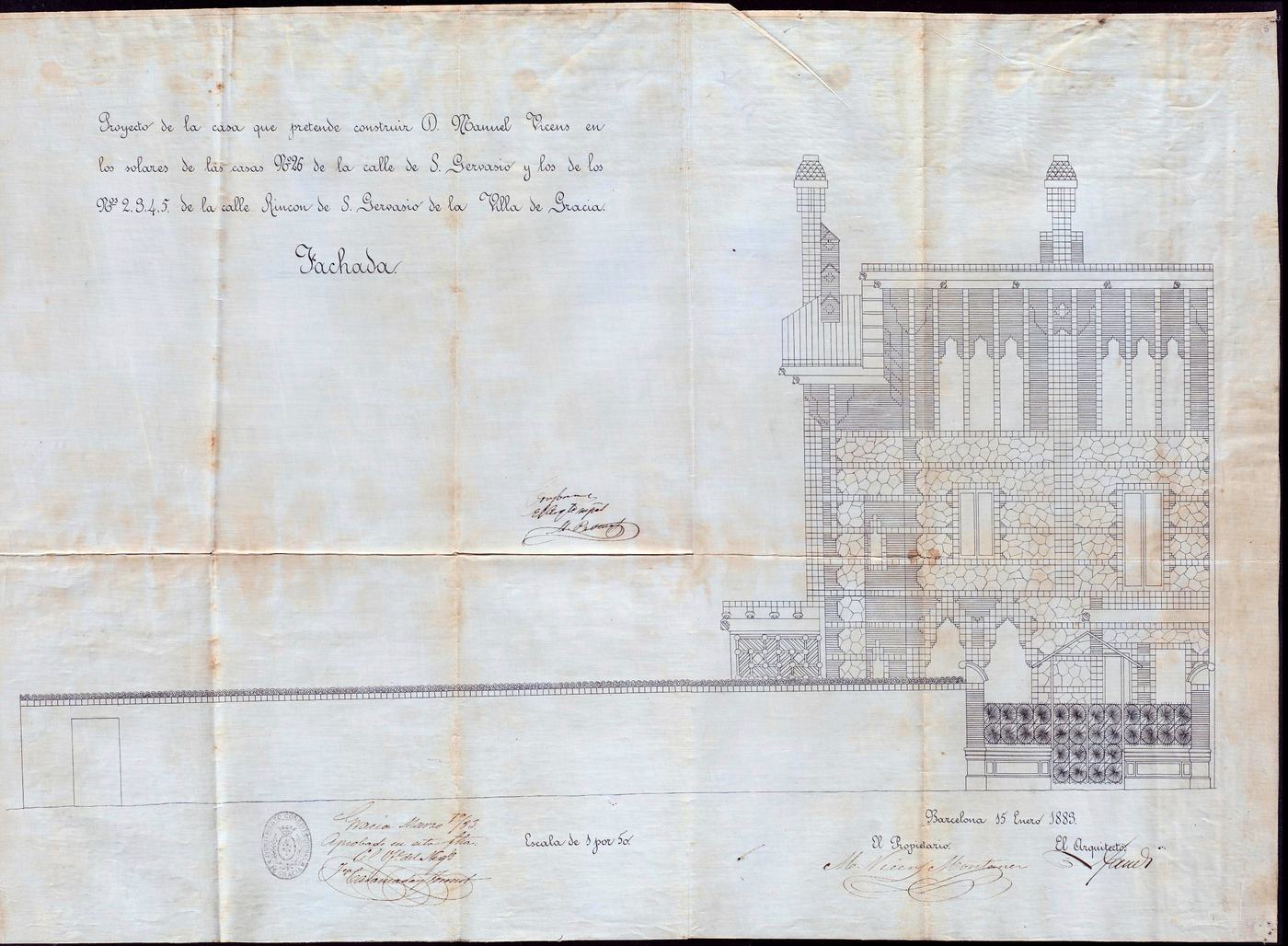
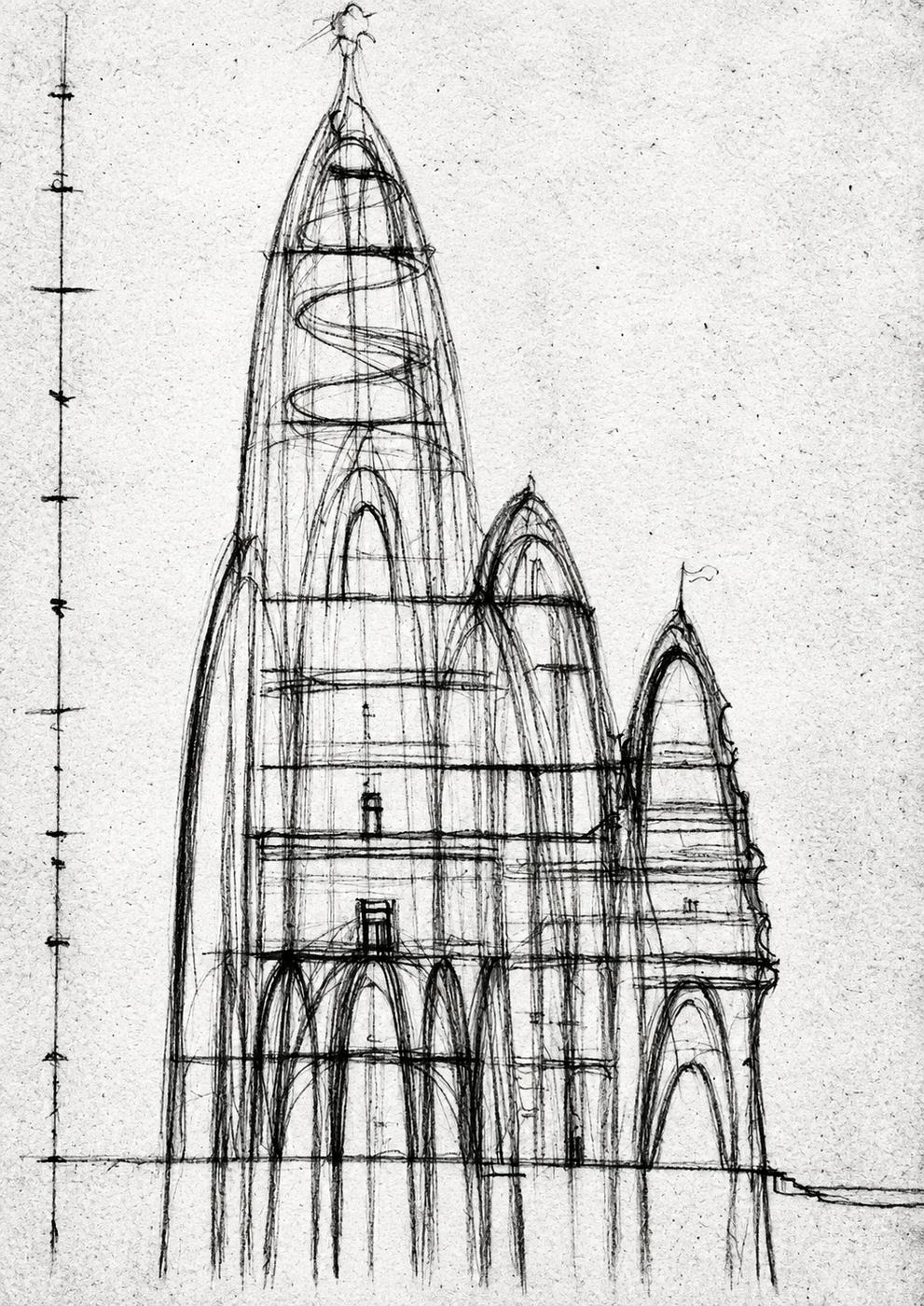
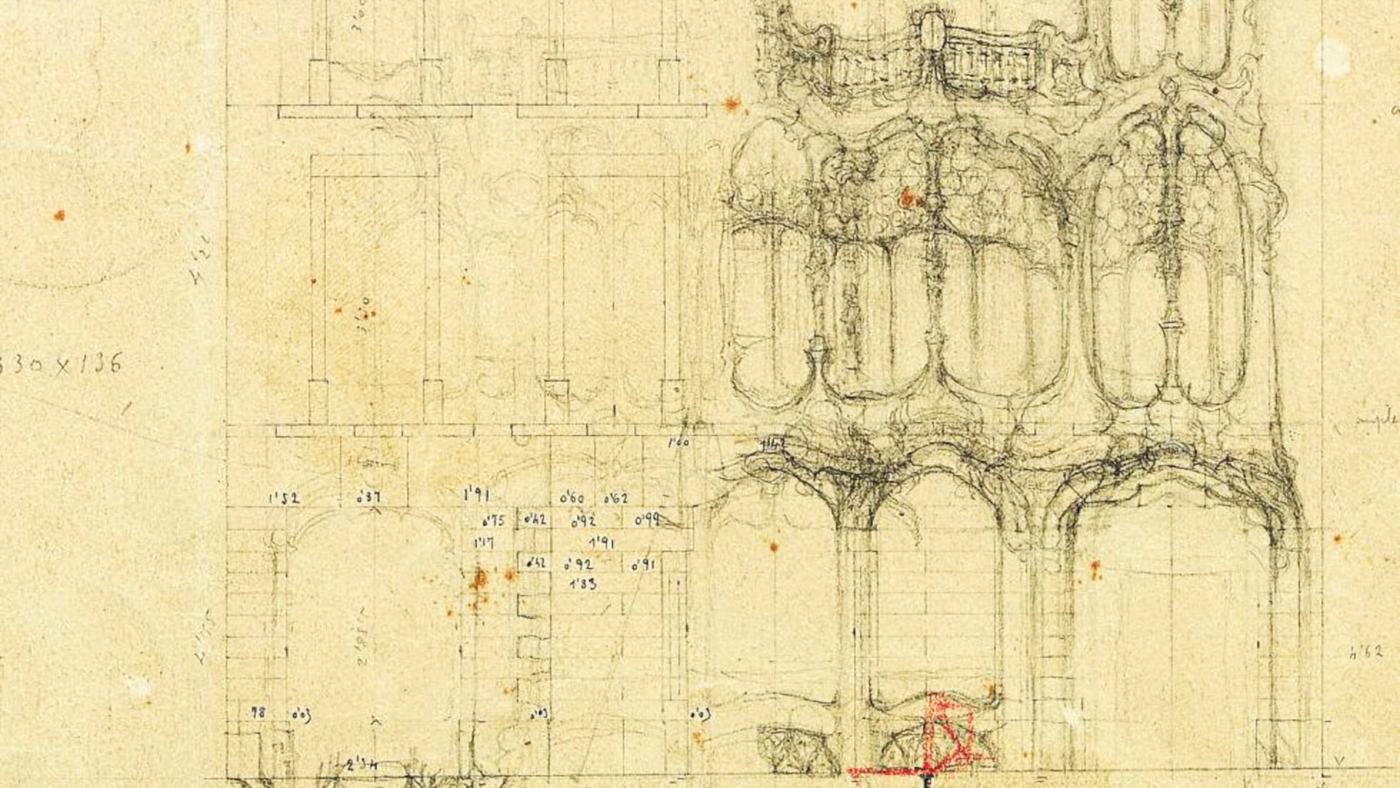
Quatre imatges de l’exposició que no tenen capítol propi.
Four images from the exhibition without a chapter of their own.
Per a l’aula · 1r i 2n d’ESOFor the classroom · ages 12 to 14
Activitats per a l’aulaClassroom activities
Sis activitats per a alumnes de 12 a 14 anys, una per a cada idea de l’exposició. Es fan amb material d’aula (fil, clips, paper vegetal, un tub de cartró) i cada una inclou una pàgina de solucions per al professorat i, quan calen, plantilles per imprimir.
Six activities for students aged 12 to 14, one for each idea in the exhibition. They use classroom materials (thread, paper clips, tracing paper, a cardboard tube), and each one comes with a page of solutions for teachers and, where needed, templates to print.
PDF · 25 pàgines · 1,0 MBPDF · 25 pages · 1.0 MB
El quadern completThe complete booklet
Les sis activitats en un sol fitxer, amb una pàgina de presentació per al professorat i una taula amb la durada i el material de cada una.
All six activities in one file, with an introduction for teachers and a table of the time and materials each one needs.
-
01Capítol 01 · La catenàriaChapter 01 · The catenary
Penja una cadenaHang a chain
Una cadeneta, dues xinxetes i una graella. La corba de la cadena es compara amb una paràbola calculada punt a punt, i es veu on tenia raó Galileu i on no.
A small chain, two drawing pins and a grid. The chain’s curve is compared with a parabola worked out point by point, to see where Galileo was right and where he wasn’t.
-
02Capítols 02 i 03 · La maqueta penjadaChapters 02 and 03 · The hanging model
Una església de cap per avallAn upside-down church
Fil, clips i la tapa d’una capsa de sabates. Primer, un fil amb tres pesos; després, una maqueta penjada com la de Gaudí, que es fotografia i es gira.
Thread, paper clips and a shoebox lid. First a single thread with three weights, then a hanging model like Gaudí’s, photographed and turned upside down.
-
03Capítol 04 · Superfícies regladesChapter 04 · Ruled surfaces
Corbes fetes de rectesCurves made of straight lines
Només rectes traçades amb regle, i en surten una paràbola, una cardioide i una nefroide. Després, un hiperboloide de fil elàstic que s’aprima quan el gires.
Nothing but straight lines drawn with a ruler, and out come a parabola, a cardioid and a nephroid. Then an elastic-thread hyperboloid that gets thinner as you twist it.
-
04Capítol 05 · Corbes vivesChapter 05 · Living curves
Una recta que s’enroscaA straight line that coils
Un triangle de paper enrotllat en un tub de cartró fa una hèlix. Amb una proporció es calcula quant puja cada volta, i quants esglaons té una escala de cargol.
A paper triangle rolled round a cardboard tube makes a helix. One proportion tells you how far each turn climbs, and how many steps a spiral staircase needs.
-
05Capítols 06 i 07 · La columna i el mòdulChapters 06 and 07 · The column and the module
L’estrella que pujaThe climbing star
Dues estrelles de paper vegetal i una xinxeta expliquen com passen les columnes de la Sagrada Família de vuit puntes a gairebé un cercle. De passada, una suma infinita que no arriba mai a 16.
Two tracing-paper stars and a drawing pin show how the Sagrada Família’s columns go from eight points to almost a circle. Along the way, an infinite sum that never reaches 16.
-
06Capítol 08 · El quadrat (gairebé) màgicChapter 08 · The (almost) magic square
El teu quadrat (gairebé) màgicYour own (almost) magic square
Per què el quadrat de Subirachs no pot ser màgic del tot, i com se’n fa un amb la data de naixement de cadascú.
Why Subirachs’s square can’t be fully magic, and how to make one from your own date of birth.
Imprimiu les plantilles al 100 %, sense ajustar-les a la pàgina: algunes es mesuren amb el regle. Totes les fitxes es poden imprimir en blanc i negre.
Print the templates at 100%, without fit-to-page: some of them get measured with a ruler. Every sheet works in black and white.
Per saber-ne mésFurther reading
Llibres, articles i llocs per seguir estirant el fil. N’hi ha molts que es poden llegir en línia.
Books, papers and places for pulling the thread a little further. Plenty of them can be read online.
Per començarTo start with
-
Alsina, C. (2016). «Un templo de Geometría: la Sagrada Familia en 2026». Suma, 82, 35–42.
Alsina, C. (2016). “Un templo de Geometría: la Sagrada Familia en 2026”. Suma, 82, 35–42.
Les corbes, les superfícies reglades i els poliedres del temple, en un article breu de la revista del professorat de matemàtiques. En castellà.
The curves, ruled surfaces and polyhedra of the basilica, in a short piece from the Spanish maths teachers’ journal. In Spanish.
-
Alsina, C. i Gómez Serrano, J. (2002). «Gaudí, geométricamente». La Gaceta de la RSME, 5(3), 523–539.
Alsina, C. and Gómez Serrano, J. (2002). “Gaudí, geométricamente”. La Gaceta de la RSME, 5(3), 523–539.
Un repàs matemàtic de les formes de Gaudí, escrit pel matemàtic Claudi Alsina i l’arquitecte Josep Gómez Serrano. En castellà.
A mathematical tour of Gaudí’s shapes by the mathematician Claudi Alsina and the architect Josep Gómez Serrano. In Spanish.
-
Fernández Jiménez, A. (2020). «La catenaria y su influencia en la arquitectura de Gaudí». La Gaceta de la RSME, 23(2), 303–323.
Fernández Jiménez, A. (2020). “La catenaria y su influencia en la arquitectura de Gaudí”. La Gaceta de la RSME, 23(2), 303–323.
La corba de la cadena, de l’equació als arcs de Gaudí. En castellà.
The hanging-chain curve, from its equation to Gaudí’s arches. In Spanish.
-
Block, P., DeJong, M. i Ochsendorf, J. (2006). «As Hangs the Flexible Line: Equilibrium of Masonry Arches». Nexus Network Journal, 8(2), 13–24.
Block, P., DeJong, M. and Ochsendorf, J. (2006). “As Hangs the Flexible Line: Equilibrium of Masonry Arches”. Nexus Network Journal, 8(2), 13–24.
Per què s’aguanta un arc que copia una cadena girada, explicat per enginyers d’estructures. El títol tradueix la primera meitat de la frase de Hooke. En anglès.
Why an arch that copies an upside-down chain stands up, explained by structural engineers. The title translates the first half of Hooke’s sentence.
Per anar a fonsGoing deeper
-
Huerta, S. (2003). «El cálculo de estructuras en la obra de Gaudí». Ingeniería Civil, 130, 121–133.
Huerta, S. (2006). “Structural Design in the Work of Gaudí”. Architectural Science Review, 49(4), 324–339.
Com calculava Gaudí les estructures, amb estàtica gràfica i maquetes penjades. En castellà; n’hi ha una versió en anglès a l’Architectural Science Review (2006), també en línia.
How Gaudí worked out his structures, with graphic statics and hanging models. Free to read online, as is an earlier Spanish version in Ingeniería Civil (2003).
Llegeix-lo en líniaSpanish version onlineVersió anglesa en líniaRead it onlineDOIDOI
-
Tomlow, J. (1989). Das Modell / The Model / El modelo (IL 34). Stuttgart: Institut für leichte Flächentragwerke.
La reconstrucció de la maqueta penjada de la Colònia Güell, explicada per l’equip de Stuttgart que la va fer. La maqueta reconstruïda és al Museu de la Sagrada Família. En alemany, anglès i castellà; el PDF ocupa més de 30 MB.
The rebuilding of the Colònia Güell hanging model, told by the Stuttgart team that did it. The rebuilt model is in the Sagrada Família museum. In German, English and Spanish; the PDF is over 30 MB.
-
Roca i Fabregat, P. (2005). Antoni Gaudí i el disseny estructural: la síntesi de la geometria i de la resistència. Barcelona: Institut d’Estudis Catalans.
El discurs inaugural del curs 2005–2006 de l’IEC, sobre com s’entenen la geometria i la resistència a l’obra de Gaudí.
The Institut d’Estudis Catalans’ 2005–06 inaugural lecture, on how geometry and strength work together in Gaudí’s buildings. In Catalan.
-
Alsina, C., Gómez Serrano, J. i Faulí, J. (2004). «La geometria i la mecànica a l’obrador de Gaudí». Revista de Tecnologia, 1, 12–27.
Alsina, C., Gómez Serrano, J. and Faulí, J. (2004). “La geometria i la mecànica a l’obrador de Gaudí”. Revista de Tecnologia, 1, 12–27.
La geometria i la mecànica del taller de Gaudí, contades pel matemàtic Claudi Alsina i els arquitectes Josep Gómez Serrano i Jordi Faulí.
The geometry and mechanics of Gaudí’s workshop, told by the mathematician Claudi Alsina and the architects Josep Gómez Serrano and Jordi Faulí. In Catalan.
-
Bonet i Armengol, J. (2000). L’últim Gaudí: el modulat geomètric del Temple de la Sagrada Família = The Essential Gaudí: The Geometric Modulation of the Church of the Sagrada Família. Barcelona: Pòrtic.
Els mòduls i les proporcions de la Sagrada Família, explicats per qui en va dirigir les obres durant més de vint anys. En català i anglès.
The modules and proportions of the Sagrada Família, explained by the man who directed its construction for more than twenty years. In Catalan and English.
-
Burry, M. (ed.) (2007). Gaudí Unseen: Completing the Sagrada Família. Berlín: Jovis.
Burry, M. (ed.) (2007). Gaudí Unseen: Completing the Sagrada Família. Berlin: Jovis.
Com s’ha acabat de definir la geometria del temple a partir de les maquetes de guix de Gaudí, amb eines digitals. En anglès.
How the geometry of the basilica has been completed from Gaudí’s plaster models, with digital tools.
-
Giralt-Miracle, D. (dir.) (2002). Gaudí. La recerca de la forma: espai, geometria, estructura i construcció. Barcelona: Lunwerg.
Giralt-Miracle, D. (ed.) (2002). Gaudí. Exploring Form: Space, Geometry, Structure and Construction. Barcelona: Lunwerg.
El catàleg de l’exposició de l’Any Gaudí 2002 dedicada a la geometria i l’estructura. L’edició castellana es pot llegir en línia.
The catalogue of the 2002 Gaudí Year exhibition on geometry and structure. The Spanish edition can be read online.
-
Alsina, C. i Nelsen, R. B. (2025). The Genius of Gaudí: Geometry and Architecture. MAA Press / American Mathematical Society.
Alsina, C. and Nelsen, R. B. (2025). The Genius of Gaudí: Geometry and Architecture. MAA Press / American Mathematical Society.
Un llibre sencer sobre la geometria de l’obra de Gaudí. En anglès.
A whole book on the geometry of Gaudí’s buildings.
Les fontsThe sources
-
Galilei, G. (1638). Discorsi e dimostrazioni matematiche intorno a due nuove scienze. Leiden: Elzevir.
El llibre on Galileu compara la cadena que penja amb una paràbola. En italià i llatí.
The book in which Galileo compares the hanging chain with a parabola. In Italian and Latin.
-
Hooke, R. (1676). A Description of Helioscopes, and Some Other Instruments. Londres.
Hooke, R. (1676). A Description of Helioscopes, and Some Other Instruments. London.
Al final hi ha l’anagrama on Hooke va amagar la seva idea sobre els arcs. La solució es va publicar el 1705, després de la seva mort. En anglès.
The anagram in which Hooke hid his idea about arches is at the end. Its solution was published in 1705, after his death.
Facsímil (dins les Lectiones Cutlerianae, 1679)Facsimile (in Lectiones Cutlerianae, 1679)
-
Dürer, A. (1514). Melencolia I. Gravat. National Gallery of Art, Washington.
Dürer, A. (1514). Melencolia I. Engraving. National Gallery of Art, Washington.
El gravat amb el quadrat màgic que suma 34, el que Subirachs va girar i retocar.
The engraving with the magic square that adds up to 34, the one Subirachs turned and retouched.
Per visitarPlaces to visit
-
Cripta de la Colònia Güell, Santa Coloma de Cervelló.
Crypt of the Colònia Güell, Santa Coloma de Cervelló.
L’única part de l’església que es va arribar a construir. A l’exposició de l’antiga cooperativa hi ha una reproducció de la maqueta penjada.
The only part of the church that was ever built. The exhibition in the old cooperative building has a reproduction of the hanging model.
-
Àtic de la Pedrera (Casa Milà), Barcelona.
The attic of La Pedrera (Casa Milà), Barcelona.
Dos-cents setanta arcs catenaris de maó que sostenen la teulada.
Two hundred and seventy brick catenary arches holding up the roof.
-
Museu Nacional d’Art de Catalunya. Exposició en línia «Gaudí, l’arquitecte».
Museu Nacional d’Art de Catalunya. Online exhibition “Gaudí, the Architect”.
Les dues fotografies de la maqueta penjada on Gaudí va dibuixar l’església amb carbonet i clarió.
The two photographs of the hanging model on which Gaudí drew the church in charcoal and chalk.
Exposició en líniaOnline exhibitionVista exteriorExterior viewVista interiorInterior view
-
MMACA, Museu de Matemàtiques de Catalunya, Cornellà de Llobregat.
Matemàtiques per tocar, amb una sala de corbes i poliedres, el pont de Leonardo i visites per a grups escolars.
Hands-on mathematics, with a room on curves and polyhedra, Leonardo’s bridge and visits for school groups.
Per a l’aulaFor the classroom
-
Basílica de la Sagrada Família. Recursos educatius.
Basílica de la Sagrada Família. Educational resources.
Vídeos curts per a ESO i batxillerat: catenàries, el mètode dels models invertits, la columna de doble gir, voltes foradades, conoides.
Short videos for secondary school, in Catalan: catenaries, the inverted-model method, the double-twist column, perforated vaults, conoids.
-
Basílica de la Sagrada Família. Blog.
Dos articles que van bé amb les activitats 5 i 6: les columnes de doble gir i el quadrat de la façana de la Passió. Els enllaços porten a la versió anglesa; el blog també es publica en català i castellà.
Two articles that go well with activities 5 and 6: the double-twist columns and the square on the Passion façade.
-
Red Blob Games. «Mathologer’s multiplication on a circle with modulo».
Red Blob Games. “Mathologer’s multiplication on a circle with modulo”.
La part A de l’activitat 3 en moviment: tries el multiplicador i apareixen la cardioide, la nefroide i la resta. En anglès.
Part A of activity 3 in motion: pick the multiplier and watch the cardioid, the nephroid and the rest appear.
-
Alsina, C. (2020). «Los hiperboloides de Gaudí». Gaussianos.
Alsina, C. (2020). “Los hiperboloides de Gaudí”. Gaussianos.
Un article de divulgació de Claudi Alsina sobre els hiperboloides de Gaudí. En castellà.
A popular-maths piece by Claudi Alsina on Gaudí’s hyperboloids. In Spanish.
-
Weisstein, E. W. MathWorld. Wolfram Research.
Les definicions i les fórmules, per a qui en vulgui més. En anglès.
Definitions and formulas, for anyone who wants more.
CatenàriaCatenaryHiperboloideHyperboloidSuperfície regladaRuled surfaceQuadrat de DürerDürer’s squareQuadrat màgicMagic square