
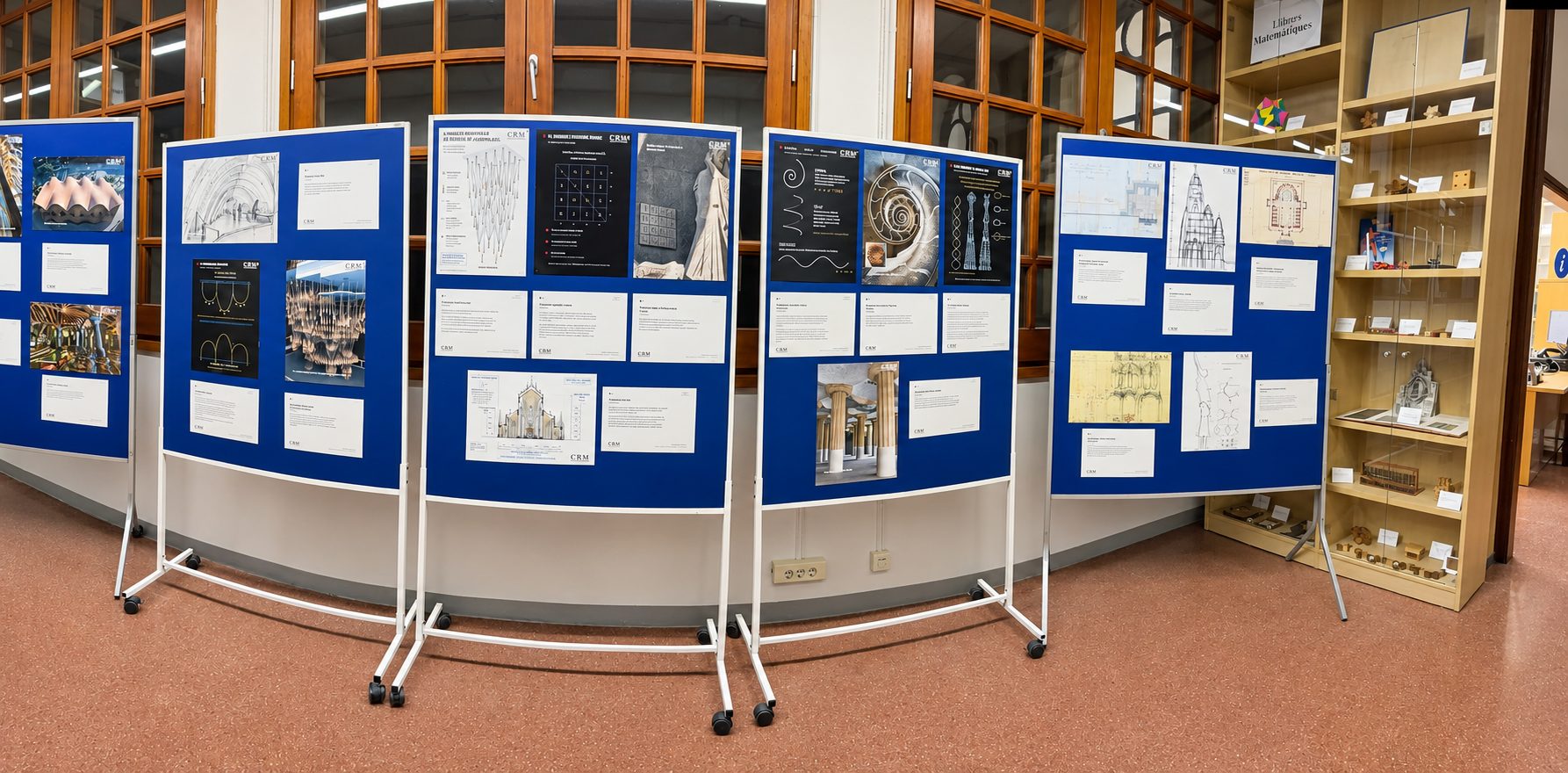
The CRM exhibition ‘Les matemàtiques de Gaudí’ moves to the University of Barcelona
L’exposició del CRM «Les matemàtiques de Gaudí» es trasllada a la Universitat de Barcelona
Eight posters on the mathematics behind Gaudí’s architecture, on display at the UB until 30 November
Vuit pòsters sobre les matemàtiques que hi ha darrere l’arquitectura de Gaudí, a la UB fins al 30 de novembre
Després de passar l’octubre a la UAB, l’exposició «Les matemàtiques de Gaudí», produïda pel CRM, es pot veure al CRAI Biblioteca de Matemàtiques i Informàtica de la Universitat de Barcelona del 2 al 30 de novembre de 2026.
After a month at the UAB’s Biblioteca de Ciència i Tecnologia, the CRM exhibition Les matemàtiques de Gaudí has moved to the University of Barcelona. It is on display at the CRAI Biblioteca de Matemàtiques i Informàtica from 2 to 30 November 2026.
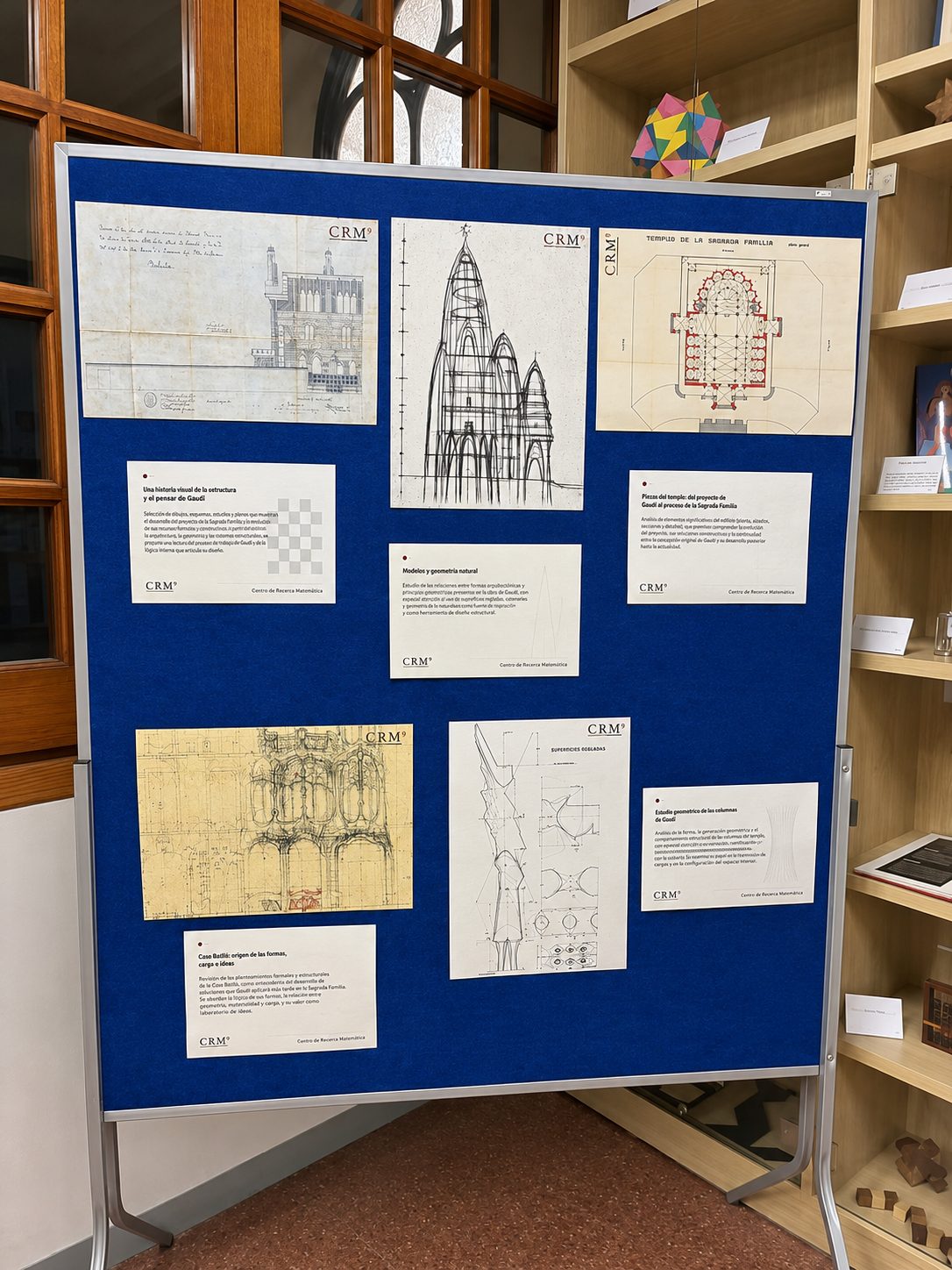
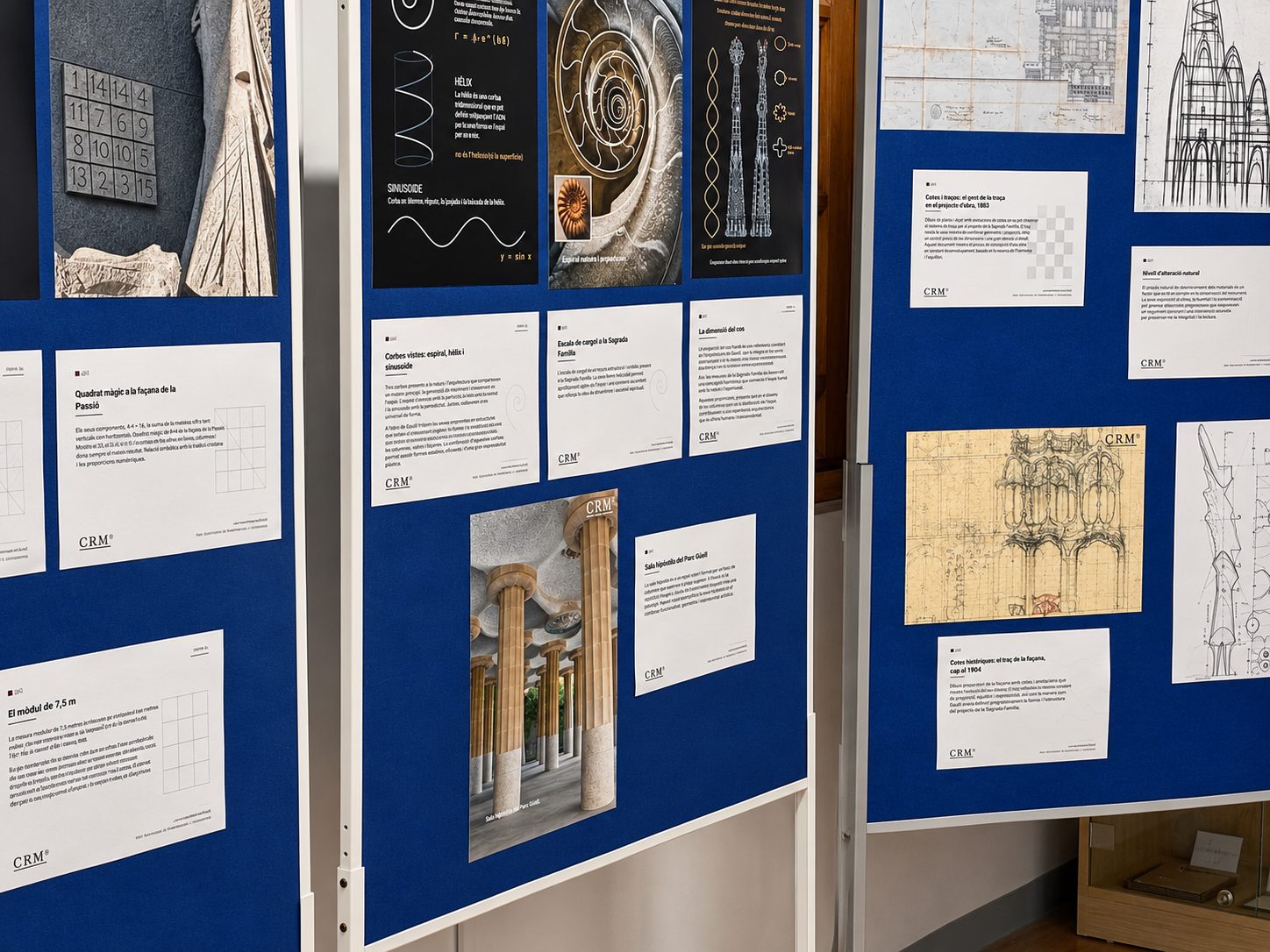
The exhibition looks at Gaudí’s architecture through the mathematics behind it, in eight posters. It starts with a hanging chain, the catenary, which turned upside down becomes an arch that stands without buttresses. From there it follows the hanging model of cords and small weights that Gaudí used to design the church of the Colònia Güell, the ruled surfaces of the Sagrada Família, the double-twist column and the 7.5-metre module of the basilica. It ends with the almost-magic square that the sculptor Josep Maria Subirachs placed on the Passion façade.
The scientific adviser is Marc Calvo-Schwarzwälder, a mathematics lecturer at the Universitat Politècnica de Catalunya and an affiliated researcher at the CRM. The exhibition is part of the Gaudí Year, which marks the centenary of the architect’s death in 1926.
The exhibition also has a version on the CRM website, with interactive figures for each chapter, six classroom activities in Catalan and English, and annotated further reading. The library has published a post about the exhibition on its blog, and the CRAI has announced it in its news section.
Després d’un mes a la Biblioteca de Ciència i Tecnologia de la UAB, l’exposició del CRM Les matemàtiques de Gaudí s’ha traslladat a la Universitat de Barcelona. Es pot veure al CRAI Biblioteca de Matemàtiques i Informàtica del 2 al 30 de novembre de 2026.
L’exposició recorre en vuit pòsters les matemàtiques que hi ha darrere l’arquitectura de Gaudí. Comença amb una cadena penjada, la catenària, que, capgirada, es converteix en un arc que s’aguanta sense contraforts. Des d’aquí continua amb la maqueta de cordills i petits pesos que Gaudí va fer servir per dissenyar l’església de la Colònia Güell, les superfícies reglades de la Sagrada Família, la columna de doble gir i el mòdul de 7,5 metres de la basílica. Acaba amb el quadrat gairebé màgic que l’escultor Josep Maria Subirachs va col·locar a la façana de la Passió.
L’assessor científic és Marc Calvo-Schwarzwälder, professor de matemàtiques de la Universitat Politècnica de Catalunya i investigador afiliat al CRM. La mostra forma part de l’Any Gaudí, que commemora el centenari de la mort de l’arquitecte, el 1926.
L’exposició també té una versió al web del CRM, amb figures interactives per a cada capítol, sis activitats per a l’aula en català i en anglès i una bibliografia comentada. La biblioteca ha publicat una entrada sobre l’exposició al seu blog, i el CRAI l’ha anunciada a la secció de notícies.
More from the CRM
Advanced Course on Free Boundary Problems Opens the Intensive Weeks of the IRP
Three mini-courses by Bozhidar Velichkov, Max Engelstein and Zihui Zhao, from 26 to 30 October at the CRMParticipants in the Advanced Course on Free Boundary Problems.CRM CommPau VarelaCRMComm@crm.catGet the latest CRM news and activities in your...
El CRM rep els estudiants de la prova de nivell de Bojos per les Matemàtiques 2027
The CRM welcomes students from the Bojos per les Matemàtiques 2027 entrance testVisita guiada al centre i xerrada de Tomás Sanz (UB-CRM) sobre les matemàtiques del soA guided tour of the centre and a talk by Tomás Sanz (UB-CRM) on the mathematics of soundTomás Sanz...
Eight CRM Researchers in the 2026 Stanford-Elsevier List of Highly Cited Scientists
The database ranks scientists by citation impact, over their whole careers and in 2025 aloneCRM CommPau VarelaCRMComm@crm.catGet the latest CRM news and activities in your inbox.Recent newsletters →The 2026 edition of the Stanford-Elsevier database...
Fish schools and growing tissues: a workshop on how collective behaviour emerges
Mathematicians and biologists met at the Institut d’Estudis Catalans to discuss how local interactions shape tissues and animal groups.A talk in the Pere i Joan Coromines room of the Institut d’Estudis Catalans. Image: CRMCRM CommPau...
The CRM opens the academic year and unveils its Directors’ Gallery
A review of the year, the Communication Plan 2026–2030 and three research talks filled the morning of 19 October.The unveiling of the Directors’ Gallery.CRM CommPau VarelaCRMComm@crm.catGet the latest CRM news and activities in your inbox.Recent...
The CRM Mentoring Programme, as Told by One of Its Pairs
PhD student Joaquim Duran and mathematician Robert Cardona, one of the pairs in the CRM Mentoring ProgrammeJoaquim Duran (left) and Robert Cardona.CRM CommPau VarelaCRMComm@crm.catGet the latest CRM news and activities in your inbox.Recent...
When the reward comes within reach, the brain changes what it compares
As the tokens piled up, choices got faster and more accurate at the same time. The yardstick for judging each offer had moved.CRM CommPau VarelaCRMComm@crm.catGet the latest CRM news and activities in your inbox.Recent newsletters →Two subjects...
Almost every automaton can be reset with a short word
For a random automaton with n states, a word of about √n log n letters is almost always enough to reset it.CRM CommPau VarelaCRMComm@crm.catGet the latest CRM news and activities in your inbox.Recent newsletters →Picture a conveyor belt carrying...
Exposició ‘Les matemàtiques de Gaudí’
CRM quod erat demonstrandum | 48
ADA: Decoding Brain Signals Misaligned in Time
The study addresses a key limitation of current brain decoding techniques: the difficulty of interpreting internal mental processes whose temporal dynamics vary from trial to trial.Decoding what is happening in a person’s mind from their brain activity is one of the...