
Fish schools and growing tissues: a workshop on how collective behaviour emerges
Mathematicians and biologists met at the Institut d’Estudis Catalans to discuss how local interactions shape tissues and animal groups.
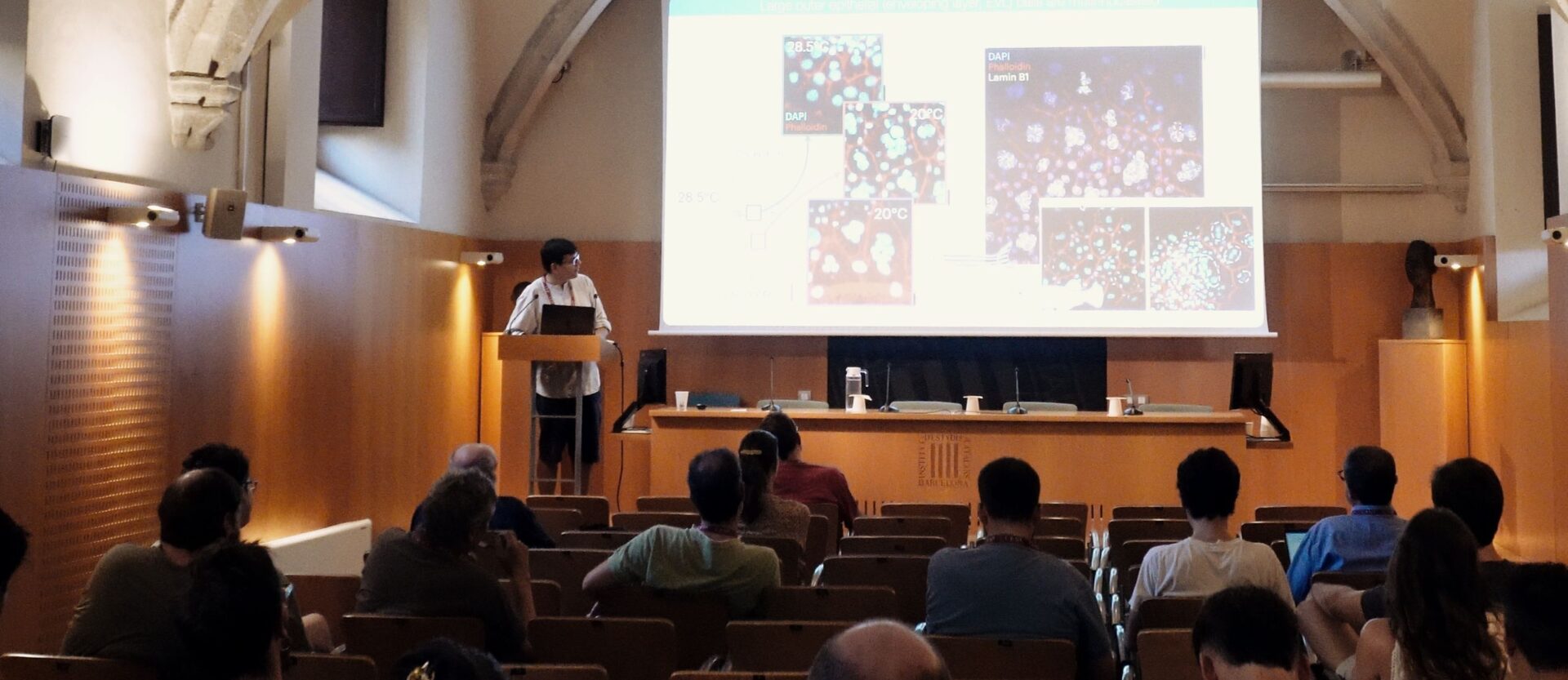
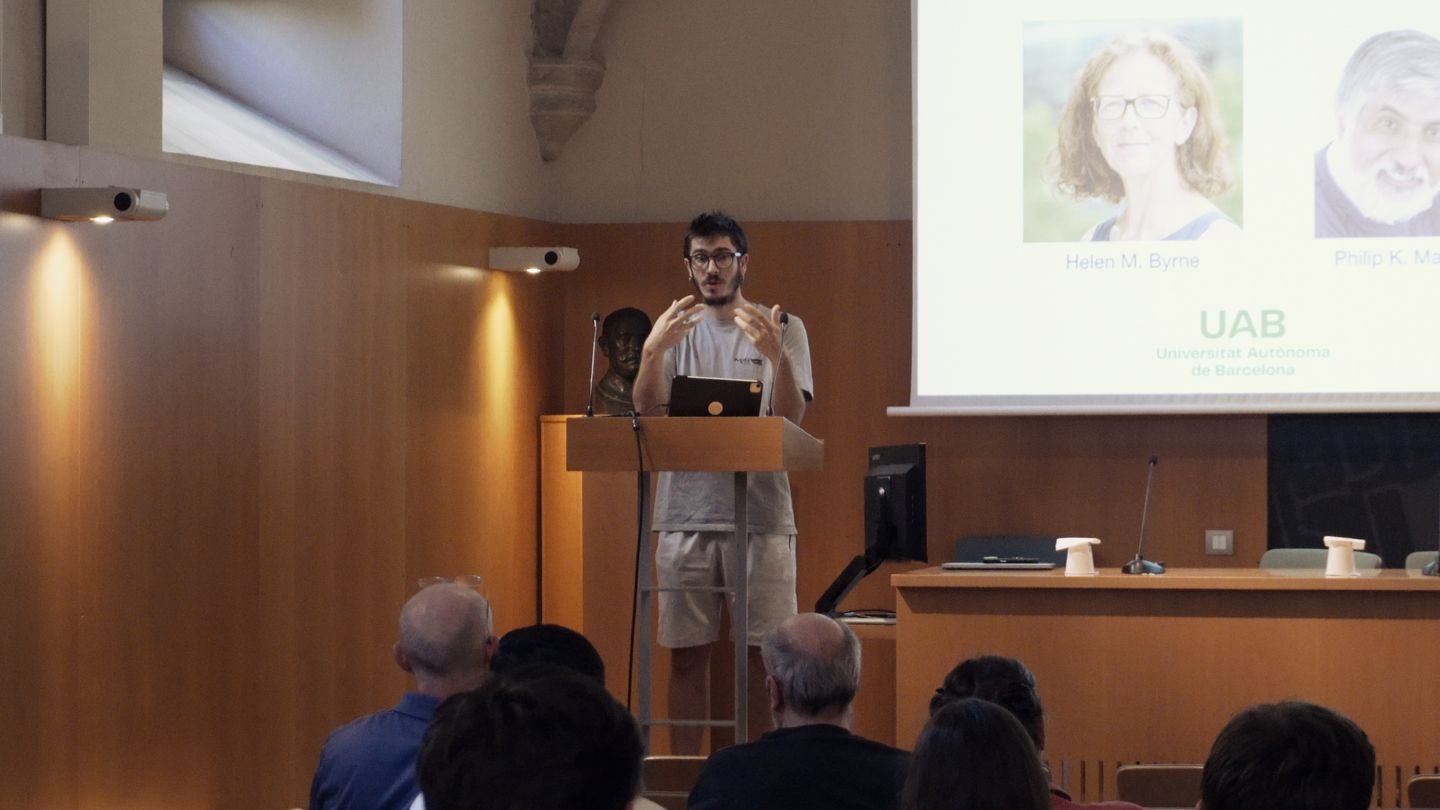
A talk in the Pere i Joan Coromines room of the Institut d’Estudis Catalans. Image: CRM
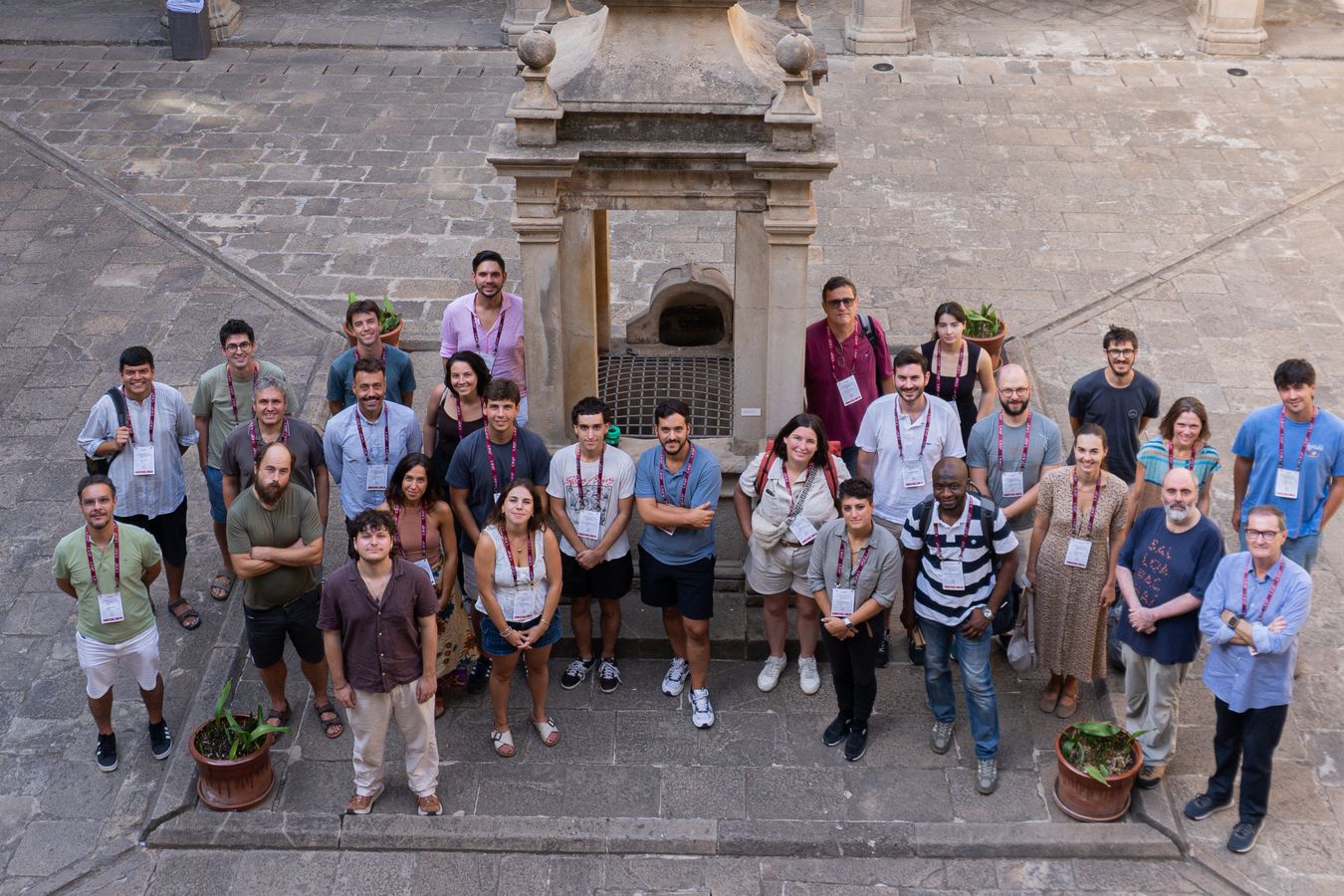
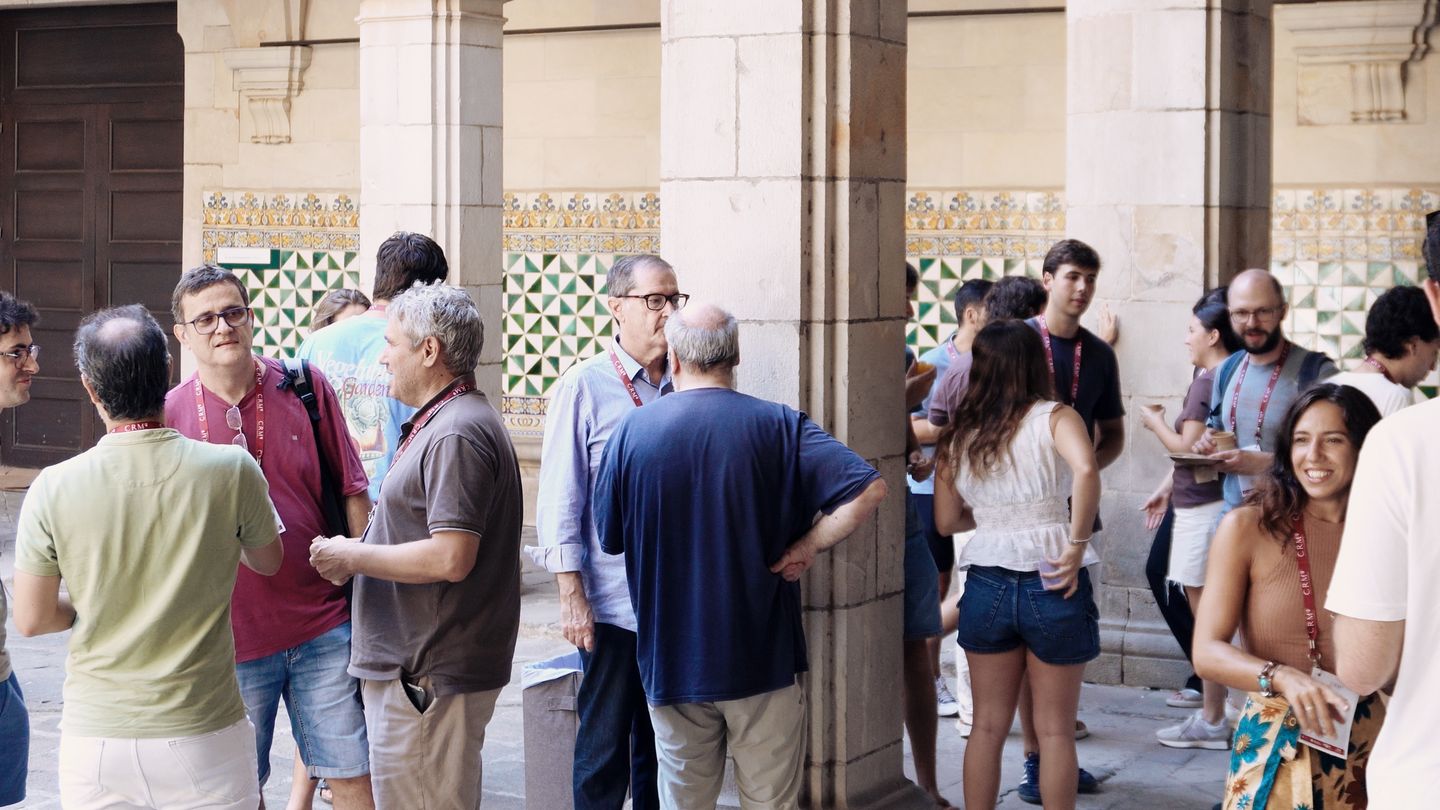
The organising committee, formed by Tomás Alarcón (ICREA, CRM) and Gissell Estrada-Rodriguez (UPC, CRM), brought together more than thirty researchers whose tools differ a great deal: some of the speakers prove limit theorems, while others came with imaging data from their labs. There was also a poster session on the first afternoon, and a guided walk through Barcelona’s Old Town on the Wednesday.
Fish schools featured in two talks. Romualdo Pastor-Satorras (UPC) presented a stochastic, data-driven description of schooling in which groups tend to operate close to a critical point, and Nastassia Pouradier Duteil (Inria, Sorbonne Université) studied how a school can switch between swimming in alignment and milling in a ring around a common centre. Zebrafish appeared again in the talk by Daniel Santos-Oliván (EMBL Barcelona), whose work shows that the contractions of the embryonic heart fracture the extracellular matrix around it, and that the fractures guide the formation of ridges in the ventricular wall. Several talks dealt with the passage between scales itself, among them those of David Poyato (University of Granada) and Markus Schmidtchen (TU Dresden), who derived macroscopic equations from systems of interacting particles.
Besides the two organisers, two CRM researchers presented their work. Daria Stepanova (CRM) spoke about aggregation in Capsaspora owczarzaki, one of the closest known unicellular relatives of animals, which she and her collaborators have established as a model system for studying the origins of multicellularity. In the kinetic model she presented, adhesion between cells increases nonlinearly with the concentration of serum in the medium, and coupling that response with the cells’ own consumption of the serum is enough to reproduce the cycle seen in experiments, in which aggregates grow and merge before dissolving again. On the final day, Juan Arellano-Tintó (CRM) presented his work on the mathematical modelling of mechanical communication between cells.
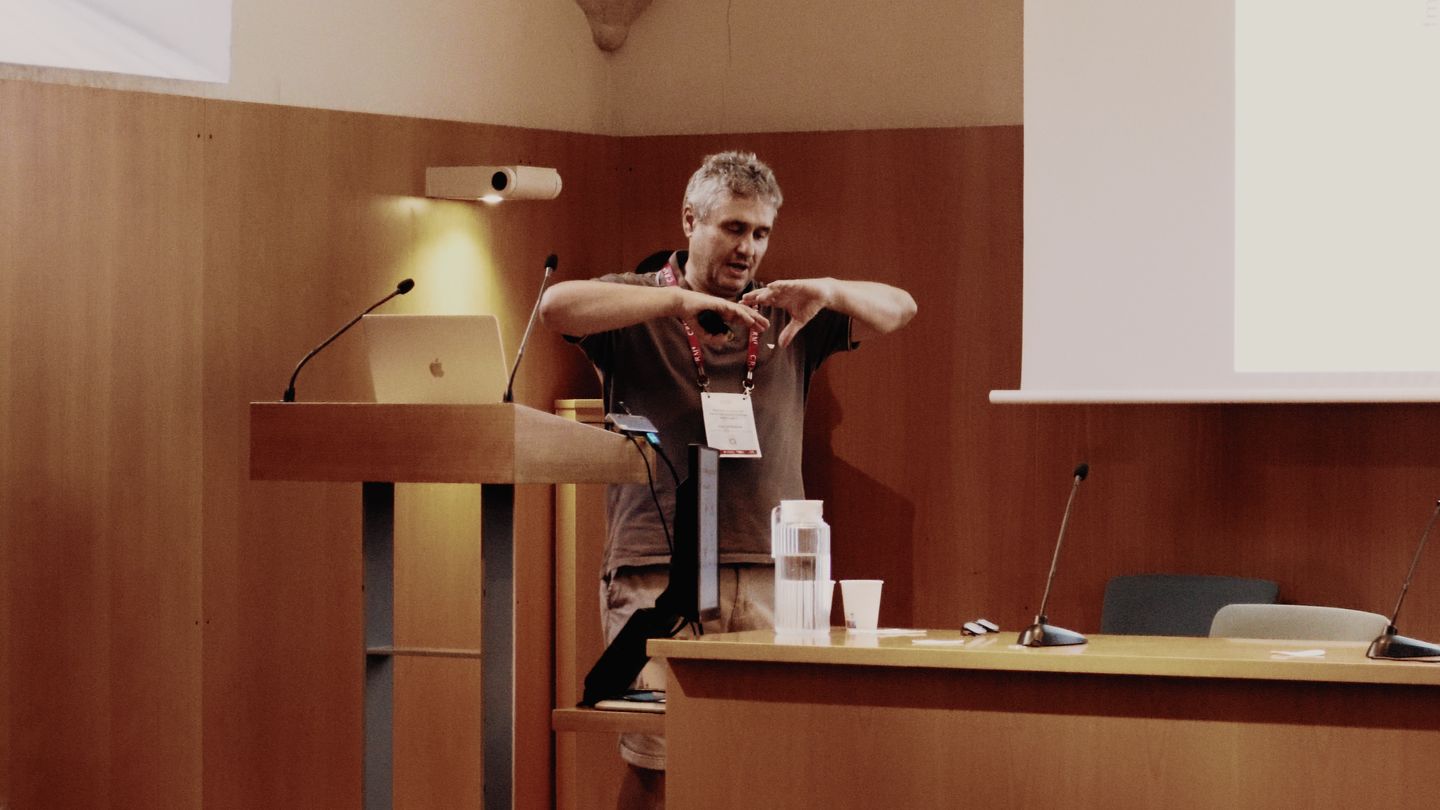
James Sharpe (EMBL Barcelona) spoke about swarms of more than 300 small robots, each programmed with a simple model of gene regulation and chemical gradients, to test whether they would organise themselves into patterns the way tissues do. The robots are a side project. “My lab actually studies developmental biology, so how thousands or millions of cells interact to create our organs and our tissues,” Sharpe said in an interview recorded during the workshop. “Each cell can only really detect information from its immediate neighbours. So the mystery is, how do cells have the right program to make the right decisions to end up building a complex structure like an organ?”
“Each cell can only really detect information from its immediate neighbours.”
James Sharpe
Sharpe worked at the Centre for Genomic Regulation (CRG) before joining EMBL Barcelona, which opened in 2017 and which he now heads. Its research focuses on tissue biology and disease modelling. He saw the workshop as “a perfect example of this idea of bringing together interdisciplinary people from different perspectives”, the same idea behind the Barcelona Collaboratorium for Modelling and Predictive Biology, a joint initiative of EMBL Barcelona and the CRG. “Many of us believe that biology is too complex to be understood if we don’t bring computational modelling,” he said of its origins. Universitat Pompeu Fabra and the CRM, he recalled, were involved from very early on.
“The great thing about models is that they’re not an empirical system.”
Chiara Villa
Chiara Villa (CNRS, Université Paris Cité) presented work on how endocrine disruptors affect the reproductive function of zebrafish. Her approach couples a system of ordinary differential equations, which follows hormone levels throughout the body, with a partial differential equation describing the growth of oocytes, the female reproductive cells. “By coupling these models, we can really track how oocyte maturation, which is ultimately impacting the reproductive function, is impacted by endocrine disruptors,” she explained. The work is part of the OvoTox project, carried out with teams at Inria, INRAE and INERIS.
Villa did her PhD at the University of St Andrews and her postdoctoral research in Paris before joining the CNRS, where she is now a researcher at the MAP5 laboratory of Université Paris Cité. Her position gives her, she said, “the freedom to explore questions that will have more of a mathematical impact or a more interdisciplinary impact”. Models, in her view, are a way to test new theories “without having to perform too many experiments”. “The great thing about models is that they’re not an empirical system. So whatever you put inside the model is what will drive the emergent behaviour.” When a model built on a proposed mechanism fails to reproduce what is observed, she added, “it means that we’re missing something that is very crucial”.

Sharpe kept his expectations for the meeting modest. “Hopefully what comes out of it is more collaborations, maybe, and step by step, a better framework for understanding the interaction between the local and the global, the microscopic and the macroscopic.” Villa took something closer to the bench from it: “Something that I found very valuable is to actually hear the talks from people that are working in experimental labs, because I have very little experience in that.”
The interviews with James Sharpe and Chiara Villa can be watched in the video below.
More from the CRM
Jagged walls and unknown edges: a workshop on free boundary problems
Fourteen invited talks and seven short talks, from 2 to 6 November at the CRMParticipants of the Workshop on Free Boundary Problems on the CRM stairs.CRM CommPau VarelaCRMComm@crm.catGet the latest CRM news and activities in your inbox.Recent...
La guerra de les granotes i els ratolins
The CRM exhibition ‘Les matemàtiques de Gaudí’ moves to the University of Barcelona
L'exposició del CRM «Les matemàtiques de Gaudí» es trasllada a la Universitat de BarcelonaEight posters on the mathematics behind Gaudí's architecture, on display at the UB until 30 NovemberVuit pòsters sobre les matemàtiques que hi ha darrere l'arquitectura de Gaudí,...
Advanced Course on Free Boundary Problems Opens the Intensive Weeks of the IRP
Three mini-courses by Bozhidar Velichkov, Max Engelstein and Zihui Zhao, from 26 to 30 October at the CRMParticipants in the Advanced Course on Free Boundary Problems.CRM CommPau VarelaCRMComm@crm.catGet the latest CRM news and activities in your...
El CRM rep els estudiants de la prova de nivell de Bojos per les Matemàtiques 2027
The CRM welcomes students from the Bojos per les Matemàtiques 2027 entrance testVisita guiada al centre i xerrada de Tomás Sanz (UB-CRM) sobre les matemàtiques del soA guided tour of the centre and a talk by Tomás Sanz (UB-CRM) on the mathematics of soundTomás Sanz...
Eight CRM Researchers in the 2026 Stanford-Elsevier List of Highly Cited Scientists
The database ranks scientists by citation impact, over their whole careers and in 2025 aloneCRM CommPau VarelaCRMComm@crm.catGet the latest CRM news and activities in your inbox.Recent newsletters →The 2026 edition of the Stanford-Elsevier database...
The CRM opens the academic year and unveils its Directors’ Gallery
A review of the year, the Communication Plan 2026–2030 and three research talks filled the morning of 19 October.The unveiling of the Directors’ Gallery.CRM CommPau VarelaCRMComm@crm.catGet the latest CRM news and activities in your inbox.Recent...
The CRM Mentoring Programme, as Told by One of Its Pairs
PhD student Joaquim Duran and mathematician Robert Cardona, one of the pairs in the CRM Mentoring ProgrammeJoaquim Duran (left) and Robert Cardona.CRM CommPau VarelaCRMComm@crm.catGet the latest CRM news and activities in your inbox.Recent...
When the reward comes within reach, the brain changes what it compares
As the tokens piled up, choices got faster and more accurate at the same time. The yardstick for judging each offer had moved.CRM CommPau VarelaCRMComm@crm.catGet the latest CRM news and activities in your inbox.Recent newsletters →Two subjects...
Almost every automaton can be reset with a short word
For a random automaton with n states, a word of about √n log n letters is almost always enough to reset it.CRM CommPau VarelaCRMComm@crm.catGet the latest CRM news and activities in your inbox.Recent newsletters →Picture a conveyor belt carrying...