
Advanced Course on Free Boundary Problems Opens the Intensive Weeks of the IRP
Three mini-courses by Bozhidar Velichkov, Max Engelstein and Zihui Zhao, from 26 to 30 October at the CRM
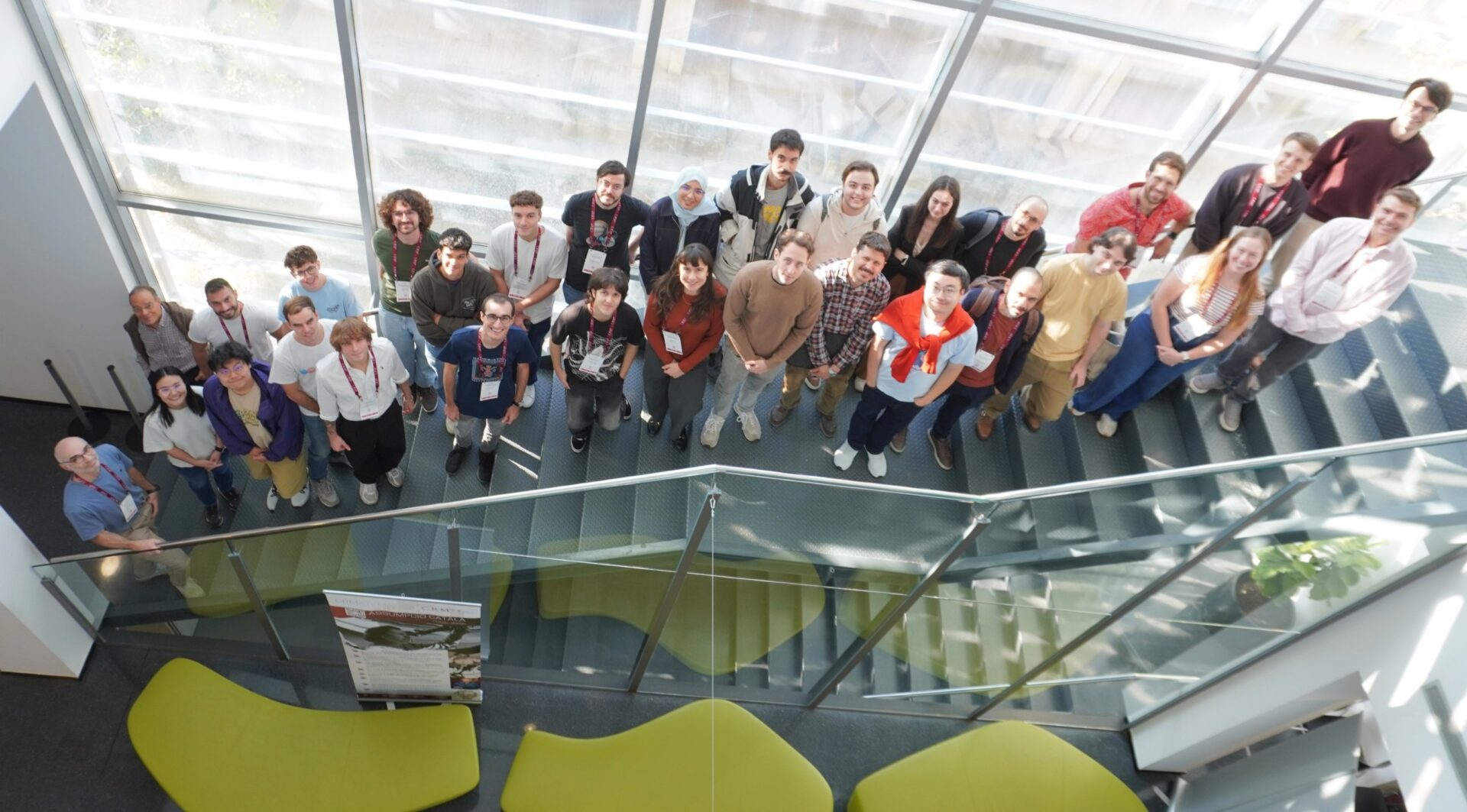
Participants in the Advanced Course on Free Boundary Problems.
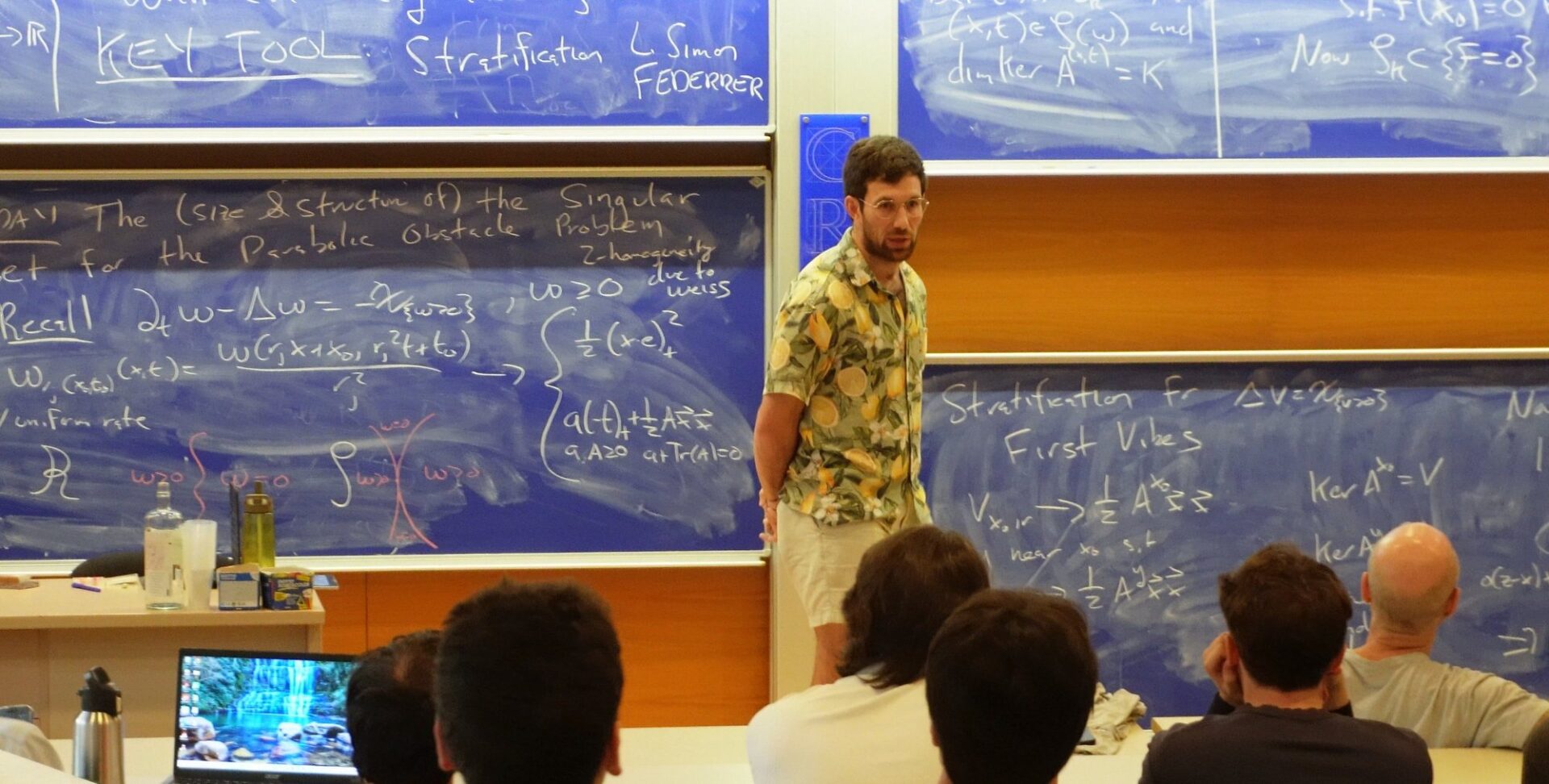
Water can stay liquid below zero degrees, but only precariously. A small disturbance is enough to set off a freeze that is hard to predict. Ice can appear in the middle of the liquid with no visible cause, a phenomenon known as nucleation, and the edge between the frozen and the liquid parts can turn fractal or move forward at what looks like infinite speed. On the morning of 26 October, Max Engelstein (University of Minnesota) opened the Advanced Course on Free Boundary Problems at the CRM with a lecture on this kind of freezing.
In a free boundary problem, the position of that edge is one of the unknowns. Models of phase transitions and flame propagation are built this way, and the same mathematics turns up in pure analysis too, for instance in the study of harmonic measure on rough domains. The Intensive Research Programme on Analysis of Free Boundary Problems, which the CRM organises from 19 October to 4 December, brings specialists in partial differential equations together with researchers in harmonic analysis and geometric measure theory. The Advanced Course, held from 26 to 30 October in the CRM Auditorium, was the first of its two intensive weeks. Each lecturer gave a seven-hour mini-course spread over the five days, with time left for discussion and for links to current research. Around forty participants registered. Most came from Catalan universities, and the rest from elsewhere in Spain and from Italy, Switzerland, the United States, Portugal, Tunisia and Saudi Arabia.
Engelstein’s course, On Freezing Problems, dealt with the supercooled Stefan problem, the classical model for this kind of freezing. The problem is ill-posed, so the lectures concentrated on the cases in which it can be regularised, which leads to the parabolic obstacle problem. In joint work with Inwon Kim and Sebastian Munoz, both at UCLA, Engelstein has proved that the regularised model reproduces some of the pathologies of supercooled freezing, nucleation and fast-moving fronts among them, but that, generically, it does not develop large fractal interfaces between ice and liquid. Two earlier papers on the parabolic obstacle problem, which shaped that analysis, were also part of the course. One is the 2004 work of Caffarelli, Petrosyan and Shahgholian. The other, from 2024, is by Alessio Figalli, Xavier Ros-Oton and Joaquim Serra. Ros-Oton, ICREA researcher at the Universitat de Barcelona and the CRM, sits on the course’s organising committee.
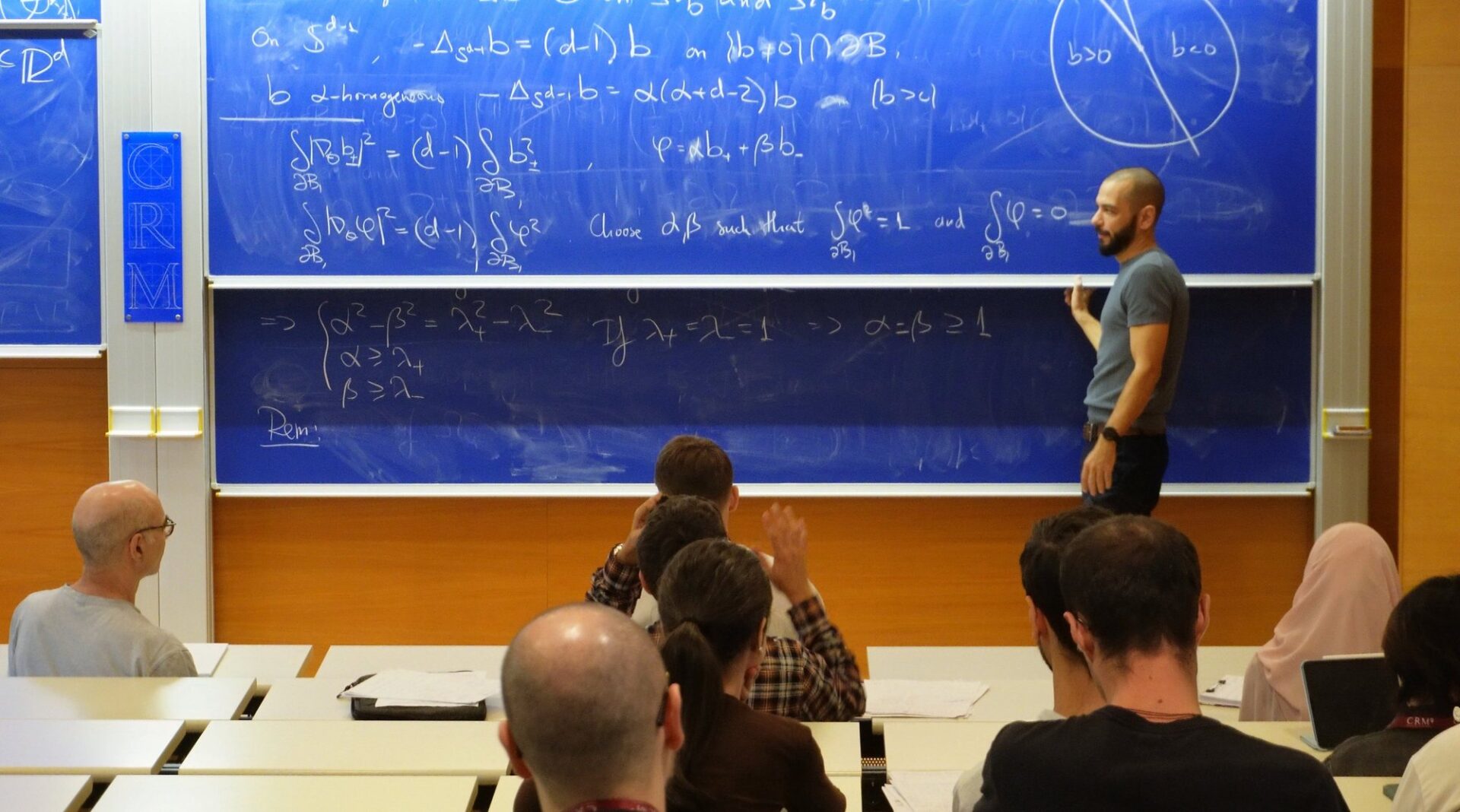
Bozhidar Velichkov (Università di Pisa) lectured on the two-phase Bernoulli problem. Here the solution changes sign, so both its positive and its negative part have a free boundary, and its zero set may even have positive Lebesgue measure. Alt, Caffarelli and Friedman formulated the problem in the 1980s and proved that solutions are Lipschitz continuous, using the monotonicity formula that carries their names. From there the course moved on to Velichkov’s own results. He proved the C1,α regularity of the free boundaries in dimension two with Luca Spolaor, now one of the programme’s visiting researchers, by means of an epiperimetric inequality. The higher-dimensional case came later, with Guido De Philippis and Spolaor, through an improvement-of-flatness argument in the style of Daniela De Silva. The last part of the course looked at the points where the two free boundaries touch.
In the plane, this contact set is locally made of finitely many disjoint smooth arcs. To prove it, Velichkov uses a Weierstrass-type representation formula, inspired by the work of Hélein, Hauswirth, Pacard and Traizet, which turns the question into a free boundary problem for minimal surfaces in a three-dimensional half-space.
Zihui Zhao (Johns Hopkins University) gave the course on the one-phase problem, in which a function minimises the Alt-Caffarelli energy for prescribed boundary values. That energy adds the Dirichlet energy of the function to the volume of the region where it is positive. As is often the case with free boundaries, the regularity of the solution is tied to that of its free boundary. To study the free boundary near a singular point, the course used blow-up analysis, zooming in on the point until the picture stops changing with the scale. What remains is a non-flat one-homogeneous solution of the problem. Zhao went through several examples of these solutions and showed how the analysis around them reveals the structure of the free boundary near a singularity.
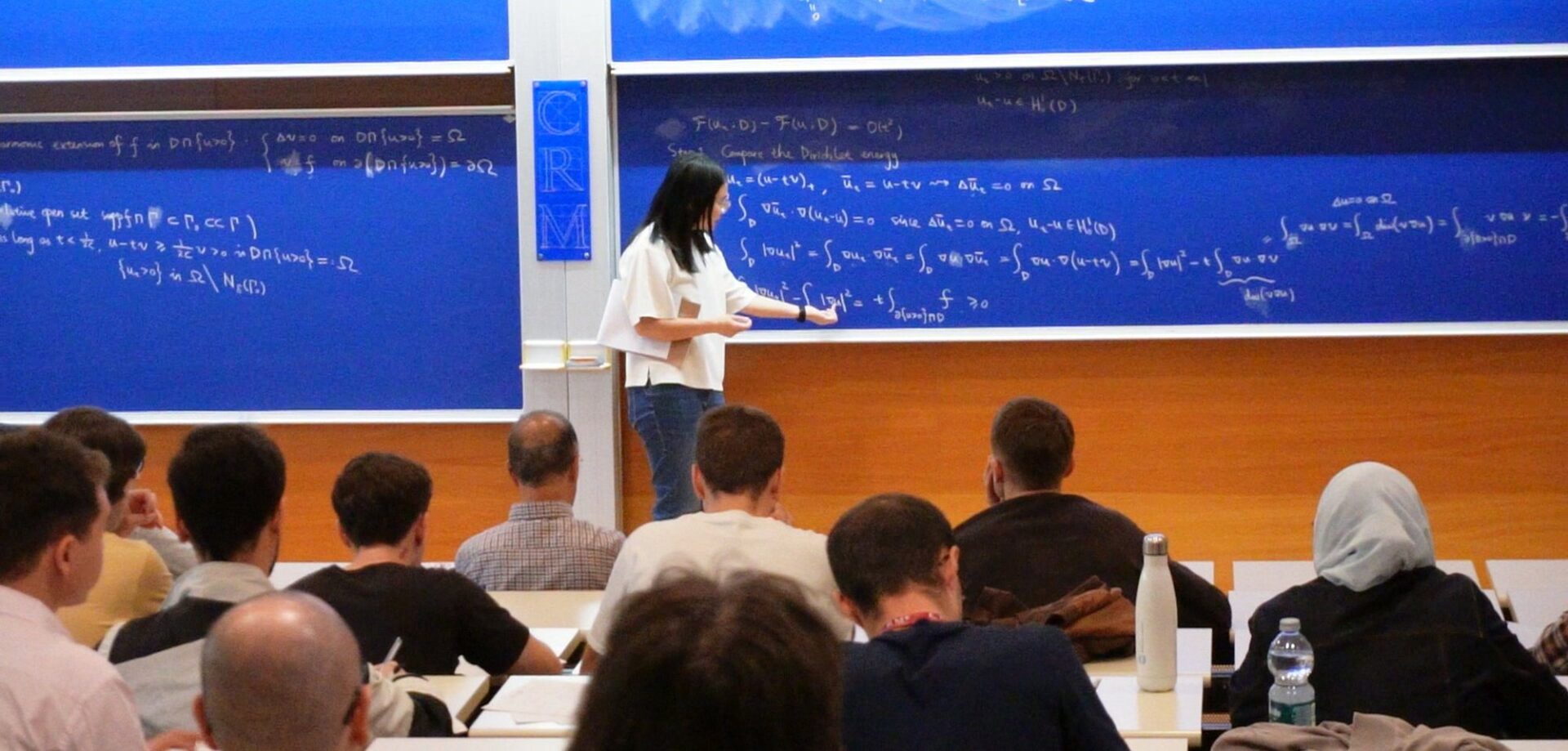
The scientific committee brought Engelstein and Zhao together with Mariana Smit Vega Garcia (Western Washington University), and the organising committee was formed by Xavier Fernández-Real (EPFL), Cole Jeznach (UAB), Xavier Ros-Oton and Xavier Tolsa (ICREA-UAB-CRM).
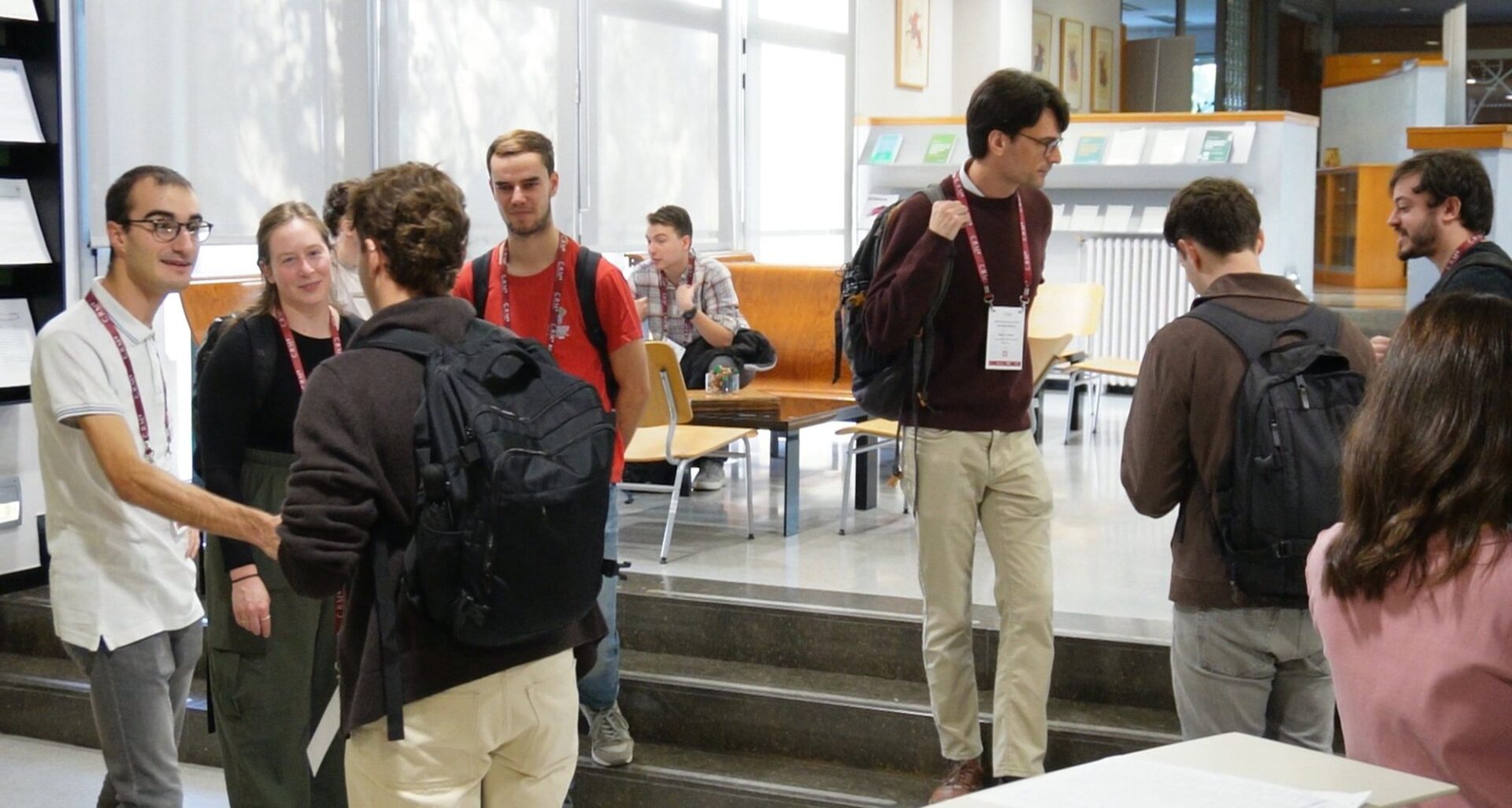
The programme continues with the Workshop on Free Boundary Problems, from 2 to 6 November, with research talks by around seventeen researchers and shorter slots for students to present their own work. A mini-course by Andrea Merlo (Ikerbasque, EHU) on Alberti representations and the WALA conjecture follows from 9 to 20 November, and the weekly seminars run on Monday afternoons until 30 November. The programme ends on 4 December.
More from the CRM
El CRM rep els estudiants de la prova de nivell de Bojos per les Matemàtiques 2027
The CRM welcomes students from the Bojos per les Matemàtiques 2027 entrance testVisita guiada al centre i xerrada de Tomás Sanz (UB-CRM) sobre les matemàtiques del soA guided tour of the centre and a talk by Tomás Sanz (UB-CRM) on the mathematics of soundTomás Sanz...
Eight CRM Researchers in the 2026 Stanford-Elsevier List of Highly Cited Scientists
The database ranks scientists by citation impact, over their whole careers and in 2025 aloneCRM CommPau VarelaCRMComm@crm.catGet the latest CRM news and activities in your inbox.Recent newsletters →The 2026 edition of the Stanford-Elsevier database...
Fish schools and growing tissues: a workshop on how collective behaviour emerges
Mathematicians and biologists met at the Institut d’Estudis Catalans to discuss how local interactions shape tissues and animal groups.A talk in the Pere i Joan Coromines room of the Institut d’Estudis Catalans. Image: CRMCRM CommPau...
The CRM opens the academic year and unveils its Directors’ Gallery
A review of the year, the Communication Plan 2026–2030 and three research talks filled the morning of 19 October.The unveiling of the Directors’ Gallery.CRM CommPau VarelaCRMComm@crm.catGet the latest CRM news and activities in your inbox.Recent...
The CRM Mentoring Programme, as Told by One of Its Pairs
PhD student Joaquim Duran and mathematician Robert Cardona, one of the pairs in the CRM Mentoring ProgrammeJoaquim Duran (left) and Robert Cardona.CRM CommPau VarelaCRMComm@crm.catGet the latest CRM news and activities in your inbox.Recent...
When the reward comes within reach, the brain changes what it compares
As the tokens piled up, choices got faster and more accurate at the same time. The yardstick for judging each offer had moved.CRM CommPau VarelaCRMComm@crm.catGet the latest CRM news and activities in your inbox.Recent newsletters →Two subjects...
Almost every automaton can be reset with a short word
For a random automaton with n states, a word of about √n log n letters is almost always enough to reset it.CRM CommPau VarelaCRMComm@crm.catGet the latest CRM news and activities in your inbox.Recent newsletters →Picture a conveyor belt carrying...
Exposició ‘Les matemàtiques de Gaudí’
CRM quod erat demonstrandum | 48
ADA: Decoding Brain Signals Misaligned in Time
The study addresses a key limitation of current brain decoding techniques: the difficulty of interpreting internal mental processes whose temporal dynamics vary from trial to trial.Decoding what is happening in a person’s mind from their brain activity is one of the...
Rare curves, many points: Christophe Ritzenthaler and Rachel Pries on their research and the work around it
Christophe Ritzenthaler (Université de Rennes) and Rachel Pries (Colorado State University) both work on curves over finite fields: he hunts curves with as many points as possible, she hunts curves that almost never occur. In conversation with the CRM during their...