
Jagged walls and unknown edges: a workshop on free boundary problems
Fourteen invited talks and seven short talks, from 2 to 6 November at the CRM
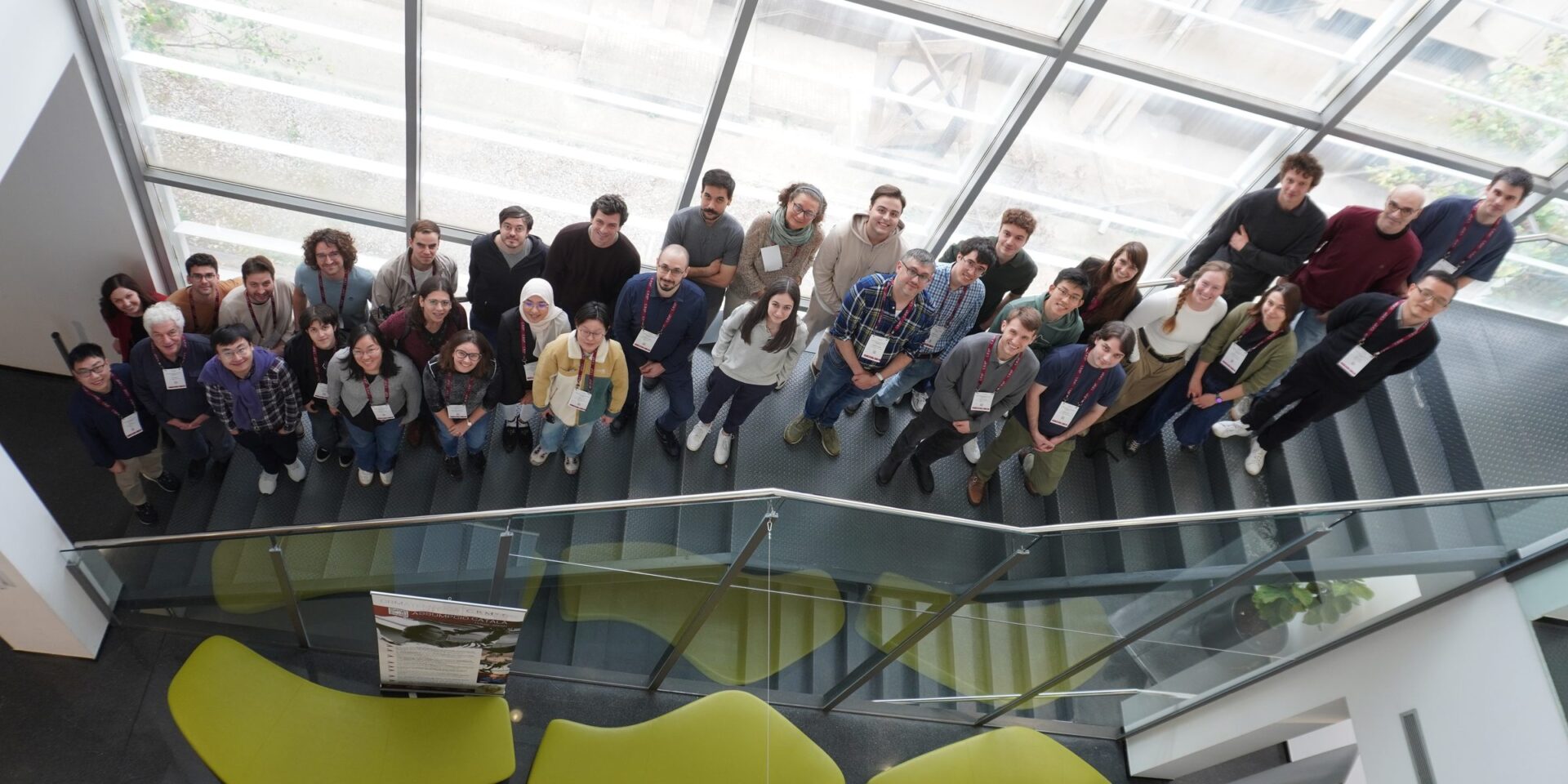
Participants of the Workshop on Free Boundary Problems on the CRM stairs.
Let a particle wander at random inside a room until it touches a wall, and ask where it is likely to land. Mathematicians call the answer harmonic measure. When the walls are smooth, it is well understood. When they are jagged or fractal, it becomes a research problem, and it turns into another kind of problem altogether when nobody knows in advance where the walls are.
That last case is a free boundary problem, in which part of the boundary, a flame front or the line where ice meets water, is one of the unknowns. Both cases filled the blackboards of the CRM auditorium from 2 to 6 November, during the Workshop on Free Boundary Problems. It was the second intensive week of the Intensive Research Programme on Analysis of Free Boundary Problems (IRP), which runs at the CRM from 19 October to 4 December, and it followed the Advanced Course held the week before. More than fifty researchers from institutions in eleven countries registered for a programme of fourteen invited talks and seven shorter ones, which the organisers had planned so that students could present their work.
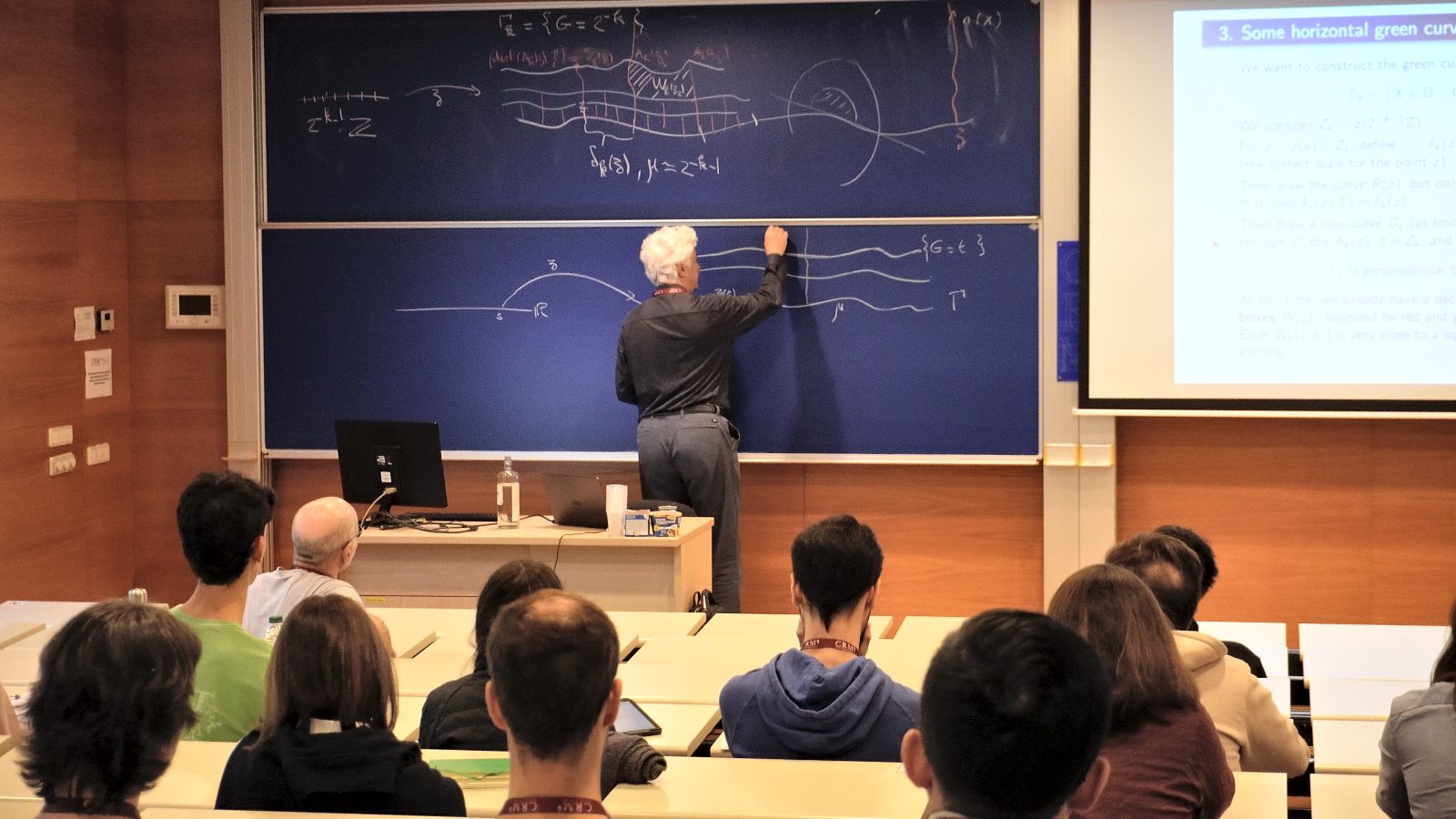
Guy David (Université Paris-Saclay) opened the week on Monday morning by asking whether a rectangle can carry two families of curves, one running from left to right and the other from bottom to top, that always meet at right angles. The question comes from building elliptic operators with a prescribed harmonic measure on domains bounded by snowflake-type curves. His abstract described the work, joint with Polina Perstneva (University of Geneva), as “not yet secured but probably interesting anyway”. That afternoon Perstneva took the same rectangle back to the auditorium in a short talk subtitled “the era of proof abundance”.
The wandering particle came back with Matthew Badger (University of Connecticut). In the plane, the dimension of harmonic measure never exceeds 1. In three dimensions its largest possible value is only known to lie strictly between 2 and 3, and the exact values conjectured by Bishop are still open. Badger’s title promised sets of dimension 2.999999. Mihalis Mourgoglou (Ikerbasque, EHU) went from analysis to geometry, showing that whether the regularity problem for elliptic operators can be solved in a rough domain is tied to a precise geometric property of its boundary, uniform rectifiability. In the afternoon, Emily Casey (University of Minnesota) presented a characterisation of domains with higher regularity through a spherical function, joint work with Tatiana Toro and with Max Engelstein, who had taught one of the mini-courses the week before.
Robin Neumayer (Carnegie Mellon University) opened Tuesday with energy minimisers for quasilinear one-phase problems, showing in joint work with A. De Rosa and H. Yu that their free boundaries are regular outside a singular set of codimension at least 2+ε. Kelei Wang (Wuhan University), on minimal cones, and Hui Yu (National University of Singapore), on the Bernoulli problem, completed the morning. In the afternoon, Hedong Hou (ETH Zurich) spoke on parabolic Cauchy problems with rough coefficients and Johannes Hosle (Carnegie Mellon University in Qatar) on monotonicity formulas for two-phase problems.
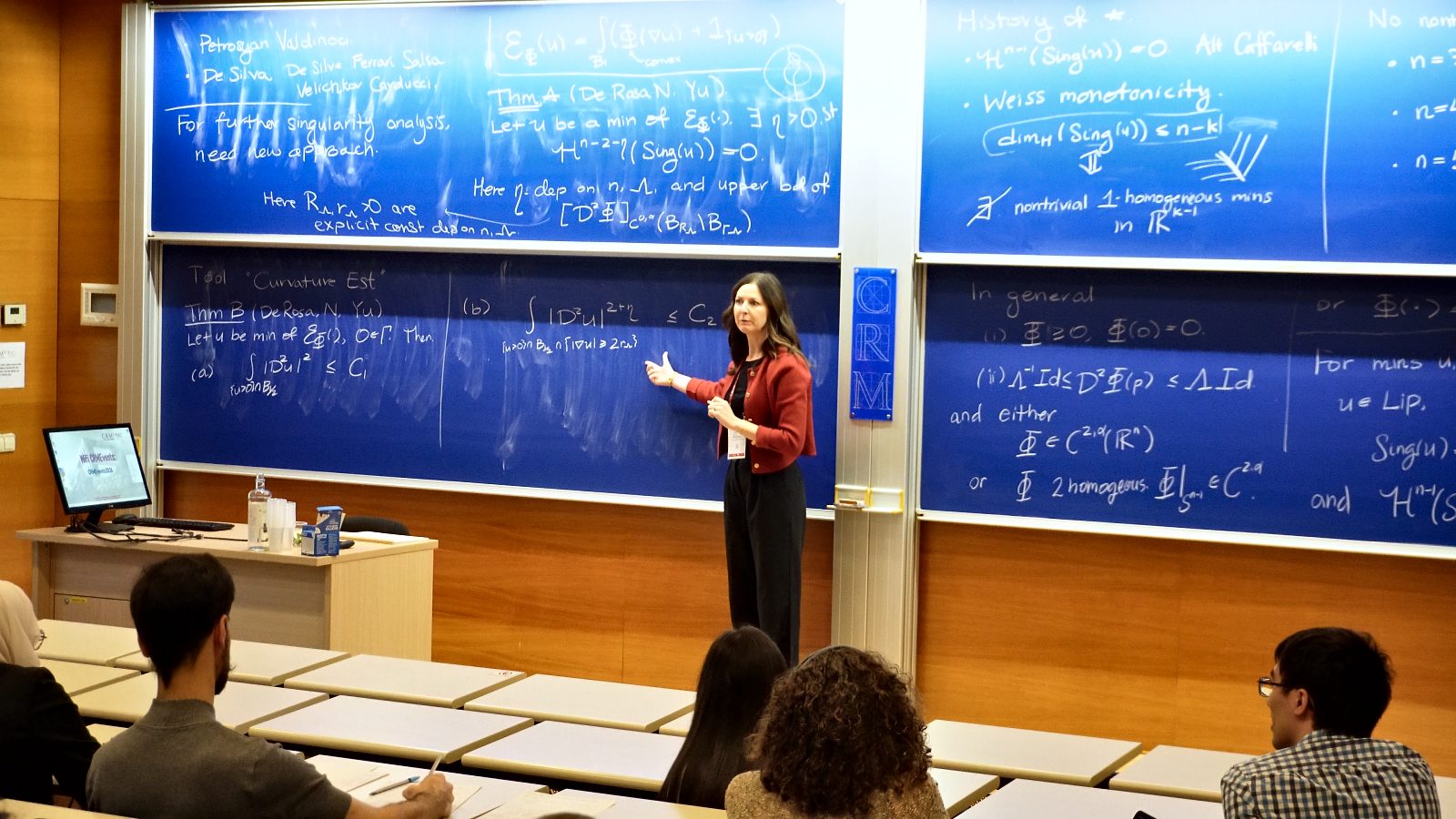
On Wednesday Federico Franceschini (Stanford University) spoke about mean curvature bounds for the free boundary, and Susanna Terracini (Università di Torino), who had given the CRM Colloquium in July, about elliptic systems that model partial separation. Anna Skorobogatova (Institute for Theoretical Studies, ETH Zurich) closed the morning with two-phase elliptic measure. The afternoon was free, and the social dinner was that evening.
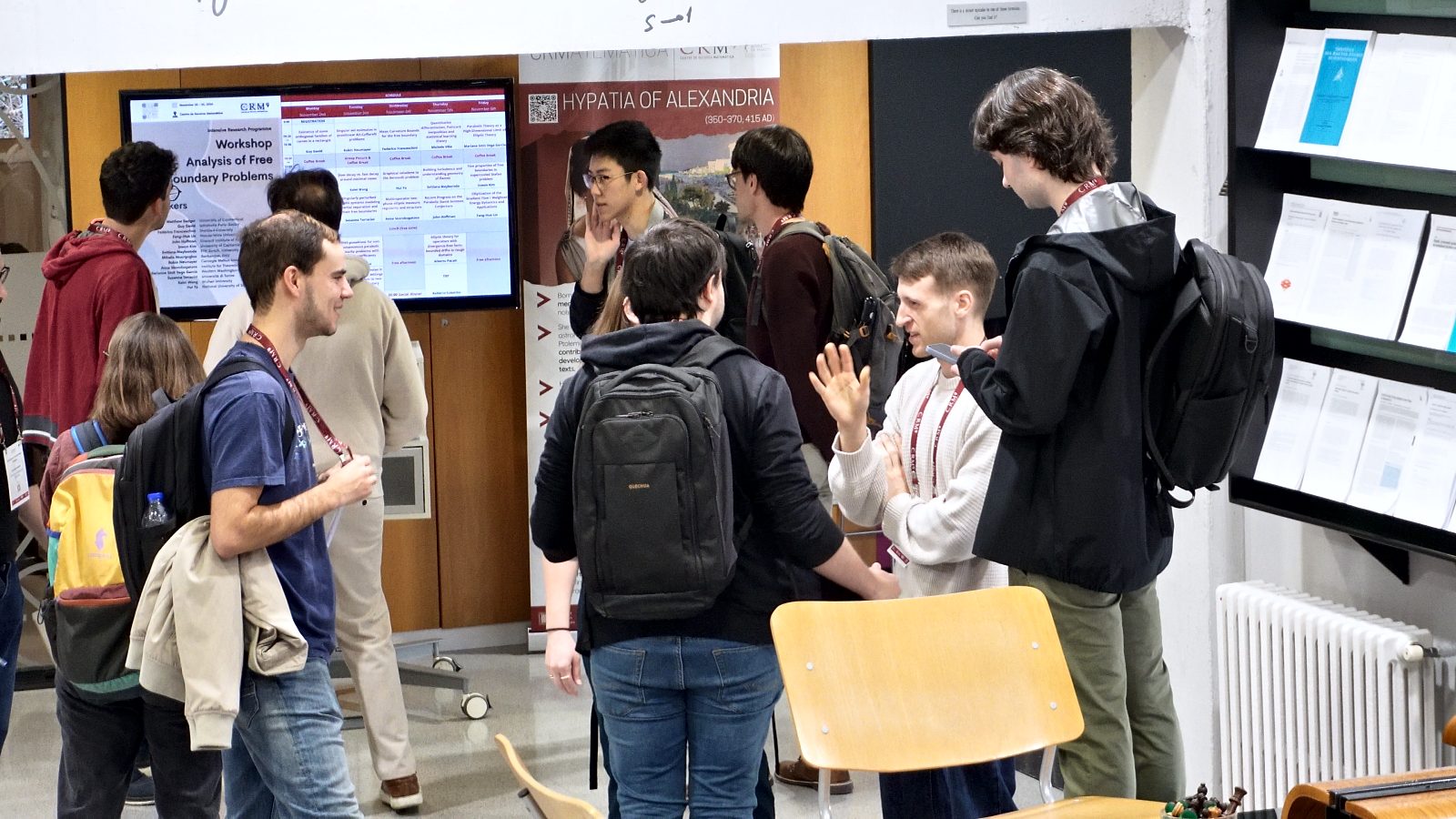
Michele Villa (UPV/EHU) opened Thursday with a talk that put statistical learning theory next to quantitative differentiation and Poincaré inequalities, and Svitlana Mayboroda (ETH Zurich, University of Minnesota, IAS) talked about building turbulence and understanding the geometry of flames. John Hoffman (Florida State University) then reported recent progress on the parabolic David-Semmes conjecture. The David in its name is the speaker who had opened the week. Alberto Pacati (ETH Zurich) and Roberto Colombo (EPFL) gave the afternoon’s short talks, on elliptic theory in rough domains and on the fractional Laplacian in Lipschitz domains.
On Friday, Yingying Cai (UAB) returned to the dimension of harmonic measure with a short talk on when it drops and when it fails to. Clara Torres-Latorre (ICMAT) followed with the equilibrium measure of a Coulomb gas in a half-space, and Mariana Smit Vega Garcia (Western Washington University), a member of the scientific committee, closed the workshop by presenting parabolic theory as a high-dimensional limit of elliptic theory.
The workshop was organised by Xavier Fernández-Real (EPFL), Cole Jeznach (Universitat Autònoma de Barcelona), Xavier Ros-Oton (ICREA, Universitat de Barcelona, CRM) and Xavier Tolsa (ICREA, Universitat Autònoma de Barcelona, CRM), with a scientific committee formed by Max Engelstein (University of Minnesota), Mariana Smit Vega Garcia and Zihui Zhao (Johns Hopkins University).
With the intensive weeks over, the programme continues with its long-term visitors at the CRM. Andrea Merlo (Ikerbasque, EHU) gives a mini-course on Alberti representations, the WALA conjecture and applications from 9 to 20 November, alongside the weekly seminars on free boundary problems. The IRP closes on 4 December.
More from the CRM
La guerra de les granotes i els ratolins
The CRM exhibition ‘Les matemàtiques de Gaudí’ moves to the University of Barcelona
L'exposició del CRM «Les matemàtiques de Gaudí» es trasllada a la Universitat de BarcelonaEight posters on the mathematics behind Gaudí's architecture, on display at the UB until 30 NovemberVuit pòsters sobre les matemàtiques que hi ha darrere l'arquitectura de Gaudí,...
Advanced Course on Free Boundary Problems Opens the Intensive Weeks of the IRP
Three mini-courses by Bozhidar Velichkov, Max Engelstein and Zihui Zhao, from 26 to 30 October at the CRMParticipants in the Advanced Course on Free Boundary Problems.CRM CommPau VarelaCRMComm@crm.catGet the latest CRM news and activities in your...
El CRM rep els estudiants de la prova de nivell de Bojos per les Matemàtiques 2027
The CRM welcomes students from the Bojos per les Matemàtiques 2027 entrance testVisita guiada al centre i xerrada de Tomás Sanz (UB-CRM) sobre les matemàtiques del soA guided tour of the centre and a talk by Tomás Sanz (UB-CRM) on the mathematics of soundTomás Sanz...
Eight CRM Researchers in the 2026 Stanford-Elsevier List of Highly Cited Scientists
The database ranks scientists by citation impact, over their whole careers and in 2025 aloneCRM CommPau VarelaCRMComm@crm.catGet the latest CRM news and activities in your inbox.Recent newsletters →The 2026 edition of the Stanford-Elsevier database...
Fish schools and growing tissues: a workshop on how collective behaviour emerges
Mathematicians and biologists met at the Institut d’Estudis Catalans to discuss how local interactions shape tissues and animal groups.A talk in the Pere i Joan Coromines room of the Institut d’Estudis Catalans. Image: CRMCRM CommPau...
The CRM opens the academic year and unveils its Directors’ Gallery
A review of the year, the Communication Plan 2026–2030 and three research talks filled the morning of 19 October.The unveiling of the Directors’ Gallery.CRM CommPau VarelaCRMComm@crm.catGet the latest CRM news and activities in your inbox.Recent...
The CRM Mentoring Programme, as Told by One of Its Pairs
PhD student Joaquim Duran and mathematician Robert Cardona, one of the pairs in the CRM Mentoring ProgrammeJoaquim Duran (left) and Robert Cardona.CRM CommPau VarelaCRMComm@crm.catGet the latest CRM news and activities in your inbox.Recent...
When the reward comes within reach, the brain changes what it compares
As the tokens piled up, choices got faster and more accurate at the same time. The yardstick for judging each offer had moved.CRM CommPau VarelaCRMComm@crm.catGet the latest CRM news and activities in your inbox.Recent newsletters →Two subjects...
Almost every automaton can be reset with a short word
For a random automaton with n states, a word of about √n log n letters is almost always enough to reset it.CRM CommPau VarelaCRMComm@crm.catGet the latest CRM news and activities in your inbox.Recent newsletters →Picture a conveyor belt carrying...