
CRM–María de Maeztu programme
Chair of Excellence
Each year, one or two senior women mathematicians come to the CRM for up to four months. They join one of the research groups and give a colloquium or a short course along the way. Three have come so far.
The first lecture of the programme opened with a ball rolling downhill. Almost four hundred years ago, Galileo noticed that the quickest way down isn’t a straight line, and suspected that solving it properly would take a ‘higher’ mathematics. Chenchang Zhu borrowed his problem on 9 April 2025 to open her stay as the first CRM–María de Maeztu Chair of Excellence.
The chair has two jobs. One is scientific: collaborations that keep going after the visit ends. The other has to do with who students get to see at the blackboard, and for how long. Chair holders stay between one and four months, long enough to turn into someone you can stop in a corridor with a question.
01
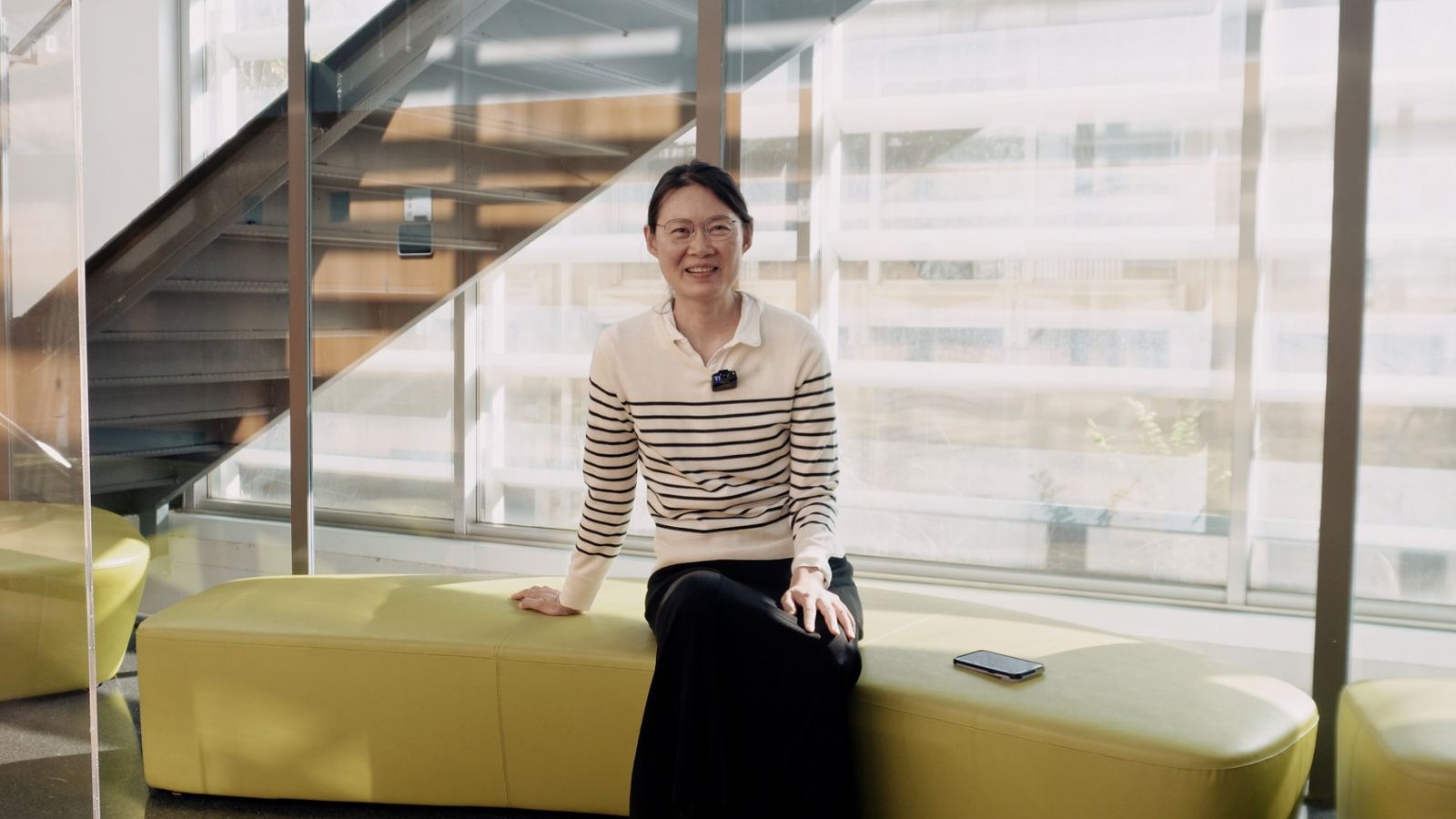
Chenchang Zhu
When a symmetry leaves a space with singular points, she reaches for higher geometry.
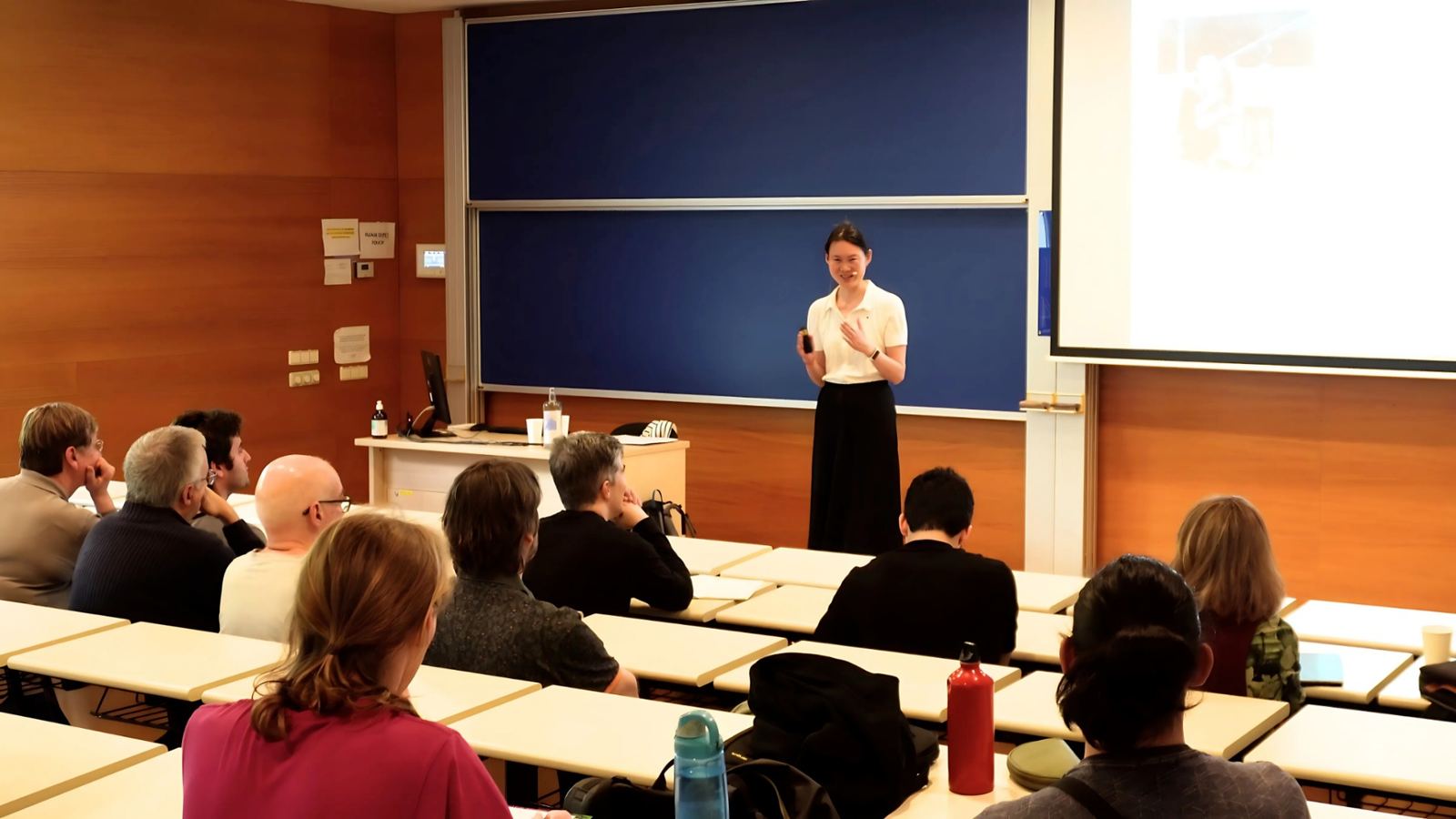
A professor at the Mathematisches Institut in Göttingen, Chenchang Zhu began her stay on 9 April 2025 with the inaugural colloquium in the CRM auditorium. It travelled from Galileo’s ball to the geometry she works on today, with a stop at her doctoral advisor, Alan Weinstein, and his line that ‘everything is Lagrangian’.
Her field is higher and derived differential geometry, where points are allowed to carry symmetries of their own. She found her way in through Weinstein, who pointed her to a topological groupoid built by Crainic and Fernandes and suspected some differential structure was hiding behind it. She had just attended Barbara Fantechi’s course on algebraic stacks in Park City, and it struck her that the answer might be a stack. ‘I didn’t understand stacks yet, but the spark was there.’ It clicked later, at the 2002 International Congress of Mathematicians in Beijing, while she was talking to Kai Behrend.
The CRM wasn’t new to her. In 2022 she had chaired the scientific committee of the advanced school of the Poisson 2022 research programme, with Eva Miranda as local chair. ‘Eva self-generated so many things, it turned the event into an absolute fantasy.’ Her project for this stay was to use differential graded groupoids to deal with singularities in symplectic reduction.
Her institute in Göttingen has reached gender parity, she says. Travel hasn’t caught up: as a single mother, she still has to justify bringing her child along, or explain why she needs an extra day. ‘These should be obvious considerations.’
 Interview
“It feels like an invitation to dream a bit bolder.”
Chenchang Zhu, on holding the chair
At the CRM
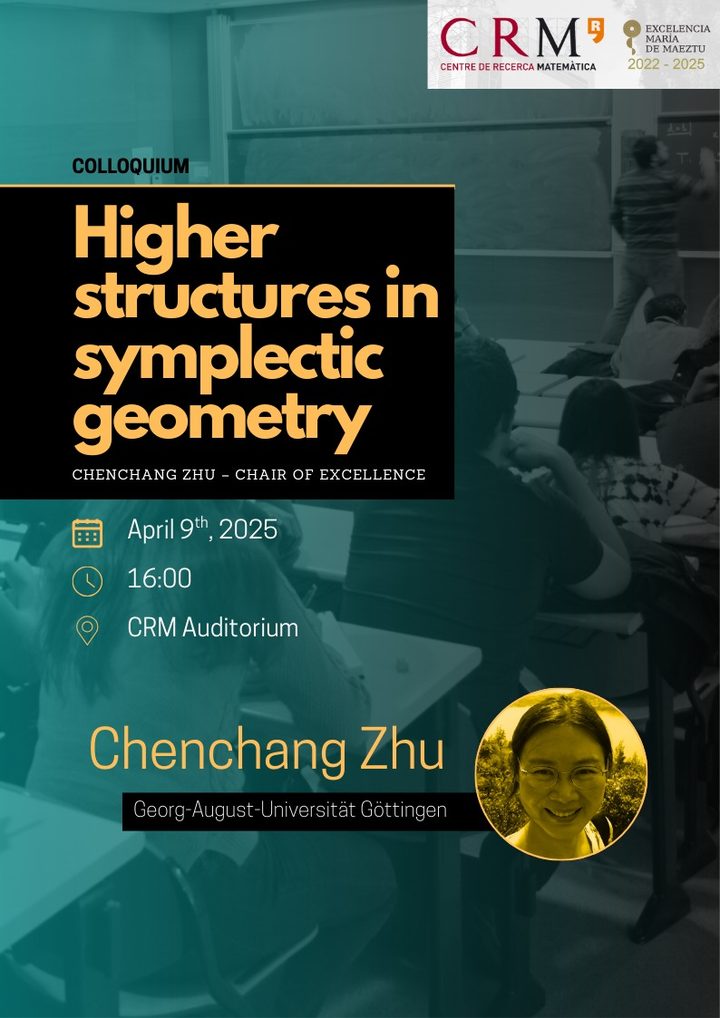
Inaugural colloquium9 April 2025 · 16:00
Higher structures in symplectic geometry
CRM Auditorium
02
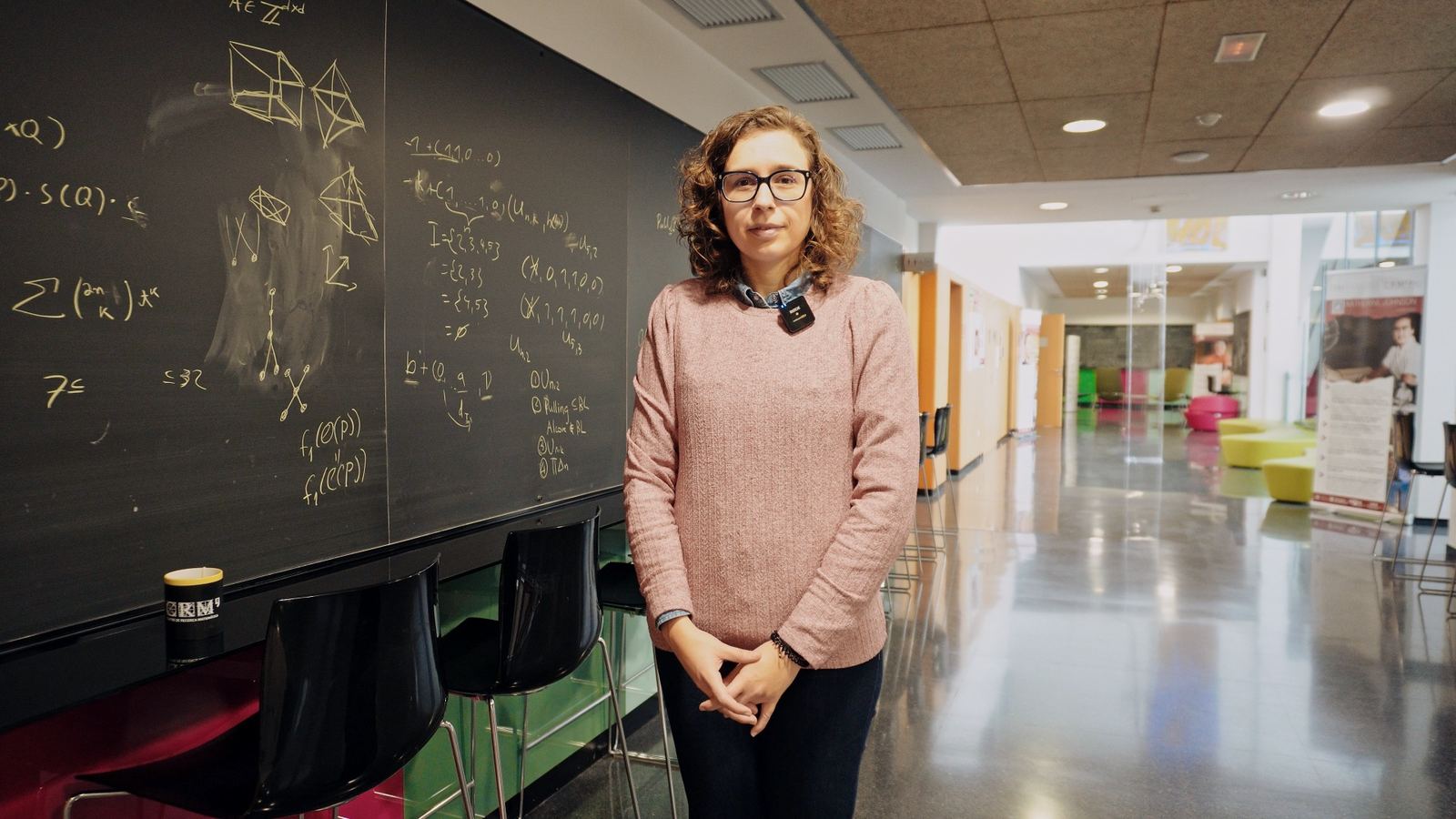
María Ángeles García-Ferrero
How to see inside something when all you can measure is its surface.
María Ángeles García-Ferrero works on inverse problems, which run the usual question backwards: you know the effects and want the cause. Her main one is the Calderón problem. Apply voltages on the surface of an object and measure the currents that result. From that, work out how well every part of the inside conducts electricity.
Done right, that’s a scan without radiation. Electrical impedance tomography could tell a stroke caused by bleeding from one caused by a blockage, or watch a premature baby’s lungs without another X-ray. ‘The real-world motivation gives me additional incentives to dedicate myself to it,’ she says.
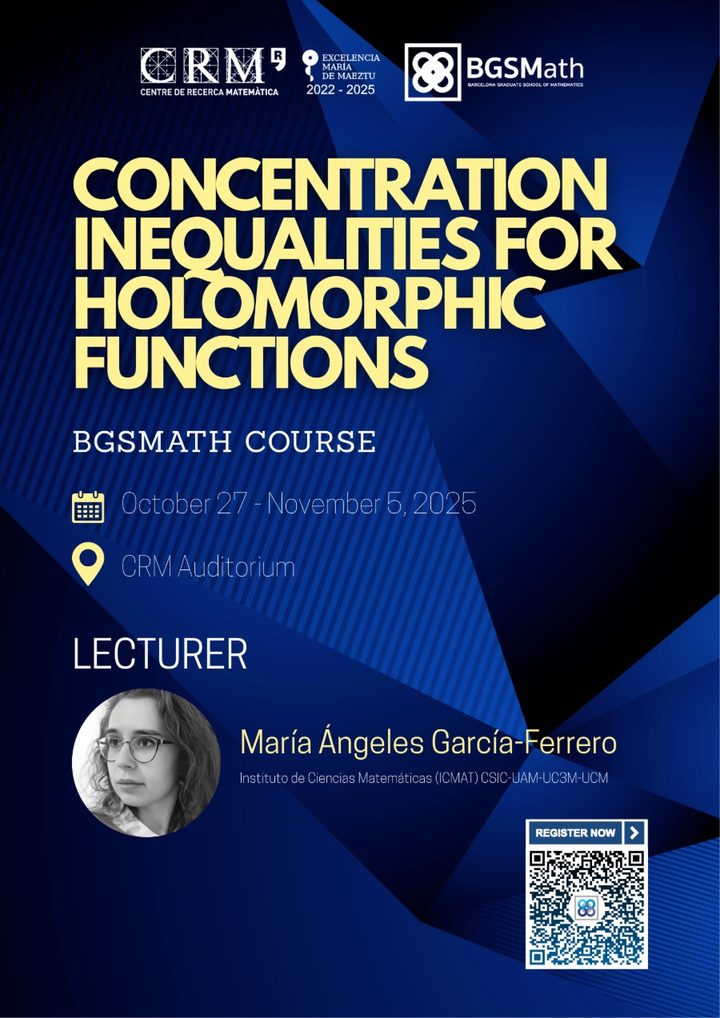
At the CRM she spent October and November 2025 on something else: concentration inequalities for holomorphic functions, with Joaquim Ortega-Cerdà (Universitat de Barcelona and CRM). The two had already studied how concentrated a polynomial can be on a region of the complex plane, and were now generalising the result without some of the tools that had worked the first time. She came to the topic through him. ‘Honestly, listening to him talk about any subject and not becoming interested is very difficult.’
She taught it too, in a five-session BGSMath course that went from uncertainty principles to Lieb’s conjecture on the Wehrl entropy, a line of questions that goes back to the late 1970s. On 19 November she went back to Calderón for a colloquium at the María de Maeztu Closing Conference.
 Interview
“Sometimes we look for role models in our day-to-day life.”
María Ángeles García-Ferrero, on initiatives like the chair
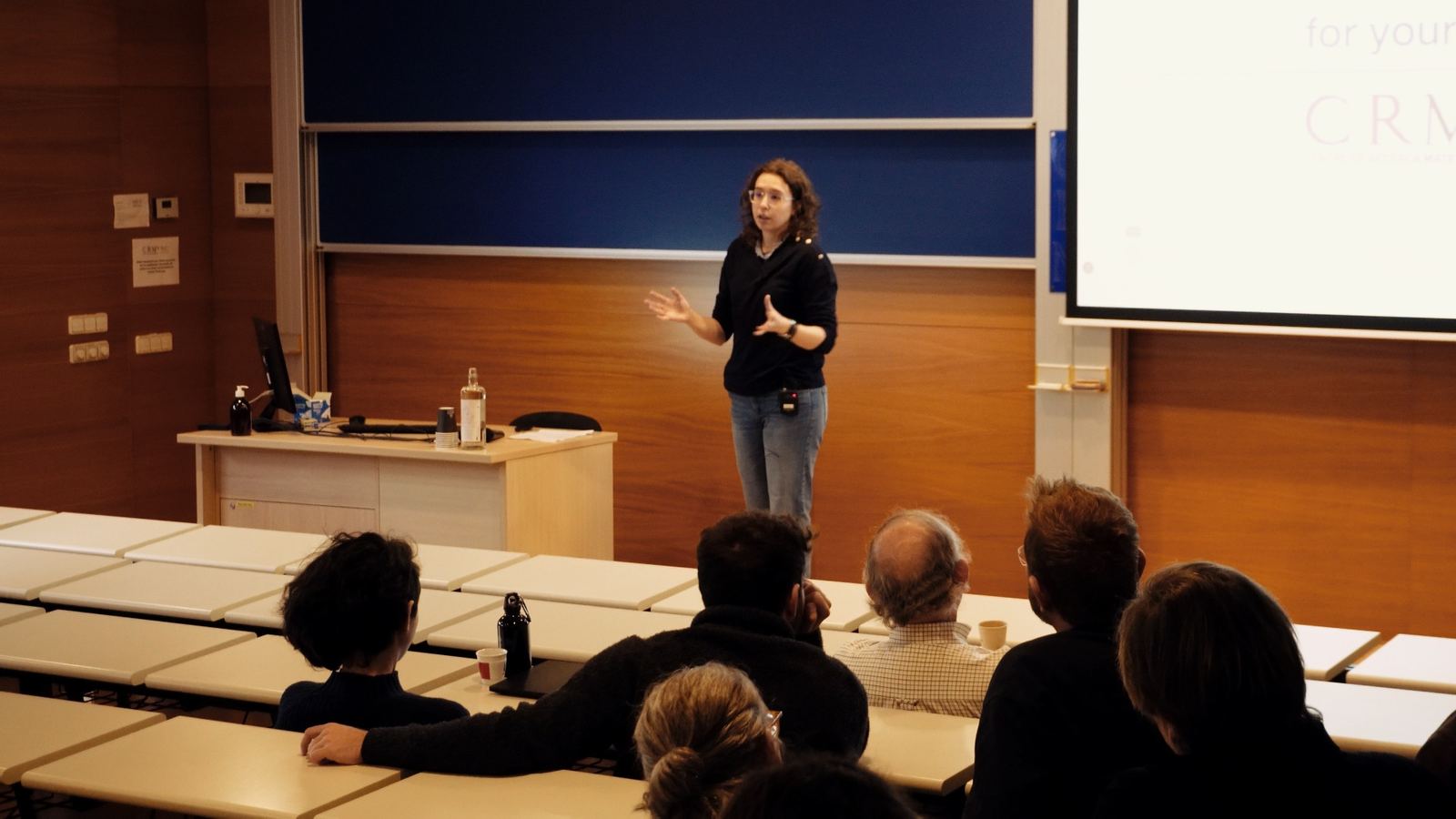
At the CRM
BGSMath course27 October – 5 November 2025 · 11:00–13:00
Concentration inequalities for holomorphic functions
Five two-hour sessions · CRM Auditorium
Colloquium19 November 2025
María de Maeztu Closing Conference
Her talk: the inverse conductivity problem, also known as the Calderón problem.
03
Anna Florio
A ball, a table, no friction. Then a little friction.
‘As long as there is something that moves, I’m interested in what we can say about it.’ Anna Florio works in dynamical systems, the part of mathematics that asks what a moving system ends up doing in the long run, and she spent the summer of 2026 at the CRM asking it about billiards.
A mathematical billiard is the bar game with the beer taken away. ‘You take a ball; let’s say it’s massless. You put it somewhere on the boundary of your table, and you just have to shoot it.’ The ball runs straight and bounces off the edge at the angle it arrived. Then it does it again, forever. George Birkhoff made a branch of dynamics out of that a century ago, although Florio likes to point out that Lewis Carroll got to the circular table first.
Here she worked with Immaculada Baldomà and Tere Martínez-Seara, both at the UPC and the CRM, on analytic billiards, the most rigid tables the theory allows. They want to show that chaos is still what you should expect there and, further off, that an analytic billiard can hide essentially any dynamics of the disc inside it. On the side, she planned to talk with Eva Miranda about universality in flows linked to the Euler equation.
Her case for coming for months instead of meeting online is simple. One day you talk, the next you come back with ideas you didn’t have before. On 22 July she gave her colloquium at the Universitat de Barcelona, about what happens when the ball loses a little energy at each bounce and attractors start pulling the trajectories in.
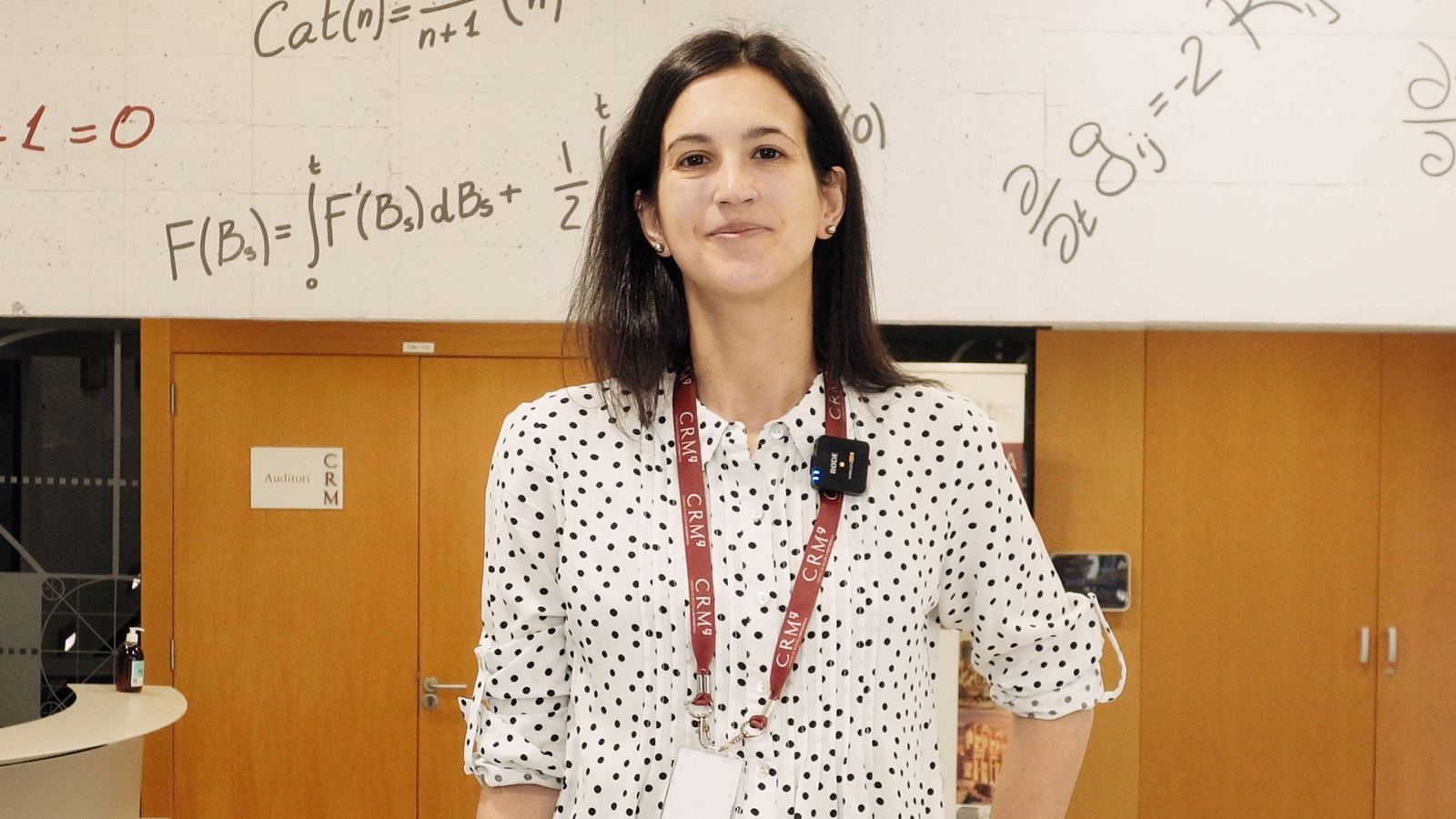 Interview
“There are women doing maths, and doing good maths, and enjoying it.”
Anna Florio, on having women as advisors
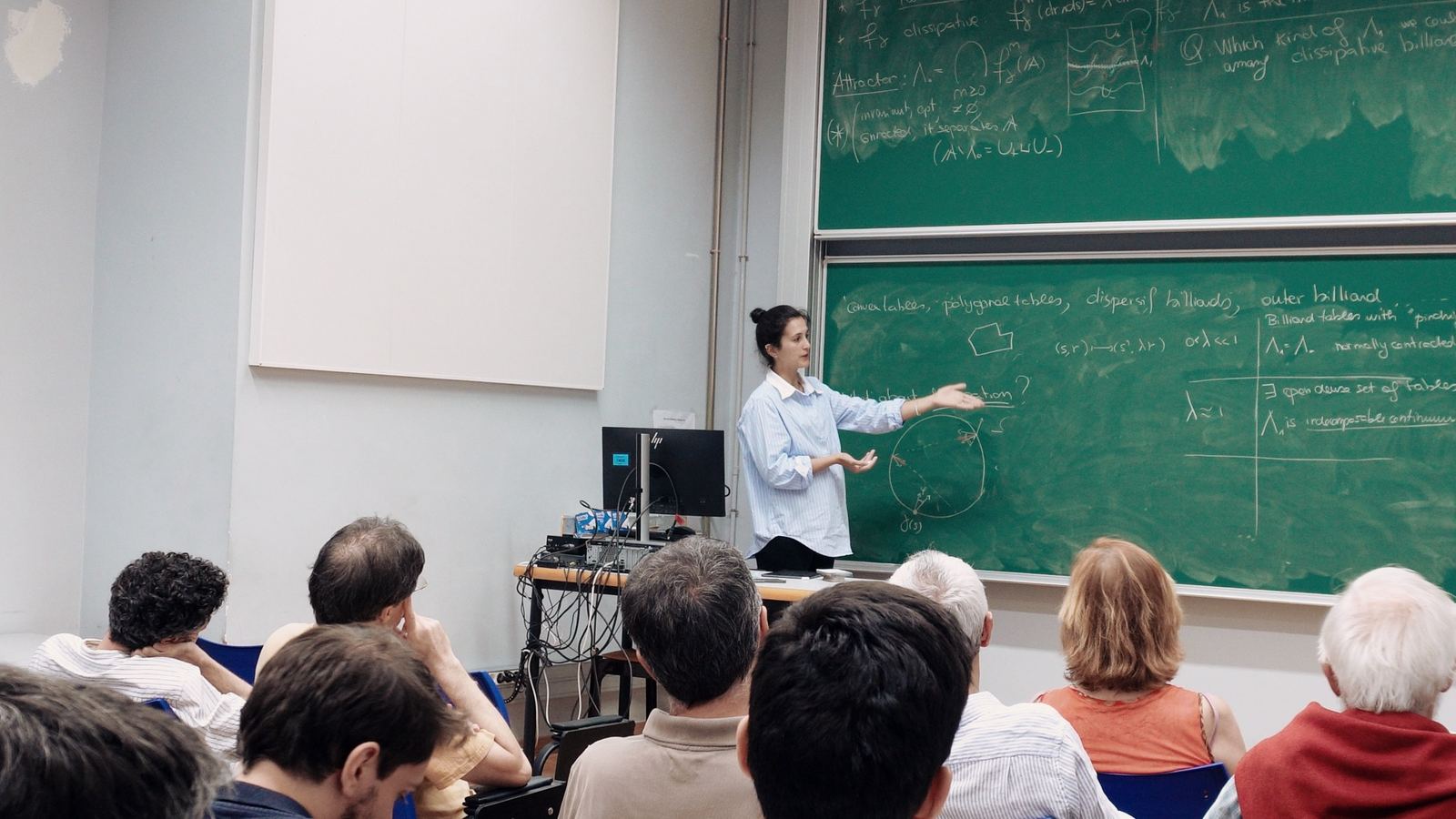
At the CRM
Colloquium22 July 2026 · 16:00
The Dynamics of Billiards: Between Conservative and Dissipative Regimes
Room T2, Facultat de Matemàtiques i Informàtica, Universitat de Barcelona

“You cannot say: we will solve these problems in one hour during a Zoom meeting.”
Anna Florio