Intensive Research Programme
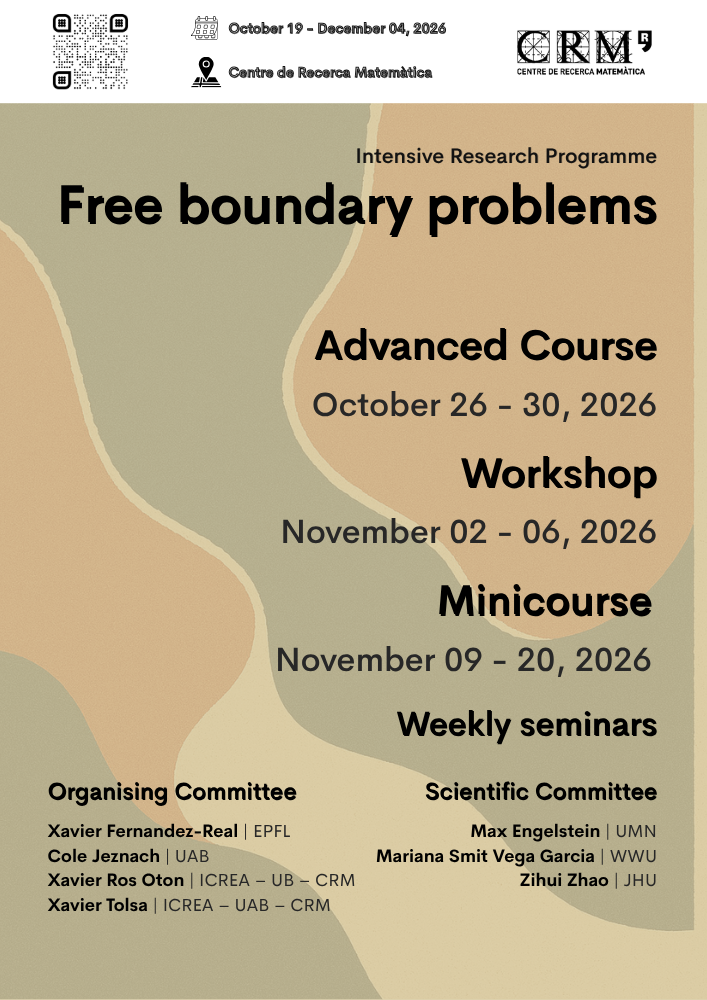
Analysis of Free Boundary Problems
19 October – 4 December 2026
Centre de Recerca Matemàtica, Bellaterra
IRP on Analysis of Free Boundary Problems
Sign into December 04, 2026
If you wish to register only for one of the activities, please choose the one you are interested in from the list
Description
The study of free boundary problems (FBP) is a classical topic in Analysis and PDE that has seen an enormous development in the last years. On the one hand, these problems are central to modeling a vast array of physical and natural phenomena, including phase transitions, flame propagation, and fluid dynamics. On the other hand, FBP have deep connections to Geometric Measure Theory, Harmonic Analysis, and the Calculus of Variations, and appear for example in the study of the harmonic measure in rough domains.
While the motivation and origin of these two topics of research are quite different, there have been important connections between them, and the development we have seen in the last years would have not been possible without such deep connections. This Intensive Research Program aims to bring together leading experts in both Analysis and PDE, working on topics including: elliptic and parabolic FBP, geometric measure theory, harmonic measure, and unique continuation in rough sets. The first part of the program will consist of two intensive weeks: the first week consists of three intensive mini-courses, while the second week consists of a workshop including research talks given by roughly 17 leading researchers in the field. Following these intensive weeks, the program will continue with 2 weekly seminars, and the opportunity for long-term visitors to collaborate.
CRM-CIMPA Fellowships
CIMPA and CRM jointly offer fellowships to support the participation of young researchers from developing countries. These fellowships are aimed at researchers aged 36 or younger, or who have completed their PhD within the last five years. Fellows will be selected through an open call for applications to be published soon on the CIMPA website. The program includes travel, accommodation during the whole program, full board, and visa fees if required, enabling selected participants to attend the program.
Applications must be submitted via the CIMPA website (https://www.cimpa.info/fr/node/8205). The deadline to apply is July 1.
Activities
Advanced Course on Free Boundary Problems
26–30 October 2026
Auditorium, Centre de Recerca Matemàtica
Three mini-courses delivered by Max Engelstein (UMN), Bozhidar Velichkov (Università di Pisa) and Zihui Zhao (JHU).
Workshop on Free Boundary Problems
2–6 November 2026
Auditorium, Centre de Recerca Matemàtica
Research talks by leading researchers in the field, with shorter blocks for students to present their work.
Alberti representations, the WALA conjecture and applications
9–20 November 2026
Centre de Recerca Matemàtica
Minicourse by Andrea Merlo.
Weekly Seminars on Free Boundary Problems
Mondays, 9–30 November 2026, 15:00–17:00
Auditorium, Centre de Recerca Matemàtica
After the two intensive weeks, an opportunity for long-term visitors to collaborate.
Invited visiting researchers
- Asma Amira
- Matthew Badger
University of Connecticut - Guy David
Université Paris-Saclay - Max Engelstein
University of Minnesota - Xavier Fernández-Real
École polytechnique fédérale de Lausanne - Federico Franceschini
Stanford University - John Hoffman
Florida State University - Cole Jeznach
Universitat Autònoma de Barcelona - Inwon Kim
University of California – Los Angeles - Fang-Hua Lin
Courant Institute of Mathematical Sciences - Svitlana Mayboroda
ETH Zurich, University of Minnesota, IAS - Andrea Merlo
Ikerbasque, EHU - Mihalis Mourgoglou
Ikerbasque, EHU - Robin Neumayer
Carnegie Mellon University - Chayma Nssibi
ENIT (LAMSIN) - Xavier Ros-Oton
ICREA – Universitat de Barcelona – Centre de Recerca Matemàtica - Anna Skorobogatova
Institute for Theoretical Studies / ETH Zurich - Mariana Smit Vega Garcia
Western Washington University - Luca Spolaor
University of California – San Diego - Susanna Terracini
Università di Torino - Xavier Tolsa
ICREA – Universitat Autònoma de Barcelona – Centre de Recerca Matemàtica - Bozhidar Velichkov
Università di Pisa - Kelei Wang
Wuhan University - Hui Yu
National University of Singapore - Zihui Zhao
Johns Hopkins University
Scientific committee
- Max Engelstein
University of Minnesota - Mariana Smit Vega Garcia
Western Washington University - Zihui Zhao
Johns Hopkins University
Organising committee
- Xavier Fernández-Real
École polytechnique fédérale de Lausanne - Cole Jeznach
Universitat Autònoma de Barcelona - Xavier Ros-Oton
ICREA – Universitat de Barcelona – Centre de Recerca Matemàtica - Xavier Tolsa
ICREA – Universitat Autònoma de Barcelona – Centre de Recerca Matemàtica
Registration
Before registering for the activity, you will be asked to create a CRM web user account through the following link. Please note that both personal and academic information must be completed in the web user intranet.
After creating your CRM user account, you can log in on the activity webpage to complete your registration, or by clicking the button and then selecting ‘Sign in’.
Poster and contributed talks
Participants are invited to share their research findings or propose open problems through a short talk or a poster presentation. Poster boards will be available in A0 size, vertical orientation. You will be asked to attach the abstract (between 300 and 600 words) including the title, in .pdf format. The file name must follow the format: surname_name.
- Abstract submission deadline: TBP
- Decisions communicated by: TBP
List of participants
| Name | Institution |
|---|
Venue
Centre de Recerca Matemàtica
Edifici C, Campus de Bellaterra
08193 Bellaterra, Barcelona
Centre de Recerca Matemàtica
Accommodation
Where to stay, with the options the CRM keeps up to date.
Contact
For enquiries about this event, please contact crmactivitats@crm.cat.
Policies and commitments
CRM Events Code of Conduct
Scam warning
We are aware of a number of current scams targeting participants at CRM activities concerning registration or accommodation bookings. If you are approached by a third party (eg travellerpoint.org, Conference Committee, Global Travel Experts or Royal Visit) asking for booking or payment details, please ignore them.
Please remember:
i) CRM never uses third parties to do our administration for events: messages will come directly from CRM staff
ii) CRM will never ask participants for credit card or bank details
iii) If you have any doubt about an email you receive please get in touch
Sustainable events
We are committed to organising sustainable events that minimise environmental impact and create a positive legacy for the host community. We support organisers in designing events aligned with the UN 2030 Sustainable Development Goals, reducing negative environmental impacts and promoting responsible practices.
All materials provided during our activities are responsibly sourced, including recycled pens and plastic-free badges. We work with responsible suppliers, and our catering partners use fully compostable materials while offering vegetarian and vegan options, with at least one event day being fully vegetarian.
After the activity
TBP

[CAPTION TBP]