
Advanced Course
Advanced Course on Free Boundary Problems
26–30 October 2026
Auditorium, Centre de Recerca Matemàtica, Bellaterra

Advanced Course on Free Boundary Problems
Sign into October 30, 2026
Venue: Centre de Recerca Matemàtica (CRM)
Room: Auditorium
Description
This Advanced Course is part of the Intensive Research Programme on Analysis of Free Boundary Problems.
The advanced course will consist of three mini-courses delivered by Professors Max Engelstein (UMN), Bozhidar Velichkov (Università di Pisa), and Zihui Zhao (JHU). While the details of the courses are still to be determined, a large emphasis will be placed on techniques for the regularity theory for free boundary problems, and regularity of harmonic/elliptic measure. Each course will consist of 7 hours of lectures. During this week, additional time will be allotted for discussions regarding the lectures, and further connections to active areas in research.
Lecturers
The two-phase Bernoulli problem: regularity and fine structure of the free boundaries
Bozhidar Velichkov
Università di Pisa
Abstract
This course is dedicated to the two-phase Bernoulli free boundary problem. I will discuss the theory in the general case, in which the solution changes sign and might have zero level set of positive Lebesgue measure. Alt, Caffarelli and Friedman formulated the problem in the 80’s and proved the Lipschitz continuity of the solutions by introducing the Alt-Caffarelli-Friedman’s monotonicity formula. I obtained the  regularity of the free boundaries of the positive and the negative phases with Spolaor in 2016 via an epiperimetric inequality in 2D, while with De Philippis and Spolaor, we solved the higher dimensional case in 2021 via an improvement of flatness argument à la De Silva. I will also discuss the structure of the contact set between the free boundaries of the positive and the negative parts. Precisely, I will show that in 2D the contact set is locally composed of finitely many disjoint smooth arcs. The proof is based on a Weierstrass-type representation formula, inspired by the works of Hélein-Hauswirth-Pacard and Traizet, which allows to rewrite the problem into a geometric free boundary problem for minimal surfaces in the half 3D space.
On Freezing Problems
Max Engelstein
University of Minnesota
Abstract
Supercooling is the process of cooling a liquid to below its freezing temperature yet maintaining its liquid state (due to certain chemical properties of the liquid molecules). This configuration is quite unstable and when perturbed the liquid freezes in unpredictable and pathological ways. Ice can appear out of “nowhere” (nucleation), fractal shapes develop in the liquid ice interface and freezing fronts can move with “infinite speed”. You can see these phenomena at home with your freezer (or on YouTube).
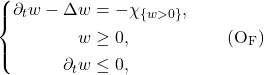
In this mini-course we will discuss a mathematical model for this physical process called the Supercooled Stefan Problem. This is an ill-posed parabolic free boundary problem. We are most interested in instances when the problem can be regularized, giving rise to the parabolic obstacle problem
Interestingly, this regularized model exhibits some of the pathological behavior of freezing supercooled liquids (nucleation and rapidly advancing freezing fronts) but provably does not develop large fractal liquid-ice interfaces generically. We will present this proof, which is joint work with I. Kim (UCLA) and S. Munoz (UCLA). Along the way we will discuss other work on parabolic obstacle problems, especially that of Caffarelli, Petrosyan and Shahgholian (JAMS 2004) and Figalli, Ros-Oton and Serra (JAMS 2024), both of which majorly influence and inform the analysis of the supercooled problem.
One-phase free boundary problem and singularity analysis
Zihui Zhao
Johns Hopkins University
Abstract
The topic of the mini-course is the one-phase free boundary problem, namely the variational problem of the Alt-Caffarelli energy functional 
subject to prescribed boundary condition. As is often the case in free boundary problems, the regularity of solutions is tied to the regularity of the corresponding free boundaries. To study the latter, we perform a blow-up analysis and show that singular points of the free boundary are locally modeled on non-flat one-homogeneous solutions to the problem. We discuss a few examples of these homogeneous solutions. Further analysis near these tangent functions reveals the structure of the free boundary near singularity.
Schedule
Monday 26 October
Tuesday 27 October
Wednesday 28 October
Thursday 29 October
Friday 30 October
Scientific committee
- Max Engelstein
University of Minnesota - Mariana Smit Vega Garcia
Western Washington University - Zihui Zhao
Johns Hopkins University
Organising committee
- Xavier Fernández-Real
École polytechnique fédérale de Lausanne - Cole Jeznach
Universitat Autònoma de Barcelona - Xavier Ros-Oton
ICREA – Universitat de Barcelona – Centre de Recerca Matemàtica - Xavier Tolsa
ICREA – Universitat Autònoma de Barcelona – Centre de Recerca Matemàtica
Registration
Before registering for the activity, you will be asked to create a CRM web user account through the following link. Please note that both personal and academic information must be completed in the web user intranet.
After creating your CRM user account, you can log in on the activity webpage to complete your registration, or by clicking the button and then selecting ‘Sign in’.
Payment information
Effective June 15th, 2026, bank transfer payments will no longer be accepted for any CRM activity. All registration fees must be paid by card to complete the registration process.
If your institution requires an invoice for reimbursement or administrative purposes, you can request it during the registration process. Once your registration fee has been paid, please send the proof of payment to comptabilitat@crm.cat. The invoice will be issued after the payment has been received and verified.
Contributed talks
Participants are encouraged to present their research results or open problems in a short talk format. To apply, participants will find the relevant option during the registration process. You will be asked to attach the abstract (between 300 and 600 words) including the title, in .pdf format. The file name must follow the format: surname_name.
- Deadline for abstract submission: TBP
- Resolutions: TBP
Accommodation grants
In order to increase the number of young researchers participating in this activity, the CRM offers grants to cover the accommodation during the activity.
To apply, you must complete the registration process, please go to SIGN IN, and choose that you wish to apply for an accommodation grant, you will be asked to attach your CV in .pdf format. Please click on the Reservation option before finishing the process.
- Application deadline for grants: TBP
- Resolutions for accommodation grants: TBP
List of participants
| Name | Institution |
|---|---|
| Chayma Nssibi | LAMSIN, National Engineering School of Tunis (ENIT), University of Tunis El Manar |
| Xavier Tolsa Domènech | ICREA, Universitat Autònoma de Barcelona, and CRM |
| Xavier Fernàndez-Real | École Polytechnique Fédérale de Lausanne |
| Xavier Ros Oton | Universitat de Barcelona |
| Joan Domingo Pasarin | Universitat de Barcelona |
| Alejandro Martínez Sánchez | Universitat de Barcelona |
| Pablo Hidalgo Palencia | Universitat de Barcelona |
| Joan Mateu Bennassar | Universitat Autònoma de Barcelona |
| Joan Hernández García | Universitat Autònoma de Barcelona |
| Martí Prats Soler | Universitat Autònoma de Barcelona |
| Marina Fernàndez Vilaseca | Universitat Autònoma de Barcelona |
| Joaquim Martin | Universitat Autònoma de Barcelona |
| Luis Lloret-Sanchez | Universitat Autònoma de Barcelona |
| Àlex Martín | Universitat Autònoma de Barcelona |
| Jaume Capdevila Jové | Universitat Autònoma de Barcelona |
| Cole Jeznach | Universitat Autònoma de Barcelona |
| Yingying Cai | Universitat Autònoma de Barcelona |
| Carmelo Puliatti | Universitat Autònoma de Barcelona |
| Juan Carlos Cantero | Universitat Autònoma de Barcelona |
| Laura Prat Baiget | Universitat Autònoma de Barcelona |
| Joan Orobitg Huguet | Universitat Autònoma de Barcelona |
| Joan Verdera | Universitat Autònoma de Barcelona |
| Iñigo U. Erneta | Universitat Politècnica de Catalunya |
| Gerard Codina | Universitat Politècnica de Catalunya |
| Andrés Alejandro Méndez Hernández | Universitat Politècnica de Catalunya |
| Ian Cornejo Amores | Universitat Rovira i Virgili |
| Eleftherios Vasilatos | Euskal Herriko Unibertsitateko |
| Max Engelstein | University of Minnesota |
| Emily Casey | University of Minnesota |
| Enrico Caneti | University of Bologna |
| Lorenzo Giaretto | University of Turin |
| Filippo Paiano | University of Pisa |
| Bozhidar Velichkov | University of Pisa |
| Nuno Carneiro | University of Pisa |
| Anita Ribeiro | University of Lisbon |
| Hanan Albarqi | King Abdullah University of Science and Technology |
| Hedong Hou | Swiss Federal Institute of Technology in Zurich |
| Alberto Pacati | Swiss Federal Institute of Technology in Zurich |
| Kunyi (Mark) Ma | Columbia University |
| Zihui Zhao | Johns Hopkins University |
| Miquel Saucedo | Centre de Recerca Matemàtica |
Practical information
Venue
Centre de Recerca Matemàtica
Edifici C, Campus de Bellaterra
08193 Bellaterra, Barcelona
Auditorium
Centre de Recerca Matemàtica
Accommodation
Where to stay, with the options the CRM keeps up to date.
Contact
For enquiries about this event, please contact the Head of Scientific Events, Ms Núria Hernández, at nhernandez@crm.cat.
Policies and commitments
CRM Events Code of Conduct
Scam warning
We are aware of a number of current scams targeting participants at CRM activities concerning registration or accommodation bookings. If you are approached by a third party (eg travellerpoint.org, Conference Committee, Global Travel Experts or Royal Visit) asking for booking or payment details, please ignore them.
Please remember:
i) CRM never uses third parties to do our administration for events: messages will come directly from CRM staff
ii) CRM will never ask participants for credit card or bank details
iii) If you have any doubt about an email you receive please get in touch
Sustainable events

We are committed to organising sustainable events that minimise environmental impact and create a positive legacy for the host community. We support organisers in designing events aligned with the UN 2030 Sustainable Development Goals, reducing negative environmental impacts and promoting responsible practices.
All materials provided during our activities are responsibly sourced, including recycled pens and plastic-free badges. We work with responsible suppliers, and our catering partners use fully compostable materials while offering vegetarian and vegan options, with at least one event day being fully vegetarian.
After the activity
TBP

[CAPTION TBP]