
In the article “Wigglyhedra”, researchers Asilata Bapat (Australian National University) and Vincent Pilaud (Universitat de Barcelona – Centre de Recerca Matemàtica) introduce the wiggly complex, a novel combinatorial and geometric structure, along with its associated polytope, the wigglyhedron, which bridges geometry, combinatorics, and category theory in innovative ways.
In their recent article, Wigglyhedra, published in Mathematische Zeitschrift, Asilata Bapat (The Australian National University) and Vincent Pilaud (Universitat de Barcelona – Centre de Recerca Matemàtica) introduce the wiggly complex, a novel and rich combinatorial and geometric structure. Through a deep exploration of its properties (combinatorial, categorical, and geometric), they construct the wigglyhedron, a polytope that realizes this complex and connects it to broader mathematical frameworks such as Cambrian lattices, flip graphs, and representation theory.
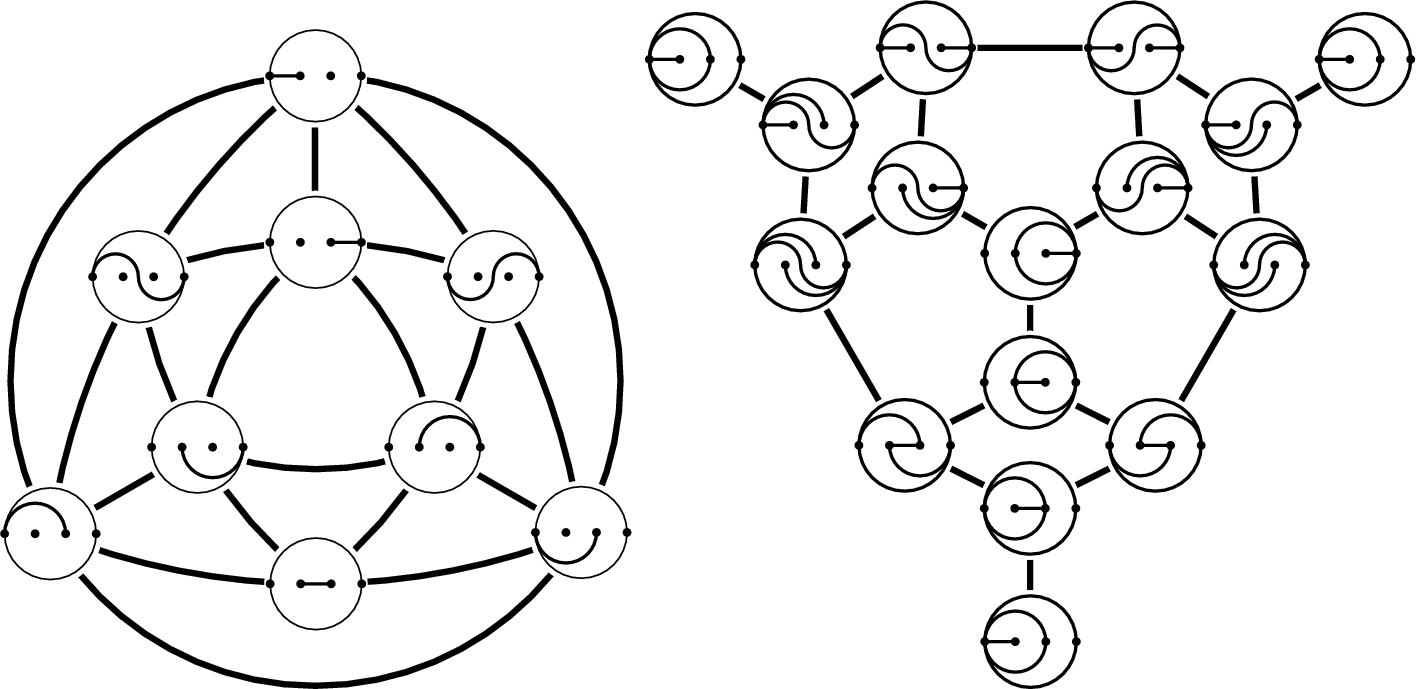
The wiggly complex (left) and the wiggly flip graph (right). Figure taken from the original publication.
The journey begins with a simple idea: draw arcs between points on a line, allowing them to wiggle above and below the axis, but never cross. These wiggly arcs form the basis of the wiggly complex, a (2n−1)-dimensional pseudomanifold without boundary. It is the simplicial complex of pairwise pointed and non-crossing subsets of internal wiggly arcs.
The wiggly arcs were inspired by certain decompositions of arbitrary curvy paths between points arising from a geometric model in representation theory.
Given a set of points on along a line segment, they provide a combinatorial way to decide on which side of the line lies each point.
They also appeared in work of Nathan Reading on non-crossing arc diagrams, although the compatibility condition was very different.— Vincent Pilaud (UB – CRM)
The vertices of the complex are the wiggly arcs themselves—curves that wiggle around n+2 collinear points. Its faces are sets of arcs that are pairwise pointed and non-crossing, and its facets—called wiggly pseudotriangulations—are maximal such sets. These pseudotriangulations divide the space into curved, triangle-like regions, forming the top-dimensional cells of the complex.

Four wiggly pseudotriangles. Figure taken from the original publication.
In my work, it is very important to experiment with the combinatorial objects, to get familiar with their properties and develop conjectures and statements. I do a lot of experiments using the open-source software sagemath. In particular, once we discovered the rule for the coordinates of the rays of the wiggly fan and of the facets of the wigglyhedron, it was interesting to look at the 3-dimensional wiggly fan and wigglyhedron that are represented in the paper.
— Vincent Pilaud (UB – CRM)
A Visual Metaphor
Imagine a row of evenly spaced pegs on a board, and flexible wires connecting them in pairs. These wires can loop above or below the board, but they must follow two rules: they cannot cross each other, and they must be “pointed”—meaning they can’t start where another ends. Each wire in this setup represents a wiggly arc, and the entire configuration of wires forms what mathematicians call the wiggly complex. In this complex, the vertices are the individual arcs (the wires), the faces are sets of arcs that can coexist without violating the rules (non-crossing and pointed), and the facets—the largest such sets—are called wiggly pseudotriangulations. These divide the space into curved, triangle-like regions, much like how a network of wires might partition the board into distinct zones.

The wiggly complex is not just a geometric object—it encodes deep combinatorial structures. The authors define wiggly permutations, a class of pattern-avoiding permutations of [2n], and prove a bijection between these and wiggly pseudotriangulations. This bijection induces an isomorphism from the wiggly flip graph to the cover graph of the wiggly lattice. The wiggly permutations form a sublattice of the weak order on permutations (the wiggly lattice), whose Hasse diagram is regular of degree 2n−1 and isomorphic to the graph of the wigglyhedron oriented in a suitable direction.
The most surprising result is that the wiggly complex is the boundary complex of a polytope.
While simplicial complexes are very common in mathematics (they just encode collections of subsets closed under taking subsets), boundary complexes of polytopes are very specific.— Vincent Pilaud (UB – CRM)
This lattice-theoretic viewpoint is enriched by a categorical one. Using the Khovanov–Seidel model, the authors interpret the decomposed objects in a triangulated category as wiggly arcs, whose intersections correspond to morphisms. Decomposing a general curve into wiggly arcs mirrors the decomposition of a complex object into its cohomology pieces.
Moreover, compatibility is defined both geometrically (non-crossing and pointedness) and categorically: each arc corresponds to an object in an abelian category, and compatibility reflects the absence of extensions between these objects. This dual interpretation allows the authors to connect geometry with homological algebra in a precise and elegant way.

Some incompatible wiggly arcs: non pointed (left) and crossing (right). Figure taken from the original publication
After developing the wiggly complex and its associated structures, the authors construct the wigglyhedron—a simplicial polytope whose polar has a boundary complex isomorphic to the wiggly complex. This polytope is defined in two equivalent ways:
- As the intersection of halfspaces defined by all internal wiggly arcs.
- As the convex hull of points associated with all wiggly pseudotriangulations.
The wigglyhedron has deep connections with representation theory (but I would not say that this was unexpected as the motivation for the definition came from that side).
Trying to extend the wigglyhedron to arbitrary point sets in the plane we also need to understand connections with rigidity theory (but this was also expected as this was already present in the work of Rote-Santos-Streinu).— Vincent Pilaud (UB – CRM)
The collection of cones generated by the g-vectors of wiggly pseudodissections forms the wiggly fan, the normal fan of this simplicial polytope.
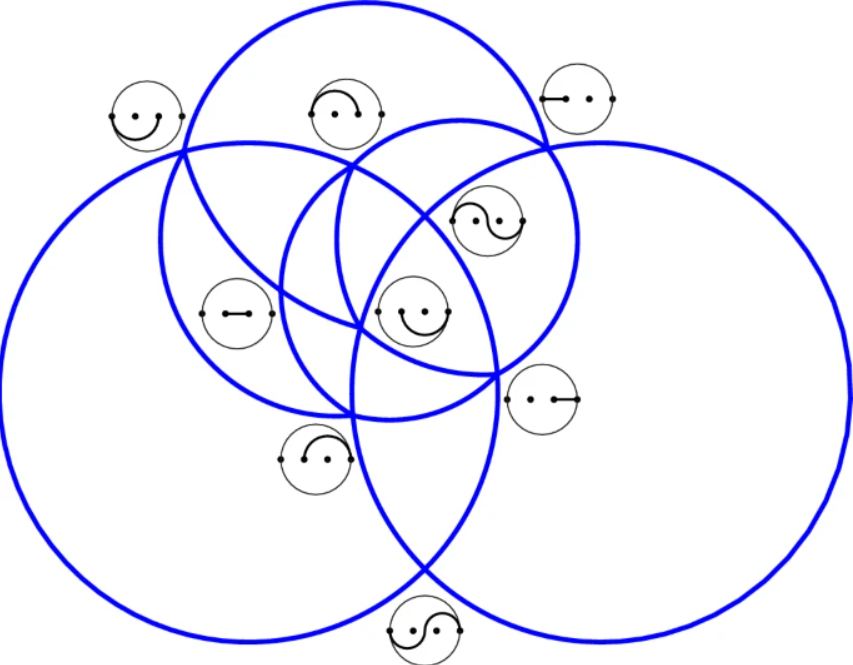
The wiggly fan WF2 , intersected with the unit sphere and projected stereographically to the plane. The vertices of the projection are rays of WF2 and are labeled by the corresponding wiggly arcs. Figure taken from the original publication
The wigglyhedron is not an isolated object. In fact, it embeds known structures from the Cambrian world:
- Any type A Cambrian associahedron is normally equivalent to a well-chosen face of the wigglyhedron.
- The corresponding Cambrian lattice—appearing through triangulations, permutations, wiggly pseudotriangulations, and wiggly permutations—emerges as an interval in the wiggly lattice.
- The Cambrian fan is a link in the wiggly fan.
These connections position the wigglyhedron as a unifying object in discrete geometry, capable of capturing and extending classical constructions.
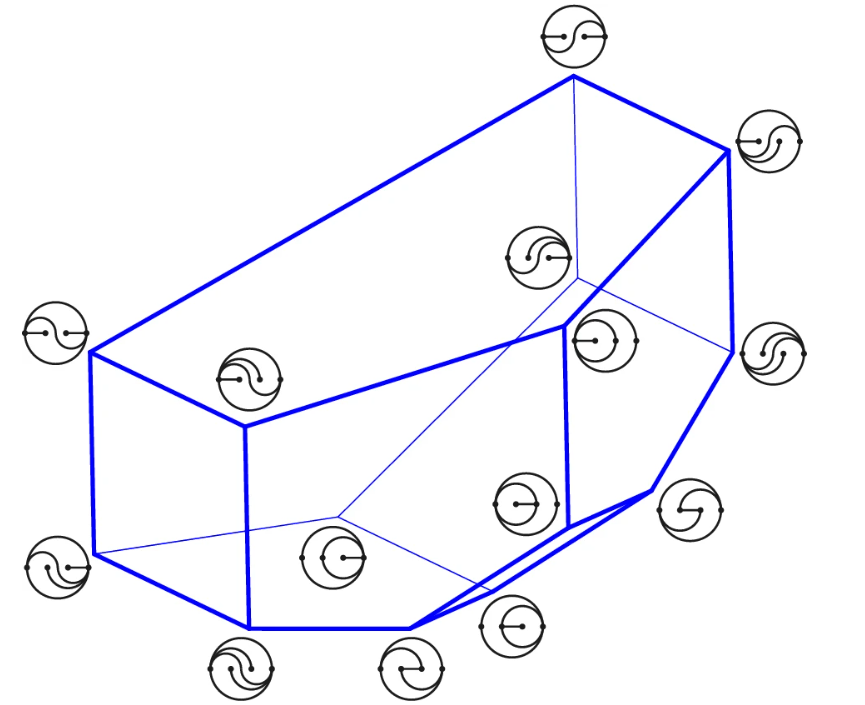
The wigglyhedron W2 . The vertices are labeled by the corresponding wiggly pseudotriangulations. Figure taken from the original publication
The paper concludes with a rich set of open problems, grouped into three main areas:
Graphical and Geometric Properties
- What is the diameter of the wiggly flip graph?
- Does the wiggly complex satisfy the non-leaving face property, relevant to polytope navigation and optimization?
- Does the wiggly flip graph admit a Hamiltonian path or cycle?
Generalizations and Dualities
- Is there a dual interpretation of wiggly pseudotriangulations, as some sort of pseudoline arrangements?
- Can we define a multi-wiggly complex?
- Can the wiggly complex be extended to arbitrary finite Coxeter groups?
Categorical and Algebraic Questions
- Can we characterize maximal compatible collections of objects without reference to curves?
- Can such collections always be realized as cohomology pieces of a larger object?
I hope that our work will have consequences in representation theory. As I am not a representation theorist myself, it is difficult to imagine what it will bring there, but my experience indicates that it will certainly inspire future results.
— Vincent Pilaud (UB – CRM)
The wigglyhedron is not the starting point—it is the culmination of a deep exploration into the structure of the wiggly complex. Through a blend of geometry, combinatorics, and category theory, Bapat and Pilaud have introduced a new mathematical landscape, rich with connections and open questions. Their work lays the foundation for future discoveries at the intersection of discrete geometry and algebraic structures.
The most challenging open problem is to extend our study to the wiggly complex of arbitrary point sets in the plane. In our work, we consider the wiggly complex of a set of n aligned points and prove that it is the boundary complex of a polytope. Rote-Santos-Streinu had the same result for the pseudotriangulation complex (there is no wiggly here, the line segments are all straight) of a set of n points in general position in the plane (when no three points are aligned). These are the two extreme of a much more general situation of an arbitrary point set in the plane (not necessarily aligned, not necessarily in general position), for which there is a natural notion of wiggly complex which should be the boundary complex of a polytope as well.
— Vincent Pilaud (UB – CRM)

|
|
CRM CommNatalia Vallina
|


When the reward comes within reach, the brain changes what it compares
As the tokens piled up, choices got faster and more accurate at the same time. The yardstick for judging each offer had moved.CRM CommPau VarelaCRMComm@crm.catGet the latest CRM news and activities in your inbox.Recent newsletters →Two subjects...

Almost every automaton can be reset with a short word
Guillaume Chapuy (Université Paris Cité, CNRS) and Guillem Perarnau (UPC, CRM) have shown that a random finite automaton with n states can, with high probability, be reset by a word of length of order √n log n. The result, published in ACM Transactions on Algorithms, pins the exponent at 1/2, the lower end of a decade of numerical estimates, and addresses the random version of the synchronization problem behind a conjecture Ján Černý posed in 1964 and which still remains open.
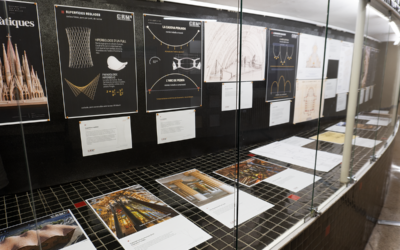
Exposició ‘Les matemàtiques de Gaudí’
CRM quod erat demonstrandum | 48

ADA: Decoding Brain Signals Misaligned in Time
The study addresses a key limitation of current brain decoding techniques: the difficulty of interpreting internal mental processes whose temporal dynamics vary from trial to trial.Decoding what is happening in a person’s mind from their brain activity is one of the...

Rare curves, many points: Christophe Ritzenthaler and Rachel Pries on their research and the work around it
Christophe Ritzenthaler (Université de Rennes) and Rachel Pries (Colorado State University) both work on curves over finite fields: he hunts curves with as many points as possible, she hunts curves that almost never occur. In conversation with the CRM during their...

Call open for the 2027 Ferran Sunyer i Balaguer Prize
The Ferran Sunyer i Balaguer Foundation is accepting submissions for its 2027 prize, which awards 15,000 euros and publication in Birkhäuser's Progress in Mathematics series to an expository monograph on an active area of mathematical research. The deadline is 27...

Susanna Terracini delivers the CRM Colloquium 2026
Susanna Terracini (Università di Torino) delivered the CRM Colloquium 2026 on 14 July, presenting a rigidity result for Kepler billiards obtained with Stefano Baranzini, Vivina Barutello and Irene De Blasi. She was at the centre as a member of the CRM Scientific...
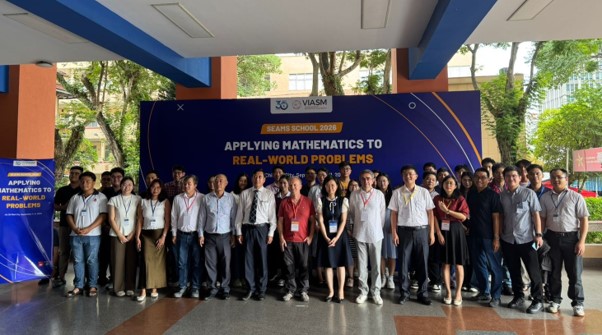
Ho Chi Minh City hosts the SEAMS School on applying mathematics to real-world problems
Students from across the region took courses and worked on group projects at a school co-organised by CRM researcher Tim Myers.CRM CommPau VarelaCRMComm@crm.catGet the latest CRM news and activities in your inbox.Recent newsletters →Between 4 and...

A single ball on a fixed table can compute: Eva Miranda and Isaac Ramos prove that two-dimensional billiards are Turing complete
Eva Miranda (UPC, CRM) and Isaac Ramos (ETH Zürich) show that a point particle bouncing inside a planar table with fixed walls can simulate a universal Turing machine, settling a question Cristopher Moore left open in 1990. The result grew out of a master’s project...
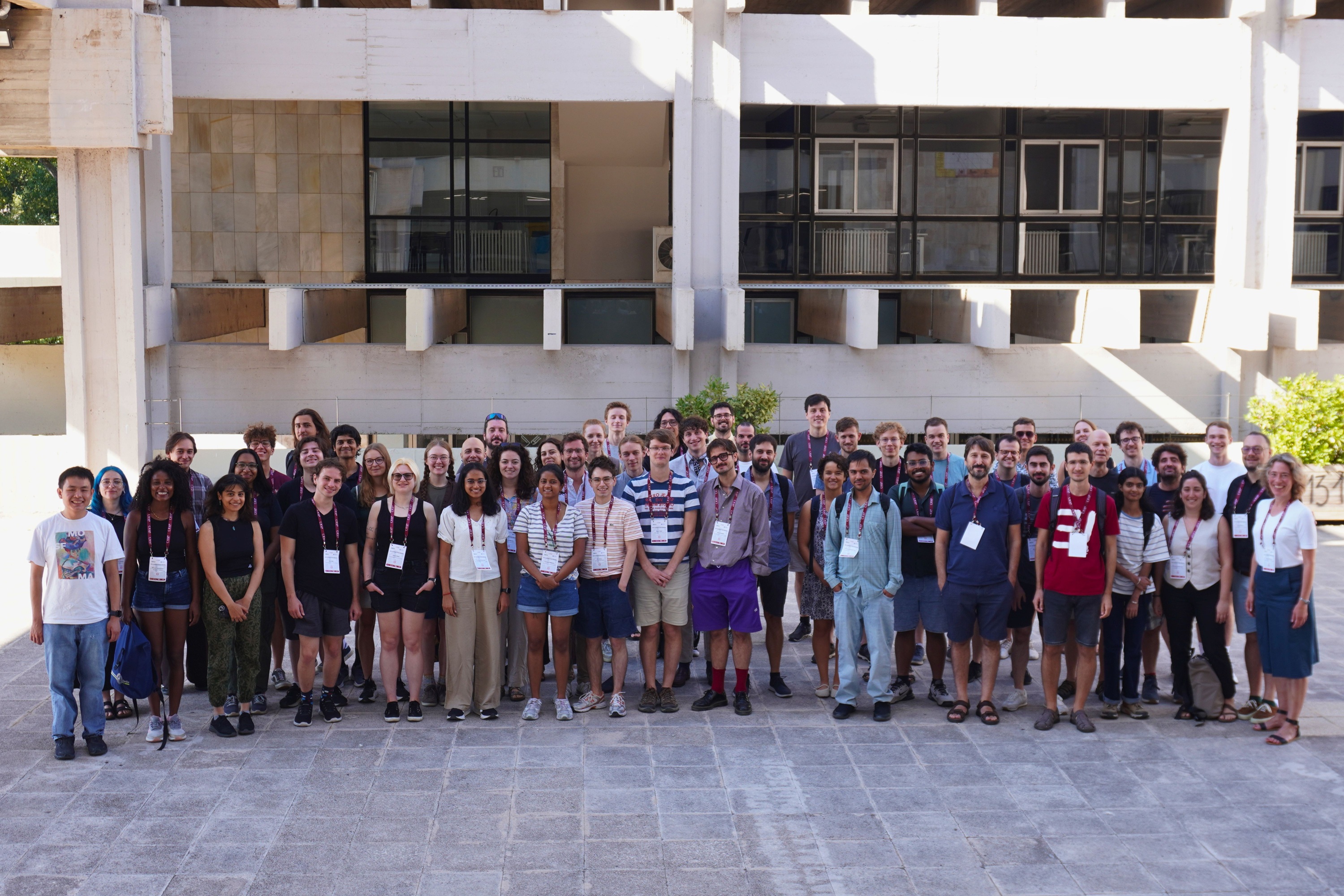
BMS-BGSMath Junior Meeting 2026: Barcelona and Berlin Strengthen Scientific Ties
From 2 to 4 September 2026, the Centre de Recerca Matemàtica (CRM) hosted the BMS-BGSMath Junior Meeting 2026, a three-day event jointly organised by the Berlin Mathematical School (BMS) and the Barcelona Graduate School of Mathematics (BGSMath), with the Centre de...
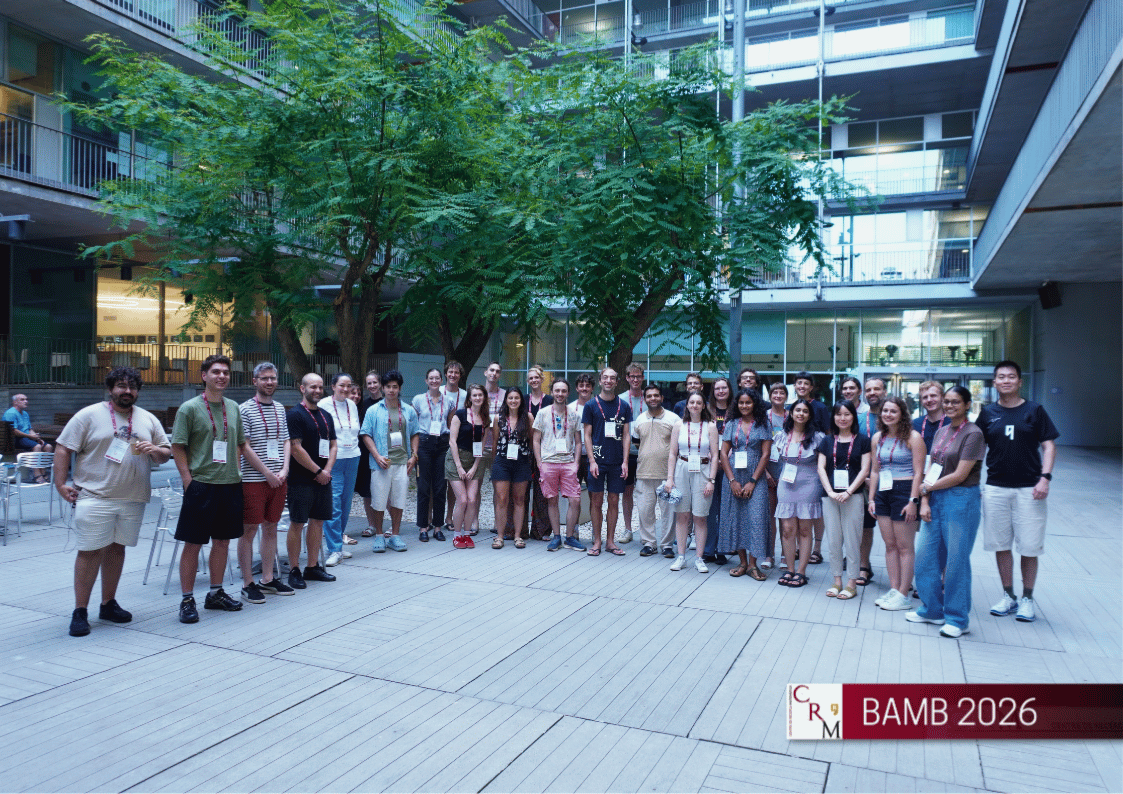
The CRM organises the 2026 Barcelona Summer School for Advanced Modeling of Behavior
The Centre de Recerca Matemàtica held the sixth edition of BAMB!, the Barcelona Summer School for Advanced Modeling of Behavior, from 12 to 23 July 2026 at the Parc de Recerca Biomèdica de Barcelona. Thirty early-career researchers from fourteen countries followed...