
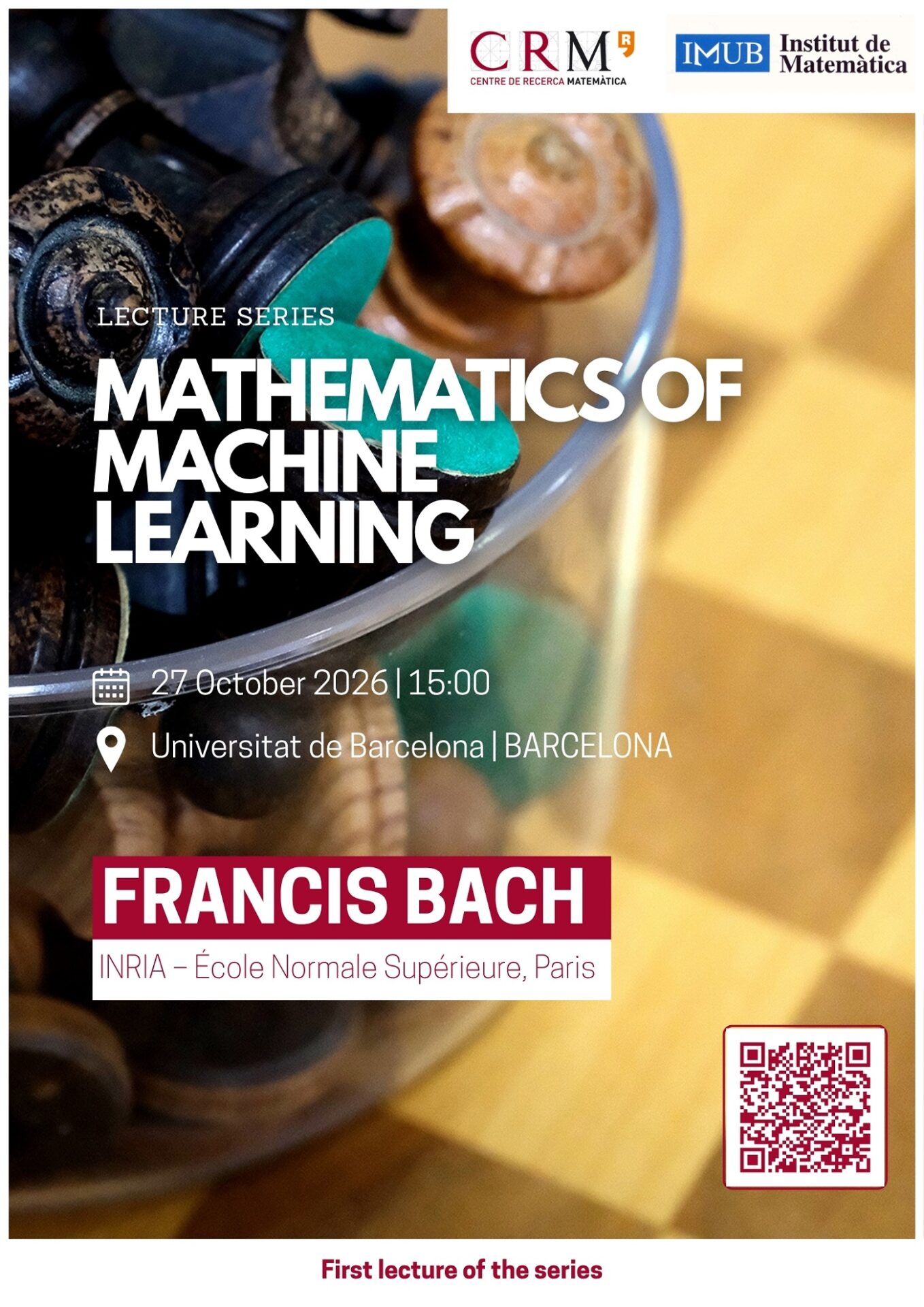
Lecture series
Mathematics of Machine Learning
First session: Francis Bach, Tuesday 27 October 2026, 15:00–17:00
Room iC, Facultat de Matemàtiques i Informàtica, Universitat de Barcelona
Introduction
The goal of this series of lectures is to introduce and popularize the mathematics of certain aspects of machine learning within the local community. The lectures should provide an accessible entry point into the field while also connecting the introductory material with current research directions. The activity is intended for people in mathematics, as well as for people in computer science who are especially interested in the mathematical ideas behind machine learning.
Format
Each speaker of the lecture series gives two closely related talks. The first talk, of 45 minutes, is introductory, at master’s or PhD level, and its aim is to present the relevant concepts, mathematical background, and previous results needed to understand the topic. The second talk, also of 45 minutes, focuses on research aspects linked to the first one. There is a break between the two talks.
The lectures take place in person in Room iC at the Facultat de Matemàtiques i Informàtica, Universitat de Barcelona (Edifici Històric, Gran Via de les Corts Catalanes 585, Barcelona). Attendance is free and open to all.
Lecturers and speakers
A Spectral Framework for Closed-Form Relative Density Estimation
Francis Bach
INRIA – SIERRA project-team, École Normale Supérieure, PSL Research University
First lecture: Tuesday 27 October 2026, 15:00–17:00
Venue: Room iC, Facultat de Matemàtiques i Informàtica, Universitat de Barcelona
Abstract
Log-sum-exp functions are ubiquitous in machine learning, but their estimation from samples can suffer from exploding variance. In this talk, I will present an alternative approach to estimating log-density ratios and Kullback–Leibler divergences, based on an integral representation of divergences as a continuum of weighted least-squares problems. For linear models, these problems can be solved simultaneously through a single generalized eigenvalue decomposition, leading to closed-form spectral estimators. I will discuss the statistical and computational benefits of this approach, including its bias–variance trade-offs compared with classical variational estimation. Finally, I will highlight applications to mutual information estimation, conditional density estimation, and a closed-form alternative to softmax regression.
See francisbach.com/spectral_log_density_estimation for more details.
About Francis Bach
Francis Bach is a researcher at INRIA, where he has led the SIERRA project-team since 2011. The team is part of the Computer Science Department at the École Normale Supérieure, and is joint between CNRS, ENS and INRIA. He completed his PhD in computer science at U.C. Berkeley with Michael Jordan, spent two years in the Mathematical Morphology group at the École des Mines de Paris, and was part of the WILLOW project-team at INRIA/ENS/CNRS from 2007 to 2010. He ran the ERC project SIERRA from 2009 to 2014 and now runs the ERC project SEQUOIA. He was elected to the French Academy of Sciences in 2020.
His work is in statistical machine learning, with a particular interest in optimization, sparse methods, kernel-based learning, neural networks, graphical models, and signal processing. His book Learning Theory from First Principles was published by MIT Press in December 2024.
Website: di.ens.fr/~fbach
Periodic strategies for blocking bandits
Nicolò Cesa-Bianchi
Università degli Studi di Milano
Second lecture: 23 November 2026, 15:00–17:00 (date to be confirmed)
Venue: Room iC, Facultat de Matemàtiques i Informàtica, Universitat de Barcelona
Abstract
In blocking K-armed bandits, playing an arm renders it unavailable for a fixed number of future rounds. While this model is relatively well understood in the stochastic regime, much less is known when rewards are generated adversarially. We first show that computing the total reward of the best dynamic policy is NP-hard, even when the blocking time is identical across arms. We therefore turn to tractable comparators and study the class of d-periodic policies, proving that the optimal periodic policy is efficiently computable and characterizing the worst-case approximation factor against the dynamic optimum. Our main result shows that blocking bandits are just as hard as bandits with switching costs, and the optimal rate is achievable by a simple and efficient algorithm.
Joint work with: Junya Honda, Yuko Kuroki, Atsushi Miyauchi, and Lukas Zierahn.
About Nicolò Cesa-Bianchi
Nicolò Cesa-Bianchi is Professor of Computer Science at the Università degli Studi di Milano, where he has held a full professorship in the Department of Computer Science since 2002, with a joint appointment at the Politecnico di Milano since 2022. He graduated in computer science from the University of Milan in 1988 and completed his PhD there in 1993 under Alberto Bertoni, visiting UC Santa Cruz during his doctorate to work with Manfred Warmuth and David Haussler. He co-directs the Milan ELLIS unit and is a member of the Accademia Nazionale dei Lincei.
His research is in machine learning theory and online learning, in particular sequential decision-making and multi-armed bandits. He is co-author, with Gábor Lugosi, of Prediction, Learning, and Games (Cambridge University Press, 2006), and with Sébastien Bubeck of Regret Analysis of Stochastic and Nonstochastic Multi-armed Bandit Problems.
Website: unimi.it
TBP
Andrea Agazzi
University of Bern
Third lecture: December 2026 (date to be confirmed)
Venue: Room iC, Facultat de Matemàtiques i Informàtica, Universitat de Barcelona
About Andrea Agazzi
Andrea Agazzi is Professor of Applied Stochastics at the Institute of Mathematical Statistics and Actuarial Science of the University of Bern, which he also co-directs. He graduated in physics from Imperial College London and ETH Zurich, and completed his PhD in theoretical physics at the University of Geneva under Jean-Pierre Eckmann. He was then a Griffiths Research Assistant Professor at Duke University, working with Jonathan Mattingly and Jianfeng Lu, and a tenure-track assistant professor in the Department of Mathematics at the University of Pisa.
His research is in applied probability, in particular interacting particle systems and their real-world applications. He has worked on scaling limits of chemical reaction networks and of machine learning algorithms seen as interacting particle systems, and on the dynamics of fluid models.
Website: andagazzi.github.io
Organising committee
- Gábor Lugosi
ICREA–Universitat Pompeu Fabra - Gergely Neu
ICREA–Universitat Pompeu Fabra - Domènec Ruiz-Balet
UB–CRM
Schedule
Provisional calendar of speakers and dates:
Tuesday 27 October 2026
23 November 2026 (TBP)
December 2026 (TBP)
Contact
For enquiries about this event, please contact crmactivitats@crm.cat.
Acknowledgement

Policies and commitments
CRM Events Code of Conduct
After the activity
TBP

[CAPTION TBP]