

An international collaboration including researchers from the Centre de Recerca Matemàtica (CRM) has shown that when several bifurcations occur close to one another, their interaction can dramatically amplify critical slowing down effect – the progressive slowdown of trajectories near critical transitions. Published in Physical Review E, the study also shows that molecular noise can tune these transient times, offering new insights for synthetic biology and cellular decision-making.
When a dynamical system approaches a bifurcation, its trajectories slow down, meaning that small changes in conditions take longer to produce a response. This effect, known as critical slowing down, is well understood for isolated bifurcations. But what happens when several bifurcations occur close together? A new study published in Physical Review E shows that the interaction between nearby bifurcations can amplify this slowdown through nonlinear synergies. The work, titled “Local nearby bifurcations lead to synergies in critical slowing down: The case of mushroom bifurcations” was carried out by Mariona Fucho-Rius (Universitat Politècnica de Catalunya), Smitha Maretvadakethope and Rubén Pérez-Carrasco (Imperial College London), Àlex Haro (Universitat de Barcelona – Centre de Recerca Matemàtica), Tomás Alarcón (ICREA – Centre de Recerca Matemàtica), and Josep Sardanyés (Centre de Recerca Matemàtica).
Background: Bifurcations and Complex Systems
In dynamical systems, a bifurcation marks a critical change in behavior as a control parameter varies, for instance, when a stable equilibrium disappears or new equilibria emerge. As the system approaches this point, its trajectories slow down before switching to a new regime, a phenomenon known as critical slowing down. It has been widely studied in cases where the transition is triggered by a single bifurcation.
However, in contexts like cellular biology, multiple nearby bifurcations often interact. This is especially relevant in genetic regulatory networks, where decision-making —such as cellular differentiation— depends not only on the final state of the system, but also on how long it takes to reach it.
Bifurcations and their associated scaling laws have been studied for decades and even tested experimentally in an electronic circuit in the work of Trickey and Virgin (Phys. Lett. A, 1998). However, the behavior of nearby bifurcations -how their proximity and mutual influence affect transient dynamics- remains largely unexplored. We were intrigued by this gap and wondered whether the combination of multiple local bifurcations could produce nonlinear, synergistic effects on critical slowing down. This question also connects directly with synthetic biology, where gene regulatory networks often operate close to several bifurcations: understanding their interplay could help us design genetic circuits or biosensors capable of fine-tuning their temporal responses.
— Mariona Fucho-Rius (UPC)
In this scenario, mushroom-shaped bifurcation diagrams —visual maps showing how a system’s behavior changes with varying conditions— offer a particularly interesting configuration. These diagrams arise in simple genetic models where a gene self-activates and is regulated by an external signal. Under certain conditions, four sudden change points (bifurcations) and three possible stable states appear, forming a structure reminiscent of a mushroom. Although these diagrams had been studied for their stationary behavior —such as bistability or memory— until now, their influence on the system’s temporal dynamics had not been analyzed.
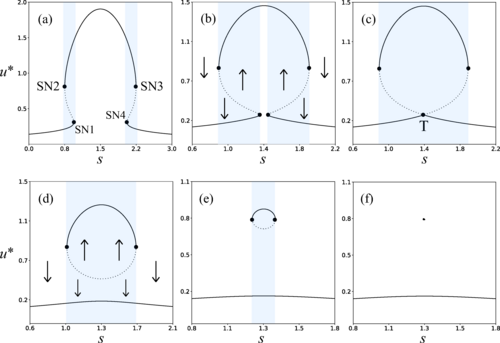
Evolution of the mushroom bifurcation diagram. Figure taken from the original publication.
This study starts precisely from that question: what happens to the transient times when two bifurcations are so close that they begin to interact?
We started by characterizing the types of bifurcations that appear in the so-called mushroom bifurcation diagram (four saddle-node bifurcations, two of which collide into a transcritical bifurcation). Once we analyzed the model mathematically, we confirmed analytically the coexistence of these bifurcations and could connect them to known scaling laws for each case. This analytical basis, supported by numerical simulations, revealed that the mushroom geometry provides an ideal setting to study what happens when several bifurcations coexist and interact, leading to synergistic critical slowing down effect.
— Mariona Fucho-Rius (UPC)
Findings: When Bifurcations Interact
The research team demonstrated —both analytically and numerically— that the proximity of bifurcations generates a synergistic effect on transition time: the system slows down much more than it would if each bifurcation acted independently. It’s not a sum of effects, but a nonlinear amplification of the slowdown.
They also studied how molecular noise —the fluctuations affecting the system— modulates this behavior. Intrinsic noise, caused by the random nature of biochemical reactions, can accelerate transitions but with less precision. Extrinsic noise, derived from environmental factors such as variability in cellular signals, tends to slow transitions but maintains low variability.
In our study, extrinsic noise slowed down transient times, in contrast with intrinsic noise, which tended to accelerate them. This means that by tuning the balance between these two noise sources, one could design systems that respond with a specific transient timing and a prescribed precision. In the context of synthetic biology, this could be exploited to engineer gene circuits or biosensors that display smooth and controllable transitions, effectively providing a way to modulate response sensitivity through noise. Moreover, this interplay between noise sources could enable the design of genetic clocks, which are systems where the duration of a transient acts as a controllable delay mechanism. Such timing control is fundamental in many biological contexts, from developmental decision-making to rhythmic gene expression.
— Mariona Fucho-Rius (UPC)
When both types of noise are introduced simultaneously, the average transition time and precision can be tuned, opening the door to adjustable genetic clocks. Moreover, the system can transition across a wider range of signals, thanks to a phenomenon known as noise-induced tipping, where random fluctuations push the system into a new stable state.
This discovery suggests molecular strategies for designing genetic circuits with transitions much slower than the typical timescales of the reactions involved. This is especially relevant in synthetic biology, where systems are built to respond with precision, flexibility, and temporal control.
We were surprised by how large the slowing-down effect became when the bifurcations were close. The combined impact of the two saddle-node bifurcations and the transcritical one was far greater than the sum of each taken separately. This synergistic amplification of transients (in a sense, “2 + 2 > 4”) was unexpected and suggested that nearby bifurcations can resonate with each other. That observation encouraged us to explore stochastic effects and also to consider other geometries, such as isolas -closed curves in the phase space-, where similar or even stronger temporal effects might emerge.
— Mariona Fucho-Rius (UPC)
What’s next: Open Questions and Future Directions
These results reveal a new mechanism for generating long, tunable transients using minimal genetic architectures, an approach that could be key for designing synthetic gene circuits with programmable timing and or graded responses instead of abrupt switches.
The results suggest promising research lines. On one hand, the design of genetic circuits that leverage bifurcation synergies to control transition timing. On the other, the study of how these effects apply to real systems, such as cellular transitions, biological memories, or molecular sensors.
It also opens the door to exploring the bifurcation landscape as a tool to design more robust and precise systems, and to use molecular noise not as interference, but as a control mechanism.
A natural next step would be to test these ideas experimentally, for instance by constructing a synthetic gene circuit in bacteria that reproduces the mushroom-like bifurcation structure. Such experiments would allow us to measure the predicted transient extensions and study how intrinsic and extrinsic noise shape timing in living systems. Another exciting line of study is to study how other geometries, such as isola formations or higher-dimensional analogues, affect stochastic dynamics.
— Mariona Fucho-Rius (UPC)
Additionally, the authors point to future directions such as:
- Studying overshooting in nearby bifurcations —a temporary overshoot of the system beyond its target state—, which could reduce the likelihood of abrupt transitions.
- Analyzing multidimensional systems, with multiple genes and interconnected bifurcations.
- Exploring new dynamic regimes in genetic regulatory networks (GRNs), with applications in synthetic biology, personalized medicine, and molecular engineering.
- Overall, this research opens a new perspective on time control in biological systems, with the potential to transform how we understand and design cellular decision-making processes.


Alex Haro is a professor at the University of Barcelona. He earned his PhD under the supervision of Carles Simó and held a Fulbright-funded postdoctoral position at the University of Texas at Austin, where he began a long-term collaboration with Rafael de la Llave. His research focuses on dynamical systems, especially invariant tori, KAM theory, and rigorous computational methods. He is co-author of the book The Parameterization Method for Invariant Manifolds (Springer, 2016) and has received the Barcelona Dynamical Systems Prize (2017) and the R.E. Moore Prize (2018).
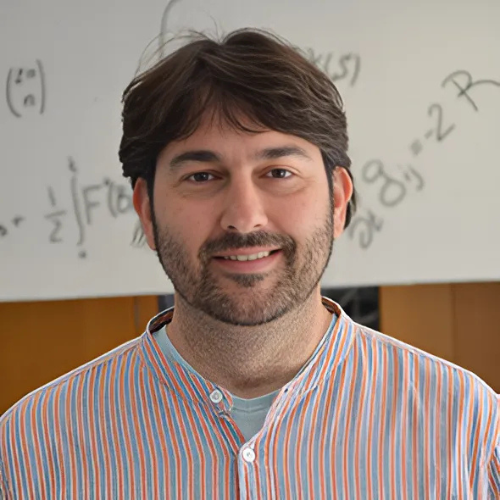
Josep Sardanyés is a researcher at the Centre de Recerca Matemàtica (CRM), where he co-leads the Mathematical and Computational Biology group with ICREA Prof. Tomás Alarcón. He earned his PhD at the Complex Systems Lab (UPF) under Ricard V. Solé and held postdoctoral positions at CSIC-UPV, UCSF, UPF, and CRM. Since 2019, he holds a Ramón y Cajal fellowship in Mathematics and teaches master-level courses at the UAB and the University of Valencia.
Subscribe for more CRM News
|
|
CRM CommNatalia Vallina
|

The CRM opens the academic year and unveils its Directors’ Gallery
A review of the year, the Communication Plan 2026–2030 and three research talks filled the morning of 19 October.The unveiling of the Directors’ Gallery.CRM CommPau VarelaCRMComm@crm.catGet the latest CRM news and activities in your inbox.Recent...

The CRM Mentoring Programme, as Told by One of Its Pairs
PhD student Joaquim Duran and mathematician Robert Cardona, one of the pairs in the CRM Mentoring ProgrammeJoaquim Duran (left) and Robert Cardona.CRM CommPau VarelaCRMComm@crm.catGet the latest CRM news and activities in your inbox.Recent...
When the reward comes within reach, the brain changes what it compares
As the tokens piled up, choices got faster and more accurate at the same time. The yardstick for judging each offer had moved.CRM CommPau VarelaCRMComm@crm.catGet the latest CRM news and activities in your inbox.Recent newsletters →Two subjects...

Almost every automaton can be reset with a short word
Guillaume Chapuy (Université Paris Cité, CNRS) and Guillem Perarnau (UPC, CRM) have shown that a random finite automaton with n states can, with high probability, be reset by a word of length of order √n log n. The result, published in ACM Transactions on Algorithms, pins the exponent at 1/2, the lower end of a decade of numerical estimates, and addresses the random version of the synchronization problem behind a conjecture Ján Černý posed in 1964 and which still remains open.

Exposició ‘Les matemàtiques de Gaudí’

CRM quod erat demonstrandum | 48

ADA: Decoding Brain Signals Misaligned in Time
The study addresses a key limitation of current brain decoding techniques: the difficulty of interpreting internal mental processes whose temporal dynamics vary from trial to trial.Decoding what is happening in a person’s mind from their brain activity is one of the...
Rare curves, many points: Christophe Ritzenthaler and Rachel Pries on their research and the work around it
Christophe Ritzenthaler (Université de Rennes) and Rachel Pries (Colorado State University) both work on curves over finite fields: he hunts curves with as many points as possible, she hunts curves that almost never occur. In conversation with the CRM during their...

Call open for the 2027 Ferran Sunyer i Balaguer Prize
The Ferran Sunyer i Balaguer Foundation is accepting submissions for its 2027 prize, which awards 15,000 euros and publication in Birkhäuser's Progress in Mathematics series to an expository monograph on an active area of mathematical research. The deadline is 27...
Susanna Terracini delivers the CRM Colloquium 2026
Susanna Terracini (Università di Torino) delivered the CRM Colloquium 2026 on 14 July, presenting a rigidity result for Kepler billiards obtained with Stefano Baranzini, Vivina Barutello and Irene De Blasi. She was at the centre as a member of the CRM Scientific...

Ho Chi Minh City hosts the SEAMS School on applying mathematics to real-world problems
Students from across the region took courses and worked on group projects at a school co-organised by CRM researcher Tim Myers.CRM CommPau VarelaCRMComm@crm.catGet the latest CRM news and activities in your inbox.Recent newsletters →Between 4 and...

A single ball on a fixed table can compute: Eva Miranda and Isaac Ramos prove that two-dimensional billiards are Turing complete
Eva Miranda (UPC, CRM) and Isaac Ramos (ETH Zürich) show that a point particle bouncing inside a planar table with fixed walls can simulate a universal Turing machine, settling a question Cristopher Moore left open in 1990. The result grew out of a master’s project...