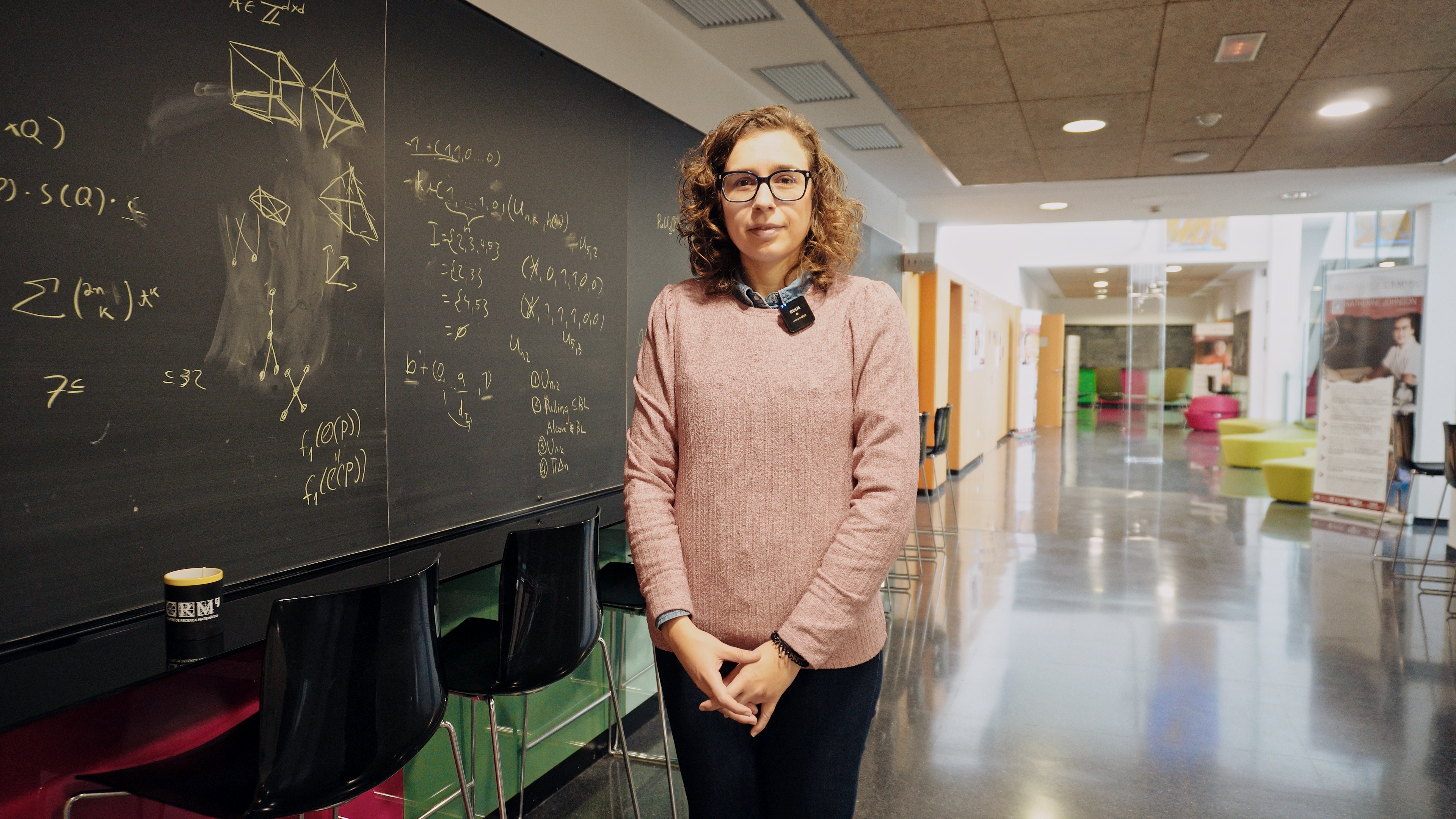
From October to November 2025, María Ángeles García Ferrero held the CRM Chair of Excellence, collaborating with Joaquim Ortega-Cerdà on concentration inequalities and teaching a BGSMath course on the topic. Her main research focuses on the Calderón problem, determining a medium’s internal electrical conductivity from surface measurements, which has applications in medical imaging for distinguishing stroke types and monitoring brain function.
In October and November 2025, María Ángeles García Ferrero (ICMAT – Institute of Mathematical Sciences) spent two months at CRM as the Maria de Maeztu Chair of Excellence, working on problems that sound almost like magic: how to see what’s hidden, how to know what you can’t measure directly, how to reconstruct the invisible.
Her main field is inverse problems, the mathematics of gaining information about an unknown object from related data. “In particular, I work on the Calderón problem, which attempts to determine the electrical conductivity of a medium from measurements of voltage and current at the boundary,” she explains. It’s the kind of problem that only makes sense when you think about what it enables. If you can measure electrical signals on the surface of a human skull, can you map what’s happening inside the brain? If you know how electricity flows through different tissues, can you distinguish a stroke caused by bleeding from one caused by blockage?
She came to the field during her first postdoc. “It was connected with what I had done previously, but it was something different,” she says. The shift opened a new door, and what pulled her through was the applicability. “The applications of these problems, which in particular involve medical imaging techniques, were one of the reasons that made me stick with this topic. So, it interests me mathematically, but the real-world motivation gives me additional incentives to dedicate myself to it.”
Working with Joaquim Ortega-Cerdà
However, at CRM, García Ferrero worked on something different: concentration inequalities for holomorphic functions, a topic she developed through her collaboration with Joaquim Ortega-Cerdà (Universitat de Barcelona – CRM). “It’s a topic I got to know thanks to him,” she says. “Honestly, listening to him talk about any subject and not becoming interested is very difficult.”
The work they’re pursuing is both a continuation and an expansion. In a previous paper, they studied how concentrated polynomials can be when restricted to domains of the complex plane. Now they’re generalising that result, though not all the tools that worked before are available in the new setting. It’s the kind of problem that requires building new machinery.
From October 27 to November 5, García Ferrero taught a BGSMath course on precisely this topic: concentration inequalities for holomorphic functions. Five sessions, each two hours long. The course covered uncertainty principles, spaces of holomorphic functions, the Lieb conjecture on generalised Wehrl entropy, and the stability of these inequalities. It’s a field where conjectures from the late 1970s have only recently been proven and where quantitative stability results are still emerging.
The Calderón Problem
On November 19, García Ferrero gave a colloquium at the Maria de Maeztu Closing Conference, a gathering of the CRM research community marking the completion of a four-year strategic research program. The María de Maeztu distinction, awarded by Spain’s Ministry of Science and Innovation, recognises research units that demonstrate exceptional international scientific leadership. It provides substantial funding and connects CRM to the SOMMa alliance of Spain’s top research centres and units of excellence. It’s one of the highest honours in Spanish research.
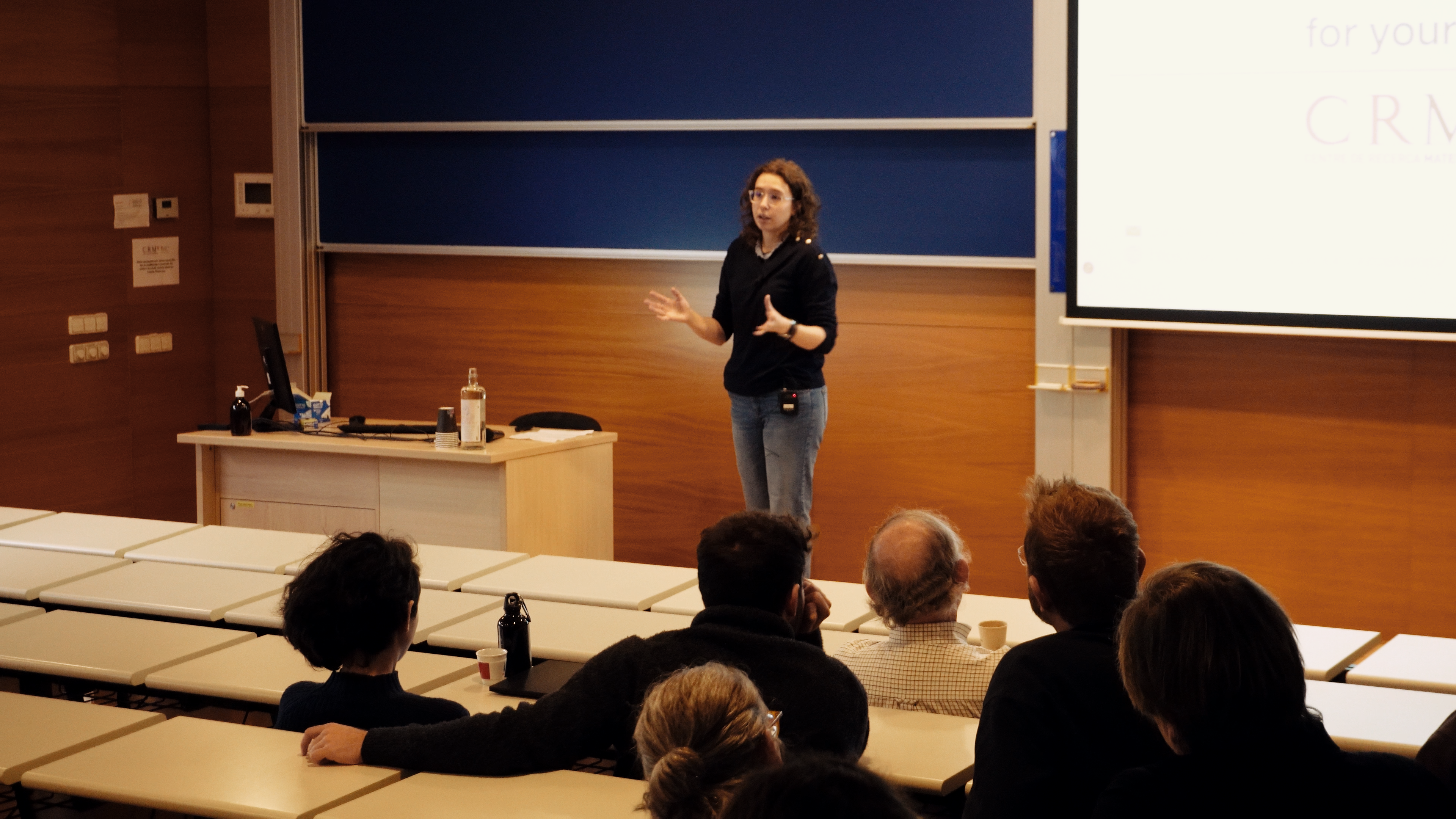
Her talk returned to her main research: the inverse conductivity problem, also known as the Calderón problem. Named after Argentine mathematician Alberto Calderón, who posed it in 1980, the setup sounds deceptively simple. If you can measure voltage and current on the surface of an object, can you determine its internal electrical conductivity?
Think of it as X-rays, but instead of using radiation, you’re using electrical measurements. You apply voltage at the boundary, measure the resulting current, and try to reconstruct what must be happening inside. In medical imaging, this translates to Electrical Impedance Tomography (EIT). Different tissues conduct electricity differently: blood, bone, healthy tissue, tumorous tissue, bleeding, and blockages. If you can solve the Calderón problem, you can monitor brain function or monitor the lung activity of premature infants without invasive procedures or the risks of repeated X-rays.
“I think initiatives such as the MdM Chair of Excellence are important because sometimes we look for role models in our day-to-day life. This opportunity I’ve had to come here and talk with students, with people visiting CRM and also the universities in Barcelona, I think it helps a lot to give visibility to this role of women in mathematics, but in an approachable way.”
García Ferrero’s talk walked through the main questions: Can you uniquely determine the conductivity? If so, how stable is the reconstruction? Does a small measurement error lead to a catastrophic error in the recovered conductivity? And can you actually compute it? In one dimension, the problem has no solution at all: completely different conductivities can produce identical boundary measurements. In two dimensions, uniqueness was proven in 2006 for bounded conductivities. In three or more dimensions, the breakthrough came in the 1980s from John Sylvester and Gunther Uhlmann, but only for very smooth conductivities.
The talk also touched on what makes the problem mathematically delicate. The stability is logarithmic, meaning that to improve your reconstruction accuracy by a factor of 10, you need to improve your measurement accuracy exponentially. This isn’t just a technical annoyance; it is fundamental to the problem’s structure. Under certain special assumptions (for instance, if the conductivity is piecewise constant with known jump locations), the stability improves dramatically. But in the general case, you’re stuck with logarithmic stability.
The colloquium covered the full arc: the problem’s origins in geophysical prospecting and medical imaging, the mathematical framework of Dirichlet-to-Neumann maps that encode the boundary measurements, the construction of CGO solutions that make reconstruction possible, and the ongoing work to handle ever-more-realistic conductivity profiles. It was technical but accessible, pitched to an audience of mathematicians across specialities. And it showcased exactly what the María de Maeztu program aims to support: frontier research with both mathematical depth and real-world impact.
Visibility from the day-to-day
The Chair of Excellence program doesn’t just fund research visits. It’s designed to bring senior women mathematicians into sustained contact with the CRM community. “I think it’s important because sometimes we look for role models in our day-to-day life,” García Ferrero says. “This opportunity I’ve had to come here and talk with students, with people visiting CRM and also the universities in Barcelona, I think it helps a lot to give visibility to the role of women in mathematics, but in an approachable way.”
Visibility isn’t just about seeing someone at a conference. It’s about proximity. It’s about the conversations that happen in corridors, the questions asked after a course, the presence that becomes ordinary rather than exceptional. For García Ferrero, the Chair also carried personal significance. “At a personal level, it’s an honour because of the centre that grants it, because of the people I know are behind it. It’s a very important recognition. And at an even more personal level, the opportunity to return to the mathematical community in Barcelona, where I already spent time before, it’s an opportunity I couldn’t pass up.”
She’s based at ICMAT in Madrid now, a tenured researcher, elected to the Executive Committee of the European Mathematical Society in 2024. But for two months, her office was at CRM, her collaboration was with Ortega-Cerdà, and her work was on polynomials and concentration inequalities. The inverse problem she’s always working on (how to reconstruct the hidden from the visible) took on a different form. And the visibility she provided, simply by being present, working through problems in real time, is exactly what the program was designed for.
You can watch the full interview with María Ángeles García Ferrero on the CRM YouTube channel:
|
|
CRM CommPau Varela
|
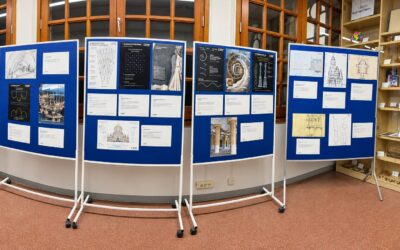
The CRM exhibition ‘Les matemàtiques de Gaudí’ moves to the University of Barcelona
After its October run at the UAB, the exhibition Les matemàtiques de Gaudí, produced by the CRM, can be seen at the University of Barcelona’s CRAI Biblioteca de Matemàtiques i Informàtica from 2 to 30 November 2026.
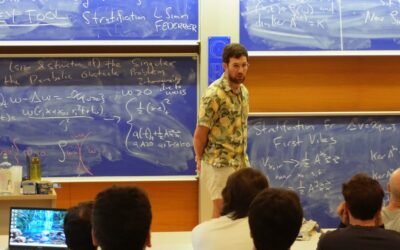
Advanced Course on Free Boundary Problems Opens the Intensive Weeks of the IRP
From 26 to 30 October, around forty researchers attended the Advanced Course on Free Boundary Problems at the CRM, three seven-hour mini-courses given by Bozhidar Velichkov (Università di Pisa), Max Engelstein (University of Minnesota) and Zihui Zhao (Johns Hopkins University). The course was the first of the two intensive weeks of the Intensive Research Programme on Analysis of Free Boundary Problems, which runs until 4 December.
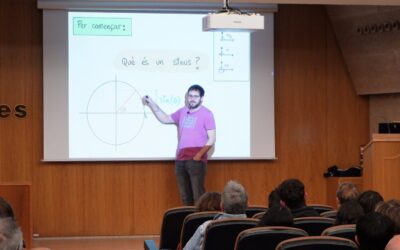
El CRM rep els estudiants de la prova de nivell de Bojos per les Matemàtiques 2027
Els aspirants a Bojos per les Matemàtiques 2027 van visitar el Centre de Recerca Matemàtica (CRM) dissabte 24 d’octubre, després de fer la prova de nivell a la Facultat de Ciències i Biociències de la UAB. En acabat, Tomás Sanz (UB-CRM) els va explicar què té a veure l’escalfament d’una barra de ferro amb els àudios de WhatsApp.
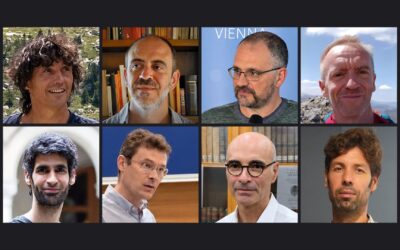
Eight CRM Researchers in the 2026 Stanford-Elsevier List of Highly Cited Scientists
The Centre de Recerca Matemàtica (CRM) has eight researchers in the 2026 update of the Stanford-Elsevier ranking of highly cited scientists, which John P. A. Ioannidis (Stanford University) and Jeroen Baas (Elsevier) compile from Scopus data. Xavier Cabré, Álvaro Corral, Tim Myers, Xavier Ros-Oton, Sergey Tikhonov and Xavier Tolsa appear both in the career-long ranking and in the one for 2025, and Diego Vidaurre and Simeon Ball in the 2025 ranking.
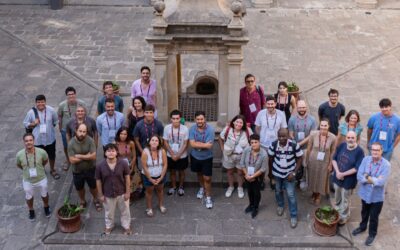
Fish schools and growing tissues: a workshop on how collective behaviour emerges
The Centre de Recerca Matemàtica (CRM) organised the Barcelona Workshop on Kinetic and Macroscopic Models in Biology with Friends II, held from 7 to 10 September at the Institut d’Estudis Catalans. More than thirty researchers discussed how order at the scale of tissues and animal groups arises from local interactions between individuals, in a programme that included talks by CRM researchers Daria Stepanova and Juan Arellano-Tintó. Two of the speakers, James Sharpe (EMBL Barcelona) and Chiara Villa (CNRS, Université Paris Cité), talked to the CRM about their research.
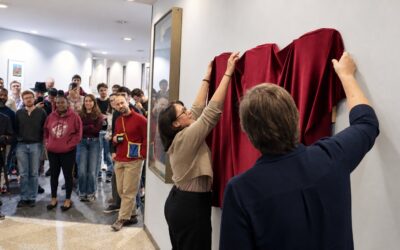
The CRM opens the academic year and unveils its Directors’ Gallery
A review of the year, the Communication Plan 2026–2030 and three research talks filled the morning of 19 October.The unveiling of the Directors’ Gallery.CRM CommPau VarelaCRMComm@crm.catGet the latest CRM news and activities in your inbox.Recent...
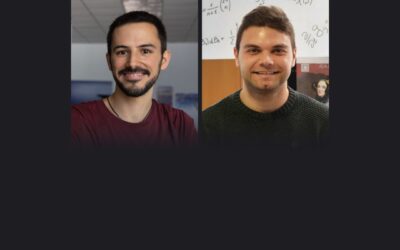
The CRM Mentoring Programme, as Told by One of Its Pairs
PhD student Joaquim Duran and mathematician Robert Cardona, one of the pairs in the CRM Mentoring ProgrammeJoaquim Duran (left) and Robert Cardona.CRM CommPau VarelaCRMComm@crm.catGet the latest CRM news and activities in your inbox.Recent...
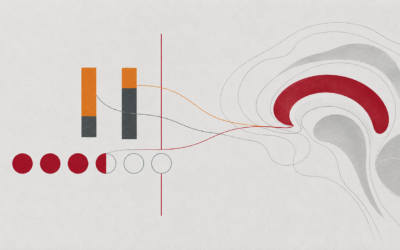
When the reward comes within reach, the brain changes what it compares
As the tokens piled up, choices got faster and more accurate at the same time. The yardstick for judging each offer had moved.CRM CommPau VarelaCRMComm@crm.catGet the latest CRM news and activities in your inbox.Recent newsletters →Two subjects...

Almost every automaton can be reset with a short word
Guillaume Chapuy (Université Paris Cité, CNRS) and Guillem Perarnau (UPC, CRM) have shown that a random finite automaton with n states can, with high probability, be reset by a word of length of order √n log n. The result, published in ACM Transactions on Algorithms, pins the exponent at 1/2, the lower end of a decade of numerical estimates, and addresses the random version of the synchronization problem behind a conjecture Ján Černý posed in 1964 and which still remains open.
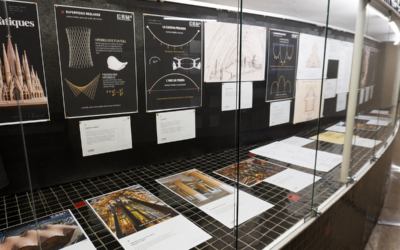
Exposició ‘Les matemàtiques de Gaudí’
CRM quod erat demonstrandum | 48

ADA: Decoding Brain Signals Misaligned in Time
The study addresses a key limitation of current brain decoding techniques: the difficulty of interpreting internal mental processes whose temporal dynamics vary from trial to trial.Decoding what is happening in a person’s mind from their brain activity is one of the...