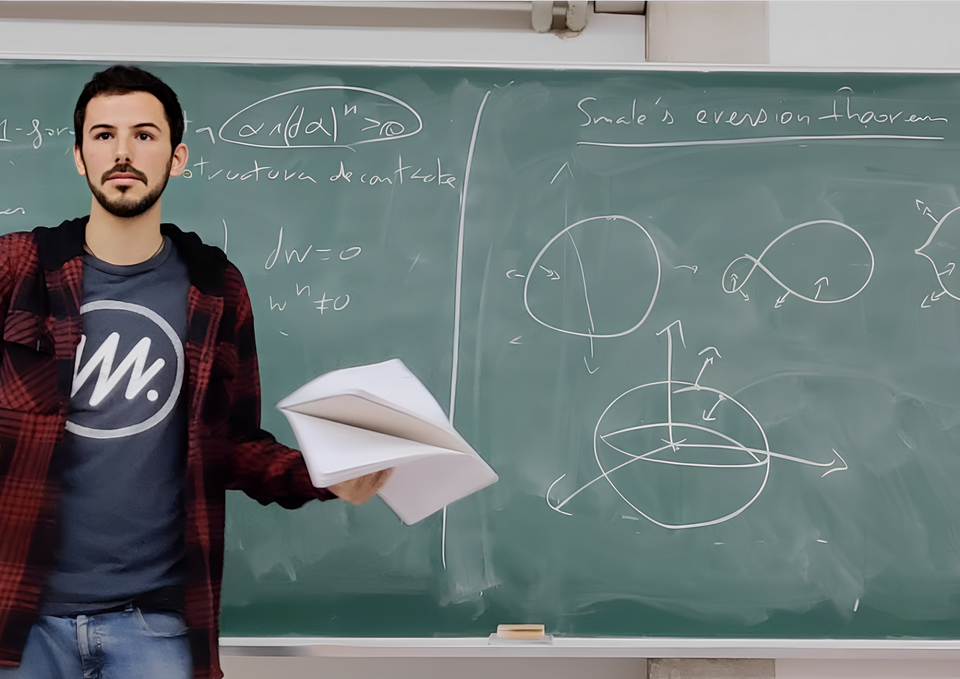
The Real Sociedad Matemática Española (RSME) and the BBVA Foundation have announced the names of the six winners of the Vicent Caselles Mathematical Research Awards in its 2023 edition, including BGSMath alumni Robert Cardona. The aim of these awards is to support and encourage young professionals who carry out their work in the field of mathematical research.
Former BGSMath PhD student Robert Cardona has been awarded the prestigious Vicent Caselles RSME Mathematical Research Award. Cardona obtained his PhD in 2021 under the guidance of Eva Miranda, a professor at the Universitat Politècnica de Catalunya (UPC) and CRM affiliated researcher. The jury of the 2023 edition met on June 26 and its unanimous decision was ratified by the Governing Board of the RSME.
The award, granted jointly by the Real Sociedad Matemática Española (RSME) and the BBVA Foundation, recognizes Cardona’s remarkable contributions to mathematical research. Currently holding a Margarita Salas postdoctoral research position at ICMAT and the UPC, Cardona’s research has focused on geometric methods in dynamical systems, specifically in fluids and Hamiltonian dynamics, and their relationship with contact and symplectic topology.
In his young research career, which has included also a postdoctoral stay at the Université de Strasbourg, Cardona has been recognised with an Extraordinary PhD Prize from the Universitat Politecnica de Catalunya, and the Évariste Galois prize in 2019 from the Societat Catalana de Matemàtiques (SCM). We want to extend our warmest congratulations to Robert on winning the Vicent Caselles RSME Mathematical Research Awards.

CRM Comm Team
Anna Drou | Pau Varela
CRMComm@crm.cat
Subscribe for more CRM News
Jagged walls and unknown edges: a workshop on free boundary problems
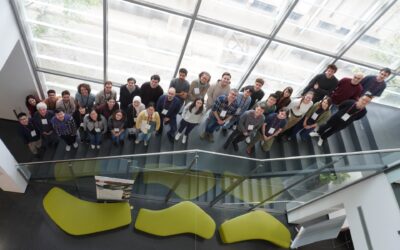
From 2 to 6 November, the Workshop on Free Boundary Problems brought together more than fifty registered participants from institutions in eleven countries at the CRM. Over five days they heard 21 talks on elliptic and parabolic free boundaries and on geometric measure theory and harmonic analysis in rough domains, with speakers including Guy David, Svitlana Mayboroda, Susanna Terracini and Robin Neumayer. The workshop was the second intensive week of the Intensive Research Programme on Analysis of Free Boundary Problems, which continues at the CRM until 4 December.
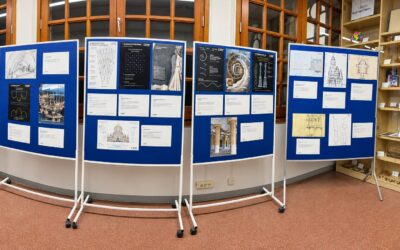
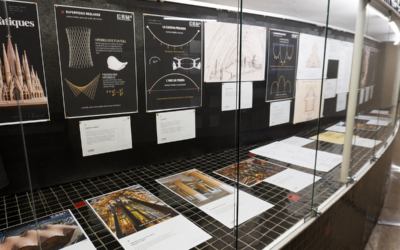
The CRM exhibition ‘Les matemàtiques de Gaudí’ moves to the University of Barcelona
After its October run at the UAB, the exhibition Les matemàtiques de Gaudí, produced by the CRM, can be seen at the University of Barcelona’s CRAI Biblioteca de Matemàtiques i Informàtica from 2 to 30 November 2026.
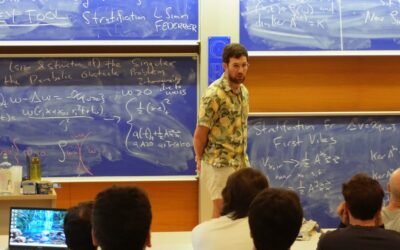
Advanced Course on Free Boundary Problems Opens the Intensive Weeks of the IRP
From 26 to 30 October, around forty researchers attended the Advanced Course on Free Boundary Problems at the CRM, three seven-hour mini-courses given by Bozhidar Velichkov (Università di Pisa), Max Engelstein (University of Minnesota) and Zihui Zhao (Johns Hopkins University). The course was the first of the two intensive weeks of the Intensive Research Programme on Analysis of Free Boundary Problems, which runs until 4 December.
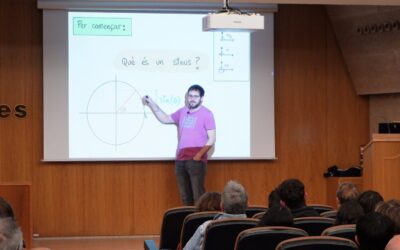
El CRM rep els estudiants de la prova de nivell de Bojos per les Matemàtiques 2027
Els aspirants a Bojos per les Matemàtiques 2027 van visitar el Centre de Recerca Matemàtica (CRM) dissabte 24 d’octubre, després de fer la prova de nivell a la Facultat de Ciències i Biociències de la UAB. En acabat, Tomás Sanz (UB-CRM) els va explicar què té a veure l’escalfament d’una barra de ferro amb els àudios de WhatsApp.
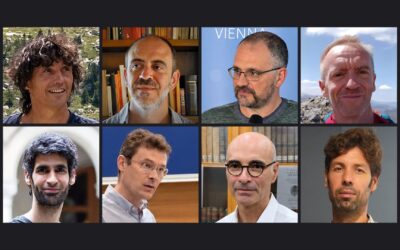
Eight CRM Researchers in the 2026 Stanford-Elsevier List of Highly Cited Scientists
The Centre de Recerca Matemàtica (CRM) has eight researchers in the 2026 update of the Stanford-Elsevier ranking of highly cited scientists, which John P. A. Ioannidis (Stanford University) and Jeroen Baas (Elsevier) compile from Scopus data. Xavier Cabré, Álvaro Corral, Tim Myers, Xavier Ros-Oton, Sergey Tikhonov and Xavier Tolsa appear both in the career-long ranking and in the one for 2025, and Diego Vidaurre and Simeon Ball in the 2025 ranking.
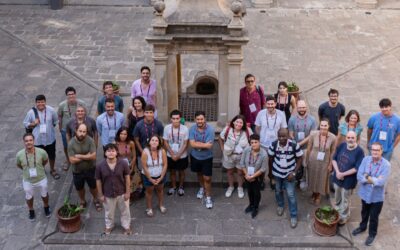
Fish schools and growing tissues: a workshop on how collective behaviour emerges
The Centre de Recerca Matemàtica (CRM) organised the Barcelona Workshop on Kinetic and Macroscopic Models in Biology with Friends II, held from 7 to 10 September at the Institut d’Estudis Catalans. More than thirty researchers discussed how order at the scale of tissues and animal groups arises from local interactions between individuals, in a programme that included talks by CRM researchers Daria Stepanova and Juan Arellano-Tintó. Two of the speakers, James Sharpe (EMBL Barcelona) and Chiara Villa (CNRS, Université Paris Cité), talked to the CRM about their research.
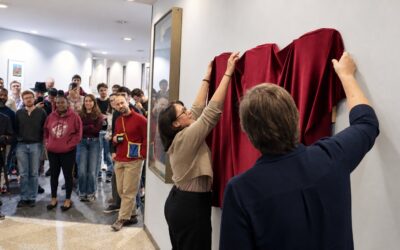
The CRM opens the academic year and unveils its Directors’ Gallery
A review of the year, the Communication Plan 2026–2030 and three research talks filled the morning of 19 October.The unveiling of the Directors’ Gallery.CRM CommPau VarelaCRMComm@crm.catGet the latest CRM news and activities in your inbox.Recent...
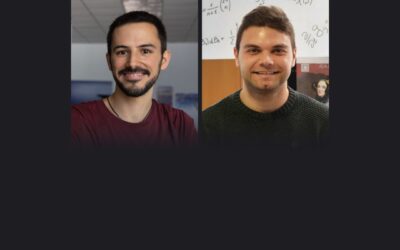
The CRM Mentoring Programme, as Told by One of Its Pairs
PhD student Joaquim Duran and mathematician Robert Cardona, one of the pairs in the CRM Mentoring ProgrammeJoaquim Duran (left) and Robert Cardona.CRM CommPau VarelaCRMComm@crm.catGet the latest CRM news and activities in your inbox.Recent...
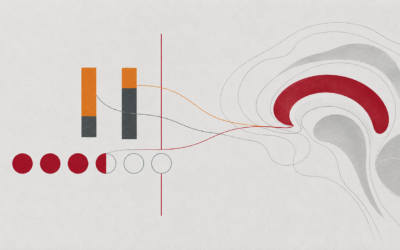
When the reward comes within reach, the brain changes what it compares
As the tokens piled up, choices got faster and more accurate at the same time. The yardstick for judging each offer had moved.CRM CommPau VarelaCRMComm@crm.catGet the latest CRM news and activities in your inbox.Recent newsletters →Two subjects...

Almost every automaton can be reset with a short word
Guillaume Chapuy (Université Paris Cité, CNRS) and Guillem Perarnau (UPC, CRM) have shown that a random finite automaton with n states can, with high probability, be reset by a word of length of order √n log n. The result, published in ACM Transactions on Algorithms, pins the exponent at 1/2, the lower end of a decade of numerical estimates, and addresses the random version of the synchronization problem behind a conjecture Ján Černý posed in 1964 and which still remains open.
Exposició ‘Les matemàtiques de Gaudí’