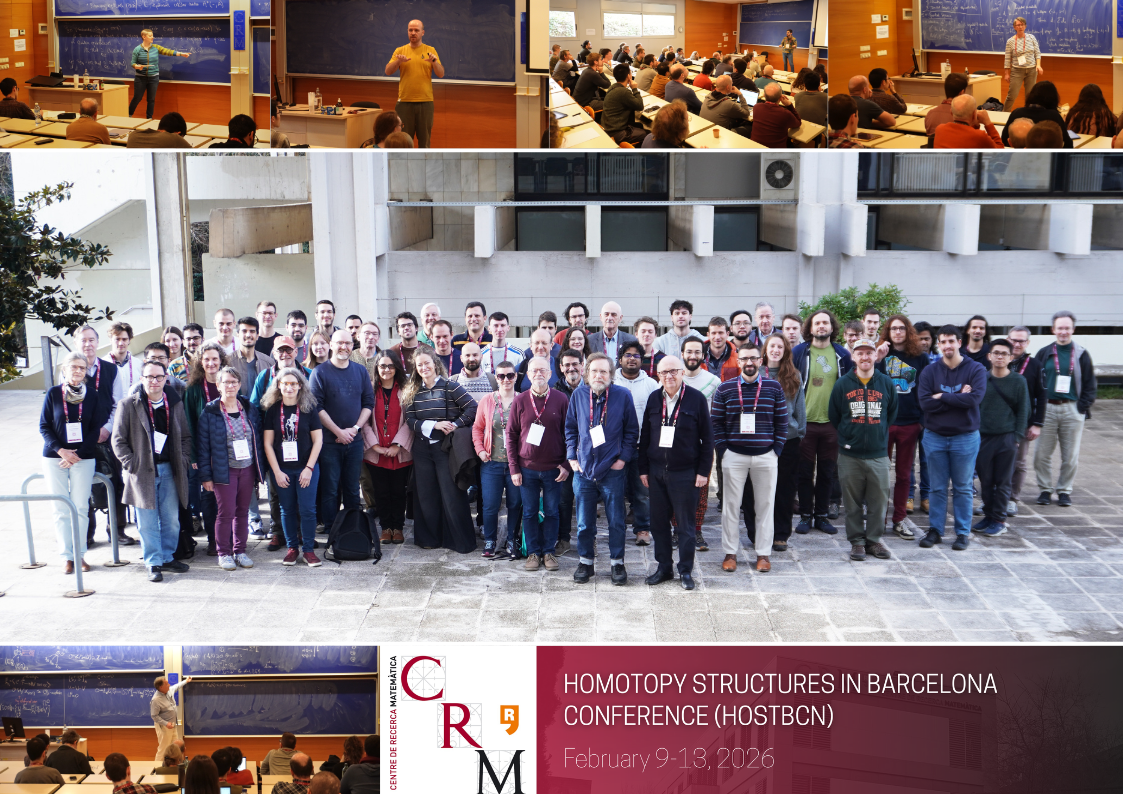
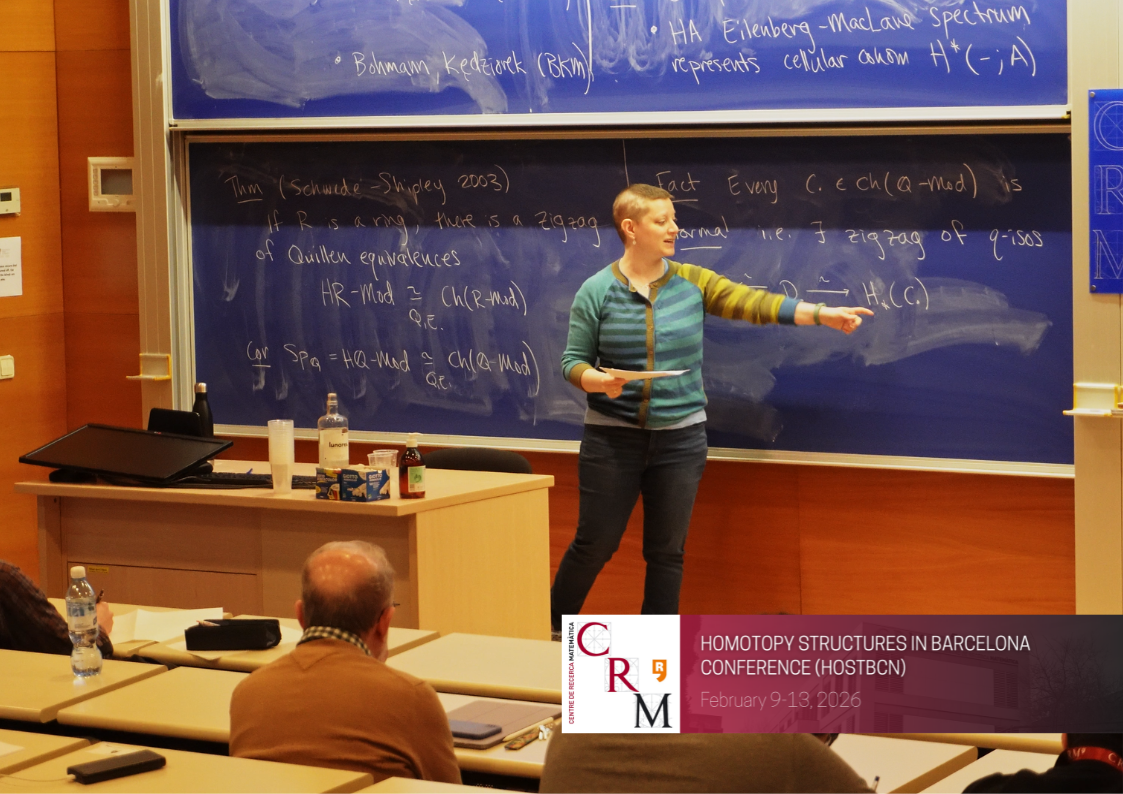
The Centre de Recerca Matemàtica hosted 75 mathematicians from over 20 countries for the Homotopy Structures in Barcelona conference, held February 9-13, 2026. Fourteen invited speakers presented research spanning rational equivariant cohomology theories, isovariant homotopy theory, higher groupoid cardinality, intersection cohomology, and tensor triangulated geometry, among other topics. Participants came from institutions across Europe, North America, and Asia, with at least ten extending their stays to develop collaborations with local researchers.
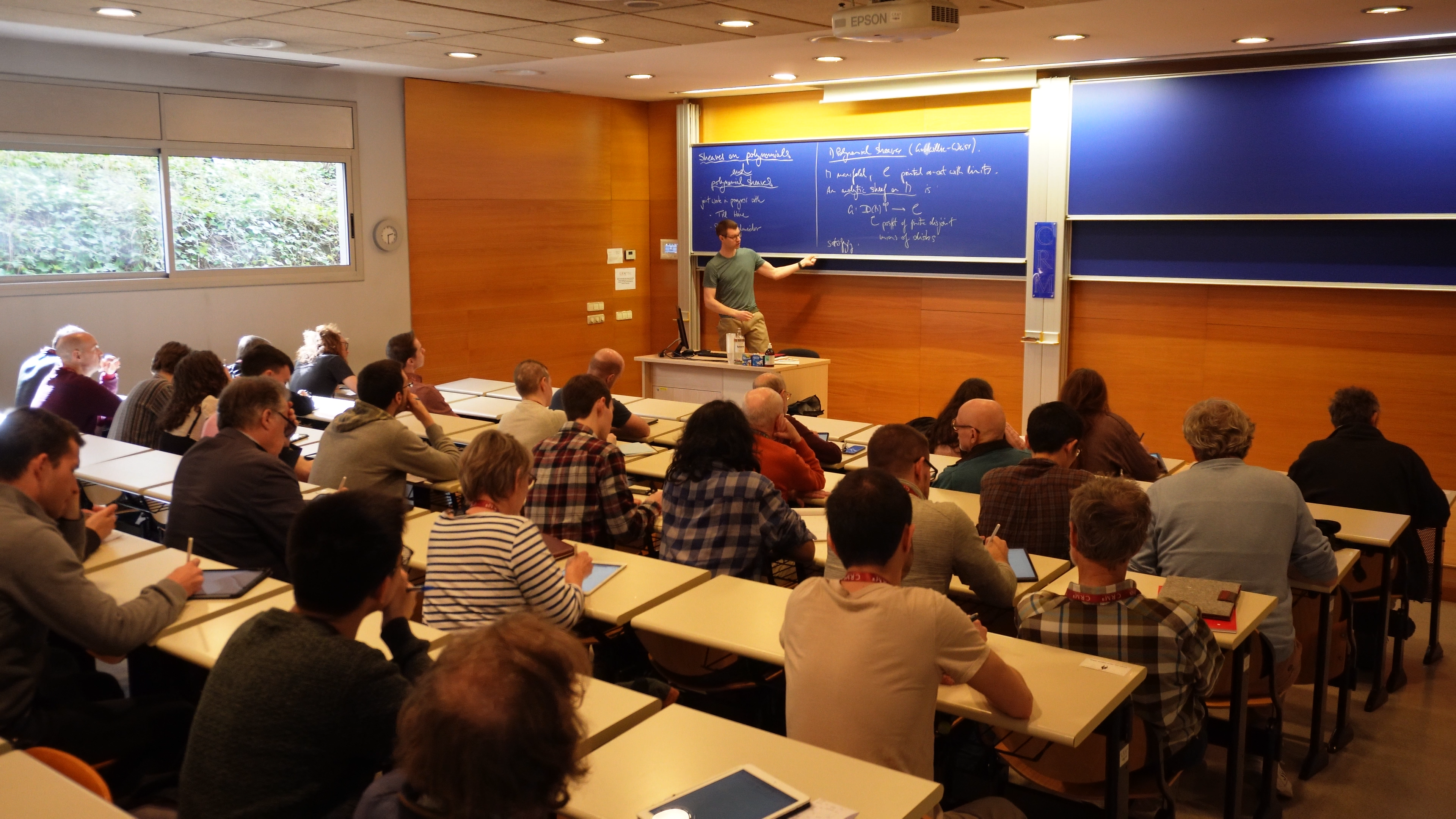
From February 9 to 13, the Centre de Recerca Matemàtica hosted Homotopy Structures in Barcelona, bringing together 75 mathematicians from institutions across Europe, North America, and Asia, including researchers from universities in Spain, the United Kingdom, Germany, France, the Netherlands, Switzerland, the United States, Canada, Poland, Denmark, and Japan, among others. This international gathering reflected both the global nature of contemporary mathematical research and Barcelona’s established position as a hub for algebraic topology.
Homotopy theory operates at the intersection of topology, algebra, and geometry, studying spaces through continuous deformations and the algebraic structures that encode them. The conference program reflected the breadth of current research, with fourteen invited speakers presenting work across a wide spectrum of topics.
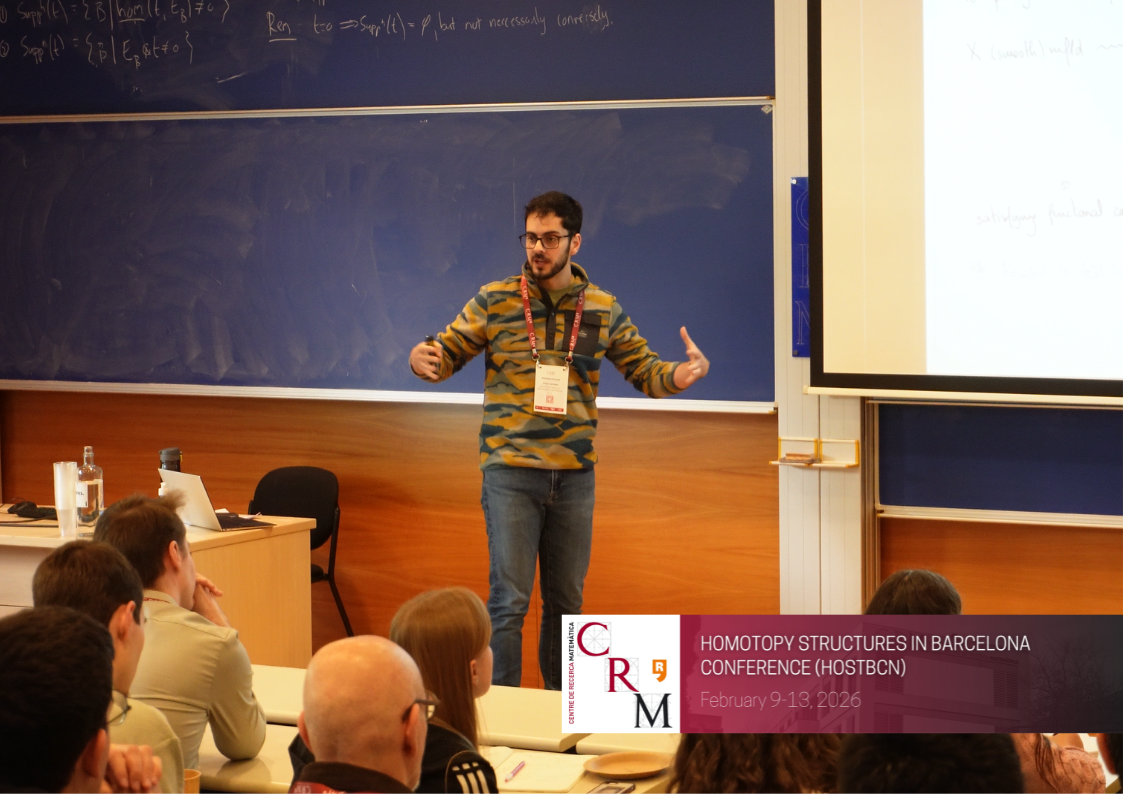
The organising committee, Carles Broto, Natàlia Castellana, Wolfgang Pitsch, and Albert Ruiz, all from the Universitat Autònoma de Barcelona, designed the conference with a specific philosophy in mind. “We deliberately chose a fairly broad topic, homotopy without too much specification, precisely to attract people who have interests in homotopy but who are sometimes very specialised,” explained Wolfgang Pitsch. “We conceived this conference as a moment to step back and have a broad view of what’s being done in this field.”
The approach also addressed what Pitsch described as the human aspect of scientific progress. “It’s about allowing people to put a face behind the papers they’re reading, behind the articles,” he said. “I think this human aspect is fundamental for science to advance.”
The schedule combined plenary lectures from established experts with contributed talks from early-career researchers, creating opportunities for exchange across career stages. As Pitsch noted, research in mathematics is often thought of as solitary work, but “in reality it’s fundamentally social. You do good mathematics with people you get along with.”
Research Highlights
Maxime Ramzi, from the University of Münster, presented work on higher groupoid cardinality. Building on concepts introduced by John Baez and James Dolan in the 1990s, Ramzi investigated whether groupoid cardinality, a way of assigning numbers to certain mathematical structures, admits a homotopical refinement analogous to the way the Euler characteristic lifts to algebraic K-theory.
The result was unexpected. While the construction can be defined, it produces a discrete object rather than a genuinely “higher” invariant. “The surprising result was that it is not more complicated,” Ramzi explained. “It’s very naive in the end.” This kind of result, which establishes the boundaries of what refinements are possible, provides important structural information about the invariants being studied.
John Greenlees, from the University of Warwick, spoke about rational equivariant cohomology theories for compact Lie groups. His talk focused on the Balmer spectrum, which organises these theories through conjugacy classes of subgroups. For groups like SU(3), this spectrum decomposes into multiple blocks (eighteen in that particular case), each encoding distinct information about group actions.
Greenlees presented calculations originally developed during a 1998 visit to the CRM, but contextualised them within current research on algebraic models. “Having an algebraic model of rational equivariant cohomology theories does let you do some new calculations,” he noted. These models translate topological questions into algebraic terms, often making them more tractable.
Regarding open problems in the field, Greenlees highlighted work on chromatic homotopy theory, particularly the redshift and blueshift phenomena that describe how complexity changes under operations like taking fixed points or K-theory. He also mentioned the challenge of understanding cobordism for non-abelian groups, noting that significant progress on that problem may still be some distance away.
Inbar Klang, from the Vrije Universiteit Amsterdam, presented joint work on isovariant homotopy theory. This framework studies spaces with group actions where maps are required to preserve isotropy subgroups, a condition important in equivariant surgery theory and h-cobordism theory. Klang described the approach as examining “not just the group action, but also the different layers of the space that are specified by the action of the group.”
The talk drew connections to other areas represented at the conference. Klang noted that David Chataur’s work on intersection cohomology, while new to her, appeared to have meaningful connections to isovariant theory. She described her broader research interest as understanding “what can homotopy theory tell us about manifolds,” a question that encompasses many different research programs across the field.
Emerging Themes and Open Questions
Pitsch, when asked about particularly exciting current directions in homotopy theory, pointed to equivariant methods. “What most attracts me personally right now is everything related to equivariant methods,” he said. “It’s the idea of studying not just objects but objects with prescribed symmetry groups.” He noted that significant progress has been made recently with finite groups, work is beginning with compact Lie groups, “and then there’s a large field of infinite discrete groups where any idea is welcome, and that’s very exciting right now.”
“Sometimes you really just need to talk to the person that has the missing piece of your puzzle.” — Inbar Klang
Beyond the formal presentations, participants emphasised the importance of informal exchange. Greenlees, who has organised numerous conferences and research programs throughout his career, stressed that bringing together researchers at different career stages is “fundamental for passing on the culture of the subject.” He noted that important mathematical conversations often happen during coffee breaks, meals, and informal gatherings.
Klang made a similar observation about the role of collaboration and discussion in mathematical progress. She noted that during the pandemic, when in-person gatherings were impossible, research productivity decreased substantially across the field. “Sometimes you really just need to talk to the person who has the missing piece of your puzzle,” she explained.
Pitsch emphasised this aspect when discussing why mixing career stages matters. “Conferences are a moment for people to get to know each other, to appreciate each other, for young people to present their ideas, their ‘craziness,’ not just at the blackboard in talks but informally in the hallways,” he said. “They can benefit from the experience of senior people, and senior people learn from the new ‘craziness’ that occurs to young people.”
Ramzi described how informal connections can lead to unexpected collaborations. He keeps a list of mathematical questions on his website, inviting others to discuss them. In one case, someone contacted him about a question from that list, and while they never solved that particular problem, the exchange led to a collaboration on an entirely different topic. “A lot of the math is about ideas and about new definitions, and about which questions are interesting to attack and what angle to attack them,” he said. “It’s often small interactions where somehow a small piece of what’s been said inspires you that will spark new research.”
Barcelona’s Historical Role
The conference took place within a broader historical context. The CRM has maintained a strong connection to algebraic topology since its founding by Manuel Castellet, himself a topologist. “There’s been a series of conferences in algebraic topology since the mid-1990s that have been fundamental in this respect,” Pitsch explained, “both for researchers from outside, many things were initiated here in the CRM hallways, and for the local community.”
This historical continuity has helped establish Barcelona as a recognised centre for the field. Algebraic topology entered Spain, and Catalonia in particular, through the Universitat Autònoma de Barcelona and the Universitat de Barcelona, and the regular conferences at the CRM have helped maintain and strengthen that tradition.
The impact was visible during the conference week. “The hallway was full of people collaborating, writing on blackboards,” Pitsch noted. At least ten participants extended their stays beyond the conference dates to collaborate with local researchers. Pitsch himself began working with two collaborators during the week, one of whom he was meeting for the first time. “Something will come of this,” he said. “I don’t know what, but it will be interesting.”
The week’s discussions will likely continue in various forms, through follow-up conversations, new collaborations, and research directions sparked by the exchange of ideas at the CRM.
Watch interviews with conference speakers and organisers to hear more about the research presented and the role of collaboration in advancing mathematics.
|
|
CRM CommPau Varela
|
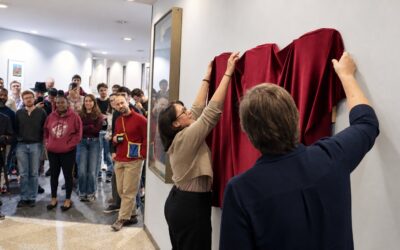
The CRM opens the academic year and unveils its Directors’ Gallery
A review of the year, the Communication Plan 2026–2030 and three research talks filled the morning of 19 October.The unveiling of the Directors’ Gallery.CRM CommPau VarelaCRMComm@crm.catGet the latest CRM news and activities in your inbox.Recent...
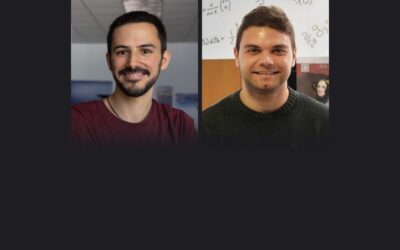
The CRM Mentoring Programme, as Told by One of Its Pairs
PhD student Joaquim Duran and mathematician Robert Cardona, one of the pairs in the CRM Mentoring ProgrammeJoaquim Duran (left) and Robert Cardona.CRM CommPau VarelaCRMComm@crm.catGet the latest CRM news and activities in your inbox.Recent...
When the reward comes within reach, the brain changes what it compares
As the tokens piled up, choices got faster and more accurate at the same time. The yardstick for judging each offer had moved.CRM CommPau VarelaCRMComm@crm.catGet the latest CRM news and activities in your inbox.Recent newsletters →Two subjects...
Almost every automaton can be reset with a short word
Guillaume Chapuy (Université Paris Cité, CNRS) and Guillem Perarnau (UPC, CRM) have shown that a random finite automaton with n states can, with high probability, be reset by a word of length of order √n log n. The result, published in ACM Transactions on Algorithms, pins the exponent at 1/2, the lower end of a decade of numerical estimates, and addresses the random version of the synchronization problem behind a conjecture Ján Černý posed in 1964 and which still remains open.
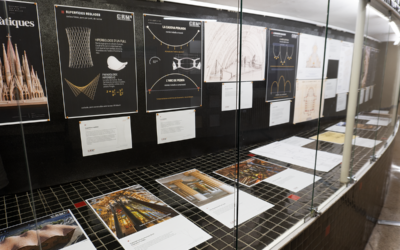
Exposició ‘Les matemàtiques de Gaudí’
CRM quod erat demonstrandum | 48

ADA: Decoding Brain Signals Misaligned in Time
The study addresses a key limitation of current brain decoding techniques: the difficulty of interpreting internal mental processes whose temporal dynamics vary from trial to trial.Decoding what is happening in a person’s mind from their brain activity is one of the...
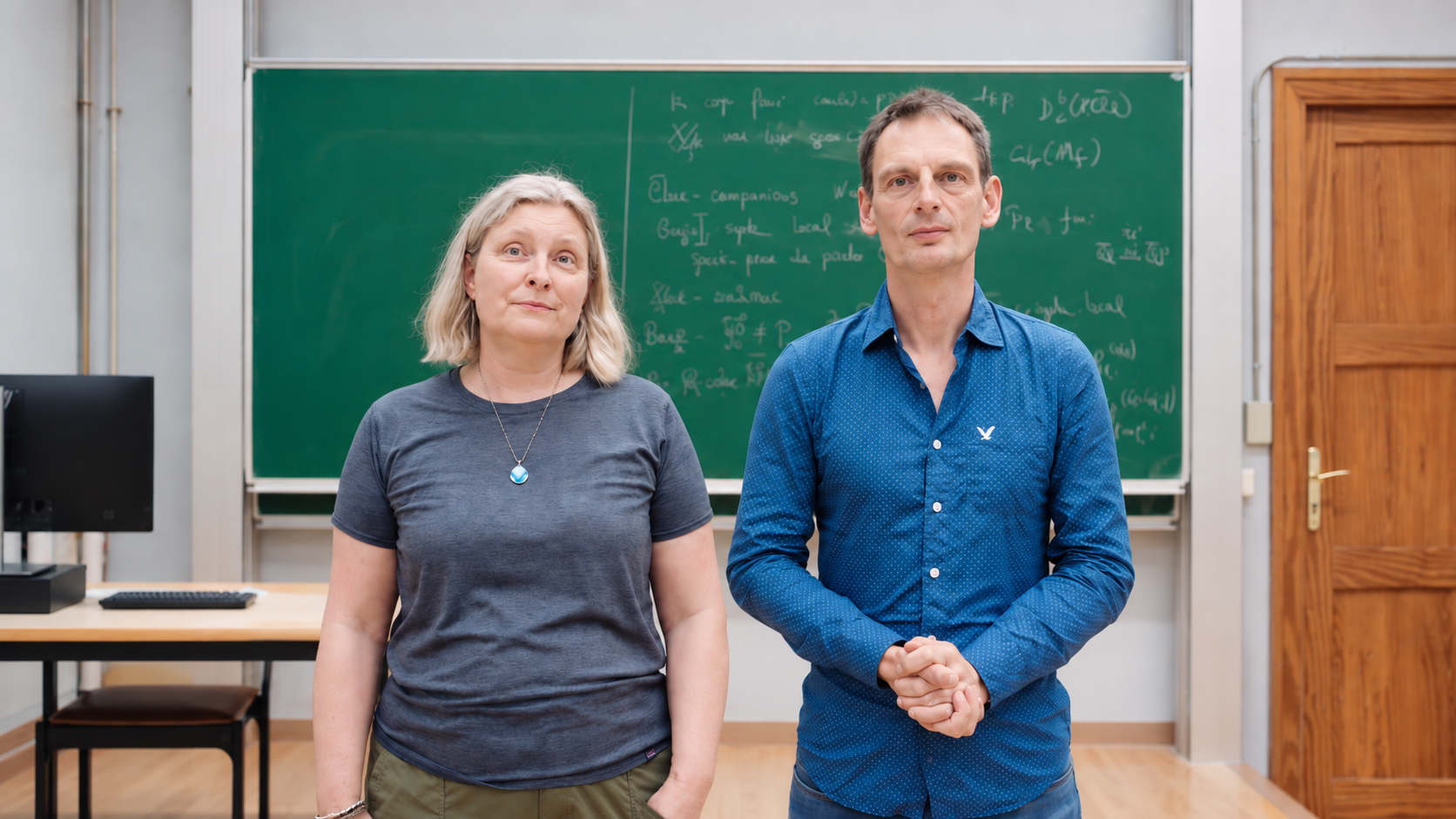
Rare curves, many points: Christophe Ritzenthaler and Rachel Pries on their research and the work around it
Christophe Ritzenthaler (Université de Rennes) and Rachel Pries (Colorado State University) both work on curves over finite fields: he hunts curves with as many points as possible, she hunts curves that almost never occur. In conversation with the CRM during their...
Call open for the 2027 Ferran Sunyer i Balaguer Prize
The Ferran Sunyer i Balaguer Foundation is accepting submissions for its 2027 prize, which awards 15,000 euros and publication in Birkhäuser's Progress in Mathematics series to an expository monograph on an active area of mathematical research. The deadline is 27...
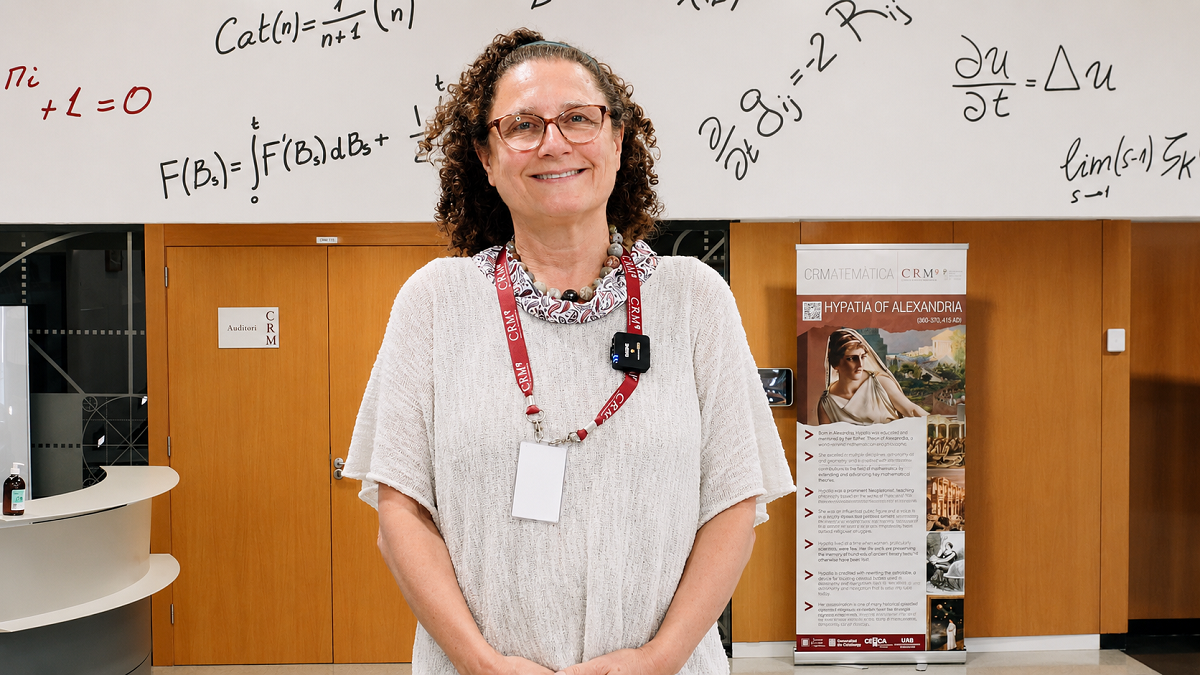
Susanna Terracini delivers the CRM Colloquium 2026
Susanna Terracini (Università di Torino) delivered the CRM Colloquium 2026 on 14 July, presenting a rigidity result for Kepler billiards obtained with Stefano Baranzini, Vivina Barutello and Irene De Blasi. She was at the centre as a member of the CRM Scientific...
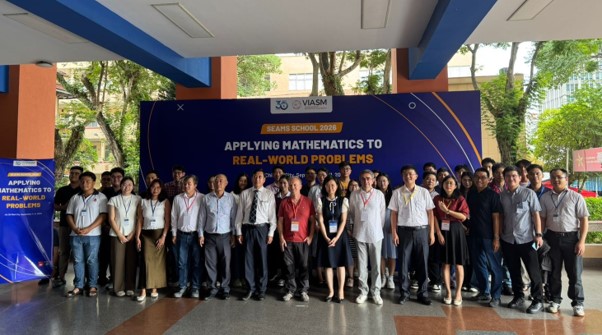
Ho Chi Minh City hosts the SEAMS School on applying mathematics to real-world problems
Students from across the region took courses and worked on group projects at a school co-organised by CRM researcher Tim Myers.CRM CommPau VarelaCRMComm@crm.catGet the latest CRM news and activities in your inbox.Recent newsletters →Between 4 and...

A single ball on a fixed table can compute: Eva Miranda and Isaac Ramos prove that two-dimensional billiards are Turing complete
Eva Miranda (UPC, CRM) and Isaac Ramos (ETH Zürich) show that a point particle bouncing inside a planar table with fixed walls can simulate a universal Turing machine, settling a question Cristopher Moore left open in 1990. The result grew out of a master’s project...