Ho Chi Minh City hosts the SEAMS School on applying mathematics to real-world problems
Students from across the region took courses and worked on group projects at a school co-organised by CRM researcher Tim Myers.
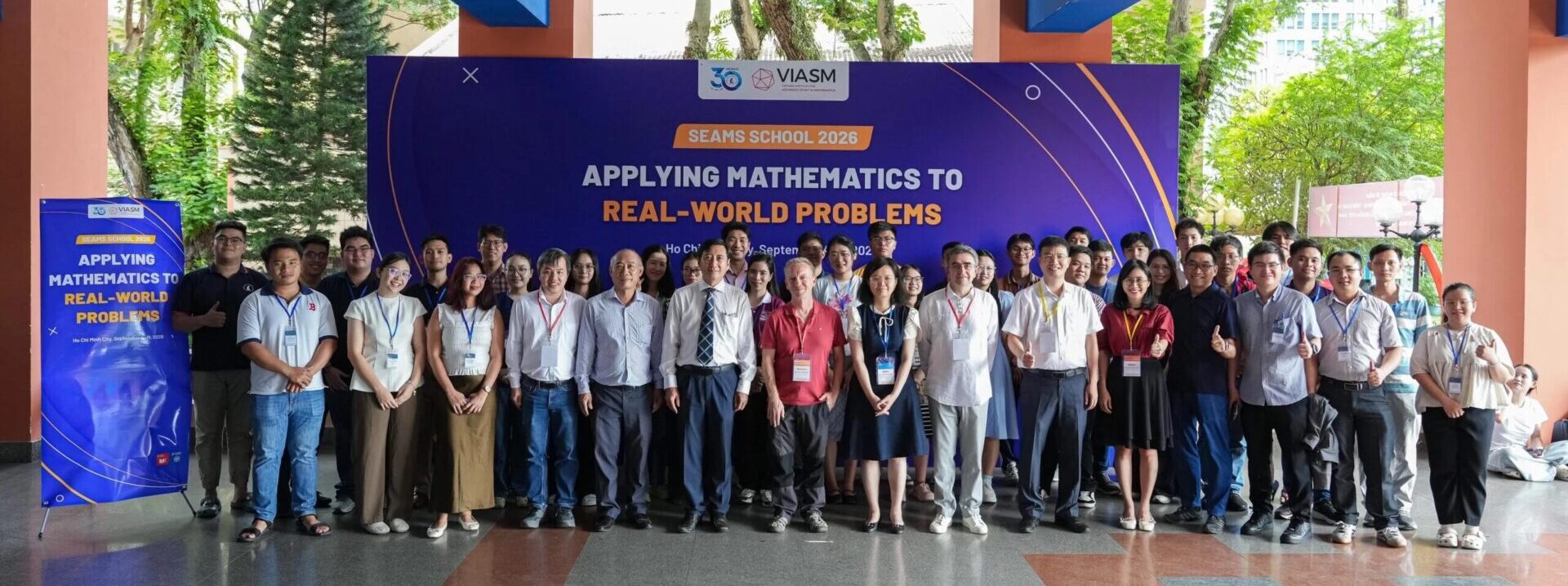
Between 4 and 11 September, the University of Science, Vietnam National University Ho Chi Minh City (HCMUS) hosted the Southeast Asian Mathematical Society School on Applying Mathematics to Real-World Problems. More than fifty students took part, from Vietnam, Cambodia, Thailand, South Korea, the Philippines and Indonesia.
Tim Myers, a CRM researcher who works on industrial mathematics, was one of four organisers and taught one of the four courses.
For Myers, it started with a report. In 2022, a review committee chaired by Sir John Ball evaluated the Vietnam Institute for Advanced Study in Mathematics (VIASM). Its report praised the institute’s international standing and made nine recommendations, two of which could serve as a brief for this school. One asked VIASM to widen its impact on neighbouring countries, for instance by helping mathematicians across Southeast Asia work together through networks such as the Southeast Asian Mathematical Society (SEAMS) and the Centre International de Mathématiques Pures et Appliquées (CIMPA). The other was about applied mathematics: more of it, and closer ties with industry.
In early 2025, Myers met Prof. Joaquim Correia (Universidade de Évora) at a meeting of the European Mathematical Society’s Committee for Developing Countries, where both are associates. The EMS committee had twice named VIASM one of its Emerging Regional Centres of Excellence. The two talked about the report and its recommendations, and about helping Vietnamese applied mathematics along. That September, Myers attended the board meeting of the International Council for Industrial and Applied Mathematics (ICIAM) at VIASM in Hanoi, which CRM covered at the time, and went on to HCMUS to lecture on study groups with industry. Both institutions wanted to start a study group. After discussion, the organisers settled on a gentler first step: a modelling week.
The school’s stated goal follows the review’s recommendations closely. It set out to stimulate “groups to start researching in specific industry areas”, and more broadly to get young mathematicians working on real problems.
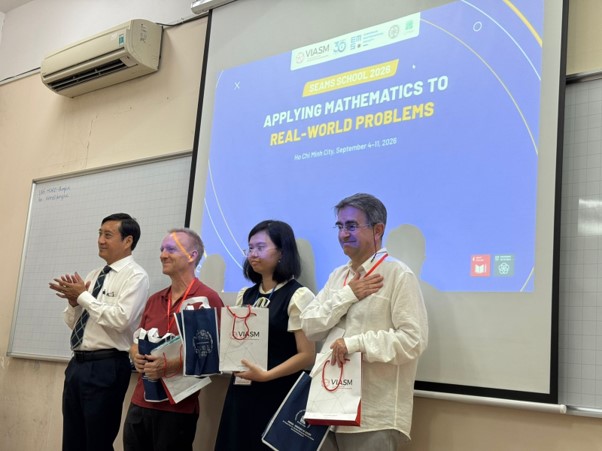
Four courses ran through the week: moving boundary problems (Myers), conservation laws (Joaquim Correia, U. Évora), stochastic processes (Gaël Raoul, CMAP, École Polytechnique) and infectious disease modelling (Lê Thị Minh Thảo, IST Lisbon). There were also talks on image restoration and clinical genomics. Students worked together on research projects throughout, presenting them on the final day, and Tuesday brought a round table on the role of study groups in developing applied mathematics.
According to the organisers, the week also introduced the study group model and gave it a trial run, with a specific target: an industry-connected applied mathematics group inside the Faculty of Mathematics and Computer Science at HCMUS. Study groups put mathematicians in a room with companies and turn whatever the companies are stuck on into research problems.
The meeting was organised by Prof. Lê Minh Hà (VIASM), Prof. Joaquim Correia (U. Évora), Dr Hoàng Văn Hà (HCMUS) and Myers, with funding from CIMPA and SEAMS (both mentioned in the 2022 review) and the EMS Committee for Developing Countries. Assoc. Prof. Trần Lê Quan, president of HCMUS, opened it.
Both VIASM and HCMUS wanted a study group before the school existed. They now have a week of groundwork, and fifty-odd young applied mathematicians across six countries who have met each other.
Further reading
School programme and details: VIASM: SEAMS 2026
Previous coverage: Tim Myers represents ECMI at the ICIAM Board Meeting and promotes industrial mathematics in Vietnam (CRM, September 2025)
Review committee report: VIASM Annual Report 2022, from p. 143
More from the CRM
The CRM opens the academic year and unveils its Directors’ Gallery
A review of the year, the Communication Plan 2026–2030 and three research talks filled the morning of 19 October.The unveiling of the Directors’ Gallery.CRM CommPau VarelaCRMComm@crm.catGet the latest CRM news and activities in your inbox.Recent...
The CRM Mentoring Programme, as Told by One of Its Pairs
PhD student Joaquim Duran and mathematician Robert Cardona, one of the pairs in the CRM Mentoring ProgrammeJoaquim Duran (left) and Robert Cardona.CRM CommPau VarelaCRMComm@crm.catGet the latest CRM news and activities in your inbox.Recent...
When the reward comes within reach, the brain changes what it compares
As the tokens piled up, choices got faster and more accurate at the same time. The yardstick for judging each offer had moved.CRM CommPau VarelaCRMComm@crm.catGet the latest CRM news and activities in your inbox.Recent newsletters →Two subjects...
Almost every automaton can be reset with a short word
For a random automaton with n states, a word of about √n log n letters is almost always enough to reset it.CRM CommPau VarelaCRMComm@crm.catGet the latest CRM news and activities in your inbox.Recent newsletters →Picture a conveyor belt carrying...
Exposició ‘Les matemàtiques de Gaudí’
CRM quod erat demonstrandum | 48
ADA: Decoding Brain Signals Misaligned in Time
The study addresses a key limitation of current brain decoding techniques: the difficulty of interpreting internal mental processes whose temporal dynamics vary from trial to trial.Decoding what is happening in a person’s mind from their brain activity is one of the...
Rare curves, many points: Christophe Ritzenthaler and Rachel Pries on their research and the work around it
Christophe Ritzenthaler (Université de Rennes) and Rachel Pries (Colorado State University) both work on curves over finite fields: he hunts curves with as many points as possible, she hunts curves that almost never occur. In conversation with the CRM during their...
Call open for the 2027 Ferran Sunyer i Balaguer Prize
The Ferran Sunyer i Balaguer Foundation is accepting submissions for its 2027 prize, which awards 15,000 euros and publication in Birkhäuser's Progress in Mathematics series to an expository monograph on an active area of mathematical research. The deadline is 27...
Susanna Terracini delivers the CRM Colloquium 2026
Susanna Terracini (Università di Torino) delivered the CRM Colloquium 2026 on 14 July, presenting a rigidity result for Kepler billiards obtained with Stefano Baranzini, Vivina Barutello and Irene De Blasi. She was at the centre as a member of the CRM Scientific...
A single ball on a fixed table can compute: Eva Miranda and Isaac Ramos prove that two-dimensional billiards are Turing complete
Eva Miranda (UPC, CRM) and Isaac Ramos (ETH Zürich) show that a point particle bouncing inside a planar table with fixed walls can simulate a universal Turing machine, settling a question Cristopher Moore left open in 1990. The result grew out of a master’s project...