
with Friends II
REGISTRATION FEE
300€
(Includes coffee breaks and guided tour)
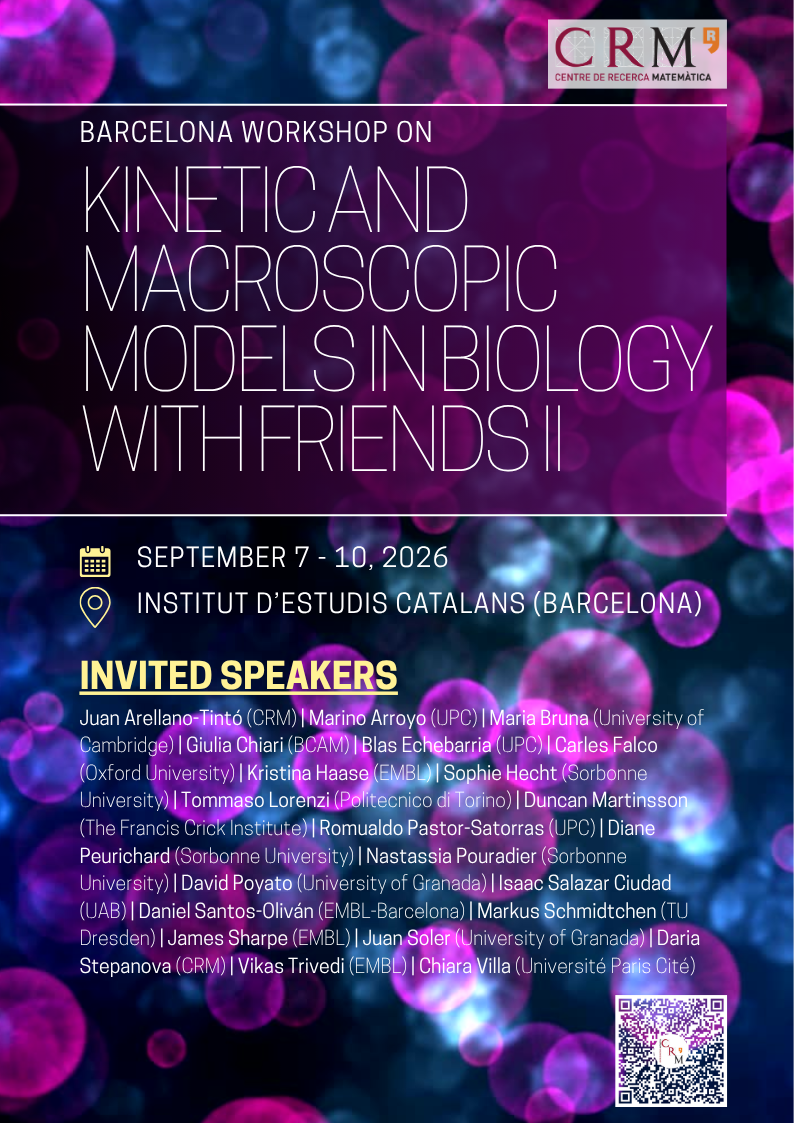
Barcelona Workshop on Kinetic and Macroscopic Models in Biology with Friends II
Sign into September 10, 2026
Venue: Institut d'Estudis Catalans (IEC)
Room: Pere i Joan Coromines
Effective June 15th, 2026, bank transfer payments will no longer be accepted for any CRM activity. All registration fees must be paid by card to complete the registration process.
If your institution requires an invoice for reimbursement or administrative purposes, you can request it during the registration process. Once your registration fee has been paid, please send the proof of payment to comptabilitat@crm.cat. The invoice will be issued after the payment has been received and verified.
CONTRIBUTIONS
SCHEDULE
REGISTRATION
Introduction
A fundamental problem in a wide range of disciplines is understanding how functional complexity at a macroscopic scale results from the actions and interactions among the individual components. Animal groups such as insect swarms, fish schools and bird flocks frequently display coordinated behaviours that result from individual interactions. The resulting collective movement is observed across different scales, from cells forming biological tissues to fish schools moving in synchrony. This also constitutes a challenge for the mathematical modelling and analysis of these systems.
The Workshop will provide the opportunity for established specialists in collective behaviour from a mathematical, biological, and physical perspective to present their most recent work. Ample scope will be provided for interactive discussions to identify possible collaborative or independent projects that further develop the techniques and extend the applications.
Invited Speakers
| Juan Arellano-Tintó | CRM |
| Marino Arroyo | UPC |
| Maria Bruna | University of Cambridge |
| Giulia Chiari | BCAM |
| Blas Echebarria | UPC |
| Carles Falcó | Oxford University |
| Kristina Haase | EMBL |
| Sophie Hecht | Sorbonne University |
| Tommaso Lorenzi | Politecnico di Torino |
| Duncan Martinsson | The Francis Crick Institute |
| Romualdo Pastor-Satorras | UPC |
| Diane Peurichard | Sorbonne University |
| Nastassia Pouradier | Sorbonne University |
| David Poyato | University of Granada |
| Isaac Salazar Ciudad | UAB |
| Daniel Santos-Oliván | EMBL-Barcelona |
| Markus Schmidtchen | TU Dresden |
| James Sharpe | EMBL |
| Juan Soler | University of Granada |
| Daria Stepanova | CRM |
| Vikas Trivedi | EMBL |
| Chiara Villa | Université Paris Cité |
ORGANISING committee
| Tomas Alarcon | ICREA – CRM |
| Gissell Estrada-Rodriguez | UPC – CRM |
SCHEDULE
| Time | Monday 7th September | Tuesday 8th September | Wednesday 9th September | Thursday 10th September |
|---|---|---|---|---|
| 09:00 → 09:45 |
09:30 → 09:45
Registration
|
Vikas Trivedi
EMBL
|
Juan Soler
Universidad de Granada
|
Real robot swarms programmed to act like morphogenetic tissues
James Sharpe
EMBL
|
| 09:45 → 10:30 |
Quantitative insights into vascular adaptation across the human lifespan
Kristina Haase
EMBL
|
Tommaso Lorenzi
Politecnico di Torino
|
Giulia Chiari
BCAM
|
Carles Falcó
Oxford University
|
| 10:30 → 11:00 | Coffee Break | Group Picture + Coffee Break | Coffee Break | |
| 11:00 → 11:45 |
Duncan Martinsson
The Francis Crick Institute
|
Markus Schmidtchen
TU Dresden
|
Maria Bruna
University of Cambridge
|
TBP
Marino Arroyo
UPC
|
| 11:45 → 12:30 |
Romualdo Pastor
UPC
|
David Poyato
Universidad de Granada
|
Diane Peurichard
Sorbonne University
|
Juan Arellano
CRM
|
| 12:30 → 14:00 | Lunch Break | |||
| 14:00 → 14:45 |
Daria Stepanova
CRM
|
Blas Echebarría
UPC
|
Daniel Santos
EMBL
|
|
| 14:45 → 15:30 |
Chiara Villa
Université Paris Cité
|
Sophie Hecht
Sorbonne University
|
Nastassia Pouradier
Sorbonne University
|
|
| 15:30 → 16:00 | Coffee Break |
Old Town Guided Tour
|
||
| 16:00 → 16:45 |
Isaac Salazar
UAB
|
|||
| 16:45 → 17:45 |
Poster Session + Reception
|
|||
LIST OF PARTICIPANTS
| Name | Institution |
|---|---|
| Duncan Martinson | The Francis Crick Institute |
| Kristina Haase | EMBL |
| Tommaso Lorenzi | Politecnico di Torino |
| Nastassia Pouradier Duteil | Inria |
| Chiara Villa | CNRS |
| Sam Gaborieau | ESPCI and Sorbonne University |
| Sophie Hecht | Sorbonne Université, CRNS |
| Daniel Santos-Oliván | EMBL-Barcelona |
| Diane Peurichard | Sorbonne University |
| James Sharpe | EMBL |
| Vikas Trivedi | EMBL |
| Antoni Matyjaszkiewicz | EMBL Barcelona |
| Jordan Martinez | Universitat Autònoma de Barcelona |
| Romualdo Pastor Satorras | Universitat Politècnica de Catalunya |
| David Oriola | Universitat Politècnica de Catalunya |
| Víctor Villegas-Morral | Universitat Politècnica de Catalunya |
| Blas Echebarria | Universitat Politècnica de Catalunya |
| Marina Martins Cano | Universitat Politècnica de Catalunya |
| Sergio Alonso | Universitat Politècnica de Catalunya |
| Gissell Estrada-Rodriguez | Universitat Politècnica de Catalunya |
| Martí Planasdemunt Hospital | Universitat Politècnica de Catalunya |
| Marino Arroyo | Universitat Politècnica de Catalunya |
| Badamasi Bashir Mikailu | Universitat Ramon Llull |
| Jesús David Poyato Sánchez | Universidad de Granada |
| Juan Soler | Universidad de Granada |
| Nicolás Martínez Tomás | Pierre-and-Marie-Curie University |
| Angelina Jammart | Pierre-and-Marie-Curie University |
| Markus Schmidtchen | Dresden University of Technology |
| Maria Bruna | University of Oxford |
| Carles Falco | University of Oxford |
| Daria Stepanova | Centre de Recerca Matemàtica |
| Tomás Alarcón | Centre de Recerca Matemàtica |
| Juan Arellano Tintó | Centre de Recerca Matemàtica |
| Isaac Salazar Ciudad | Centre de Recerca Matemàtica |
registration
Registration deadline: 17th July 2026
CRM User Account Creation
After creating your CRM user account, you can log in on the activity webpage to complete your registration, or by clicking the button and then selecting ‘Sign in’.
REGISTER
POSTER CONTRIBUTIONS
Participants are encouraged to present their research results with a poster presentation. Posters have to measure 841mm x 1189mm (A0).
To apply, participants will find the relevant option during the registration process. You will be asked to attach the abstract (between 300 and 600 words) including the title, in .pdf format. The file name must follow the format: surname_name.
- Deadline for abstract submission: 4 July 2026
- Resolutions: 15 July 2026
LODGING INFORMATION
ON-CAMPUS AND BELLATERRA
BARCELONA AND OFF-CAMPUS
 |
For inquiries about this event please contact the Scientific Events Coordinator Ms. Núria Hernández at nhernandez@crm.cat
|
CRM Events code of conduct
All activities organized by the CRM are required to comply with the following Code of Conduct.
CRM Code of Conduct
scam warning
We are aware of a number of current scams targeting participants at CRM activities concerning registration or accommodation bookings. If you are approached by a third party (eg travellerpoint.org, Conference Committee, Global Travel Experts or Royal Visit) asking for booking or payment details, please ignore them.
Please remember:
i) CRM never uses third parties to do our administration for events: messages will come directly from CRM staff
ii) CRM will never ask participants for credit card or bank details
iii) If you have any doubt about an email you receive please get in touch

Sustainable Events
We are committed to organising sustainable events that minimise environmental impact and create a positive legacy for the host community. We support organisers in designing events aligned with the UN 2030 Sustainable Development Goals, reducing negative environmental impacts and promoting responsible practices.
All materials provided during our activities are responsibly sourced, including recycled pens and plastic-free badges. We work with responsible suppliers, and our catering partners use fully compostable materials while offering vegetarian and vegan options, with at least one event day being fully vegetarian.
| Sam Gaborieau | ESPCI and Sorbonne University | Numerical and experimental study of phase transitions in fish collective motion |
| Jordan Martínez | Universitat Autònoma de Barcelona | Mathematical model of cancer and (CAR) T cells as structured populations. Cancer cells structured by damage and T cells by exhaustion |
| Marina Martins | Universitat Politècnica de Catalunya | Inference of Atrial Conduction Properties from Activation Time Measurements Using Computational Modelling and Finite Element Methods |
| Badamasi Bashir Mikailu | Universitat Ramon Llull | Stochastic models for cell polarization and crawling |
| Víctor Villegas | Universitat Politècnica de Catalunya | Decision making in heterogeneous self-propelled particle systems |
From Cellular Kinetics to Tissue-Scale Robustness: Developmental robustness under changing temperature
Ectotherm development remains robust across temperature ranges, yet how temperature-dependent cellular kinetics generate conserved tissue-scale dynamics is unclear. Using light-sheet imaging of gastrulation, combined with vertex and continuum models, we examine epithelial dynamics from optimal to suboptimal temperatures. At 20°C, cytokinesis failures produce enlarged, multinucleated cells in the enveloping layer, while altered tissue and actomyosin-ring tensions drive non-spherical morphologies and epithelial rupture during epiboly. These findings connect temperature-dependent changes in cellular activity to macroscopic tissue behaviour, revealing how developmental robustness is maintained—and where it fails—under thermal stress.
Macroscopic limits and dynamical patterns in active particle systems
Active particle systems provide microscopic models for collective behaviour far from equilibrium, but their macroscopic descriptions can have very different mathematical structures depending on the interactions and the system’s composition.
In this talk, I will discuss hydrodynamic limits for interacting active particles, focusing on two settings. First, I will consider active Brownian particles with purely repulsive interactions and discuss how their microscopic dynamics lead to nonlinear macroscopic PDEs that describe motility-induced phase separation. I will briefly review different approaches to obtaining these limits and discuss stability and analytical properties of the resulting equations.
I will then turn to mixtures of active and passive particles, where the hydrodynamic limit leads to an effective cross-diffusion system with non-reciprocal interactions. We will explore how the lack of reciprocity gives rise to richer collective behaviour, including phase separation and dynamical states such as travelling waves.
From Soft Particle Interactions to Cross-Diffusion Models
We derive a macroscopic cross-diffusion model for two species of Brownian particles interacting through short-range repulsive potentials. Starting from an overdamped stochastic particle system, we use matched asymptotic expansions to close the associated Fokker–Planck hierarchy in the dilute interaction regime. The resulting continuum equations retain local pair correlations that are lost in a conventional mean-field closure.
For weak regular potentials, the model reduces to the familiar localised mean-field system. For singular inverse power-law interactions, however, additional cross-crowding terms arise that decrease the effective self-diffusion of one species in the presence of the other. These terms are relevant to crowded heterogeneous populations and cannot be recovered by first taking a mean-field limit andsubsequently localising the interaction kernel.
Large-scale Dynamics of Self-propelled Particles moving through Obstacles: How Environment Affects Particle Swarms
We investigate the collective motion of self-propelled agents in an environment filled with obstacles that are tethered to fixed positions via springs. The active particles are able to modify the environment by moving the obstacles through repulsion forces. This creates feedback interactions between the particles and the obstacles from which a breadth of patterns emerges (trails, band, clusters, honey-comb structures,…). We derive a macroscopic partial differential equations model from the agent-based dynamics describing the interactions between the self-propelled particles and the obstacles, under large tether stiffness. We perform an in-depth investigation of pattern formation of the discrete and continuum models in 2D: we provide phase-diagrams and determine the key mechanisms for bifurcations to happen using linear stability analysis. As a result, we discover that the agent-agent repulsion, the agent-obstacle repulsion and the obstacle’s spring stiffness are the key forces in the appearance of patterns, while alignment forces between the particles play a secondary role. We present an innovative methodology to compare discrete and continuum models that we apply here to perform an in-depth analysis of the agreement between the discrete and continuum models. Altogether, this study enables to shed light on the influence of the environment in the collective motion of self-propelled particles.
In collaboration with: P. Aceves Sanchez (UCLA), P. Degond (IMT, Toulouse), Eric Keaveny (IMFT, Toulouse), A. Manhart (Wien University), S. Merino Aceituno (Wien University), L. Sala (INRAE)
Microscopic and macroscopic models for the growth of bacteria micro-colony
Bacteria are abundant organisms that participate in many processes occurring in medicine, agriculture, ecology, industry. Starting from a single organism, they quickly develop into organized micro-colonies and bio-films. The formation of microcolonies, although widely studied over the past decade, is still poorly understood. We will first consider a microscopic model where each bacterium is modeled by a spherocylinder and where the bacteria interact through non-overlapping constraints. By taking into account the asymmetry of the poles of the bacteria, the model reproduces the mechanical characteristics of the growth of micro-colonies, and this without implementing either attraction or adhesion. Then we present the derivation of this model toward an aggregation model with growth and fragmentation.
This work is in collaboration with Diane Peurichard (INRIA Paris), Marie Doumic (INIRIA Paris Saclay) and Mark Hoffman (Université Paris-Dauphine)
Cytoneme-Mediated Cellular Communication and Its Implications in Glioblastoma
In this talk, we explore a new paradigm in cellular communication that extends beyond traditional diffusion processes. Cell-to-cell contact via filopodia-like structures, known as cytonemes, has been proposed as a key mechanism for morphogen gradient formation. Despite recent advances in cytoneme signaling, little is known about how cytonemes navigate the extracellular matrix and orient themselves to find their targets. Here, we demonstrate that variations in cytoneme stabilization and orientation depend on the relative levels of specific proteins, suggesting a novel mechanism for cytoneme guidance. Integrating experimental data, we developed a mathematical model to analyze and validate this guidance mechanism. Finally, we investigate its implications for glioblastoma dynamics and neuron-glioblastoma interactions.
References:
• A. Aguirre-Tamaral, M. Cambón, D. Poyato, J. Soler, I. Guerrero. Predictive model for cytoneme guidance in Hedgehog signaling based on Ihog-Glypicans interaction. Nature Communications 13 (2022), 5647.
• M. Conte, S. Casas-Tintò, J. Soler. Modeling invasion patterns in the glioblastoma battlefield. PLOS Computational Biology 17(1): e1008632, (2021).
• J. Calvo, J. Campos, V. Caselles, O. Sánchez, J. Soler. Pattern formation in a flux limited reaction-diffusion equation of porous media type. Inventiones Mathematicae 206 (2016), 57–108.
• R.C. Rockne, …, J. Soler, …, K. Urbaniak. The future of mathematical oncology in the age of AI. Nature npj Systems Biology and Applications volume 12, Article number: 22 (2026)
Learning cell-cycle control from tissue-scale dynamics
In this talk, we will present a continuum modelling and Bayesian inference framework for studying how cell-cycle regulation shapes epithelial tissue expansion. Using models that couple tissue growth to density-dependent cell-cycle progression, we infer how crowding constraints modulate transitions through the cell cycle and generate spatial patterns of proliferation in growing tissues. This provides a quantitative route to linking experimentally observed tissue-scale expansion with underlying rules of cell-cycle control. We will also discuss several extensions of this framework. These include data-driven approaches for directly learning the functional form of density-dependent cell-cycle transition rates using universal diHerential equations, age-dependent models for investigating cell-cycle synchrony, and error models based on fluctuating hydrodynamics to better account for intrinsic variability and improve inference. Together, these approaches aim to develop more robust and mechanistically interpretable methods for inferring cell-cycle regulation from population-level experimental data.
This talk is based on a series of work in collaboration with Ruth Baker, José A. Carrillo, Luke De-Bretton Gordon, Marjorie Watts, Benjamin Stephens, Helen Byrne, Torkel Loman (Oxford), and Daniel Cohen (Princeton).
Graph-induced rotational states in the modeling of fish collective motion
It is known experimentally that fish schools are able to transition between various forms of collective motion, including schooling, in which all velocities are aligned, and milling, in which all individuals rotate at a common angular velocity around a common point. Most models for fish collective behavior are second-order particle systems containing three main social forces: attraction-repulsion, alignment, and self-propulsion. The study of such models has shown that milling behavior can be induced by the sole presence of the attraction-repulsion and self-propulsion terms. Here, we investigate the feasibility of producing phase-transitions between milling and schooling via heterogeneities in an alignment operator, as opposed to the attraction and repulsion forces used previously in the litterature. In this aim, we reduce the model to a first-order Stuart-Landau oscillatory model, and show that under certain graph structures, the model produces bistability of the rotational states (indicative of milling), and fully synchronized states (indicative of schooling).
This works is in collaboration with David Poyato (University of Granada) and David Nicholas Reynolds (University of Warsaw).
Modelling aggregation dynamics in Capsaspora owczarzaki for understanding the origins of multicellularity
The origin of animal multicellularity remains one of the central questions in evolutionary biology. While aggregation has long been considered a possible route toward multicellularity, its role has remained difficult to evaluate experimentally due to the lack of a stable, reproducible, and quantitatively tractable model system in a close unicellular relative of animals.
We establish the filasterean Capsaspora owczarzaki, one of the closest known unicellular relatives of animals, as such a system and combine experimental observations, transcriptomics, and mathematical modelling to characterise its aggregation dynamics. In this talk, I will particularly focus on the theoretical modelling of Capsaspora aggregation. By analysing time-resolved imaging data, we formulated a kinetic model in which cell-cell adhesion increases nonlinearly with the concentration of fetal bovine serum (FBS), an environmental trigger of aggregation. Coupling this threshold-like adhesion response with local FBS depletion through cellular consumption was sufficient to reproduce the full aggregation-disaggregation cycle observed experimentally, including aggregate growth, merging, and dissolution dynamics.
Temporal transcriptomic analyses independently support the model predictions, revealing coordinated upregulation of genes associated with adhesion, signalling, and motility during aggregation, followed by downregulation as FBS levels decline. These results suggest that aggregation in Capsaspora is not merely a passive physical process, but a dynamically regulated multicellular behaviour.
More broadly, this work illustrates how quantitative mathematical modelling can provide a predictive framework linking molecular state transitions to collective cellular behaviour. By integrating modelling with experimental cell biology and evolutionary genomics, we propose Capsaspora as a new platform to investigate how environmentally induced aggregation may have contributed to the emergence of multicellular traits in the animal lineage.
This work was carried out in collaboration with Gonzalo Bercedo-Saborido (Institut de Biologia Evolutiva, IBE), Iñaki Ruiz-Trillo (IBE), Tomás Alarcón (ICREA, CRM, UAB), and Koryu Kin (Juntendo University)
Coupling physiologically-based kinetic models of endocrine axes with structured cell population dynamics models: an integrative approach of reproductive toxicity
The impact of micropollutants on living organisms is a major concern for health and the environment. Endocrine disruptors (ED) interfere with the physiology of organisms and can alter major biological functions, particularly the reproductive function. Fish are species of interest in toxicology, because their aquatic living environment and their physiology make them particularly sensitive to pollutants. Initial work [3, 4] was dedicated to the development of a physiological-based kinetic-toxicodynamic (PBK-TD) model, comprising a system of ODEs, of the HPG axis which regulates the endocrine –and reproductive – function. The model, calibrated with experimental data on adult female zebrafish, was used to assess the influence of ED exposure on hormone secretion and spawning.
I will present an extension of this work focused on coupling a PBK-TD model of the type developed in [3] with a quasilinear PDE modelling the dynamics of a size-structured population of female gametes (a.k.a. oocytes), exhibiting nonlinearities accounting for nonlocal interactions between individual cells and hormones in the body. The qualitative behaviour of the solution of the PDE model, which was introduced and analysed in [1], well reflects the dynamics of oocyte maturation, and the coupling of the two models enables the integration not only of the data in [3, 4] on hormone and ED levels in different body compartments, but also on oocyte size distribution [2]. Careful model reduction strategies have been applied to achieve practical identifiability of selected model parameters using a Bayesian approach, ultimately enabling a more in depth knowledge of the disrupted endocrine and reproductive function in a critical phase of the oocyte maturation process.
This work is part of the project 23FC3R-009 (OvoTox), with the financial support of GIS FC3R on funds managed by Inserm.
References
[1] F. Clément, L. Fostier, and R. Yvinec. Well-posedness and bifurcation analysis of a size-structured population model: Application to female gametes dynamics. Under revision in SIAM Journal on Applied Dynamical Systems, 2024.
[2] M. Lesage, M. Thomas, T. P´ecot, T.-K. Ly, N. Hinfray, R. Beaudouin, M. Neumann, R. Lovell-Badge, J. Bugeon, and V. Thermes. An end-to-end pipeline based on open source deep learning tools for reliable analysis of complex 3D images of ovaries. Development, 150(7):dev201185, 2023.
[3] T.-K. Ly, E. Chadili, O. Palluel, K. Le Menach, H. Budzinski, C. Tebby, N. Hinfray, and R. Beaudouin. PBK-TD Modelling of the Gonadotropic Axis: Case Study with Two Azole Fungicides in Female Zebrafish. Aquatic Toxicology, page 107337, 2025.
[4] T.-K. Ly, J. De Oliveira, E. Chadili, K. Le Menach, H. Budzinski, A. James, N. Hinfray, and R. Beaudouin. Imazalil and prochloraz toxicokinetics in fish probed by a physiologically based kinetic (PBK) model. Environmental Science and Pollution Research, 31(40):52758–52773, 2024.
Collaboration with: Frédérique CLEMENT (EPC CNRS-INRAE-INRIA MUSCA), Romain
YVINEC and Louis FOSTIER (Unité UMR PRC & EPC CNRS-INRAE-INRIA MUSCA), Rémy BEAUDOUIN and Tu-Ky LY (TEAM & UMR-I02 SEBIO, INERIS), Violette THERMES (LPGP)
Macroscopic limits of distinguishable multi-agent systems
Multi-agent systems are ubiquitous in Science, and they can be regarded as large systems of interacting particles with the ability to generate large-scale self-organized structures from simple local interactions rules between each agent and its neighbors. Since the size of the system is typically huge, an important question is to connect the microscopic and macroscopic scales in terms of macroscopic limits, which is a fundamental problem in Physics and Mathematics closely related to Hilbert Sixth Problem.
In most real-life applications, the communication between agents is not based on uniform all-to-all couplings, but on highly heterogeneous connections, and this makes agents distinguishable. Since the precise architecture of the network of connections plays a crucial role in the resulting emergent behavior of the full group, it is desirable to preserve it in the macroscopic limit. However, the classical strategies based on mean-field and hydrodynamic limits are strongly based on the crucial assumption that agents are indistinguishable, and it therefore does not apply to our distinguishable setting, so that we need substantially new ideas.
In this talk I will review some recent results about the rigorous derivation of macroscopic PDE-based models from microscopic ODE-based dynamics for distinguishable multi-agent systems as the size of the group grows. First, in [1] we considered binary interactions modeled by asymmetric, sparse and static graphs. Second, in [2] we considered higher-order interactions modeled by symmetric, dense and static hypergraphs (possibly of unbounded rank). Finally, in our recent work [3], we considered non-exchangeable interacting diffusions with binary interactions modeled by dynamical graphs co-evolving with the agent’s states. This leads to non-Markovian dynamics, which therefore requires jumping from the PDEs to the stochastic world in order to find the macroscopic limit.
References
[1] P.-E. Jabin, D. Poyato, J. Soler, Mean-field limit of non-exchangeable systems, Commun. Pure Appl. Math. 78, 651–741 (2025).
[2] N. Ayi, N. Pouradier Duteil, D. Poyato, Mean-field limit of non-exchangeable multiagent systems over hypergraphs of unbounded rank, arXiv:2406.04691.
[3] J. Cabrera-Nyst, D. Poyato, Mean-field limit of non-exchangeable interacting diffusions on co-evolutionary networks, in preparation
Mathematical modelling of mechanical communication between cells
Cell-cell communication is essential for coordinating cell migration during processes such as early development, blood vessel growth, and wound healing. Cellular migration occurs within a complex, fibrous, and elastic environment called the Extracellular Matrix (ECM), whose properties can significantly influence cellular behaviour. During migration, cells exert traction forces which deform and generate mechanical stress in the ECM. This deformation is transmitted over distance, influencing the behaviour of nearby cells.
The aim of this work is twofold: to analyse and quantify mechanical feedback arising from cell-ECM interactions and to study cell crosstalk at distance via these mechanical cues during cell migration. In this work, we present an agent-based model that incorporates the main properties of cell-ECM interactions in a 2D framework. Cell structure is provided by viscoelastic elements joined in an organising centre placed on an elastic substrate, with their interactions captured through mechanical forces. In addition, our model includes the dynamics of the attachment and detachment of focal adhesions, the complexes that mediate the interaction between cells and the ECM and the polymerisation and myosin contraction cell activity.
This mathematical framework allows us to explore how mechanical signals emerge and propagate within the ECM. In particular, it enables us to study how fibre alignment and strain transmission mediate interactions between distant cells, and how intracellular coordination between protrusion and contraction drives effective migration. In this talk, I will present recent results illustrating how deformation fields generated by active cells act as indirect mechanical cues that influence nearby cells. Particularly, I will show how these mechanical signals can trigger migratory activity on nearby passive cells, leading to collective motion or how they can alter the migration direction of nearby cells.
Multiscale Modeling of Spatiotemporal Calcium Dynamics: From Stochastic Nanodomain Signaling to Cardiac Arrhythmias
The rhythmic stability of the heart is governed by a complex, multiscale signaling cascade where microscopic, stochastic calcium ( ) release events integrate to form macroscopic electrical phenomena. This talk provides an overview of the various dynamical regimes and instabilities that arise in the cardiac cell, transitioning from stable homeostasis to oscillatory and disordered behaviors.
We first examine the conditions for homeostasis, exploring how the cell maintains a general ionic equilibrium and identifying the parametric shifts that lead to calcium overload. We then address the emergence of alternans (a period-doubling bifurcation), focusing on two distinct underlying mechanisms: the role of sarcoplasmic reticulum (SR) release refractoriness in minimal models, and the interpretation of alternans as a global order-disorder phase transition in high-dimensional, spatially explicit systems. This is further complemented by an analysis of -Calmodulin (CaM) dependent inactivation of the Ryanodine Receptor (RyR2) as a potent nonlinear feedback driver of these oscillations.
Finally, we discuss the transition from local stochastic “sparks” to propagating waves. We analyze the biophysical conditions—determined by total calcium levels and buffering— that allow these waves to become self-sustaining. These propagating fronts are of critical importance as they trigger the inward sodium-calcium exchange current (INaCa), providing the deterministic link between subcellular calcium waves and delayed afterdepolarizations (DADs). By bridging nanodomain biophysics with macroscopic wave dynamics, we highlight how multiscale modeling identifies the specific bifurcations that lead to life-threatening cardiac arrhythmias.
What happens to the questions and answers of evolutionary theory when we can model the genotype-phenotype map and its evolution with multilevel models
Evolutionary theory has developed without much understanding of the genotype phenotype map (GPM) and the processes responsible for it (e.g. development). Most models assume GPMs with specific characteristics (e.g. linearity) without any understanding on the underlying development. Here we introduce a theoretical framework to include this understanding into evolutionary theory and explore how the classical answers to evolutionary questions become modified, and new questions become addressable, with such an inclusion. To that end we introduce EvolutionMaker, a general model of evolution in which the GPM is not assumed but arises from networks of gene and cell interactions. The model considers a population of individuals, each with a genotype and a phenotype. The phenotypes are 3D morphologies that arise from running each genotype (i.e. a gene network) through a general model of development, EmbryoMaker. The latter model can simulate extracellular signal diffusion, cell behaviors (cell division, cell adhesion, etc.) and any arbitrary gene network. In each generation there is mutation, drift and selection on the individual phenotypes.
We found that morphology, development and the GPM evolve but that, quite often,
populations do not reach the optimal phenotypes. Even for relatively simple optima, the underlying GPM is so complex that populations get trapped in local optima from which further adaptive mutations are unlikely. We also that when the GPM is understood, many aspects of evolution become predictable (at the level of how phenotypes change and how the underlying development evolves). We also found that other classical answers to evolutionary questions do not hold, while others do, when considering realistic and evolvable GPMs, as we do.
Mechanics and geometry shape biological form: from cardiac morphogenesis to malaria cytoadherence
Biological systems exploit mechanical forces to self-organize into functional architectures. We present two computational biophysical studies that illustrate this principle: morphogenesis of the vertebrate heart, and nanoscale remodeling of the erythrocyte membrane during Plasmodium falciparum infection. Both combine quantitative imaging, geometrical analysis on complex geometries, and physical modeling.
Trabeculation, where cardiomyocytes delaminate to form the essential ventricular ridges, is a critical step in heart development. Previously attributed to biochemical prepatterning, we demonstrate that trabeculation is instead guided by mechanical fracturing of the cardiac extracellular matrix (cECM), induced by myocardial contractions. The heart’s anisotropic curvature directs mechanical stress, producing spatially patterned cECM fractures that serve as structural cues for trabeculation. We quantify myocardial strain and develop a biophysical 3D model of cECM dynamics under the cyclic beating reconstructed from experimental data. Our simulations predict fracture patterns matching observations in zebrafish embryos, helping establish mechanical fracturing as a direct morphogenetic driver of trabeculation.
P. falciparum infection remodels the erythrocyte membrane into nanoscale protrusions called knobs, which cluster adhesion molecules and mediate cytoadherence to the vascular endothelium, a key determinant of malaria pathogenesis. We present a computational framework to quantify the 3D spatial organization of knobs from electron microscopy data and characterise their distribution using surface-tensor descriptors that capture their anisotropy and preferential alignment.
In both cases, geometric analysis and numerical simulations on complex curved geometries prove crucial to properly understand how mechanics influences living matter across scales.
From Individuals to Collective Motion: A Stochastic and Data-Driven View of Fish Schools
The synchronized movement of fish schools provides a classic example of how macroscopic order emerges from the local interactions of individuals. In this presentation, we will introduce a stochastic framework for schooling dynamics that bridges the gap between individual-based descriptions and collective motion. By developing an effective mesoscopic representation, we can successfully decouple collective trajectories from inherent fluctuations. Using this framework, we will examine how individual heterogeneity—specifically variations in risk perception—shapes the spatial organization of the group. We will further demonstrate that these systems often operate near a critical point, a state that optimizes information transfer via behavioral avalanches. To conclude, we will discuss the inference of interaction rules from empirical data using force-map analysis, providing a direct link between experimental observations and the effective kinetic descriptions of collective behavior.
Leveraging spatial data analysis to provide robust pattern quantification and parameter inference of two-population cell movement models
Understanding how groups of cells robustly coordinate their behavior represents a key question in developmental biology. Mathematical modeling helps address this problem by enabling researchers to investigate hypotheses in an abstract setting, yet it remains challenging to link these theoretical frameworks to experimental data. Here, I will present a novel computational pipeline designed to address this issue. The pipeline generates labeled point clouds from experimental and synthetic images, extracts information about their patterns using tools from spatial data analysis, including shape-based statistics and multiscale correlation functions, then uses the difference between such quantities as the basis for parameter inference via Approximate Bayesian Computation. I will apply this pipeline to the example case of zebrafish pattern formation, where two cell types interact to produce alternating black and yellow stripes. I will show that statistics which measure spatial organization across multiple length scales are robust to experimental and synthetic replicates, even when synthetic data are sampled from a nearly spatially uniform initial state. Unsupervised clustering of images based on pipeline-derived statistics yields biologically interpretable clusters based on the presence of stripes, spots, or maze-like structures. Finally, I will demonstrate that this pipeline recovers parameters governing attractive forces between cells in a stochastic agent-based model. I envision that this spatial analysis pipeline, which is agnostic to data source and not limited to models of zebrafish pattern formation, will enable future researchers to robustly and accurately link dynamic models of spatially heterogeneous phenomena to experimental data.
This work is part of a collaboration with Markus Schmidtchen (TU Dresden), Alexandria Volkening (Purdue University), Chandrasekhar Venkataraman (University of Sussex), Joshua Bull (University of Oxford), José A. Carrillo (University of Oxford), and Erik Sahai (The Francis Crick Institute).
Mathematical Perspectives on Phenotypic Heterogeneity in Complex Diseases
Phenotypic heterogeneity is a hallmark of many complex diseases, including cancer and atherosclerosis, where cells continuously adapt their behaviour in response to local microenvironmental cues. Mathematical models that explicitly represent phenotypic structure provide a powerful framework for understanding how such adaptive processes shape disease progression and treatment response. Through a series of case studies, I will show how phenotype‑structured models can be used to study the impact of tumour-immune interactions on tumour growth and response to immunotherapy, the development of early atherosclerotic lesions, and the emergence and consequences of phenotypic heterogeneity in melanoma.
PDE models for the growth of heterogeneous cell populations: travelling fronts, sharp interfaces, and concentration phenomena
In this talk, PDE models for the growth of heterogeneous cell populations will be considered. Both models with discrete phenotype states, which consist of coupled systems of nonlinear PDEs, and models wherein the phenotype enters as a continuous structuring variable, which are formulated as non-local PDEs, will be examined. Focusing on scenarios where cells with different phenotypes are spatially segregated across invading fronts, travelling wave solutions that exhibit sharp interfaces, for the first class of models, and concentration phenomena, for the second class of models, will be studied. The insights into the mechanisms that underpin collective cell migration generated by these mathematical results will be briefly discussed.
From Hypoxia to Migration: A Multiscale Mathematical Model of Snail-Driven Tumor Dynamics
Hypoxia is a key feature of the tumor microenvironment and plays an important role in promoting cancer cell migration and phenotypic adaptation. In particular, the transcription factor Snail is known to mediate cellular responses to low oxygen levels and to influence both migratory behavior and proliferation.
In this talk, I will present a multiscale mathematical framework designed to investigate how Snail expression shapes tumor cell dynamics under hypoxic conditions. Starting from a single-cell description of Snail-regulated behavior, we derive a kinetic transport model for the evolution of the cell population and, through a suitable scaling procedure, obtain a macroscopic description of tumor dynamics.
The resulting model allows us to explore how hypoxia-driven cues, cell migration, proliferation, and Snail expression interact across different spatial and temporal scales. Numerical simulations reveal the emergence of distinct migration patterns and highlight the contribution of Snail to the migratory potential of tumor cells. Finally, comparison with experimental data shows that the model can quantitatively capture the effect of Snail transcription on cell motility.
Overall, this work illustrates how multiscale mathematical modelling can connect intracellular regulation with population-level tumor behavior and provide insight into the mechanisms underlying hypoxia-driven cancer progression.
Based on: Chiari, Conte & Delitala (2025), Commun. Nonlinear Sci. Numer. Simul. 145, 108673.