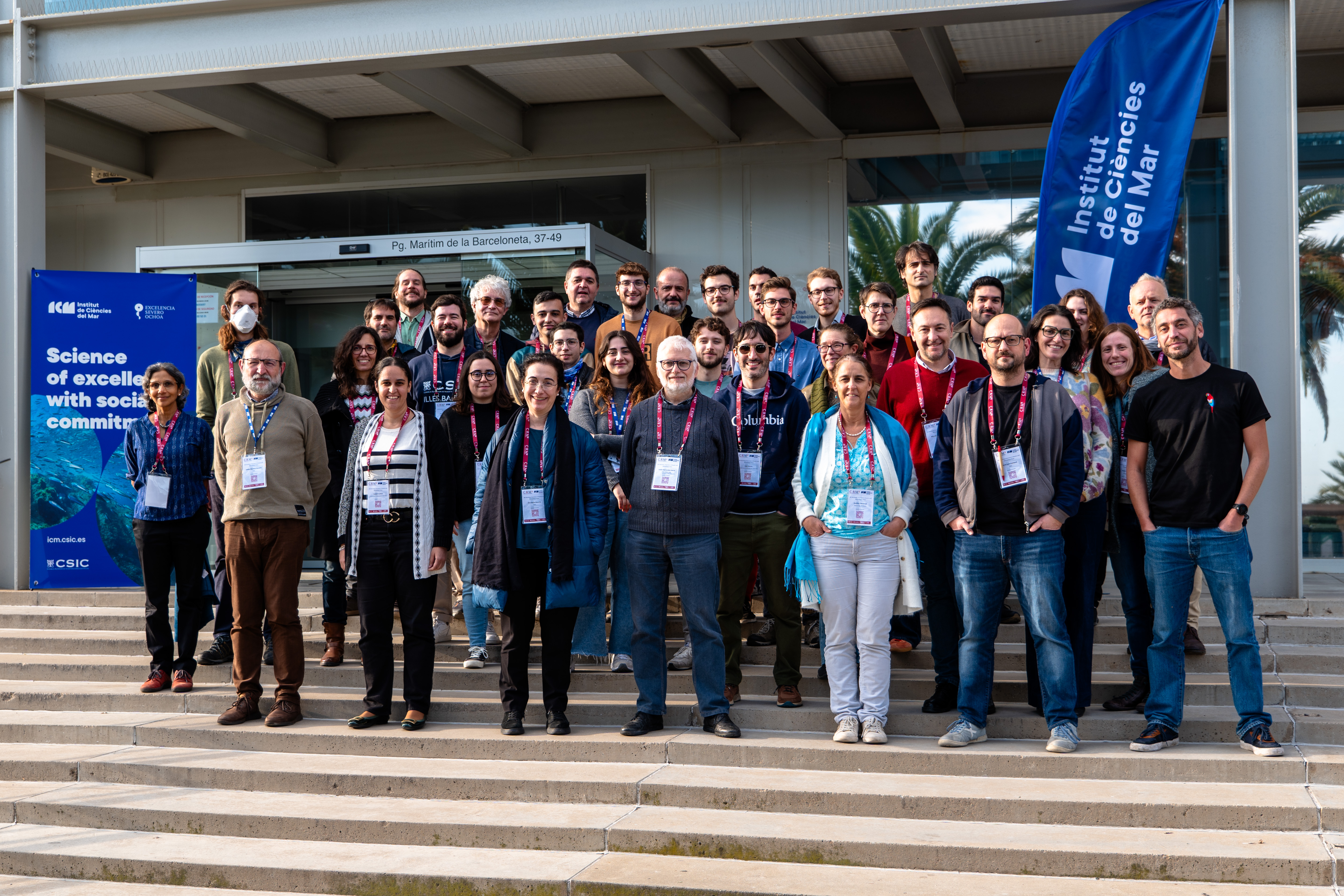
The 4th NLOA Conference, co-organized by CRM and ICM, gathered experts in Barcelona to discuss nonlinear dynamics in oceanic and atmospheric sciences. The event fostered interdisciplinary collaboration and international partnerships, with discussions on climate modelling and ocean dynamics.
Bellaterra, January 27th, 2025 – Last week, the Centre de Recerca Matemàtica (CRM), in collaboration with the Institut de Ciències del Mar (ICM), organized the 4th Nonlinear Processes in Oceanic and Atmospheric Flows (NLOA 2025) conference in Barcelona. The event, which took place from January 22 to January 24, brought together leading experts in mathematics, physics, oceanography, and atmospheric sciences to discuss the latest developments in nonlinear dynamics related to oceanic and atmospheric phenomena.
The conference, hosted at the ICM’s premises in the Vila Olímpica district, provided an international forum for researchers to explore open challenges and innovative solutions in ocean and atmospheric science. The program featured plenary lectures, thematic sessions, and networking opportunities aimed at fostering cross-disciplinary collaboration.
 The conference featured a diverse lineup of plenary speakers, including Peter Ditlevsen, a climate scientist from the Niels Bohr Institute in Denmark. Ditlevsen delivered a talk titled Warning of a Forthcoming Collapse of the Atlantic Meridional Overturning Circulation (AMOC), highlighting the critical role this ocean current plays in regulating the climate of the North Atlantic region. He discussed alarming signs of its weakening, which could trigger severe climate disruptions across Europe and North America. While leading climate models project that a complete collapse is unlikely within this century, recent findings suggest it could occur much sooner if greenhouse gas emissions remain unchecked.
In addition to Professor Ditlevsen, the conference featured a diverse roster of plenary speakers, including Daniele Iudicone, from Stazione Zoologica Anton Dohrn, who discussed the interplay between oceanic ecosystems and physical processes. Bernard Legras, from the Laboratoire de Météorologie Dynamique – ENS, presented on the dynamics of stratospheric aerosol vortices. Amala Mahadevan, from the Woods Hole Oceanographic Institution, explored pathways for the vertical transport of organic carbon and oxygen in the ocean. Maria Josefina Olascoaga, from the University of Miami, offered insights into finite-sized buoyant particle dynamics in surface ocean flows. Lastly, Pablo Ortega, from the Barcelona Supercomputing Center, examined the role of ocean mesoscale processes in shaping future climate conditions.
An interdisciplinary meeting
The NLOA 2025 conference facilitated exchanges across disciplines, with participants discussing a broad spectrum of topics such as climate modelling, turbulence, transport processes, and predictive analytics for environmental monitoring. The event also featured interactive poster sessions, where early-career researchers showcased their contributions to the field.

A key aspect of the conference was its commitment to fostering international collaboration. Representatives from institutions across Europe, North America, and beyond engaged in dialogues about ongoing projects and potential future partnerships, underscoring the event’s significance in the global scientific community.
Visit the official websites of CRM and ICM for more information about the NLOA 2025 conference and upcoming initiatives.
About CRM and ICM

The Centre de Recerca Matemàtica (CRM) is a leading institution dedicated to mathematical research, with a focus on interdisciplinary applications. The Institut de Ciències del Mar (ICM) is a renowned centre specializing in marine and environmental sciences, contributing to cutting-edge research on ocean dynamics and climate change.
Further reading:
Check out La Vanguardia’s article featuring an interview with Professor Ditlevsen, and don’t miss the TV3 report showcasing Ditlevsen and Ortega.
Subscribe for more CRM News
|
|
CRM CommPau Varela
|

The CRM exhibition ‘Les matemàtiques de Gaudí’ moves to the University of Barcelona
After its October run at the UAB, the exhibition Les matemàtiques de Gaudí, produced by the CRM, can be seen at the University of Barcelona’s CRAI Biblioteca de Matemàtiques i Informàtica from 2 to 30 November 2026.
Advanced Course on Free Boundary Problems Opens the Intensive Weeks of the IRP
From 26 to 30 October, around forty researchers attended the Advanced Course on Free Boundary Problems at the CRM, three seven-hour mini-courses given by Bozhidar Velichkov (Università di Pisa), Max Engelstein (University of Minnesota) and Zihui Zhao (Johns Hopkins University). The course was the first of the two intensive weeks of the Intensive Research Programme on Analysis of Free Boundary Problems, which runs until 4 December.
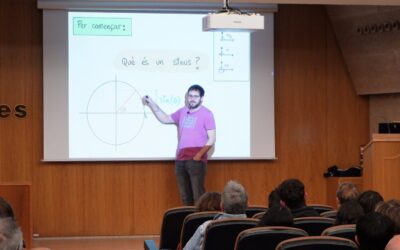
El CRM rep els estudiants de la prova de nivell de Bojos per les Matemàtiques 2027
Els aspirants a Bojos per les Matemàtiques 2027 van visitar el Centre de Recerca Matemàtica (CRM) dissabte 24 d’octubre, després de fer la prova de nivell a la Facultat de Ciències i Biociències de la UAB. En acabat, Tomás Sanz (UB-CRM) els va explicar què té a veure l’escalfament d’una barra de ferro amb els àudios de WhatsApp.
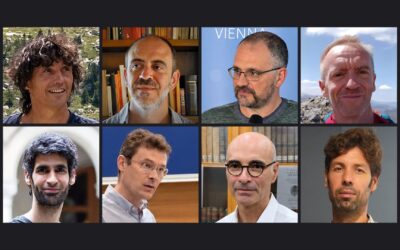
Eight CRM Researchers in the 2026 Stanford-Elsevier List of Highly Cited Scientists
The Centre de Recerca Matemàtica (CRM) has eight researchers in the 2026 update of the Stanford-Elsevier ranking of highly cited scientists, which John P. A. Ioannidis (Stanford University) and Jeroen Baas (Elsevier) compile from Scopus data. Xavier Cabré, Álvaro Corral, Tim Myers, Xavier Ros-Oton, Sergey Tikhonov and Xavier Tolsa appear both in the career-long ranking and in the one for 2025, and Diego Vidaurre and Simeon Ball in the 2025 ranking.
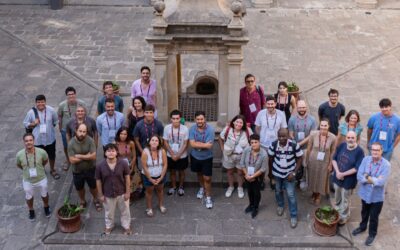
Fish schools and growing tissues: a workshop on how collective behaviour emerges
The Centre de Recerca Matemàtica (CRM) organised the Barcelona Workshop on Kinetic and Macroscopic Models in Biology with Friends II, held from 7 to 10 September at the Institut d’Estudis Catalans. More than thirty researchers discussed how order at the scale of tissues and animal groups arises from local interactions between individuals, in a programme that included talks by CRM researchers Daria Stepanova and Juan Arellano-Tintó. Two of the speakers, James Sharpe (EMBL Barcelona) and Chiara Villa (CNRS, Université Paris Cité), talked to the CRM about their research.
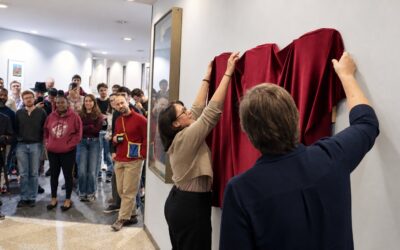
The CRM opens the academic year and unveils its Directors’ Gallery
A review of the year, the Communication Plan 2026–2030 and three research talks filled the morning of 19 October.The unveiling of the Directors’ Gallery.CRM CommPau VarelaCRMComm@crm.catGet the latest CRM news and activities in your inbox.Recent...
The CRM Mentoring Programme, as Told by One of Its Pairs
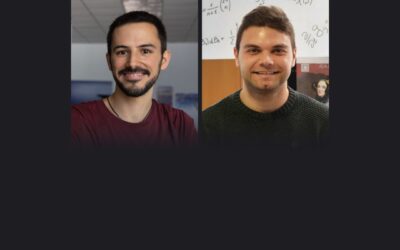
PhD student Joaquim Duran and mathematician Robert Cardona, one of the pairs in the CRM Mentoring ProgrammeJoaquim Duran (left) and Robert Cardona.CRM CommPau VarelaCRMComm@crm.catGet the latest CRM news and activities in your inbox.Recent...
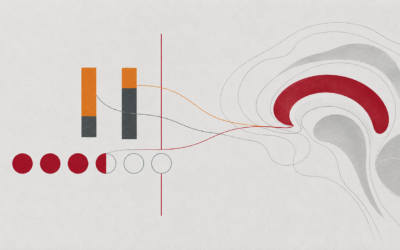
When the reward comes within reach, the brain changes what it compares
As the tokens piled up, choices got faster and more accurate at the same time. The yardstick for judging each offer had moved.CRM CommPau VarelaCRMComm@crm.catGet the latest CRM news and activities in your inbox.Recent newsletters →Two subjects...

Almost every automaton can be reset with a short word
Guillaume Chapuy (Université Paris Cité, CNRS) and Guillem Perarnau (UPC, CRM) have shown that a random finite automaton with n states can, with high probability, be reset by a word of length of order √n log n. The result, published in ACM Transactions on Algorithms, pins the exponent at 1/2, the lower end of a decade of numerical estimates, and addresses the random version of the synchronization problem behind a conjecture Ján Černý posed in 1964 and which still remains open.
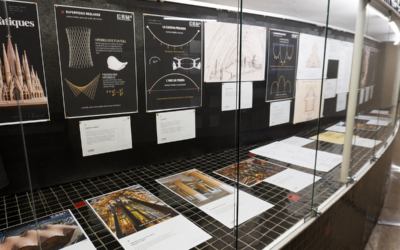
Exposició ‘Les matemàtiques de Gaudí’
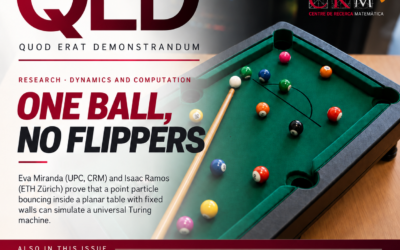
CRM quod erat demonstrandum | 48
ADA: Decoding Brain Signals Misaligned in Time
The study addresses a key limitation of current brain decoding techniques: the difficulty of interpreting internal mental processes whose temporal dynamics vary from trial to trial.Decoding what is happening in a person’s mind from their brain activity is one of the...