
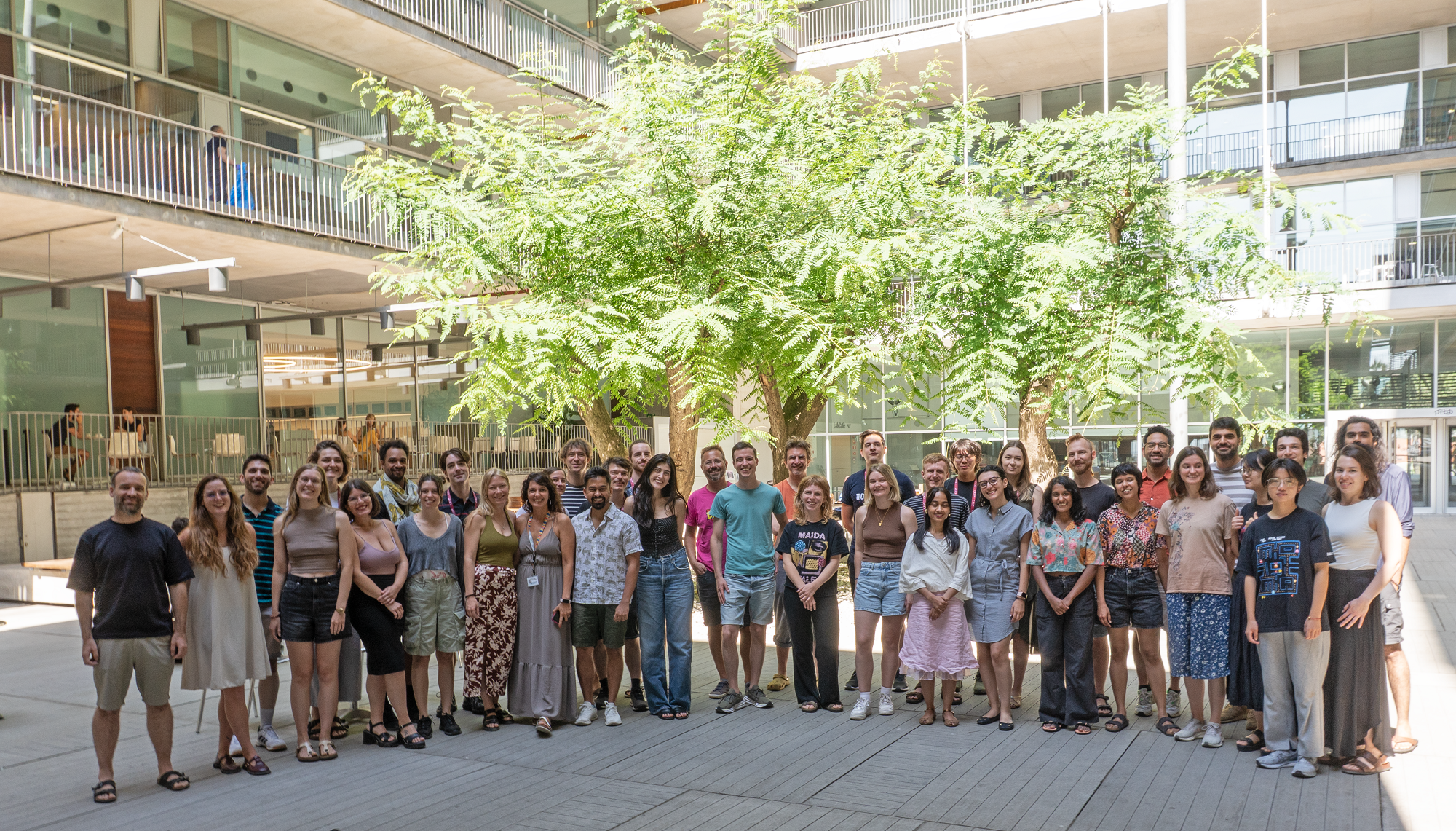
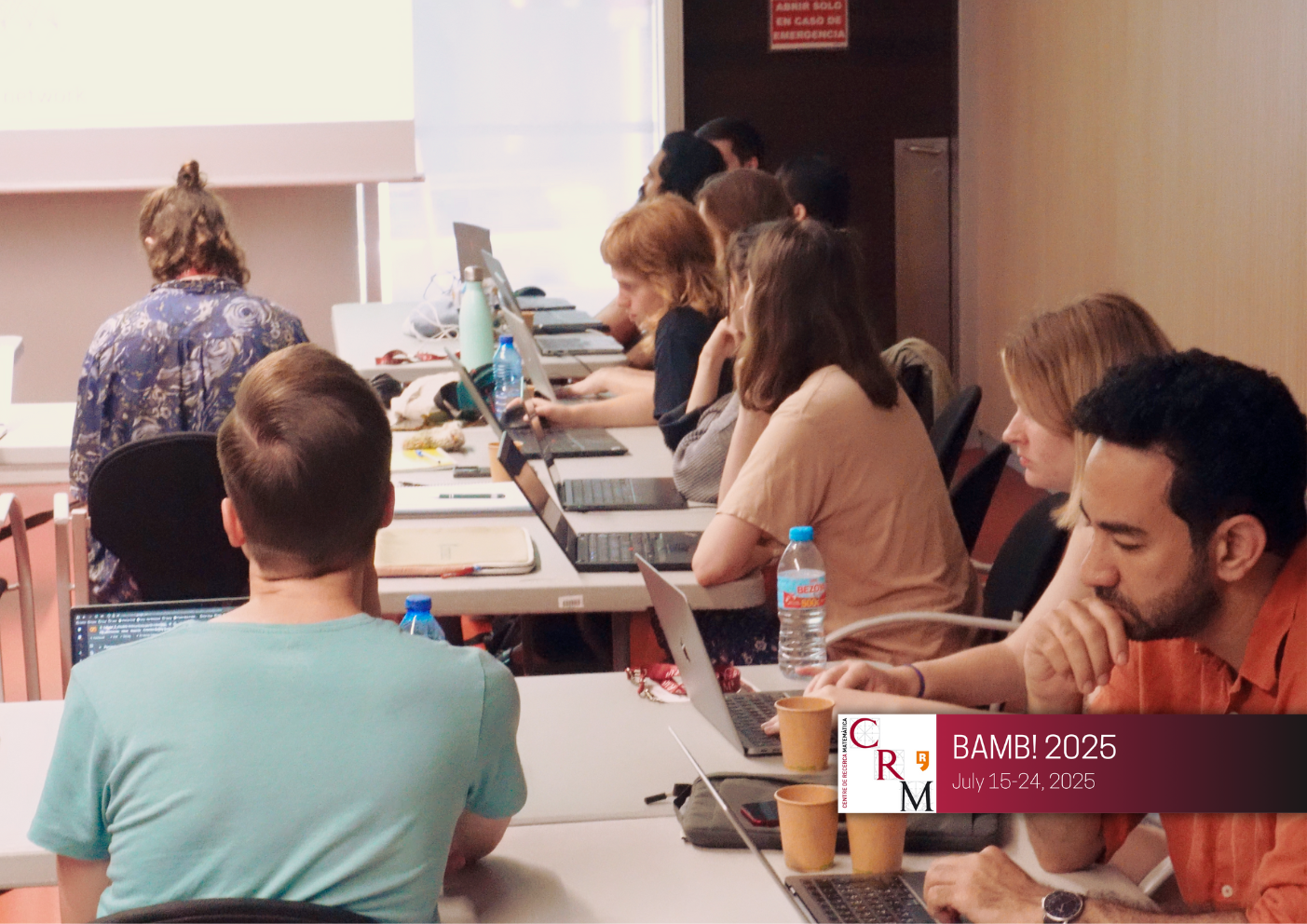
In a classroom right next to the Mediterranean, the fifth edition of the BAMB! summer school came to life. For nine days, 30 early-career researchers stepped away from their usual routines and immersed themselves in the elusive craft of modeling behavior. What they found was a set of techniques and a community of minds committed to asking questions about how animals, ourselves included, make sense of a world full of noise, pattern, and uncertainty.
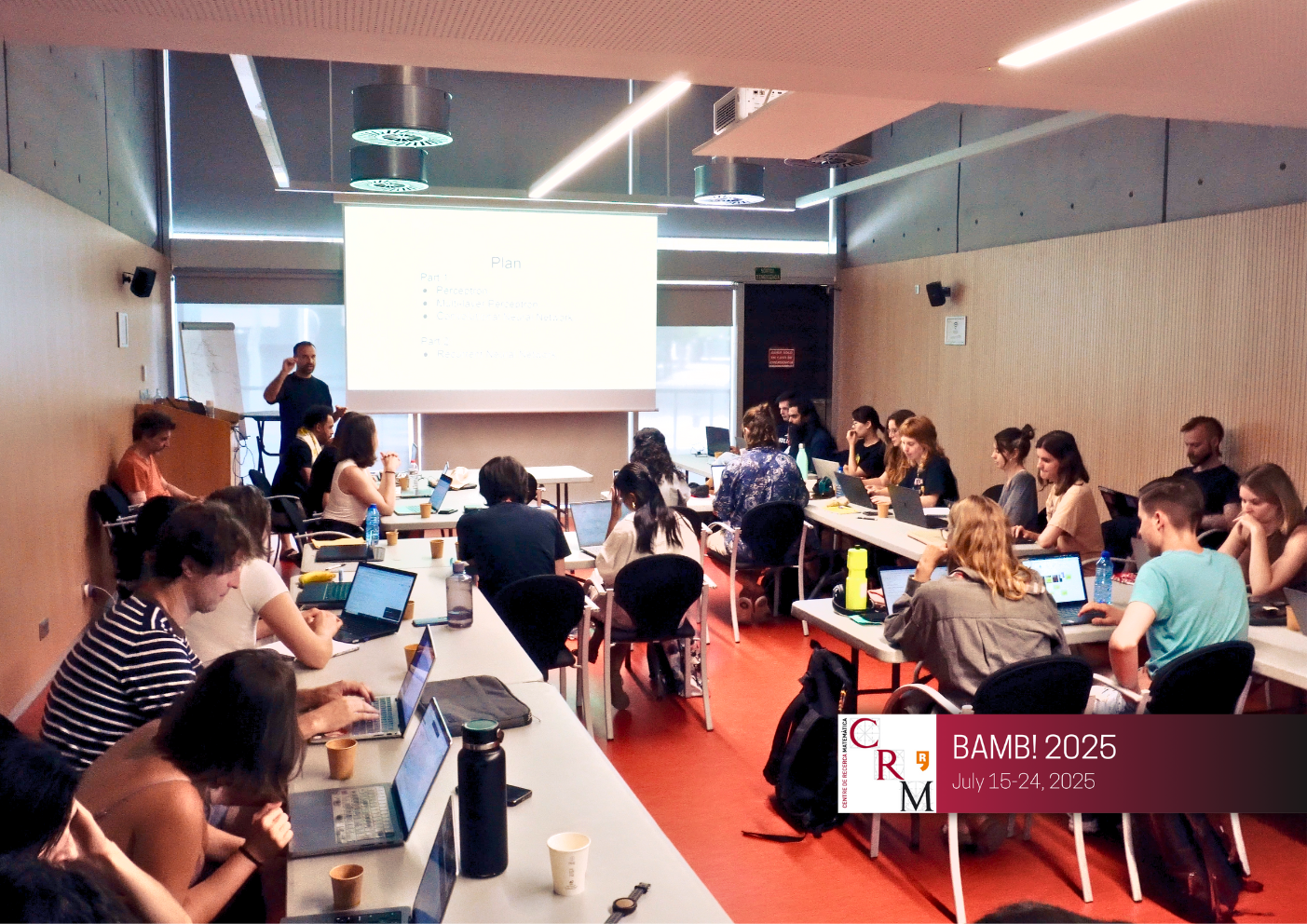
BAMB! was more than lectures. It was a place for connection and the quiet satisfaction of figuring things out together.
The school, officially titled Barcelona Summer School for Advanced Modeling of Behaviour, has established itself as one of the premier training grounds for computational neuroscientists in Europe. Organised by researchers from CRM, ENS Paris, Sorbonne University, Oxford/DeepMind, and the Paris Brain Institute, and hosted this year at the Parc de Recerca Biomèdica de Barcelona (PRBB), BAMB! 2025 stayed true to its founding principle: rigorous hands-on learning rooted in conceptual clarity.
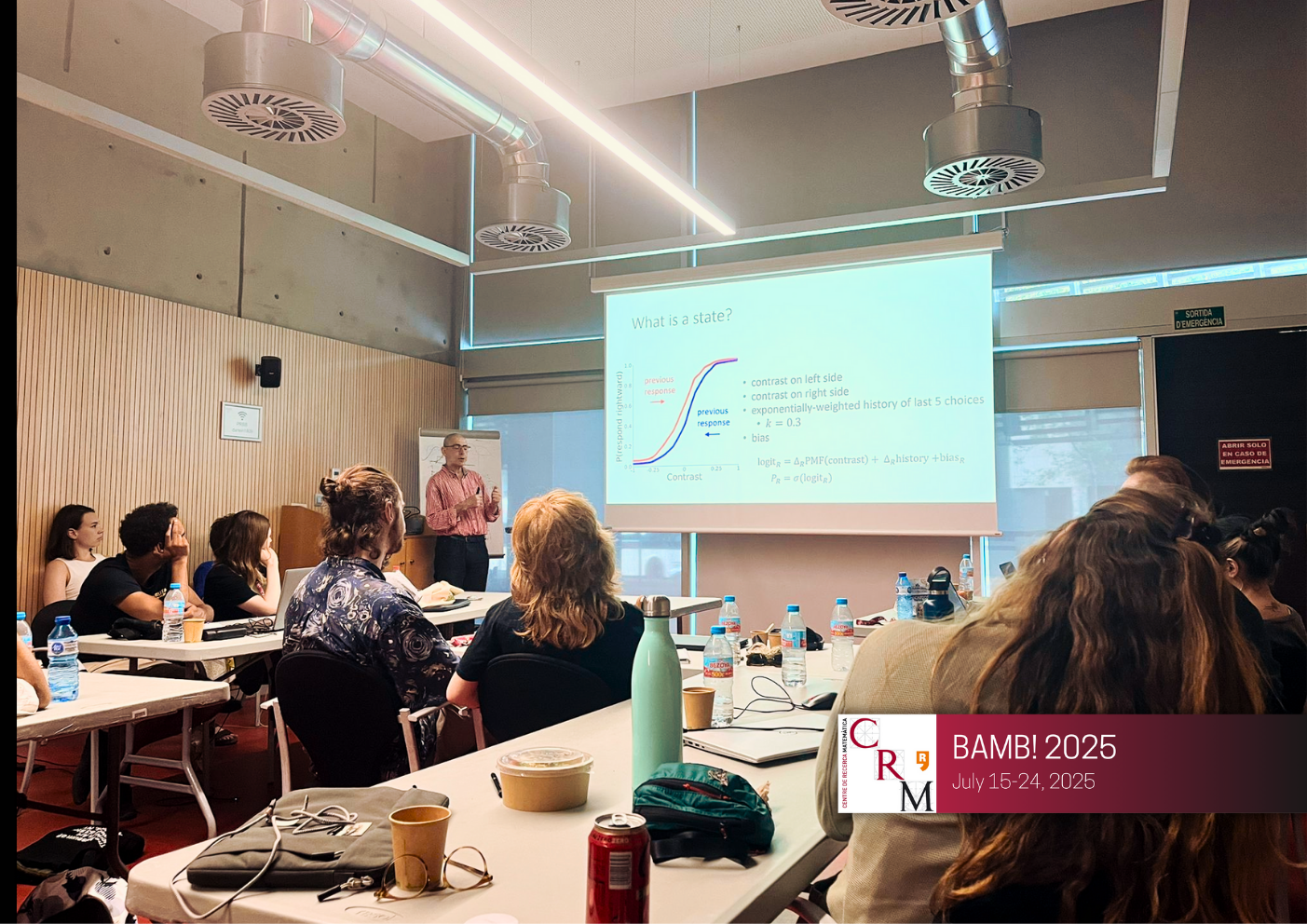
Each day unfolded around a different modeling tradition. From parameter recovery and model comparison to reinforcement learning, Bayesian inference, latent variable models, and simulation-based techniques, the curriculum moved fast and with purpose.
The BAMB! School also centres around group projects designed to make the newly acquired knowledge resonate with each participant’s own research. On the final day, each team had ten minutes to present their approach. No one expected polished results. What mattered was the thinking behind the model, the clarity of the question, and the honest effort to answer it.
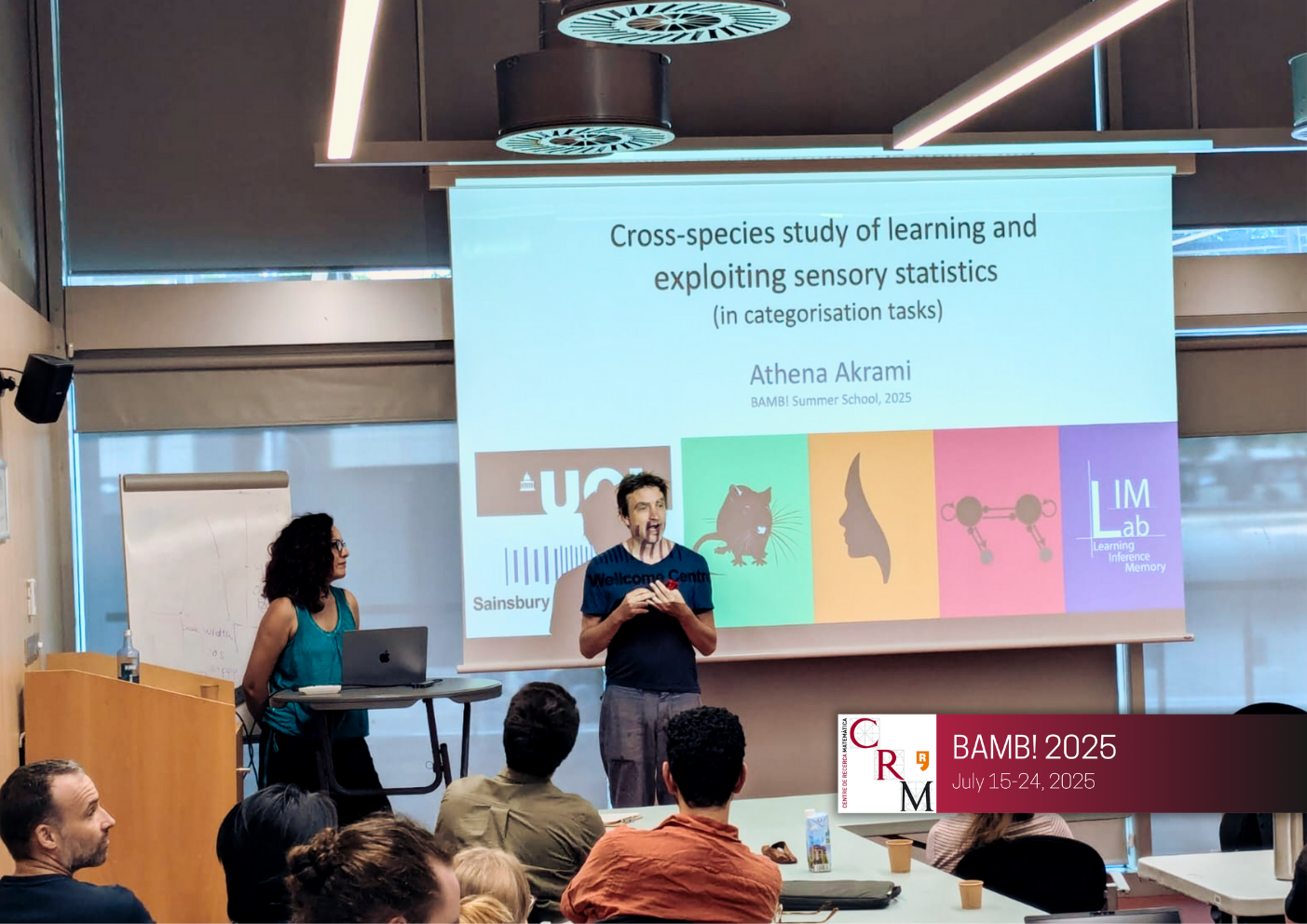
Two keynote talks closed two of the school’s days. The first was by Athena Akrami, from the Sainsbury Wellcome Centre at University College London. Her research asks how animals uncover patterns in the world and how they detect structure in noise, build abstract relationships, and carry those priors forward to guide behaviour. From the fluidity of working memory to the rigidity of perceptual biases, Akrami’s work captures cognition as a living system woven from past experience and statistical expectation.
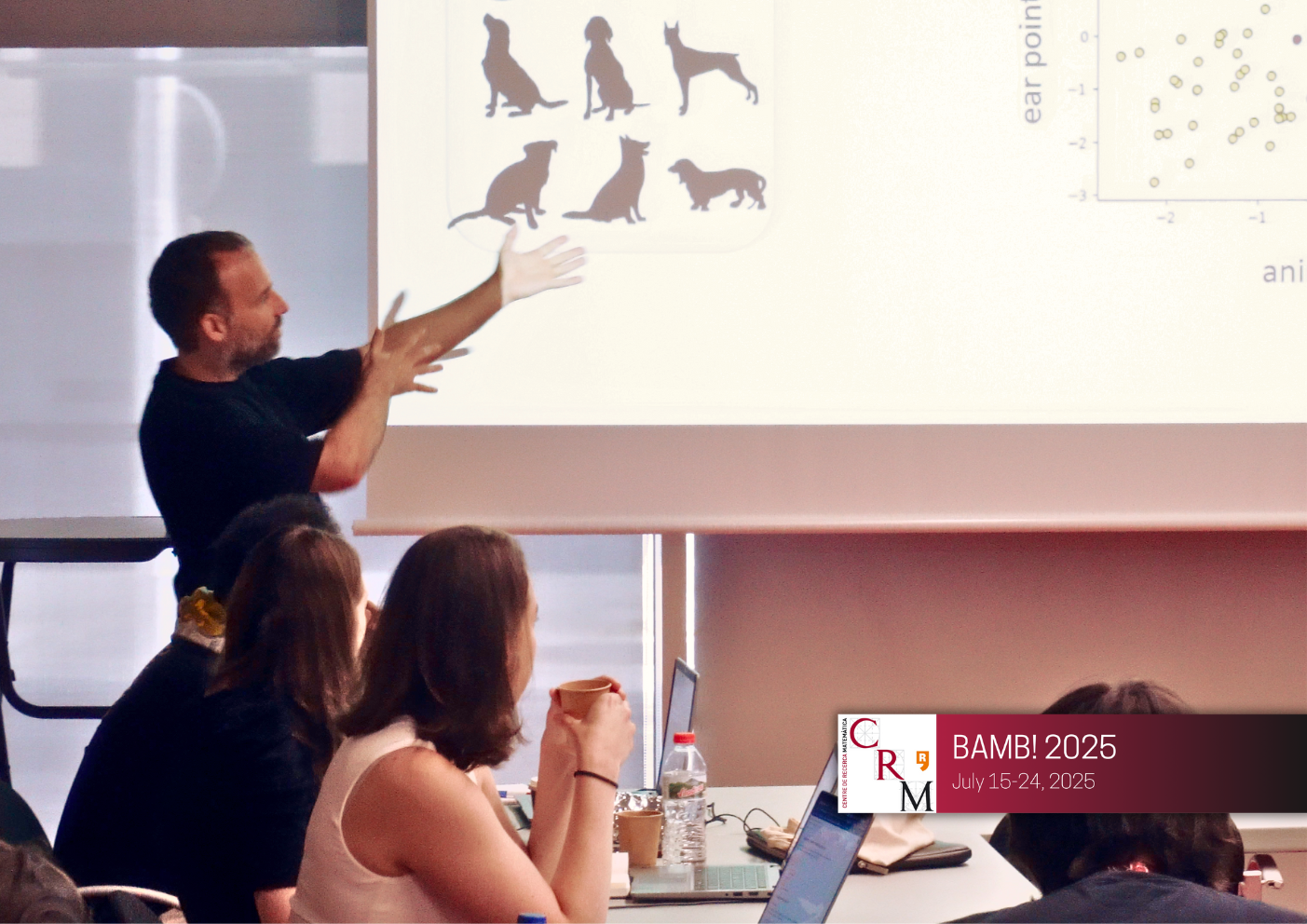
Later in the week, Peter Dayan, director at the Max Planck Institute for Biological Cybernetics in Tübingen, took the stage. A pioneer at the intersection of artificial intelligence, neuroscience, and psychiatry, Dayan’s career has shaped how we understand learning, reward, and neuromodulation. His research deals with the brain’s decision-making machinery and its failure modes, always anchored in formal models.
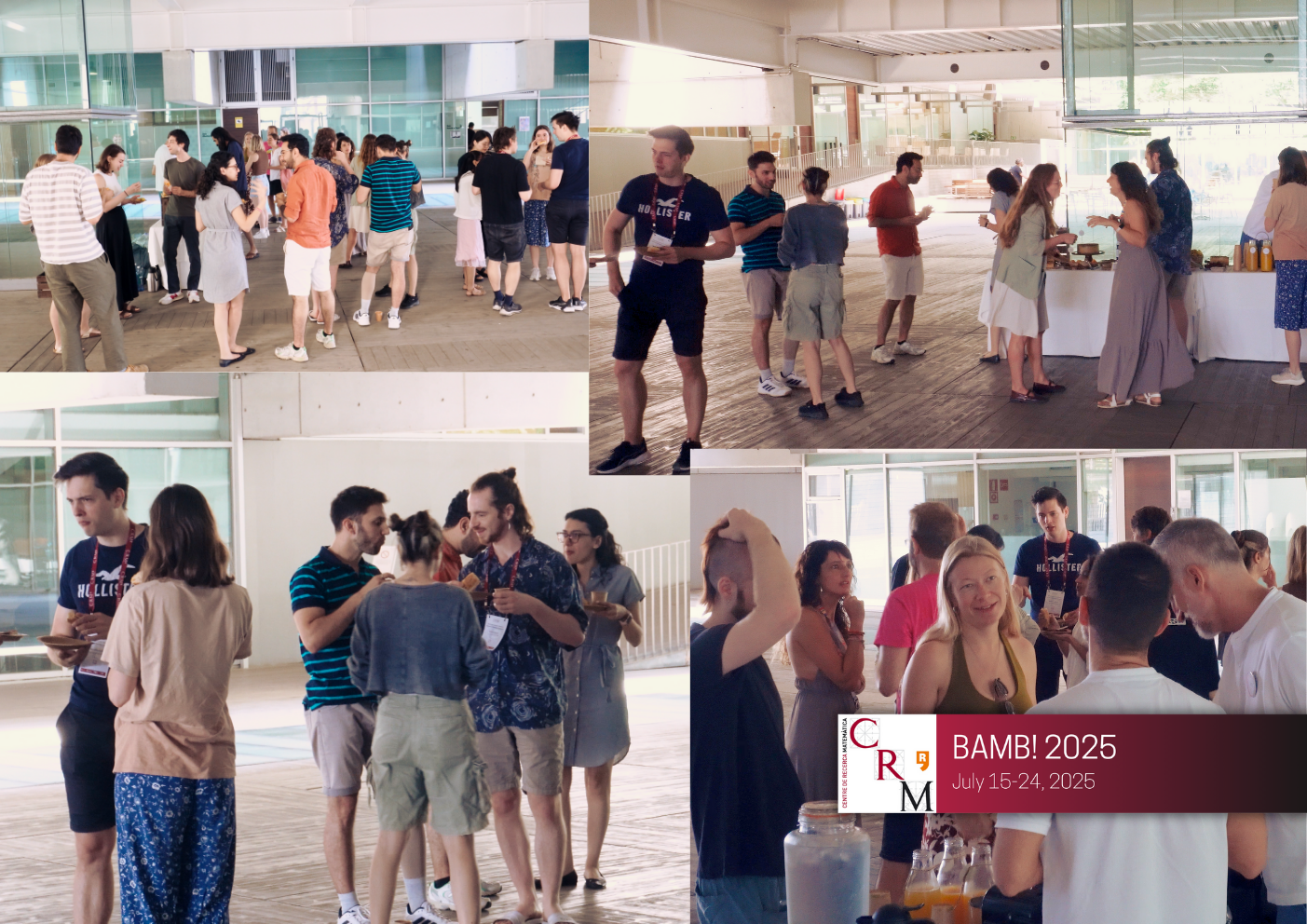
A place for community and connection
Beyond the lectures and tutorials, BAMB! was held together by something quieter: conversations over lunch, fragments of code exchanged at coffee breaks, one-to-one meetings where career anxieties found sympathetic ears. Faculty weren’t distant figures; they were co-conspirators. The teaching assistants were tireless, orbiting from laptop to laptop like helpful satellites, keeping the chaos just within bounds.
Huge thanks to the organising team, the brilliant teaching assistants, keynote speakers, and all the participants whose energy, curiosity, and collaboration made BAMB! 2025 such a memorable and inspiring experience. This was BAMB!’s fifth edition, and it hasn’t lost its edge.
Subscribe for more CRM News
|
|
CRM CommPau Varela
|

When the reward comes within reach, the brain changes what it compares
As the tokens piled up, choices got faster and more accurate at the same time. The yardstick for judging each offer had moved.CRM CommPau VarelaCRMComm@crm.catGet the latest CRM news and activities in your inbox.Recent newsletters →Two subjects...

Almost every automaton can be reset with a short word
Guillaume Chapuy (Université Paris Cité, CNRS) and Guillem Perarnau (UPC, CRM) have shown that a random finite automaton with n states can, with high probability, be reset by a word of length of order √n log n. The result, published in ACM Transactions on Algorithms, pins the exponent at 1/2, the lower end of a decade of numerical estimates, and addresses the random version of the synchronization problem behind a conjecture Ján Černý posed in 1964 and which still remains open.
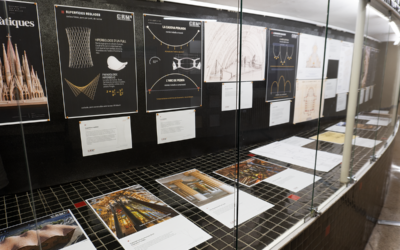
Exposició ‘Les matemàtiques de Gaudí’

CRM quod erat demonstrandum | 48

ADA: Decoding Brain Signals Misaligned in Time
The study addresses a key limitation of current brain decoding techniques: the difficulty of interpreting internal mental processes whose temporal dynamics vary from trial to trial.Decoding what is happening in a person’s mind from their brain activity is one of the...
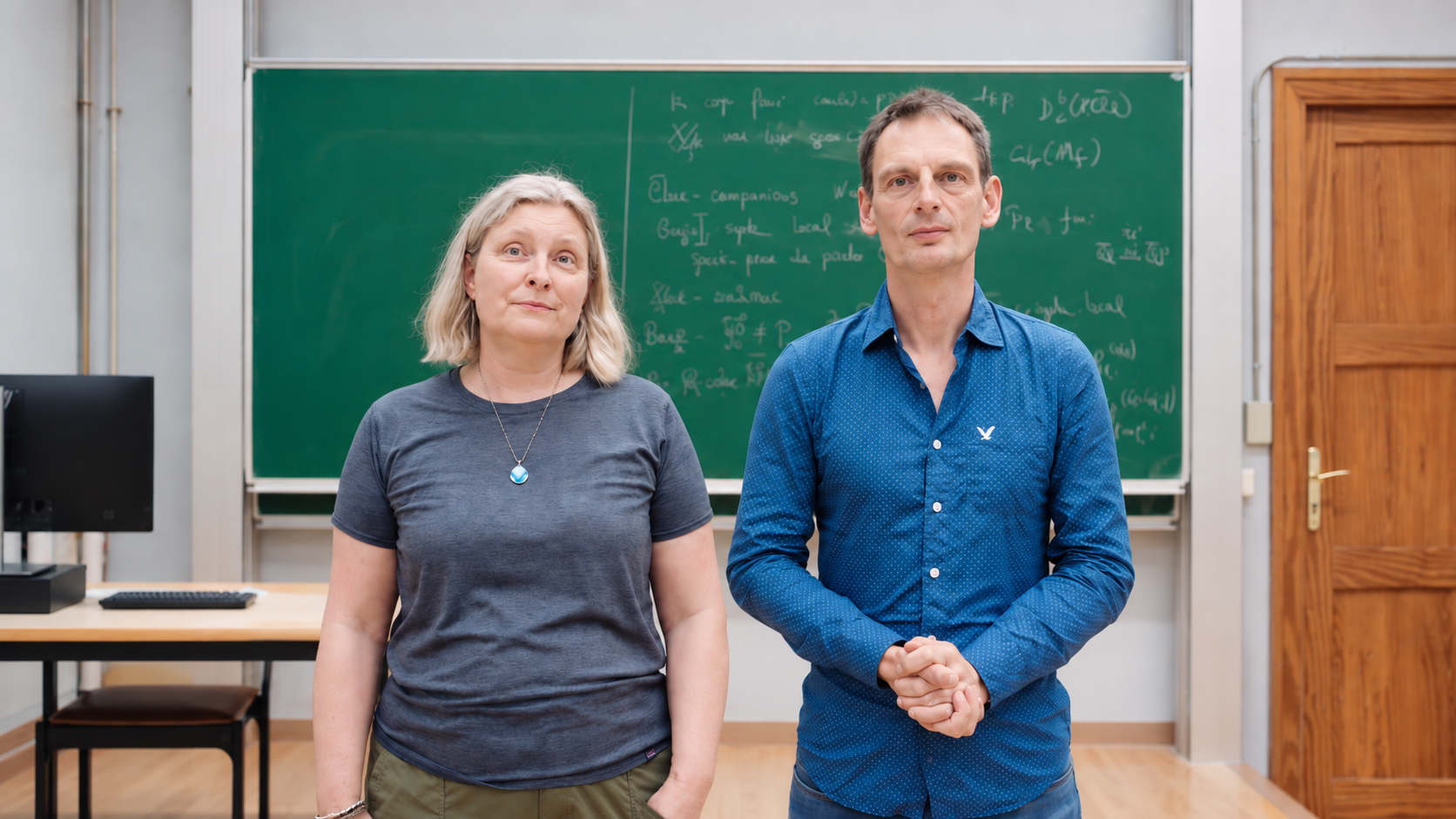
Rare curves, many points: Christophe Ritzenthaler and Rachel Pries on their research and the work around it
Christophe Ritzenthaler (Université de Rennes) and Rachel Pries (Colorado State University) both work on curves over finite fields: he hunts curves with as many points as possible, she hunts curves that almost never occur. In conversation with the CRM during their...

Call open for the 2027 Ferran Sunyer i Balaguer Prize
The Ferran Sunyer i Balaguer Foundation is accepting submissions for its 2027 prize, which awards 15,000 euros and publication in Birkhäuser's Progress in Mathematics series to an expository monograph on an active area of mathematical research. The deadline is 27...
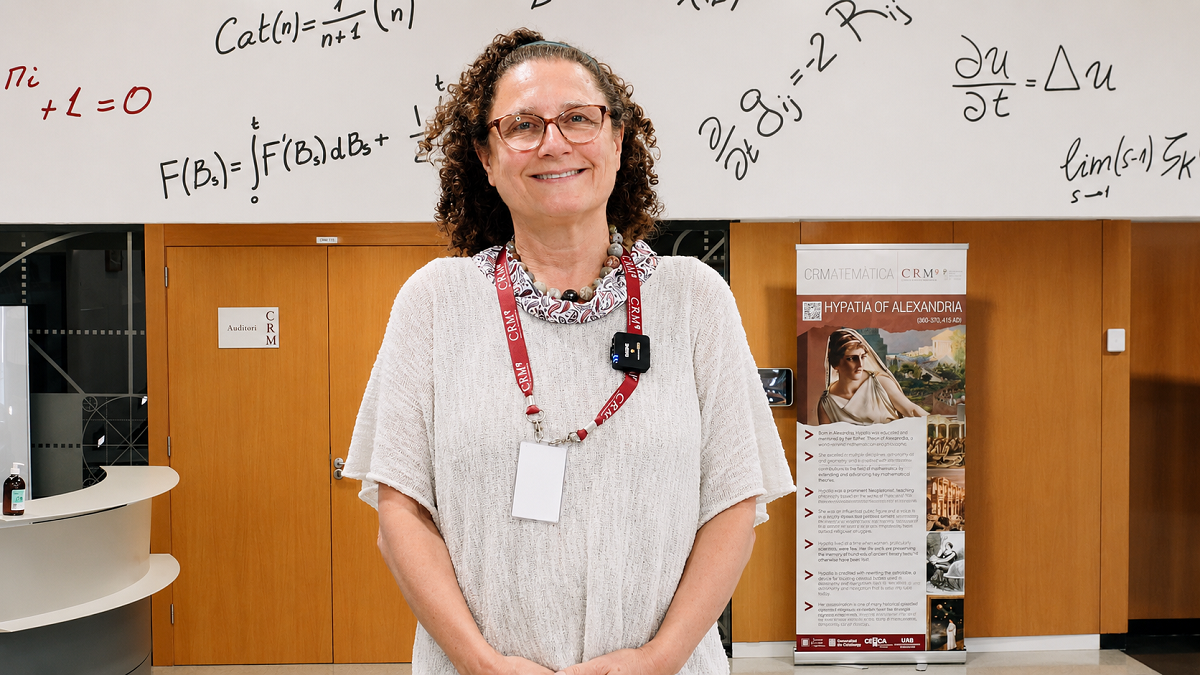
Susanna Terracini delivers the CRM Colloquium 2026
Susanna Terracini (Università di Torino) delivered the CRM Colloquium 2026 on 14 July, presenting a rigidity result for Kepler billiards obtained with Stefano Baranzini, Vivina Barutello and Irene De Blasi. She was at the centre as a member of the CRM Scientific...
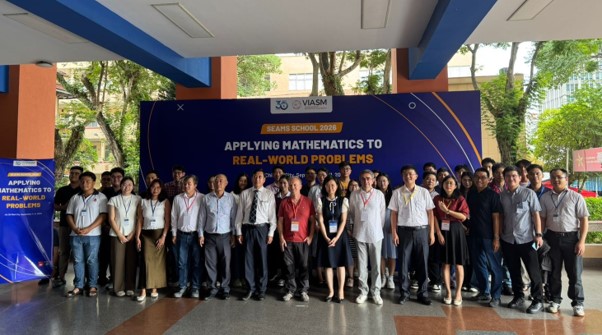
Ho Chi Minh City hosts the SEAMS School on applying mathematics to real-world problems
Students from across the region took courses and worked on group projects at a school co-organised by CRM researcher Tim Myers.CRM CommPau VarelaCRMComm@crm.catGet the latest CRM news and activities in your inbox.Recent newsletters →Between 4 and...

A single ball on a fixed table can compute: Eva Miranda and Isaac Ramos prove that two-dimensional billiards are Turing complete
Eva Miranda (UPC, CRM) and Isaac Ramos (ETH Zürich) show that a point particle bouncing inside a planar table with fixed walls can simulate a universal Turing machine, settling a question Cristopher Moore left open in 1990. The result grew out of a master’s project...
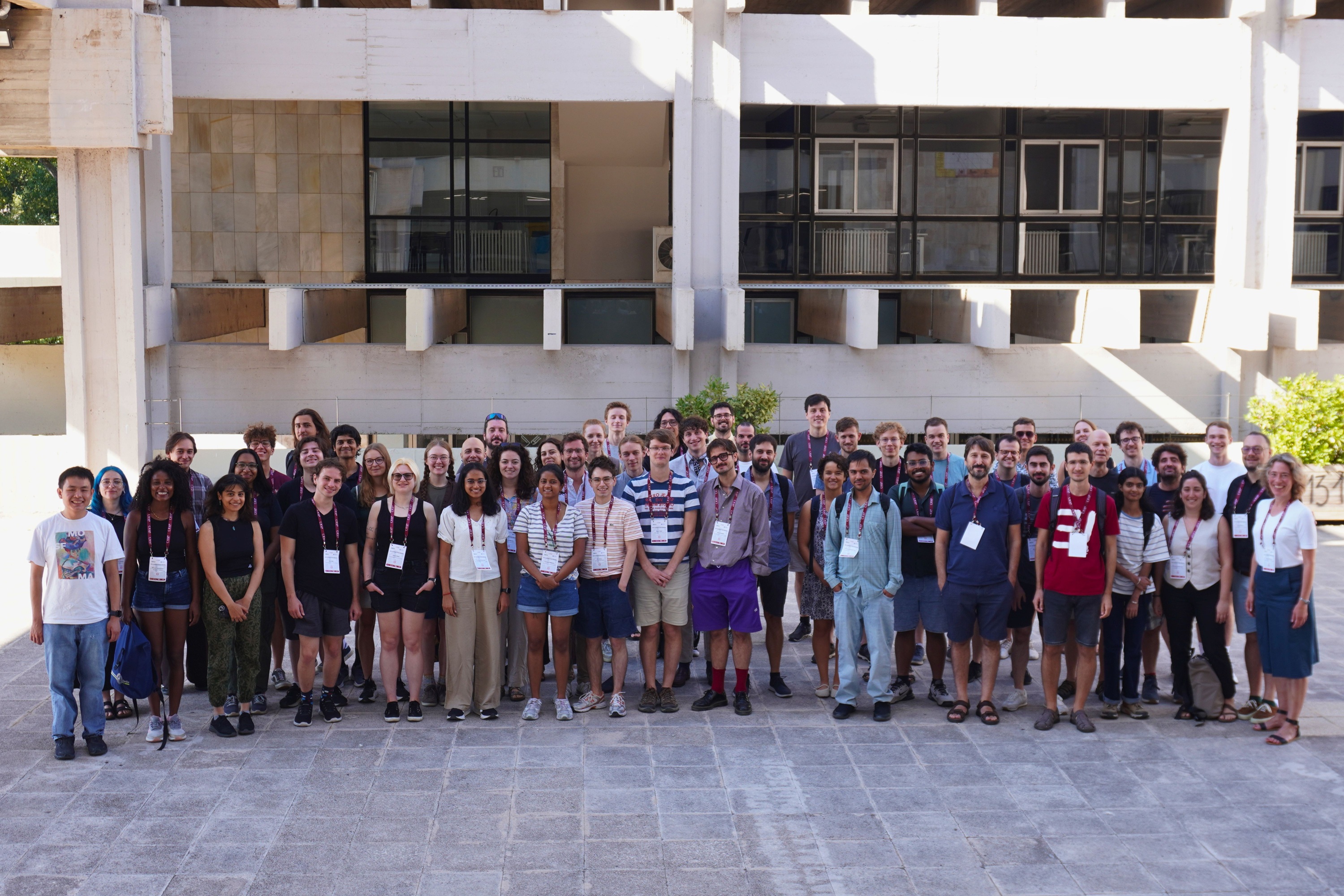
BMS-BGSMath Junior Meeting 2026: Barcelona and Berlin Strengthen Scientific Ties
From 2 to 4 September 2026, the Centre de Recerca Matemàtica (CRM) hosted the BMS-BGSMath Junior Meeting 2026, a three-day event jointly organised by the Berlin Mathematical School (BMS) and the Barcelona Graduate School of Mathematics (BGSMath), with the Centre de...
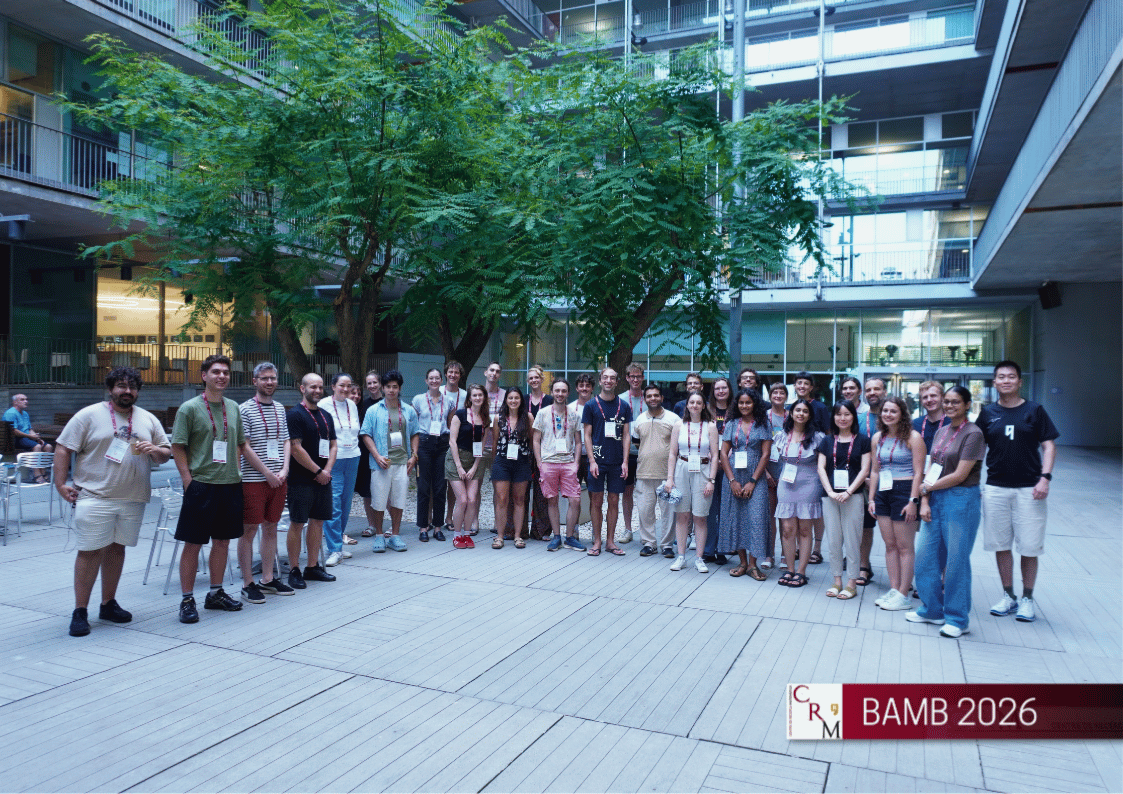
The CRM organises the 2026 Barcelona Summer School for Advanced Modeling of Behavior
The Centre de Recerca Matemàtica held the sixth edition of BAMB!, the Barcelona Summer School for Advanced Modeling of Behavior, from 12 to 23 July 2026 at the Parc de Recerca Biomèdica de Barcelona. Thirty early-career researchers from fourteen countries followed...