

Eva Miranda, professor of mathematics at the Universitat Politècnica de Catalunya (UPC) and affiliated researcher at the Centre de Recerca Matemàtica (CRM), is one of the featured experts in an article by the international publication Quanta Magazine that explores one of the most profound questions in modern science: are there limits to what we can ever know about the physical world?
The article, titled Next-Level Chaos Traces the True Limit of Predictability and published on March 7th, examines how chaos theory, originally concerned with systems sensitive to initial conditions, is evolving into a more radical conceptual landscape: undecidability. If classical chaos already shattered our hopes of perfect prediction by showing that small differences in starting conditions can lead to wildly different outcomes, undecidability goes a step further. It does not stem from imprecision, but from the intrinsic structure of certain systems that defy computation entirely.
As Miranda explains, classical chaos is the realm of the butterfly and the hurricane, a world where evolution is deterministic but practically unpredictable. “It’s the dance of shadows,” she says, “a choreography of dynamical systems that elude our grasp not because they lack order, but because that order escapes us.” Undecidability, by contrast, emerges when a physical system (a fluid, a planetary orbit, a mechanical structure) is so rich that it can encode any computation, like a Turing machine. And when that happens, the halting problem enters the picture: no algorithm can determine whether the system will evolve in one way or another.
“Undecidability is something else entirely; colder, more philosophical, and perhaps more disquieting,” she adds. “It’s a closed door we may knock on forever without knowing if it will ever open.”
Within this context, Miranda and her collaborators, Robert Cardona, Daniel Peralta-Salas, and Francisco Presas, designed a theoretical fluid system that encodes the operations of a Turing machine. In this setup, a particle (symbolically represented by a rubber duck) follows a trajectory that simulates a computation. Predicting whether the duck reaches a certain area is equivalent to solving the halting problem, a provably unresolvable problem. This means that, in principle, even with perfect knowledge of the system’s initial state, no definitive prediction can be made.
“Some systems are so complex, so capable of encoding processes, that they simulate any computation,” Miranda explains. “And when that happens, we enter the realm of problems that are not difficult, but impossible.”
Beyond the sensitivity to initial conditions lies a deeper void. “Some systems contain, at their core, regions of mathematical silence,” she says. “It is precisely this silence, this space where even logic cannot advance, that fascinates us. As Emily Dickinson wrote: ‘The brain is wider than the sky.’ But even that brain, reaching out through conjectures, proofs, and intuitions, sometimes meets skies that will never be crossed. And perhaps it is in those limits that we truly begin to understand.”
This contribution is part of a broader intellectual shift, one that Quanta Magazine has chronicled in its Quanta Fundamentals series. In a related piece, How Chaos Theory Makes the Future Unpredictable (March 31, 2025), the magazine revisits the origins of chaos theory, from Edward Lorenz’s butterfly effect to more recent understandings of nonlinear dynamics in fields ranging from meteorology to orbital mechanics.
Miranda sees the growing presence of undecidability in physics not as a limitation, but as a transformation. “The 20th century already cracked some certainties with relativity and quantum mechanics,” she says. “But now the shift is subtler, more internal. It doesn’t come from the lab or the telescope, but from a change in perspective: we’re beginning to suspect that some questions don’t just lack answers, they lack meaning within our systems.”
She highlights that these logical boundaries, long familiar to mathematicians, are now surfacing in concrete physical contexts: “In celestial mechanics, fluid evolution, and Hamiltonian systems with symmetries, we are beginning to encounter questions that may be undecidable, not because we lack data, but because of the system’s internal structure.”
In this changing landscape, Miranda also underscores the importance of high-level science communication. “Magazines like Quanta are a necessary exception in the midst of all the noise,” she says. She believes such platforms bridge the artificial divide between science and culture: “They remind us that doing mathematics or physics is also a way of seeing the world, of listening to it, of translating it. Communicating it well doesn’t mean watering it down, it means sharing its essence.”

|
|
CRM CommPau Varela
|

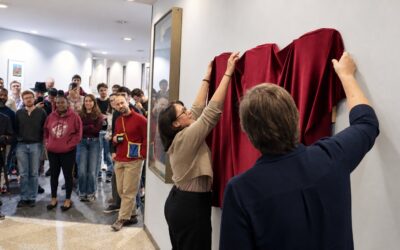
The CRM opens the academic year and unveils its Directors’ Gallery
A review of the year, the Communication Plan 2026–2030 and three research talks filled the morning of 19 October.The unveiling of the Directors’ Gallery.CRM CommPau VarelaCRMComm@crm.catGet the latest CRM news and activities in your inbox.Recent...
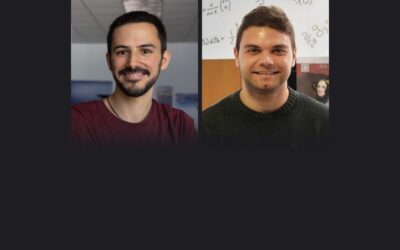
The CRM Mentoring Programme, as Told by One of Its Pairs
PhD student Joaquim Duran and mathematician Robert Cardona, one of the pairs in the CRM Mentoring ProgrammeJoaquim Duran (left) and Robert Cardona.CRM CommPau VarelaCRMComm@crm.catGet the latest CRM news and activities in your inbox.Recent...
When the reward comes within reach, the brain changes what it compares
As the tokens piled up, choices got faster and more accurate at the same time. The yardstick for judging each offer had moved.CRM CommPau VarelaCRMComm@crm.catGet the latest CRM news and activities in your inbox.Recent newsletters →Two subjects...

Almost every automaton can be reset with a short word
Guillaume Chapuy (Université Paris Cité, CNRS) and Guillem Perarnau (UPC, CRM) have shown that a random finite automaton with n states can, with high probability, be reset by a word of length of order √n log n. The result, published in ACM Transactions on Algorithms, pins the exponent at 1/2, the lower end of a decade of numerical estimates, and addresses the random version of the synchronization problem behind a conjecture Ján Černý posed in 1964 and which still remains open.
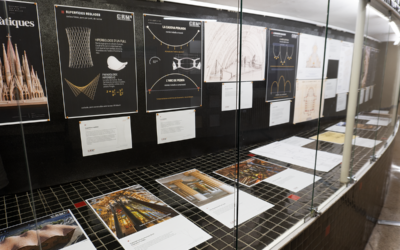
Exposició ‘Les matemàtiques de Gaudí’

CRM quod erat demonstrandum | 48

ADA: Decoding Brain Signals Misaligned in Time
The study addresses a key limitation of current brain decoding techniques: the difficulty of interpreting internal mental processes whose temporal dynamics vary from trial to trial.Decoding what is happening in a person’s mind from their brain activity is one of the...
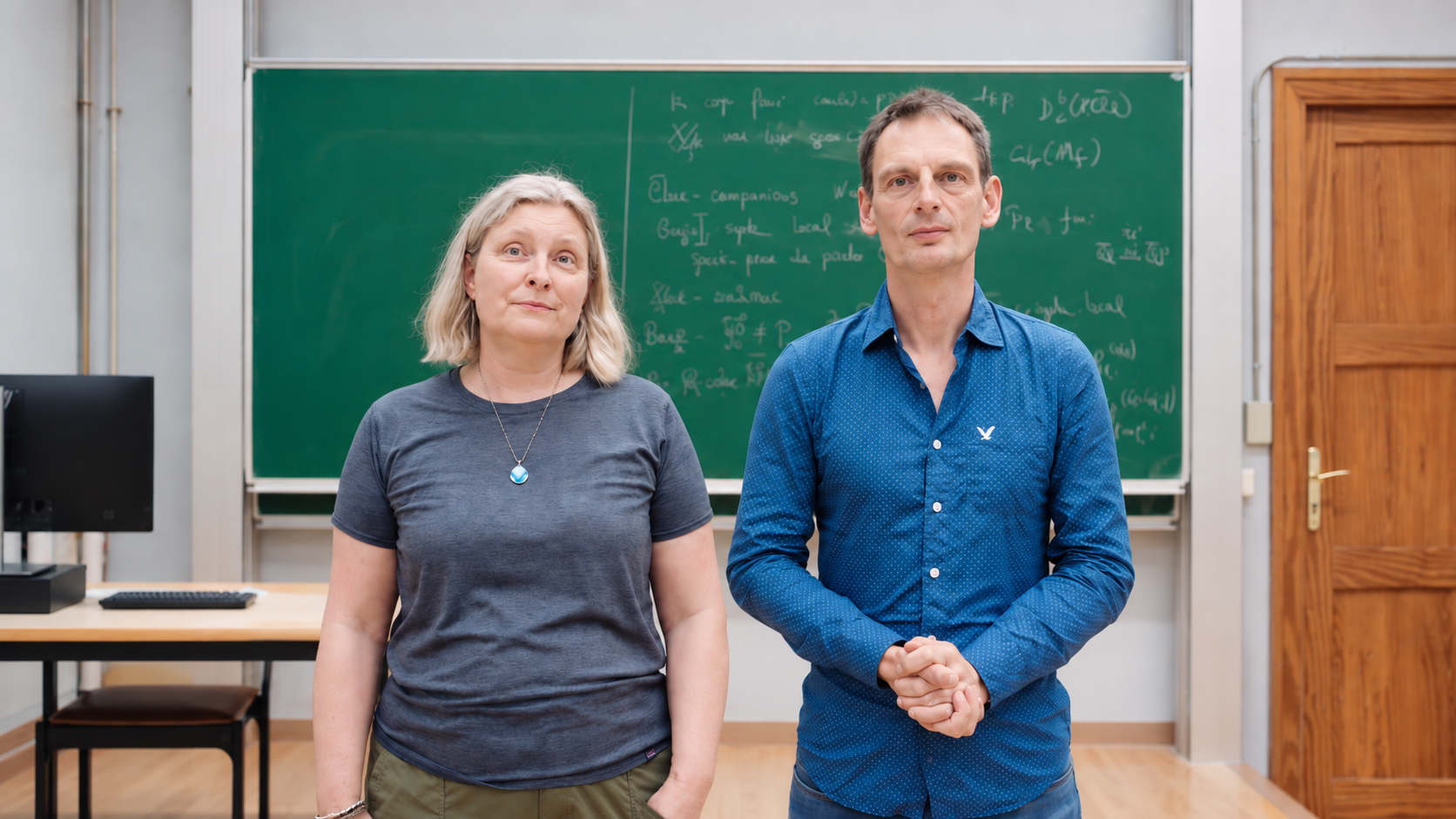
Rare curves, many points: Christophe Ritzenthaler and Rachel Pries on their research and the work around it
Christophe Ritzenthaler (Université de Rennes) and Rachel Pries (Colorado State University) both work on curves over finite fields: he hunts curves with as many points as possible, she hunts curves that almost never occur. In conversation with the CRM during their...

Call open for the 2027 Ferran Sunyer i Balaguer Prize
The Ferran Sunyer i Balaguer Foundation is accepting submissions for its 2027 prize, which awards 15,000 euros and publication in Birkhäuser's Progress in Mathematics series to an expository monograph on an active area of mathematical research. The deadline is 27...
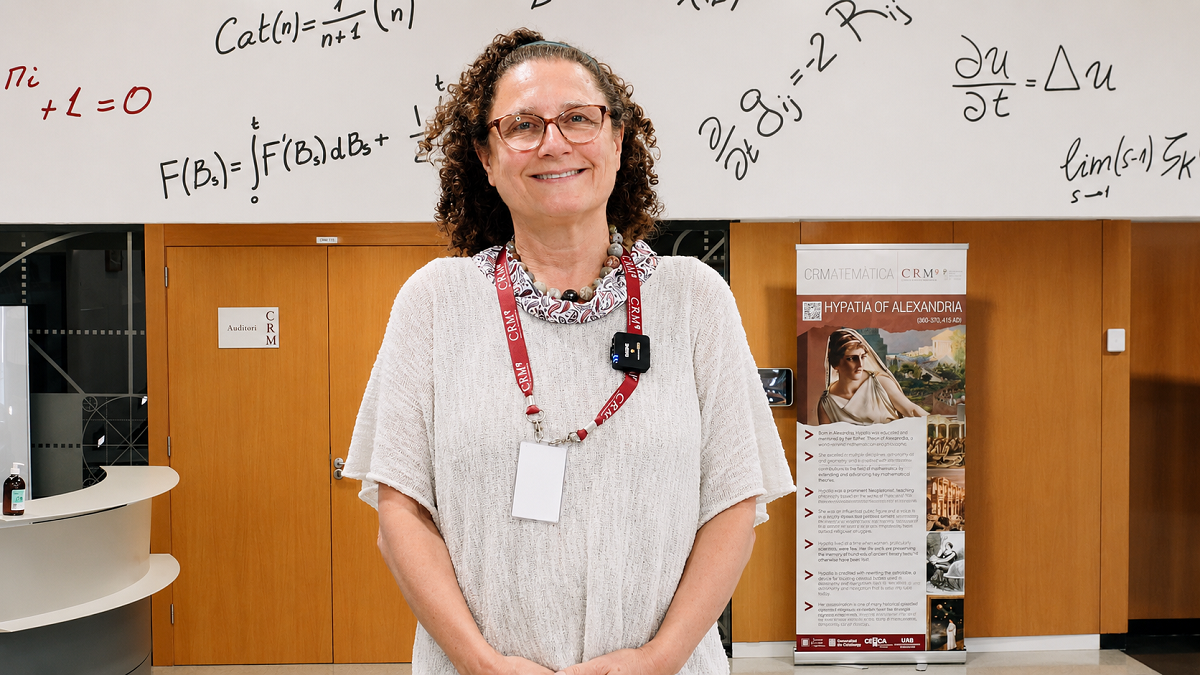
Susanna Terracini delivers the CRM Colloquium 2026
Susanna Terracini (Università di Torino) delivered the CRM Colloquium 2026 on 14 July, presenting a rigidity result for Kepler billiards obtained with Stefano Baranzini, Vivina Barutello and Irene De Blasi. She was at the centre as a member of the CRM Scientific...
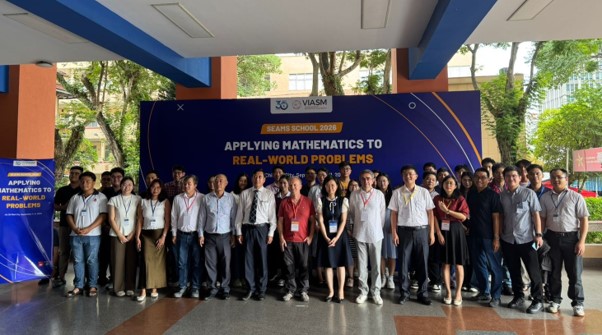
Ho Chi Minh City hosts the SEAMS School on applying mathematics to real-world problems
Students from across the region took courses and worked on group projects at a school co-organised by CRM researcher Tim Myers.CRM CommPau VarelaCRMComm@crm.catGet the latest CRM news and activities in your inbox.Recent newsletters →Between 4 and...

A single ball on a fixed table can compute: Eva Miranda and Isaac Ramos prove that two-dimensional billiards are Turing complete
Eva Miranda (UPC, CRM) and Isaac Ramos (ETH Zürich) show that a point particle bouncing inside a planar table with fixed walls can simulate a universal Turing machine, settling a question Cristopher Moore left open in 1990. The result grew out of a master’s project...