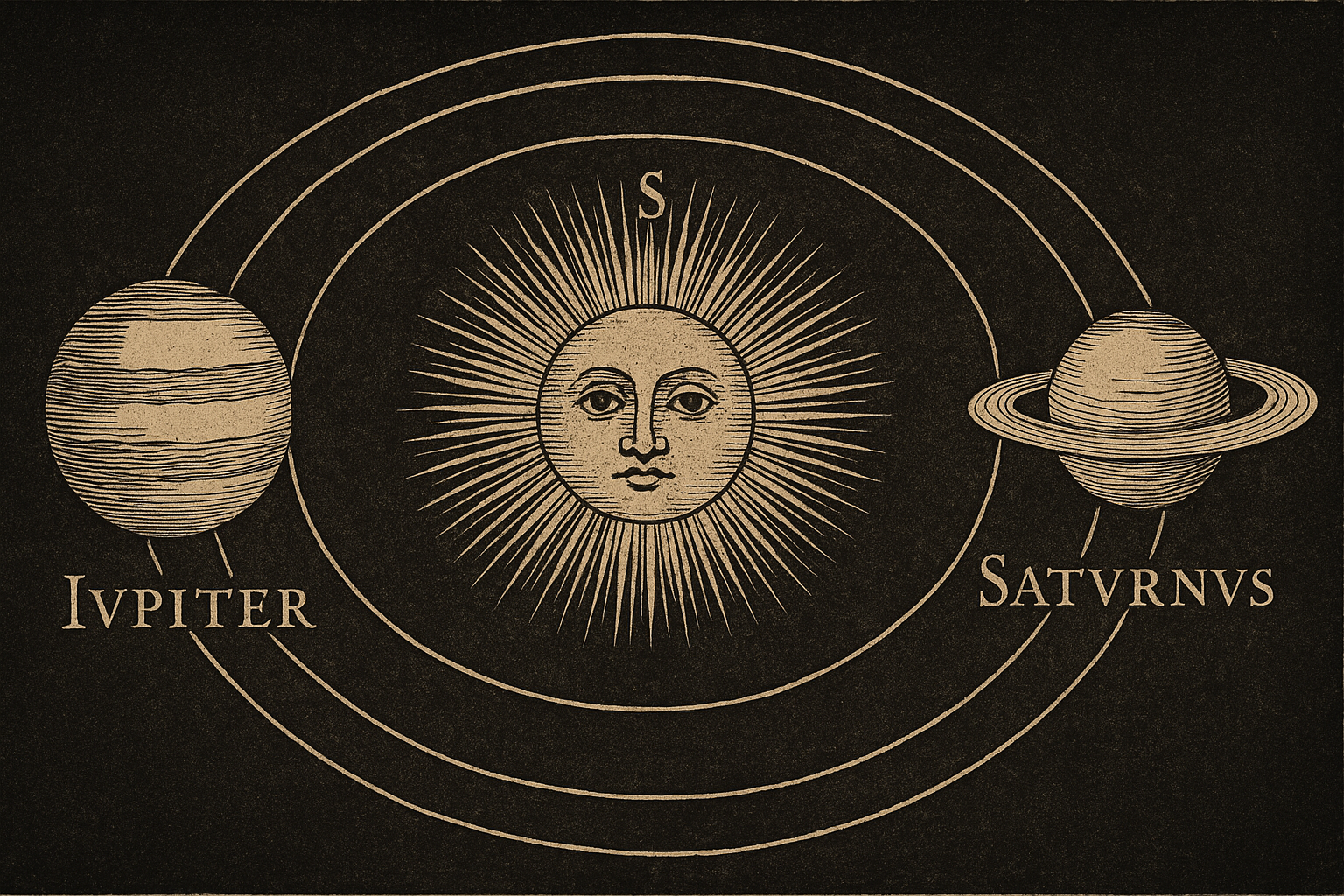
When we picture the Solar System, most of us still see that neat little diagram from our school days with the planets lined up like obedient dancers, each tracing a perfect circle around the Sun. But the reality is far messier. Over long timescales, planetary motion is chaotic and notoriously difficult to predict. Understanding the gravitational dance between just three celestial bodies (say, the Sun, Jupiter, and Saturn) has been one of mathematics’ most enduring challenges since the time of Isaac Newton.
Now, a recent study by Jordi-Lluís Figueras (Uppsala University) and Alex Haro (Universitat de Barcelona and the Centre de Recerca Matemàtica) sheds new light on this centuries-old puzzle. Using a sophisticated mathematical framework known as KAM theory (after Kolmogorov, Arnold, and Moser), they’ve shown that stable, quasiperiodic motion might be possible in a simplified version of the Sun–Jupiter–Saturn system. Their computations, carried out with ultra-high precision, have produced convincing numerical evidence that supports the applicability of a KAM theorem to this celestial configuration.
“What our work shows,” explains Alex Haro, “is that the most astronomically significant part of the Solar System could, in fact, be stable. That’s precisely the problem Newton raised in his Principia when asking about the mutual gravitational effects between Jupiter and Saturn.”
Three Bodies, Chaos, and a Historic Puzzle
In the 17th century, Newton solved the two-body problem: a planet orbits the Sun in an ellipse. But if we introduce a third body (another planet, for instance), the problem becomes wildly more complex. This infamous three-body problem is chaotic, meaning small variations in initial conditions can lead to drastically different long-term behaviour, and no general solution exists.
In the 20th century, KAM theory offered hope. It showed that under specific conditions, stable, quasiperiodic orbits could persist even in systems susceptible to chaos; trajectories that never exactly repeat but remain bounded and regular. However, those conditions were thought to be nearly impossible to meet in real astronomical systems.
Figueras and Haro’s work challenges that view. Their study, published in the Journal of Nonlinear Science, takes real values for the masses and orbital parameters of Jupiter and Saturn and shows that even outside the narrow scope of classical perturbative methods, stable motion can still emerge. They achieved this using a refined numerical approach rooted in the parameterisation method, which allowed them to compute and validate the existence of what are known as invariant tori (geometrical objects that represent quasiperiodic orbits in phase space).
“In particular,” says Haro, “our result confirms that, in a reduced and simplified Newtonian model of the Solar System, where only the Sun and its two largest planets move on a plane, perpetually bounded, regular motion can exist, and that such motion corresponds to realistic data.”
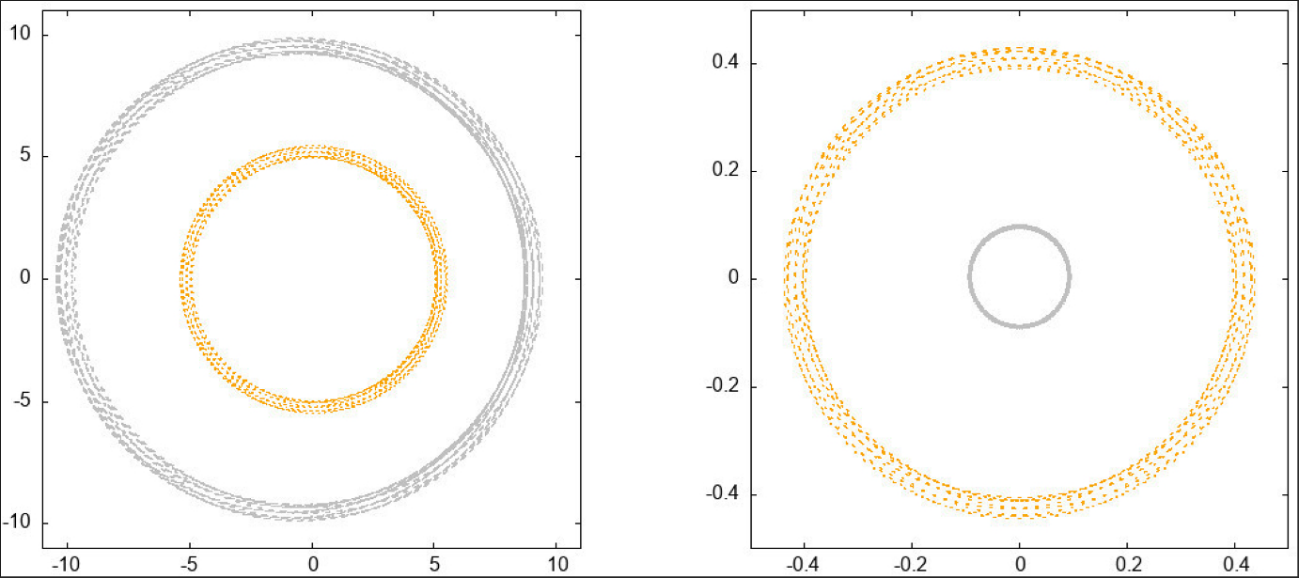
Projections of the 3d invariant torus (which generates a 4d torus) in Cartesian coordinates, showing the positions and momenta of Jupiter and Saturn. The coordinates for Jupiter are shown in orange, and those for Saturn in grey.
One of the conceptual sparks behind this work is a lesser-known observation by French mathematician Michel Hénon. Hénon suggested that some stable orbits could survive even under strong perturbations, an idea that at the time was seen as too optimistic. But Figueras and Haro took it seriously.
“Computers made these calculations possible,” says Haro, “but we couldn’t have done them without the right algorithms. These involve both the dynamical and geometric aspects of the functional equations we need to solve. And by proving the convergence of our algorithms via KAM methods, we ensure the reliability of our results.”
Among their tools is the notion of translated tori, which act as a kind of workaround for the degeneracies that normally prevent the application of KAM theory to realistic planetary systems. Their calculations, carried out with ultra-high precision on supercomputers, achieved an error of invariance as low as 10⁻⁵⁴, far surpassing the threshold required by the theory.
Although their model is limited, since it assumes planar motion and includes only two planets, the implications are far-reaching. “The final step,” Haro explains, “will be a mathematical proof of the existence of this quasiperiodic motion, with the actual frequencies of Jupiter and Saturn. This proof will be computer-assisted. The object we’re validating, a three-dimensional torus in a six-dimensional space, is encoded with over six billion Fourier coefficients.”
This step builds directly on their earlier paper, presenting a tailored KAM theorem and an iterative lemma. The third and final phase, currently in progress, will combine all these ingredients to produce a complete, rigorous, computer-assisted proof. But what happens when the methodology is applied beyond our Solar System?
“Applying this to exoplanetary systems is something we’d love to explore,” Haro says. “A key challenge is the difficulty of obtaining precise data. But our theorems are coordinate-independent, so they can be adapted to other configurations.”
The Beauty of the Problem
Haro’s interest in celestial mechanics traces back to the deep, almost mythic allure of the three-body problem. “It’s a paradigmatic problem,” he says, “one that contains both order and chaos. That makes it a testing ground for methods and ideas that often go on to apply elsewhere—even when the original problem isn’t fully solved.”
Indeed, the very foundations of dynamical systems theory were laid by Henri Poincaré while trying to understand the three-body problem. Later, KAM theory emerged from attempts to resolve the same questions. Haro points to key contributions by mathematicians like Michel Herman, Jacques Féjoz, Luigi Chierchia, and Gabriella Pinzari, as well as Vladimir Arnold’s influential mechanisms for explaining chaos and diffusion.
Haro and Figueras’ work stands on the shoulders of this tradition but carves out its own space. They’ve also collaborated with researchers like Miquel Barcelona, Renato Calleja, Chiara Caracciolo, Álvaro Fernández-Mora, Josep Maria Mondelo, and Pedro Porras on related applications, from space mission design to plasma physics. “What drew us to this problem,” Haro says, “was partly its beauty, but also the fact that many in the scientific community, especially among physicists, believed KAM theory couldn’t be applied to realistic planetary systems. That’s something Henry Dumas discusses in The KAM Story.”
“Mathematicians like challenges,” Haro says, “and this one is formidable (at least for us) because it involves difficulties at many levels, both mathematical and computational.”
“Jordi-Lluís and I had already worked on computer-assisted proofs in a different context, building on work I had previously done with Rafael de la Llave,” he adds. “Later, together with Alejandro Luque, we turned our attention to KAM theory, drawing inspiration from a key paper by Alejandra González, Rafael de la Llave, Jordi Villanueva, and Àngel Jorba. That’s when we developed our first method for computer-assisted KAM proofs, which we initially tested on simpler problems.”
Much of Haro’s journey through these ideas has been shaped by a longstanding collaboration with mathematician Rafael de la Llave. “My collaboration with Rafa has been foundational,” he says. “During my postdoc in Austin, he introduced me to a new way of doing mathematics. We developed a shared language that shaped the work I’ve done ever since.”
Together, they explored invariant tori, their associated structures, and eventually, the frontier of KAM theory for degenerate systems, work that continues to echo through Haro’s current research in astrodynamics. “We still have unfinished projects that go back to those early days,” he adds. “My connection with Rafa goes far beyond mathematics.”
While scientists like Jacques Laskar have shown that chaos leaves its imprint on the inner planets over long timescales, Figueras and Haro’s work reveals another side of the cosmic story: that even amid instability, mathematical order can survive. “Humanity has been fascinated by celestial motion since the dawn of time,” Haro reflects. “And we’re no exception.”
The Sun-Jupiter-Saturn system may be just one sliver of the sky, captured in a model. But it reminds us that beneath the turbulence of the cosmos, there is a hidden rhythm; complex, delicate, and, with the right tools, knowable.
Citation:
Figueras, J.-L., & Haro, A. (2024). Sun-Jupiter-Saturn System May Exist: A Verified Computation of Quasiperiodic Solutions for the Planar Three-Body Problem. Journal of Nonlinear Science, 34(4), Article 10109. https://doi.org/10.1007/s00332-024-10109-4
crm researchers

Alex Haro is a professor at the University of Barcelona. He earned his PhD under the supervision of Carles Simó and held a Fulbright-funded postdoctoral position at the University of Texas at Austin, where he began a long-term collaboration with Rafael de la Llave. His research focuses on dynamical systems, especially invariant tori, KAM theory, and rigorous computational methods. He is co-author of the book The Parameterization Method for Invariant Manifolds (Springer, 2016) and has received the Barcelona Dynamical Systems Prize (2017) and the R.E. Moore Prize (2018).
Website: https://webgrec.ub.edu/webpages/000006/cat/alex.haro.ub.edu.html
Subscribe for more CRM News
|
|
CRM CommPau Varela
|

When the reward comes within reach, the brain changes what it compares
As the tokens piled up, choices got faster and more accurate at the same time. The yardstick for judging each offer had moved.CRM CommPau VarelaCRMComm@crm.catGet the latest CRM news and activities in your inbox.Recent newsletters →Two subjects...
Almost every automaton can be reset with a short word
Guillaume Chapuy (Université Paris Cité, CNRS) and Guillem Perarnau (UPC, CRM) have shown that a random finite automaton with n states can, with high probability, be reset by a word of length of order √n log n. The result, published in ACM Transactions on Algorithms, pins the exponent at 1/2, the lower end of a decade of numerical estimates, and addresses the random version of the synchronization problem behind a conjecture Ján Černý posed in 1964 and which still remains open.
Exposició ‘Les matemàtiques de Gaudí’

CRM quod erat demonstrandum | 48

ADA: Decoding Brain Signals Misaligned in Time
The study addresses a key limitation of current brain decoding techniques: the difficulty of interpreting internal mental processes whose temporal dynamics vary from trial to trial.Decoding what is happening in a person’s mind from their brain activity is one of the...
Rare curves, many points: Christophe Ritzenthaler and Rachel Pries on their research and the work around it
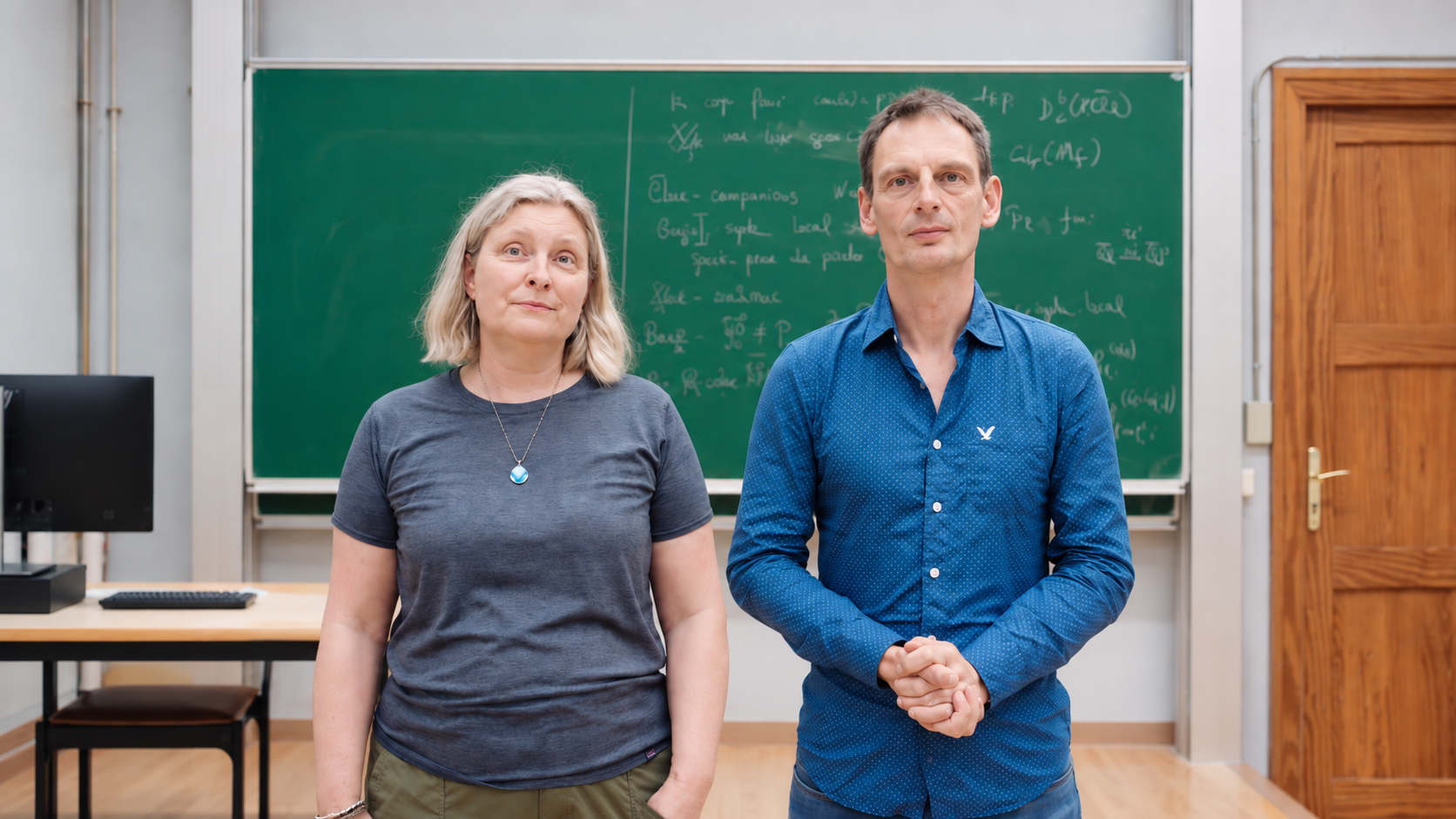
Christophe Ritzenthaler (Université de Rennes) and Rachel Pries (Colorado State University) both work on curves over finite fields: he hunts curves with as many points as possible, she hunts curves that almost never occur. In conversation with the CRM during their...

Call open for the 2027 Ferran Sunyer i Balaguer Prize
The Ferran Sunyer i Balaguer Foundation is accepting submissions for its 2027 prize, which awards 15,000 euros and publication in Birkhäuser's Progress in Mathematics series to an expository monograph on an active area of mathematical research. The deadline is 27...
Susanna Terracini delivers the CRM Colloquium 2026
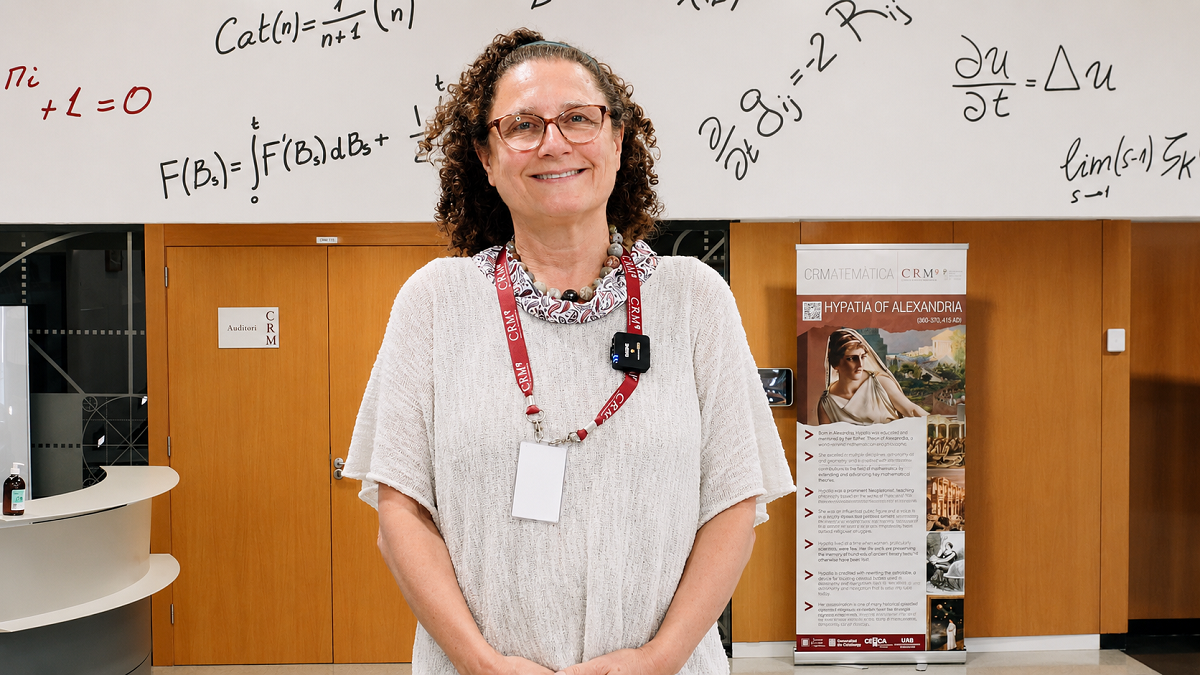
Susanna Terracini (Università di Torino) delivered the CRM Colloquium 2026 on 14 July, presenting a rigidity result for Kepler billiards obtained with Stefano Baranzini, Vivina Barutello and Irene De Blasi. She was at the centre as a member of the CRM Scientific...

Ho Chi Minh City hosts the SEAMS School on applying mathematics to real-world problems
Students from across the region took courses and worked on group projects at a school co-organised by CRM researcher Tim Myers.CRM CommPau VarelaCRMComm@crm.catGet the latest CRM news and activities in your inbox.Recent newsletters →Between 4 and...

A single ball on a fixed table can compute: Eva Miranda and Isaac Ramos prove that two-dimensional billiards are Turing complete
Eva Miranda (UPC, CRM) and Isaac Ramos (ETH Zürich) show that a point particle bouncing inside a planar table with fixed walls can simulate a universal Turing machine, settling a question Cristopher Moore left open in 1990. The result grew out of a master’s project...
BMS-BGSMath Junior Meeting 2026: Barcelona and Berlin Strengthen Scientific Ties
From 2 to 4 September 2026, the Centre de Recerca Matemàtica (CRM) hosted the BMS-BGSMath Junior Meeting 2026, a three-day event jointly organised by the Berlin Mathematical School (BMS) and the Barcelona Graduate School of Mathematics (BGSMath), with the Centre de...
The CRM organises the 2026 Barcelona Summer School for Advanced Modeling of Behavior
The Centre de Recerca Matemàtica held the sixth edition of BAMB!, the Barcelona Summer School for Advanced Modeling of Behavior, from 12 to 23 July 2026 at the Parc de Recerca Biomèdica de Barcelona. Thirty early-career researchers from fourteen countries followed...