
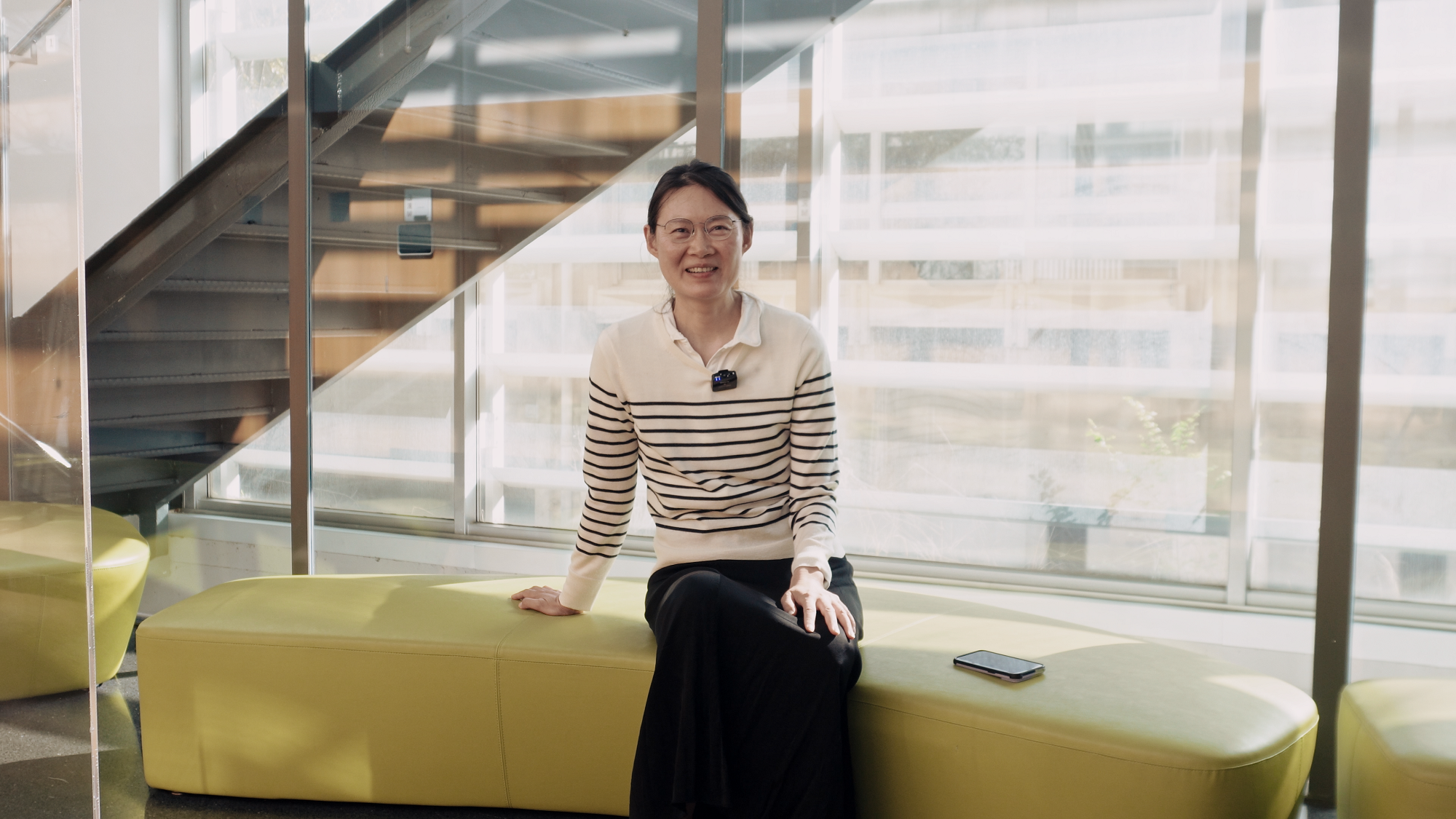
The Centre de Recerca Matemàtica (CRM) is proud to announce the appointment of Professor Chenchang Zhu (Georg-August-Universität Göttingen) as the first María de Maeztu Chair of Excellence, a distinction that recognises world-leading women mathematicians whose work aligns with the strategic priorities of CRM.
The CRM–MdM Chair of Excellence, funded through the María de Maeztu Unit of Excellence (2022–2025), is a newly created initiative aimed at hosting 1–2 senior women mathematicians or computer scientists annually for short stays of up to four months. The program seeks to foster collaboration with inspiring role models in mathematics and to build enduring scientific connections with international leaders.
Professor Zhu’s appointment formally began on April 9, 2025, with an inaugural colloquium titled Higher Structures in Symplectic Geometry: A Journey from Galileo to Weinstein. In this lecture, she traced a conceptual arc from Galileo’s early insight into the brachistochrone problem to modern symplectic geometry and its deep interplay with quantum theory. The talk introduced the language of higher and derived structures, inspired by Grothendieck’s derived geometry, as tools to tackle singularities in geometric reduction and explore new frontiers in mathematical physics.
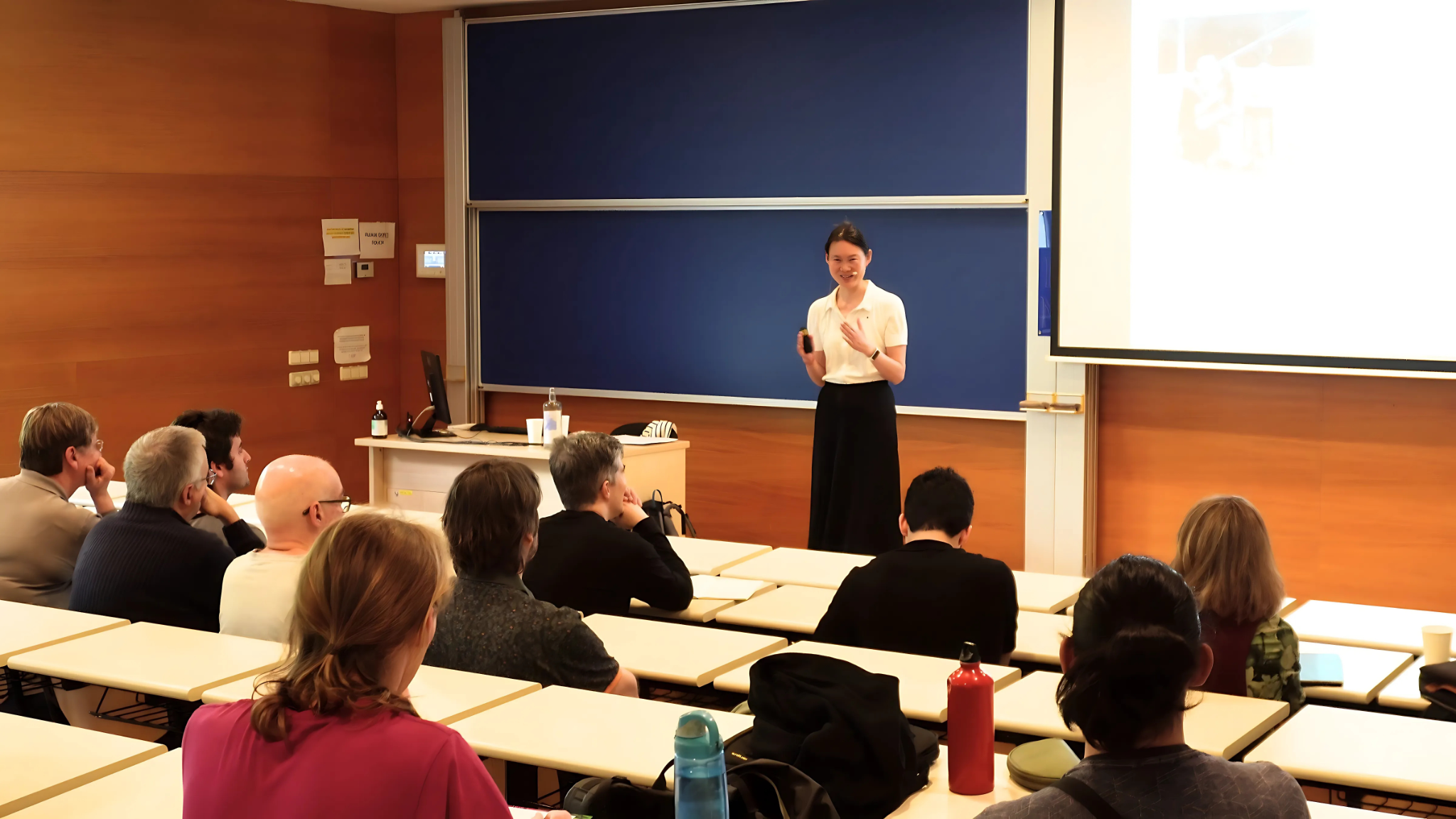
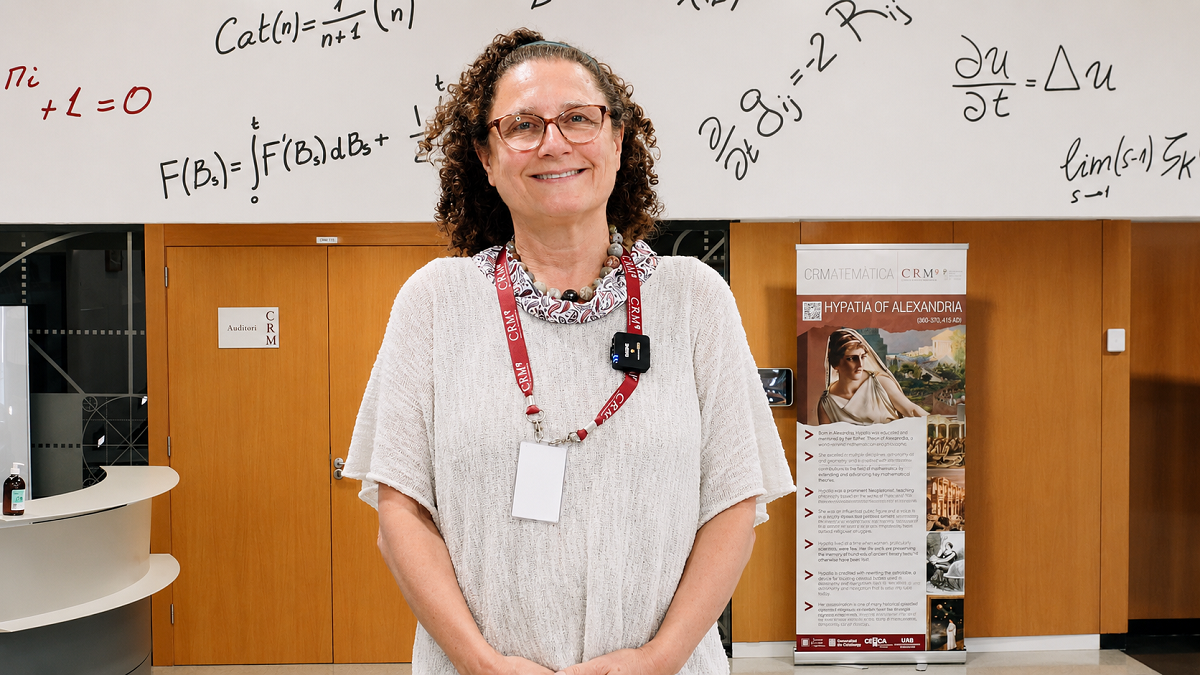
Professor Chenchang Zhu delivers the inaugural CRM–María de Maeztu Chair of Excellence Colloquium, held on April 9, 2025, at the Centre de Recerca Matemàtica. Her lecture, “Higher Structures in Symplectic Geometry,” marked the beginning of her stay as the first holder of this appointment.
Drawing from the philosophical perspective of her advisor Alan Weinstein, who once said “everything is Lagrangian”, Zhu presented a vision of differential geometry that incorporates modern homotopical tools, from Lie groupoids and NQ-manifolds to shifted symplectic structures. These ideas, she argued, may be essential for understanding the mathematical underpinnings of topological quantum field theories and sigma models, owing to the fundamental 3+1-dimensional nature of our universe.
While this is her first formal collaboration with CRM researchers, Zhu is no stranger to the CRM. She previously played a role in the Intensive Research Programme Poisson 2022, where she chaired the scientific committee of the advanced school alongside Eva Miranda, who served as local chair. “The collaboration was amazing,” Zhu recalls. “Eva self-generated so many things, it turned the event into an absolute fantasy. Through that, I began discovering the charming, concrete work of many Spanish colleagues in higher geometry.”
Her research interests, spanning higher and derived differential geometry, Poisson and symplectic structures, and their connections to mathematical physics, are the result of a deeply personal and intellectually curious journey. She credits a pivotal moment to a conversation with Alan Weinstein, who drew her attention to the topological groupoid constructed by Crainic and Fernandes for integrating Lie algebroids. “Alan suspected there should be some differential structure behind it,” Zhu recounts. “I had just attended Barbara Fantechi’s course on algebraic stacks in Park City, and it suddenly struck me that maybe this structure should be a stack, though adapted to differential geometry. I didn’t understand stacks yet, but the spark was there.” A subsequent encounter with Kai Behrend at the ICM 2002 in Beijing proved transformative: “That’s when things clicked. It was the first time I really saw how these higher structures could solve actual problems.”
Zhu’s career has been marked by a global academic trajectory, with formative periods in China, the United States, Switzerland, France, and Germany. This multicultural experience has shaped not only her mathematics but also her collaborative ethos. “It helps you become more open and understanding,” she says. “Different systems have different strengths, and you learn to navigate and appreciate those differences.”
She also brings a thoughtful perspective on gender equity in mathematics. “Things have improved a lot,” she notes. “When I was starting, France was already better, it had around 20% women in mathematics. Now, our institute in Göttingen has reached parity.” But she also emphasises the importance of integrating family support into institutional policies. As a single mother, she has faced logistical hurdles when travelling for work: “You still have to justify travelling with your child, or explain why you need an extra day. These should be obvious considerations.”
Programs like the CRM–MdM Chair of Excellence, she believes, play a role in fostering equity. “They’re more than symbolic. They send a message of recognition and trust. They give visibility and encouragement to the kind of work that often happens quietly; foundational, long-term, and connecting different communities.”
Reflecting on what this recognition means at this stage in her career, Zhu speaks with warmth and clarity: “It’s a moment of deep encouragement. It affirms the work I care about: the bridges between ideas, the invisible efforts, and the interdisciplinary visions. It gives me the confidence to keep pushing boundaries and reminds me that staying true to one’s path, even when it’s unconventional, matters. It feels like an invitation to dream a bit bolder.”
Her inaugural colloquium is available to watch on the CRM YouTube channel, offering a window into the vibrant intellectual landscape she continues to shape.
You can watch our interview with her in the video below.
|
|
CRM CommPau Varela
|

When the reward comes within reach, the brain changes what it compares
As the tokens piled up, choices got faster and more accurate at the same time. The yardstick for judging each offer had moved.CRM CommPau VarelaCRMComm@crm.catGet the latest CRM news and activities in your inbox.Recent newsletters →Two subjects...

Almost every automaton can be reset with a short word
Guillaume Chapuy (Université Paris Cité, CNRS) and Guillem Perarnau (UPC, CRM) have shown that a random finite automaton with n states can, with high probability, be reset by a word of length of order √n log n. The result, published in ACM Transactions on Algorithms, pins the exponent at 1/2, the lower end of a decade of numerical estimates, and addresses the random version of the synchronization problem behind a conjecture Ján Černý posed in 1964 and which still remains open.
Exposició ‘Les matemàtiques de Gaudí’
CRM quod erat demonstrandum | 48

ADA: Decoding Brain Signals Misaligned in Time
The study addresses a key limitation of current brain decoding techniques: the difficulty of interpreting internal mental processes whose temporal dynamics vary from trial to trial.Decoding what is happening in a person’s mind from their brain activity is one of the...
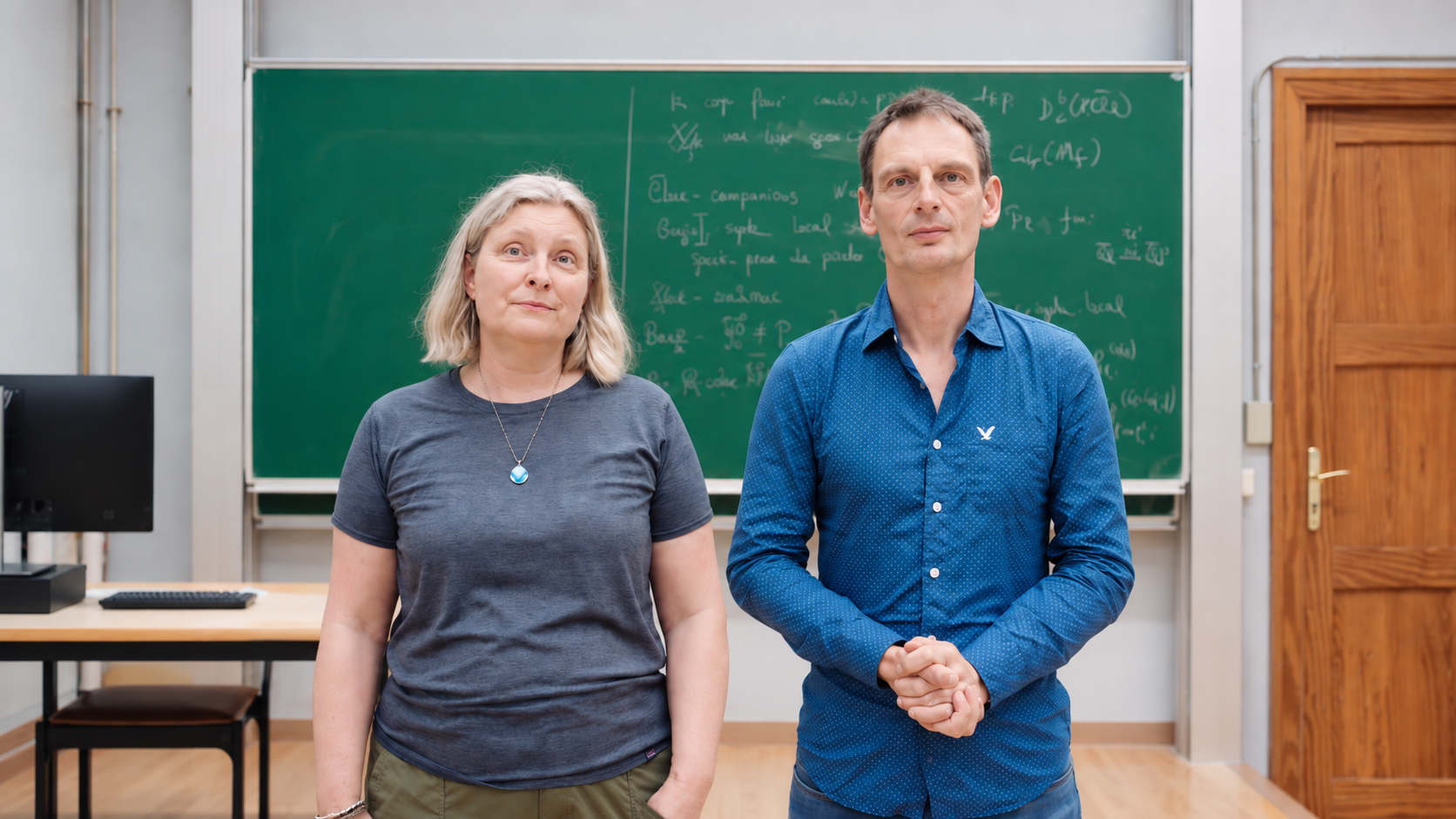
Rare curves, many points: Christophe Ritzenthaler and Rachel Pries on their research and the work around it
Christophe Ritzenthaler (Université de Rennes) and Rachel Pries (Colorado State University) both work on curves over finite fields: he hunts curves with as many points as possible, she hunts curves that almost never occur. In conversation with the CRM during their...

Call open for the 2027 Ferran Sunyer i Balaguer Prize
The Ferran Sunyer i Balaguer Foundation is accepting submissions for its 2027 prize, which awards 15,000 euros and publication in Birkhäuser's Progress in Mathematics series to an expository monograph on an active area of mathematical research. The deadline is 27...
Susanna Terracini delivers the CRM Colloquium 2026
Susanna Terracini (Università di Torino) delivered the CRM Colloquium 2026 on 14 July, presenting a rigidity result for Kepler billiards obtained with Stefano Baranzini, Vivina Barutello and Irene De Blasi. She was at the centre as a member of the CRM Scientific...
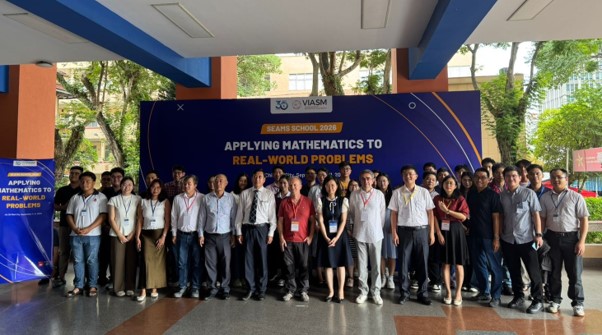
Ho Chi Minh City hosts the SEAMS School on applying mathematics to real-world problems
Students from across the region took courses and worked on group projects at a school co-organised by CRM researcher Tim Myers.CRM CommPau VarelaCRMComm@crm.catGet the latest CRM news and activities in your inbox.Recent newsletters →Between 4 and...

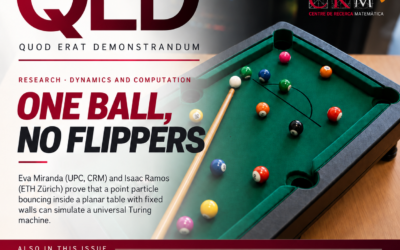
A single ball on a fixed table can compute: Eva Miranda and Isaac Ramos prove that two-dimensional billiards are Turing complete
Eva Miranda (UPC, CRM) and Isaac Ramos (ETH Zürich) show that a point particle bouncing inside a planar table with fixed walls can simulate a universal Turing machine, settling a question Cristopher Moore left open in 1990. The result grew out of a master’s project...
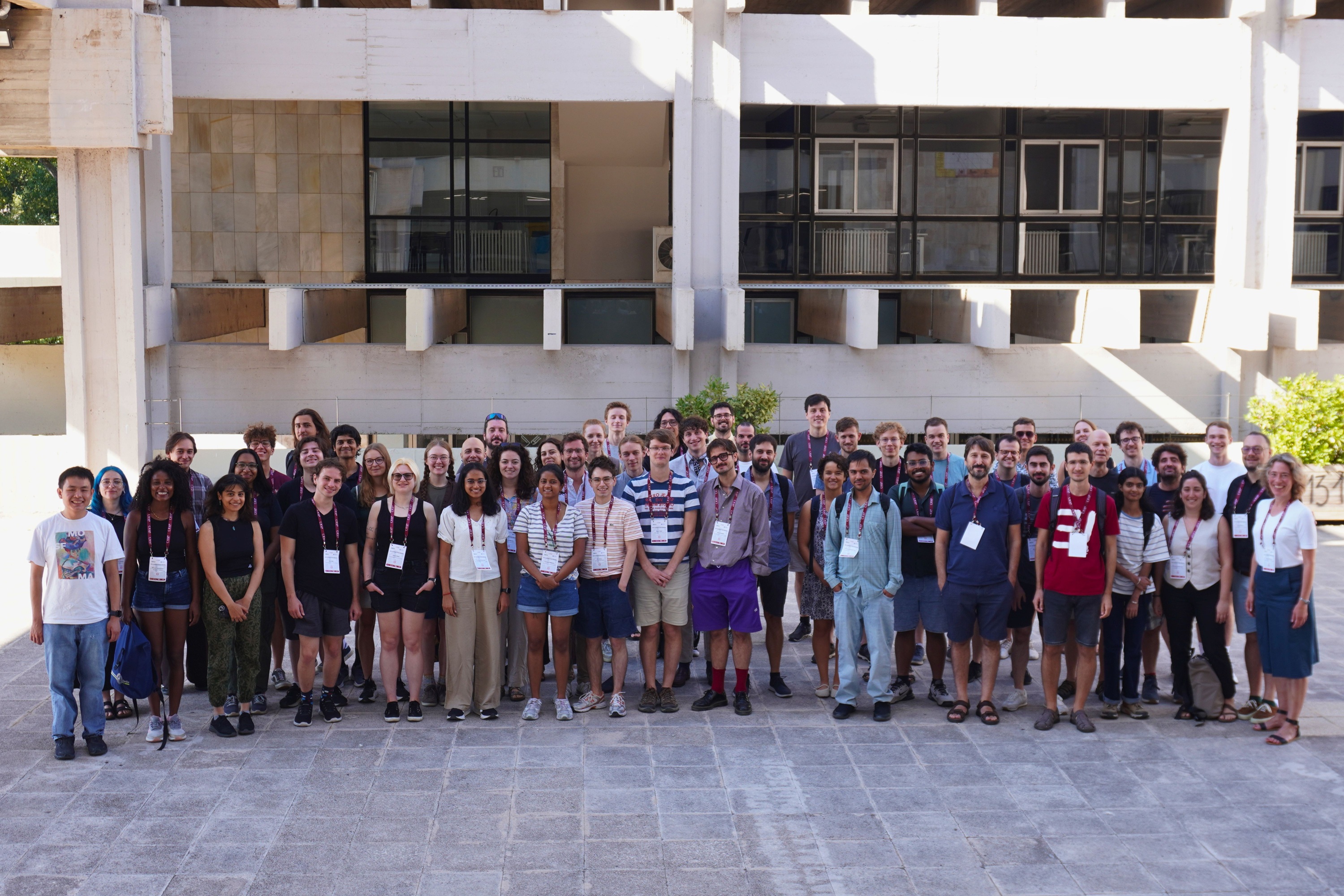
BMS-BGSMath Junior Meeting 2026: Barcelona and Berlin Strengthen Scientific Ties
From 2 to 4 September 2026, the Centre de Recerca Matemàtica (CRM) hosted the BMS-BGSMath Junior Meeting 2026, a three-day event jointly organised by the Berlin Mathematical School (BMS) and the Barcelona Graduate School of Mathematics (BGSMath), with the Centre de...
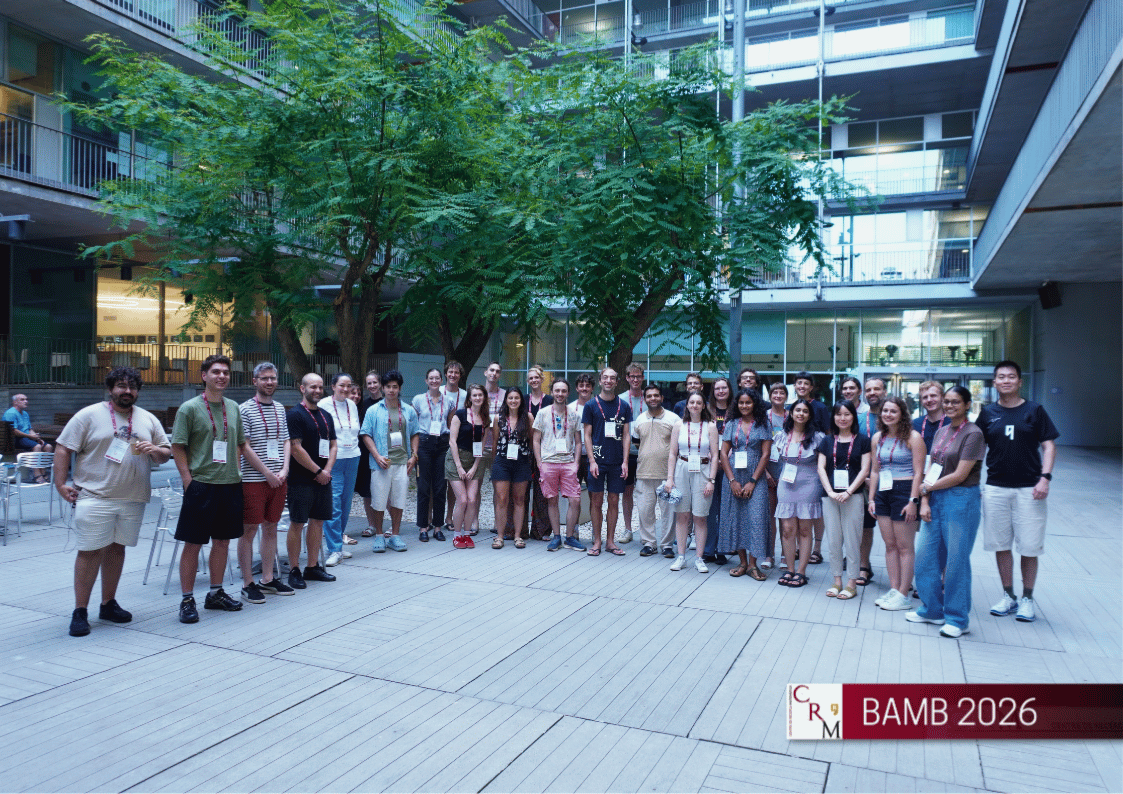
The CRM organises the 2026 Barcelona Summer School for Advanced Modeling of Behavior
The Centre de Recerca Matemàtica held the sixth edition of BAMB!, the Barcelona Summer School for Advanced Modeling of Behavior, from 12 to 23 July 2026 at the Parc de Recerca Biomèdica de Barcelona. Thirty early-career researchers from fourteen countries followed...