
Carme Cascante Canut, a professor at the University of Barcelona, has been appointed director of the Centre de Recerca Matemàtica (CRM), becoming the first director from outside the Universitat Autònoma de Barcelona. Her leadership comes as CRM celebrates 40 years as Spain’s oldest and internationally renowned mathematics research centre.
Bellaterra, September 3, 2024 – The Governing Board of the Centre de Recerca Matemàtica (CRM) has appointed Professor Carme Cascante Canut as its new director, following a decision made on July 2. Cascante, a professor in the Department of Mathematics at the University of Barcelona (UB), succeeds Lluís Alsedà i Soler. Her appointment marks a significant moment for the CRM, as she becomes the first director from one of the recently affiliated universities, highlighting the centre’s commitment to fully integrating the University of Barcelona and the Universitat Politècnica de Catalunya (UPC) into its research and governance structure.
Celebrating its 40th anniversary this year, the CRM is the oldest mathematics centre in Spain and a leading international reference for excellence in mathematical research. As part of the CERCA network of research centres in Catalonia, the CRM currently hosts 126 affiliated researchers and has received numerous accolades, including the Narcís Monturiol Medal for Scientific and Technological Merit and the María de Maeztu Unit of Excellence Award, which it has earned twice.
Reflecting on the institution’s history, Cascante remarked, “The CRM has long been a key reference for mathematical research in Catalonia, fulfilling a dual role as both a high-level CERCA research centre and a service hub for the mathematical community. It has played a unifying role, acting as an umbrella for all mathematicians in Catalonia.” She further emphasized that the CRM is well-positioned to foster collaboration and interdisciplinary projects among the three universities on its Governing Council, thereby expanding the reach and impact of mathematical research both in Catalonia and internationally.
Looking ahead, Cascante acknowledged the immediate challenges, emphasizing the need to “consolidate the integration of researchers from UAB, UB, and UPC, fostering greater cohesion among affiliated researchers.” She also pointed out that “renewing the María de Maeztu seal next year and initiating the Centre’s Strategic Plan are crucial steps for CRM’s future.”
As she outlined her vision for the CRM, Cascante highlighted the centre’s commitment to innovation and visibility: “We aim to continue promoting the centre’s innovation and transfer initiatives, increasing CRM’s visibility, and solidifying its position as one of Europe’s leading institutions in mathematical research.”
Over Three Decades of Experience as a Researcher and University Professor
Professor Cascante brings a distinguished academic and research career to her new role. She has been a professor at UB since 1989 and has served as Dean of the Faculty of Mathematics and Director of the Barcelona Graduate School of Mathematics (BGSMath). She earned her PhD at the Universitat Autònoma de Barcelona (UAB) under the supervision of Joaquim Bruna, a former CRM director. Her research focuses on complex analysis, including Carleson measures, pointwise multipliers, and Hankel and Toeplitz operators.
Cascante also acknowledged the significance of her appointment as one of only a few female directors among the 42 CERCA centres. She noted, “Ideally, the appointment of a woman as director would no longer be newsworthy, as this would indicate true parity had been achieved. However, such appointments can still help break stereotypes and inspire young female researchers.”
With her leadership, the CRM is set to further advance its research capabilities, foster international collaboration, and promote opportunities for the next generation of mathematicians. “This is a new challenge I take on with great energy, and I look forward to collaborating with all CRM members to strengthen the centre’s position as a reference in mathematical research,” Cascante concluded.
|
|
CRM CommPau Varela
|

Subscribe for more CRM News
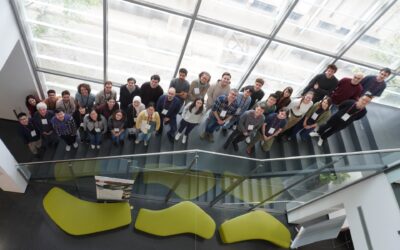
Jagged walls and unknown edges: a workshop on free boundary problems
From 2 to 6 November, the Workshop on Free Boundary Problems brought together more than fifty registered participants from institutions in eleven countries at the CRM. Over five days they heard 21 talks on elliptic and parabolic free boundaries and on geometric measure theory and harmonic analysis in rough domains, with speakers including Guy David, Svitlana Mayboroda, Susanna Terracini and Robin Neumayer. The workshop was the second intensive week of the Intensive Research Programme on Analysis of Free Boundary Problems, which continues at the CRM until 4 December.
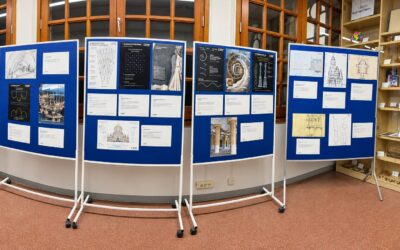
The CRM exhibition ‘Les matemàtiques de Gaudí’ moves to the University of Barcelona
After its October run at the UAB, the exhibition Les matemàtiques de Gaudí, produced by the CRM, can be seen at the University of Barcelona’s CRAI Biblioteca de Matemàtiques i Informàtica from 2 to 30 November 2026.
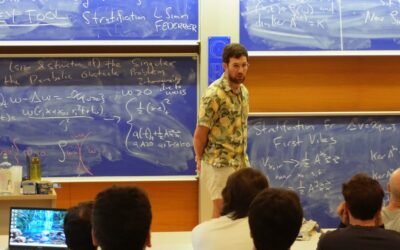
Advanced Course on Free Boundary Problems Opens the Intensive Weeks of the IRP
From 26 to 30 October, around forty researchers attended the Advanced Course on Free Boundary Problems at the CRM, three seven-hour mini-courses given by Bozhidar Velichkov (Università di Pisa), Max Engelstein (University of Minnesota) and Zihui Zhao (Johns Hopkins University). The course was the first of the two intensive weeks of the Intensive Research Programme on Analysis of Free Boundary Problems, which runs until 4 December.
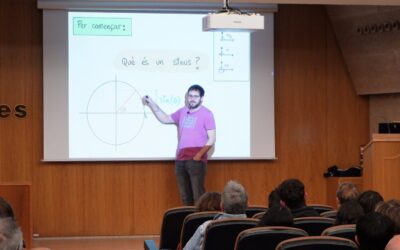
El CRM rep els estudiants de la prova de nivell de Bojos per les Matemàtiques 2027
Els aspirants a Bojos per les Matemàtiques 2027 van visitar el Centre de Recerca Matemàtica (CRM) dissabte 24 d’octubre, després de fer la prova de nivell a la Facultat de Ciències i Biociències de la UAB. En acabat, Tomás Sanz (UB-CRM) els va explicar què té a veure l’escalfament d’una barra de ferro amb els àudios de WhatsApp.
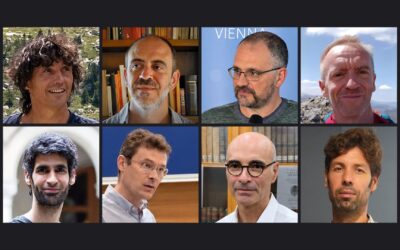
Eight CRM Researchers in the 2026 Stanford-Elsevier List of Highly Cited Scientists
The Centre de Recerca Matemàtica (CRM) has eight researchers in the 2026 update of the Stanford-Elsevier ranking of highly cited scientists, which John P. A. Ioannidis (Stanford University) and Jeroen Baas (Elsevier) compile from Scopus data. Xavier Cabré, Álvaro Corral, Tim Myers, Xavier Ros-Oton, Sergey Tikhonov and Xavier Tolsa appear both in the career-long ranking and in the one for 2025, and Diego Vidaurre and Simeon Ball in the 2025 ranking.
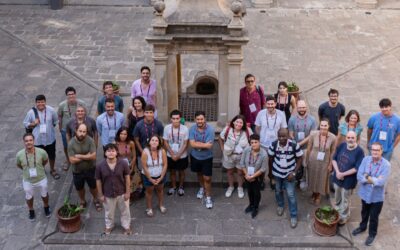
Fish schools and growing tissues: a workshop on how collective behaviour emerges
The Centre de Recerca Matemàtica (CRM) organised the Barcelona Workshop on Kinetic and Macroscopic Models in Biology with Friends II, held from 7 to 10 September at the Institut d’Estudis Catalans. More than thirty researchers discussed how order at the scale of tissues and animal groups arises from local interactions between individuals, in a programme that included talks by CRM researchers Daria Stepanova and Juan Arellano-Tintó. Two of the speakers, James Sharpe (EMBL Barcelona) and Chiara Villa (CNRS, Université Paris Cité), talked to the CRM about their research.
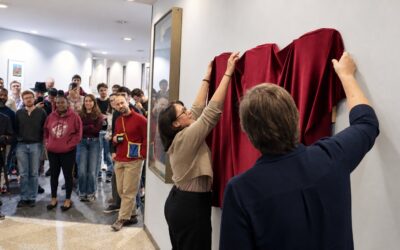
The CRM opens the academic year and unveils its Directors’ Gallery
A review of the year, the Communication Plan 2026–2030 and three research talks filled the morning of 19 October.The unveiling of the Directors’ Gallery.CRM CommPau VarelaCRMComm@crm.catGet the latest CRM news and activities in your inbox.Recent...
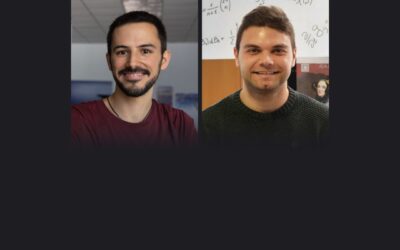
The CRM Mentoring Programme, as Told by One of Its Pairs
PhD student Joaquim Duran and mathematician Robert Cardona, one of the pairs in the CRM Mentoring ProgrammeJoaquim Duran (left) and Robert Cardona.CRM CommPau VarelaCRMComm@crm.catGet the latest CRM news and activities in your inbox.Recent...
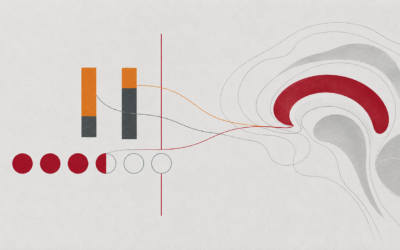
When the reward comes within reach, the brain changes what it compares
As the tokens piled up, choices got faster and more accurate at the same time. The yardstick for judging each offer had moved.CRM CommPau VarelaCRMComm@crm.catGet the latest CRM news and activities in your inbox.Recent newsletters →Two subjects...

Almost every automaton can be reset with a short word
Guillaume Chapuy (Université Paris Cité, CNRS) and Guillem Perarnau (UPC, CRM) have shown that a random finite automaton with n states can, with high probability, be reset by a word of length of order √n log n. The result, published in ACM Transactions on Algorithms, pins the exponent at 1/2, the lower end of a decade of numerical estimates, and addresses the random version of the synchronization problem behind a conjecture Ján Černý posed in 1964 and which still remains open.
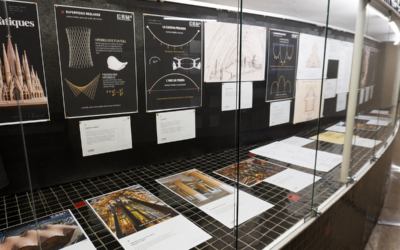
Exposició ‘Les matemàtiques de Gaudí’