Maria Bruna visits the CRM through the María Wonenburger SOMMa Lecture Series
The Oxford mathematician studies how large groups of interacting particles behave, from cells to ants on a crowded trail.
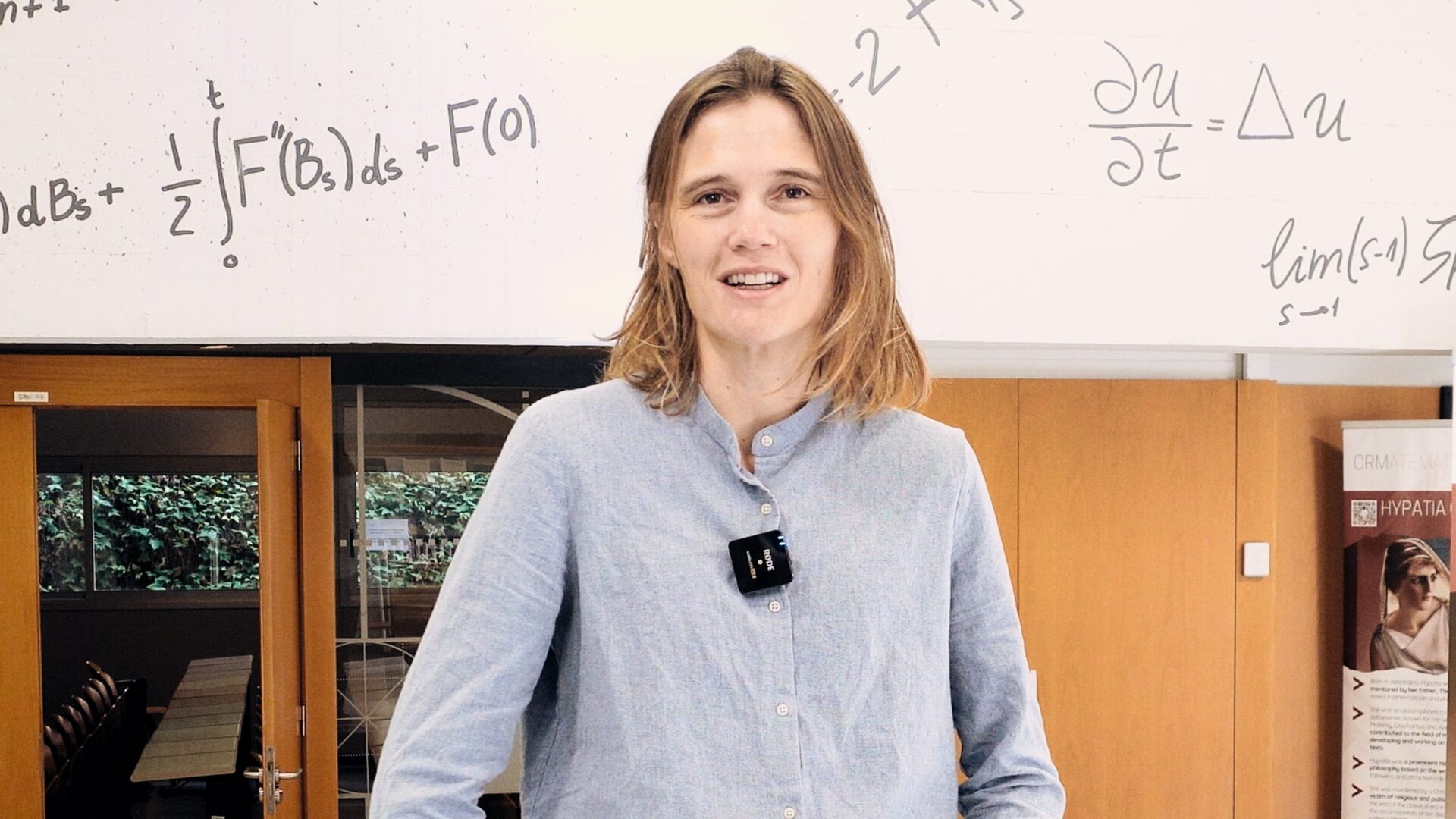
Maria Bruna at the CRM, where she recorded an interview for the Mathematics in Conversation series. Image: CRM
The problems mathematicians work on can come from almost anywhere, ants included. One of the questions Maria Bruna is working on at the moment, together with biologists, is how ants avoid traffic jams. On a crowded trail they can reach very high densities and still carry their loads from one point to another without getting stuck. “When you have lots of ants together, how do they optimise the traffic?” she asks. The answer might also say something about how to design efficient transport systems for people or goods.
Bruna, who is from Barcelona and works at the University of Oxford, spent part of October at the CRM as its first visitor through the María Wonenburger SOMMa Lecture Series. On Friday 23 October she gave the minicourse “Stochastic particle systems and macroscopic limits in active matter” in the CRM Auditorium, and she also recorded an interview for the CRM’s Mathematics in Conversation series.
Particles out of equilibrium
Bruna works on applied stochastic processes, the mathematics of systems that evolve with an element of chance. She is especially interested in the collective behaviour of systems of many interacting particles, and lately in particles out of equilibrium, which don’t evolve to minimise an energy. “Examples of this are when you have particles that represent living beings, for example, cells or animals,” she says. Systems of self-propelled individuals like these are known as active matter. A flock of birds is one, and so is a school of fish or a suspension of swimming bacteria.
A busy ant trail is another. In a 2025 paper with Martin Burger and Oscar de Wit, published in the SIAM Journal on Applied Dynamical Systems, Bruna modelled a foraging colony in which each ant turns towards stronger pheromone signals. Depending on a single parameter, the ants gather in spots or travel in lanes, and neither pattern needs a nest or a food source to appear.
“It pushes the frontiers of knowledge a little further.”
Maria Bruna
Much of Bruna’s research is applied, with work in biology, ecology and industrial problems such as filtration. Her training explains part of it. She graduated in both mathematics and industrial engineering at the Universitat Politècnica de Catalunya (UPC), and for a few years she was torn between the two.
Today she also sees these problems as a source of new mathematics. When the particles don’t minimise an energy, deriving the equations that describe the system as a whole becomes much harder and calls for new methods. Particles with very singular interactions, another of her current topics, raise similar difficulties, because some terms in the equations can become infinite at certain points and the classical tools run into trouble. “On the one hand, I think it’s interesting to work on applications simply because you get to collaborate with people from other fields,” she says, “but also, from the point of view of mathematics, it’s very enriching, because it pushes the frontiers of knowledge a little further.”
A minicourse and new collaborations
The visit had two aims. One was outreach, explaining her field and its open questions “so that people who are starting out, young people, might become interested in research in this field.” The minicourse served that purpose.
It set out the classical tools for studying systems of particles that interact with each other and behave stochastically. “My aim was to show how different modelling assumptions affect, first, the tools you can use, and also the final result,” she explains. In this case the final result is a partial differential equation, and she wanted the audience to see how the type of interaction between the particles shapes the equation obtained at the end. The first lecture introduced the models and tools. The second applied them to a mixture of active and passive particles on a lattice that block each other’s way, and studied solutions in which the particles split into dense and dilute regions or move as travelling waves.
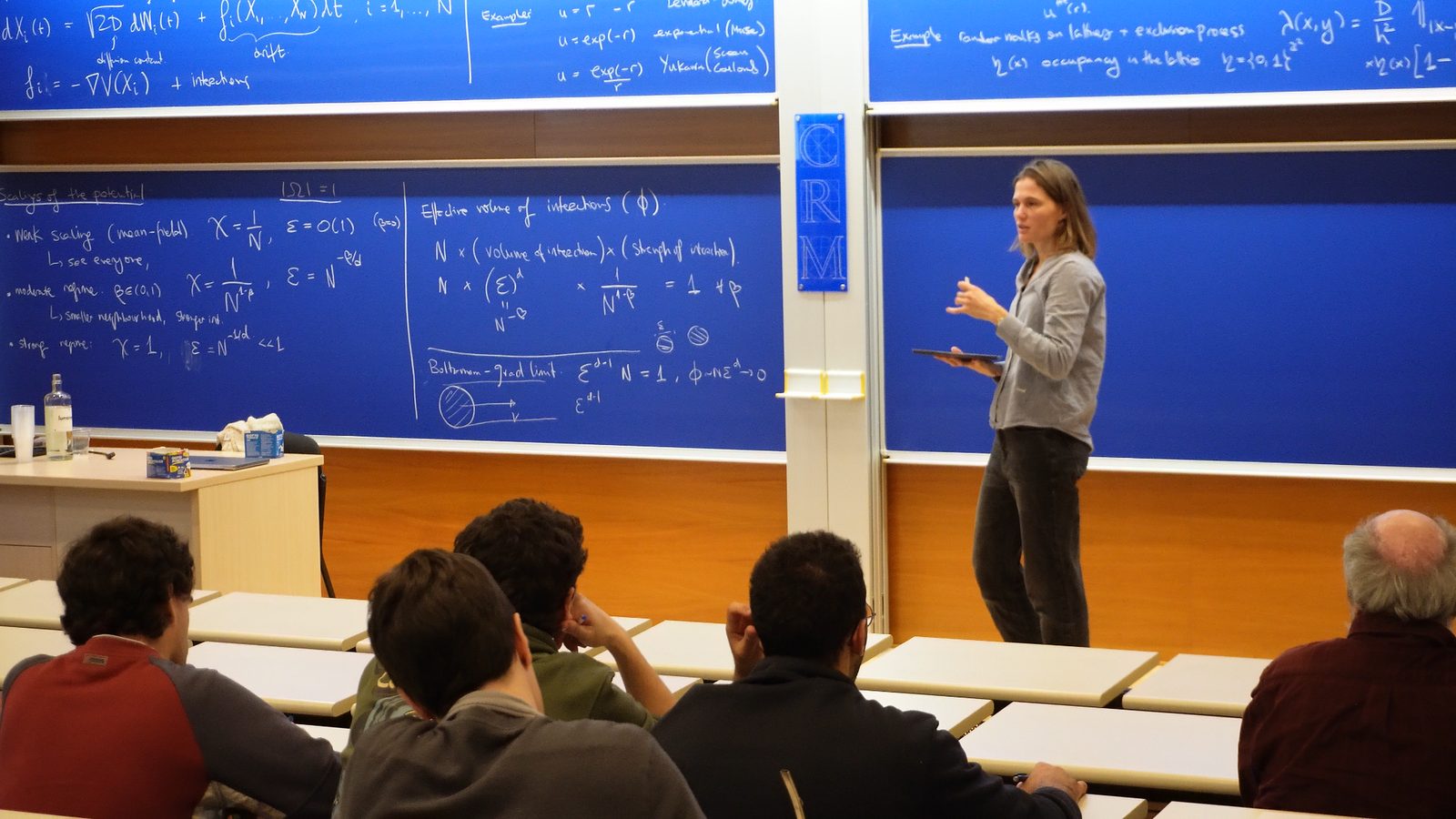
Maria Bruna during her minicourse at the CRM. Image: CRM
The other aim was collaboration. One of Bruna’s doctoral students works on mathematical models of metastasis with a group at the Sant Joan de Déu hospital in Barcelona that has experimental data on paediatric tumours. “They’re very interested in collaborating with mathematicians,” Bruna says. Her plans for the visit included a working session with that team, and they are considering a joint research project. Another of her doctoral students has just been awarded a grant to spend three months at the Barcelona Collaboratorium for Modelling and Predictive Biology. Bruna herself gave a seminar there on 29 October, “From hard needles to active rods: excluded-volume effects in anisotropic particle systems”.
Five centres, one programme
The María Wonenburger SOMMa Lecture Series is run jointly by the five mathematics centres of SOMMa, the alliance of Spain’s Severo Ochoa centres and María de Maeztu units. They are BCAM in Bilbao, the CRM, ICMAT in Madrid, IMAG in Granada and IMUS in Seville. Research groups at the centres nominate mathematicians from any field, and nominations of women are particularly encouraged. Each visitor spends one to three weeks at each of at least two centres, giving lectures or graduate courses. The current call, for visits between October 2026 and July 2027, funds up to two visitors.
“I think it’s a very good initiative,” Bruna says, “because each of these five centres, on its own, is at the forefront of certain research topics and perhaps tends to attract international research in one field.” Her own visit is a case in point. She already had ties with the CRM through Tomás Alarcón, ICREA research professor at the centre, but the series also took her to the Institute of Mathematics of the University of Granada, “a visit that wouldn’t have been possible without this initiative.”
Who was María Wonenburger
María Josefa Wonenburger Planells was born in Oleiros, near A Coruña, in 1927. A Fulbright scholarship from the programme’s first call in Spain took her to Yale in 1953, and she completed her doctorate there under Nathan Jacobson four years later. Spain did not recognise the degree. She left again in 1960, first for Queen’s University in Canada and then for the University of Toronto, where she supervised the doctoral thesis of Robert Moody. That work laid foundations for what became Kac–Moody theory, and Wonenburger is considered one of its founders. Buffalo came next, and then Indiana University, where she became a full professor in 1967. She went home to A Coruña in 1983 to look after her mother, who had fallen ill, and never went back to research.
“I’m glad that this programme now exists to recognise what she achieved.”
Maria Bruna
For years her name was barely known in Spain. In 2002 two professors at the University of A Coruña, María José Souto Salorio and Ana Tarrío Tobar, began to research her life and work. Recognition followed, including honorary membership of the Royal Spanish Mathematical Society in 2007 and an honorary doctorate from the University of A Coruña in 2010. She died in A Coruña in 2014.
Bruna admits she didn’t know about Wonenburger before joining the programme. Reading about her life, she was struck by the doctorate that Spain would not accept and by what she calls a double hurdle, at the start of Wonenburger’s career and again at its end. “She had to stop doing active research because she found herself having to care for family members, something that affects women much more than men.” It is, she says, “a rather sad story, but at the same time I’m glad that this programme now exists to recognise what she achieved.”
From Barcelona to Oxford
“In her case, that mobility worked against her,” Bruna says of Wonenburger. It did so twice, first when her doctorate was not recognised and later when she had to come home to care for her mother. Today it is almost the other way round. “In theory, mobility helps our careers, and it’s highly valued.” It has helped her too. Moving to England and studying in a different system gave her other ways of working with students and, above all, more sensitivity to the different places and educational backgrounds people come from.
Her own move wasn’t planned. She left Barcelona on an Erasmus exchange that was meant to last a year. The year turned into an MSc in Mathematical Modelling and Scientific Computing at Oxford, then a DPhil supervised by Jon Chapman and completed in 2012. After a junior research fellowship at St John’s College she moved to the University of Cambridge as a lecturer, with a Humboldt Research Fellowship in Erlangen along the way, and in 2024 she returned to Oxford, where she is now a Royal Society University Research Fellow at the Mathematical Institute.
“It doesn’t close doors but can actually open many.”
Maria Bruna
That first year in Oxford was her introduction to research in mathematics. She was surprised by the way of working, with far fewer hours in the lecture room and much more independent study. She liked it. “In the end you may not cover as much material in class, but that individual study makes you go much deeper and apply the concepts you’ve learnt much more.” It was also a discovery for her that a career in mathematics did not have to mean becoming a university lecturer or a schoolteacher. That is what hooked her on research in applied mathematics, “the fact that it doesn’t close doors but can actually open many.” In Oxford, she recalls, “I was surrounded by lots of people who’d say, ‘I’m doing a master’s or a PhD in mathematics, and then I want to do this job or work in this industry.’”
Interview with Maria Bruna for the CRM’s Mathematics in Conversation series
More from the CRM
Jagged walls and unknown edges: a workshop on free boundary problems
Fourteen invited talks and seven short talks, from 2 to 6 November at the CRMParticipants of the Workshop on Free Boundary Problems on the CRM stairs.CRM CommPau VarelaCRMComm@crm.catGet the latest CRM news and activities in your inbox.Recent...
La guerra de les granotes i els ratolins
The CRM exhibition ‘Les matemàtiques de Gaudí’ moves to the University of Barcelona
L'exposició del CRM «Les matemàtiques de Gaudí» es trasllada a la Universitat de BarcelonaEight posters on the mathematics behind Gaudí's architecture, on display at the UB until 30 NovemberVuit pòsters sobre les matemàtiques que hi ha darrere l'arquitectura de Gaudí,...
Advanced Course on Free Boundary Problems Opens the Intensive Weeks of the IRP
Three mini-courses by Bozhidar Velichkov, Max Engelstein and Zihui Zhao, from 26 to 30 October at the CRMParticipants in the Advanced Course on Free Boundary Problems.CRM CommPau VarelaCRMComm@crm.catGet the latest CRM news and activities in your...
El CRM rep els estudiants de la prova de nivell de Bojos per les Matemàtiques 2027
The CRM welcomes students from the Bojos per les Matemàtiques 2027 entrance testVisita guiada al centre i xerrada de Tomás Sanz (UB-CRM) sobre les matemàtiques del soA guided tour of the centre and a talk by Tomás Sanz (UB-CRM) on the mathematics of soundTomás Sanz...
Eight CRM Researchers in the 2026 Stanford-Elsevier List of Highly Cited Scientists
The database ranks scientists by citation impact, over their whole careers and in 2025 aloneCRM CommPau VarelaCRMComm@crm.catGet the latest CRM news and activities in your inbox.Recent newsletters →The 2026 edition of the Stanford-Elsevier database...
Fish schools and growing tissues: a workshop on how collective behaviour emerges
Mathematicians and biologists met at the Institut d’Estudis Catalans to discuss how local interactions shape tissues and animal groups.A talk in the Pere i Joan Coromines room of the Institut d’Estudis Catalans. Image: CRMCRM CommPau...
The CRM opens the academic year and unveils its Directors’ Gallery
A review of the year, the Communication Plan 2026–2030 and three research talks filled the morning of 19 October.The unveiling of the Directors’ Gallery.CRM CommPau VarelaCRMComm@crm.catGet the latest CRM news and activities in your inbox.Recent...
The CRM Mentoring Programme, as Told by One of Its Pairs
PhD student Joaquim Duran and mathematician Robert Cardona, one of the pairs in the CRM Mentoring ProgrammeJoaquim Duran (left) and Robert Cardona.CRM CommPau VarelaCRMComm@crm.catGet the latest CRM news and activities in your inbox.Recent...
When the reward comes within reach, the brain changes what it compares
As the tokens piled up, choices got faster and more accurate at the same time. The yardstick for judging each offer had moved.CRM CommPau VarelaCRMComm@crm.catGet the latest CRM news and activities in your inbox.Recent newsletters →Two subjects...
Almost every automaton can be reset with a short word
For a random automaton with n states, a word of about √n log n letters is almost always enough to reset it.CRM CommPau VarelaCRMComm@crm.catGet the latest CRM news and activities in your inbox.Recent newsletters →Picture a conveyor belt carrying...