
When the reward comes within reach, the brain changes what it compares
As the tokens piled up, choices got faster and more accurate at the same time. The yardstick for judging each offer had moved.

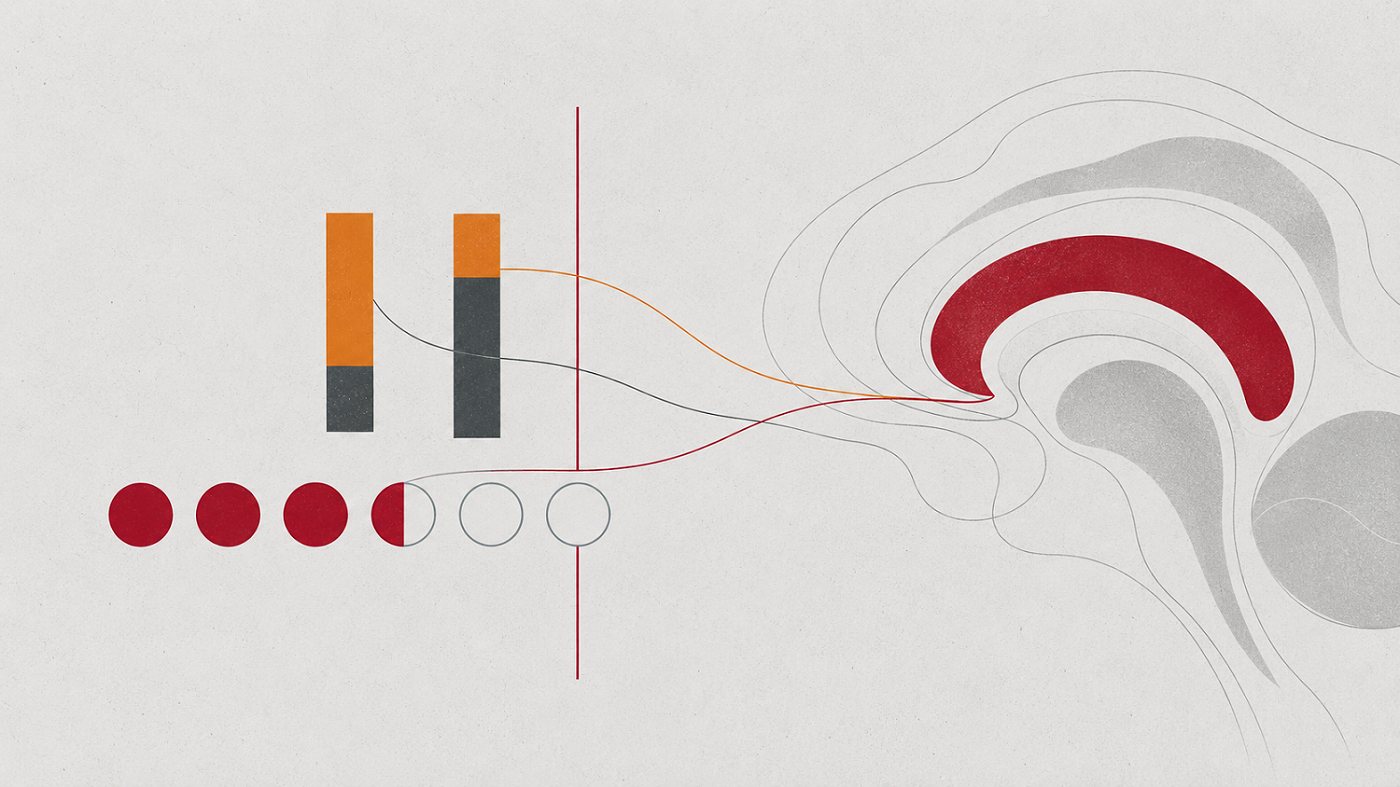
Two subjects perform a token-based decision-making task. On each trial two bars appear, one after the other, and each one is a gamble. A bar is usually split in two, one possible outcome stacked on top of the other: the colour of each section says how many virtual tokens it would bring or take away, anywhere from losing two to winning three, and its height says how likely it is. The subject reports its choice by looking at one of the bars. A small reward is delivered either way to keep the subject engaged. The goal of the task sits along the bottom of the screen, six circles that fill as tokens accumulate, and when the sixth one fills, there is a jackpot reward, and the count goes back to zero.
The experiments were carried out during previous years at the universities of Rochester and Minnesota by Benjamin Hayden’s group and collaborators. Parts of the dataset have been analysed before, for other research questions. Demetrio Ferro (CRM, UPF) curated the data and set about modelling the choices: roughly 106,000 trials across 227 sessions. In the behaviour he found two things that do not usually travel together. As the circles filled, the decisions became faster, and they also became more accurate.
“There is typically a trade-off between speed and accuracy,” says Ferro, a postdoctoral researcher in the Computational Neuroscience group at the CRM. “When we decide very quickly we tend to make more mistakes, while having more time allows more accurate decisions.” Accuracy here has a precise meaning: picking the option with the higher expected value, what it would pay out on average once its outcomes are weighted by their probabilities. On the whole, subjects also picked the riskier of the two bars less often once the jackpot came within reach.
One explanation is that they had stopped playing the same game.
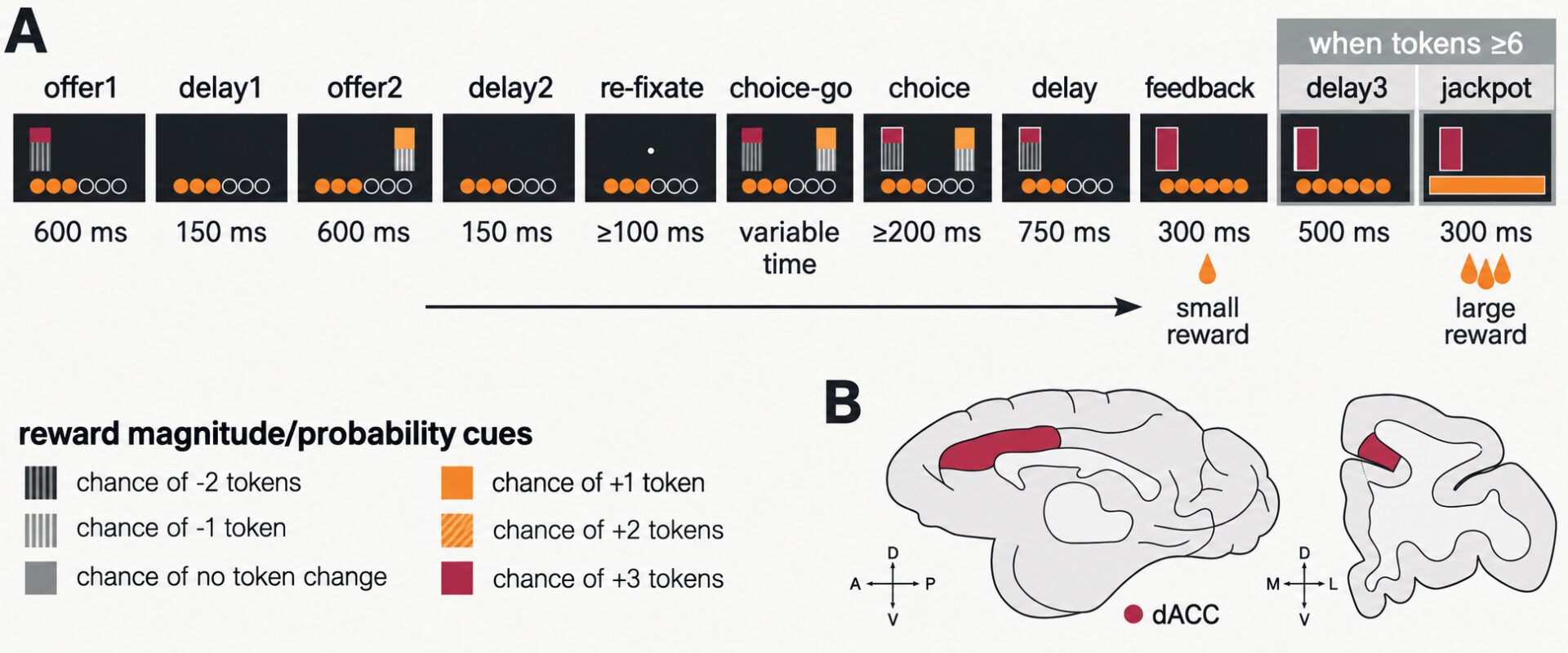
“From there I thought that perhaps, on reaching a certain number of tokens, a different strategy began to be used,” says Ferro. “Instead of simply comparing the two options against each other, what might start to matter is getting the tokens still missing to reach the jackpot.” He built a mathematical model in which the utility of an option depends both on its outcome and on how many tokens are already showing at the bottom of the screen.
The changeover between the two strategies is carried by a transition parameter, estimated from the data rather than fixed by hand. The estimate landed at around three tokens in both subjects. That is also where the arithmetic of the task puts it, since the largest available win is three: from three tokens onwards, the jackpot can be reached in a single trial. Compared against other reasonable models, and there were more of them than the three reported in the paper, the version with the moving reference predicted the subject’s real choices more accurately.
The framework behind this is prospect theory, introduced by Kahneman and Tversky in 1979, which holds that we judge outcomes as gains or losses relative to a reference point, and that a loss weighs more heavily than an equivalent gain. Ferro wanted both ingredients in the model, a reference point that moves with the token count, changing how offers are evaluated, and an asymmetry between gains and losses in the utility function.
“We were not only interested in finding the model that best reproduced the choices, but in checking whether the mechanism it proposed made sense in terms of the task and of decision-making,” Ferro says.
The cells lean towards gains
The second half of the study takes those models to the neural data; 129 single cells recorded in the dorsal anterior cingulate cortex while the subjects solved the task. Gains and losses here are the model’s own categories, measured against the moving reference, so with two tokens still missing even winning one can count as a loss. By that measure most offer values, around 57 per cent, fell on the loss side. Even so, more cells were tuned to potential gains, and their activity predicted the upcoming choice considerably better. The authors checked that trial numbers were not behind it: an effect driven by trial counts would have favoured losses, the more common category.
Ferro’s reading distinguishes between what an outcome is worth and what the brain needs in order to select an action. One possible explanation, he says, is that potential gains provide particularly useful information for deciding how to move towards the goal: depending on how many tokens are already in hand, a gain can be compared with another gain or with the tokens still missing.
“Potential gains may represent something more than the immediate value of an option: they can act as a prospective signal, indicating what can be obtained and which action can bring the goal closer.”
Demetrio Ferro, Computational Neuroscience group, CRM
That fits a region already associated with monitoring actions, their context and their consequences. The token count has a neural signal of its own in these recordings, and for much of the trial, away from the moments when the offers are on screen, more cells track it than track the value of the offers. What the reference-dependent model suggests is that the region does not simply track the token count and the risk of each option independently, and may also combine them, non-linearly, into a value that depends on where the subject stands relative to the jackpot. “For me that is one of the most interesting aspects of the work,” says Ferro. “The same signal that reports the potential value of a decision can also serve to orient future action towards a goal.”
The paper belongs to a longer line. Ferro has worked on attention in visual cortex, on how gaze gates and reactivates value signals in orbitofrontal cortex, and now on reward accumulation in the cingulate. What holds them together, he says, is cognitive selection: attention, gaze, the valuation of options and the pull of a distant goal are different processes, and every one of them can modulate neural activity and determine which information counts at a given moment.
He intends to follow the same principles at other levels of description, from single neurons and interactions between cortical layers up to the coarser signals that can be recorded in people, where he also sees translational potential, in understanding which of these mechanisms are altered in cognitive and motor dysfunction. For the moment the account rests on two subjects, 129 cells and a screen with six circles on it.
Reference
Ferro, D., Azab, H., Hayden, B. Y., & Moreno-Bote, R. (2026). Accumulation of virtual tokens towards a jackpot reward enhances performance and value encoding in dorsal anterior cingulate cortex. Nature Communications, 17, 7554. https://doi.org/10.1038/s41467-026-70423-1
More from the CRM
Almost every automaton can be reset with a short word
For a random automaton with n states, a word of about √n log n letters is almost always enough to reset it.CRM CommPau VarelaCRMComm@crm.catGet the latest CRM news and activities in your inbox.Recent newsletters →Picture a conveyor belt carrying...
Exposició ‘Les matemàtiques de Gaudí’
CRM quod erat demonstrandum | 48
ADA: Decoding Brain Signals Misaligned in Time
The study addresses a key limitation of current brain decoding techniques: the difficulty of interpreting internal mental processes whose temporal dynamics vary from trial to trial.Decoding what is happening in a person’s mind from their brain activity is one of the...
Rare curves, many points: Christophe Ritzenthaler and Rachel Pries on their research and the work around it
Christophe Ritzenthaler (Université de Rennes) and Rachel Pries (Colorado State University) both work on curves over finite fields: he hunts curves with as many points as possible, she hunts curves that almost never occur. In conversation with the CRM during their...
Call open for the 2027 Ferran Sunyer i Balaguer Prize
The Ferran Sunyer i Balaguer Foundation is accepting submissions for its 2027 prize, which awards 15,000 euros and publication in Birkhäuser's Progress in Mathematics series to an expository monograph on an active area of mathematical research. The deadline is 27...
Susanna Terracini delivers the CRM Colloquium 2026
Susanna Terracini (Università di Torino) delivered the CRM Colloquium 2026 on 14 July, presenting a rigidity result for Kepler billiards obtained with Stefano Baranzini, Vivina Barutello and Irene De Blasi. She was at the centre as a member of the CRM Scientific...
Ho Chi Minh City hosts the SEAMS School on applying mathematics to real-world problems
Students from across the region took courses and worked on group projects at a school co-organised by CRM researcher Tim Myers.CRM CommPau VarelaCRMComm@crm.catGet the latest CRM news and activities in your inbox.Recent newsletters →Between 4 and...
A single ball on a fixed table can compute: Eva Miranda and Isaac Ramos prove that two-dimensional billiards are Turing complete
Eva Miranda (UPC, CRM) and Isaac Ramos (ETH Zürich) show that a point particle bouncing inside a planar table with fixed walls can simulate a universal Turing machine, settling a question Cristopher Moore left open in 1990. The result grew out of a master’s project...
BMS-BGSMath Junior Meeting 2026: Barcelona and Berlin Strengthen Scientific Ties
From 2 to 4 September 2026, the Centre de Recerca Matemàtica (CRM) hosted the BMS-BGSMath Junior Meeting 2026, a three-day event jointly organised by the Berlin Mathematical School (BMS) and the Barcelona Graduate School of Mathematics (BGSMath), with the Centre de...
The CRM organises the 2026 Barcelona Summer School for Advanced Modeling of Behavior
The Centre de Recerca Matemàtica held the sixth edition of BAMB!, the Barcelona Summer School for Advanced Modeling of Behavior, from 12 to 23 July 2026 at the Parc de Recerca Biomèdica de Barcelona. Thirty early-career researchers from fourteen countries followed...