
In the first months of the 2022-2023 academic year, 5 pre-docs and 9 post-docs have joined the CRM research staff, 7 of which were supported by the Maria de Maeztu (MdM) award. They have joined groups from a wide spectrum of fields, from Mathematical Biology to Algebra, including Industrial Mathematics and Dynamical Systems. This growth in the staff of the CRM is good news for the quality of the Catalan mathematical research.
One of the indicators of the success of the recruitment process that the CRM studies is the gender balance reached. In this occasion, 6 out of the 14 new researchers incorporated during the period are women. Moreover, parity is reached in both categories: 2 out of 5 pre-docs are women and in the case of post-docs, the number is 4 out of 9.
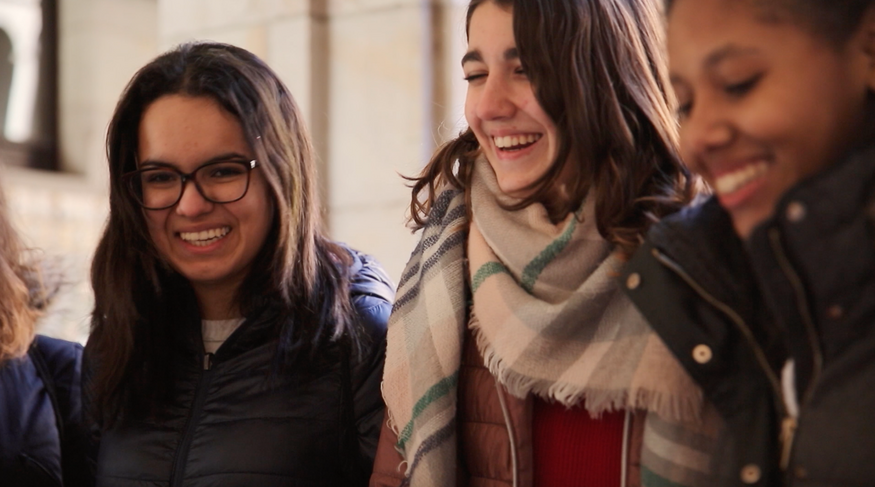
International Day of Women and Girls in Science 2018
There exists a general problem in recruiting female talent in STEM disciplines. In academia, the problem grows bigger as the research stage is more advanced, what is called the retention of talent: many women start as a PhD, however, very few of them become Professors. This is one of the motivations of the CRM focusing on the post-doc category to try new and fair methods to boost women recruitments. The MdM postdoc programme has applied a gender-bias conscious campaign and selection process. For the first call, out of seven hired postdocs, three of them are women.
First of all, the dissemination of the MdM post-doc call was done with a carefully designed campaign. The call was posted in Mathematics webpages that reach out to women (e.g: Women in Mathematics), was mindful with the language used and aimed for inclusiveness.
Secondly, the recruitment and selection method focused on engaging women as evaluators at all stages. In the first stage, a remote evaluation was conducted with 2 experts per candidate. In the second and last stage, the shortlisted candidates -a minimum of 3 and maximum of 6 per position- were interviewed by a panel of 3 members. The panels had at least a woman in every case. This was applied due to an unconscious bias of the interviewer: the similarities to their own self observed in the interviewee affect positively in its evaluation, as a result of the projection of their own strengths. Therefore, a wider variety of interviewers also helps to increase the chances of a wider variety of people getting the job.
In the last place, the focus is put in trying to maximize the number of female candidates that arrive to the interview. After the first stage, results are reviewed by a Panel chair so, for example, if two scores for the same candidate are differing by 20%, the moderator calls for a consensus meeting with the two evaluators, and eventually, organizes a third evaluation for that candidate. The Panel moderator also hands out to the Recruitment Committee handling the process at CRM (headed by Director and MdM Scientific Director) a shortlist of the candidates to be interviewed. In the MdM post-doc call, the shortlist was requested to be extended as to include one woman.
Arantxa Sanz, CRM’s Head of Strategy and member of the CRM Equity Committee, has driven the introduction of the gender perspective in the recruitment process. She participated in the final workshops of the LIBRA H2020 Project (1), addressing gender equality in academia and how to articulate gender plans and actions deriving from them. More specifically, one of the project work packages was focused on recruitment without Gender Bias (2), from which some of the ideas that have been implemented in the CRM-MdM postdoc recruitment method were hinted (some of them previously tested for the CAFE-ITN). She also got advice from the Universitat Autònoma de Barcelona’s Equality Observatory and collected some cases of good practices (e.g. Those from Anita’s Borg Institute (3)). Facts and knowledge on strategies that work are needed since some procedures to increase the number of women in research are not as fruitful as it would seem. For example, opening positions just for women doesn’t lead to a long-term change. For structural transformations, more subtle and strategic adjustments need to be introduced.
In the soon-to-start year, another MdM post-doc selection process will start, hopefully with results as good as this first round. These actions are one of the measures in the CRM Equity Plan (21-23) and are aligned with the goal of making science more approachable and giving more people the opportunity to shape research. As Arantxa states, gender is the first step to open to more kinds of diversity.
References:
(1) LIBRA H2020 project: https://www.eu-libra.eu/
(2) LIBRA’s Work Package: Recruiting without Gender Bias: https://www.eu-libra.eu/work-packages/recruit-without-gender-bias
(3) Anita Borg’s Institute (Google-related foundation, focused on attracting and retaining more women into technological careers) material:
https://anitab.org/wp-content/uploads/2020/08/woc-case-study-2018.pdf

CRM Comm Team
Anna Drou | Pau Varela
CRMComm@crm.cat
Subscribe for more CRM News
The CRM Mentoring Programme, as Told by One of Its Pairs
PhD student Joaquim Duran and mathematician Robert Cardona, one of the pairs in the CRM Mentoring ProgrammeJoaquim Duran (left) and Robert Cardona.CRM CommPau VarelaCRMComm@crm.catGet the latest CRM news and activities in your inbox.Recent...

When the reward comes within reach, the brain changes what it compares
As the tokens piled up, choices got faster and more accurate at the same time. The yardstick for judging each offer had moved.CRM CommPau VarelaCRMComm@crm.catGet the latest CRM news and activities in your inbox.Recent newsletters →Two subjects...

Almost every automaton can be reset with a short word
Guillaume Chapuy (Université Paris Cité, CNRS) and Guillem Perarnau (UPC, CRM) have shown that a random finite automaton with n states can, with high probability, be reset by a word of length of order √n log n. The result, published in ACM Transactions on Algorithms, pins the exponent at 1/2, the lower end of a decade of numerical estimates, and addresses the random version of the synchronization problem behind a conjecture Ján Černý posed in 1964 and which still remains open.
Exposició ‘Les matemàtiques de Gaudí’
CRM quod erat demonstrandum | 48

ADA: Decoding Brain Signals Misaligned in Time
The study addresses a key limitation of current brain decoding techniques: the difficulty of interpreting internal mental processes whose temporal dynamics vary from trial to trial.Decoding what is happening in a person’s mind from their brain activity is one of the...
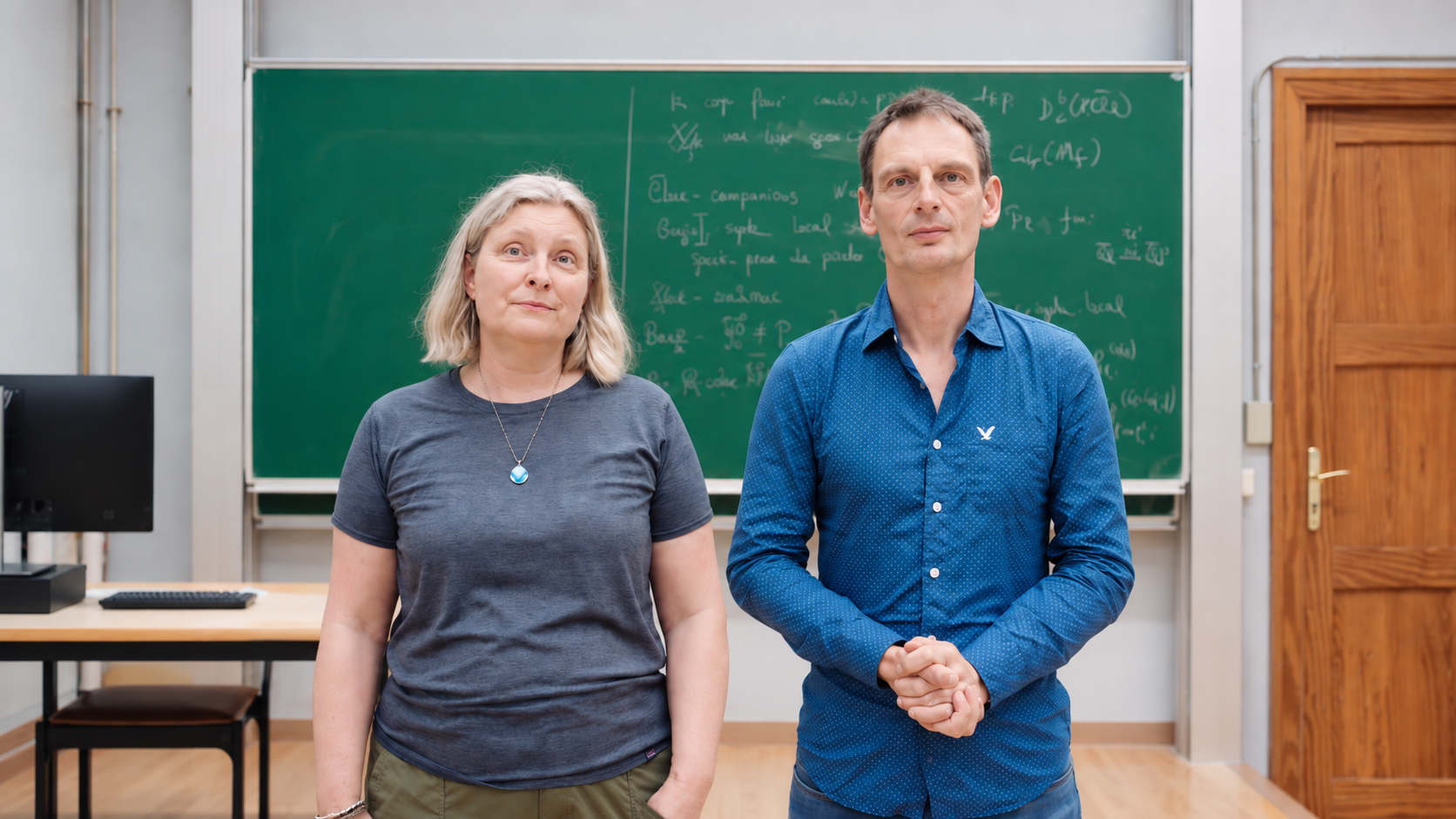
Rare curves, many points: Christophe Ritzenthaler and Rachel Pries on their research and the work around it
Christophe Ritzenthaler (Université de Rennes) and Rachel Pries (Colorado State University) both work on curves over finite fields: he hunts curves with as many points as possible, she hunts curves that almost never occur. In conversation with the CRM during their...

Call open for the 2027 Ferran Sunyer i Balaguer Prize
The Ferran Sunyer i Balaguer Foundation is accepting submissions for its 2027 prize, which awards 15,000 euros and publication in Birkhäuser's Progress in Mathematics series to an expository monograph on an active area of mathematical research. The deadline is 27...
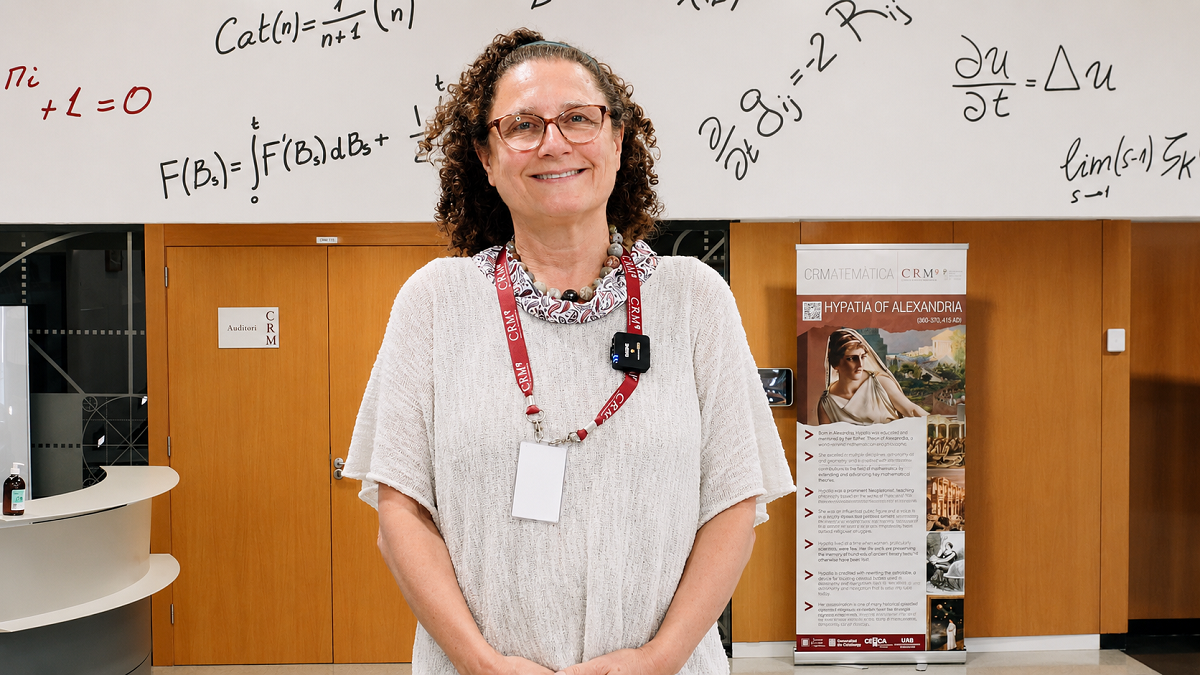
Susanna Terracini delivers the CRM Colloquium 2026
Susanna Terracini (Università di Torino) delivered the CRM Colloquium 2026 on 14 July, presenting a rigidity result for Kepler billiards obtained with Stefano Baranzini, Vivina Barutello and Irene De Blasi. She was at the centre as a member of the CRM Scientific...
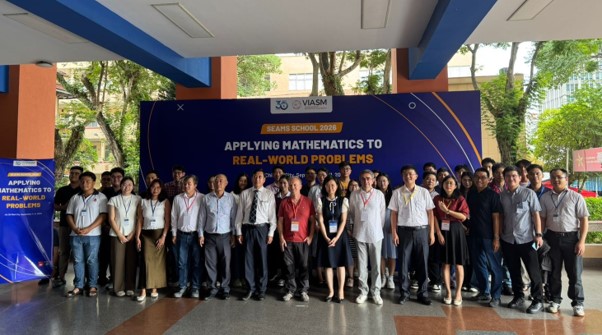
Ho Chi Minh City hosts the SEAMS School on applying mathematics to real-world problems
Students from across the region took courses and worked on group projects at a school co-organised by CRM researcher Tim Myers.CRM CommPau VarelaCRMComm@crm.catGet the latest CRM news and activities in your inbox.Recent newsletters →Between 4 and...

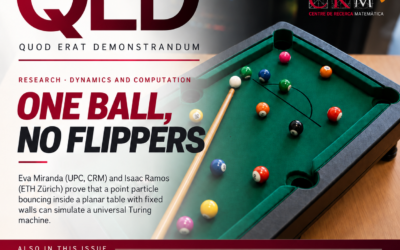
A single ball on a fixed table can compute: Eva Miranda and Isaac Ramos prove that two-dimensional billiards are Turing complete
Eva Miranda (UPC, CRM) and Isaac Ramos (ETH Zürich) show that a point particle bouncing inside a planar table with fixed walls can simulate a universal Turing machine, settling a question Cristopher Moore left open in 1990. The result grew out of a master’s project...
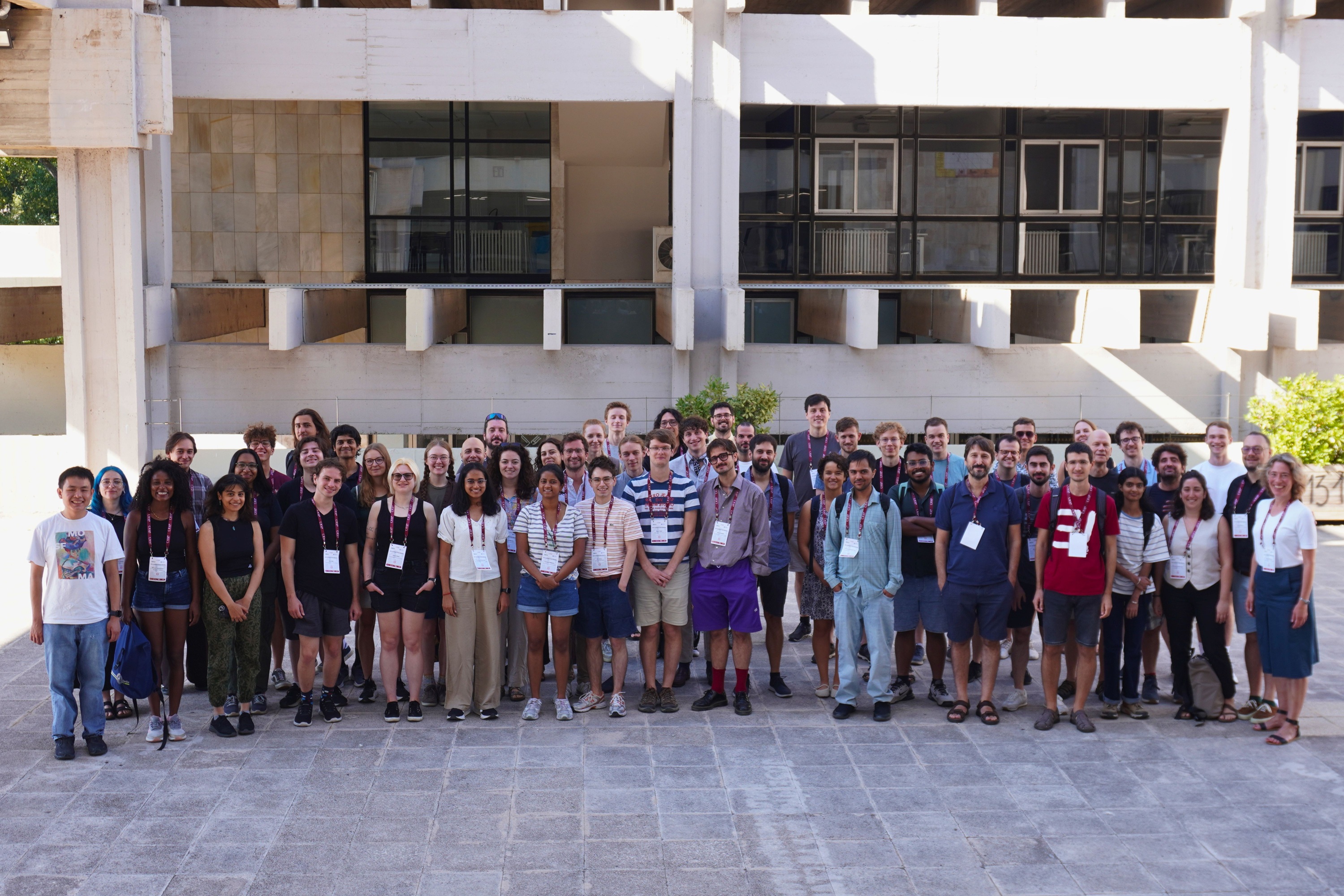
BMS-BGSMath Junior Meeting 2026: Barcelona and Berlin Strengthen Scientific Ties
From 2 to 4 September 2026, the Centre de Recerca Matemàtica (CRM) hosted the BMS-BGSMath Junior Meeting 2026, a three-day event jointly organised by the Berlin Mathematical School (BMS) and the Barcelona Graduate School of Mathematics (BGSMath), with the Centre de...