
The dynamicist Anna Florio (CEREMADE, Université Paris Dauphine-PSL) spends the summer at the CRM as the centre’s third María de Maeztu Chair of Excellence. She is working with Immaculada Baldomà and Tere Martínez-Seara on billiards in the analytic setting, and on 22 July she gives a colloquium at the UB on what friction does to a bouncing ball.
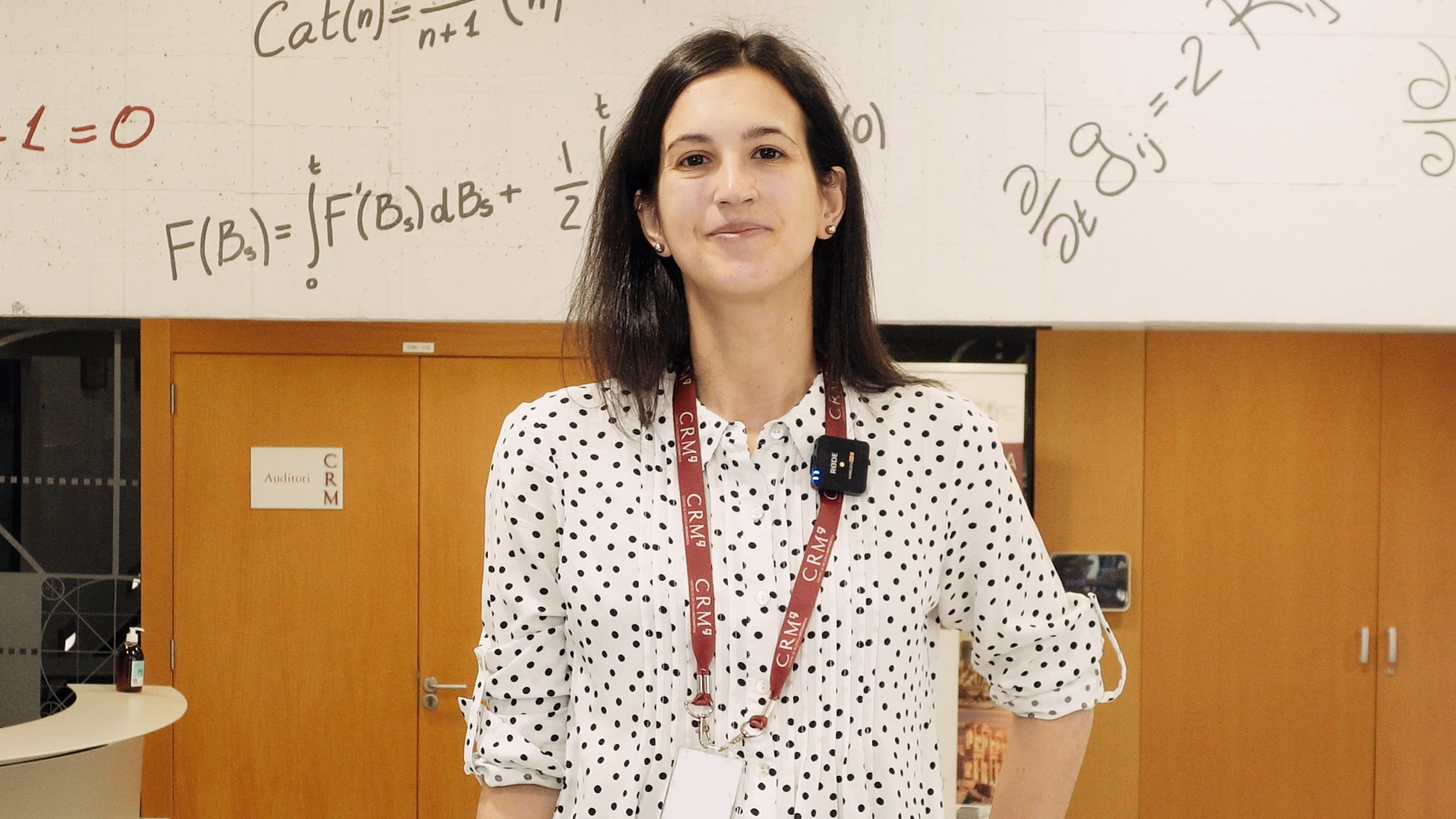
“As long as there is something that moves, I’m interested in what we can say about it.” That is how Anna Florio, assistant professor at Université Paris Dauphine-PSL and member of CEREMADE, sums up her field. Dynamical systems is the branch of mathematics that asks what happens to a system in the long run: whether it settles, repeats, or turns chaotic. Florio has spent her career on the low-dimensional end of that question, and this summer she is asking it from Barcelona, as the third CRM–María de Maeztu Chair of Excellence.
The Chair of Excellence, funded through the centre’s María de Maeztu Unit of Excellence, brings leading women mathematicians and computer scientists to the CRM for stays of up to four months. The idea behind it is deliberately double: to seed long-term collaborations between visiting researchers and the Barcelona mathematical community, and to put accomplished women mathematicians in front of the students who will come after them. Florio follows Chenchang Zhu (University of Göttingen), who inaugurated the programme in 2025, and María Ángeles García-Ferrero (ICMAT).
Florio wrote her doctoral thesis at Avignon Université under Marie-Claude Arnaud and Andrea Venturelli, held a postdoctoral position of the Fondation Sciences Mathématiques de Paris, and has been at Dauphine since 2021. From October she will also be a junior member of the Institut Universitaire de France. Her work runs through Reeb flows, symplectic dynamics, and, centrally for this visit, billiards.
The rules of the game
A mathematical billiard is easier to picture than most objects in her field. “You just do what you would do in a bar with friends,” she explains. “You take a ball; let’s say it’s massless. You put it somewhere on the boundary of your table, and you just have to shoot it.” The ball travels in a straight line, meets the boundary, and reflects with the angle of incidence equal to the angle of reflection. Then it does it again. Forever. George Birkhoff turned this game into a branch of dynamics in the early twentieth century (though Florio likes to point out that the first person to think about billiards in a circular table was Lewis Carroll, who was a mathematician before he was the author of Alice). Behind the simplicity of the rules sits nearly a century of open problems.
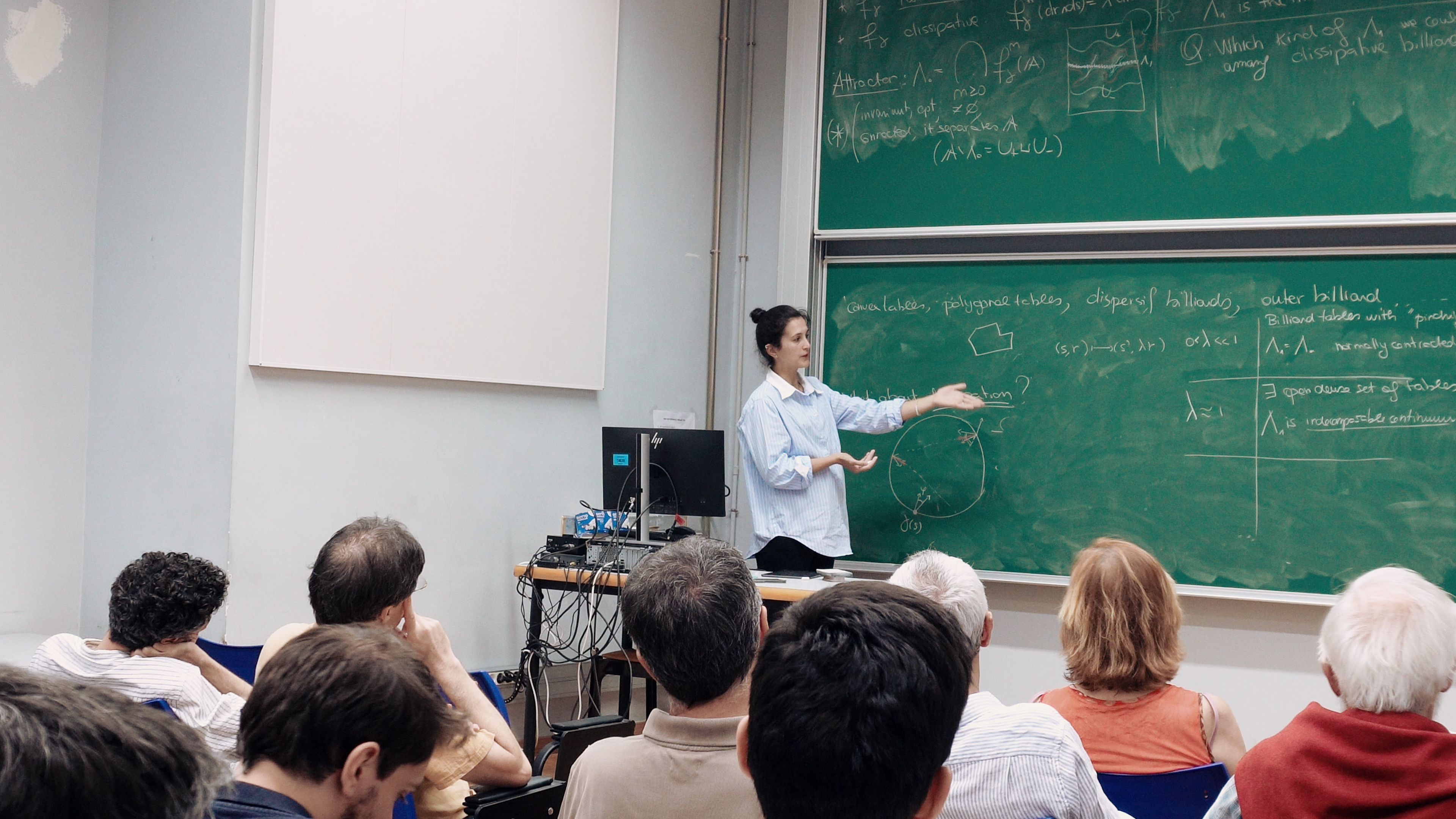
Anna Florio during her colloquium “The Dynamics of Billiards: Between Conservative and Dissipative Regimes” at the Facultat de Matemàtiques i Informàtica of the Universitat de Barcelona, 22 July 2026.
During her stay, Florio is working with Immaculada Baldomà and Tere Martínez-Seara, both at the Universitat Politècnica de Catalunya and the CRM, on billiards in the analytic setting: tables whose boundary is described by an analytic function, the most rigid framework the theory allows. Their ongoing project aims to show that, even under that rigidity, chaotic behaviour is not the exception among analytic billiards. It is what one should typically expect. A longer-term goal is universality, the idea that inside an analytic billiard one can find, encoded as a first return map, essentially any dynamics of the disc. She also plans to open a parallel conversation with Eva Miranda (UPC and CRM) on universality in flows connected to solutions of the Euler equation.
Why come for months rather than meet online? For Florio the answer is about the shape of mathematical time. “You can discuss with people one day, then you go back, you think about it, and the next day you come with new ideas,” she says. “You cannot say: we will solve these problems in one hour during a Zoom meeting.”
“There are women doing maths, and doing good maths”
The other purpose of the chair, visibility, is one she speaks about from experience. “It’s undeniable that there is a problem with the presence, or rather the absence, of women in mathematics, particularly in pure mathematics,” she says. Her own path ran through counterexamples: “My master’s thesis advisor was a woman, and one of my PhD advisors was a woman. For me that was really important, because I knew that there are women doing maths, and doing good maths, and enjoying it.” Programmes like the chair matter, she argues, for the PhD and master’s students who get to watch that up close.
“There is no reason why women should not go and do research in mathematics, if they love it.”
Her colloquium, The Dynamics of Billiards: Between Conservative and Dissipative Regimes, took place on 22 July at the Faculty of Mathematics and Computer Science of the Universitat de Barcelona. The talk moves from the classical, elastic world of Birkhoff billiards to what happens when the bounce loses energy. Add a little friction, so that each rebound bends the trajectory slightly toward the normal, and area is no longer preserved. Attractors appear, invariant sets that draw in every trajectory of the phase space. “Which kinds of attractors can there be? Are they simple, are they complicated?” she asks. Both, it turns out, depending on the strength of the dissipation.
More about Anna Florio’s work can be found on her personal page.
Watch the full interview with Anna Florio on the CRM’s YouTube channel.
Newsletter
Get the latest CRM news and activities delivered to your inbox
Subscribe now
Recent newsletters →

The CRM Mentoring Programme, as Told by One of Its Pairs
PhD student Joaquim Duran and mathematician Robert Cardona, one of the pairs in the CRM Mentoring ProgrammeJoaquim Duran (left) and Robert Cardona.CRM CommPau VarelaCRMComm@crm.catGet the latest CRM news and activities in your inbox.Recent...
When the reward comes within reach, the brain changes what it compares
As the tokens piled up, choices got faster and more accurate at the same time. The yardstick for judging each offer had moved.CRM CommPau VarelaCRMComm@crm.catGet the latest CRM news and activities in your inbox.Recent newsletters →Two subjects...

Almost every automaton can be reset with a short word
For a random automaton with n states, a word of about √n log n letters is almost always enough to reset it.CRM CommPau VarelaCRMComm@crm.catGet the latest CRM news and activities in your inbox.Recent newsletters →Picture a conveyor belt carrying...
Exposició ‘Les matemàtiques de Gaudí’

CRM quod erat demonstrandum | 48
|
|
CRM CommPau Varela
|