

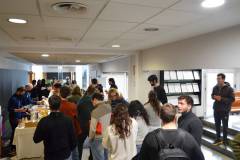
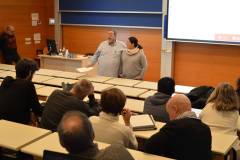
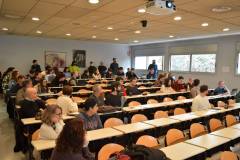
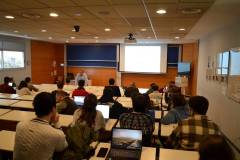


Lluís Alsedà, the director of the CRM, commenced the welcome day by expressing his satisfaction with both the quantity and diversity of individuals present at the center.
“In research, while individual contributions are fundamental, collective governance is equally essential. The feedback I receive assures me that we are on the right trajectory.”
The philosophy underlying the María de Maeztu award is not a project itself but rather a recognition aimed at enhancing research centers. Consequently, it is imperative to foster collaboration among different research groups from various institutions, as working independently is not persuasive to stakeholders and evaluators. To this end, a process of affiliations has been initiated to facilitate visualization and promote collaboration.
It is crucial to recognize that projects serve as a means rather than an end in themselves. The path forward entails executing tasks meticulously and adhering to high standards.
A brief presentation on the new incorporations in 2023 of the CRM followed his talk.

David Romero: “Mathematics in motion: Fostering Societal Impact through Knowledge Transfer”
Romero, head of the KTU, began the discussion at CRM by emphasizing a core aspect of the center’s mission: transferring research and methodologies to have a real impact on society, a principle enshrined in its statutes. Collaboration is key at CRM, as it partners with various research institutions, the private sector, institutions, SMEs, and industries to serve the broader community. The key word Romero used, was that KTU was based on the dialogue between society and investigation.
The Knowledge Transfer Unit (KTU) plays a vital role in this collaborative effort, acting as a bridge between CRM and external entities to foster partnerships. The KTU’s objectives include bringing CRM’s research and expertise back into society and addressing societal challenges by leveraging mathematical tools and expertise.
However, transferring mathematical concepts presents unique challenges due to their abstract nature and specialization, as Romero explained during the discussion. Nonetheless, situated within CRM, the KTU utilizes mathematical expertise to apply mathematics, take advantage of CRM’s position as a mathematical hub, and provide training opportunities.
Recent projects have covered a range of topics, from cybersecurity and data compression algorithms to pharmacological modeling, cooking steaks and microplastics analysis, reflecting CRM’s impact across various sectors. KENIA program allows enterprises to implement best practices in mathematics and programming.
One notable project arose from Transports de Barcelona, S.A (TB), seeking to enhance its Bus de Barri (BB) service by exploring the transition from fixed lines to a Demand-Responsive Transport (DRT) model. The challenge involved defining optimal and feasible routes while ensuring a smooth transition for existing users. The outcome improved mobility for TB’s service and garnered recognition at events such as the Transportation Research Board Annual Meeting. Additionally, CRM’s involvement in projects like Horizon Europe project EBRT2030 highlights its ongoing commitment to shaping transportation’s future.
In a promising development, new outcomes are emerging, including optimizing freight distribution and the study of gulls’ behavior as a Google Maps -in association with Institut de Ciències del Mar-, demonstrating CRM’s role in driving innovation and societal progress through mathematics.

Dr. Eva Miranda’s talk: “Paths that close… or not”
Eva Miranda‘s presentation began with the Seifert conjecture (1950), which initially suggested that a continuous vector field on the 3-sphere must contain a closed orbit. However, subsequent counterexamples, like Harrison’s \(C^2\) counterexample in 1988, challenged this notion. Miranda then provided a brief overview of symplectic and contact geometries to set the stage for the discussion.
She transitioned to an interesting anecdote about the “friendly floaters” – rubber ducks lost from the Ever Laurel carrier in 1992, with one resurfacing unexpectedly in Scotland in 2007. This led to a reflection on the unpredictable and complex behavior of fluids, such as lava and water.
The core question of Miranda’s talk revolved around whether fluids are complicated enough to perform computations and simulate Turing machines. A Turing machine is a mathematical model of computation describing an abstract machine that manipulates symbols according to a table of rules; it can be thought as a “printer” of a states in a long tape, and when it reaches the “halting” state” -the program stops-, it stops printing. Drawing from Turing’s work in 1936 on the undecidability of the Halting problem, Miranda posed the idea of associating Turing machines or supercomputers with the trajectories of rubber ducks, highlighting the connection between computational theory and fluid dynamics.
She introduced Moore’s paradigm shift, which generalized the concept of shift in dynamical systems, demonstrating their ability to simulate Turing machines, thus introducing a form of logical chaos. This raised the question of how one could link a Turing machine with a dynamical system, which Miranda explained by equating the halting of a Turing machine with a specific trajectory of a field entering an open set in M.
A significant breakthrough came in 2020 when Cardona, Peralta, Miranda, and Presas (Constructing Turing complete Euler flows in dimension 3, PNAS, 2021) demonstrated the existence of stationary Euler flows in dimension 3 that are Turing complete, representing a milestone in fluid computation.
In conclusion, Miranda highlighted the existence of undecidable fluid paths, underscoring the lack of algorithms capable of determining whether a trajectory will enter an open set. This solidified the concept of a fluid computer à la Feynman, paving the way for advancements in computational fluid dynamics.

Dr. Alex Roxin’s talk: “The formation and long-term dynamics of memory in the hippocampus”
Alex Roxin discussed the dynamics of memory formed in the hippocampus and candidate mechanisms for episodic memory to optimize the storage of information in neurons through synaptic plasticity and its association with learning.
Synaptic plasticity is the ability of neurons to modify the strength of their connections; it is a neurophysiological process involved in brain network development and reorganization after damage. Altogether with Ye Lin (Ye Li and Roxin, PLoS Comp Biol 2023), they experimentally discovered a rule that allows for optimal storage of information in neurons. When looking for a mechanism to optimize learning in our daily life, and specifically, episodic memory (which involves the ability to learn, store, and retrieve information that occurs in daily life that is formed after a single exposure to novel stimuli), this new model looks like a good candidate mechanism for it.
This new mechanism, a recently discovered form of in-vivo plasticity called Behavioral Time-scale Plasticity (BTSP), leads to the generation of a place cell in CA1 from a previously silent cell after a single intracellular plateau potential (PP). They show that this one-shot learning process is well-described by a one-dimensional map, which updates the synaptic weight matrix after the PP. The map allows us to calculate the correlation of the weight matrix with all past explored environments analytically. When only a small fraction of cells are place cells in any given environment, we show that the full dynamics of a recurrent network endowed with BTSP is equivalent to its projection onto a series of weakly interacting manifolds, one for each environment, which can be represented by ring models. Interestingly, this weak interaction, actually enhances the memory capacity by stabilizing remote memories which otherwise would be unretrievable.

Subscribe for more CRM News
|
|
CRM CommPau Varela & Mariona Fucho
|
Jagged walls and unknown edges: a workshop on free boundary problems
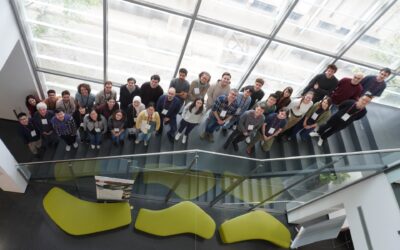
From 2 to 6 November, the Workshop on Free Boundary Problems brought together more than fifty registered participants from institutions in eleven countries at the CRM. Over five days they heard 21 talks on elliptic and parabolic free boundaries and on geometric measure theory and harmonic analysis in rough domains, with speakers including Guy David, Svitlana Mayboroda, Susanna Terracini and Robin Neumayer. The workshop was the second intensive week of the Intensive Research Programme on Analysis of Free Boundary Problems, which continues at the CRM until 4 December.
The CRM exhibition ‘Les matemàtiques de Gaudí’ moves to the University of Barcelona
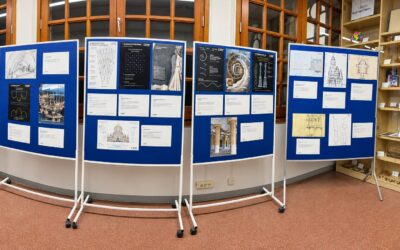
After its October run at the UAB, the exhibition Les matemàtiques de Gaudí, produced by the CRM, can be seen at the University of Barcelona’s CRAI Biblioteca de Matemàtiques i Informàtica from 2 to 30 November 2026.
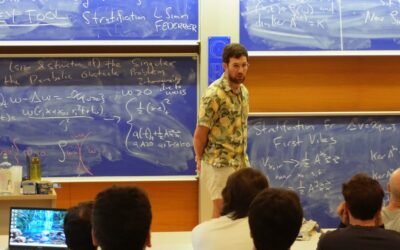
Advanced Course on Free Boundary Problems Opens the Intensive Weeks of the IRP
From 26 to 30 October, around forty researchers attended the Advanced Course on Free Boundary Problems at the CRM, three seven-hour mini-courses given by Bozhidar Velichkov (Università di Pisa), Max Engelstein (University of Minnesota) and Zihui Zhao (Johns Hopkins University). The course was the first of the two intensive weeks of the Intensive Research Programme on Analysis of Free Boundary Problems, which runs until 4 December.
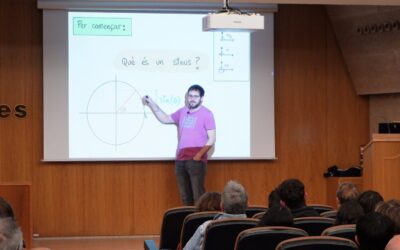
El CRM rep els estudiants de la prova de nivell de Bojos per les Matemàtiques 2027
Els aspirants a Bojos per les Matemàtiques 2027 van visitar el Centre de Recerca Matemàtica (CRM) dissabte 24 d’octubre, després de fer la prova de nivell a la Facultat de Ciències i Biociències de la UAB. En acabat, Tomás Sanz (UB-CRM) els va explicar què té a veure l’escalfament d’una barra de ferro amb els àudios de WhatsApp.
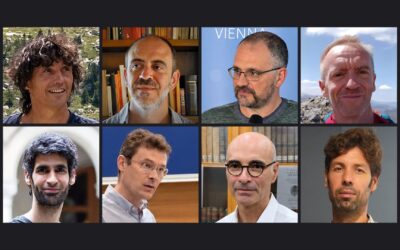
Eight CRM Researchers in the 2026 Stanford-Elsevier List of Highly Cited Scientists
The Centre de Recerca Matemàtica (CRM) has eight researchers in the 2026 update of the Stanford-Elsevier ranking of highly cited scientists, which John P. A. Ioannidis (Stanford University) and Jeroen Baas (Elsevier) compile from Scopus data. Xavier Cabré, Álvaro Corral, Tim Myers, Xavier Ros-Oton, Sergey Tikhonov and Xavier Tolsa appear both in the career-long ranking and in the one for 2025, and Diego Vidaurre and Simeon Ball in the 2025 ranking.
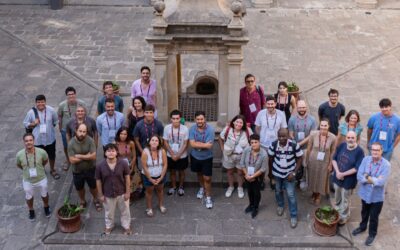
Fish schools and growing tissues: a workshop on how collective behaviour emerges
The Centre de Recerca Matemàtica (CRM) organised the Barcelona Workshop on Kinetic and Macroscopic Models in Biology with Friends II, held from 7 to 10 September at the Institut d’Estudis Catalans. More than thirty researchers discussed how order at the scale of tissues and animal groups arises from local interactions between individuals, in a programme that included talks by CRM researchers Daria Stepanova and Juan Arellano-Tintó. Two of the speakers, James Sharpe (EMBL Barcelona) and Chiara Villa (CNRS, Université Paris Cité), talked to the CRM about their research.
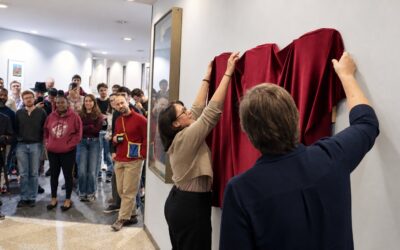
The CRM opens the academic year and unveils its Directors’ Gallery
A review of the year, the Communication Plan 2026–2030 and three research talks filled the morning of 19 October.The unveiling of the Directors’ Gallery.CRM CommPau VarelaCRMComm@crm.catGet the latest CRM news and activities in your inbox.Recent...
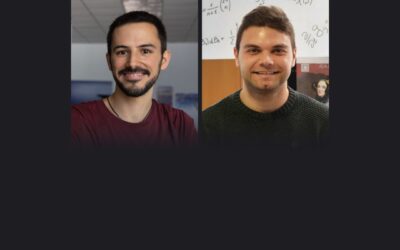
The CRM Mentoring Programme, as Told by One of Its Pairs
PhD student Joaquim Duran and mathematician Robert Cardona, one of the pairs in the CRM Mentoring ProgrammeJoaquim Duran (left) and Robert Cardona.CRM CommPau VarelaCRMComm@crm.catGet the latest CRM news and activities in your inbox.Recent...
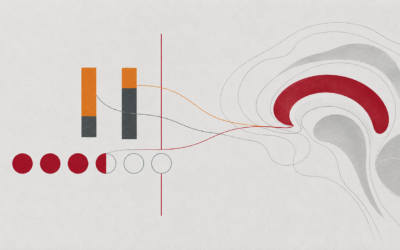
When the reward comes within reach, the brain changes what it compares
As the tokens piled up, choices got faster and more accurate at the same time. The yardstick for judging each offer had moved.CRM CommPau VarelaCRMComm@crm.catGet the latest CRM news and activities in your inbox.Recent newsletters →Two subjects...

Almost every automaton can be reset with a short word
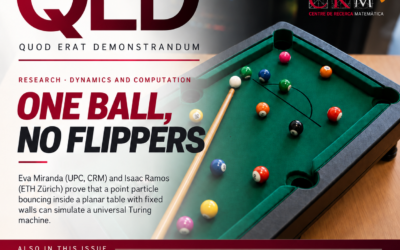
Guillaume Chapuy (Université Paris Cité, CNRS) and Guillem Perarnau (UPC, CRM) have shown that a random finite automaton with n states can, with high probability, be reset by a word of length of order √n log n. The result, published in ACM Transactions on Algorithms, pins the exponent at 1/2, the lower end of a decade of numerical estimates, and addresses the random version of the synchronization problem behind a conjecture Ján Černý posed in 1964 and which still remains open.
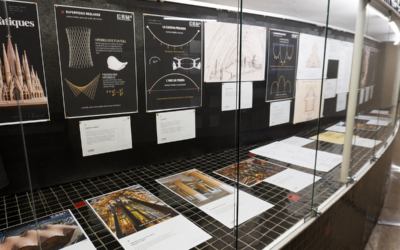
Exposició ‘Les matemàtiques de Gaudí’
CRM quod erat demonstrandum | 48
Pleateau Potential: sustained depolarization of a neuron’s membrane potential, typically lasting for hundreds of milliseconds to seconds
3-sphere: It may be embedded in 4-dimensional Euclidean space as the set of points equidistant from a fixed central point.
In coordinates, a 3-sphere with center (C0, C1, C2, C3) and radius r is the set of all points (x0, x1, x2, x3) in R4 such that:

Symplectic geometry deals with symplectic manifolds, which are smooth manifolds equipped with a closed nondegenerate differential 2-form, known as the symplectic form. Mathematically, a symplectic form on a manifold M is a closed 2-form ω that is nondegenerate, meaning that for any point p in M, the 2-form ω_p is nondegenerate. A differential 2-form can be thought of as measuring an infinitesimal oriented area, or 2-dimensional oriented density, meaning it can be integrated over 2-dimensional surfaces.
Contact geometry studies contact manifolds, which are odd-dimensional manifolds equipped with a maximally nondegenerate field of tangent hyperplanes, called the contact structure. A contact structure is defined by a globally defined 1-form α that is nondegenerate, meaning that α∧(dα)^n is a volume form on the manifold, where n is the dimension of the manifold. The contact structure α on a manifold M satisfies α∧(dα)^n≠0, where n is the dimension of M. Geometrically, this means that at each point on the manifold, there is a unique hyperplane (the kernel of α) that is tangent to the manifold.
Place cells: pyramidal cells in the hyppocampus that bece active when an animal enters a specific enironment (place field), they act as a cognitive representation of a specific location in space.
In-vitro plasticity: the ability of the brain to change its structure and function in response to experiences and environmental stimuli while the organism is alive