
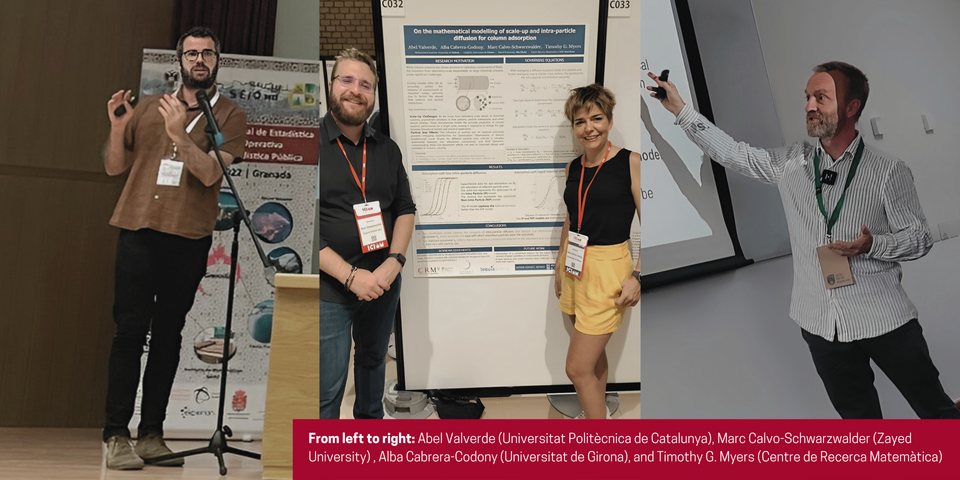
A new article by Abel Valverde (Universitat Politècnica de Catalunya), Alba Cabrera-Codony (Universitat de Girona), Marc Calvo-Schwarzwalder (Zayed University) and Timothy G. Myers (Centre de Recerca Matemàtica), published by the International Journal of Heat and Mass Transfer, proposes a mathematical formulation that, unlike standard models, focuses on the impact of adsorbent particle size on the efficiency of column sorption.
In our ongoing quest for a more sustainable future, one of the pivotal challenges we face is the removal of contaminants from our atmosphere and water. The most widely used method is a technique known as column sorption, either through absorption (where fluid molecules are dissolved or soaked up inside a solid or liquid) or adsorption (where molecules attach to a material’s surface). This process is like a molecular filter, selectively trapping and removing undesirable substances from gases or liquids as they flow through a column. Think of it as a super-efficient bouncer at a nightclub, only allowing the most unwanted party crashers to be ejected.
While this process may sound straightforward, the reality is much more intricate. Column sorption, as it stands, can be quite costly while more cost-effective alternatives do not offer the same environmental benefits. To understand why, we need to delve into the nitty-gritty of these filtration systems. Scientists typically start by testing small sorption columns about 1 to 15 centimetres long. However, real industrial-sized filters can be colossal in comparison, stretching up to 5 meters in length. Here’s the problem; what we discover from the small ones doesn’t always translate seamlessly to their bigger counterparts. A host of factors contributes to this unpredictability, including changes in flow patterns and the influence of wall proximity in small columns.

Now a team of researchers from the Universitat Politècnica de Catalunya, the Universitat de Girona, Zayed University, and the Centre de Recerca Matemàtica has developed a new mathematical model that accounts for the size of the adsorbent particles, which could help work around the scale-up problem when moving from experimental studies to working devices. This work sets up the basis to help us prepare for future research on how to make the big filters work better and be more cost-effective.
A Mathematical Model Accounting for Intra-particle Diffusion.
In the article, published by the International Journal of Heat and Mass Transfer, the research team has focused on a concept called intra-particle diffusion. This refers to how contaminants move within the adsorbent particles. As these particles grow in size, the time it takes for contaminants to reach the inner sanctum of adsorption sites also increases. Sometimes, this diffusion timescale becomes comparable to the adsorption timescale, leading to an imbalance in the governing equations. In simpler terms, it’s like a marathon where some runners have a head start and others need to catch up.
Another crucial aspect of sorption column studies is the breakthrough curve, a graphical representation of the concentration of contaminants at the column outlet over time that shows us how efficiently our filter works. To obtain a breakthrough curve, a column or adsorption bed filled with a solid adsorbent material is commonly used. In the column, a mixture containing the components to be separated is introduced. As the contaminants flow through the column, initially, our filter is at the peak of its performance, effectively capturing the unwanted components. However, as time goes on, it gets worn out and can’t catch any more.
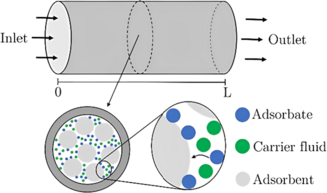
Schematic of the experimental setup.
To validate their models, the researchers turned to experiments to compare their findings with real-world breakthrough data. When they used bagasse fly ash as the adsorbent for wastewater treatment from a sugar distillery, for instance, smaller particles behaved predictably, producing a more common S-shaped breakthrough curve. However, larger particles marched to a different drumbeat, displaying an initial linear rise followed by an exponential increase. These findings deviated from more conventional mathematical models.
Similarly, when they looked at phosphorus removal with biochar microspheres, larger spheres exhibited a similar initial linear increase, followed by a slow decay, while smaller spheres followed a different pattern. Despite variations in materials and adsorption mechanisms, the common denominator appeared to be the impact of particle size.
Exploring the Environmental Applications of Diffusion
The study analyses comprehensive analytical models with and without intra-particle diffusion, based on linear and nonlinear sinks. The researchers developed a sophisticated mathematical formulation that takes into account the size of the particles and their internal diffusion. This model introduces a rate parameter, essentially a measure of how easily adsorbent particles allow contaminants to be absorbed. A high value means easy entry and a low value indicates difficulty. This parameter’s behaviour was confirmed through experiments, showing it’s sensitive to factors like inlet concentration and flow rate.
This model is more complex than traditional models involving mass balance and kinetic equations. However, it offers the advantage of accommodating size effects and intra-particle diffusion. In certain scenarios, it aligns with traditional models. Conversely, in cases where contaminants take their time to enter or adsorption mainly occurs on the particle’s outer surface, this model exhibits clear distinctions, surpassing traditional models in predicting breakthrough trends.
This study is part of a project funded by the Spanish Ministry of Science and Innovation and provides a significant contribution to our understanding of column sorption and contaminant removal. Future research endeavours may explore even more advanced models, including those that consider a broader range of effects, such as pore blocking by large molecules. As we continue our journey toward a cleaner tomorrow, the synergy between mathematics and environmental science remains one of our most potent tools.
Referenced article:
Valverde, A., Cabrera-Codony, A., Calvo-Schwarzwalder, M., & Myers, T. G. (2024). Investigating the impact of adsorbent particle size on column adsorption kinetics through a mathematical model. International Journal of Heat and Mass Transfer, 218, 124724.
RESEARCH TEAM





CRM Comm
Pau Varela
CRMComm@crm.cat
Subscribe for more CRM News

Almost every automaton can be reset with a short word
Guillaume Chapuy (Université Paris Cité, CNRS) and Guillem Perarnau (UPC, CRM) have shown that a random finite automaton with n states can, with high probability, be reset by a word of length of order √n log n. The result, published in ACM Transactions on Algorithms, pins the exponent at 1/2, the lower end of a decade of numerical estimates, and addresses the random version of the synchronization problem behind a conjecture Ján Černý posed in 1964 and which still remains open.

Exposició ‘Les matemàtiques de Gaudí’

CRM quod erat demonstrandum | 48

ADA: Decoding Brain Signals Misaligned in Time
The study addresses a key limitation of current brain decoding techniques: the difficulty of interpreting internal mental processes whose temporal dynamics vary from trial to trial.Decoding what is happening in a person’s mind from their brain activity is one of the...
Rare curves, many points: Christophe Ritzenthaler and Rachel Pries on their research and the work around it
Christophe Ritzenthaler (Université de Rennes) and Rachel Pries (Colorado State University) both work on curves over finite fields: he hunts curves with as many points as possible, she hunts curves that almost never occur. In conversation with the CRM during their...

Call open for the 2027 Ferran Sunyer i Balaguer Prize
The Ferran Sunyer i Balaguer Foundation is accepting submissions for its 2027 prize, which awards 15,000 euros and publication in Birkhäuser's Progress in Mathematics series to an expository monograph on an active area of mathematical research. The deadline is 27...
Susanna Terracini delivers the CRM Colloquium 2026
Susanna Terracini (Università di Torino) delivered the CRM Colloquium 2026 on 14 July, presenting a rigidity result for Kepler billiards obtained with Stefano Baranzini, Vivina Barutello and Irene De Blasi. She was at the centre as a member of the CRM Scientific...
Ho Chi Minh City hosts the SEAMS School on applying mathematics to real-world problems
Students from across the region took courses and worked on group projects at a school co-organised by CRM researcher Tim Myers.CRM CommPau VarelaCRMComm@crm.catGet the latest CRM news and activities in your inbox.Recent newsletters →Between 4 and...

A single ball on a fixed table can compute: Eva Miranda and Isaac Ramos prove that two-dimensional billiards are Turing complete
Eva Miranda (UPC, CRM) and Isaac Ramos (ETH Zürich) show that a point particle bouncing inside a planar table with fixed walls can simulate a universal Turing machine, settling a question Cristopher Moore left open in 1990. The result grew out of a master’s project...
BMS-BGSMath Junior Meeting 2026: Barcelona and Berlin Strengthen Scientific Ties
From 2 to 4 September 2026, the Centre de Recerca Matemàtica (CRM) hosted the BMS-BGSMath Junior Meeting 2026, a three-day event jointly organised by the Berlin Mathematical School (BMS) and the Barcelona Graduate School of Mathematics (BGSMath), with the Centre de...
The CRM organises the 2026 Barcelona Summer School for Advanced Modeling of Behavior
The Centre de Recerca Matemàtica held the sixth edition of BAMB!, the Barcelona Summer School for Advanced Modeling of Behavior, from 12 to 23 July 2026 at the Parc de Recerca Biomèdica de Barcelona. Thirty early-career researchers from fourteen countries followed...
Mallorca’s 1820 plague did not behave like a classic bubonic outbreak, study finds
A study in PNAS by Pere Puig (UAB, CRM) and Joana Maria Pujadas-Mora (UOC, ICREA) reports what happens when the daily health records kept in Son Servera and Capdepera during the 1820 outbreak are analysed with a Bayesian epidemiological model: an unusually short...