
La London Mathematical Society (LMS) va nomenar Eva Miranda, catedràtica de geometria i topologia de la Universitat Politècnica de Catalunya i membre del CRM, com a Hardy Lecturer de la societat per aquest any 2023, per la seva condició d'”investigadora matemàtica de gran reputació” que alhora “pot adreçar-se a un ampli públic matemàtic”. Com a part d’aquest guardó, la professora Miranda iniciarà aquest mes de maig un cicle de conferències a diversos departaments de matemàtiques a universitats del Regne Unit que durarà fins al setembre.

Per a Eva Miranda, “el Hardy Tour és alhora un honor sense precedents i un gran repte per mi. Requereix una preparació molt meticulosa en un moment on ja tenia diversos compromisos assolits a congressos i són 9 xerrades diferents. Això ha fet que el Tour tingui lloc en tres etapes.”
Aquesta gira inclou l’anomenada Hardy Lecture, que tindrà lloc a la reunió anual de la LMS el pròxim 30 de juny a la Mary Ward House de Londres i anirà precedida per una conferència a càrrec de Sir Roger Penrose, guanyador del Premi Nobel de Física el 2020 pels seus estudis sobre cosmologia. “Amb en Sir Roger Penrose ens hem trobat un parell de vegades per zoom per coordinar les nostres xerrades i hem parlat més de dues hores sobre matemàtiques, computabilitat i física quàntica i hem discutit diverses demostracions detallades. És un moment àlgid per mi tant a nivell professional com personal.”
La Hardy lecture s’inscriu en un congrés d’un dia que conclourà amb una exhibició d’art From it to to Bit: Psychedelic fluids inspirada per la interacció de teoria de Fluids i Computació”.
En total seran nou conferències les impartides per Eva Miranda, algunes de les quals es podran seguir en línia a través de Zoom, amb intervencions a universitats tan prestigioses com Oxford i Cambridge i la participació en el congrés de la Universitat d’Edimburg sobre Geometria Simplèctica.
La LMS Hardy Lectureship porta el nom de G.H. Hardy, expresident de la Societat i guanyador de la medalla De Morgan, per distingir a matemàtics de fora del Regne Unit. Eva Miranda és la primera matemàtica espanyola en rebre aquesta distinció.
A continuació podeu trobar el detall de les conferències que componen el Hardy Tour.
| 30 de maig |
Counting periodic orbits University of Cambridge, Cambridge Organiser: Maciej Dunajski |
+ INFORMATION |
| 1 de juny |
From Alan Turing to contact geometry: towards a “Fluid computer” The London Institute for Mathematical Sciences at the Royal Institution, London Organiser: Saksham Sharma |
+ INFORMATION |
| 26 de juny |
Desingularizing singular symplectic structures University of Birmingham, Birmingham Organiser: Marta Mazzocco |
+ INFORMATION |
| 28 de juny |
Euler flows as universal models for dynamical Systems University of Warwick, Coventry Organiser: José Rodrigo |
+ INFORMATION |
|
Hardy Lecture 30 de juny |
From Alan Turing to fluid computers: Explored and unexplored paths Mary Ward House, London Organiser: London Mathematical Society. Register at https://www.lms.ac.uk/civicrm/event/info?reset=1&id=97 Visionat conjunt a l’Institut d’Estudis Catalans (Barcelona) |
+ INFORMATION |
| 4 de juliol |
Singular Hamiltonian and Reeb Dynamics: First steps University of Oxford, Oxford Organisers: Andrew Dancer and Vivat Nanda |
+ INFORMATION |
| 6 de juliol |
Action-angle coordinates and toric actions on singular symplectic manifolds Loughborough Organisers: Sasha Veselov and Alexey Bolsinov |
|
| 19 de setembre |
From Symplectic to Poisson manifolds and back Edinburgh Organiser: José Figueroa-O’Farrill |
|
| 21 de setembre |
Quantizing via Polytope counting: Old and new Glasgow Organiser: Ian Strachan |
Eva Miranda és catedràtica de la Universitat Politècnica de Catalunya, especialitzada en Geometria Diferencial, Física Matemàtica i Sistemes Dinàmics. Ha estat guardonada amb diversos premis prestigiosos, com ara dos premis ICREA Academia el 2016 i el 2021, una Càtedra d’excel·lència 2017 de la FSMP a París, un premi Bessel el 2022 i el premi François Deruyts el 2022.

CRM Comm Team
Anna Drou | Pau Varela
Subscribe for more CRM News
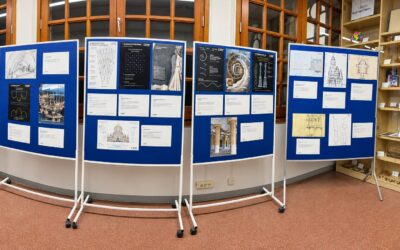
The CRM exhibition ‘Les matemàtiques de Gaudí’ moves to the University of Barcelona
After its October run at the UAB, the exhibition Les matemàtiques de Gaudí, produced by the CRM, can be seen at the University of Barcelona’s CRAI Biblioteca de Matemàtiques i Informàtica from 2 to 30 November 2026.
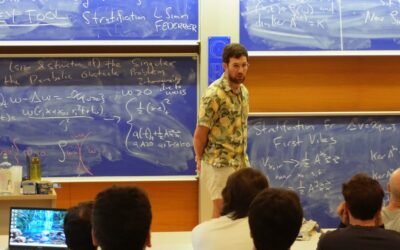
Advanced Course on Free Boundary Problems Opens the Intensive Weeks of the IRP
From 26 to 30 October, around forty researchers attended the Advanced Course on Free Boundary Problems at the CRM, three seven-hour mini-courses given by Bozhidar Velichkov (Università di Pisa), Max Engelstein (University of Minnesota) and Zihui Zhao (Johns Hopkins University). The course was the first of the two intensive weeks of the Intensive Research Programme on Analysis of Free Boundary Problems, which runs until 4 December.
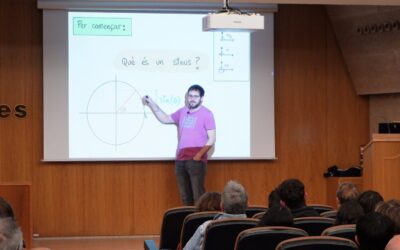
El CRM rep els estudiants de la prova de nivell de Bojos per les Matemàtiques 2027
Els aspirants a Bojos per les Matemàtiques 2027 van visitar el Centre de Recerca Matemàtica (CRM) dissabte 24 d’octubre, després de fer la prova de nivell a la Facultat de Ciències i Biociències de la UAB. En acabat, Tomás Sanz (UB-CRM) els va explicar què té a veure l’escalfament d’una barra de ferro amb els àudios de WhatsApp.
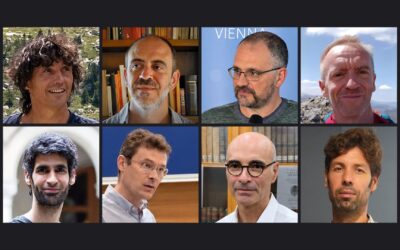
Eight CRM Researchers in the 2026 Stanford-Elsevier List of Highly Cited Scientists
The Centre de Recerca Matemàtica (CRM) has eight researchers in the 2026 update of the Stanford-Elsevier ranking of highly cited scientists, which John P. A. Ioannidis (Stanford University) and Jeroen Baas (Elsevier) compile from Scopus data. Xavier Cabré, Álvaro Corral, Tim Myers, Xavier Ros-Oton, Sergey Tikhonov and Xavier Tolsa appear both in the career-long ranking and in the one for 2025, and Diego Vidaurre and Simeon Ball in the 2025 ranking.
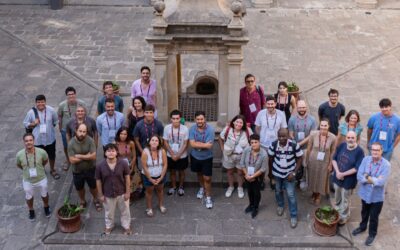
Fish schools and growing tissues: a workshop on how collective behaviour emerges
The Centre de Recerca Matemàtica (CRM) organised the Barcelona Workshop on Kinetic and Macroscopic Models in Biology with Friends II, held from 7 to 10 September at the Institut d’Estudis Catalans. More than thirty researchers discussed how order at the scale of tissues and animal groups arises from local interactions between individuals, in a programme that included talks by CRM researchers Daria Stepanova and Juan Arellano-Tintó. Two of the speakers, James Sharpe (EMBL Barcelona) and Chiara Villa (CNRS, Université Paris Cité), talked to the CRM about their research.
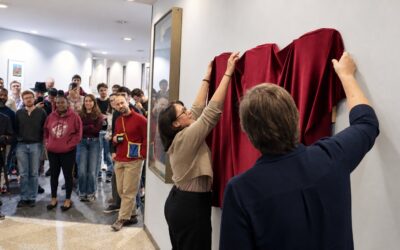
The CRM opens the academic year and unveils its Directors’ Gallery
A review of the year, the Communication Plan 2026–2030 and three research talks filled the morning of 19 October.The unveiling of the Directors’ Gallery.CRM CommPau VarelaCRMComm@crm.catGet the latest CRM news and activities in your inbox.Recent...
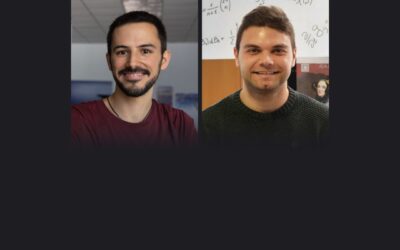
The CRM Mentoring Programme, as Told by One of Its Pairs
PhD student Joaquim Duran and mathematician Robert Cardona, one of the pairs in the CRM Mentoring ProgrammeJoaquim Duran (left) and Robert Cardona.CRM CommPau VarelaCRMComm@crm.catGet the latest CRM news and activities in your inbox.Recent...
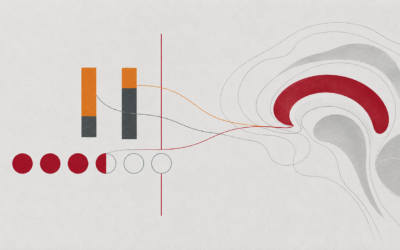
When the reward comes within reach, the brain changes what it compares
As the tokens piled up, choices got faster and more accurate at the same time. The yardstick for judging each offer had moved.CRM CommPau VarelaCRMComm@crm.catGet the latest CRM news and activities in your inbox.Recent newsletters →Two subjects...

Almost every automaton can be reset with a short word
Guillaume Chapuy (Université Paris Cité, CNRS) and Guillem Perarnau (UPC, CRM) have shown that a random finite automaton with n states can, with high probability, be reset by a word of length of order √n log n. The result, published in ACM Transactions on Algorithms, pins the exponent at 1/2, the lower end of a decade of numerical estimates, and addresses the random version of the synchronization problem behind a conjecture Ján Černý posed in 1964 and which still remains open.
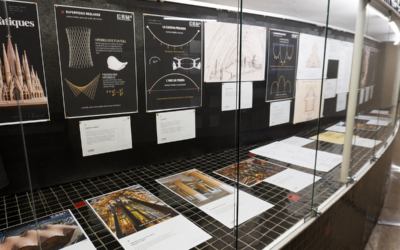
Exposició ‘Les matemàtiques de Gaudí’
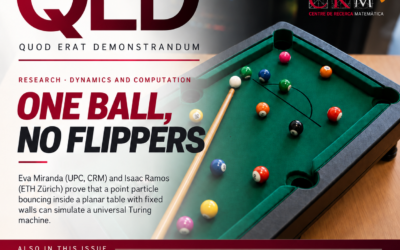
CRM quod erat demonstrandum | 48

ADA: Decoding Brain Signals Misaligned in Time
The study addresses a key limitation of current brain decoding techniques: the difficulty of interpreting internal mental processes whose temporal dynamics vary from trial to trial.Decoding what is happening in a person’s mind from their brain activity is one of the...