EscoLab és una iniciativa de Barcelona Ciència i Universitats de l’Ajuntament de Barcelona, amb la participació dels centres de recerca que ofereixen les diverses activitats.
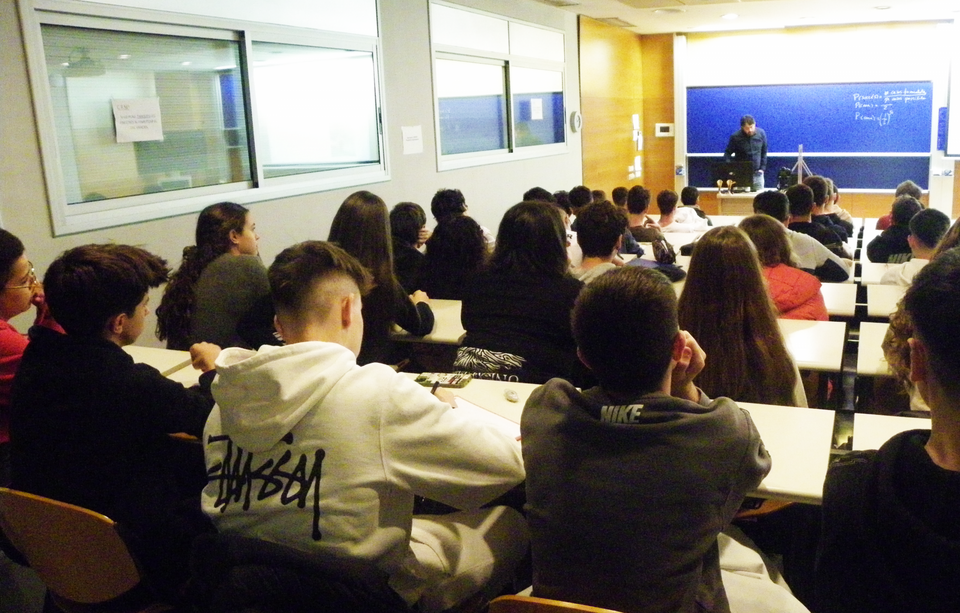
El passat 21 de novembre l’auditori del CRM va acollir un grup d’alumnes de 1er de Batxillerat de l’Escola Jaume Viladoms, a Sabadell, com a part del programa d’activitats de l’Escolab per aquest 2022-2023. L’activitat va anar a càrrec de Josep Sardanyés, investigador principal del Nonlinear Dynamics and Evolution (NoDE) Lab, amb el títol Què és el caos? i va consistir en un taller pràctic que feia visible el caos gràcies a un pèndul doble fabricat amb materials reciclats. El pèndul va permetre als alumnes observar les trajectòries erràtiques dibuixades amb la llum, proporcionada per dos llums LED a cada extrem del pèndul, i fins i tot va poder explorar formes de posar ordre en aquest caos per convertir-lo en un moviment ordenat.


La presentació també va mostrar als alumnes com el caos es ben present a la naturalesa i com ens afecta en coses tan quotidianes com el poder realitzar previsions del temps amb prou antelació. Els alumnes van poder també fer una competició per veure qui era capaç de seguir el moviment del pèndul millor i dibuixar-lo amb precisió.
Aquest taller és el primer de les quatre sessions que es realitzaran al CRM dintre del programa de l’Escolab d’enguany, adreçades a alumnat d’ESO, de batxillerat i de cicles formatius. Les activitats consisteixen en tallers presencials o visites que permeten veure la gran diversitat de laboratoris que hi ha avui i entrar en contacte directe amb els equips multidisciplinaris que hi treballen i les línies de recerca que segueixen.


CRM Comm Team
Anna Drou | Pau Varela
CRMComm@crm.cat
Subscribe for more CRM News
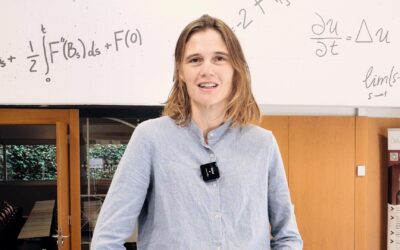
Maria Bruna visits the CRM through the María Wonenburger SOMMa Lecture Series
Maria Bruna, Royal Society University Research Fellow at the University of Oxford, visited the CRM in October through the María Wonenburger SOMMa Lecture Series, a new visiting programme run by Spain’s five SOMMa mathematics centres. During her stay she gave a minicourse on stochastic particle systems and active matter and started new collaborations in Barcelona. In an interview for the CRM, she also talked about María Wonenburger, the mathematician the series is named after.
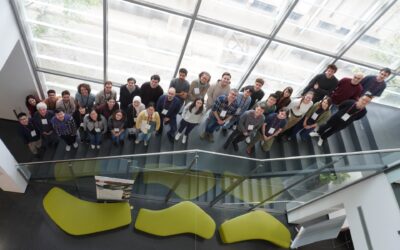
Jagged walls and unknown edges: a workshop on free boundary problems
From 2 to 6 November, the Workshop on Free Boundary Problems brought together more than fifty registered participants from institutions in eleven countries at the CRM. Over five days they heard 21 talks on elliptic and parabolic free boundaries and on geometric measure theory and harmonic analysis in rough domains, with speakers including Guy David, Svitlana Mayboroda, Susanna Terracini and Robin Neumayer. The workshop was the second intensive week of the Intensive Research Programme on Analysis of Free Boundary Problems, which continues at the CRM until 4 December.
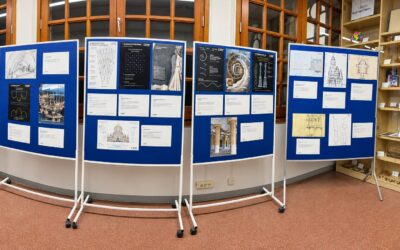
The CRM exhibition ‘Les matemàtiques de Gaudí’ moves to the University of Barcelona
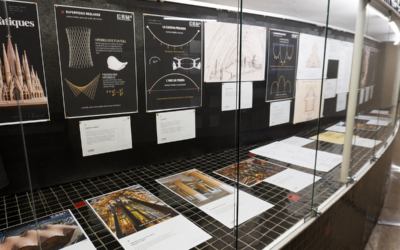
After its October run at the UAB, the exhibition Les matemàtiques de Gaudí, produced by the CRM, can be seen at the University of Barcelona’s CRAI Biblioteca de Matemàtiques i Informàtica from 2 to 30 November 2026.
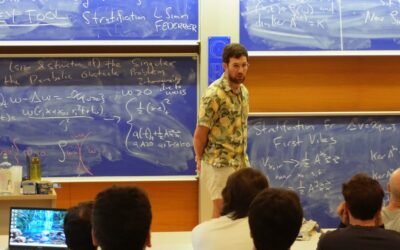
Advanced Course on Free Boundary Problems Opens the Intensive Weeks of the IRP
From 26 to 30 October, around forty researchers attended the Advanced Course on Free Boundary Problems at the CRM, three seven-hour mini-courses given by Bozhidar Velichkov (Università di Pisa), Max Engelstein (University of Minnesota) and Zihui Zhao (Johns Hopkins University). The course was the first of the two intensive weeks of the Intensive Research Programme on Analysis of Free Boundary Problems, which runs until 4 December.
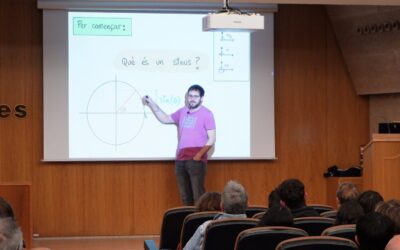
El CRM rep els estudiants de la prova de nivell de Bojos per les Matemàtiques 2027
Els aspirants a Bojos per les Matemàtiques 2027 van visitar el Centre de Recerca Matemàtica (CRM) dissabte 24 d’octubre, després de fer la prova de nivell a la Facultat de Ciències i Biociències de la UAB. En acabat, Tomás Sanz (UB-CRM) els va explicar què té a veure l’escalfament d’una barra de ferro amb els àudios de WhatsApp.
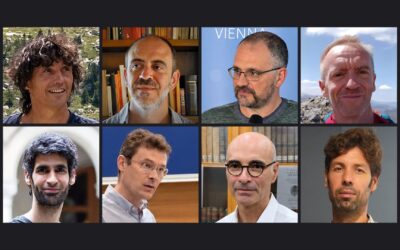
Eight CRM Researchers in the 2026 Stanford-Elsevier List of Highly Cited Scientists
The Centre de Recerca Matemàtica (CRM) has eight researchers in the 2026 update of the Stanford-Elsevier ranking of highly cited scientists, which John P. A. Ioannidis (Stanford University) and Jeroen Baas (Elsevier) compile from Scopus data. Xavier Cabré, Álvaro Corral, Tim Myers, Xavier Ros-Oton, Sergey Tikhonov and Xavier Tolsa appear both in the career-long ranking and in the one for 2025, and Diego Vidaurre and Simeon Ball in the 2025 ranking.
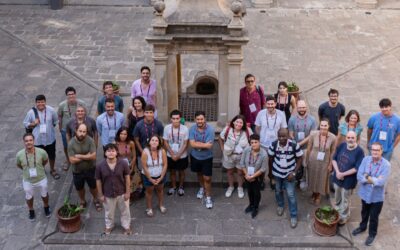
Fish schools and growing tissues: a workshop on how collective behaviour emerges
The Centre de Recerca Matemàtica (CRM) organised the Barcelona Workshop on Kinetic and Macroscopic Models in Biology with Friends II, held from 7 to 10 September at the Institut d’Estudis Catalans. More than thirty researchers discussed how order at the scale of tissues and animal groups arises from local interactions between individuals, in a programme that included talks by CRM researchers Daria Stepanova and Juan Arellano-Tintó. Two of the speakers, James Sharpe (EMBL Barcelona) and Chiara Villa (CNRS, Université Paris Cité), talked to the CRM about their research.
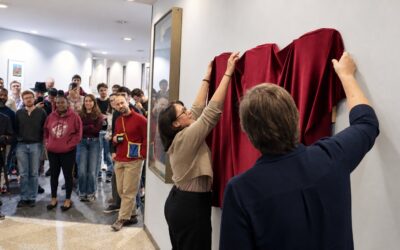
The CRM opens the academic year and unveils its Directors’ Gallery
A review of the year, the Communication Plan 2026–2030 and three research talks filled the morning of 19 October.The unveiling of the Directors’ Gallery.CRM CommPau VarelaCRMComm@crm.catGet the latest CRM news and activities in your inbox.Recent...
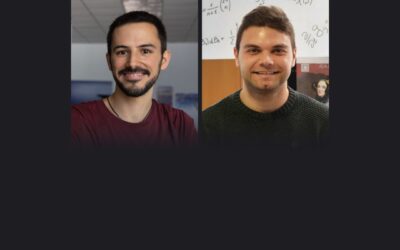
The CRM Mentoring Programme, as Told by One of Its Pairs
PhD student Joaquim Duran and mathematician Robert Cardona, one of the pairs in the CRM Mentoring ProgrammeJoaquim Duran (left) and Robert Cardona.CRM CommPau VarelaCRMComm@crm.catGet the latest CRM news and activities in your inbox.Recent...
When the reward comes within reach, the brain changes what it compares
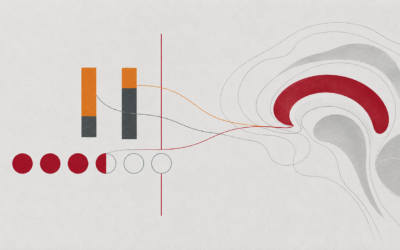
As the tokens piled up, choices got faster and more accurate at the same time. The yardstick for judging each offer had moved.CRM CommPau VarelaCRMComm@crm.catGet the latest CRM news and activities in your inbox.Recent newsletters →Two subjects...

Almost every automaton can be reset with a short word
Guillaume Chapuy (Université Paris Cité, CNRS) and Guillem Perarnau (UPC, CRM) have shown that a random finite automaton with n states can, with high probability, be reset by a word of length of order √n log n. The result, published in ACM Transactions on Algorithms, pins the exponent at 1/2, the lower end of a decade of numerical estimates, and addresses the random version of the synchronization problem behind a conjecture Ján Černý posed in 1964 and which still remains open.