A total of eight CRM researchers appear on the updated version for the 2021 list and the career-long list, based on standardized information on citation metrics and other factors that measure the impact of a researcher’s work.

From top to bottom, left to right: Tim Myers (CRM | Industrial Mathematics), Álvaro Corral (CRM | Complex Systems), Sergey Tikhonov (ICREA-CRM | Harmonic Analysis and Approximation Theory), Àngel Jorba (UB-CRM | Dynamical Systems), Xavier Cabré (ICREA-UPC-CRM | Analysis and Partial Differential Equations), Xavier Tolsa (ICREA-UAB-CRM | Analysis and Partial Differential Equations), Xavier Ros-Oton (ICREA-UB-CRM | Analysis and Partial Differential Equations) and Pere Ara (UAB-CRM | Algebra, Geometry, Number Theory and Topology).
The Stanford University (USA) has recently released an update of the list that ranks the top two percent of the world’s most-cited scientists during 2020, including seven researchers from the CRM, and the top two percent of the world’s most-cited scientists for career-long citations.
The prestigious single-year impact list includes CRM researchers Tim Myers, from the Industrial Mathematics group, Álvaro Corral, from the Complex Systems group, Sergey Tikhonov, ICREA-CRM researcher from the Analysis group, Xavier Cabré, ICREA-UPC-CRM researcher from Analysis and Partial Differential Equations, Àngel Jorba, UB-CRM researcher from Dynamical Systems, Xavier Ros-Oton, ICREA-UB-CRM researcher form Analysis and Partial Differential Equations, and Xavier Tolsa, ICREA-CRM-UAB researcher from Analysis and Partial Differential Equations.
About the study
The list, created by Professor John P. A. Ioannidis (an expert in data science) from Stanford University and his research team, contains a publicly available database that provides standardized information on citations, h-index, co-authorship-adjusted hm-index, citations to papers in different authorship positions, and a composite indicator. It is based on the bibliometric data included in the Scopus database, and comprises more than 100,000 researchers from 144 countries, out of 8 million scientists considered to be active worldwide (according to UNESCO data), classified in 22 scientific fields and 176 subfields.
Additionally, the study also includes a similar list compiling data for researcher’s entire careers, considering articles published between 1960 and 2019. This career-long list includes, from the aforementioned CRM members, Tim Myers, Álvaro Corral, Xavier Cabré, Xavier Tolsa and Àngel Jorba, alongside CRM-UAB researcher Pere Ara, from Algebra, Geometry, Number Theory and Topology.
Original reference:
Baas, Jeroen; Boyack, Kevin; Ioannidis, John P.A. (2021), “August 2021 data-update for “Updated science-wide author databases of standardized citation indicators“”, Mendeley Data, V3, doi: 10.17632/btchxktzyw.3
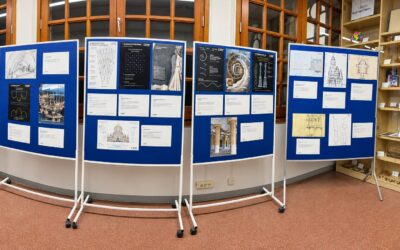
The CRM exhibition ‘Les matemàtiques de Gaudí’ moves to the University of Barcelona
After its October run at the UAB, the exhibition Les matemàtiques de Gaudí, produced by the CRM, can be seen at the University of Barcelona’s CRAI Biblioteca de Matemàtiques i Informàtica from 2 to 30 November 2026.
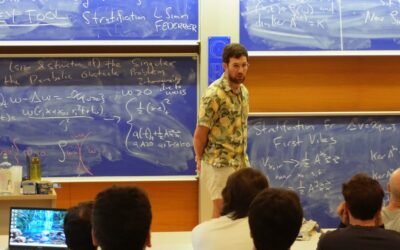
Advanced Course on Free Boundary Problems Opens the Intensive Weeks of the IRP
From 26 to 30 October, around forty researchers attended the Advanced Course on Free Boundary Problems at the CRM, three seven-hour mini-courses given by Bozhidar Velichkov (Università di Pisa), Max Engelstein (University of Minnesota) and Zihui Zhao (Johns Hopkins University). The course was the first of the two intensive weeks of the Intensive Research Programme on Analysis of Free Boundary Problems, which runs until 4 December.
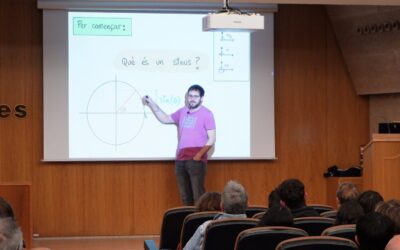
El CRM rep els estudiants de la prova de nivell de Bojos per les Matemàtiques 2027
Els aspirants a Bojos per les Matemàtiques 2027 van visitar el Centre de Recerca Matemàtica (CRM) dissabte 24 d’octubre, després de fer la prova de nivell a la Facultat de Ciències i Biociències de la UAB. En acabat, Tomás Sanz (UB-CRM) els va explicar què té a veure l’escalfament d’una barra de ferro amb els àudios de WhatsApp.
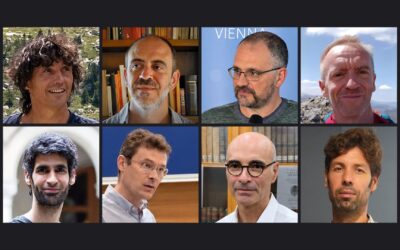
Eight CRM Researchers in the 2026 Stanford-Elsevier List of Highly Cited Scientists
The Centre de Recerca Matemàtica (CRM) has eight researchers in the 2026 update of the Stanford-Elsevier ranking of highly cited scientists, which John P. A. Ioannidis (Stanford University) and Jeroen Baas (Elsevier) compile from Scopus data. Xavier Cabré, Álvaro Corral, Tim Myers, Xavier Ros-Oton, Sergey Tikhonov and Xavier Tolsa appear both in the career-long ranking and in the one for 2025, and Diego Vidaurre and Simeon Ball in the 2025 ranking.
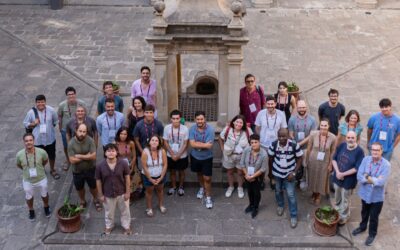
Fish schools and growing tissues: a workshop on how collective behaviour emerges
The Centre de Recerca Matemàtica (CRM) organised the Barcelona Workshop on Kinetic and Macroscopic Models in Biology with Friends II, held from 7 to 10 September at the Institut d’Estudis Catalans. More than thirty researchers discussed how order at the scale of tissues and animal groups arises from local interactions between individuals, in a programme that included talks by CRM researchers Daria Stepanova and Juan Arellano-Tintó. Two of the speakers, James Sharpe (EMBL Barcelona) and Chiara Villa (CNRS, Université Paris Cité), talked to the CRM about their research.
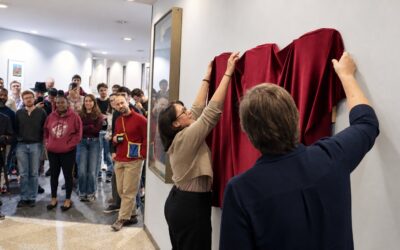
The CRM opens the academic year and unveils its Directors’ Gallery
A review of the year, the Communication Plan 2026–2030 and three research talks filled the morning of 19 October.The unveiling of the Directors’ Gallery.CRM CommPau VarelaCRMComm@crm.catGet the latest CRM news and activities in your inbox.Recent...