
A new method redefines how scientists can track jet streams, the high-altitude currents that shape weather patterns worldwide. Called JetLag, the algorithm treats jets as coherent structures in the flow of air rather than simply fast winds, recovering 85 years of atmospheric history with no hand-tuned parameters and a sensitivity to its settings more than fifty times lower than existing approaches.
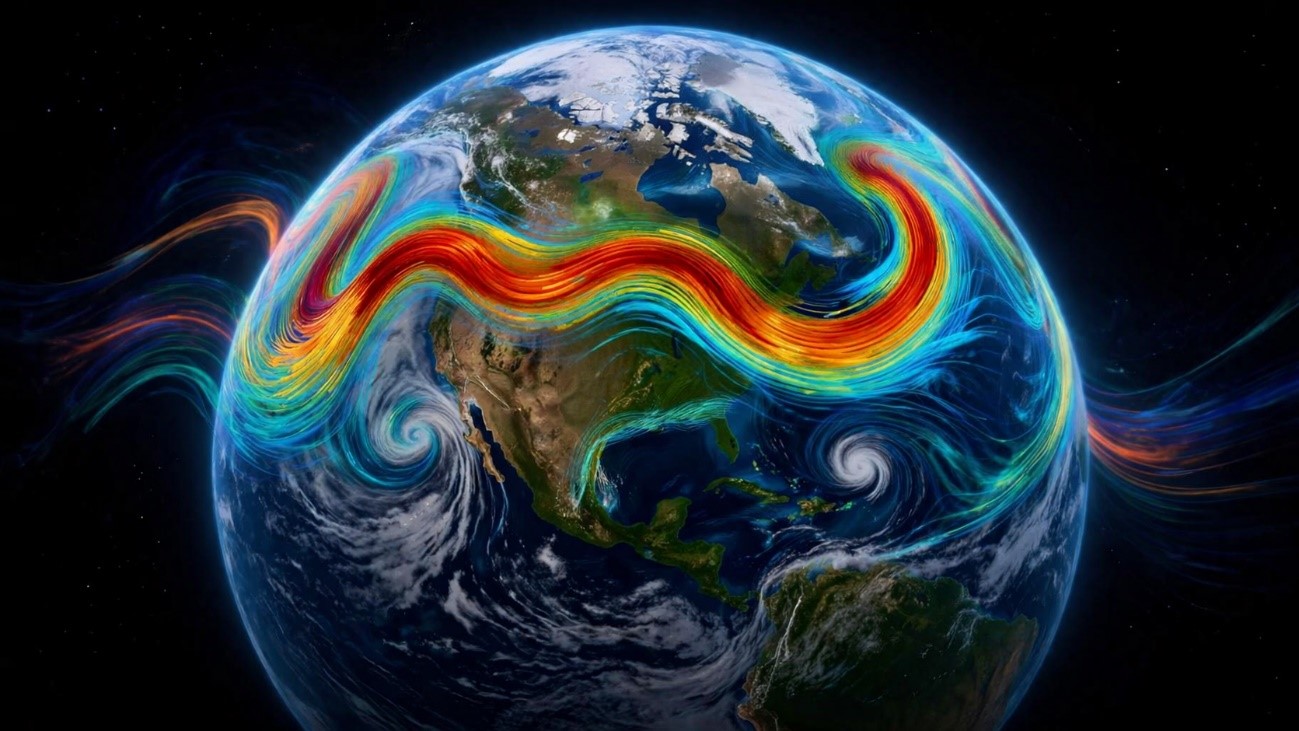
When a large wildfire sends smoke into the upper atmosphere, something odd happens. The smoke does not spread evenly. It stretches along a narrow corridor, curving and bending for thousands of kilometres, and on one side of that corridor, the air stays clean. The boundary is sharp, visible from space, and it follows the path of a jet stream.
Jet streams sit roughly ten kilometres above the surface. They are fast, persistent currents of air that wrap around the planet in sinuous bands, shaping the weather systems that reach us on the ground, from winter storms to summer heatwaves. Jets play a central role in weather and climate.
How to find them is another story.
A study published in Communications Earth & Environment, co-authored by Louis Rivoire (Massachusetts Institute of Technology), Jezabel Curbelo (Full Professor at Universitat Politècnica de Catalunya, CRM affiliated researcher and 2025 Premio Nacional de Investigación laureate), and Marianna Linz (Harvard University), proposes a different way to track these currents. Their method, called JetLag, deviates from the conventional approach of looking for fast winds and instead treats jet streams as coherent structures in the flow of air, capturing their behaviour as transport barriers that separate distinct air masses over time. It proposes a different way to track these currents.
“Trying to follow the same atmospheric features using these Eulerian methods was hopeless. The atmosphere is simply too noisy.”
The standard way to locate a jet is to define it as a maximum of wind speed at a given point in the atmosphere. This is the Eulerian perspective, named after the eighteenth-century mathematician Leonhard Euler: it describes the flow at fixed points in space. The problem, as the paper illustrates, is that these wind maxima can jump between locations from one time step to the next, producing a physically implausible picture of the jet. A powerful wind created by air flowing over a mountain, for instance, can register as a jet even where no coherent stream exists. Meanwhile, regions with lower wind speeds that nonetheless support long-range transport get overlooked entirely.
“Trying to follow the same atmospheric features using these Eulerian methods was hopeless,” Rivoire says. “The atmosphere is simply too noisy.”
Instead of measuring speed at fixed locations, the Lagrangian perspective (named after Joseph-Louis Lagrange) follows individual parcels of air as they move over several days. In this view, the jet stream is the corridor where air parcels travel the farthest. Wildfire smoke makes these corridors visible: the smoke is constrained by the jet, and stays on one side of it. As the paper puts it, jets act as transport barriers, material surfaces that remain coherent by resisting stretching and filamentation. A method that captures this barrier function needs to account for how air moves over time.
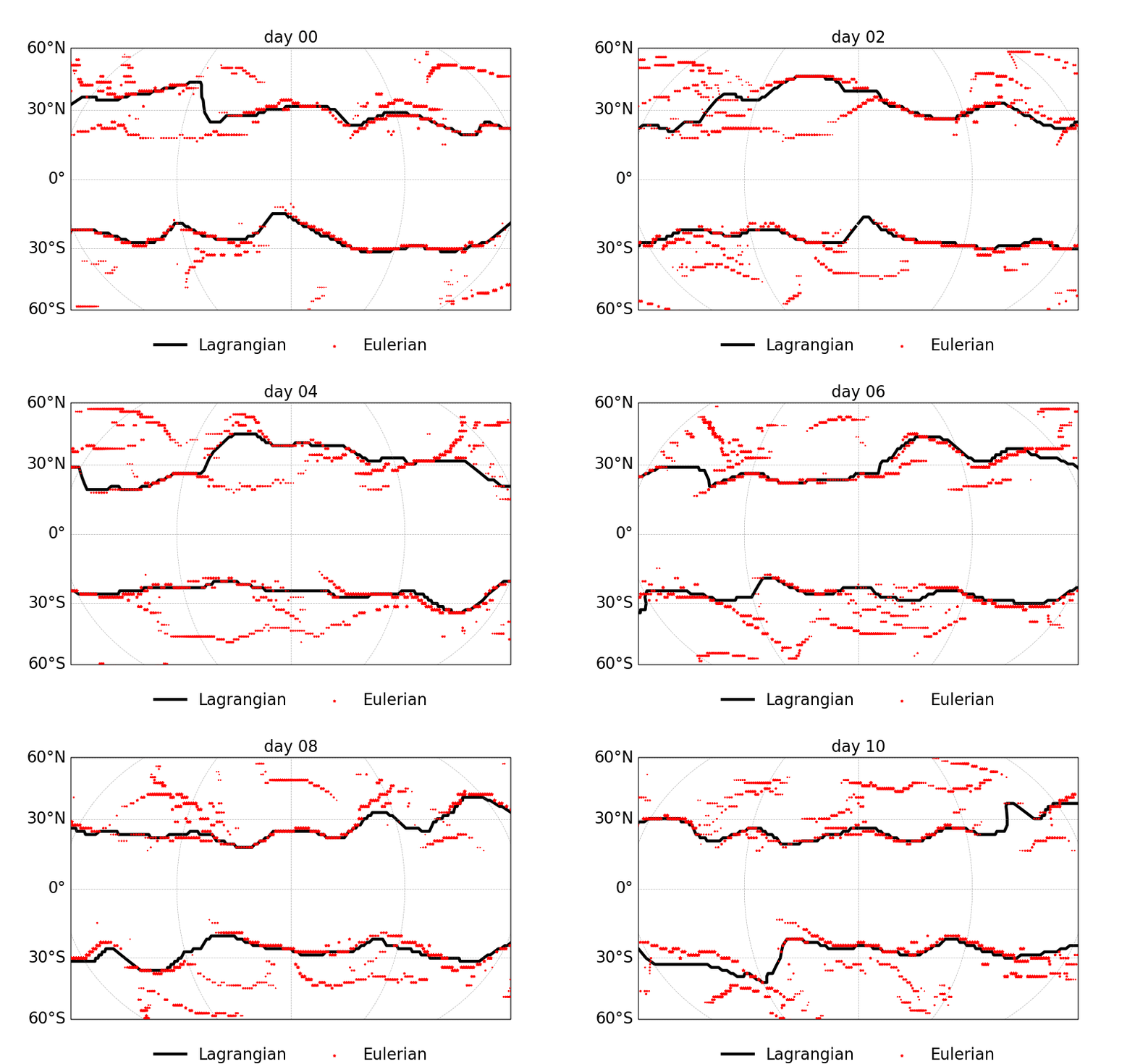
Daily evolution of the subtropical jet in both hemispheres, comparing Eulerian (red dots) and Lagrangian (black line) detection methods applied to the same wind field. The Eulerian approach produces scattered, disconnected clusters with persistent gaps, particularly over the East Pacific and North Atlantic. The Lagrangian approach recovers a continuous jet axis throughout. Animation courtesy of Louis Rivoire.
Atmospheric scientists have been tracking jets for decades using dozens of different algorithms. These methods have yielded a robust understanding of many aspects of jet behaviour and have been applied across climate science, weather forecasting and atmospheric chemistry. But they also disagree with one another in ways that carry real consequences. Different studies use different wind speed thresholds to decide what counts as a jet: 25.7 metres per second in some, 30 in others, 40 in yet others. Changing a threshold by 25 per cent can shift the estimated average latitude of the subtropical jet by about two degrees (roughly 200 km), enough to affect conclusions about long-term trends.
In a field trying to determine whether jet streams are migrating poleward under climate change, that sensitivity is hard to live with.
As Rivoire explains, “jets are not simple objects with sharp boundaries, because wind varies smoothly in space and time.” You cannot draw a line around a jet the way you draw a coastline on a map. The working framing for most of the past century has been that jets are long, narrow and wavy, but those are qualitative descriptions, and the moment you try to turn them into rules a computer can follow, choices multiply. How narrow is narrow? How fast is fast enough? Different research groups have answered differently, and their results reflect it.
On top of that, different kinds of jets arise from different physical mechanisms. The subtropical jet is relatively steady, driven by planetary rotation and the temperature gradient between the equator and the poles. Mid-latitude jets are shaped by large storm systems and shift more erratically. Most identification methods are tailored to one type or the other. JetLag works for both.
A mathematician and a climate scientist walk into the CRM
The project started because Rivoire needed reliable jet coordinates for another study. He was a postdoctoral fellow at Harvard, and the available methods kept giving him axes that jumped between different air masses from one time step to the next. What he wanted was continuity: a line through the atmosphere that followed the same weather features over time. Then Jezabel Curbelo visited from the Universitat Politècnica de Catalunya.
Curbelo’s research sits at the intersection of dynamical systems theory and geophysical fluid dynamics: she studies transport, mixing and stirring in the ocean and atmosphere using Lagrangian methods. She brought a different vocabulary to the problem. Where Rivoire saw atmospheric circulation, Curbelo saw trajectories, phase spaces, and coherent structures. “Our expertise was complementary every step of the way,” Rivoire says.
The Lagrangian descriptor they chose is called M. It works by releasing fictitious air parcels at every point in the atmosphere, like Chinese lanterns, letting them travel forward and backwards in time along surfaces of constant entropy (isentropes, in the jargon), and measuring how far each one goes. Ridges in the resulting map of displacement, the places where parcels travel farthest, reveal the jet.
Why ℳ over other Lagrangian tools?
Alternatives like finite-time Lyapunov exponents (FTLEs) require computing a Jacobian matrix and need very fine grids. For a dataset covering over eight decades of 6-hourly atmospheric data, ℳ was the only realistic option. “Several versions of the descriptor ℳ can be calculated based on the acceleration, velocity, or kinetic energy in the flow. Because jet streams are associated with sustained high-velocity regions, we chose a descriptor based on the velocity.”
Rivoire secured a grant through the CRM’s International Programme for Research Groups and came to Barcelona. The computational groundwork was done: over eight billion fictitious trajectories, computed on high-performance systems. What remained was harder.
How do you extract a jet from that data?
The jet was visible by eye in the visualisations, a bright ridge winding around the planet. Getting a computer to see it was another matter. They worked through a catalogue of extraction techniques, from edge detection to hierarchical segmentation to shortest-path algorithms. At one point, they were feeding atmospheric data into hydrological software built to trace watersheds, which gives a sense of how far afield the search went. “I started thinking that we would have to give up on a significant part of the innovation,” Rivoire says.
The key insight came during late sessions at CRM. Every technique they had tried worked locally, picking up fragments of the ridge at individual points. But jets are not local objects. What Rivoire and Curbelo call “the backbone of the atmosphere” could only be recovered as a single coherent structure, using information from the entire flow field at once, with geophysical theory setting the bounds on how much the structure could meander. “Spending a month at CRM allowed me to focus and think deeply about a complex project on which progress had been brought to a halt by other priorities,” Rivoire says. “Zoom meetings are better than nothing… but nothing beats interacting in person, chatting over lunch, immersing yourself in the work and spending an uninterrupted chunk of time thinking about one thing, and one thing only.”
“Working in Barcelona was a fantastic professional opportunity, as it allowed me to make new connections,” he adds. “Between the green and quiet UAB campus and the bustling, colourful Barcelona centre, I had a fantastic time full of interesting new experiences. I would do it again in a heartbeat!”
Greedy algorithms and Rossby waves
The technique they arrived at is called penalised forward-backward greedy selection. The algorithm steps through longitudes, connecting locally strong features (the “greedy” part), then removes connections that weaken overall coherence (the “backward” pass). A penalty term keeps undulations within theoretical bounds set by the physics of Rossby waves, the large-scale atmospheric waves that give jet streams their sinuous shape. Rossby waves propagate westward relative to the background flow and are responsible for the familiar looping patterns in weather maps. Their typical wavelength constrains how much the jet can meander between adjacent longitudes, and that constraint is what sets JetLag’s penalty parameter. Unlike conventional methods, both of JetLag’s parameters come from theory.
The comparison with existing methods produced the paper’s most notable number. Changing JetLag’s integration time (the period over which fictitious air parcels travel) by as much as 66 per cent shifts the estimated jet position by less than 0.1 degrees on average. A 25 per cent change in the wind speed threshold used by a standard Eulerian method shifts it by roughly two degrees. More than fifty times more sensitive. “We were still surprised that the stability was so large for a system as dynamic and complex as the atmosphere,” Rivoire says.
When you study whether jet streams are shifting over decades, you need a method whose results don’t quietly depend on parameter choices calibrated to a particular climate state. A fixed wind speed threshold that works for the 1950s atmosphere might not mean the same thing in a warmer future. JetLag’s parameters are grounded in physics, which makes them portable across climates. The algorithm also runs on a standard laptop, despite working with a dataset spanning 1941 to 2024.
What the jet carries
Curbelo sees the collaboration as part of something she values about working between disciplines. “The language of dynamical systems provides a natural bridge,” she says. “Many phenomena in geoscience can be understood in terms of trajectories, stability and long-term behaviour, which are all central concepts in dynamical systems. At the same time, these applications raise new questions that push the theory forward.” The feedback, she argues, runs both ways. “Interdisciplinary collaborations are also very enriching on a personal level. I learn a lot from them, and I really enjoy discovering new ideas and perspectives.”
The two researchers are now using JetLag to investigate how jet streams are evolving in a warming climate and how those changes connect to extreme weather. They are also running idealised climate simulations to deepen their understanding of the underlying dynamics. One question on Rivoire’s mind concerns the path of storms over the Atlantic and Pacific, which typically tilts from southwest to northeast. That tilt determines weather impacts across populated regions. This line of work is currently underway at the Weizmann Institute of Science, where Rivoire is studying how jet streams interact with storms.
“Are storm tracks tilted because storms themselves are carving out slanted paths, or are storms mere passengers of a jet stream that’s being reshaped by the geography of continents?”
The JetLag dataset (6-hourly jet axes for both hemispheres, 1941 to 2025) and the algorithm’s code are publicly available. For a more personal account of how the research developed, Louis Rivoire’s “Behind the Paper” blog post is recommended reading.
Reference: L. Rivoire, J. Curbelo, M. Linz. Tracking jet streams as Lagrangian objects. Communications Earth & Environment 7, 267 (2026). https://doi.org/10.1038/s43247-026-03262-z
Newsletter
Get the latest CRM news and activities delivered to your inbox
Subscribe now
Recent newsletters →
MAF 2026: Mathematics and Statistics at the Service of Actuarial Sciences and Finance
From 8 to 10 April 2026, the Centre de Recerca Matemàtica (CRM) hosted the Conference on Mathematical and Statistical Methods for Actuarial Sciences and Finance (MAF 2026). The conference is an international meeting that brings together mathematicians and...
Yves Chevallard (1946–2026)
Yves Chevallard passed away on 16 March 2026. He was 79 years old. Born in Tunis, he trained at the École normale supérieure in Paris, where he earned an agrégation de mathématiques. He went on to become a professor at Aix-Marseille Université, and it was there, over...
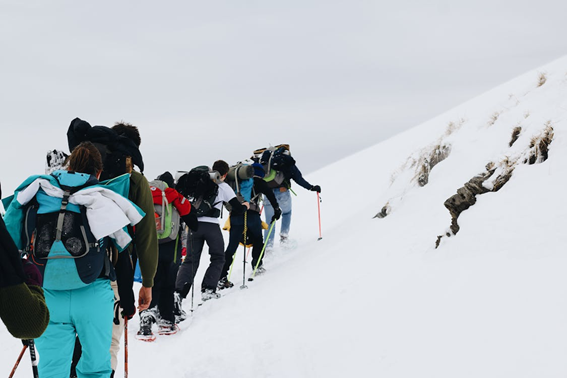
The CRM participates in a European project studying decision-making and risk perception in mountain environments
The NeuroMunt project (POCTEFA, coordinated by the Université de Perpignan Via Domitia) studies how people make decisions under risk conditions in mountain environments, bringing together researchers from France and Spain across disciplines ranging from complex...
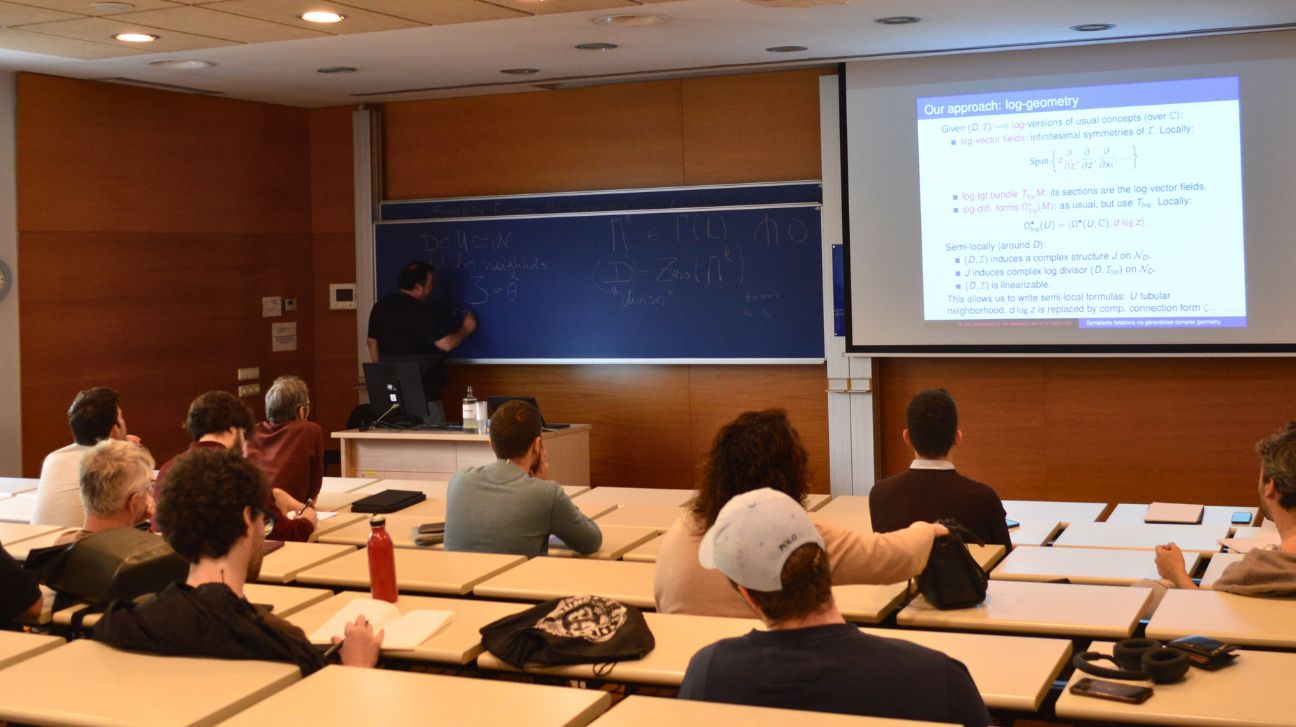
One Day, One Family, One Place: Poisson Geometry at CRM
On March 23rd, 2026, the Centre de Recerca Matemàtica hosted the thematic day “Poisson Geometry and Its Relatives”, a full‑day event that brought together researchers exploring Poisson geometry and several of its neighbouring areas. The programme combined classical...
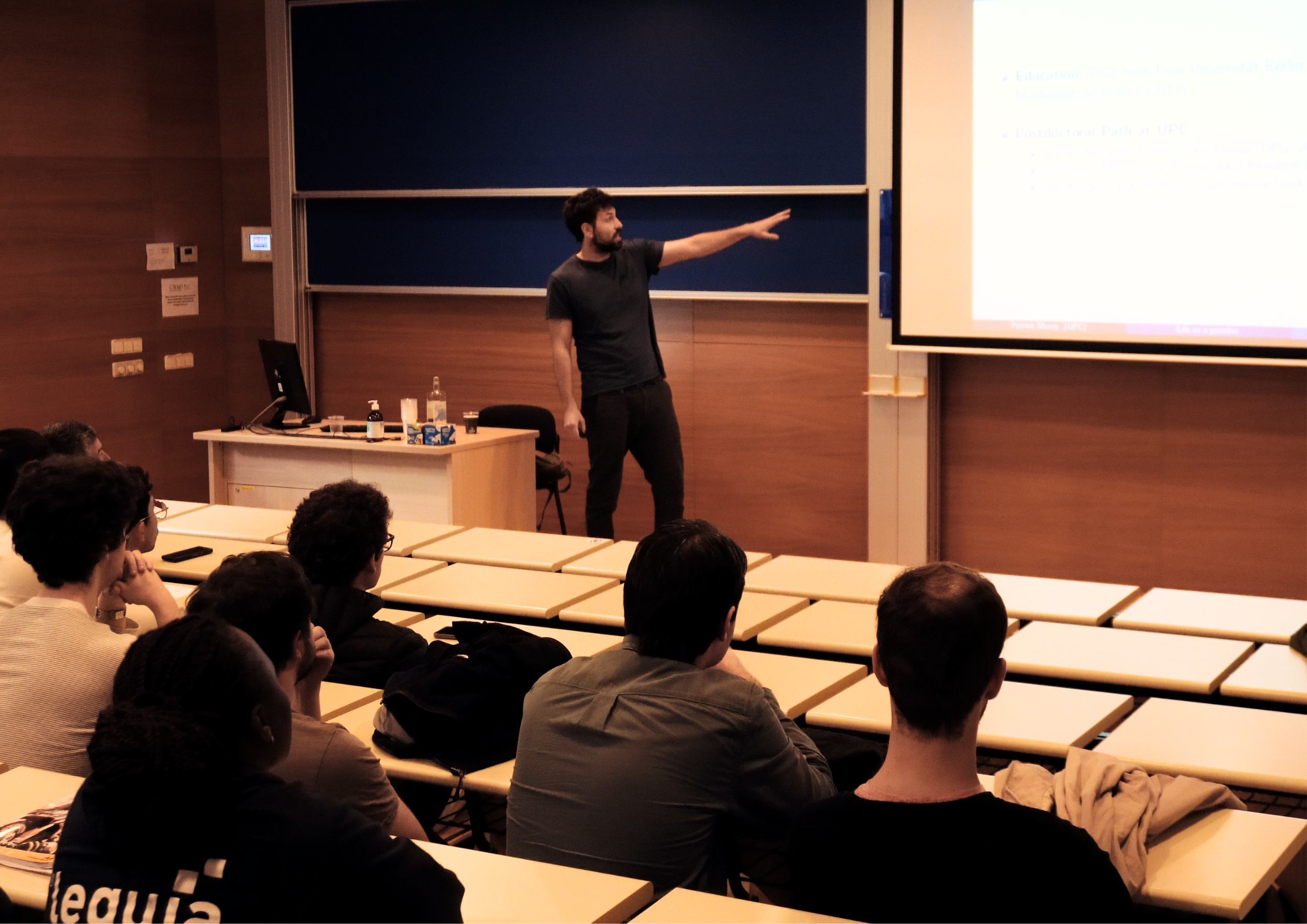
Life After the PhD: Three Roads Forward
On March 18, the BGSMath held its first session on careers after a PhD in mathematics, bringing together three speakers with different professional trajectories and 46 early-career researchers from nine institutions.On March 18, the Barcelona Graduate School of Math...
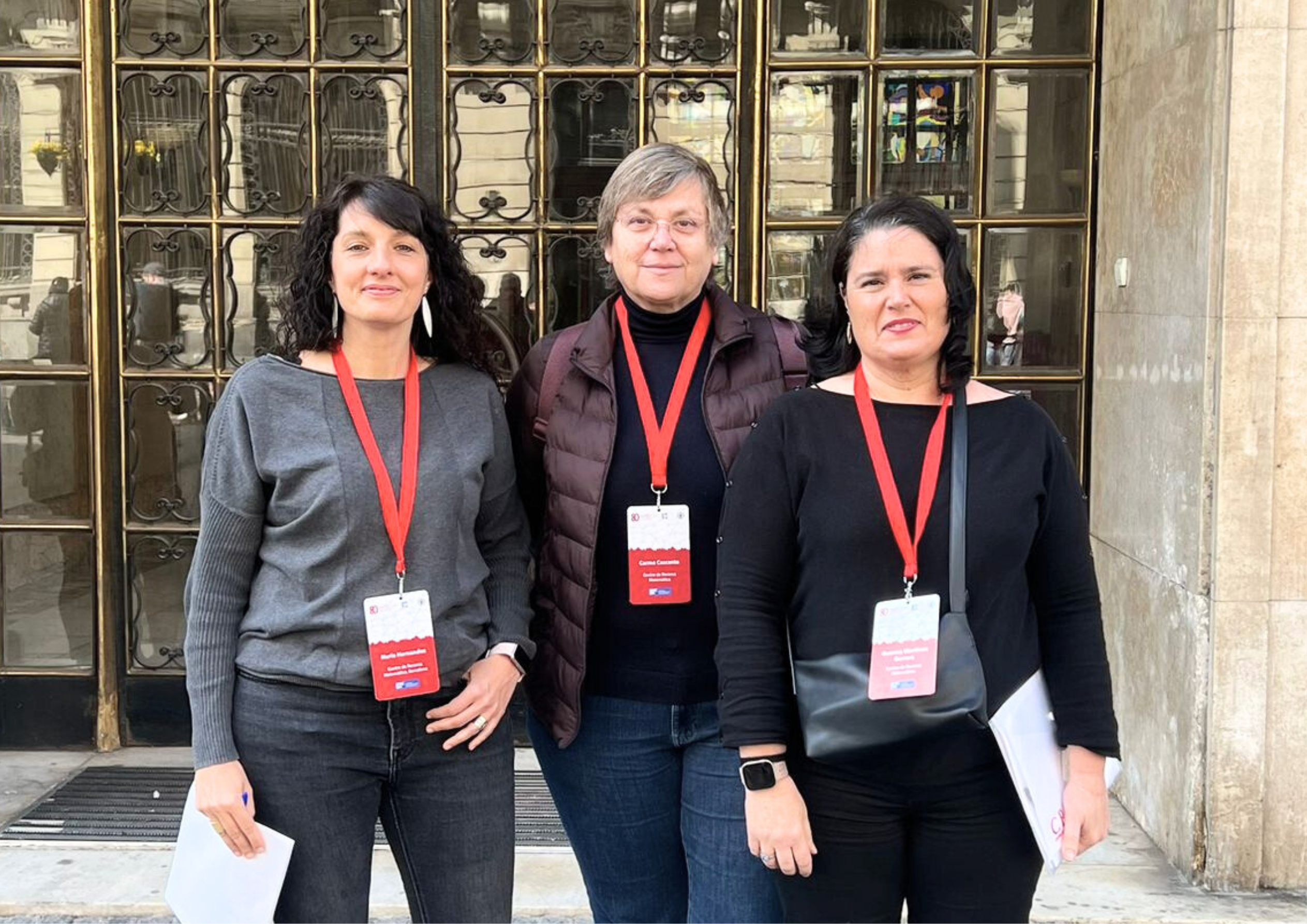
CRM participates in the 2026 ERCOM annual meeting in Belgrade
The CRM participated in the 2026 ERCOM annual meeting in Belgrade (20–21 March), represented by Director Carme Cascante, Manager Gemma Martínez, and Scientific Activities Manager Núria Hernández. The programme focused on multidisciplinarity, mathematics and the arts,...
5 Talks, 1 Topic: A Day of Combinatorics
On March 18th, 2026, the 5 Talks in Combinatorics thematic day took place in the Joan Maragall Room at the Faculty of Philology and Communication of the University of Barcelona, in the historic building. The event focused on modern combinatorics and its connections...

Gerd Faltings Awarded the 2026 Abel Prize for Transformative Work in Arithmetic Geometry
The Norwegian Academy of Science and Letters has recognised the German mathematician for solving two of the most enduring open problems in the field.The Norwegian Academy of Science and Letters announced today that the 2026 Abel Prize goes to Gerd Faltings, director...
The Centre de Recerca Matemàtica Approves Its Strategic Plan for 2026–2030
The Centre de Recerca Matemàtica has approved its Strategic Plan for 2026 - 2030, setting priorities in research, training, and knowledge transfer. Four flagship initiatives anchor the scientific programme. The Centre de Recerca Matemàtica approved its Strategic Plan...
CRM Awards Its Prize at Exporecerca Jove for the Third Time
For the third year running, CRM visited Exporecerca Jove to award its prize to the student project with the strongest mathematical content. This edition, the jury selected two winners: Xavier Ortiz Quintana, who built a real-time 3D scanner using...

When Symmetry Breaks the Rules: From Askey–Wilson Polynomials to Functions
Researchers Tom Koornwinder (U. Amsterdam) and Marta Mazzocco (ICREA-UPC-CRM) published a paper in Indagationes Mathematicae exploring DAHA symmetries. Their work shows that these symmetries shift Askey–Wilson polynomials into a continuous functional setting,and...
Homotopy Theory Conference Brings Together Diverse Research Perspectives
The Centre de Recerca Matemàtica hosted 75 mathematicians from over 20 countries for the Homotopy Structures in Barcelona conference, held February 9-13, 2026. Fourteen invited speakers presented research spanning rational equivariant cohomology theories, isovariant...
|
|
CRM CommPau Varela
|