The Centre de Recerca Matemàtica has approved its Strategic Plan for 2026 – 2030, setting priorities in research, training, and knowledge transfer. Four flagship initiatives anchor the scientific programme.
The Centre de Recerca Matemàtica approved its Strategic Plan for 2026 – 2030 last month, a document that lays out where the institution is heading across research, training, and its relationship with the broader scientific community. It contains eight global objectives, four core scientific blocks, and four flagship programmes.
The CRM was founded in 1984, which makes it Spain’s oldest mathematics research institute. Since 2021, it has grown considerably, partly through framework agreements with the three main Catalan universities (UAB, UPC, and UB) and partly through the renewal of the María de Maeztu Unit of Excellence distinction, which brought two million euros in additional funding. Eight ERC grants have been awarded to CRM affiliated researchers over the past decade. Between 2022 and 2024, the centre hosted over 120 scientific events with nearly 4,500 participants from across the world. The plan takes this recent period as its starting point without treating it as a guarantee of what comes next.
The scientific programme is organised around four core areas: analysis and PDEs together with dynamical systems, algebra and geometry, mathematical modelling, and combinatorics. Additionally, the document also signals four flagship initiatives. Two of them sit at the intersection of mathematics and artificial intelligence. One develops the mathematical underpinnings of generative AI, drawing on transport theory, partial differential equations, and high-dimensional dynamical systems. The other aims to position the CRM as a reference centre in computer-assisted proofs, a field that has expanded rapidly as computational tools become capable of verifying arguments that would take humans years to check by hand. A third flagship supports the formalisation of mathematics; writing proofs in computer-verifiable language using systems like Lean or Coq, a shift that some in the field consider genuinely transformative. The fourth addresses multiscale modelling for problems in biology, climate change, and public health. These are not easy problems to put numbers on.
The document also acknowledges the CRM’s Knowledge Transfer Unit role in translating abstract mathematical results into applications with legible real-world effects. A project optimising bus networks for Transports Metropolitans de Barcelona, and collaborations with the Institut de Ciències del Mar and Alba Synchrotron, point to what this looks like when it does happen. The plan sets out mechanisms to make it happen more often.
On training, the aim is to develop the Barcelona Graduate School of Mathematics into a genuinely international reference for doctoral and postdoctoral education. The CRM currently supervises 15 to 16 defended theses per year. The plan wants to convert more master’s students into doctoral candidates (the 2023–2024 data suggests that the gap is wider than it should be), and to give postdoctoral researchers clearer pathways toward independent positions, something that has historically been left somewhat to chance.
The Strategic Plan 2026–2030 is available on the CRM website.
|
|
CRM CommPau Varela
|
When the reward comes within reach, the brain changes what it compares
As the tokens piled up, choices got faster and more accurate at the same time. The yardstick for judging each offer had moved.CRM CommPau VarelaCRMComm@crm.catGet the latest CRM news and activities in your inbox.Recent newsletters →Two subjects...

Almost every automaton can be reset with a short word
Guillaume Chapuy (Université Paris Cité, CNRS) and Guillem Perarnau (UPC, CRM) have shown that a random finite automaton with n states can, with high probability, be reset by a word of length of order √n log n. The result, published in ACM Transactions on Algorithms, pins the exponent at 1/2, the lower end of a decade of numerical estimates, and addresses the random version of the synchronization problem behind a conjecture Ján Černý posed in 1964 and which still remains open.
Exposició ‘Les matemàtiques de Gaudí’
CRM quod erat demonstrandum | 48

ADA: Decoding Brain Signals Misaligned in Time
The study addresses a key limitation of current brain decoding techniques: the difficulty of interpreting internal mental processes whose temporal dynamics vary from trial to trial.Decoding what is happening in a person’s mind from their brain activity is one of the...
Rare curves, many points: Christophe Ritzenthaler and Rachel Pries on their research and the work around it
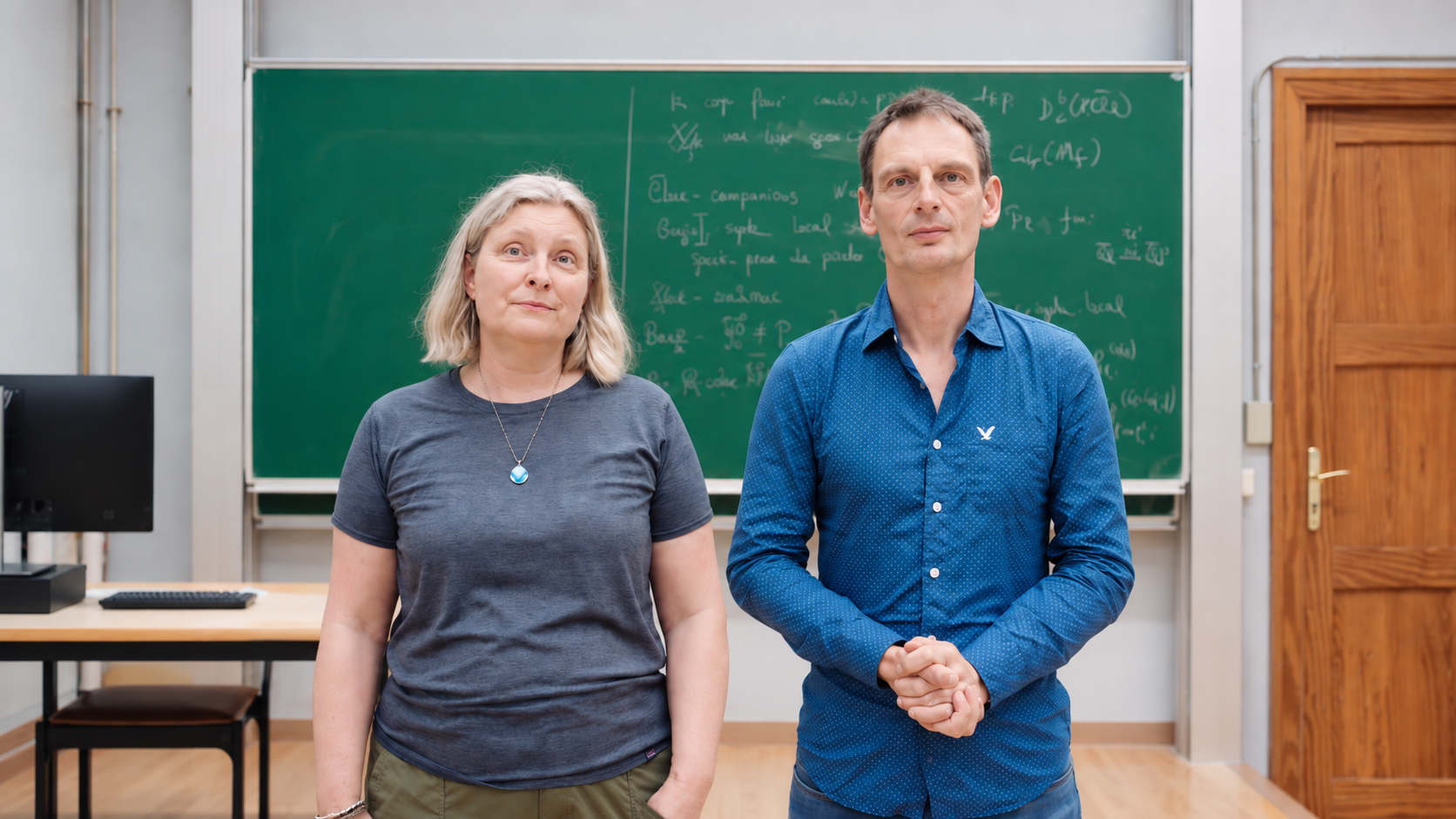
Christophe Ritzenthaler (Université de Rennes) and Rachel Pries (Colorado State University) both work on curves over finite fields: he hunts curves with as many points as possible, she hunts curves that almost never occur. In conversation with the CRM during their...

Call open for the 2027 Ferran Sunyer i Balaguer Prize
The Ferran Sunyer i Balaguer Foundation is accepting submissions for its 2027 prize, which awards 15,000 euros and publication in Birkhäuser's Progress in Mathematics series to an expository monograph on an active area of mathematical research. The deadline is 27...
Susanna Terracini delivers the CRM Colloquium 2026
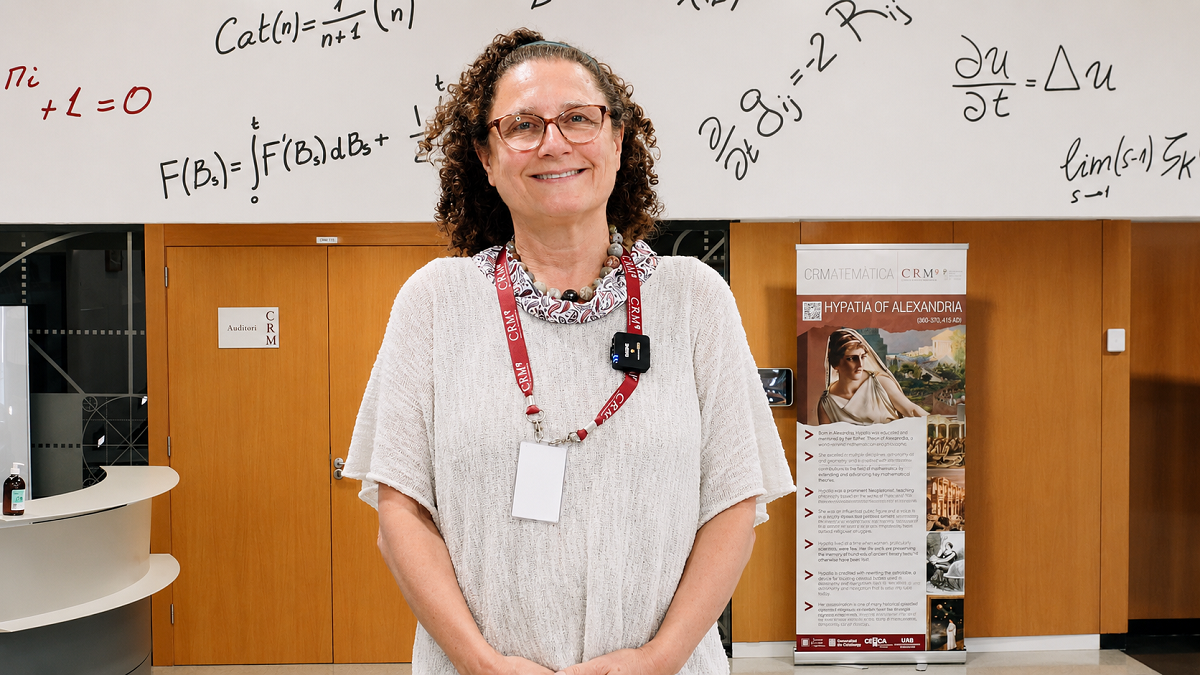
Susanna Terracini (Università di Torino) delivered the CRM Colloquium 2026 on 14 July, presenting a rigidity result for Kepler billiards obtained with Stefano Baranzini, Vivina Barutello and Irene De Blasi. She was at the centre as a member of the CRM Scientific...
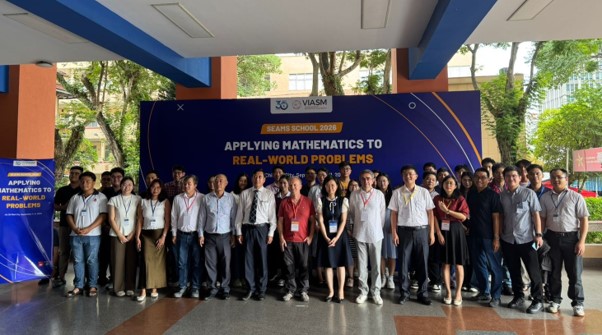
Ho Chi Minh City hosts the SEAMS School on applying mathematics to real-world problems
Students from across the region took courses and worked on group projects at a school co-organised by CRM researcher Tim Myers.CRM CommPau VarelaCRMComm@crm.catGet the latest CRM news and activities in your inbox.Recent newsletters →Between 4 and...

A single ball on a fixed table can compute: Eva Miranda and Isaac Ramos prove that two-dimensional billiards are Turing complete
Eva Miranda (UPC, CRM) and Isaac Ramos (ETH Zürich) show that a point particle bouncing inside a planar table with fixed walls can simulate a universal Turing machine, settling a question Cristopher Moore left open in 1990. The result grew out of a master’s project...
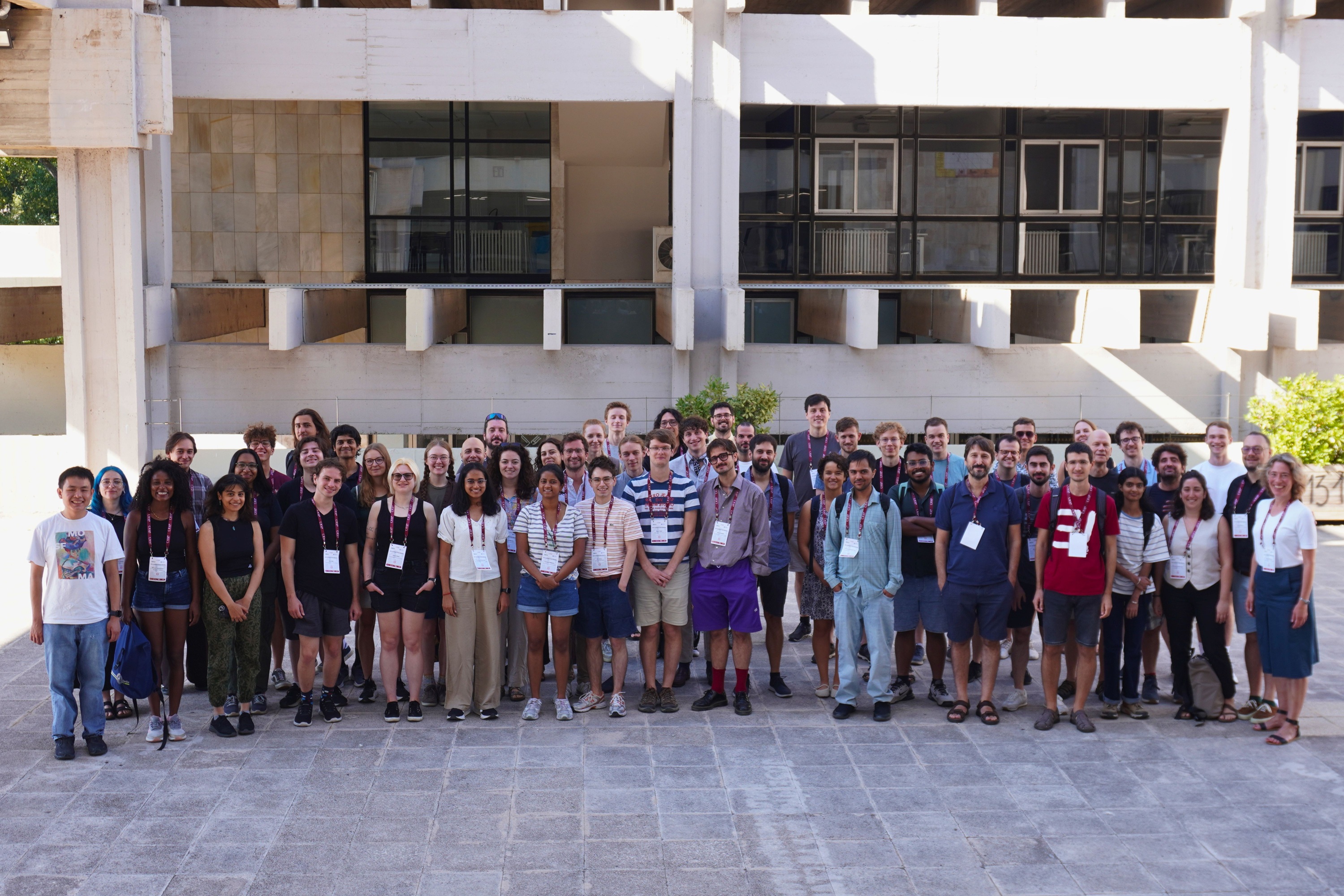
BMS-BGSMath Junior Meeting 2026: Barcelona and Berlin Strengthen Scientific Ties
From 2 to 4 September 2026, the Centre de Recerca Matemàtica (CRM) hosted the BMS-BGSMath Junior Meeting 2026, a three-day event jointly organised by the Berlin Mathematical School (BMS) and the Barcelona Graduate School of Mathematics (BGSMath), with the Centre de...
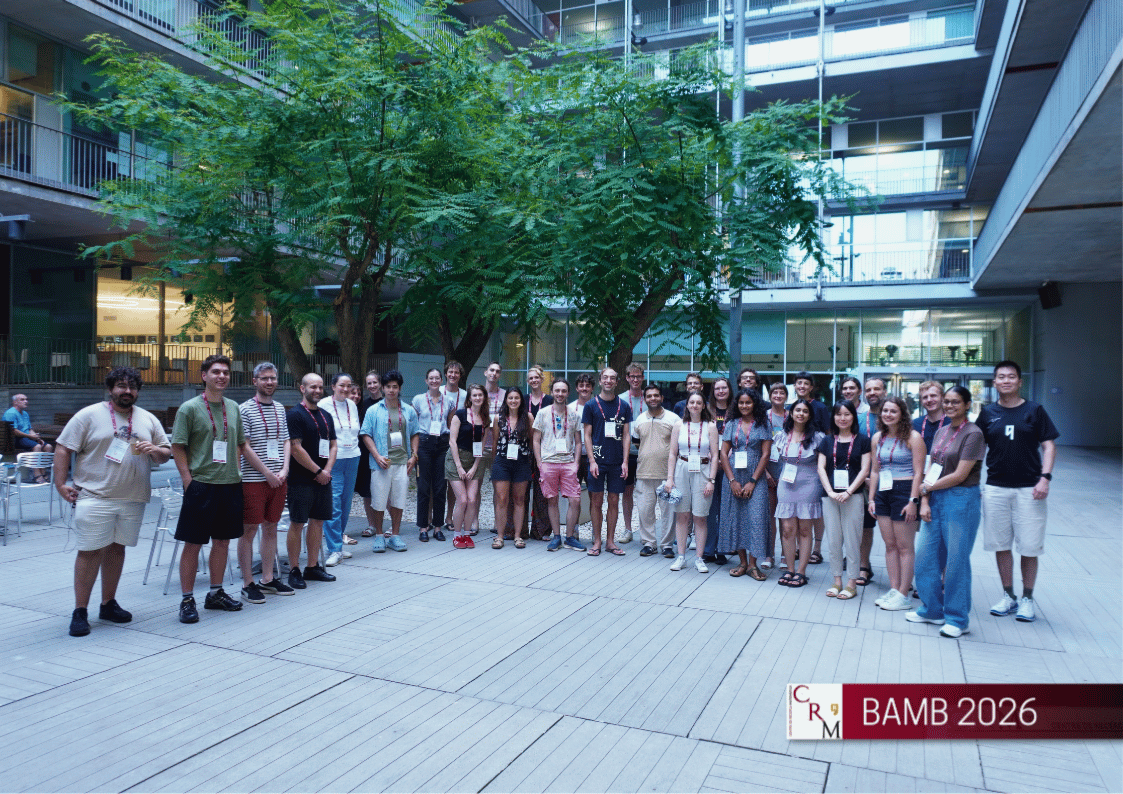
The CRM organises the 2026 Barcelona Summer School for Advanced Modeling of Behavior
The Centre de Recerca Matemàtica held the sixth edition of BAMB!, the Barcelona Summer School for Advanced Modeling of Behavior, from 12 to 23 July 2026 at the Parc de Recerca Biomèdica de Barcelona. Thirty early-career researchers from fourteen countries followed...