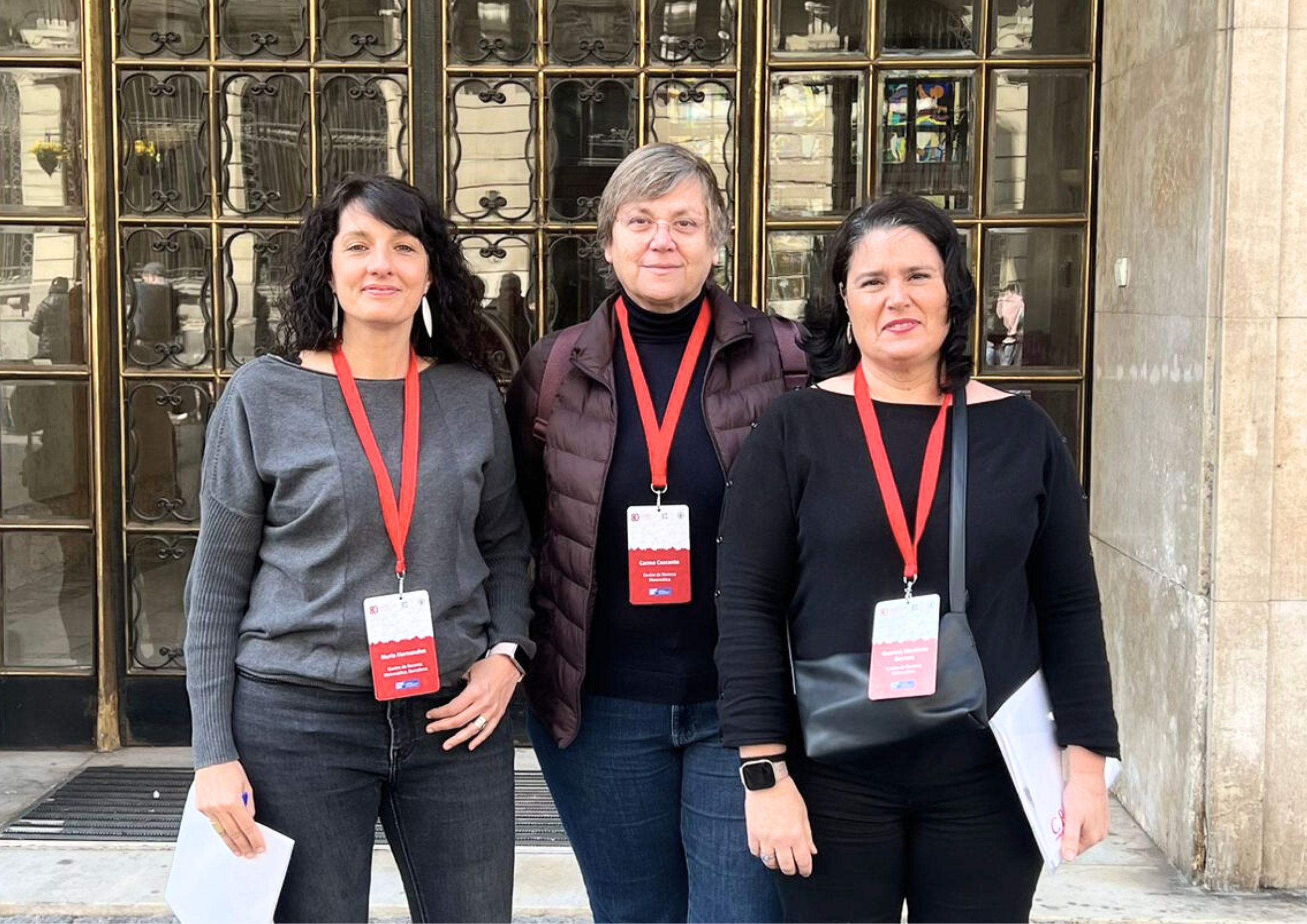
The CRM participated in the 2026 ERCOM annual meeting in Belgrade (20–21 March), represented by Director Carme Cascante, Manager Gemma Martínez, and Scientific Activities Manager Núria Hernández. The programme focused on multidisciplinarity, mathematics and the arts, and young researchers.

The Centre de Recerca Matemàtica (CRM) took part in the annual meeting of ERCOM (European Research Centres on Mathematics), held on 20–21 March 2026 at the Palace of the Serbian Academy of Sciences and Arts in Belgrade. The meeting was hosted by the Mathematical Institute of the Serbian Academy of Sciences and Arts (MISANU), which is celebrating its 80th anniversary this year.
Carme Cascante, Director of CRM, Gemma Martínez, Manager, and Núria Hernández, Scientific Activities Manager, represented the centre at the gathering, which brought together directors and administrative staff from leading mathematical research institutions across Europe.
The ERCOM meeting was preceded by a meeting of the EMS Executive Committee on 19–20 March, the first of its kind held in South East Europe. The event included a public panel discussion between EMS and the mathematical societies of the Western Balkans, as part of a broader effort to foster collaboration with the mathematical communities in Serbia, Bosnia and Herzegovina, Montenegro, and North Macedonia. EMS President Jan Philip Solovej and ERCOM Chair Christophe Ritzenthaler both took part in the meetings.
This year’s ERCOM programme focused on multidisciplinarity as a defining feature of life and work at a research centre. Sessions addressed the relationship between mathematics and the arts, interdisciplinary research initiatives, and the role of young researchers in mathematical institutes. The meeting also included presentations from several EMS committees, covering areas such as education, outreach and engagement, ethics, publications, women in mathematics, and cooperation with developing countries.
A session on European research infrastructure, led by Patrice Verdier (CNRS), explored the landscape of support for mathematical research at the continental level. On the administrative side, a parallel session was devoted to the use of AI tools in institutional management.
CRM’s participation in ERCOM reinforces its commitment to an open, collaborative European research ecosystem and its active role in shaping shared strategies for the future of mathematical sciences.
|
|
CRM CommPau Varela
|
The CRM opens the academic year and unveils its Directors’ Gallery
A review of the year, the Communication Plan 2026–2030 and three research talks filled the morning of 19 October.The unveiling of the Directors’ Gallery.CRM CommPau VarelaCRMComm@crm.catGet the latest CRM news and activities in your inbox.Recent...
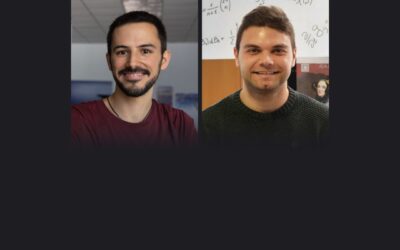
The CRM Mentoring Programme, as Told by One of Its Pairs
PhD student Joaquim Duran and mathematician Robert Cardona, one of the pairs in the CRM Mentoring ProgrammeJoaquim Duran (left) and Robert Cardona.CRM CommPau VarelaCRMComm@crm.catGet the latest CRM news and activities in your inbox.Recent...
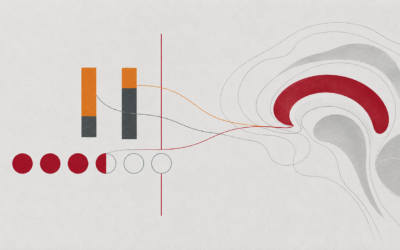
When the reward comes within reach, the brain changes what it compares
As the tokens piled up, choices got faster and more accurate at the same time. The yardstick for judging each offer had moved.CRM CommPau VarelaCRMComm@crm.catGet the latest CRM news and activities in your inbox.Recent newsletters →Two subjects...

Almost every automaton can be reset with a short word
Guillaume Chapuy (Université Paris Cité, CNRS) and Guillem Perarnau (UPC, CRM) have shown that a random finite automaton with n states can, with high probability, be reset by a word of length of order √n log n. The result, published in ACM Transactions on Algorithms, pins the exponent at 1/2, the lower end of a decade of numerical estimates, and addresses the random version of the synchronization problem behind a conjecture Ján Černý posed in 1964 and which still remains open.
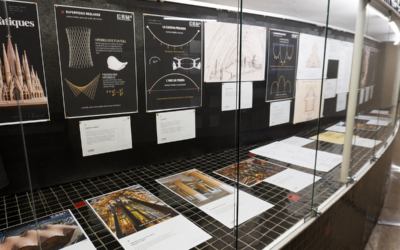
Exposició ‘Les matemàtiques de Gaudí’
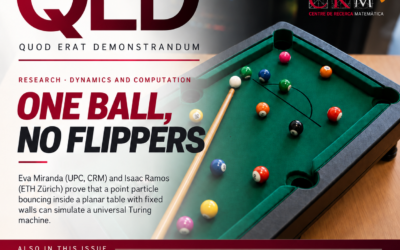
CRM quod erat demonstrandum | 48

ADA: Decoding Brain Signals Misaligned in Time
The study addresses a key limitation of current brain decoding techniques: the difficulty of interpreting internal mental processes whose temporal dynamics vary from trial to trial.Decoding what is happening in a person’s mind from their brain activity is one of the...
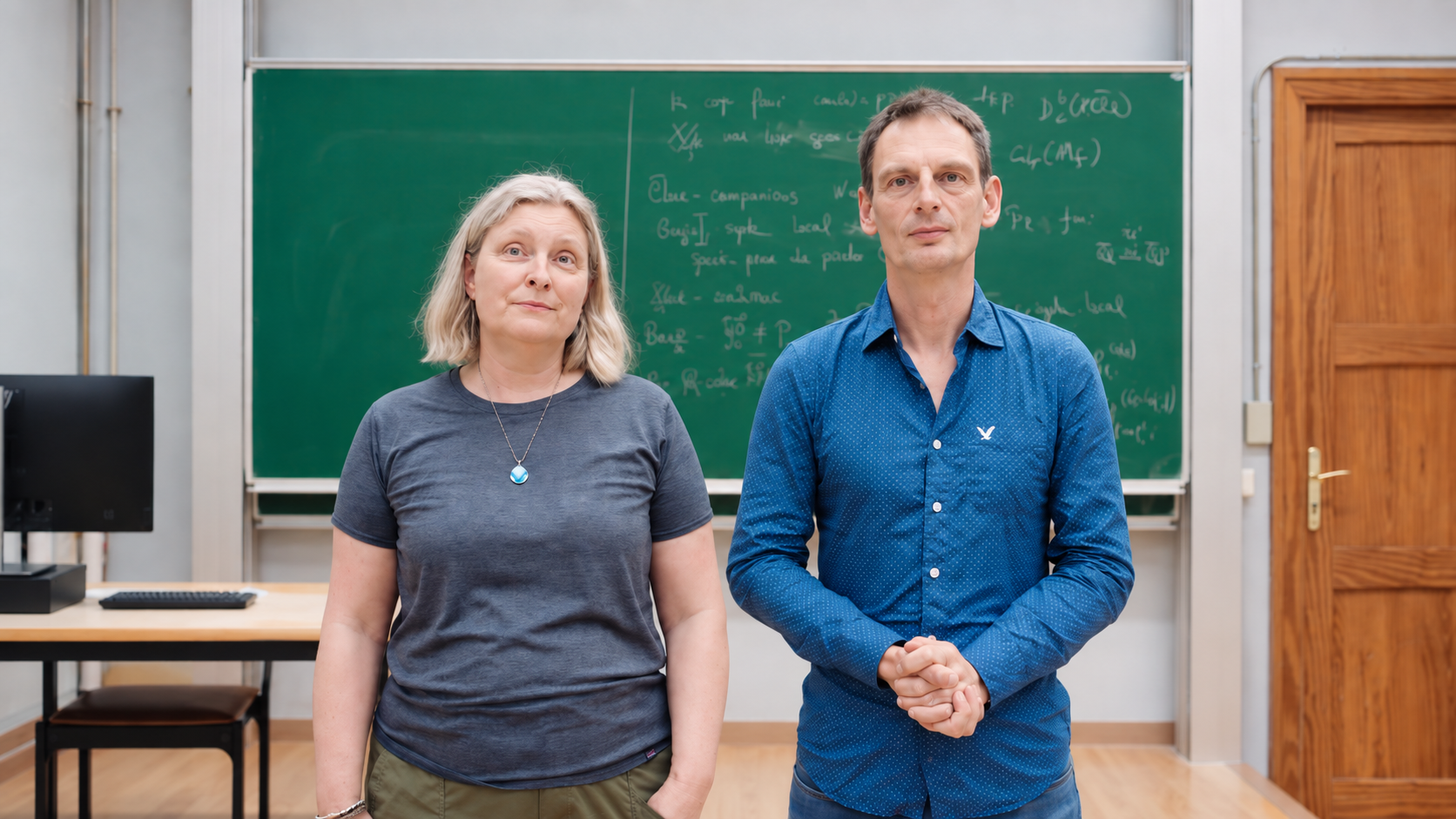
Rare curves, many points: Christophe Ritzenthaler and Rachel Pries on their research and the work around it
Christophe Ritzenthaler (Université de Rennes) and Rachel Pries (Colorado State University) both work on curves over finite fields: he hunts curves with as many points as possible, she hunts curves that almost never occur. In conversation with the CRM during their...

Call open for the 2027 Ferran Sunyer i Balaguer Prize
The Ferran Sunyer i Balaguer Foundation is accepting submissions for its 2027 prize, which awards 15,000 euros and publication in Birkhäuser's Progress in Mathematics series to an expository monograph on an active area of mathematical research. The deadline is 27...
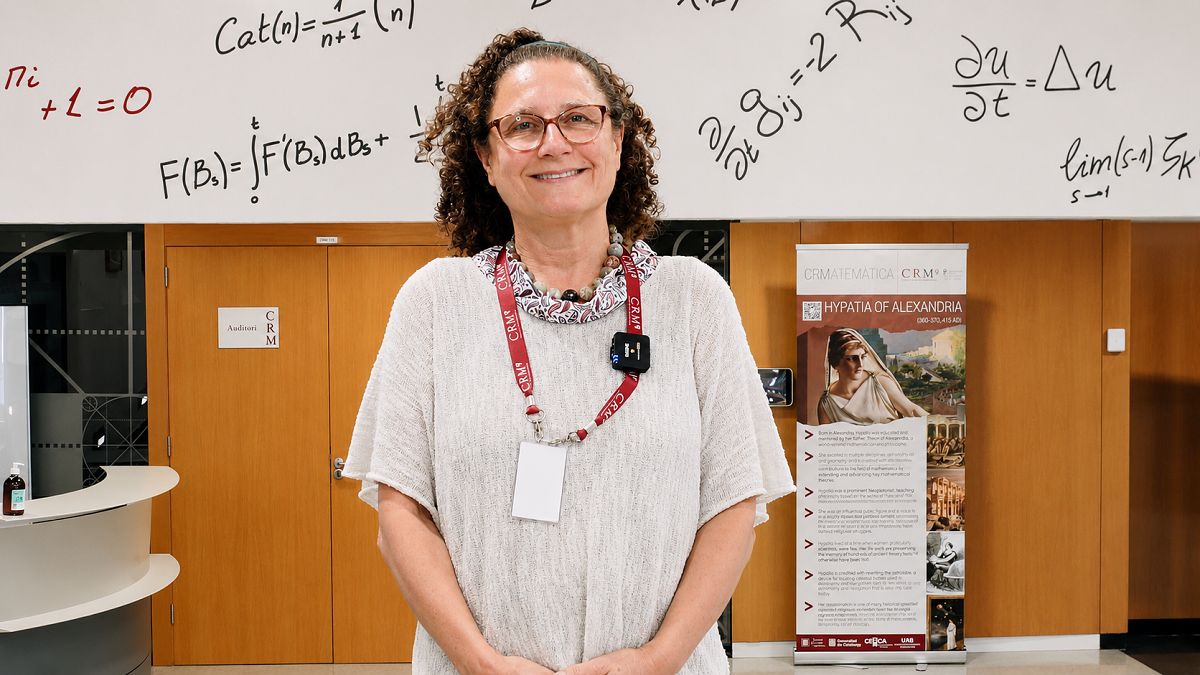
Susanna Terracini delivers the CRM Colloquium 2026
Susanna Terracini (Università di Torino) delivered the CRM Colloquium 2026 on 14 July, presenting a rigidity result for Kepler billiards obtained with Stefano Baranzini, Vivina Barutello and Irene De Blasi. She was at the centre as a member of the CRM Scientific...
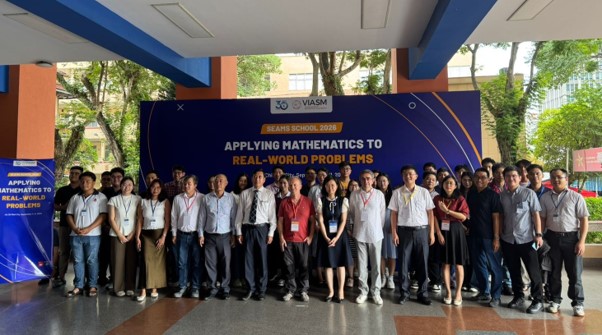
Ho Chi Minh City hosts the SEAMS School on applying mathematics to real-world problems
Students from across the region took courses and worked on group projects at a school co-organised by CRM researcher Tim Myers.CRM CommPau VarelaCRMComm@crm.catGet the latest CRM news and activities in your inbox.Recent newsletters →Between 4 and...

A single ball on a fixed table can compute: Eva Miranda and Isaac Ramos prove that two-dimensional billiards are Turing complete
Eva Miranda (UPC, CRM) and Isaac Ramos (ETH Zürich) show that a point particle bouncing inside a planar table with fixed walls can simulate a universal Turing machine, settling a question Cristopher Moore left open in 1990. The result grew out of a master’s project...