For the third year running, CRM visited Exporecerca Jove to award its prize to the student project with the strongest mathematical content. This edition, the jury selected two winners: Xavier Ortiz Quintana, who built a real-time 3D scanner using an iPhone and GPU acceleration, and Bruna Basas Jaumandreu, who trained a machine learning model to predict survival in pancreatic cancer patients.
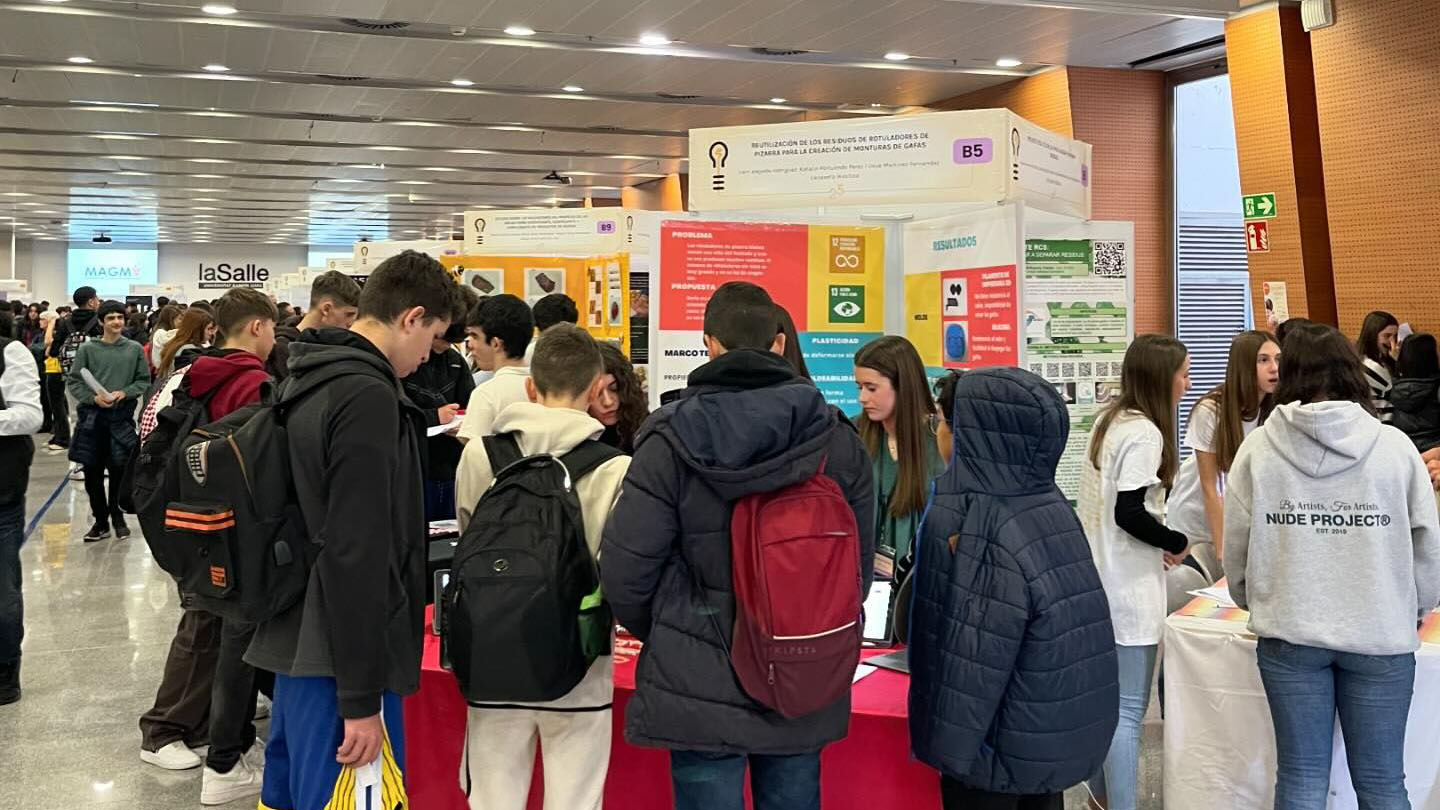
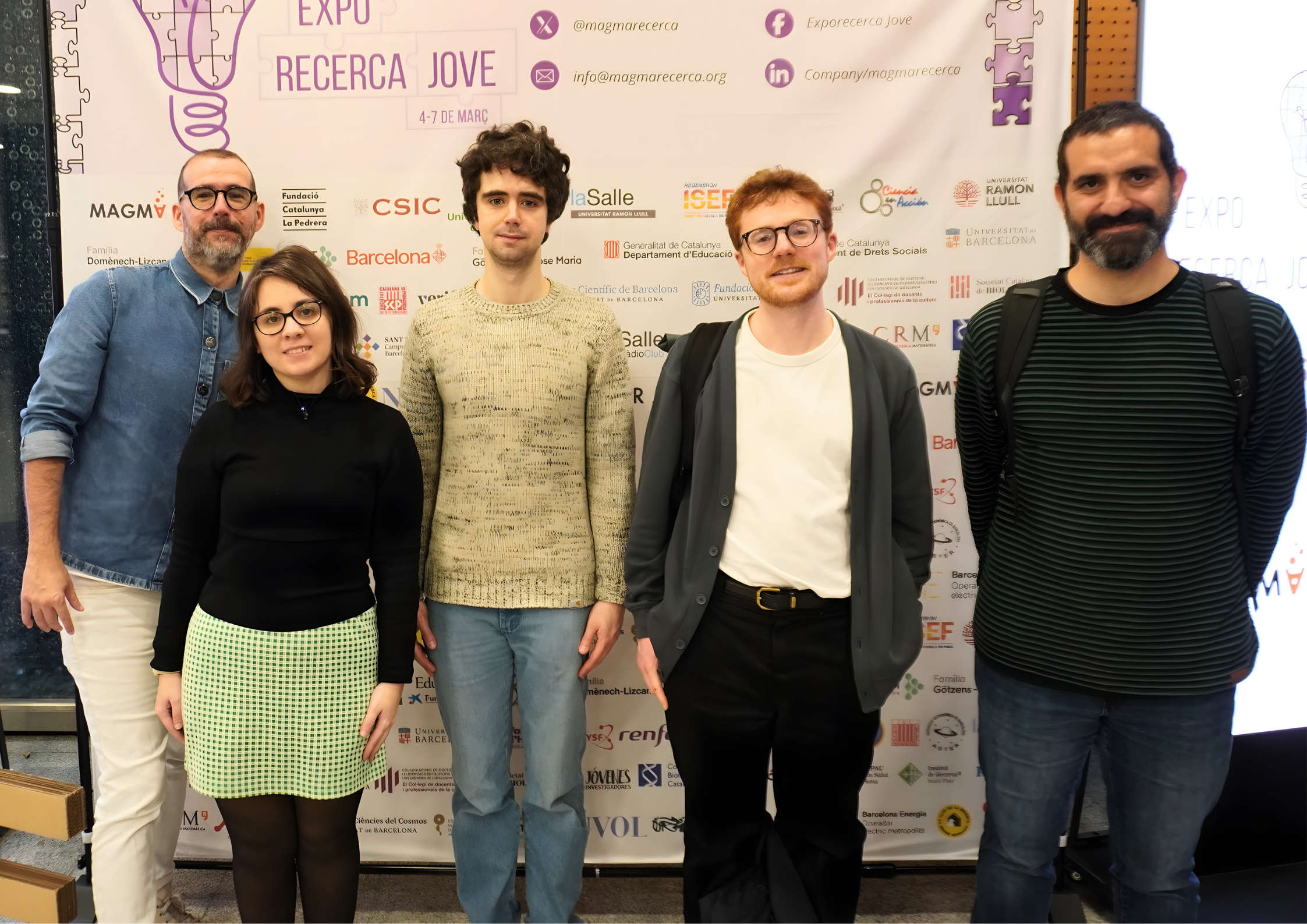
Every March, a few hundred secondary school students take over a conference hall in Barcelona to explain their research projects to anyone willing to stop at their stand. The projects range widely: genetics, climate, sociology, and engineering. This year, the Centre de Recerca Matemàtica sent five people to look for mathematics in the mix.
It was CRM’s third time at Exporecerca Jove, the international research fair for students aged 12 to 19, organised by MAGMA. The institute has been a sponsor since the fair’s XXVII edition and awards a prize to the project with the strongest mathematical content: an invitation to participate in one of the scientific activities held at CRM.
After reviewing seven projects on 6 March, the jury selected two winners.
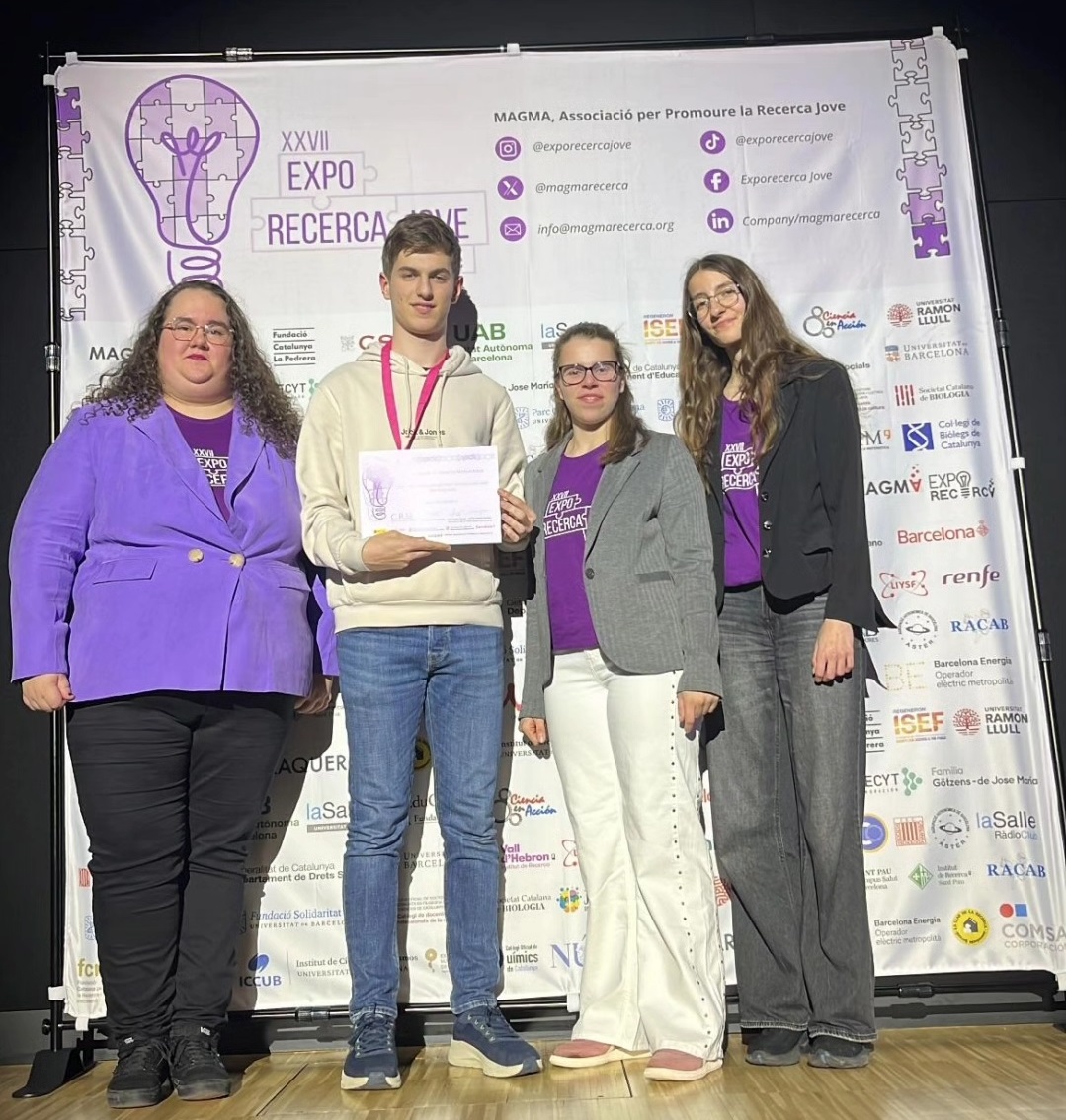
The first was Xavier Ortiz Quintana, a student at INS Montserrat Roig. His project reconstructed 3D models of real spaces in real time, using only a standard iPhone and a laptop. The setup sounds simple. The algorithm underneath is not. Depth data captured by the phone’s LiDAR sensor is integrated, frame by frame, into a mathematical structure called a Truncated Signed Distance Field. The TSDF is a volumetric representation that stores, for each point in a grid, a signed number: positive if the point is outside a surface, negative if it’s inside. The boundary where that number crosses zero is the surface itself. An algorithm called Marching Cubes then reads that grid and constructs a mesh of triangles that approximates the shape. It’s a technique from 1987, originally designed for medical imaging, here running on a GPU in a teenager’s bedroom. Xavier has published the full code on GitHub.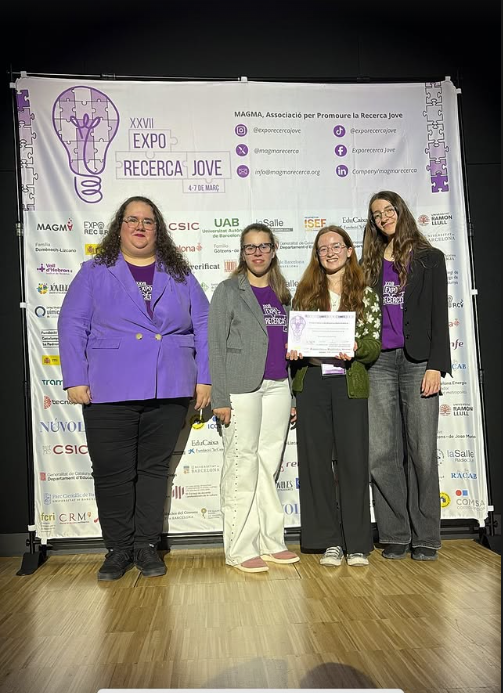
The second winner was Bruna Basas Jaumandreu, from La Salle Manresa, who trained a machine learning model to predict whether a pancreatic cancer patient would survive beyond 24 months after diagnosis. Pancreatic cancer is one of the deadliest: only about 13 per cent of patients survive five years. Part of the difficulty is late detection; another is that treatments work unevenly across patients. Bruna’s logistic regression model, built on clinical and mutational data from 2,336 patients and developed in collaboration with the Institute for Biomedical Research of Barcelona, reached 74.1 per cent accuracy. The variable that most increased survival probability was the surgical removal of the tumour. The one that most reduced it was age over 90. Both results are consistent with published studies, which is the kind of confirmation you want when working with a 185-patient validation cohort.
The jury walked the stands on a Friday morning in early March: Javier Guillán (PhD student), Ander Movilla (Beatriu de Pinós postdoctoral fellow), David Romero (director of the Knowledge Transfer Unit), and Pau Varela and Natalia Vallina from the Communications and Outreach team.
CRM’s prize is not a certificate. It is access: a place at one of the institute’s research days, seminars, or outreach events, where the winners will be in the room with working mathematicians. What they do with that is up to them.
Subscribe for more CRM News
|
|
CRM CommPau Varela
|
The CRM opens the academic year and unveils its Directors’ Gallery
A review of the year, the Communication Plan 2026–2030 and three research talks filled the morning of 19 October.The unveiling of the Directors’ Gallery.CRM CommPau VarelaCRMComm@crm.catGet the latest CRM news and activities in your inbox.Recent...
The CRM Mentoring Programme, as Told by One of Its Pairs
PhD student Joaquim Duran and mathematician Robert Cardona, one of the pairs in the CRM Mentoring ProgrammeJoaquim Duran (left) and Robert Cardona.CRM CommPau VarelaCRMComm@crm.catGet the latest CRM news and activities in your inbox.Recent...
When the reward comes within reach, the brain changes what it compares
As the tokens piled up, choices got faster and more accurate at the same time. The yardstick for judging each offer had moved.CRM CommPau VarelaCRMComm@crm.catGet the latest CRM news and activities in your inbox.Recent newsletters →Two subjects...

Almost every automaton can be reset with a short word
Guillaume Chapuy (Université Paris Cité, CNRS) and Guillem Perarnau (UPC, CRM) have shown that a random finite automaton with n states can, with high probability, be reset by a word of length of order √n log n. The result, published in ACM Transactions on Algorithms, pins the exponent at 1/2, the lower end of a decade of numerical estimates, and addresses the random version of the synchronization problem behind a conjecture Ján Černý posed in 1964 and which still remains open.
Exposició ‘Les matemàtiques de Gaudí’
CRM quod erat demonstrandum | 48

ADA: Decoding Brain Signals Misaligned in Time
The study addresses a key limitation of current brain decoding techniques: the difficulty of interpreting internal mental processes whose temporal dynamics vary from trial to trial.Decoding what is happening in a person’s mind from their brain activity is one of the...
Rare curves, many points: Christophe Ritzenthaler and Rachel Pries on their research and the work around it
Christophe Ritzenthaler (Université de Rennes) and Rachel Pries (Colorado State University) both work on curves over finite fields: he hunts curves with as many points as possible, she hunts curves that almost never occur. In conversation with the CRM during their...
Call open for the 2027 Ferran Sunyer i Balaguer Prize
The Ferran Sunyer i Balaguer Foundation is accepting submissions for its 2027 prize, which awards 15,000 euros and publication in Birkhäuser's Progress in Mathematics series to an expository monograph on an active area of mathematical research. The deadline is 27...
Susanna Terracini delivers the CRM Colloquium 2026
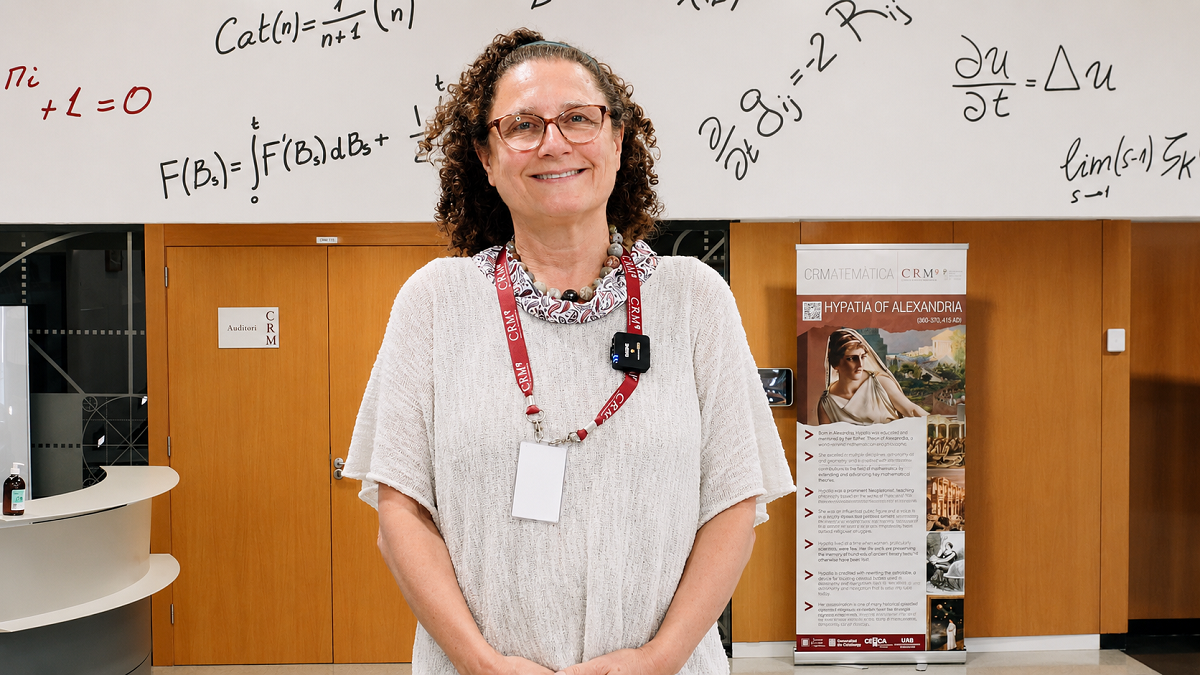
Susanna Terracini (Università di Torino) delivered the CRM Colloquium 2026 on 14 July, presenting a rigidity result for Kepler billiards obtained with Stefano Baranzini, Vivina Barutello and Irene De Blasi. She was at the centre as a member of the CRM Scientific...
Ho Chi Minh City hosts the SEAMS School on applying mathematics to real-world problems
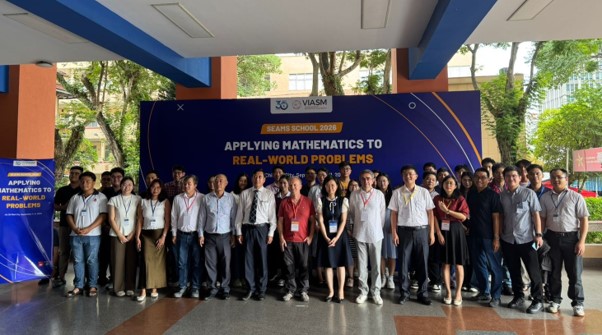
Students from across the region took courses and worked on group projects at a school co-organised by CRM researcher Tim Myers.CRM CommPau VarelaCRMComm@crm.catGet the latest CRM news and activities in your inbox.Recent newsletters →Between 4 and...

A single ball on a fixed table can compute: Eva Miranda and Isaac Ramos prove that two-dimensional billiards are Turing complete
Eva Miranda (UPC, CRM) and Isaac Ramos (ETH Zürich) show that a point particle bouncing inside a planar table with fixed walls can simulate a universal Turing machine, settling a question Cristopher Moore left open in 1990. The result grew out of a master’s project...