
The NeuroMunt project (POCTEFA, coordinated by the Université de Perpignan Via Domitia) studies how people make decisions under risk conditions in mountain environments, bringing together researchers from France and Spain across disciplines ranging from complex systems, sports psychology, nonlinear dynamics, to mountain sleep medicine and physiology. The CRM’s role is specific: developing mathematical tools to analyse brain signals recorded outdoors, on moving subjects, in conditions far removed from any laboratory.

Somewhere in the eastern Pyrenees, a mountain guide has six clients behind her, and the weather is turning. It was fine two hours ago, which counts for nothing now. Low cloud, wet snow on the ridge. She needs to decide whether to keep going or turn back, and soon, because the group is getting cold and one of them keeps asking about the summit. She trained for this kind of moment. But she is also running on less oxygen than she would at sea level, and her brain, the organ actually making the call, is doing something with risk assessment that neuroscience can describe in broad strokes but not yet predict. Whatever process leads to her decision will fire and resolve in milliseconds. It will leave faint electrical traces in the cortex. Nobody outside a research lab would normally think to measure those traces, and even inside a lab, they are hard to read.
NeuroMunt wants to try reading them anyway, outdoors, on the mountain.
The project, funded by the European programme POCTEFA and coordinated by the Université de Perpignan Via Domitia, brings together sports psychologists, sleep researchers, mountain rescue workers, physiologists, mathematicians and training centres from both sides of the Pyrenees. The CRM contributes a specific component to this consortium: the mathematical and computational analysis of field-recorded brain signals.
“A very concrete task the CRM has is to generate a toolkit, like a toolbox, to analyse electroencephalographic (EEG) signals,” says Axel Masó, a postdoctoral researcher at the CRM hired for the project. “Our toolkit will incorporate nonlinear systems metrics, complexity metrics, such as entropy or other concepts from complex systems and statistics.”
EEG data from a laboratory is already complex. EEG data from someone moving through a mountain environment is something else. The standard processing tools were built for controlled settings where you can repeat an experiment if the recording is poor, the subject holds still, and the room is quiet. None of that applies here. You get one shot at each recording, the subject is climbing or skiing, and the electrodes pick up every twitch and gust of wind. The team has learned this the hard way, working with preliminary recordings, and it has shaped the entire approach: before you can analyse anything, you must figure out which parts of the signal are worth analysing at all.
The Mathematical and Computational Biology Group, co-led by researcher Josep Sardanyés, works on this kind of problem in biological systems. “Understanding how the brain works is extraordinarily complicated,” Sardanyés says. “We are probably talking about one of the most complex of complex systems, with processes operating at different scales: the single neuron, groups of neurons, brain regions, the whole brain.” EEG captures macroscopic cortical activity, the large-scale electrical behaviour of the brain. The CRM’s job is to develop the mathematics to read that signal properly.
In concrete terms, the team is building software to quantify the complexity of EEG recordings and compare them across different situations. Entropy measures, autocorrelation, synchronisation patterns, techniques for characterising chaos: the tools come from dynamical systems theory and are designed to detect structure that standard clinical analysis would miss. These techniques are not commonly used in the EEG community. “Seeing how these measures behave across different scenarios could be very important for understanding large-scale brain dynamics in complex mountain environments and under risk conditions,” says Sardanyés. A central question is whether the EEG time series looks different when a person is approaching a decision. If they do, the mathematics should be able to show how.
One concept from the CRM’s approach is particularly suggestive. In fields like ecology and medicine, researchers have developed methods for detecting what are known as early warning signals: measurable changes in a time series that indicate the system is approaching a critical transition, a tipping point. The mathematical framework is well established for ecosystems on the verge of collapse or patients approaching a clinical crisis. Sardanyés and the team want to apply the same logic to brain signals recorded near a decision point. The idea is that a decision, choosing between two options under pressure, may behave mathematically like a bifurcation.
“These early warning signals can be measured directly from time series. They tell us how close the system is to a transition or bifurcation; in this case, a decision between two options.”
Josep Sardanyés, CRM
If the analogy holds, the EEG signal should show detectable changes as the moment of decision approaches. Whether it does is one of the things the project will test.
“From a fundamental perspective, the EEG signal has characteristics that are specific to complex systems,” Masó explains. “This allows them to be analysed with tools that are not standard within the community of EEG analysis experts. The CRM brings this more fundamental perspective, to know whether these tools will be the ones that allow us to determine if a person enters a state of panic before a risk.”
The toolkit is being developed now, in the early phase of the project, using preliminary data from an unexpected source. Before NeuroMunt began, the ultra-trail runner Kilian Jornet recorded EEG activity during mountain expeditions as part of his Alpine Connections project, in which he traversed the entire Alpine range and linked all peaks above 4,000 metres in 19 days without motorised transport: 1,207 kilometres and over 75,000 metres of accumulated elevation gain, by running, climbing, and cycling. During the expedition, Jornet wore EEG equipment and recorded brain activity under different conditions: at rest, while walking, and while climbing. Those recordings, collected under real conditions with all the mess that entails, have become the testing ground for the CRM’s methods. “We have to discard a large portion of the data,” Masó says. “This reduces the predictive capacity of the analysis enormously. The first result of all this is knowing where to place the magnifying glass within the data. Knowing exactly what to look at and where to look, that is already a result in itself.”
The early analysis has yielded something worth noting. “The first results suggest that we do observe differences in the complexity of the signal across different activities and different risk environments,” Sardanyés says. The team is working to consolidate these findings with additional data and with the mathematical models of decision-making from the UPC side of the collaboration. It is still preliminary, but the signal, so to speak, appears to be there.
David Romero, head of the Knowledge Transfer Unit at the CRM, frames the challenge differently. For him, the work sits at the far end of a long chain of translations. And the chain runs in both directions. “We will be doing pen-and-paper things, so to speak, to solve a real problem that exists in the social environment of the mountain.”
The CRM’s closest collaborators on the project are at the Universitat Politècnica de Catalunya BarcelonaTech (UPC). Professors Toni Guillamon and Tomás Lázaro, both also affiliated researchers at the CRM, will build mathematical models of decision-making, drawing on dynamical systems theory from computational neuroscience and game theory. The CRM team, for its part, analyses the raw signals. Romero describes how the pieces connect: “We will be talking a lot with the UPC to feed their models with data, to calibrate them or to support certain decisions. But at the same time, there is another layer of interaction with the people in France, who will give more psychological meaning to the metrics we extract.”
In practice, Lázaro and Guillamon have been analysing data from elite trail runners and paragliders, athletes whose decisions under pressure are already being closely monitored. There are, Lázaro explains, two kinds of decision-makers: the econs, who are perfectly rational and always optimise, and the humans, who are not and do not. The mountain is where that distinction stops being theoretical.
“There is a scientific vision of a behaviour that is very human. And that is a challenge in itself.”
Tomás Lázaro, UPC / CRM
A mountain science festival in Les Angles, in the French Pyrenees, will present partial and final results to the public, and an international scientific congress is also planned. Romero sees these as the other end of the chain. “The goal is also to give tools to mountain trainers,” he says, “and that completes the whole round trip in this problem, impacting something that is very far from basic research but hyper-applied and very specific to the natural environment.”
“It is a project that covers very broad knowledge,” explains Guillamon, talking about the internal workings of the consortium, “and it is impossible for us as mathematicians to find a direct common point with mountain guides right away. But the project has enough specialists in all areas so that there is a continuity of knowledge.” He credits Élodie Varraine, the coordinator from Perpignan, with assembling the team that way. Sardanyés puts it in more operational terms: the project has elite athletes, mountain guides, sleep experts and neuroscientists who will collect the field data and help interpret what it means. “This is a project where multidisciplinarity is key,” he says, “and one that can produce results of real scientific and applied interest.” The mathematicians cannot do the fieldwork, and the mountain professionals cannot build the analytical tools. The project only works because both sides are in the room.
It helps that everyone involved lives close by. “All the partners are very close,” emphasises Masó. “Despite being a European project with a European perspective, it also has this local component that makes interaction with partners much easier.”
The field experiments designed specifically for NeuroMunt haven’t started yet. The protocols are still being written. Whether the early patterns in the Jornet data hold up when tested against larger, more controlled datasets, nobody knows. Romero comes back to the same phrase: “We have to know where to put the magnifying glass.” And that magnifying glass is, at bottom, mathematical. Projects like NeuroMunt need people who know the mountains, and people who know the brain, but they also need people who can look at a noisy time series and find the geometry hiding inside it.
The NeuroMunt project (EFA 161/05) is co-funded by the European Union through the Interreg VI-A Spain-France-Andorra programme (POCTEFA 2021-2027). CRM researchers involved include Josep Sardanyés, David Romero, Axel Masó (CRM), and Toni Guillamon and Tomás Lázaro (UPC, affiliated with CRM).

|
|
CRM CommPau Varela
|

When the reward comes within reach, the brain changes what it compares
As the tokens piled up, choices got faster and more accurate at the same time. The yardstick for judging each offer had moved.CRM CommPau VarelaCRMComm@crm.catGet the latest CRM news and activities in your inbox.Recent newsletters →Two subjects...

Almost every automaton can be reset with a short word
Guillaume Chapuy (Université Paris Cité, CNRS) and Guillem Perarnau (UPC, CRM) have shown that a random finite automaton with n states can, with high probability, be reset by a word of length of order √n log n. The result, published in ACM Transactions on Algorithms, pins the exponent at 1/2, the lower end of a decade of numerical estimates, and addresses the random version of the synchronization problem behind a conjecture Ján Černý posed in 1964 and which still remains open.
Exposició ‘Les matemàtiques de Gaudí’

CRM quod erat demonstrandum | 48

ADA: Decoding Brain Signals Misaligned in Time
The study addresses a key limitation of current brain decoding techniques: the difficulty of interpreting internal mental processes whose temporal dynamics vary from trial to trial.Decoding what is happening in a person’s mind from their brain activity is one of the...
Rare curves, many points: Christophe Ritzenthaler and Rachel Pries on their research and the work around it
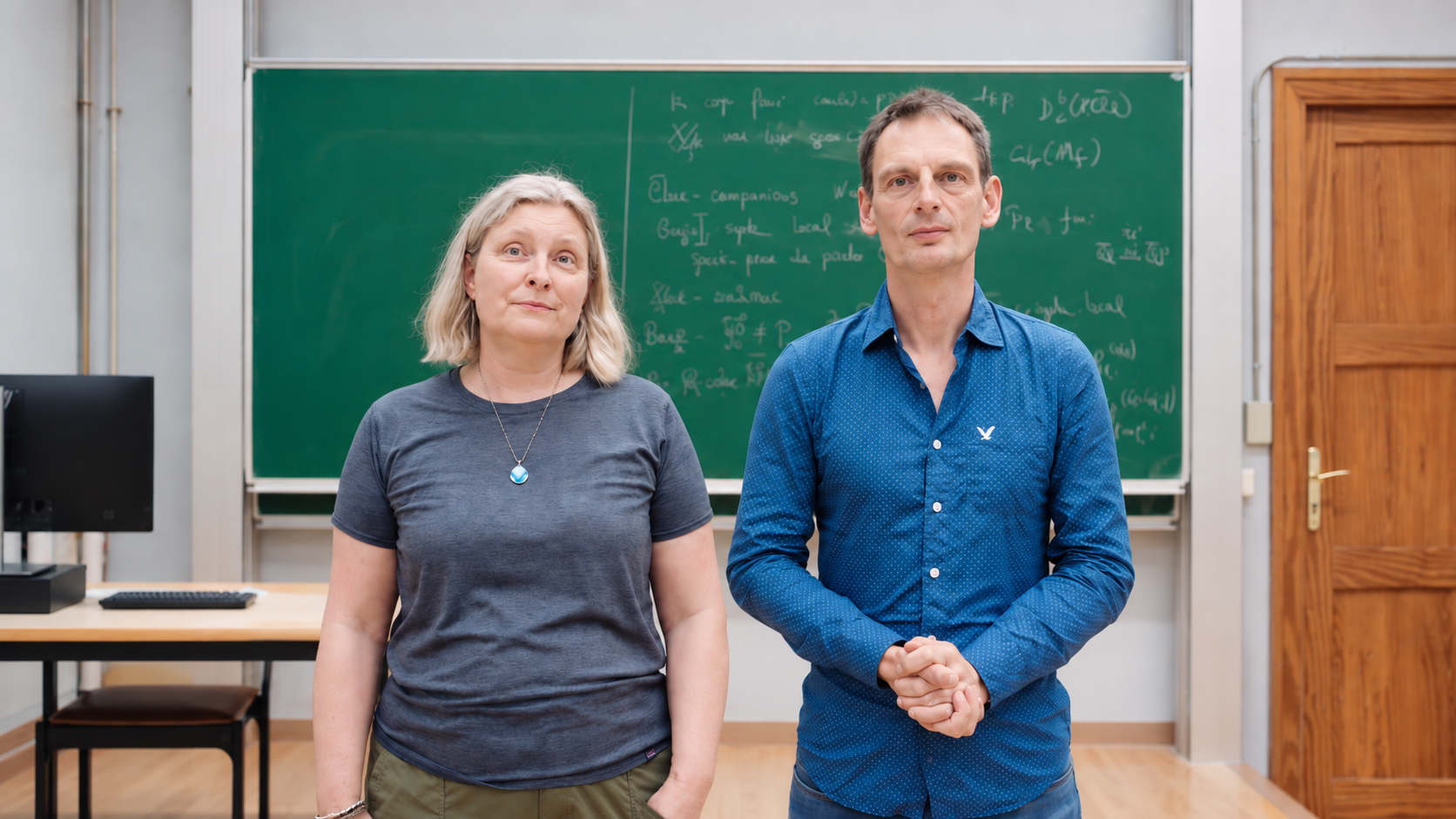
Christophe Ritzenthaler (Université de Rennes) and Rachel Pries (Colorado State University) both work on curves over finite fields: he hunts curves with as many points as possible, she hunts curves that almost never occur. In conversation with the CRM during their...
Call open for the 2027 Ferran Sunyer i Balaguer Prize
The Ferran Sunyer i Balaguer Foundation is accepting submissions for its 2027 prize, which awards 15,000 euros and publication in Birkhäuser's Progress in Mathematics series to an expository monograph on an active area of mathematical research. The deadline is 27...
Susanna Terracini delivers the CRM Colloquium 2026
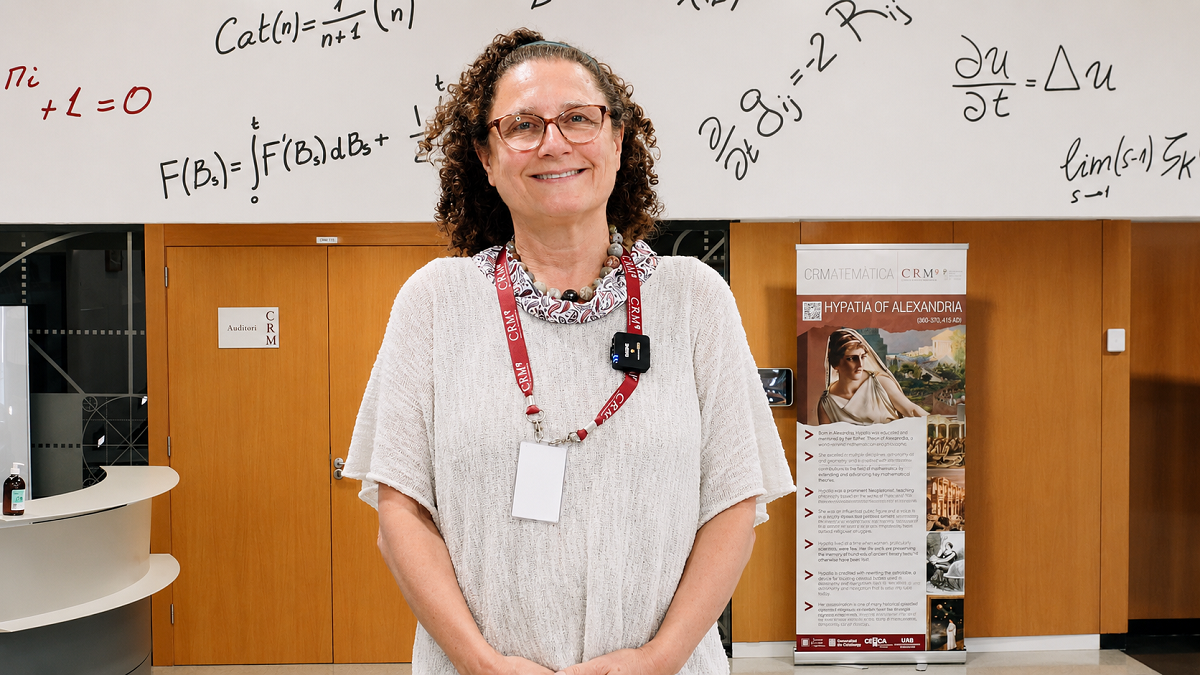
Susanna Terracini (Università di Torino) delivered the CRM Colloquium 2026 on 14 July, presenting a rigidity result for Kepler billiards obtained with Stefano Baranzini, Vivina Barutello and Irene De Blasi. She was at the centre as a member of the CRM Scientific...

Ho Chi Minh City hosts the SEAMS School on applying mathematics to real-world problems
Students from across the region took courses and worked on group projects at a school co-organised by CRM researcher Tim Myers.CRM CommPau VarelaCRMComm@crm.catGet the latest CRM news and activities in your inbox.Recent newsletters →Between 4 and...

A single ball on a fixed table can compute: Eva Miranda and Isaac Ramos prove that two-dimensional billiards are Turing complete
Eva Miranda (UPC, CRM) and Isaac Ramos (ETH Zürich) show that a point particle bouncing inside a planar table with fixed walls can simulate a universal Turing machine, settling a question Cristopher Moore left open in 1990. The result grew out of a master’s project...
BMS-BGSMath Junior Meeting 2026: Barcelona and Berlin Strengthen Scientific Ties
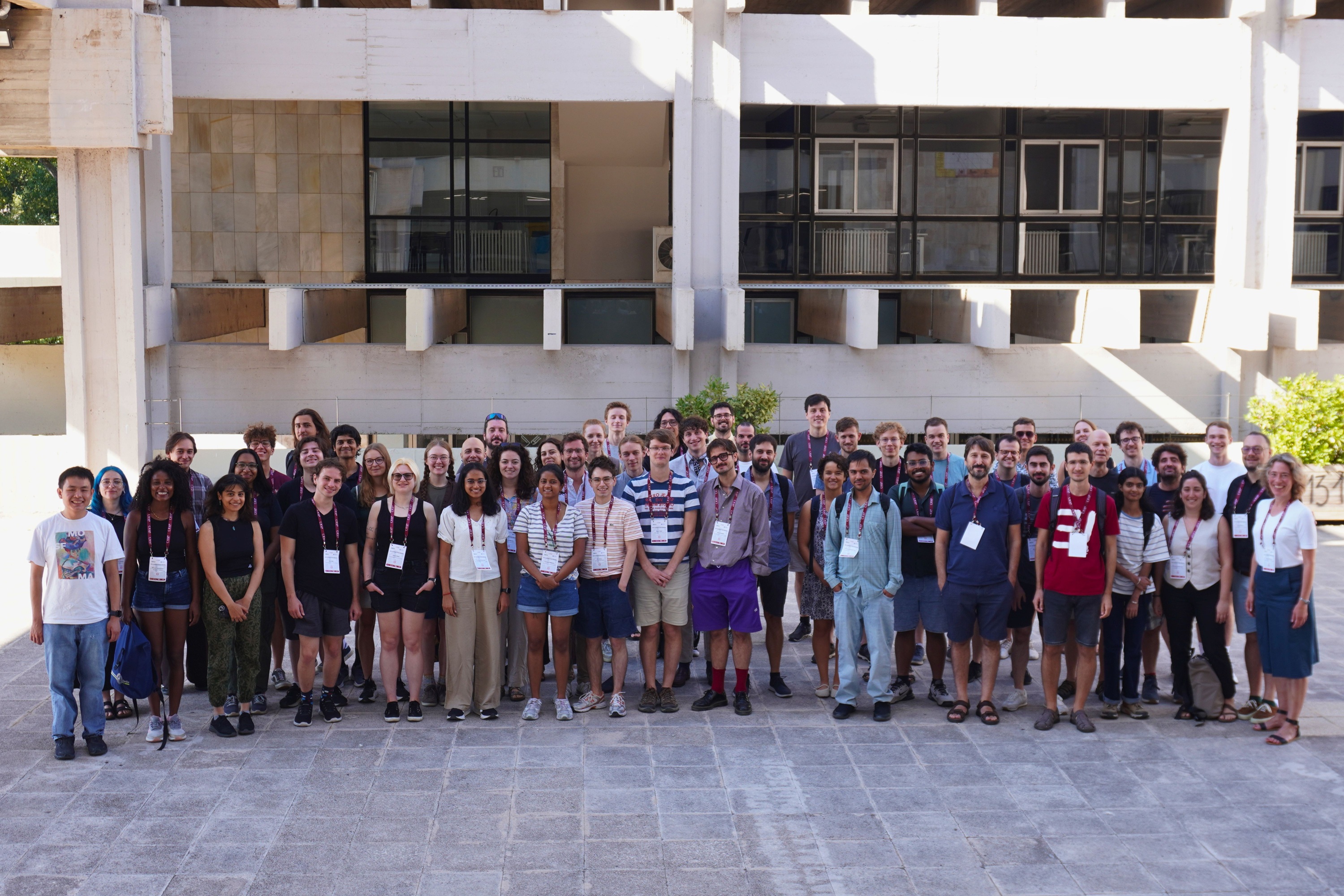
From 2 to 4 September 2026, the Centre de Recerca Matemàtica (CRM) hosted the BMS-BGSMath Junior Meeting 2026, a three-day event jointly organised by the Berlin Mathematical School (BMS) and the Barcelona Graduate School of Mathematics (BGSMath), with the Centre de...
The CRM organises the 2026 Barcelona Summer School for Advanced Modeling of Behavior
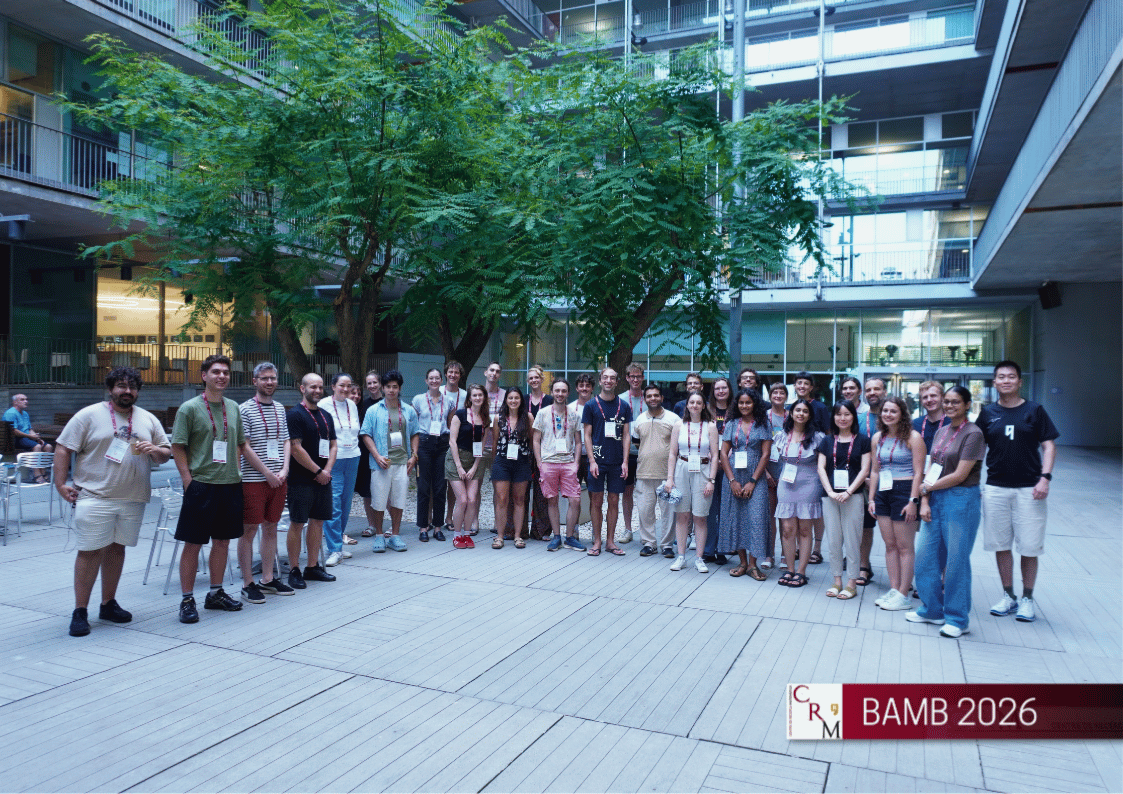
The Centre de Recerca Matemàtica held the sixth edition of BAMB!, the Barcelona Summer School for Advanced Modeling of Behavior, from 12 to 23 July 2026 at the Parc de Recerca Biomèdica de Barcelona. Thirty early-career researchers from fourteen countries followed...