The Norwegian Academy of Science and Letters has recognised the German mathematician for solving two of the most enduring open problems in the field.

The Norwegian Academy of Science and Letters announced today that the 2026 Abel Prize goes to Gerd Faltings, director emeritus at the Max Planck Institute for Mathematics in Bonn and professor emeritus at the University of Bonn. The citation reads: “for introducing powerful tools in arithmetic geometry and resolving long-standing diophantine conjectures of Mordell and Lang.”
Faltings becomes the first German mathematician to receive the prize, and the first to hold both an Abel Prize and a Fields Medal, the latter awarded to him in 1986 for the same body of work that now earns this recognition.
The Prize
The Abel Prize was established by the Norwegian government in 2002, on the occasion of the 200th anniversary of Niels Henrik Abel’s birth. It has been awarded annually since 2003. The prize carries an award of 7.5 million Norwegian kroner, equivalent to roughly 670,000 euros, and is presented each spring by the Crown Prince of Norway at a ceremony in Oslo. This year’s ceremony is scheduled for 26 May. Further information, including the full scientific citation and a popular account of Faltings’ work, is available at abelprize.no.
Abel himself died in 1829 at the age of 26, from tuberculosis, having spent most of his short life in poverty. He left behind a body of work that reshaped algebra and analysis, including a proof that the general quintic equation cannot be solved by radicals. The prize named after him was conceived to give mathematics a permanent, high-profile recognition on the level of the Nobel prizes. It took a century from the first proposal to the actual establishment of the award. By that point, the idea had been suggested, abandoned after the dissolution of the Swedish-Norwegian union in 1905, revived, debated, and eventually funded through the national budget.
Previous laureates include Andrew Wiles, Karen Uhlenbeck, Robert Langlands, and Mikhail Gromov. Last year, the prize went to Masaki Kashiwara for his contributions to algebraic analysis and representation theory.
Why Faltings
In 1922, the British mathematician Louis Mordell put forward a conjecture about a specific family of equations. He claimed that any algebraic curve of genus greater than one, defined over the rational numbers, could only have finitely many rational points. In plain terms: past a certain level of geometric complexity, a curve stops being the kind of object where solutions accumulate. There are a few, or there are none, but the supply runs out.
“His ideas and results have reshaped the field, settling major long-standing conjectures, while also establishing new frameworks that have guided decades of subsequent work.”
Abel Prize Committee, 2026
The conjecture sat open for sixty years. Many talented mathematicians came at it, found partial results, and stopped short. By the late 1970s, it had acquired the reputation of a problem that resisted whatever tools the field had available. Then in 1983, Gerd Faltings, aged 28, proved it. He used a combination of methods drawn from Arakelov theory and the arithmetic of abelian varieties, techniques that had not previously been brought to bear on the problem in that configuration. The proof surprised the community not only because it worked, but because of how much extra machinery it produced along the way.
The result carries a well-known corollary. The Fermat curves xn + yn = zn have genus greater than one when n is at least 4. Hence, Faltings’ theorem immediately implies that for those exponents, there can only be finitely many rational solutions. It does not prove the count is zero, as Andrew Wiles’ proof of Fermat’s Last Theorem in 1995 did, but it ruled out infinity, which had not been done before.
Faltings did not stop at Mordell. In 1989, Paul Vojta found a different proof of the Mordell conjecture using diophantine approximation. Faltings adapted that approach in 1991 to prove the Mordell-Lang conjecture, a substantially harder generalisation about the distribution of rational points in subvarieties of abelian varieties. The same paper also established the finiteness of integral points on affine subvarieties of abelian varieties, as conjectured by Serge Lang.
Beyond diophantine geometry, Faltings made major contributions to p-adic Hodge theory, proving the main conjectures formulated by Tate and Jean-Marc Fontaine and extending the theory into the non-abelian setting. The tools he introduced there have remained central to the field, including through the subsequent work of Peter Scholze. The Abel committee’s citation describes him as “a towering figure in arithmetic geometry” whose “ideas and results have reshaped the field, settling major long-standing conjectures, while also establishing new frameworks that have guided decades of subsequent work.”
A Career at the Intersection of Geometry and Arithmetic
Faltings was born in Gelsenkirchen in 1954. He studied mathematics and physics at the University of Münster, completing his doctorate there in 1978. A visiting scholarship at Harvard followed, then a return to Münster as an assistant, then his habilitation in 1981. At 27, he was appointed to a full professorship at the University of Wuppertal, the youngest in Germany at the time. In 1985, he moved to Princeton, where he remained for nearly a decade.
He returned to Germany in 1994, when his daughters were older, and has been based at the Max Planck Institute for Mathematics in Bonn ever since. He became director emeritus there in 2023.
Faltings’ work sits at the intersection of number theory and algebraic geometry, a territory that goes by the name of arithmetic geometry. The central questions of the field concern rational or integer solutions to polynomial equations, objects that look like algebra but live on geometric structures. His contribution was not just to answer specific questions but to import an entire set of geometric tools into that arithmetic context, tools that others have continued to develop and apply since.
Outside mathematics, Faltings is known as a devoted opera-goer, a fan of FC Schalke 04, and an enthusiastic gardener.
A Prior Visit to the CRM
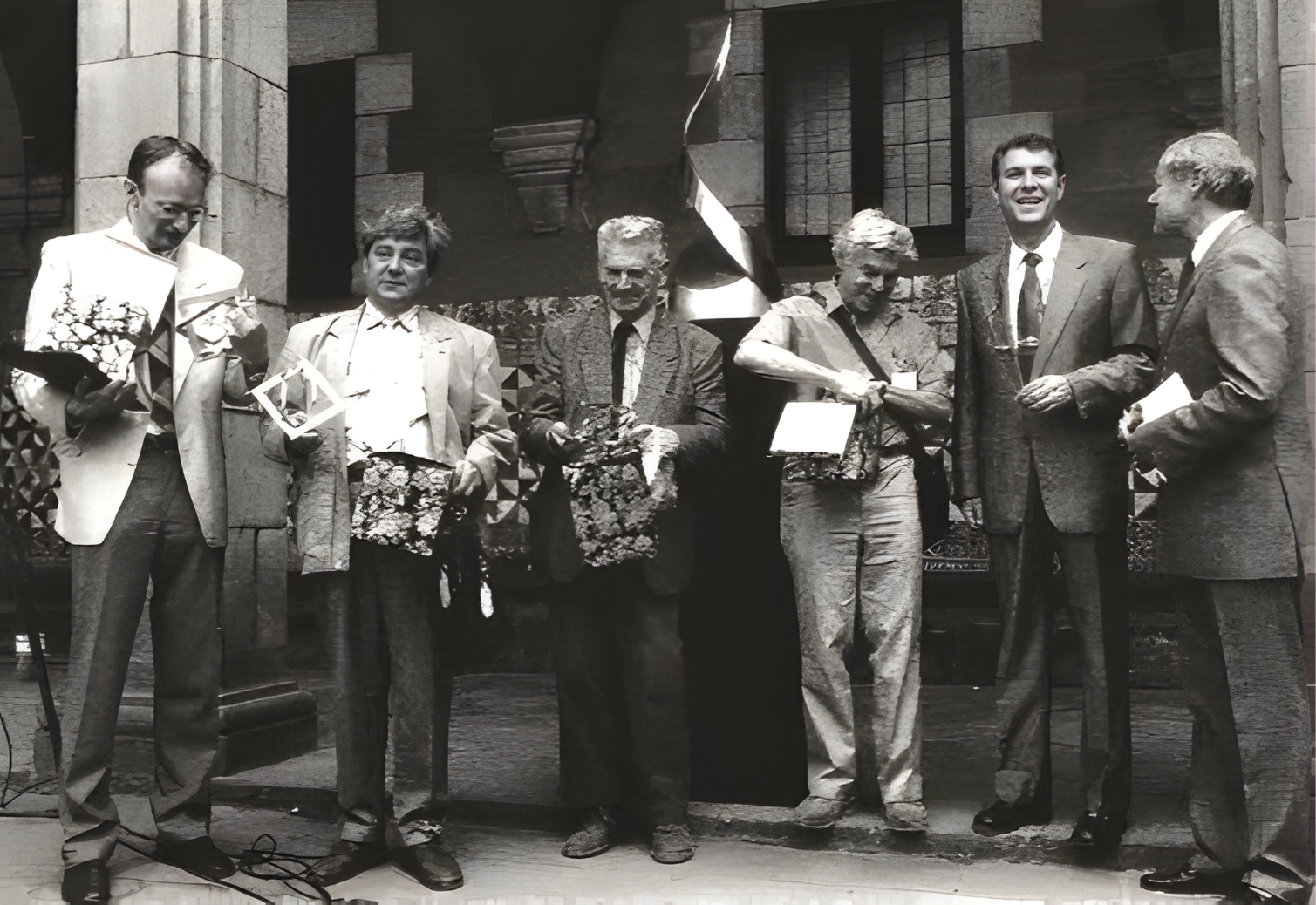 Faltings’ connection to Barcelona goes back more than three decades. In June 1991, at the height of his reputation following the Mordell proof and the Fields Medal, he was one of six Fields Medallists invited to participate in the Symposium on the Current State and Prospects in Mathematics, organised by the CRM as part of the Barcelona Cultural Olympiad. The other plenary speakers were Allan Connes, Vaughan Jones, Sergei Novikov, Stephen Smale, and René Thom. The proceedings were published by Springer under the title Mathematical Research: Today and Tomorrow.
The prize will be presented at a ceremony in Oslo on 26 May 2026.
|
|
CRM CommPau Varela
|
Yves Chevallard (1946–2026)
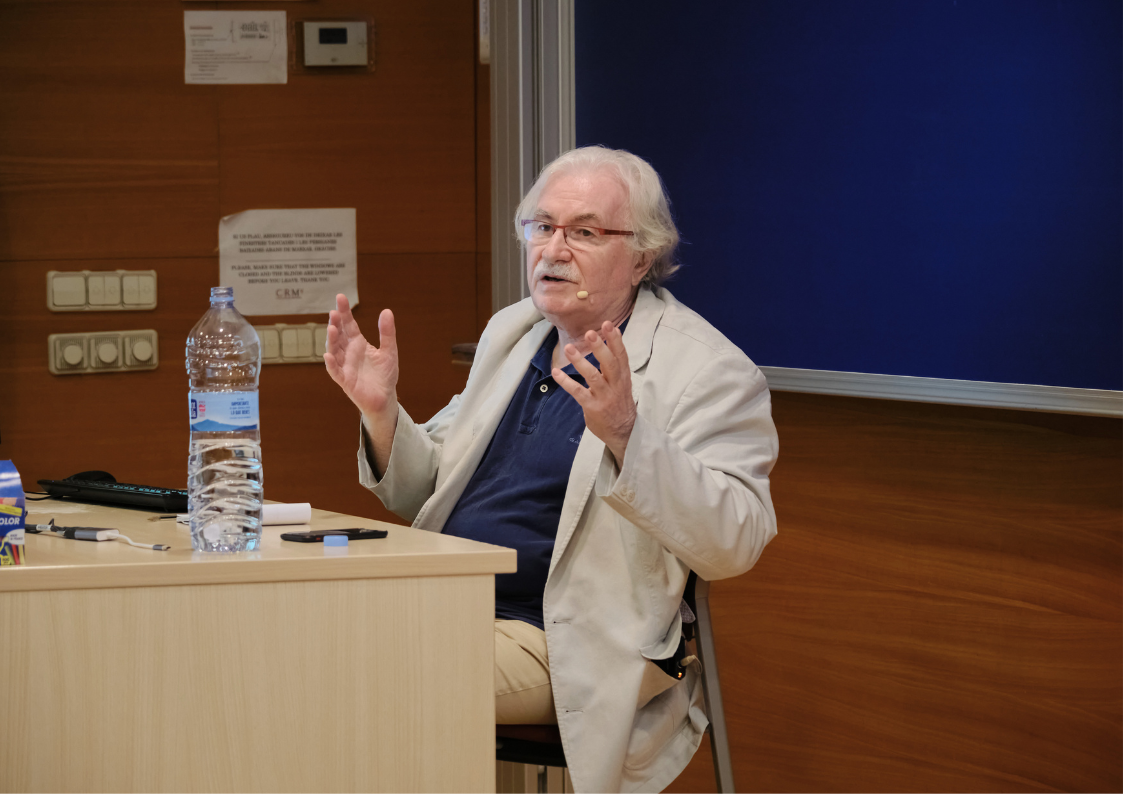
Yves Chevallard passed away on 16 March 2026. He was 79 years old. Born in Tunis, he trained at the École normale supérieure in Paris, where he earned an agrégation de mathématiques. He went on to become a professor at Aix-Marseille Université, and it was there, over...

The CRM participates in a European project studying decision-making and risk perception in mountain environments
The NeuroMunt project (POCTEFA, coordinated by the Université de Perpignan Via Domitia) studies how people make decisions under risk conditions in mountain environments, bringing together researchers from France and Spain across disciplines ranging from complex...
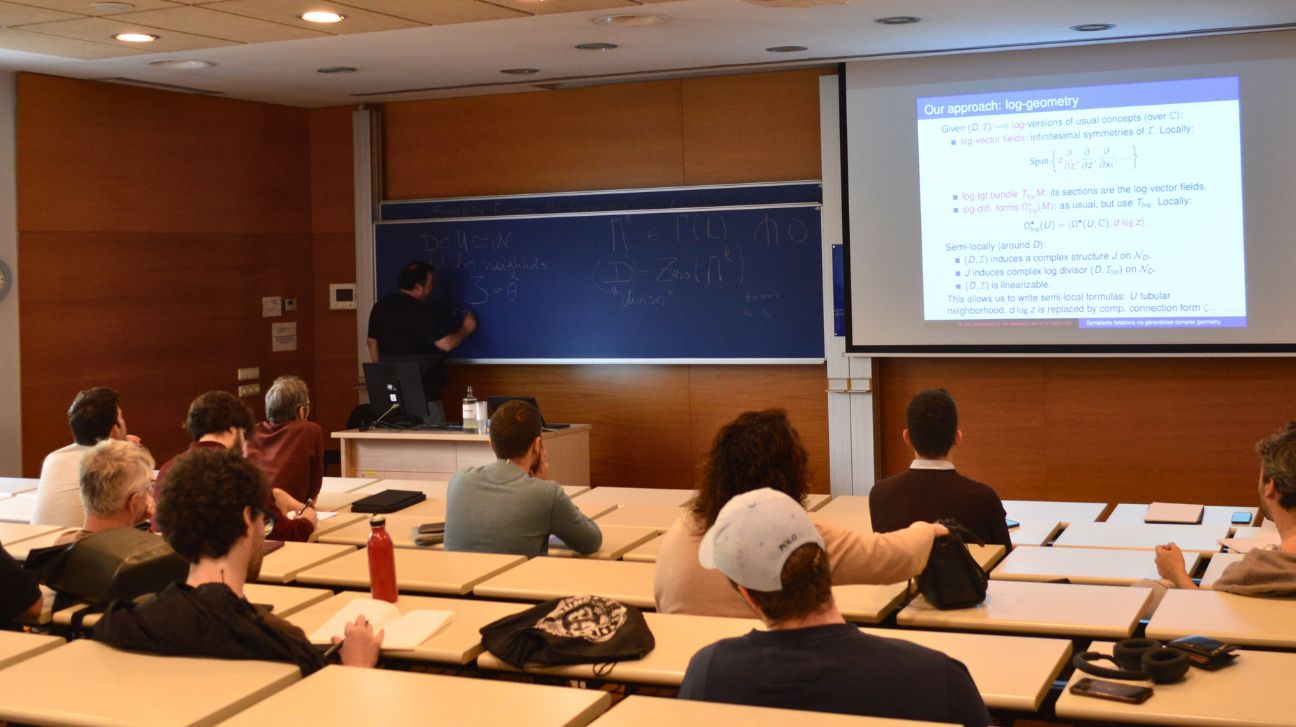
One Day, One Family, One Place: Poisson Geometry at CRM
On March 23rd, 2026, the Centre de Recerca Matemàtica hosted the thematic day “Poisson Geometry and Its Relatives”, a full‑day event that brought together researchers exploring Poisson geometry and several of its neighbouring areas. The programme combined classical...
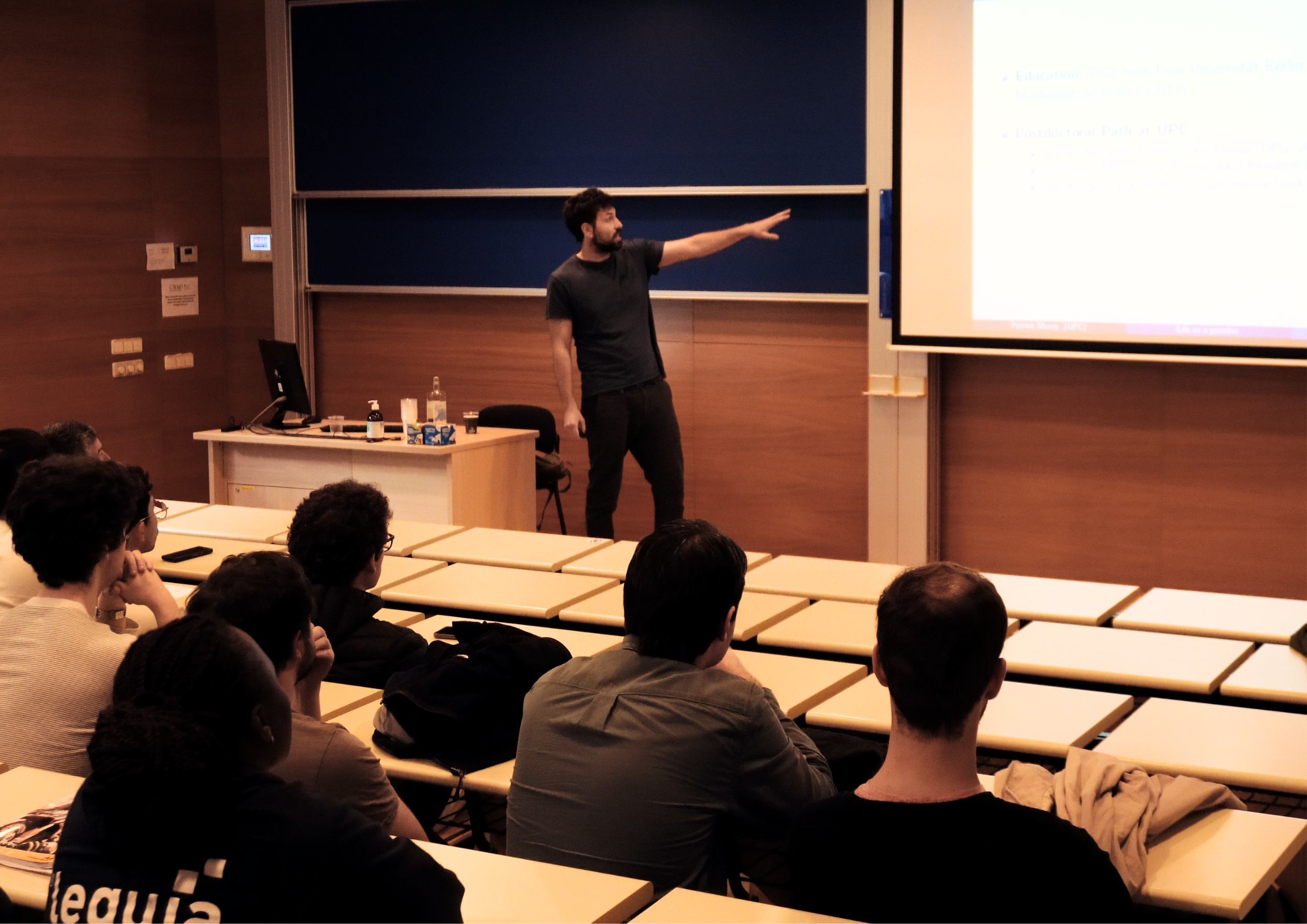
Life After the PhD: Three Roads Forward
On March 18, the BGSMath held its first session on careers after a PhD in mathematics, bringing together three speakers with different professional trajectories and 46 early-career researchers from nine institutions.On March 18, the Barcelona Graduate School of Math...
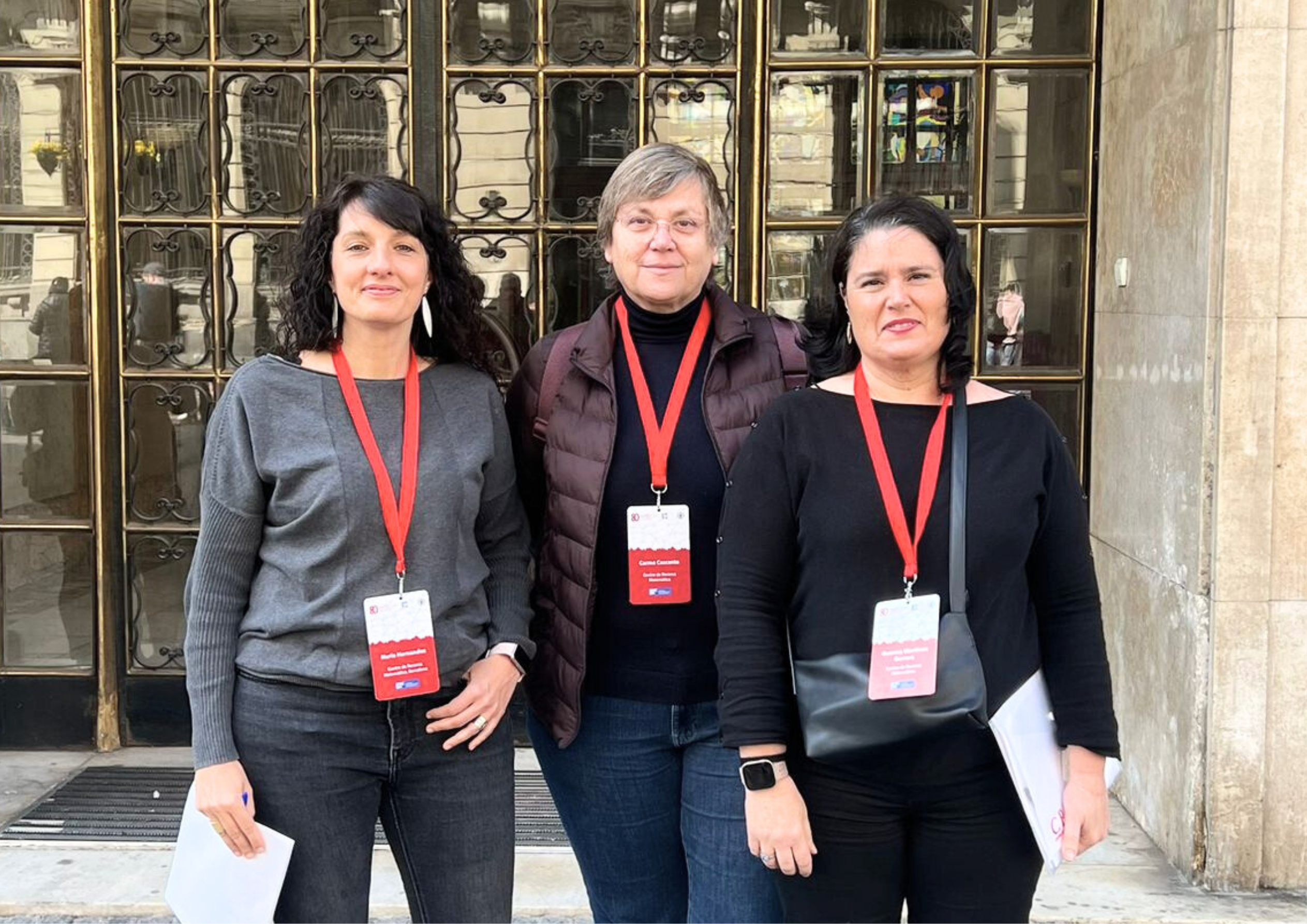
CRM participates in the 2026 ERCOM annual meeting in Belgrade
The CRM participated in the 2026 ERCOM annual meeting in Belgrade (20–21 March), represented by Director Carme Cascante, Manager Gemma Martínez, and Scientific Activities Manager Núria Hernández. The programme focused on multidisciplinarity, mathematics and the arts,...
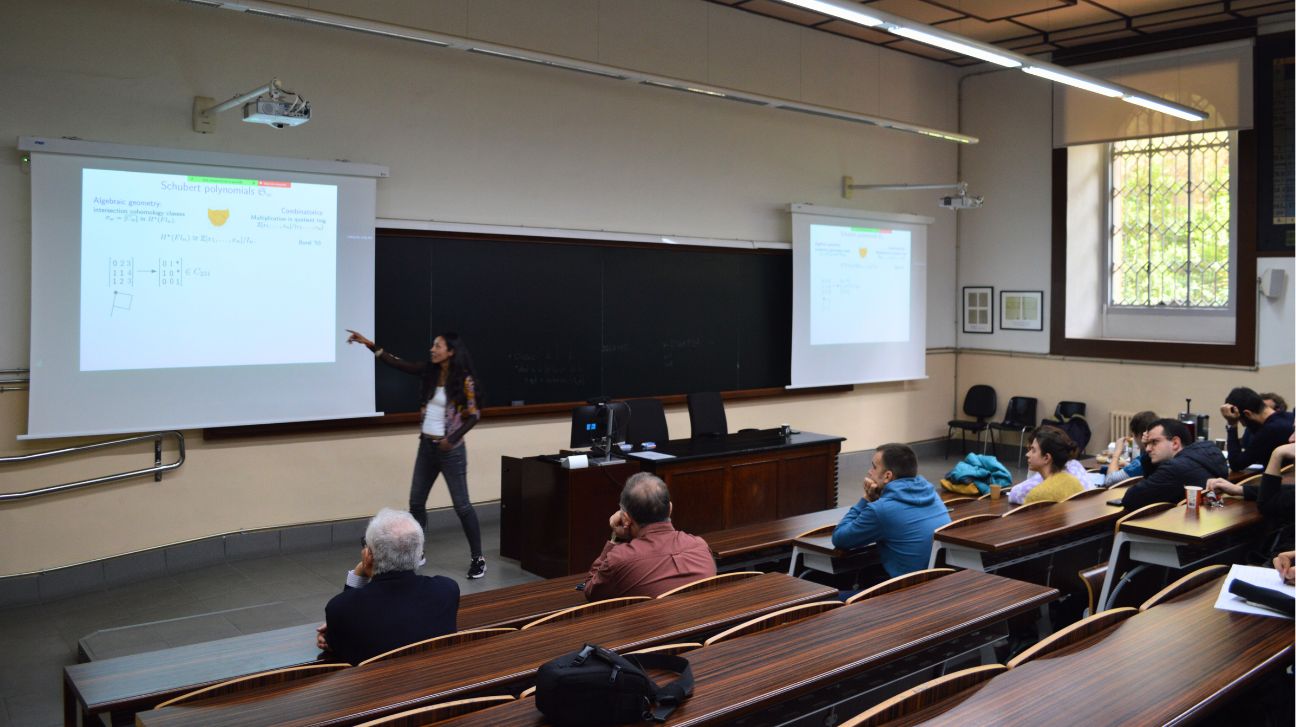
5 Talks, 1 Topic: A Day of Combinatorics
On March 18th, 2026, the 5 Talks in Combinatorics thematic day took place in the Joan Maragall Room at the Faculty of Philology and Communication of the University of Barcelona, in the historic building. The event focused on modern combinatorics and its connections...
The Centre de Recerca Matemàtica Approves Its Strategic Plan for 2026–2030
The Centre de Recerca Matemàtica has approved its Strategic Plan for 2026 - 2030, setting priorities in research, training, and knowledge transfer. Four flagship initiatives anchor the scientific programme. The Centre de Recerca Matemàtica approved its Strategic Plan...
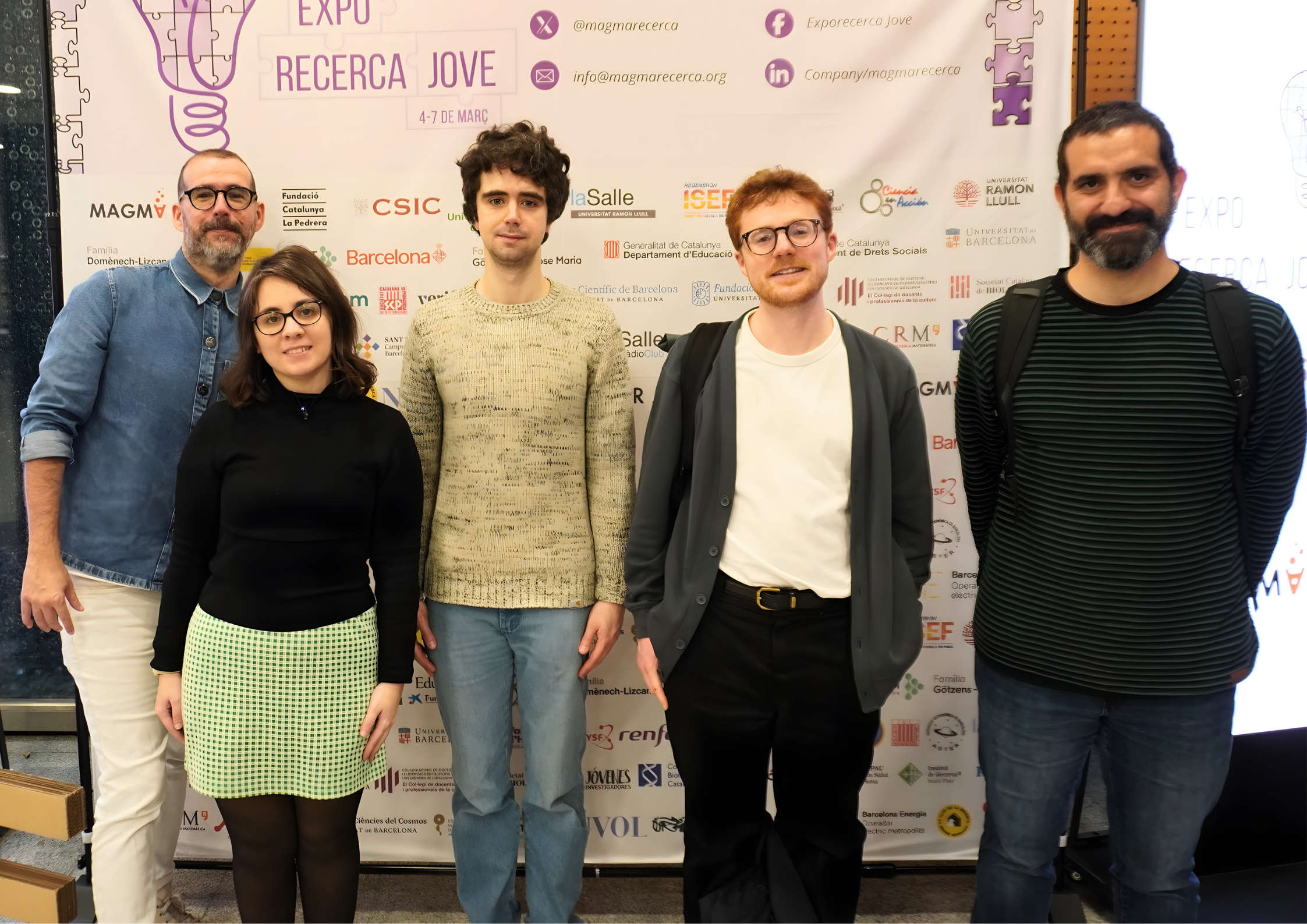
CRM Awards Its Prize at Exporecerca Jove for the Third Time
For the third year running, CRM visited Exporecerca Jove to award its prize to the student project with the strongest mathematical content. This edition, the jury selected two winners: Xavier Ortiz Quintana, who built a real-time 3D scanner using...

When Symmetry Breaks the Rules: From Askey–Wilson Polynomials to Functions
Researchers Tom Koornwinder (U. Amsterdam) and Marta Mazzocco (ICREA-UPC-CRM) published a paper in Indagationes Mathematicae exploring DAHA symmetries. Their work shows that these symmetries shift Askey–Wilson polynomials into a continuous functional setting,and...
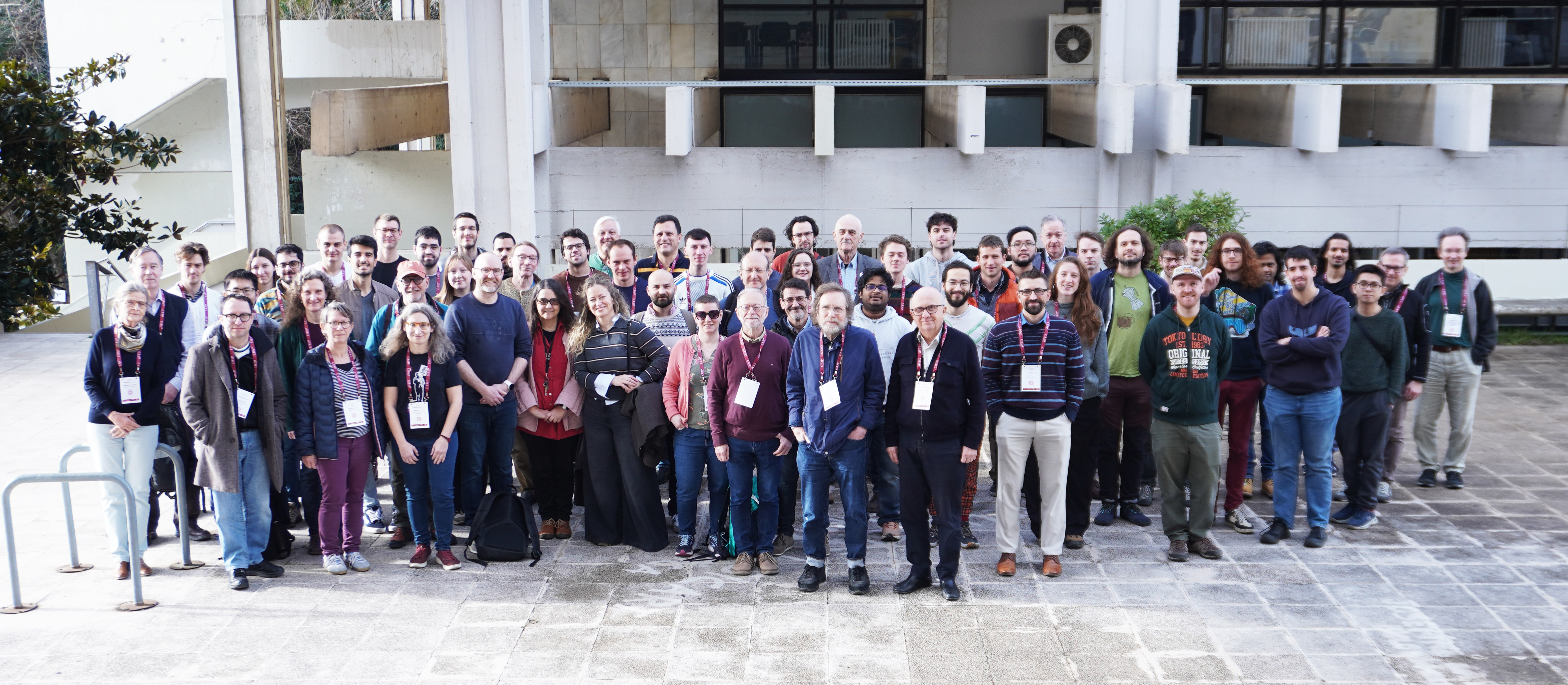
Homotopy Theory Conference Brings Together Diverse Research Perspectives
The Centre de Recerca Matemàtica hosted 75 mathematicians from over 20 countries for the Homotopy Structures in Barcelona conference, held February 9-13, 2026. Fourteen invited speakers presented research spanning rational equivariant cohomology theories, isovariant...
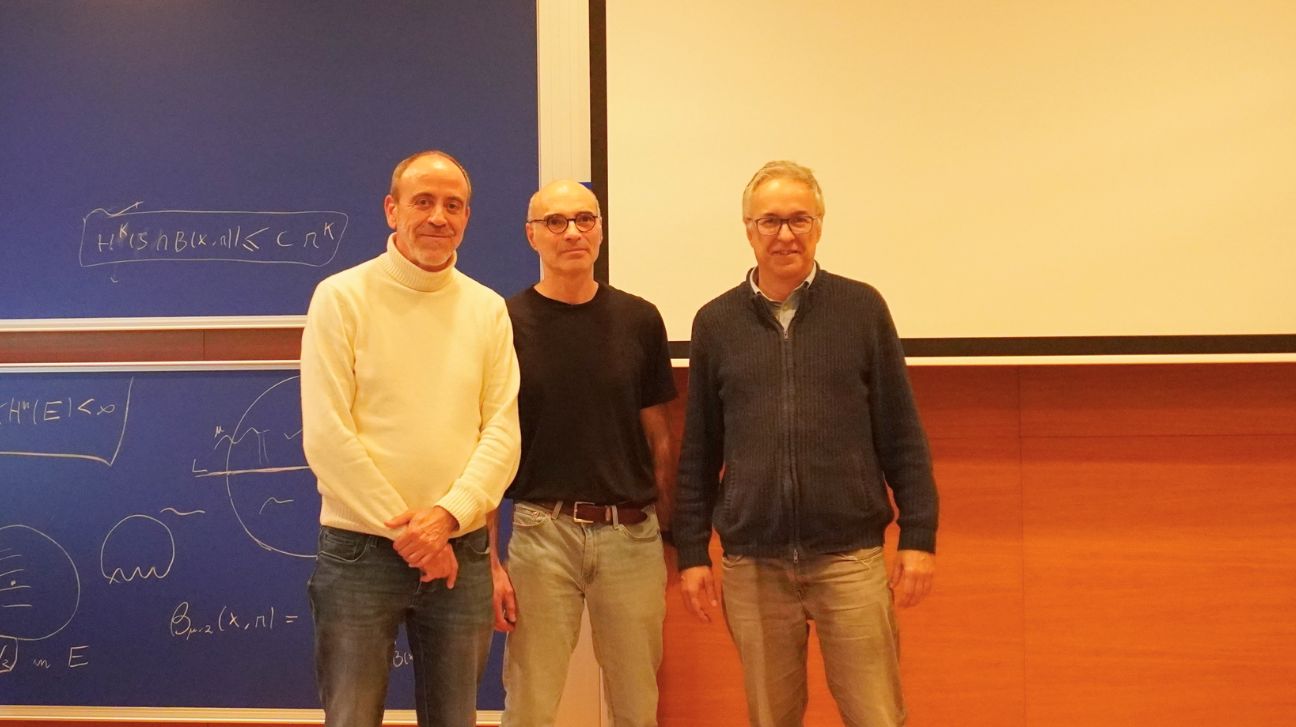
Three ICM speakers headline the first CRM Faculty Colloquium
On 19 February 2026, the Centre de Recerca Matemàtica inaugurated its first CRM Faculty Colloquium, a new quarterly event designed to bring together the mathematical community around the research carried out by scientists affiliated with the Centre. The CRM auditorium...