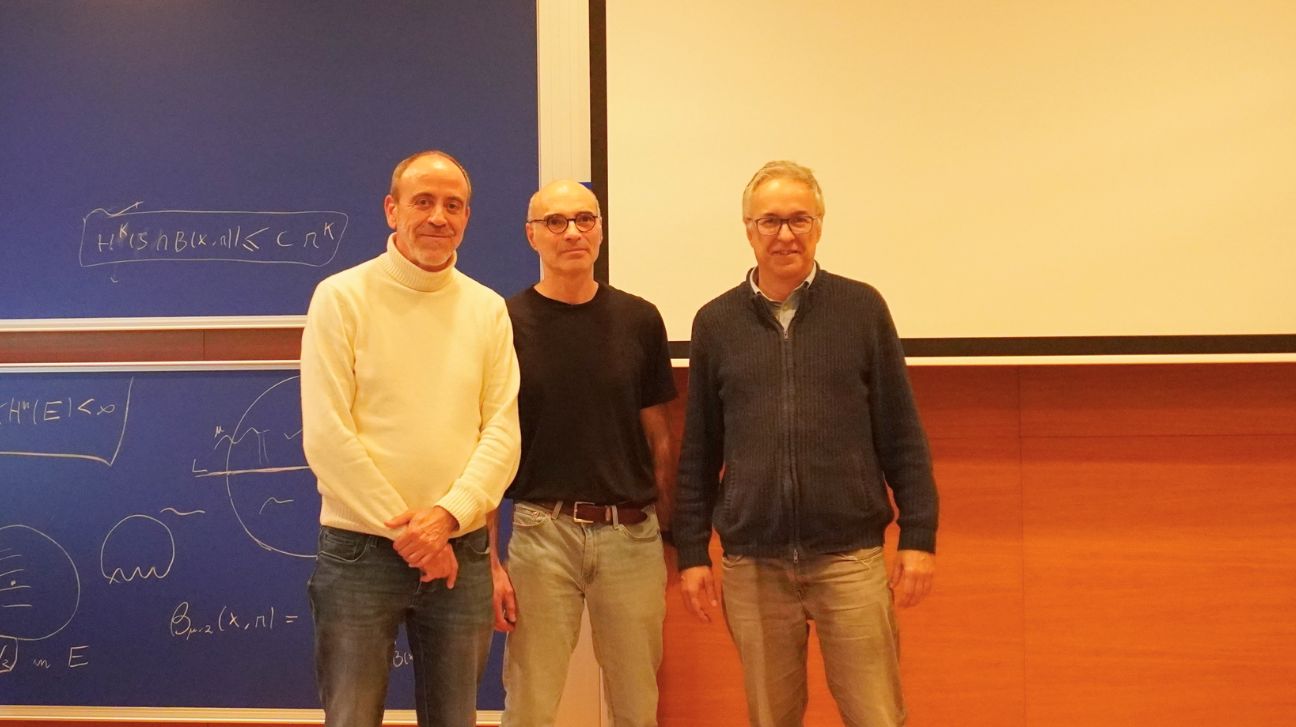
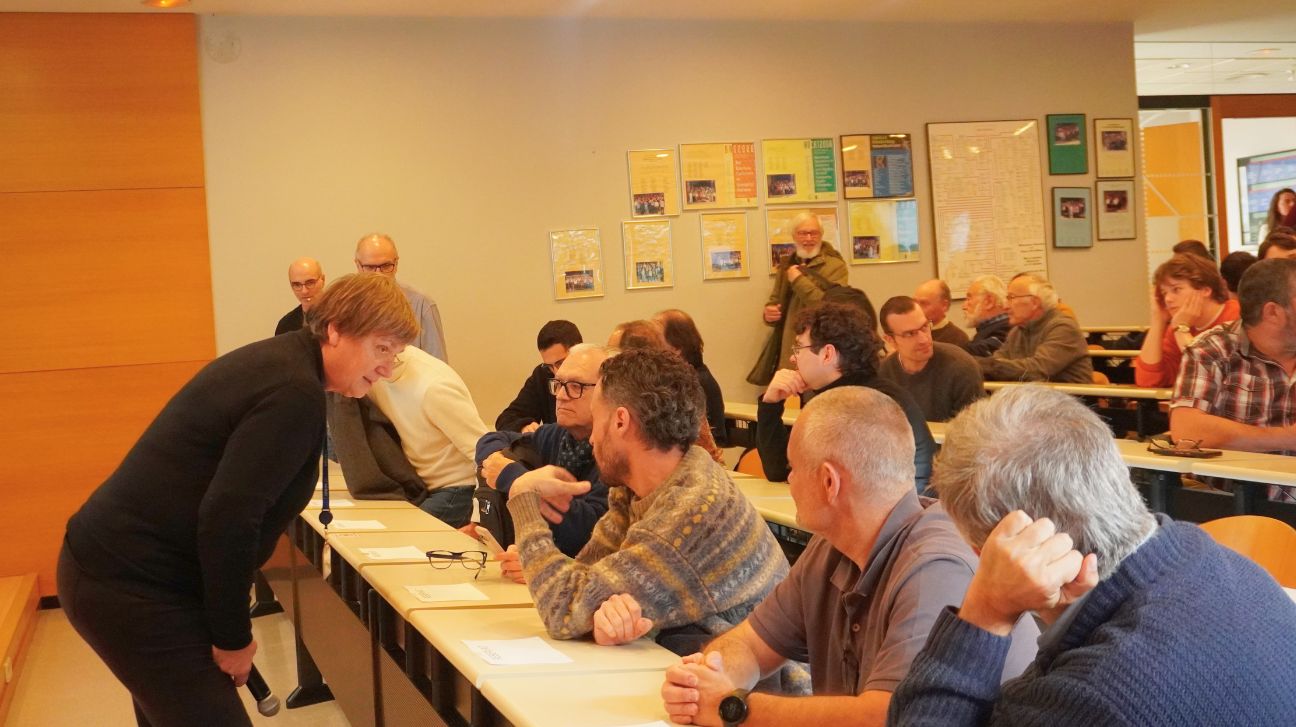
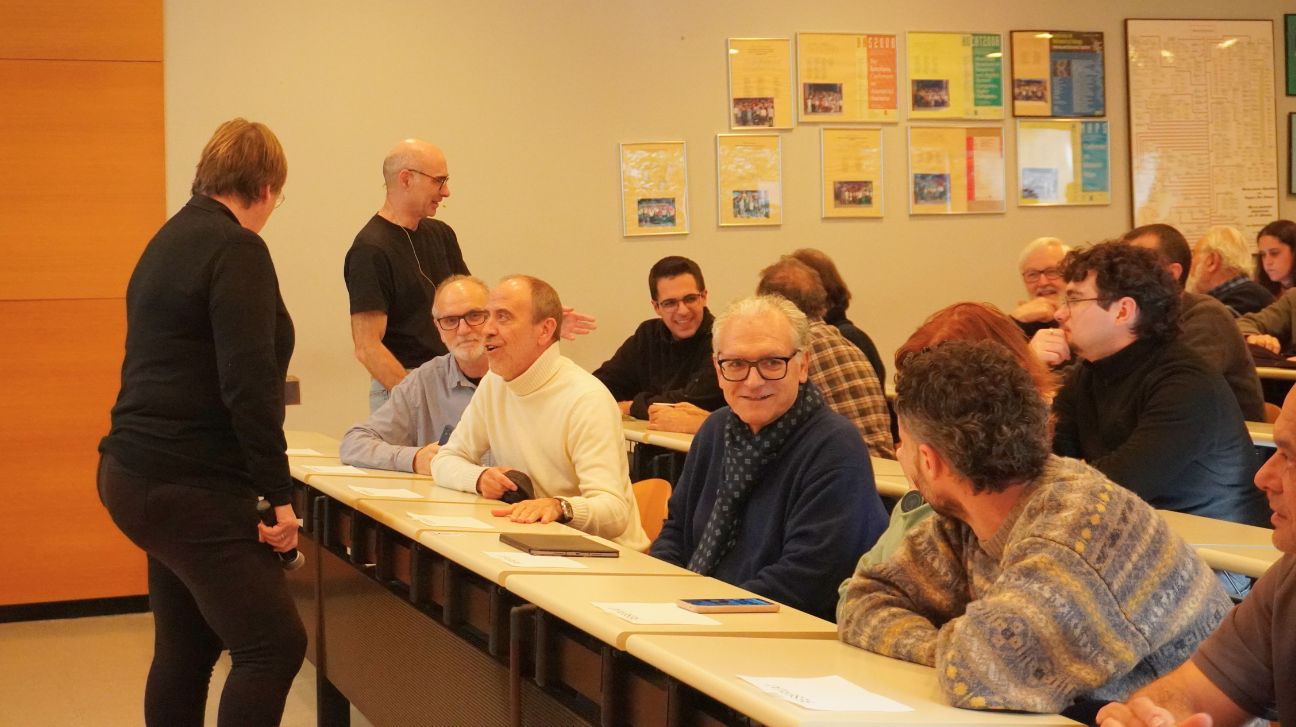
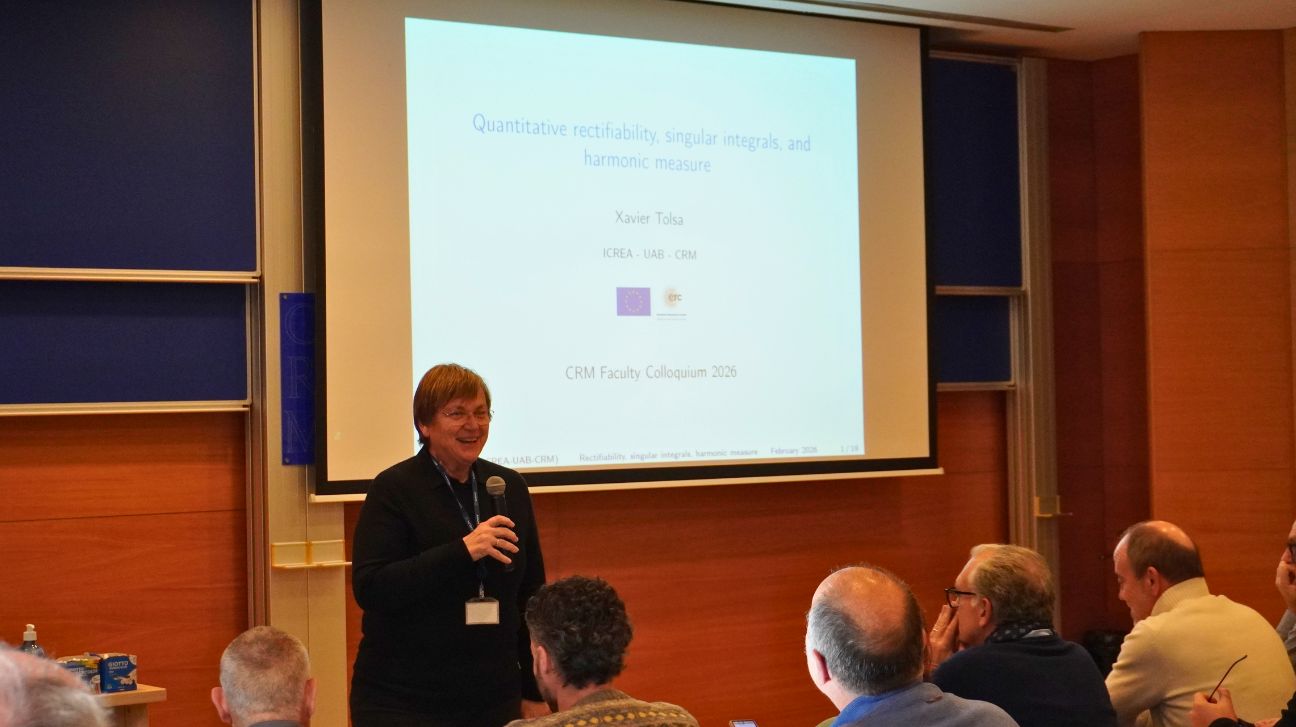
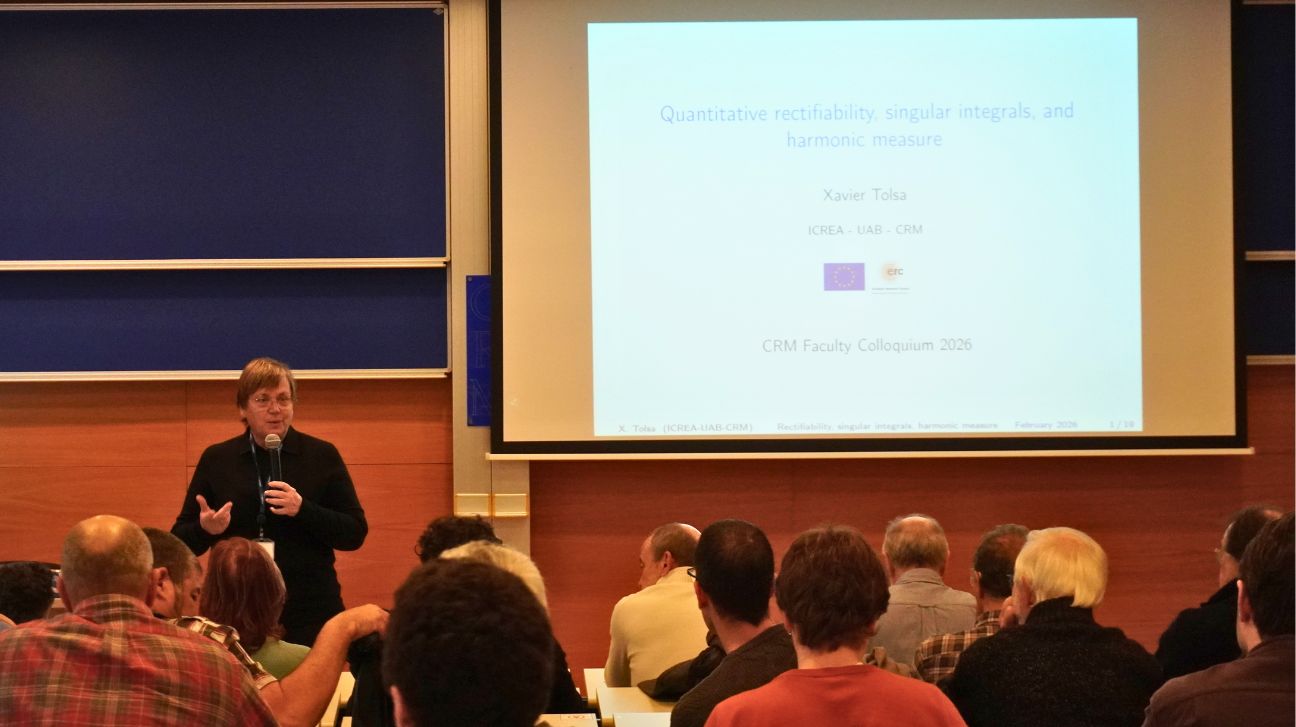
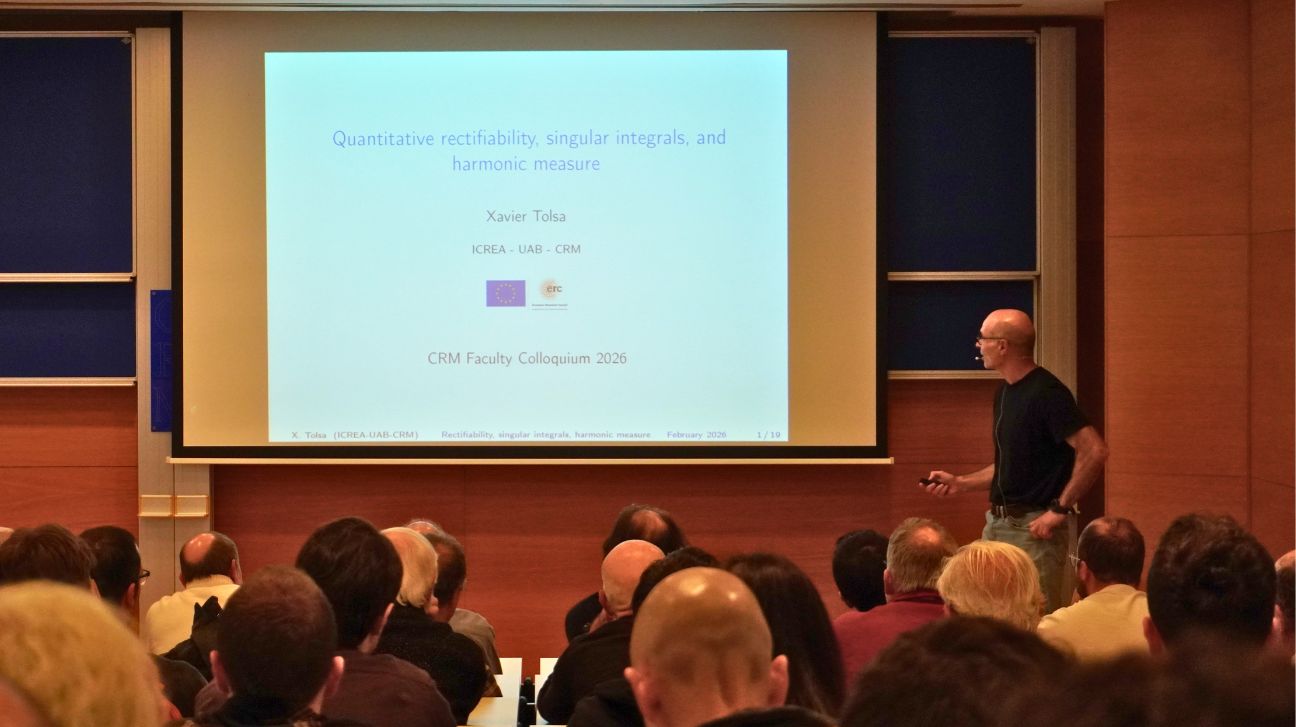
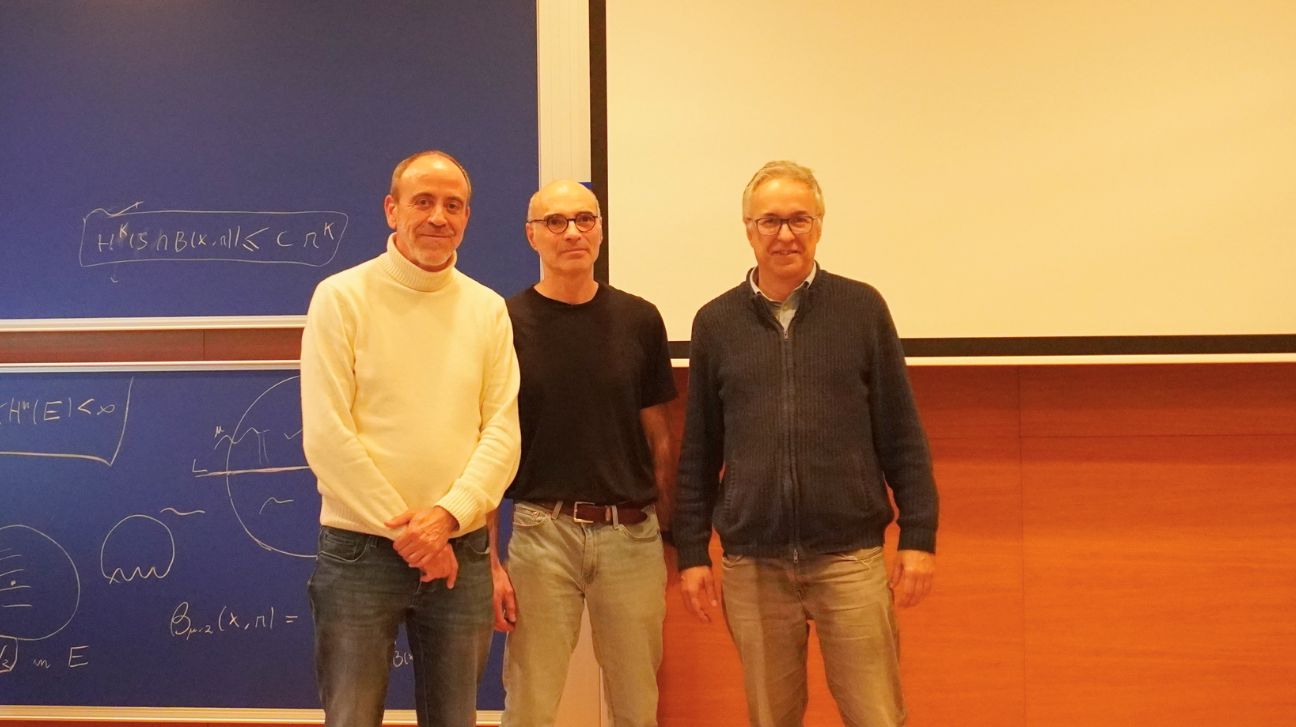
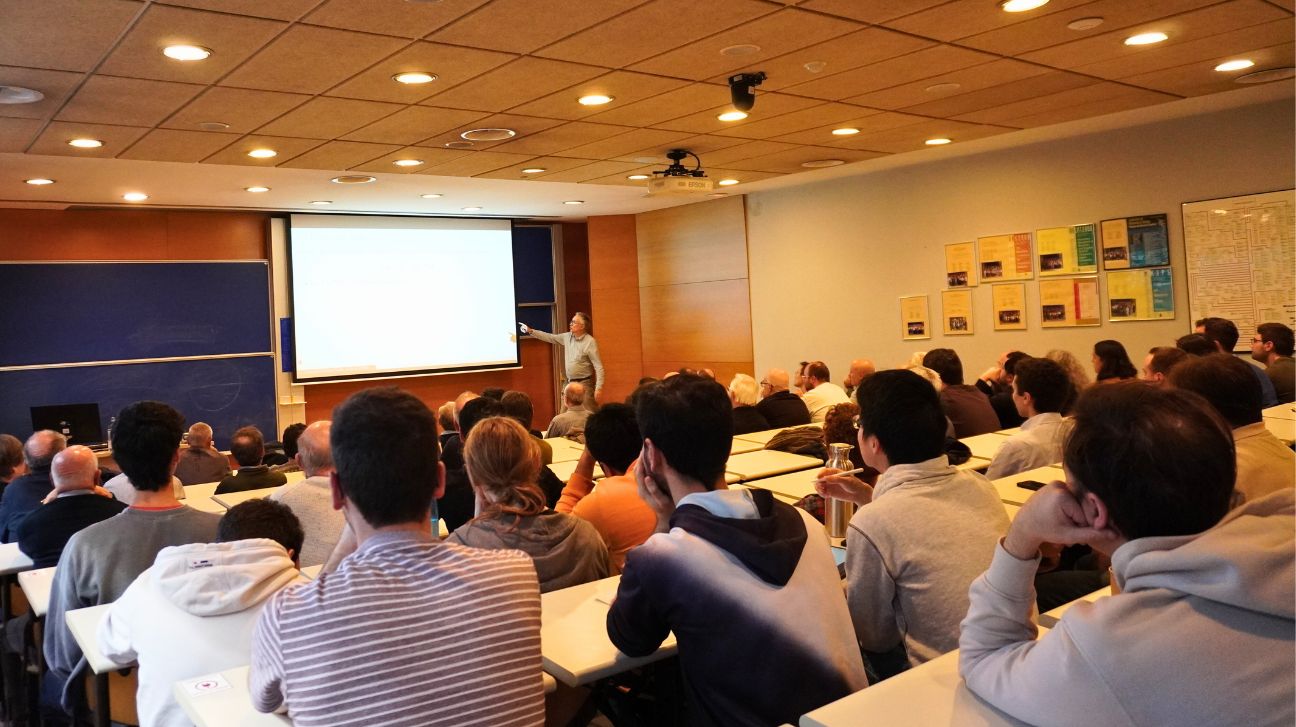
On 19 February 2026, the Centre de Recerca Matemàtica inaugurated its first CRM Faculty Colloquium, a new quarterly event designed to bring together the mathematical community around the research carried out by scientists affiliated with the Centre. The CRM auditorium filled up for this first edition, marked by the prestige and international recognition of its three speakers: Xavier Tolsa, Joaquim Ortega-Cerdà, and Xavier Cabré, all invited participants at the International Congress of Mathematicians (ICM 2026) in Philadelphia. Their joint presence in the same ICM — an unprecedented occurrence — served as a unifying thread of the colloquium, a shared source of pride, and an element that added special symbolic significance to the event.
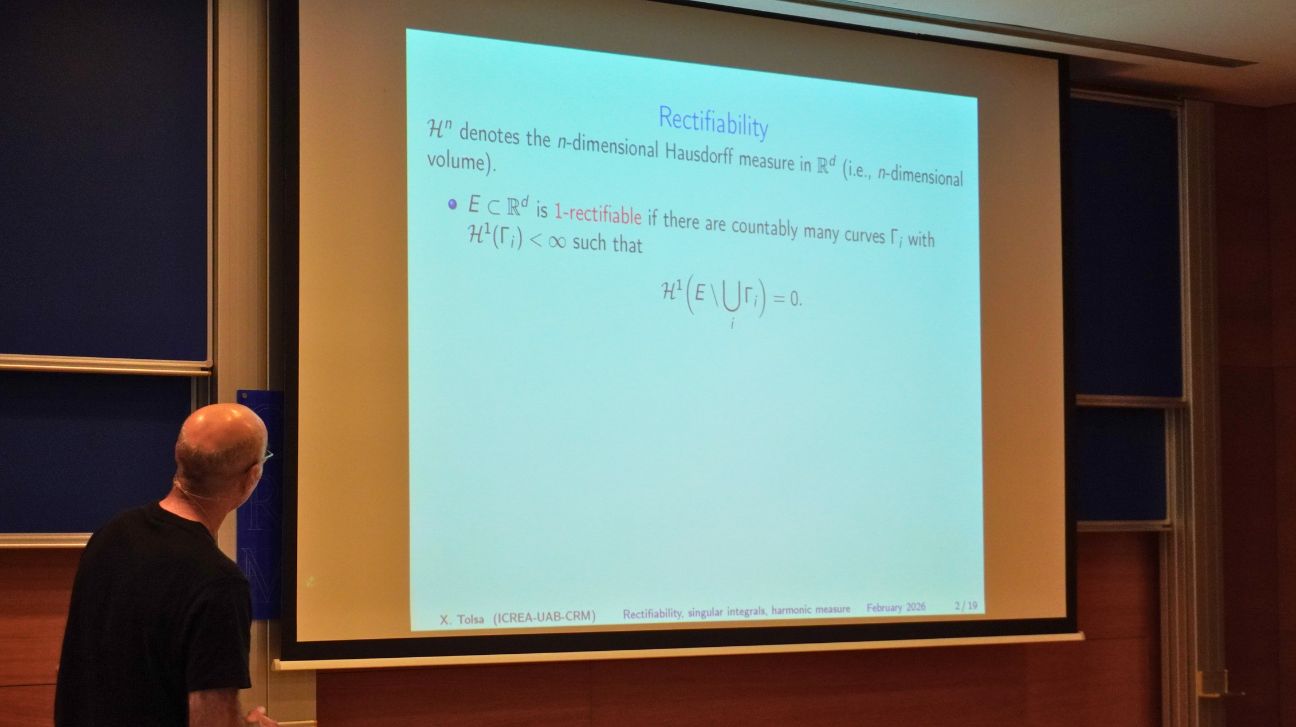
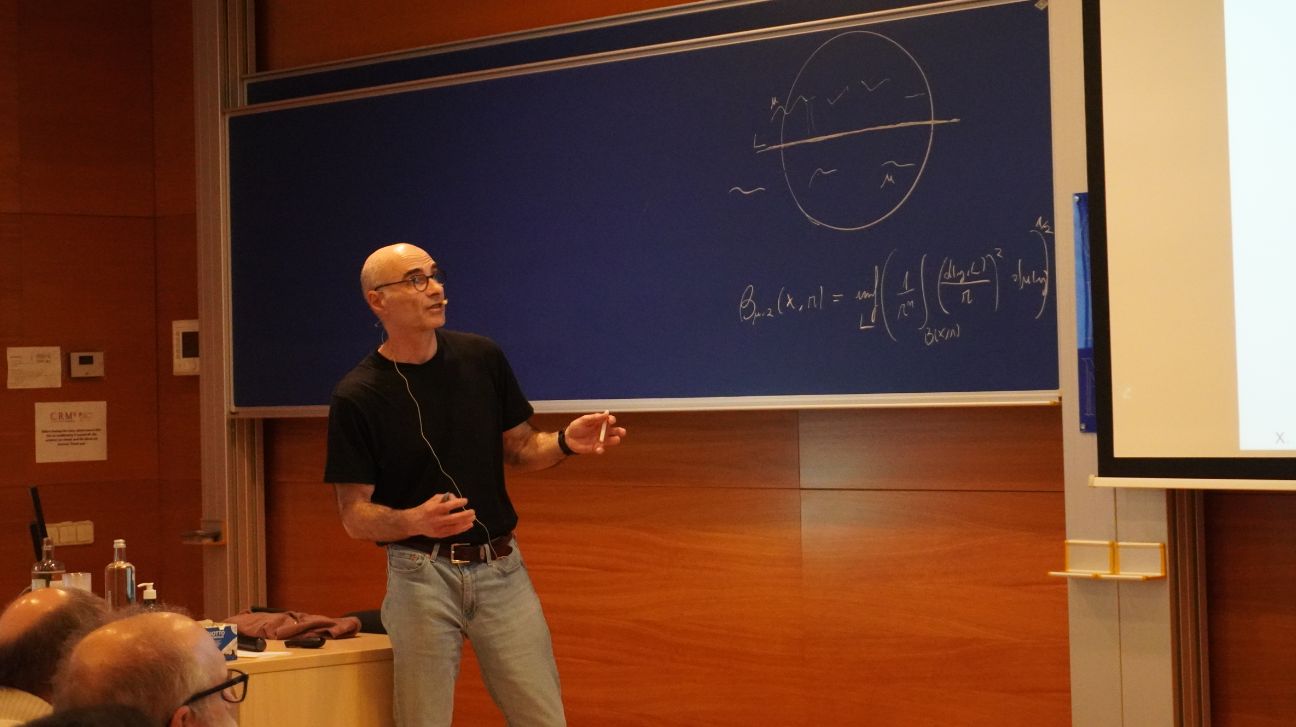
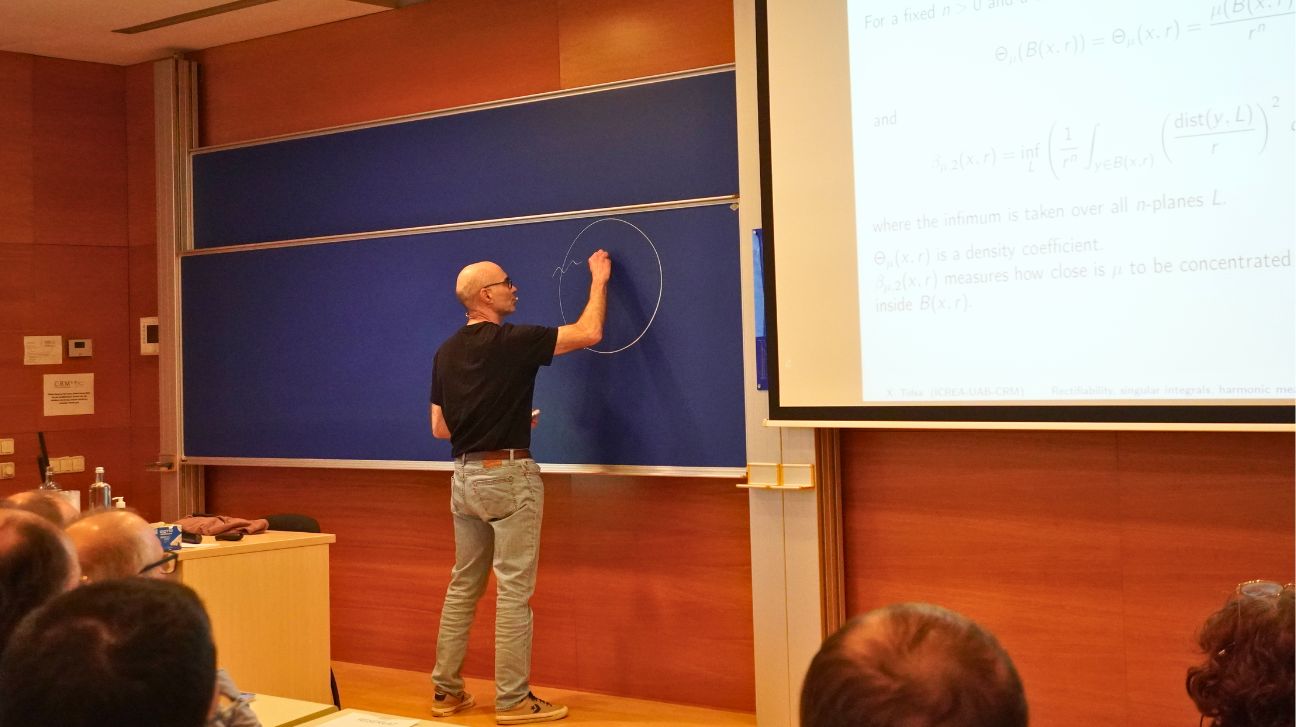
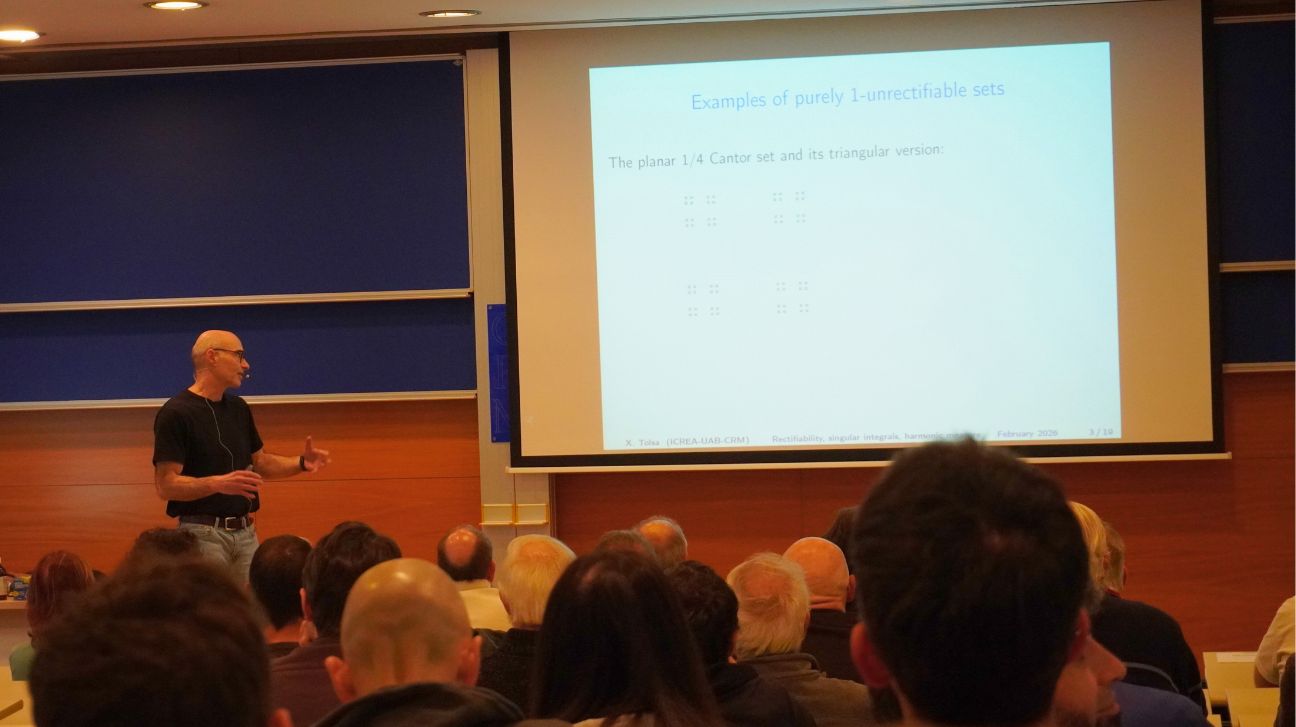
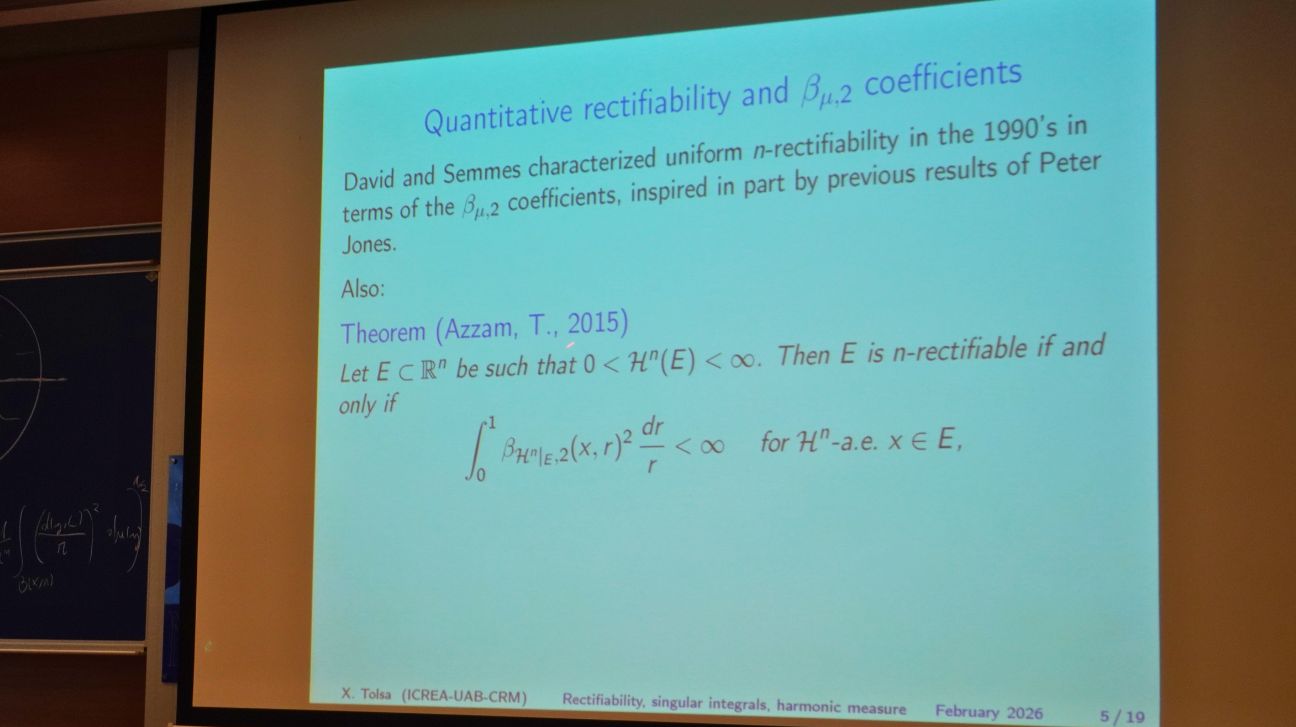
As highlighted by the CRM Director during the welcome remarks, the new colloquium aims to foster synergies between research groups, showcase recent advances, and strengthen internal scientific cohesion. In this context, the first talk was delivered by Xavier Tolsa (ICREA – UAB – CRM), titled Quantitative rectifiability, singular integrals, and harmonic measure. Tolsa, who will be a plenary speaker at this year’s ICM, introduced the foundations of quantitative rectifiability, a research area that links the fine geometry of sets with tools from harmonic analysis, such as square functions and singular integrals. Throughout his lecture, he revisited classical results while highlighting recent developments that have resolved deep problems related to harmonic measure, including the one-phase and two-phase cases, as well as new findings about its dimension. His talk allowed the audience to explore a highly active research field with connections ranging from analysis to potential theory and partial differential equations.
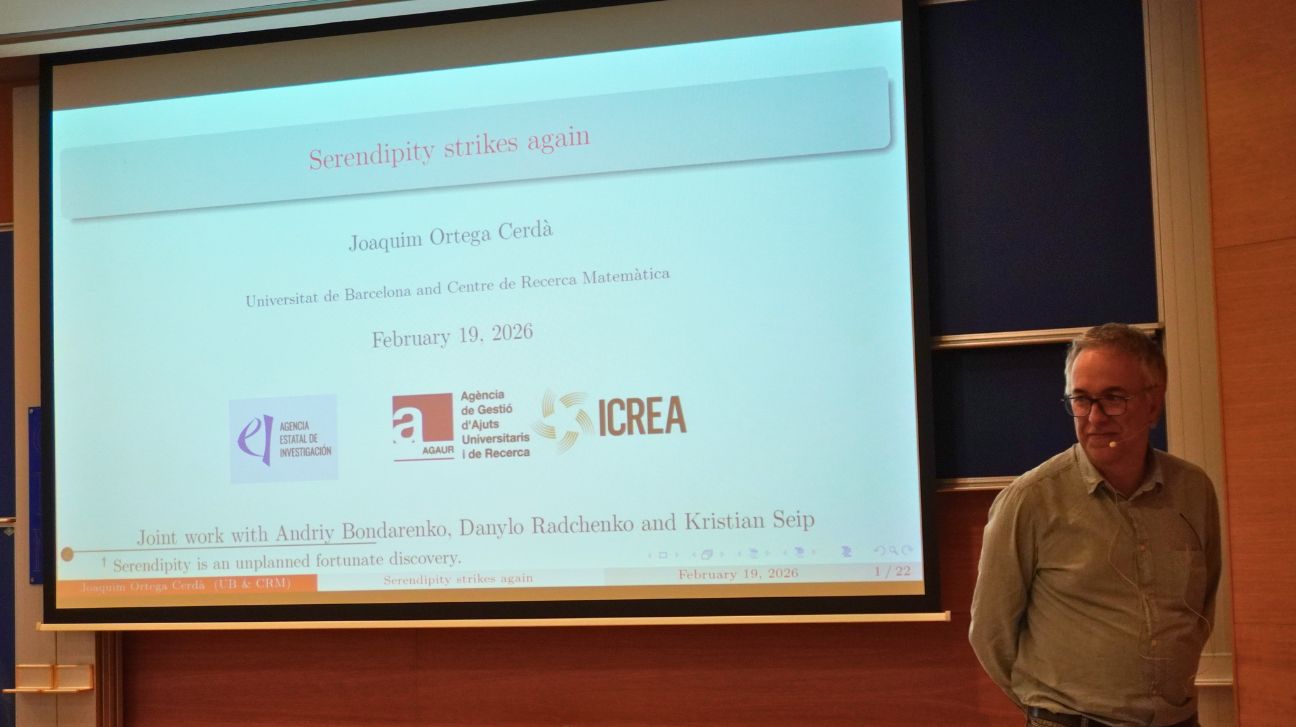
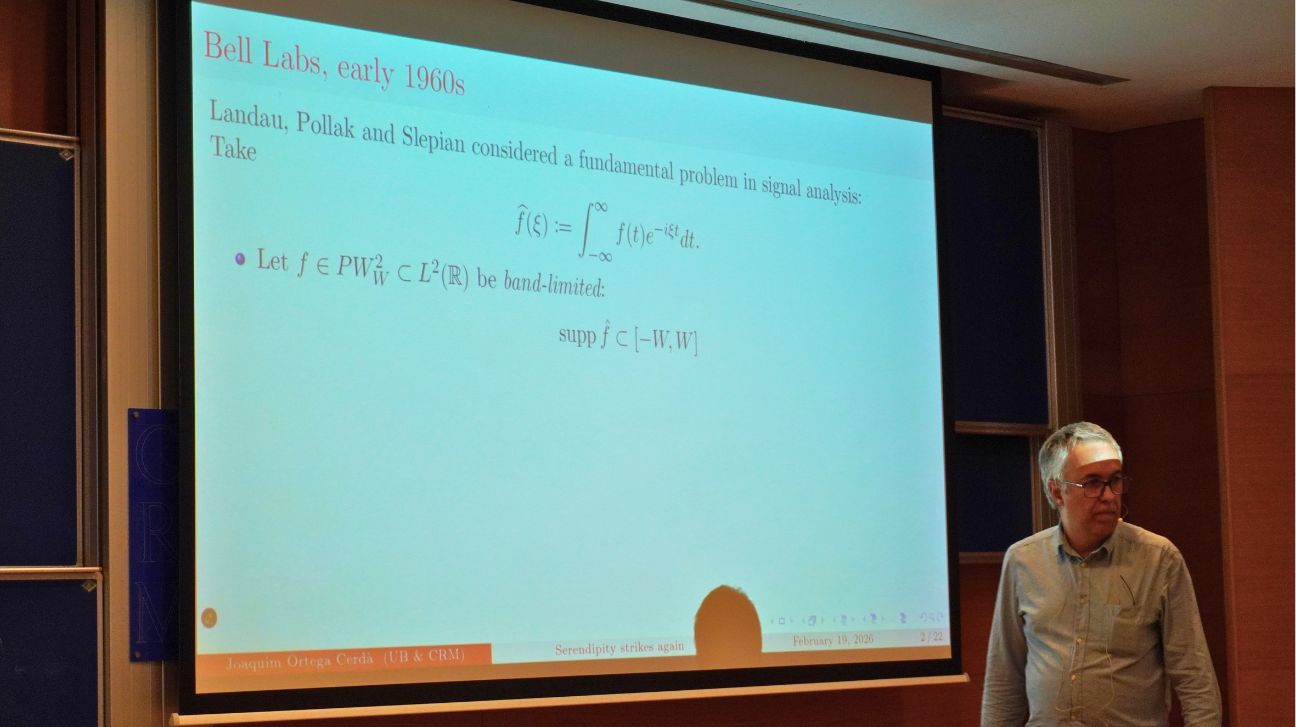
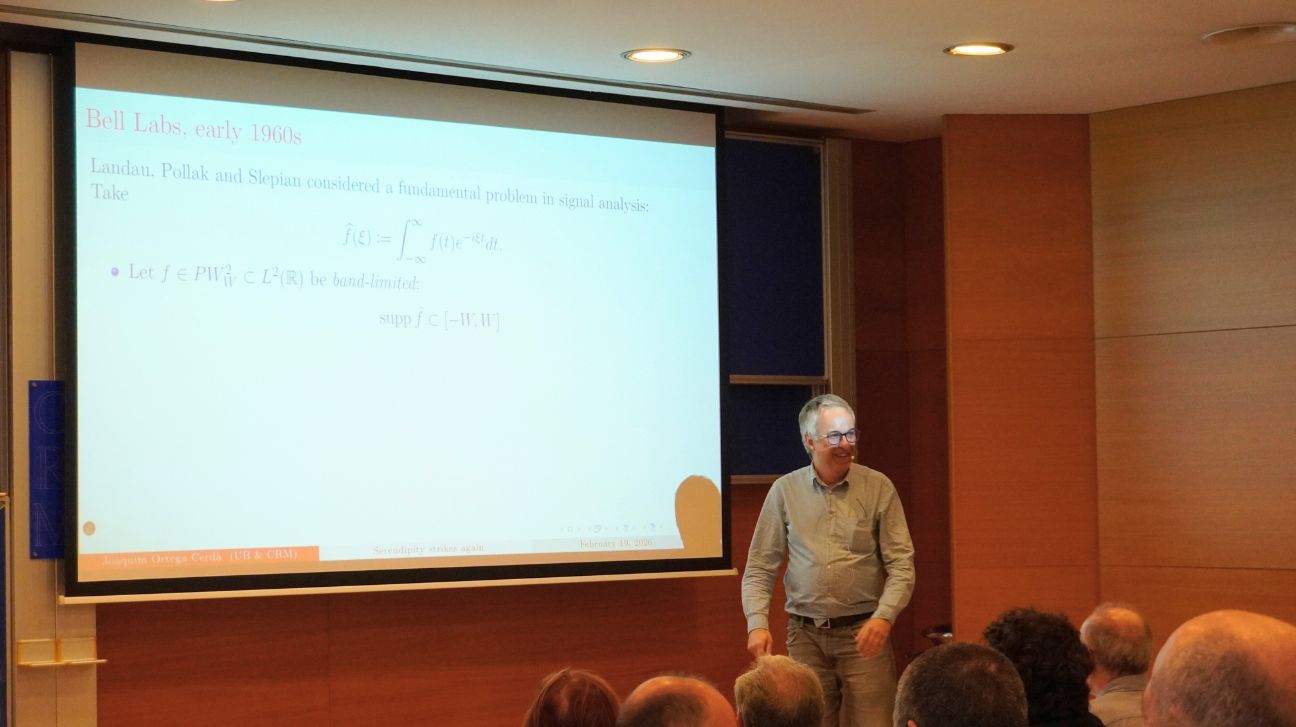
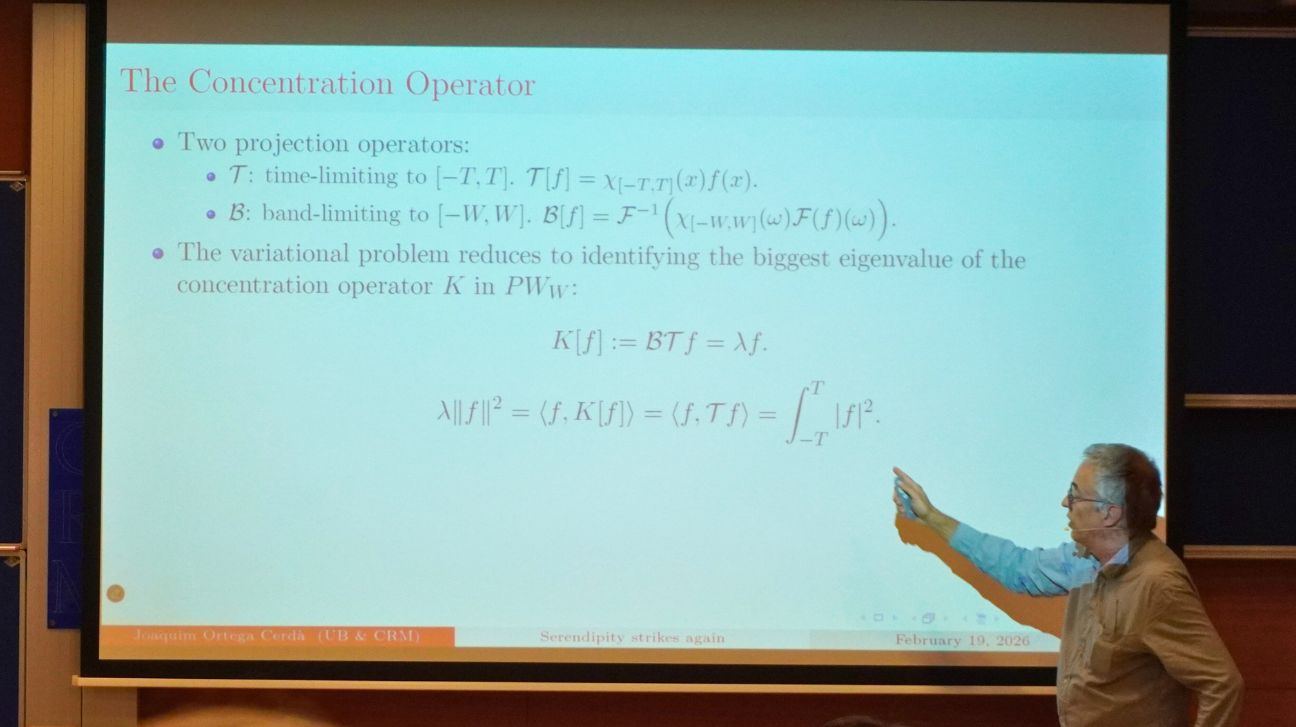
The second lecture, Serendipity strikes again, was delivered by Joaquim Ortega-Cerdà (UB – CRM), who has been invited to the Analysis section of the ICM. Ortega-Cerdà guided the audience through a fascinating journey connecting a classical problem from the Bell Labs in the 1960s with a recent result in Fourier analysis. The “fortunate accident” that enabled Landau, Slepian, and Pollack to advance signal theory reappears in a different context: the characterization of an extremal function that maximizes its value at 0 among bandlimited functions with  norm equal to 1. In a joint work with Bondarenko, Radchenko, and Seip, the team achieves a complete identification of this function, after decades in which only numerical approximations were available. The key once again lies in an unexpected commutation of operators, an episode of mathematical serendipity that gives meaning to the title of the talk and captivated the audience.
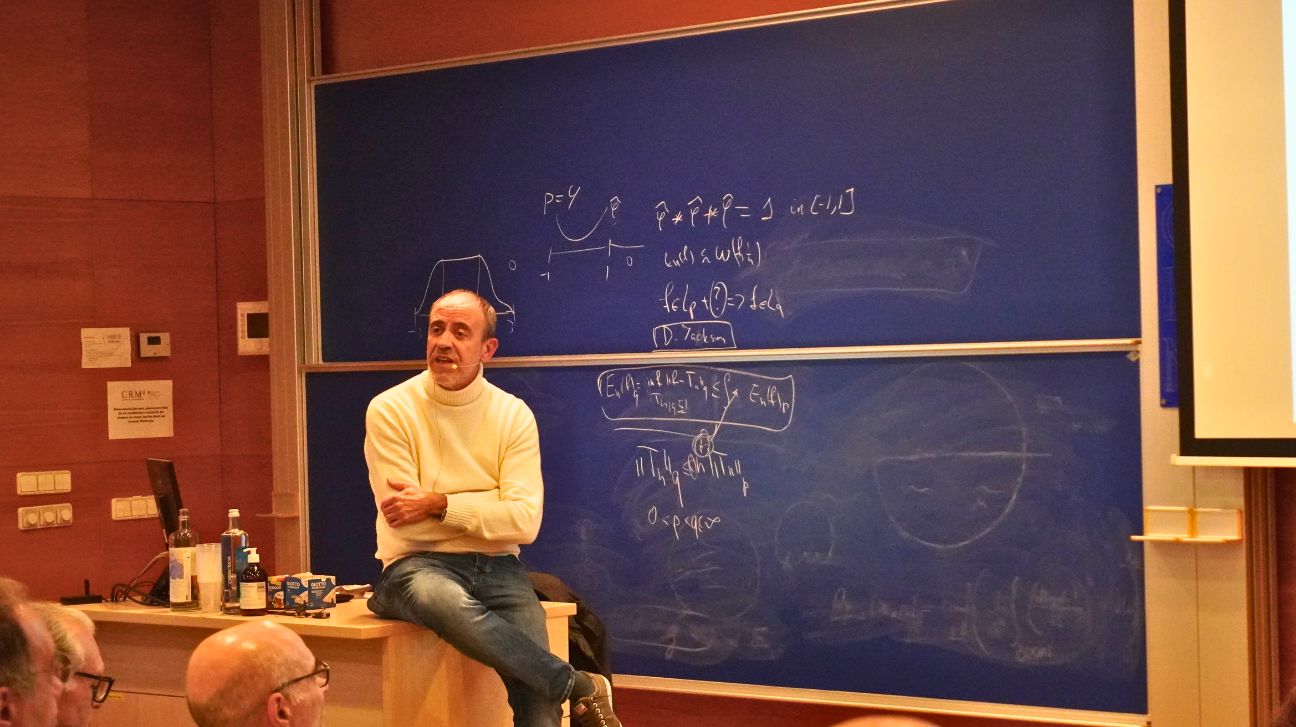
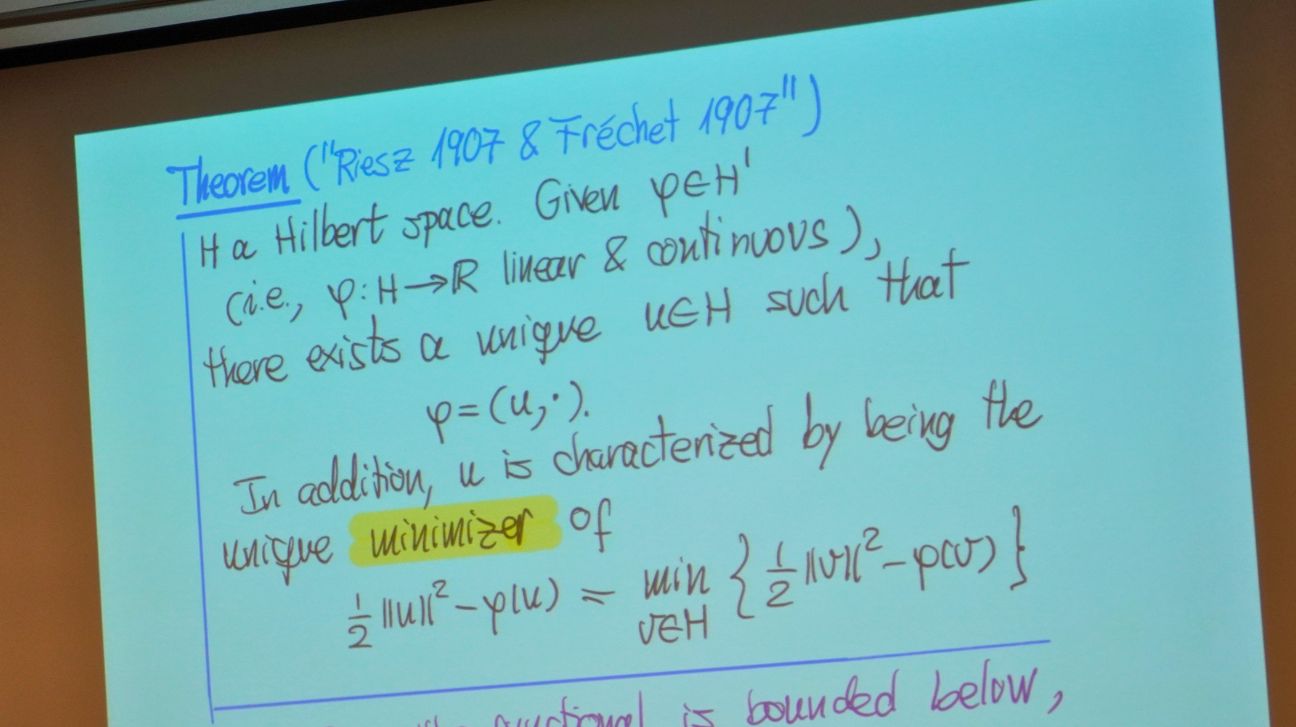
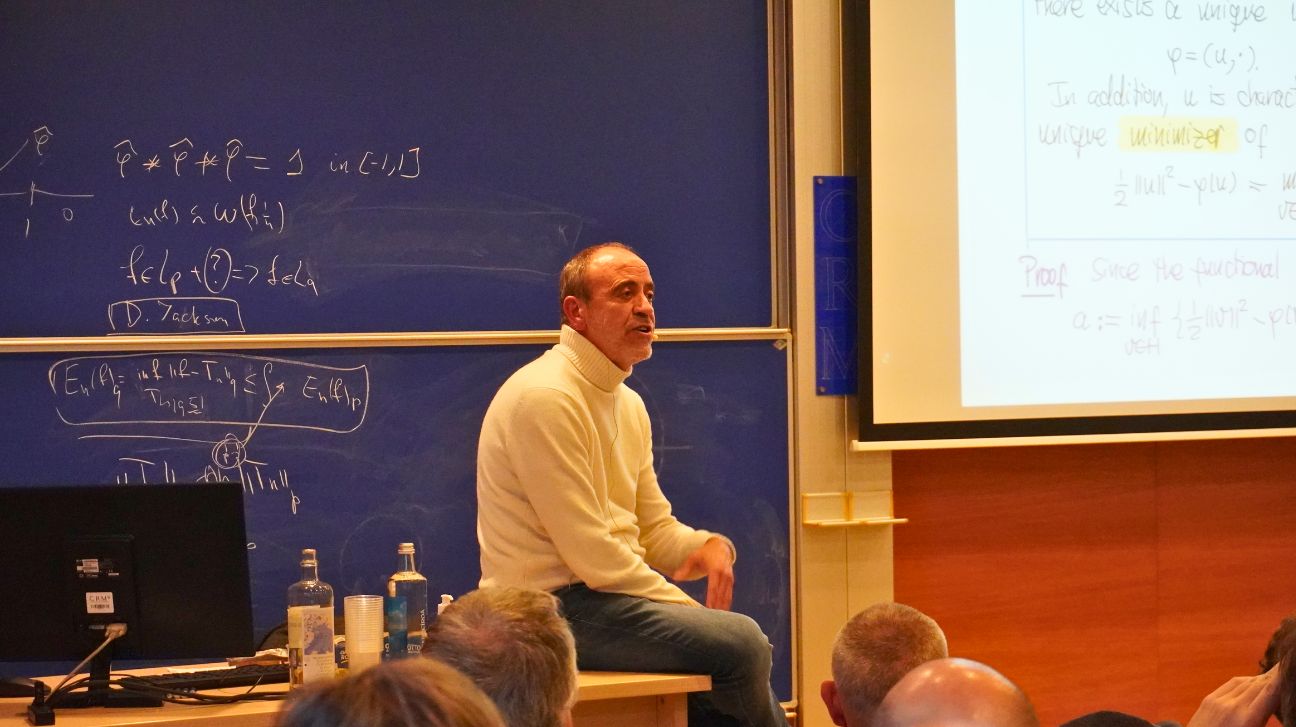
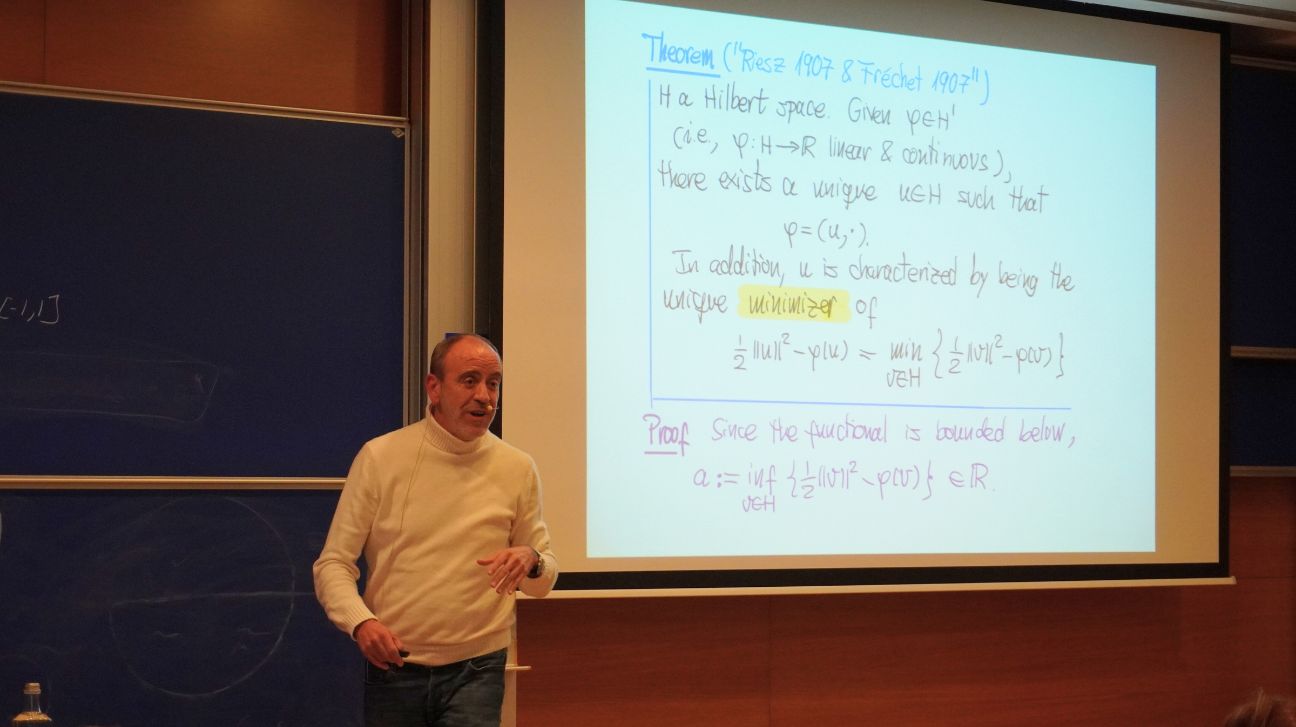
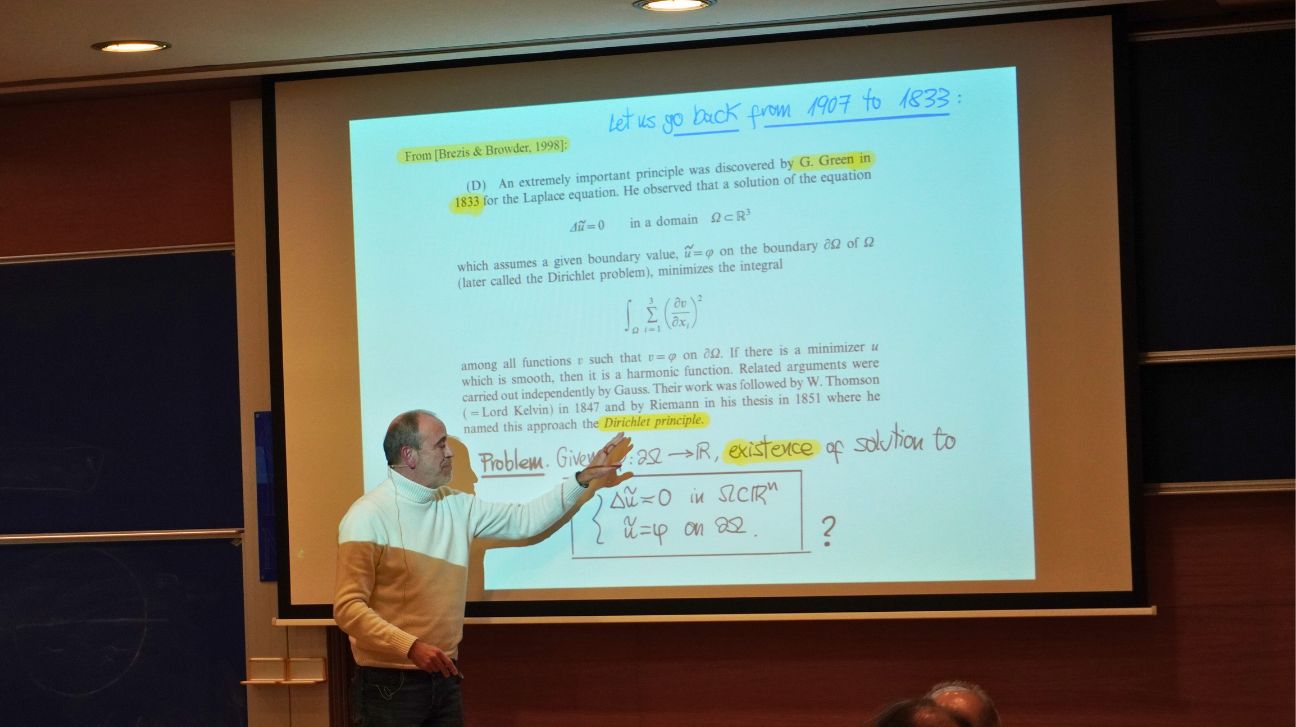
The session concluded with a lecture by Xavier Cabré (ICREA – UPC – CRM), invited to the Partial Differential Equations section of the ICM, titled Elliptic PDEs: recent extensions on Hilbert’s 19th problem. Cabré offered a historical and modern overview beginning with Hilbert’s 1900 question on the regularity of minimizers of variational integrals, followed by the foundational contributions of De Giorgi and Nash in the 1950s, and leading to Simons’ work on minimal surfaces in 1968. From there, Cabré focused on recent progress on the regularity of stable solutions, a much broader class than absolute minimizers. He presented results obtained in the past decade, including joint work with Figalli, Ros-Oton, and Serra, as well as contributions from other researchers on stable minimal surfaces. He also highlighted several important open problems, such as regularity in  and the fractional case, which remain major challenges in the field.
With this inaugural edition, the CRM Faculty Colloquium establishes itself as a valuable opportunity to share high-level research, strengthen connections, and showcase the work of the mathematical community linked to the Centre. The quality of the talks and the discussions that followed bode well for the future of this initiative, which will continue to gather researchers every quarter.
|
|
CRM CommNatalia Vallina
|
When the reward comes within reach, the brain changes what it compares
As the tokens piled up, choices got faster and more accurate at the same time. The yardstick for judging each offer had moved.CRM CommPau VarelaCRMComm@crm.catGet the latest CRM news and activities in your inbox.Recent newsletters →Two subjects...

Almost every automaton can be reset with a short word
Guillaume Chapuy (Université Paris Cité, CNRS) and Guillem Perarnau (UPC, CRM) have shown that a random finite automaton with n states can, with high probability, be reset by a word of length of order √n log n. The result, published in ACM Transactions on Algorithms, pins the exponent at 1/2, the lower end of a decade of numerical estimates, and addresses the random version of the synchronization problem behind a conjecture Ján Černý posed in 1964 and which still remains open.
Exposició ‘Les matemàtiques de Gaudí’
CRM quod erat demonstrandum | 48

ADA: Decoding Brain Signals Misaligned in Time
The study addresses a key limitation of current brain decoding techniques: the difficulty of interpreting internal mental processes whose temporal dynamics vary from trial to trial.Decoding what is happening in a person’s mind from their brain activity is one of the...
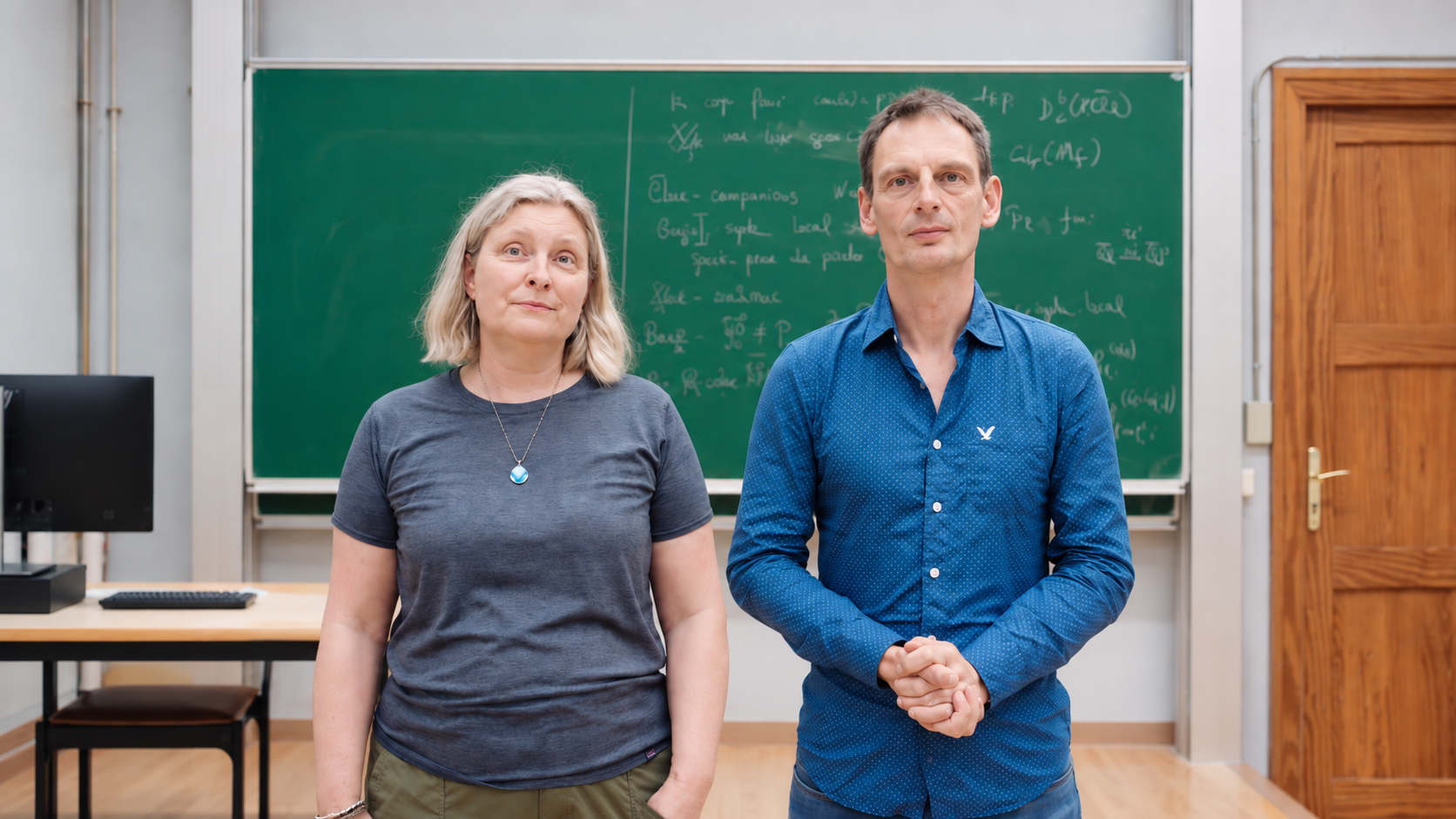
Rare curves, many points: Christophe Ritzenthaler and Rachel Pries on their research and the work around it
Christophe Ritzenthaler (Université de Rennes) and Rachel Pries (Colorado State University) both work on curves over finite fields: he hunts curves with as many points as possible, she hunts curves that almost never occur. In conversation with the CRM during their...

Call open for the 2027 Ferran Sunyer i Balaguer Prize
The Ferran Sunyer i Balaguer Foundation is accepting submissions for its 2027 prize, which awards 15,000 euros and publication in Birkhäuser's Progress in Mathematics series to an expository monograph on an active area of mathematical research. The deadline is 27...
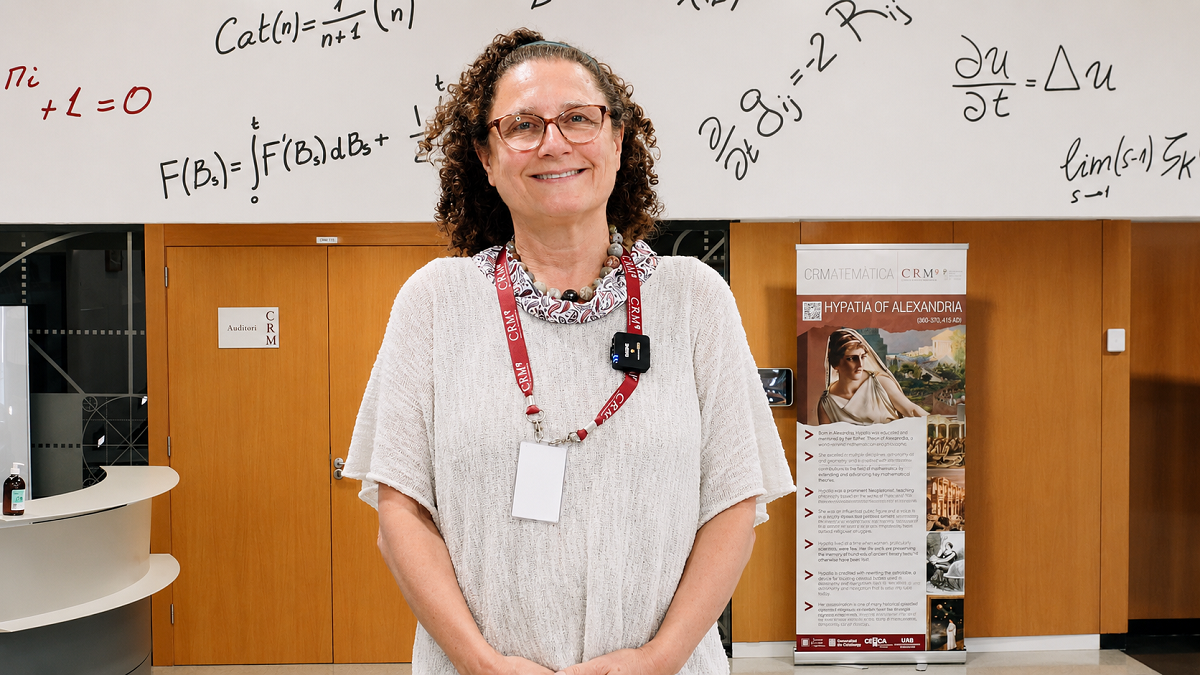
Susanna Terracini delivers the CRM Colloquium 2026
Susanna Terracini (Università di Torino) delivered the CRM Colloquium 2026 on 14 July, presenting a rigidity result for Kepler billiards obtained with Stefano Baranzini, Vivina Barutello and Irene De Blasi. She was at the centre as a member of the CRM Scientific...
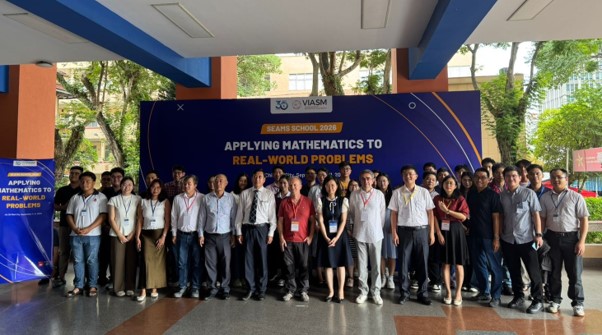
Ho Chi Minh City hosts the SEAMS School on applying mathematics to real-world problems
Students from across the region took courses and worked on group projects at a school co-organised by CRM researcher Tim Myers.CRM CommPau VarelaCRMComm@crm.catGet the latest CRM news and activities in your inbox.Recent newsletters →Between 4 and...

A single ball on a fixed table can compute: Eva Miranda and Isaac Ramos prove that two-dimensional billiards are Turing complete
Eva Miranda (UPC, CRM) and Isaac Ramos (ETH Zürich) show that a point particle bouncing inside a planar table with fixed walls can simulate a universal Turing machine, settling a question Cristopher Moore left open in 1990. The result grew out of a master’s project...
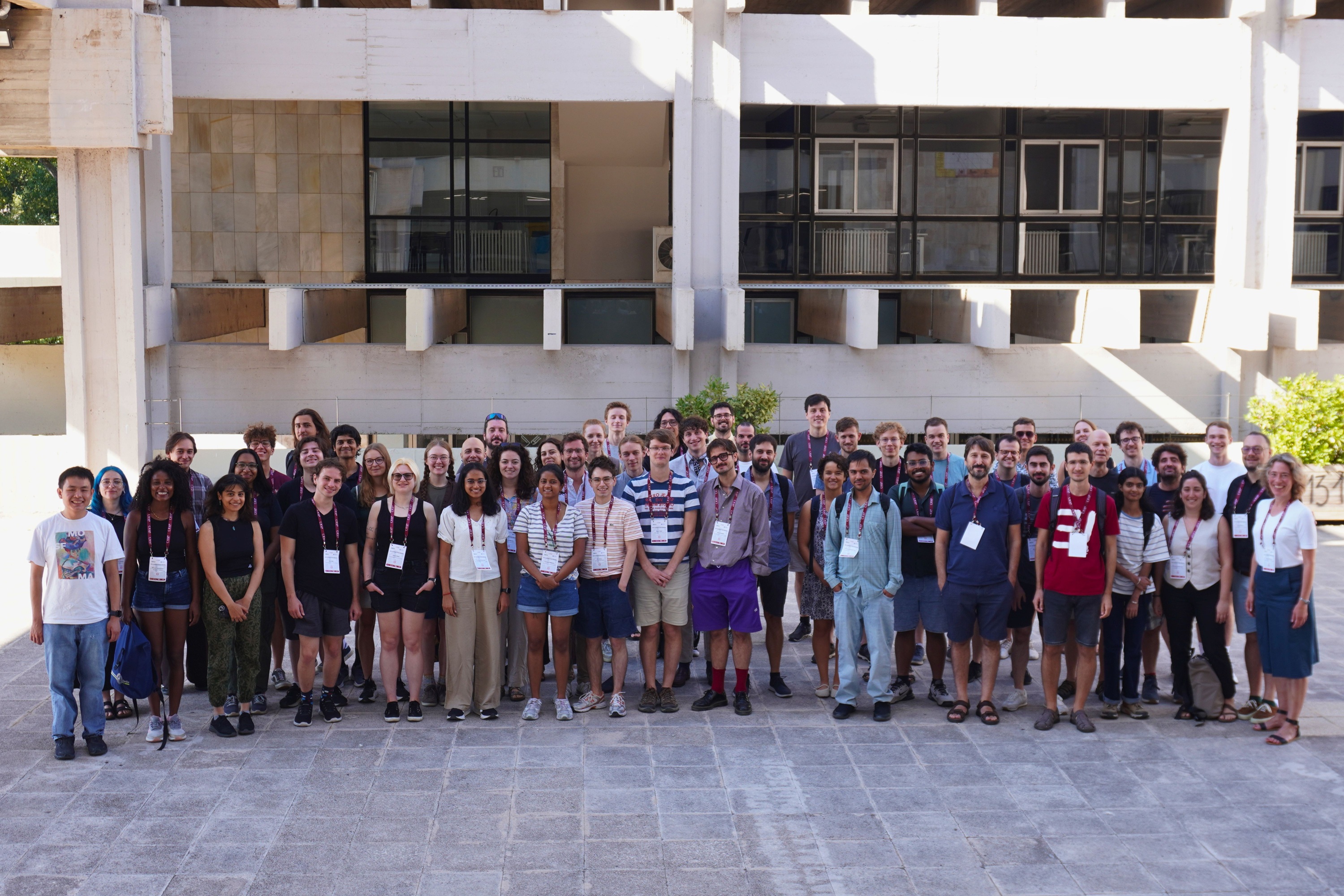
BMS-BGSMath Junior Meeting 2026: Barcelona and Berlin Strengthen Scientific Ties
From 2 to 4 September 2026, the Centre de Recerca Matemàtica (CRM) hosted the BMS-BGSMath Junior Meeting 2026, a three-day event jointly organised by the Berlin Mathematical School (BMS) and the Barcelona Graduate School of Mathematics (BGSMath), with the Centre de...
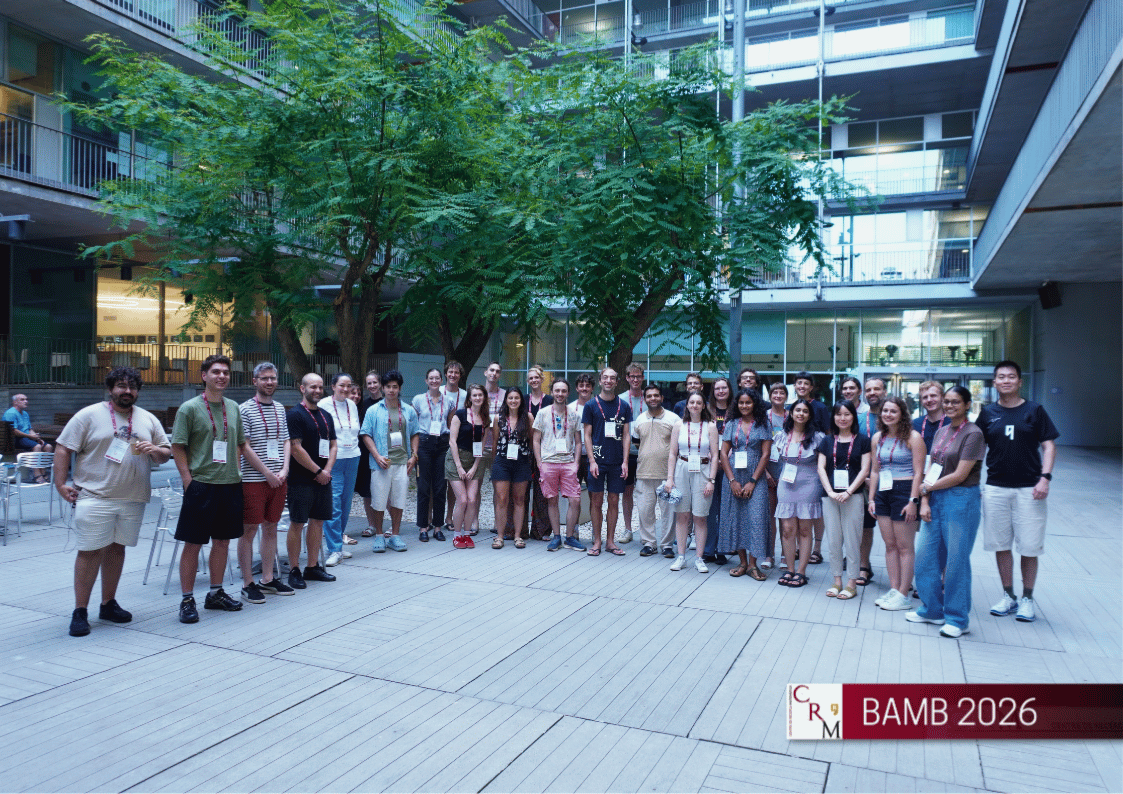
The CRM organises the 2026 Barcelona Summer School for Advanced Modeling of Behavior
The Centre de Recerca Matemàtica held the sixth edition of BAMB!, the Barcelona Summer School for Advanced Modeling of Behavior, from 12 to 23 July 2026 at the Parc de Recerca Biomèdica de Barcelona. Thirty early-career researchers from fourteen countries followed...