Tere M-Seara, Eva Miranda, Núria Fagella and Marta Mazzocco appear in the April 2026 edition of the Ranking de mujeres investigadoras españolas y en España.
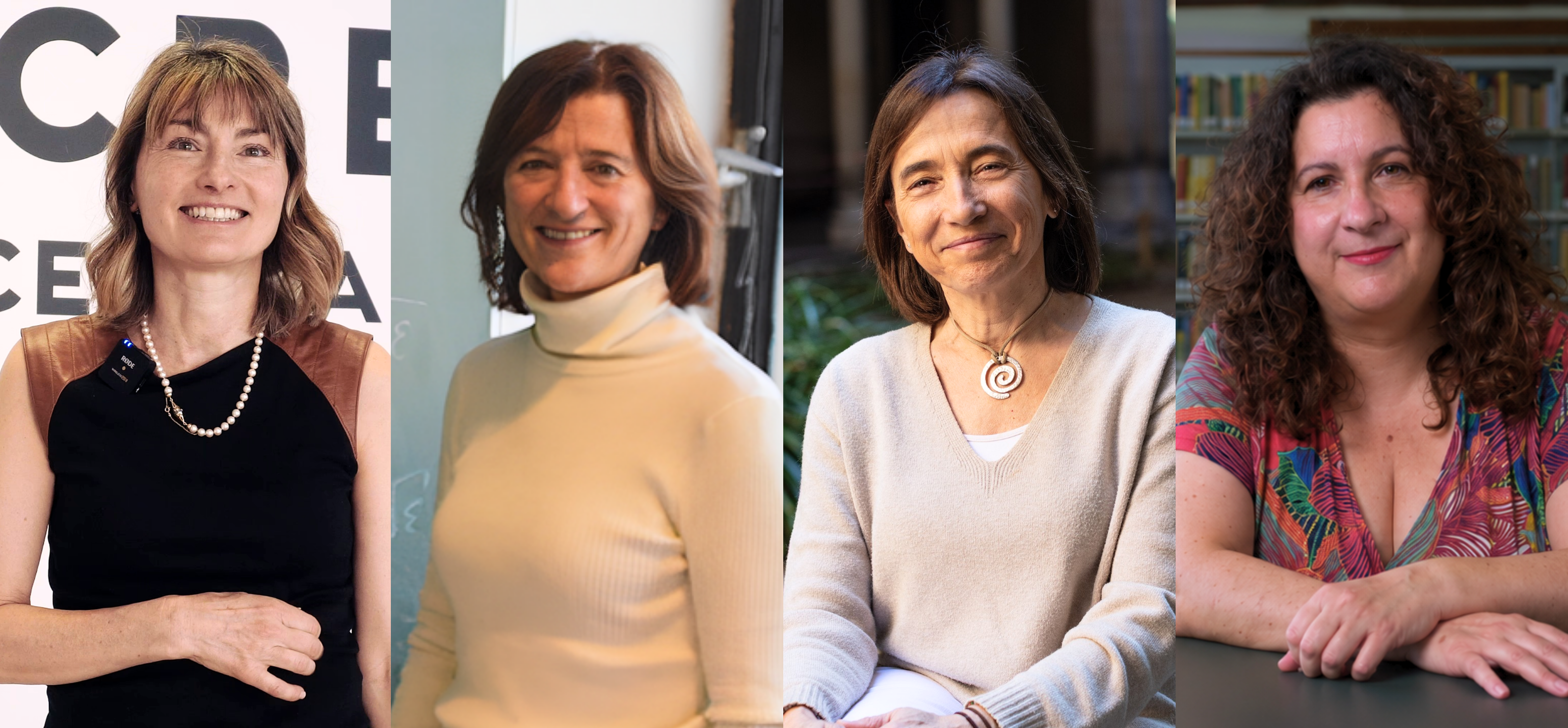
Four mathematicians affiliated with the Centre de Recerca Matemàtica (CRM) appear in the latest edition of the Ranking of Spanish and Spain-based women researchers, published in April 2026: Tere M-Seara, Eva Miranda, Núria Fagella and Marta Mazzocco. Three of them are full professors at the Universitat Politècnica de Catalunya (UPC) and the Universitat de Barcelona (UB); Marta Mazzocco is an ICREA Research Professor, also at the UPC. Their work spans geometry, mathematical physics and dynamical systems.
The ranking
The list is produced by the Cybermetrics Lab, a research group at the CSIC’s Institute of Public Goods and Policies (IPP) in Madrid. Its April 2026 edition (GS-ORCID-OpenAlex) collects the public Google Scholar profiles of 12,110 women: Spanish researchers working in Spain or abroad, and researchers of any nationality based at Spanish institutions. Profiles are ordered by h-index and total citation count, and to be included, a profile must carry a public ORCID identifier and an h-index of at least 18. This edition adds, for each researcher, the equivalent indicators drawn from OpenAlex.
The purpose is to make the output of women researchers more visible and to encourage the use of open identifiers such as ORCID and ROR, which connect researchers, institutions and publications across databases. The ranking is bibliometric: it compiles publicly available citation data and does not assess the quality of individual results.
The four researchers
Tere M-Seara (h-index 30, 3,009 citations) is a full professor at the UPC, where she leads a Dynamical Systems group of more than twenty researchers working on celestial mechanics and mathematical neuroscience. Her own research develops analytical tools for the global dynamics of a system: the study of normally hyperbolic invariant manifolds and the “scattering map”, both now widely used in work on Arnold diffusion, and rigorous methods to measure exponentially small phenomena such as the splitting of separatrices, one of the mechanisms that produce chaos. She received the first Barcelona Dynamical Systems Prize in 2015, held an Eisenbud Professorship at MSRI (Berkeley) in 2018, and is a fellow of the Sciences Division of the Institut d’Estudis Catalans.
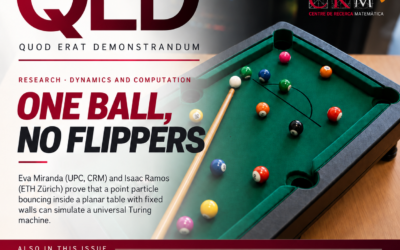
Eva Miranda (h-index 25, 2,182 citations), Chair in Geometry and Topology at the UPC, works in differential geometry and mathematical physics. Much of her work concerns b-Poisson (log-symplectic) manifolds and their appearance in celestial mechanics, including the regularised three-body problem. More recently, she has studied fluid dynamics and the computational power of physical systems, designing a model she calls Topological Kleene Field Theory to investigate undecidable phenomena in mechanics. Her distinctions include two ICREA Academia awards, the 2023 Hardy Lectureship of the London Mathematical Society, and the Karen Uhlenbeck Lectureship at the Institute for Advanced Study in Princeton in 2027.
Núria Fagella (h-index 21, 1,254 citations) is a full professor at the UB, where she is currently Dean of the Faculty of Mathematics and Computer Science. She works in holomorphic dynamics, the study of how points in the complex plane behave under repeated application of a function. She leads the Holodyn group with Xavier Jarque and, since 2005, has organised the biennial school Topics in Complex Dynamics in Barcelona.
Marta Mazzocco (h-index 20, 1,377 citations) is an ICREA Research Professor at the UPC, where she co-founded the SYMCREA excellence cluster with Eva Miranda after moving to Barcelona in 2024 from the Chair in Mathematics at the University of Birmingham. Her field is integrable systems, at the crossroads of analysis, geometry, mathematical physics and algebra, with contributions to the Painlevé equations and their generalisations, isomonodromic deformations, quantum Teichmüller theory and Cherednik algebras. In 2002, she became the first woman appointed by open call to a lectureship in pure mathematics at the University of Cambridge.
A note on the h-index
The h-index combines output and impact in a single figure: a researcher has an index h if h of their papers have each been cited at least h times. Because it accumulates over a career, it tends to be higher for researchers who have published for longer, and because citation practices differ between disciplines, the values are most meaningfully compared within a field rather than across fields. Mathematics, where papers usually have fewer authors and citations build slowly over many years, generally shows lower counts than the experimental sciences.
The complete ranking, with all 12,110 profiles, is openly available: Ranking of Spanish and Spain-based women researchers (figshare).
|
|
CRM CommPau Varela
|
Newsletter
Get the latest CRM news and activities delivered to your inbox
Subscribe now
Recent newsletters →
The CRM Mentoring Programme, as Told by One of Its Pairs
PhD student Joaquim Duran and mathematician Robert Cardona, one of the pairs in the CRM Mentoring ProgrammeJoaquim Duran (left) and Robert Cardona.CRM CommPau VarelaCRMComm@crm.catGet the latest CRM news and activities in your inbox.Recent...
When the reward comes within reach, the brain changes what it compares
As the tokens piled up, choices got faster and more accurate at the same time. The yardstick for judging each offer had moved.CRM CommPau VarelaCRMComm@crm.catGet the latest CRM news and activities in your inbox.Recent newsletters →Two subjects...
Almost every automaton can be reset with a short word
For a random automaton with n states, a word of about √n log n letters is almost always enough to reset it.CRM CommPau VarelaCRMComm@crm.catGet the latest CRM news and activities in your inbox.Recent newsletters →Picture a conveyor belt carrying...
Exposició ‘Les matemàtiques de Gaudí’