
Javier Gómez-Serrano, professor at Brown University, has been awarded the 2025 R. E. Moore Prize for Applications of Interval Analysis, together with Tristan Buckmaster (Courant Institute of Mathematical Sciences, New York University) and Gonzalo Cao-Labora (École Polytechnique Fédérale de Lausanne). The award recognises their article Smooth imploding solutions for 3D compressible fluids, published this year in Forum of Mathematics, Pi.
The R. E. Moore Prize was created in 2002 by the editorial board of the journal Reliable Computing to honour the legacy of Ramon E. Moore, a pioneer in interval arithmetic. The prize, awarded every two to four years, celebrates outstanding contributions where interval analysis makes a decisive impact.
“It is the highest distinction within this community, and I feel very proud and fortunate to have received it,” says Gómez-Serrano. He is also quick to stress the collective nature of the award, underscoring the key role of Tristan Buckmaster and Gonzalo Cao-Labora: “This article began as Gonzalo’s undergraduate thesis between Princeton and the UPC, which gives his contribution extraordinary value and deserves recognition.”
Gómez-Serrano studied Mathematics and Telecommunications Engineering at the Universitat Politècnica de Catalunya, and obtained his PhD in Mathematics from the Universidad Autónoma de Madrid in 2013. He later held positions at Princeton and the Universitat de Barcelona before joining Brown University in 2022. His work sits at the crossroads of analysis, partial differential equations, fluid mechanics, spectral geometry, numerical computation, machine learning, and rigorous computer-assisted proofs.
Smooth implosions that trigger singularities in 3D fluids
In their prize-winning paper by Buckmaster, Cao-Labora and Gómez-Serrano (which also carries the affiliation of the CRM), construct the first smooth self-similar imploding solutions to the 3D Euler equations for all adiabatic exponents γ > 1, and show that these profiles can also be used to build asymptotically self-similar imploding solutions to the Navier–Stokes equations (for γ = 7/5). This represents the first rigorous example of singularity formation in compressible fluids with density bounded away from zero and constant at infinity.
“Singularities are the central piece of any differential equation. By understanding how singularities form, we also gain a deeper understanding of the model itself and its connection with the natural world around us.”
Singularities, Gómez-Serrano explains, are “the central piece of any differential equation, in fluids or beyond. The fact that a singularity appears tells us whether a problem has a solution or not, one of the most basic questions one can ask mathematically. By understanding how singularities form, we also gain a deeper understanding of the model itself and its connection with the natural world around us.”
“For example, with a simple quadratic equation, we know that if b² – 4ac < 0 there is no real solution. For partial differential equations there is no such criterion, and all studies are very complex and must be carried out equation by equation, not always successfully. By understanding the formation of singularities, we gain a much better understanding of the mathematical model and its relationship with the nature that surrounds us.”
To establish these results, the authors combined deep mathematical analysis with rigorous computer-assisted proofs based on interval arithmetic. “The classical pencil-and-paper approach is very limited when some quantity is not perturbative (for example, when the solutions are not small) and the calculations have to be done quantitatively,” says Gómez-Serrano. “A modern approach, mixing classical analysis with highly precise quantitative estimates, can make the difference between proving a result or not.”
Opening paths for future mathematics
Beyond its specific results, the paper also highlights the growing role of computer-assisted methods in mathematics. “This research helps bring computer-assisted proofs closer to the mathematical mainstream and shows how synergy produces stronger theorems. Our methods are already being reused in other contexts, and I believe this kind of approach will be very successful in the future, especially now that AI models have made programming much faster and easier.”
This is not Javier’s first step into the frontier between mathematics and computation. Just a few months ago, we reported on his collaboration with Terence Tao and DeepMind on AlphaEvolve, an AI tool for exploring open mathematical problems. In that piece, and in a video interview available on the CRM YouTube channel, he reflected on how AI is reshaping the way mathematicians work, opening faster and more collaborative paths to discovery.
The award ceremony will take place during SCAN’2025 (International Symposium on Scientific Computing, Computer Arithmetic, and Verified Numerical Computations), held in Oldenburg, Germany, from 22 to 26 September 2025.
This is the second time the award goes to a researcher affiliated with the CRM, following Àlex Haro, professor at the Universitat de Barcelona, who was previously distinguished with the same prize in 2018.
Citation
Buckmaster T, Cao-Labora G, Gómez-Serrano J. Smooth imploding solutions for 3D compressible fluids. Forum of Mathematics, Pi. 2025;13:e6. doi:10.1017/fmp.2024.12
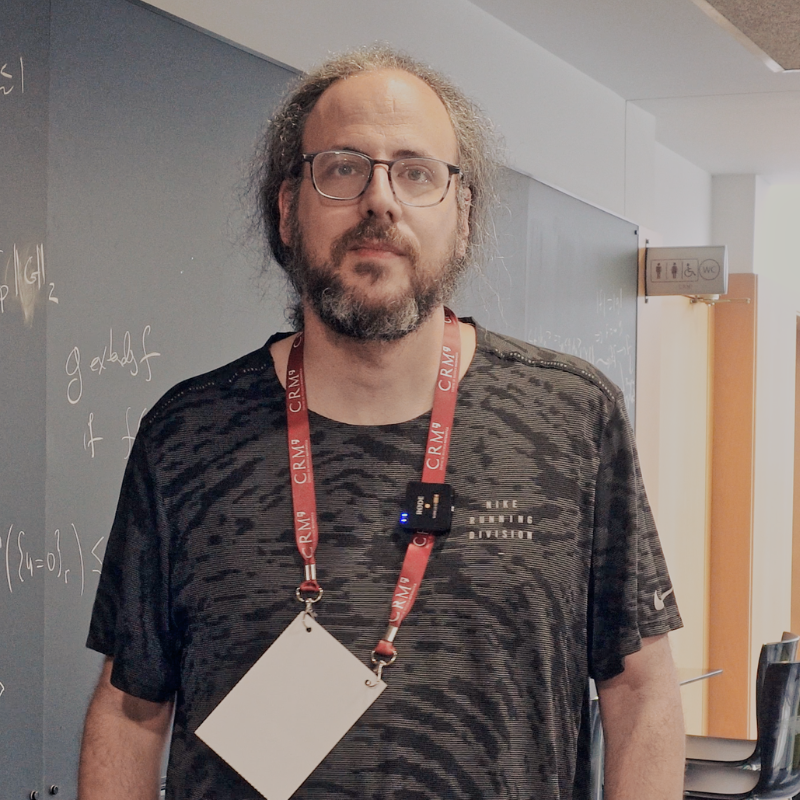
Javier Gómez-Serrano is a Professor at Brown University, formerly a Distinguished Researcher at the University of Barcelona and earlier Instructor and Assistant Professor at Princeton. His research spans analysis, partial differential equations, fluid mechanics, spectral geometry, numerical computation, machine learning, and rigorous computer-assisted proofs. He has received awards such as the MCA Prize, the Antonio Ambrosetti Medal, the Antonio Valle Prize, the Vicent Caselles Prize, and the Princeton Junior Faculty Teaching Award. Between 2020 and 2022 he held an ERC Starting Grant, and his work is now supported by the NSF, with media coverage in outlets like Quanta Magazine and El País.
Subscribe for more CRM News
|
|
CRM CommPau Varela
|

When the reward comes within reach, the brain changes what it compares
As the tokens piled up, choices got faster and more accurate at the same time. The yardstick for judging each offer had moved.CRM CommPau VarelaCRMComm@crm.catGet the latest CRM news and activities in your inbox.Recent newsletters →Two subjects...

Almost every automaton can be reset with a short word
Guillaume Chapuy (Université Paris Cité, CNRS) and Guillem Perarnau (UPC, CRM) have shown that a random finite automaton with n states can, with high probability, be reset by a word of length of order √n log n. The result, published in ACM Transactions on Algorithms, pins the exponent at 1/2, the lower end of a decade of numerical estimates, and addresses the random version of the synchronization problem behind a conjecture Ján Černý posed in 1964 and which still remains open.
Exposició ‘Les matemàtiques de Gaudí’
CRM quod erat demonstrandum | 48

ADA: Decoding Brain Signals Misaligned in Time
The study addresses a key limitation of current brain decoding techniques: the difficulty of interpreting internal mental processes whose temporal dynamics vary from trial to trial.Decoding what is happening in a person’s mind from their brain activity is one of the...
Rare curves, many points: Christophe Ritzenthaler and Rachel Pries on their research and the work around it
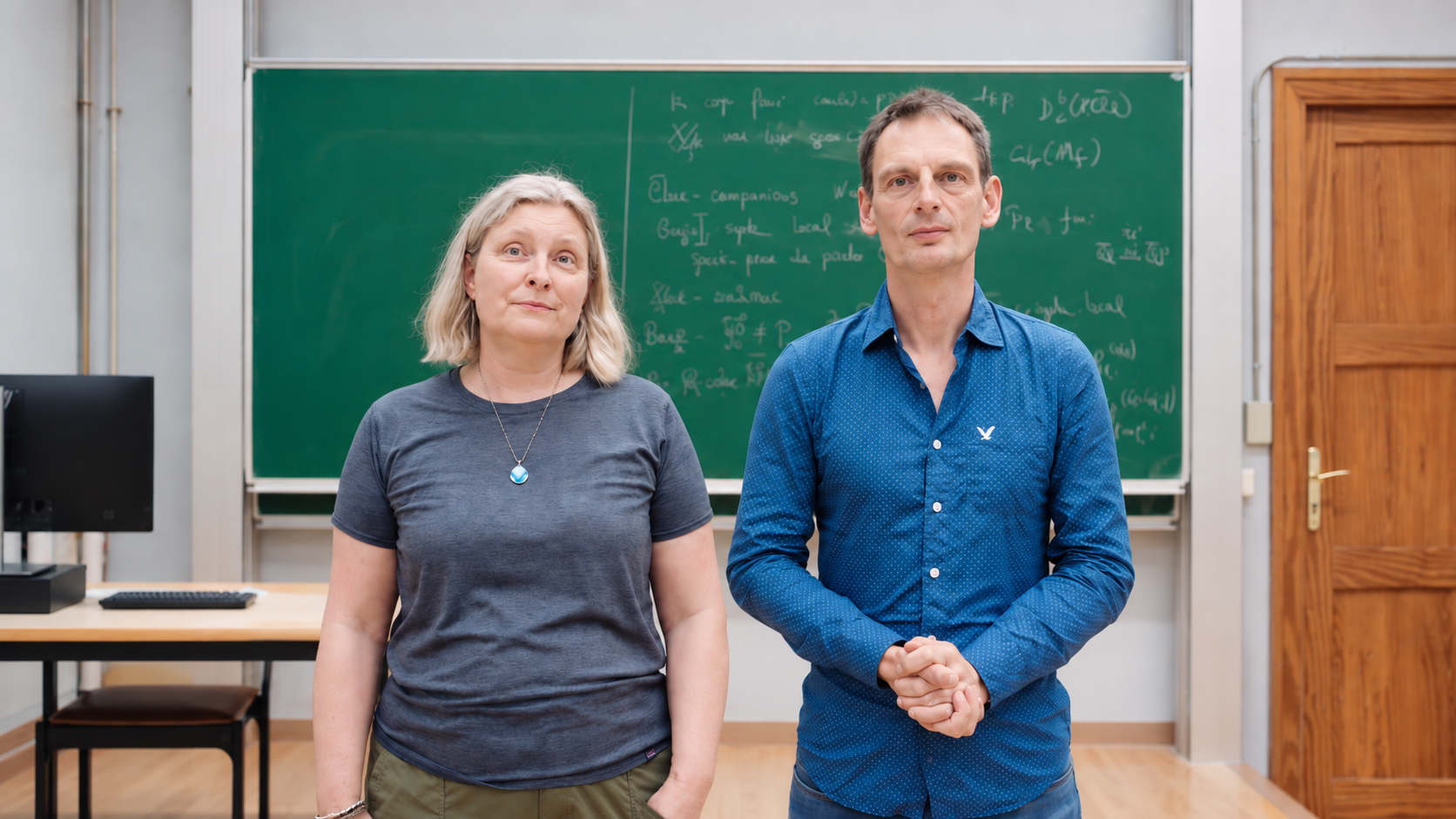
Christophe Ritzenthaler (Université de Rennes) and Rachel Pries (Colorado State University) both work on curves over finite fields: he hunts curves with as many points as possible, she hunts curves that almost never occur. In conversation with the CRM during their...

Call open for the 2027 Ferran Sunyer i Balaguer Prize
The Ferran Sunyer i Balaguer Foundation is accepting submissions for its 2027 prize, which awards 15,000 euros and publication in Birkhäuser's Progress in Mathematics series to an expository monograph on an active area of mathematical research. The deadline is 27...
Susanna Terracini delivers the CRM Colloquium 2026
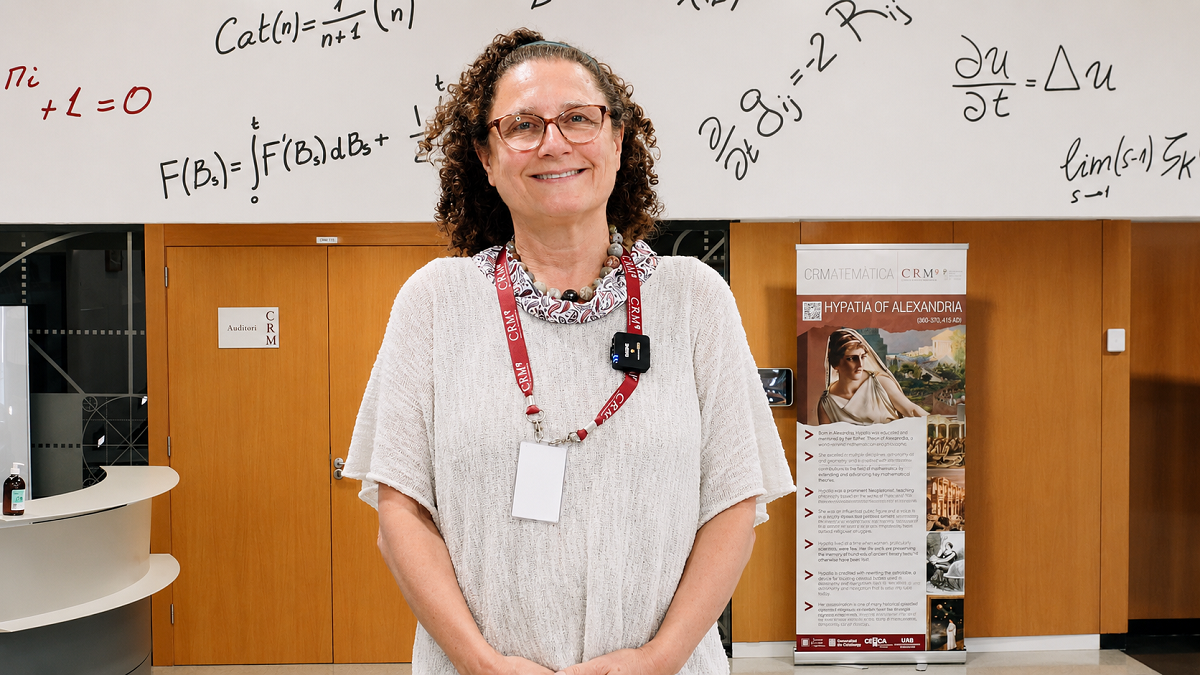
Susanna Terracini (Università di Torino) delivered the CRM Colloquium 2026 on 14 July, presenting a rigidity result for Kepler billiards obtained with Stefano Baranzini, Vivina Barutello and Irene De Blasi. She was at the centre as a member of the CRM Scientific...
Ho Chi Minh City hosts the SEAMS School on applying mathematics to real-world problems
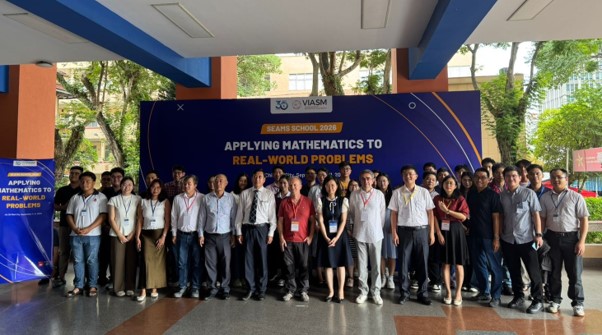
Students from across the region took courses and worked on group projects at a school co-organised by CRM researcher Tim Myers.CRM CommPau VarelaCRMComm@crm.catGet the latest CRM news and activities in your inbox.Recent newsletters →Between 4 and...

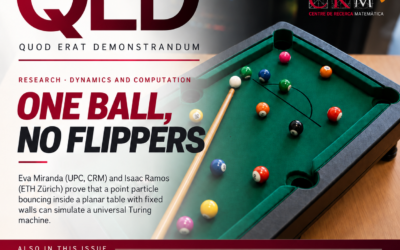
A single ball on a fixed table can compute: Eva Miranda and Isaac Ramos prove that two-dimensional billiards are Turing complete
Eva Miranda (UPC, CRM) and Isaac Ramos (ETH Zürich) show that a point particle bouncing inside a planar table with fixed walls can simulate a universal Turing machine, settling a question Cristopher Moore left open in 1990. The result grew out of a master’s project...
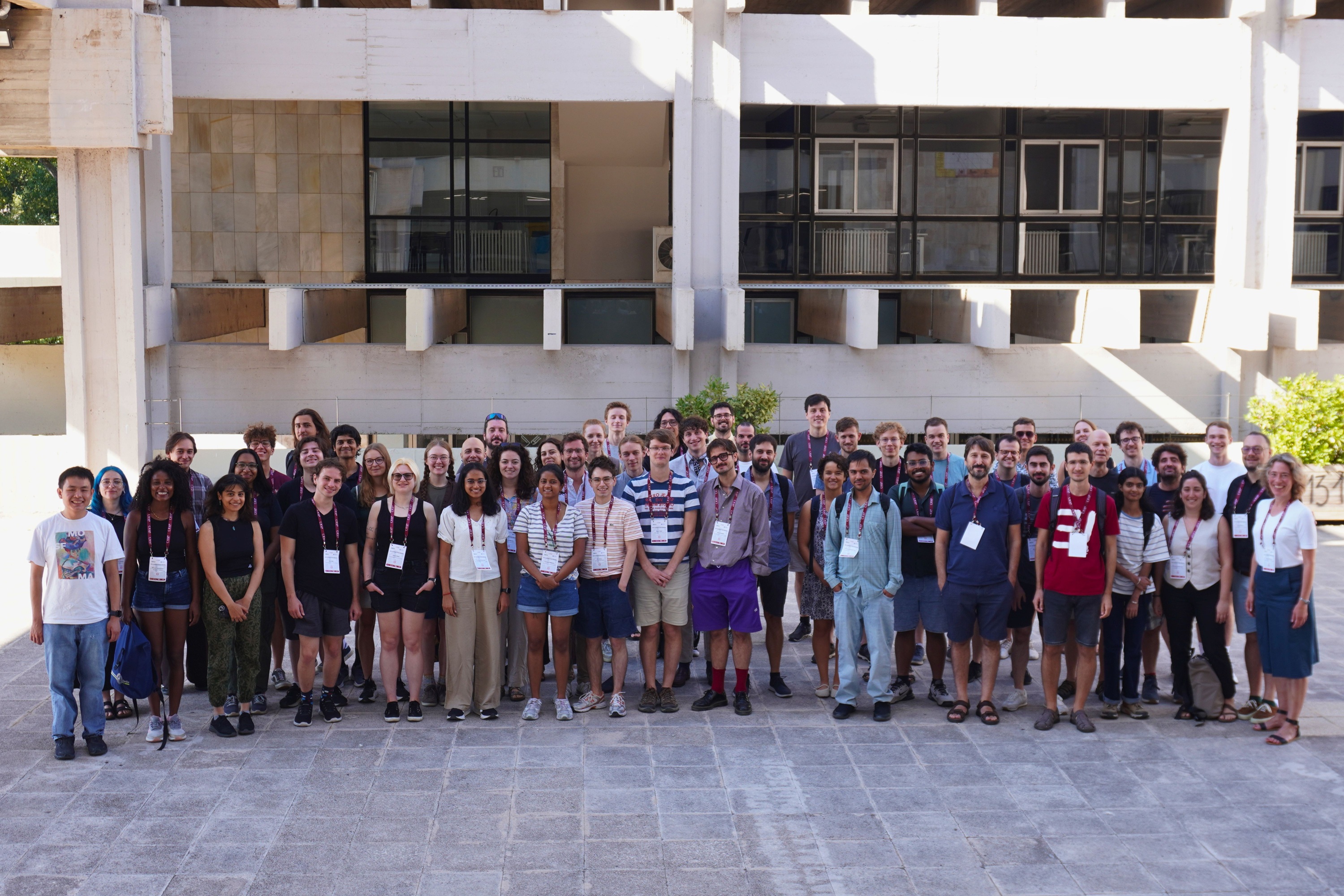
BMS-BGSMath Junior Meeting 2026: Barcelona and Berlin Strengthen Scientific Ties
From 2 to 4 September 2026, the Centre de Recerca Matemàtica (CRM) hosted the BMS-BGSMath Junior Meeting 2026, a three-day event jointly organised by the Berlin Mathematical School (BMS) and the Barcelona Graduate School of Mathematics (BGSMath), with the Centre de...
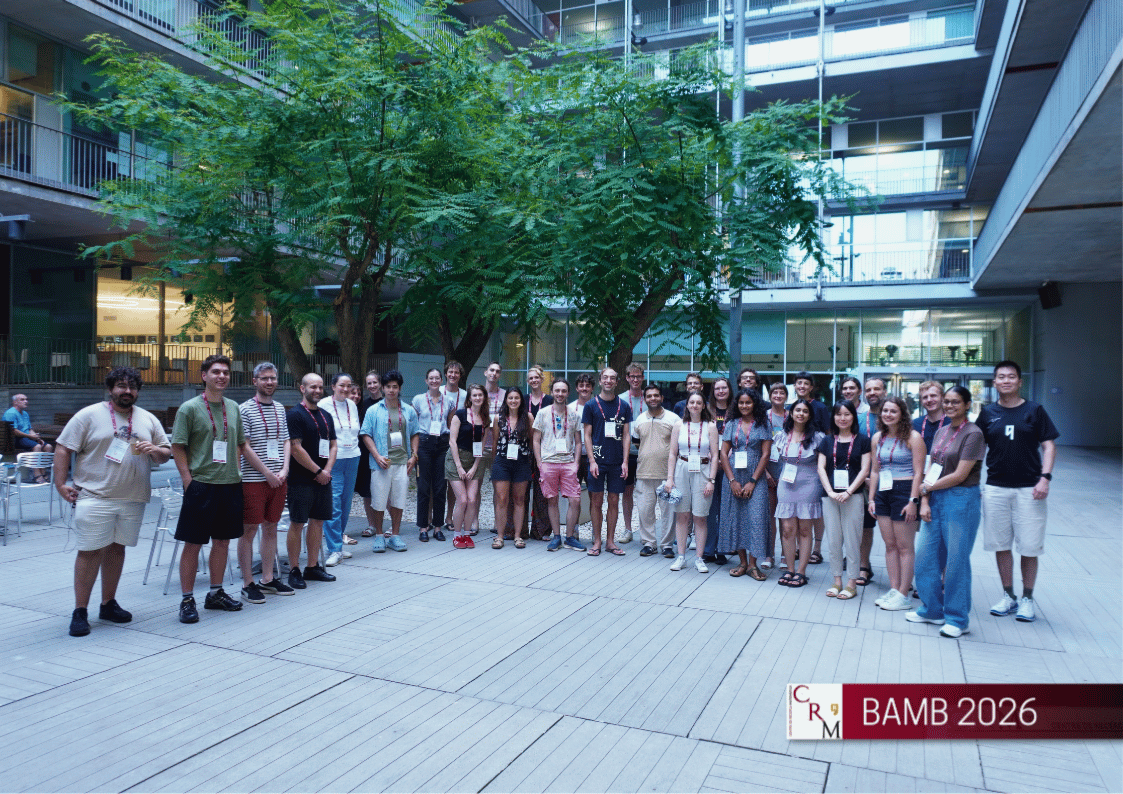
The CRM organises the 2026 Barcelona Summer School for Advanced Modeling of Behavior
The Centre de Recerca Matemàtica held the sixth edition of BAMB!, the Barcelona Summer School for Advanced Modeling of Behavior, from 12 to 23 July 2026 at the Parc de Recerca Biomèdica de Barcelona. Thirty early-career researchers from fourteen countries followed...